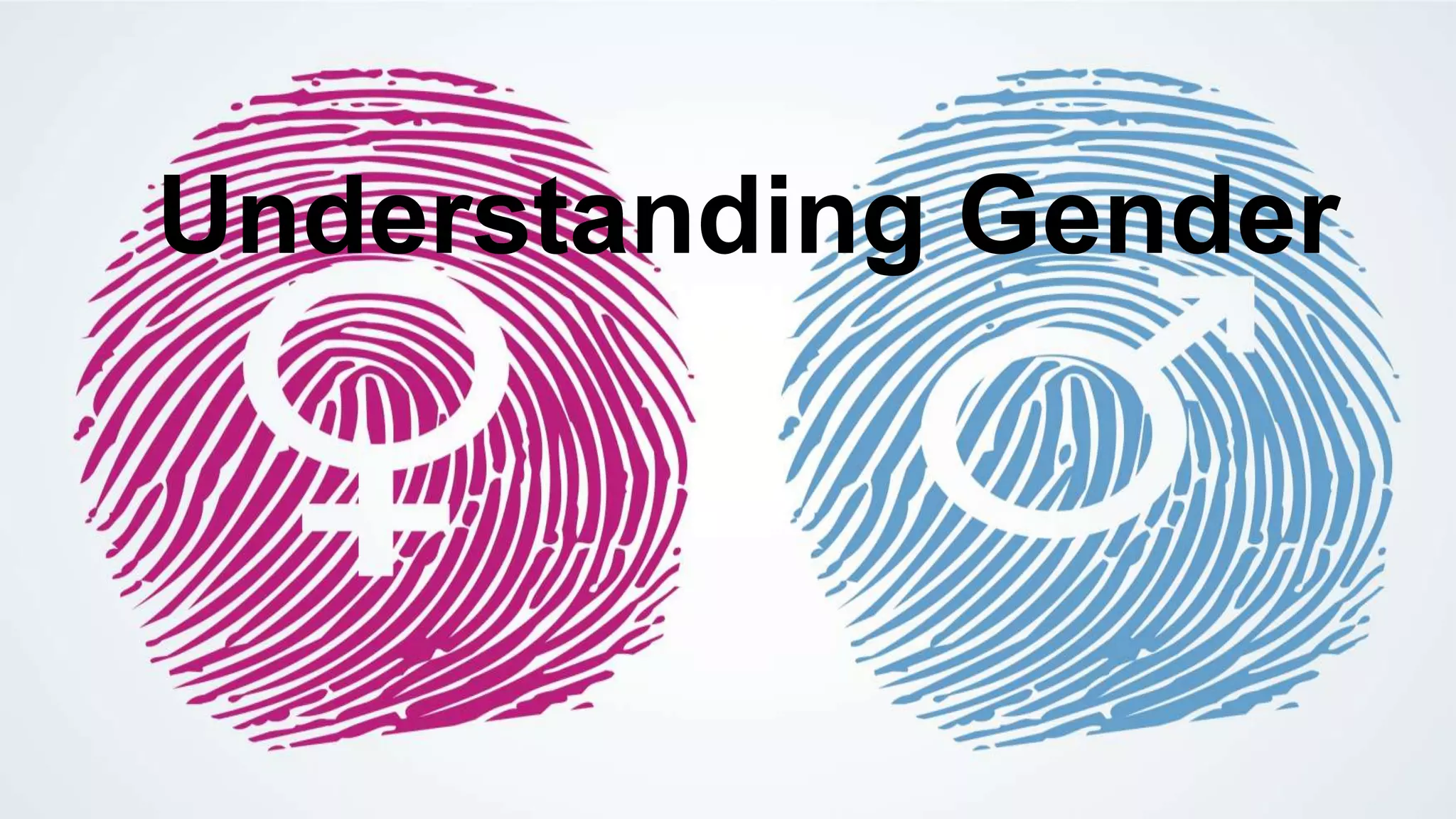



Understanding Gender
Sex is biological and includes physical attributes such as sex
chromosomes, gonads, sex hormones, internal reproductive
structures, and external genitalia. At birth, it is used to identify
individuals as male or female.

Gender is the complex interrelationship between
those traits and one’s internal sense of self as
male, female, both or neither as well as one’s
outward presentations and behaviors related to
that perception.
Gender Terminology

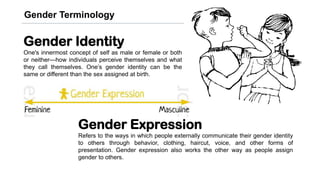
Gender Identity
One's innermost concept of self as male or female or both
or neither—how individuals perceive themselves and what
they call themselves. One’s gender identity can be the
same or different than the sex assigned at birth.

Gender Expression
Refers to the ways in which people externally communicate their gender identity
to others through behavior, clothing, haircut, voice, and other forms of
presentation. Gender expression also works the other way as people assign
gender to others.
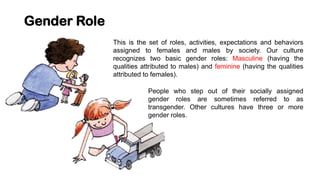
Gender Role
This is the set of roles, activities, expectations and behaviors
assigned to females and males by society. Our culture
recognizes two basic gender roles: Masculine (having the
qualities attributed to males) and feminine (having the qualities
attributed to females).
People who step out of their socially assigned
gender roles are sometimes referred to as
transgender. Other cultures have three or more
gender roles.
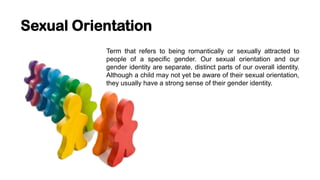
Sexual Orientation
Term that refers to being romantically or sexually attracted to
people of a specific gender. Our sexual orientation and our
gender identity are separate, distinct parts of our overall identity.
Although a child may not yet be aware of their sexual orientation,
they usually have a strong sense of their gender identity.
PUBERT
Y

A Time of Change
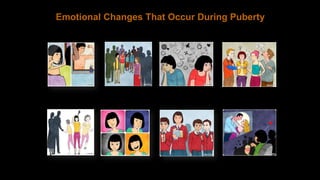
Emotional Changes That Occur During Puberty
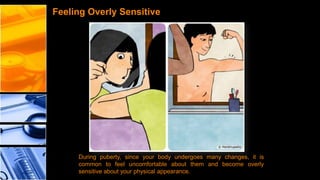
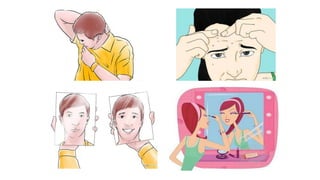
Feeling Overly Sensitive

During puberty, since your body undergoes many changes, it is
common to feel uncomfortable about them and become overly
sensitive about your physical appearance.
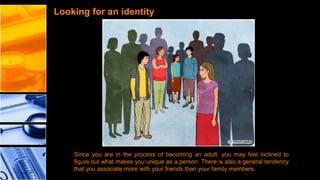
Looking for an identity

Since you are inare inprocess of becoming an adult, you may feel inclined to
Since you the the process of becoming an adult, you
figure out what makes you figure out what makes you unique asgeneral tendency
may feel inclined to unique as a person. There is also a
that you associate more with your friends than your family members.
a person.
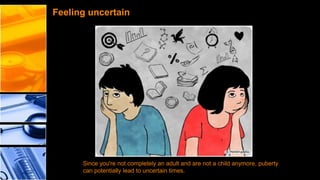
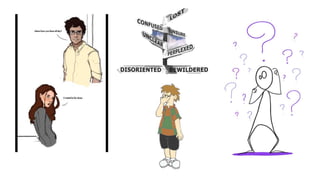
Feeling uncertain

Since you're not completely an adult and are not a child anymore, puberty
can potentially lead to uncertain times.
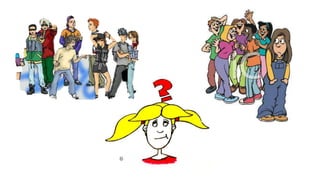
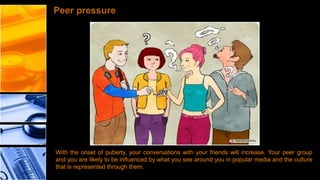
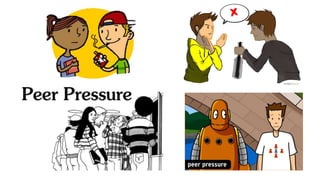
Peer pressure

With the onset of puberty, your conversations with your friends will increase. Your peer group
and you are likely to be influenced by what you see around you in popular media and the culture
that is represented through them.
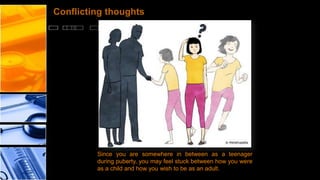
Conflicting thoughts

Since you are somewhere in between as a teenager
during puberty, you may feel stuck between how you were
as a child and how you wish to be as an adult.
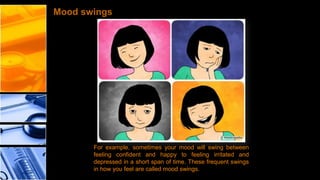
Mood swings

For example, sometimes your mood will swing between
feeling confident and happy to feeling irritated and
depressed in a short span of time. These frequent swings
in how you feel are called mood swings.
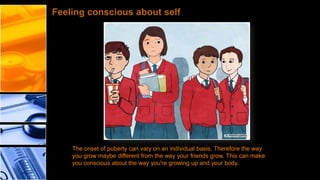
Feeling conscious about self

The onset of puberty can vary on an individual basis. Therefore the way
you grow maybe different from the way your friends grow. This can make
you conscious about the way you're growing up and your body.
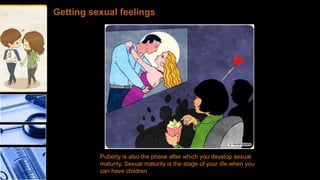
Getting sexual feelings

Puberty is also the phase after which you develop sexual
maturity. Sexual maturity is the stage of your life when you
can have children
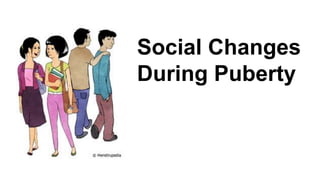
Social Changes
During Puberty
Searching for Identity
Young people are busy working out who
they are and where they fit in the world.
This search can be influenced by gender,
peer group, cultural background and family
expectations.
Seeking
More Independence
This is likely to influence the
decisions your child makes and the
relationships your child has with
family and friends
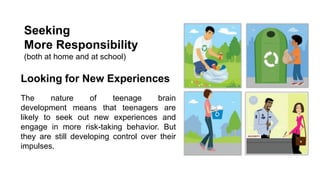
Seeking
More Responsibility
(both at home and at school)

Looking for New Experiences
The
nature
of
teenage
brain
development means that teenagers are
likely to seek out new experiences and
engage in more risk-taking behavior. But
they are still developing control over their
impulses.
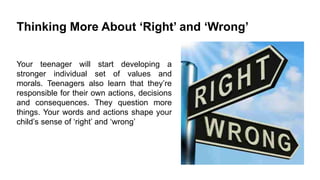
Thinking More About „Right‟ and „Wrong‟
Your teenager will start developing a
stronger individual set of values and
morals. Teenagers also learn that they’re
responsible for their own actions, decisions
and consequences. They question more
things. Your words and actions shape your
child’s sense of ‘right’ and ‘wrong’
Influenced more by
friends, especially
when it comes to
behavior, sense of
self
and
selfesteem
Communicating in
Different Ways
The internet, mobile phones and
social media can significantly
influence communication with
peers and learning about the
world.
BODY IMAGE

Body Image

Me and My Body
Valuing My Body, Valuing Me
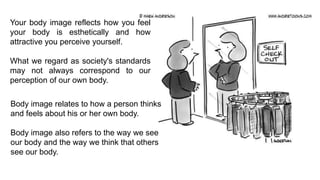
Your body image reflects how you feel
your body is esthetically and how
attractive you perceive yourself.
What we regard as society's standards
may not always correspond to our
perception of our own body.

Body image relates to how a person thinks
and feels about his or her own body.
Body image also refers to the way we see
our body and the way we think that others
see our body.
Every single one of us has a body image. We cannot avoid having
feelings about how we look; it is part of human nature. We are influenced
by how we imagine others might see us. People's overall body image
can
range
from
extremely
negative
to
very
positive.

It is normal to like some parts of your body and dislike others. Body
image refers to the overall perception, not just certain parts of your body.
It refers to how comfortable we feel in our bodies, how much in control
we feel, how agile we are, as well as our attractiveness.
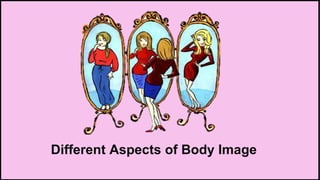
Different Aspects of Body Image
The way we see our own body
(Perceptual)

Our body image is not always an accurate reflection of what our body
actually looks like.
For example, many people in our society perceive their body to be larger
or fatter than it really is. Perceptual body image is the difference between
what you perceive your body to look like and what your body actually
looks like.
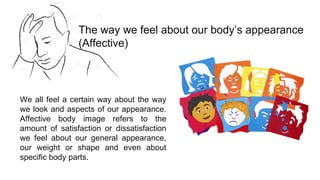
The way we feel about our body’s appearance
(Affective)

We all feel a certain way about the way
we look and aspects of our appearance.
Affective body image refers to the
amount of satisfaction or dissatisfaction
we feel about our general appearance,
our weight or shape and even about
specific body parts.
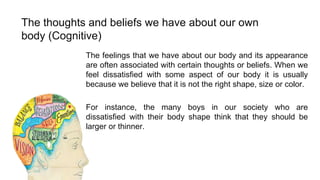
The thoughts and beliefs we have about our own
body (Cognitive)
The feelings that we have about our body and its appearance
are often associated with certain thoughts or beliefs. When we
feel dissatisfied with some aspect of our body it is usually
because we believe that it is not the right shape, size or color.
For instance, the many boys in our society who are
dissatisfied with their body shape think that they should be
larger or thinner.
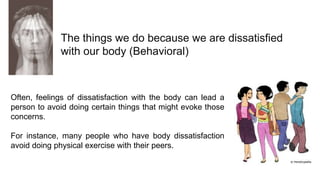
The things we do because we are dissatisfied
with our body (Behavioral)

Often, feelings of dissatisfaction with the body can lead a
person to avoid doing certain things that might evoke those
concerns.

For instance, many people who have body dissatisfaction
avoid doing physical exercise with their peers.
How do we shape our body image?
People's body images do not develop in isolation.
We are influenced by those around us and our culture.
Families and friends convey to us positive and negative
messages regarding our bodies continuously - virtually as
soon as we are born.
Studies have shown that children brought up in families
where parents enjoy physical exercise and explain the
benefits of being physically healthy tend to have a more
positive body image, compared to those who are criticized
for the way they look.
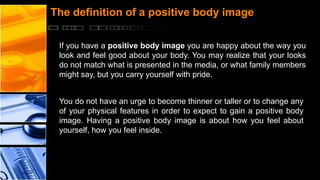
The definition of a positive body image
If you have a positive body image you are happy about the way you
look and feel good about your body. You may realize that your looks
do not match what is presented in the media, or what family members
might say, but you carry yourself with pride.
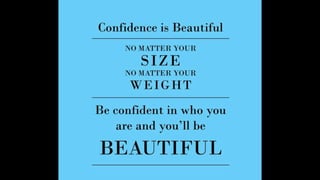
You do not have an urge to become thinner or taller or to change any
of your physical features in order to expect to gain a positive body
image. Having a positive body image is about how you feel about
yourself, how you feel inside.
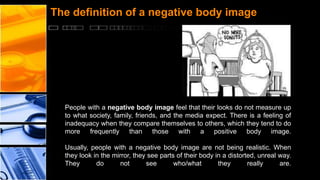
The definition of a negative body image

People with a negative body image feel that their looks do not measure up
to what society, family, friends, and the media expect. There is a feeling of
inadequacy when they compare themselves to others, which they tend to do
more frequently than those with a positive body image.
Usually, people with a negative body image are not being realistic. When
they look in the mirror, they see parts of their body in a distorted, unreal way.
They
do
not
see
who/what
they
really
are.
Sexual health & body image

Teens who lack knowledge about
sexual health and who do not feel
accepted and supported by their
parents are more likely to follow the
crowd.
By: The Emotional Life
Sexual Health

According to the current working definition, sexual health is:

“…a state of physical, emotional, mental and social well-being
in relation to sexuality; it is not merely the absence of disease,
dysfunction or infirmity. Sexual health requires a positive and
respectful approach to sexuality and sexual relationships, as
well as the possibility of having pleasurable and safe sexual
experiences, free of coercion, discrimination and violence.
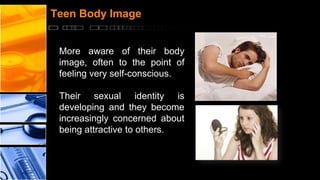
Teen Body Image

More aware of their body
image, often to the point of
feeling very self-conscious.
Their sexual identity is
developing and they become
increasingly concerned about
being attractive to others.
Improve

Tips to

Your

Body
Image
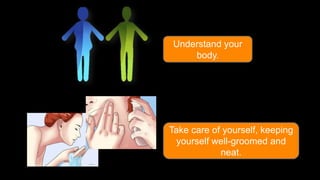
Understand your
body.

Take care of yourself, keeping
yourself well-groomed and
neat.
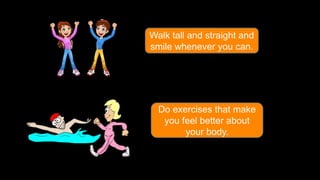
Walk tall and straight and
smile whenever you can.

Do exercises that make
you feel better about
your body.
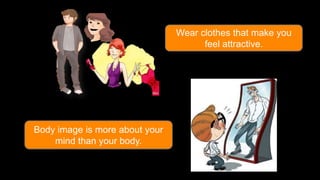
Wear clothes that make you
feel attractive.

Body image is more about your
mind than your body.
Realize that few people
are as critical of your
body as you are.

Know that you are special
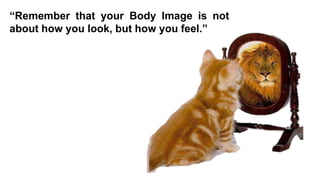
“Remember that your Body Image is not
about how you look, but how you feel.”
You hem me in behind
and before, and You lay
Your hand upon me.
Psalms 139:5

Understanding Gender and Body Image

  • 1.
  • 2.
    Sex is biologicaland includes physical attributes such as sex chromosomes, gonads, sex hormones, internal reproductive structures, and external genitalia. At birth, it is used to identify individuals as male or female. Gender is the complex interrelationship between those traits and one’s internal sense of self as male, female, both or neither as well as one’s outward presentations and behaviors related to that perception.
  • 3.
    Gender Terminology Gender Identity One'sinnermost concept of self as male or female or both or neither—how individuals perceive themselves and what they call themselves. One’s gender identity can be the same or different than the sex assigned at birth. Gender Expression Refers to the ways in which people externally communicate their gender identity to others through behavior, clothing, haircut, voice, and other forms of presentation. Gender expression also works the other way as people assign gender to others.
  • 4.
    Gender Role This isthe set of roles, activities, expectations and behaviors assigned to females and males by society. Our culture recognizes two basic gender roles: Masculine (having the qualities attributed to males) and feminine (having the qualities attributed to females). People who step out of their socially assigned gender roles are sometimes referred to as transgender. Other cultures have three or more gender roles.
  • 5.
    Sexual Orientation Term thatrefers to being romantically or sexually attracted to people of a specific gender. Our sexual orientation and our gender identity are separate, distinct parts of our overall identity. Although a child may not yet be aware of their sexual orientation, they usually have a strong sense of their gender identity.
  • 6.
  • 7.
    Emotional Changes ThatOccur During Puberty
  • 8.
    Feeling Overly Sensitive Duringpuberty, since your body undergoes many changes, it is common to feel uncomfortable about them and become overly sensitive about your physical appearance.
  • 10.
    Looking for anidentity Since you are inare inprocess of becoming an adult, you may feel inclined to Since you the the process of becoming an adult, you figure out what makes you figure out what makes you unique asgeneral tendency may feel inclined to unique as a person. There is also a that you associate more with your friends than your family members. a person.
  • 12.
    Feeling uncertain Since you'renot completely an adult and are not a child anymore, puberty can potentially lead to uncertain times.
  • 14.
    Peer pressure With theonset of puberty, your conversations with your friends will increase. Your peer group and you are likely to be influenced by what you see around you in popular media and the culture that is represented through them.
  • 16.
    Conflicting thoughts Since youare somewhere in between as a teenager during puberty, you may feel stuck between how you were as a child and how you wish to be as an adult.
  • 17.
    Mood swings For example,sometimes your mood will swing between feeling confident and happy to feeling irritated and depressed in a short span of time. These frequent swings in how you feel are called mood swings.
  • 19.
    Feeling conscious aboutself The onset of puberty can vary on an individual basis. Therefore the way you grow maybe different from the way your friends grow. This can make you conscious about the way you're growing up and your body.
  • 20.
    Getting sexual feelings Pubertyis also the phase after which you develop sexual maturity. Sexual maturity is the stage of your life when you can have children
  • 21.
  • 22.
    Searching for Identity Youngpeople are busy working out who they are and where they fit in the world. This search can be influenced by gender, peer group, cultural background and family expectations.
  • 23.
    Seeking More Independence This islikely to influence the decisions your child makes and the relationships your child has with family and friends
  • 24.
    Seeking More Responsibility (both athome and at school) Looking for New Experiences The nature of teenage brain development means that teenagers are likely to seek out new experiences and engage in more risk-taking behavior. But they are still developing control over their impulses.
  • 25.
    Thinking More About„Right‟ and „Wrong‟ Your teenager will start developing a stronger individual set of values and morals. Teenagers also learn that they’re responsible for their own actions, decisions and consequences. They question more things. Your words and actions shape your child’s sense of ‘right’ and ‘wrong’
  • 26.
    Influenced more by friends,especially when it comes to behavior, sense of self and selfesteem
  • 27.
    Communicating in Different Ways Theinternet, mobile phones and social media can significantly influence communication with peers and learning about the world.
  • 28.
    BODY IMAGE Body Image Meand My Body Valuing My Body, Valuing Me
  • 30.
    Your body imagereflects how you feel your body is esthetically and how attractive you perceive yourself. What we regard as society's standards may not always correspond to our perception of our own body. Body image relates to how a person thinks and feels about his or her own body. Body image also refers to the way we see our body and the way we think that others see our body.
  • 31.
    Every single oneof us has a body image. We cannot avoid having feelings about how we look; it is part of human nature. We are influenced by how we imagine others might see us. People's overall body image can range from extremely negative to very positive. It is normal to like some parts of your body and dislike others. Body image refers to the overall perception, not just certain parts of your body. It refers to how comfortable we feel in our bodies, how much in control we feel, how agile we are, as well as our attractiveness.
  • 32.
  • 33.
    The way wesee our own body (Perceptual) Our body image is not always an accurate reflection of what our body actually looks like. For example, many people in our society perceive their body to be larger or fatter than it really is. Perceptual body image is the difference between what you perceive your body to look like and what your body actually looks like.
  • 34.
    The way wefeel about our body’s appearance (Affective) We all feel a certain way about the way we look and aspects of our appearance. Affective body image refers to the amount of satisfaction or dissatisfaction we feel about our general appearance, our weight or shape and even about specific body parts.
  • 35.
    The thoughts andbeliefs we have about our own body (Cognitive) The feelings that we have about our body and its appearance are often associated with certain thoughts or beliefs. When we feel dissatisfied with some aspect of our body it is usually because we believe that it is not the right shape, size or color. For instance, the many boys in our society who are dissatisfied with their body shape think that they should be larger or thinner.
  • 36.
    The things wedo because we are dissatisfied with our body (Behavioral) Often, feelings of dissatisfaction with the body can lead a person to avoid doing certain things that might evoke those concerns. For instance, many people who have body dissatisfaction avoid doing physical exercise with their peers.
  • 38.
    How do weshape our body image? People's body images do not develop in isolation. We are influenced by those around us and our culture. Families and friends convey to us positive and negative messages regarding our bodies continuously - virtually as soon as we are born. Studies have shown that children brought up in families where parents enjoy physical exercise and explain the benefits of being physically healthy tend to have a more positive body image, compared to those who are criticized for the way they look.
  • 39.
    The definition ofa positive body image If you have a positive body image you are happy about the way you look and feel good about your body. You may realize that your looks do not match what is presented in the media, or what family members might say, but you carry yourself with pride. You do not have an urge to become thinner or taller or to change any of your physical features in order to expect to gain a positive body image. Having a positive body image is about how you feel about yourself, how you feel inside.
  • 42.
    The definition ofa negative body image People with a negative body image feel that their looks do not measure up to what society, family, friends, and the media expect. There is a feeling of inadequacy when they compare themselves to others, which they tend to do more frequently than those with a positive body image. Usually, people with a negative body image are not being realistic. When they look in the mirror, they see parts of their body in a distorted, unreal way. They do not see who/what they really are.
  • 43.
    Sexual health &body image Teens who lack knowledge about sexual health and who do not feel accepted and supported by their parents are more likely to follow the crowd. By: The Emotional Life
  • 44.
    Sexual Health According tothe current working definition, sexual health is: “…a state of physical, emotional, mental and social well-being in relation to sexuality; it is not merely the absence of disease, dysfunction or infirmity. Sexual health requires a positive and respectful approach to sexuality and sexual relationships, as well as the possibility of having pleasurable and safe sexual experiences, free of coercion, discrimination and violence.
  • 45.
    Teen Body Image Moreaware of their body image, often to the point of feeling very self-conscious. Their sexual identity is developing and they become increasingly concerned about being attractive to others.
  • 46.
  • 47.
    Understand your body. Take careof yourself, keeping yourself well-groomed and neat.
  • 48.
    Walk tall andstraight and smile whenever you can. Do exercises that make you feel better about your body.
  • 49.
    Wear clothes thatmake you feel attractive. Body image is more about your mind than your body.
  • 50.
    Realize that fewpeople are as critical of your body as you are. Know that you are special
  • 51.
    “Remember that yourBody Image is not about how you look, but how you feel.”
  • 52.
    You hem mein behind and before, and You lay Your hand upon me. Psalms 139:5