Understanding
Financial Products


Financial Services Marketing (303)
Mrs. Charu Rastogi, Asst. Proff.
Agenda
•   What are Financial Products?
•   What are Financial Services?
•   Financial System, its functions
•   Indian Financial System
•   Financial Products
     o Banks
     o Money market
     o Capital market
     o Asset / Fund based
     o Fee based
•   How are financial products managed?
     o Financial Planning Process
     o Individual Financial Plan
     o Customer needs and product solutions
Financial Product
•   A financial product is a facility (arrangement or intangible property) through
    which, or through the acquisition of which, a person
     o makes a financial investment
         the investor gives money to another person and the person uses the contribution to
              generate a financial return, or other benefit, for the investor
             the investor has no day-to-day control over the use of the contribution to generate
              the return or benefit
             Eg: a person paying money to a company for the issue of shares (the company uses
              the money to generate dividends for the person and the person, as a shareholder,
              does not have control over the day-to-day affairs of the company)
     o manages financial risk
         manage, avoid or limit the financial consequences to them of particular
              circumstances happening
             Eg. taking out insurance and hedging a liability by acquiring a futures contract or
              entering into a currency swap
     o makes non-cash payments
         by ways other than making physical delivery of a domestic or foreign currency in
              the form of notes / coins
             Eg: facility for direct debit of a deposit account, a facility for the use of cheques
Financial Service
•   A person provides a financial service if they
     o provide financial product advice
          to influence a person in making a decision in relation to a particular financial
               product
     o deal in a financial product
         acquiring/issuing/varying/disposing a financial product
         underwriting the securities or interests
     o make a market for a financial product
         through a facility, at a place or otherwise, the person regularly states the prices at
               which they propose to acquire or dispose of financial products on their own behalf
     o provide a custodial or depository service
         a financial product, or a beneficial interest in a financial product, is held by the
               provider in trust for the client
Financial System
• Financial system supplies the necessary
    financial inputs for the production of goods and
    services which in turn promotes the well being
    and standard of living of the people of a country
•   Efficient functioning of the financial system
    facilitates free flow of funds to more productive
    activities and thus promotes investment
•   It the intermediation between savers and
    investors and promotes faster economic
    development
Functions of Financial System
•   It serves as a link between savers and investors.
•   It channelizes flow of saving into productive investment.
•   It provides payment mechanism for exchange of goods and
    services.
•   It provides a mechanism for the transfer of resources across
    geographic boundaries
•   It provides a mechanism for managing and controlling the risk
    involved in mobilizing savings and allocating credit.
•   It promotes the process of capital formation by bringing
    together the supply of saving and the demand for investible
    funds.
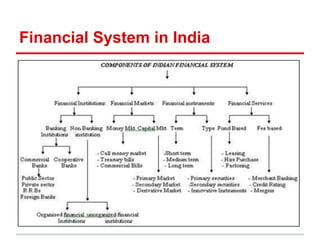
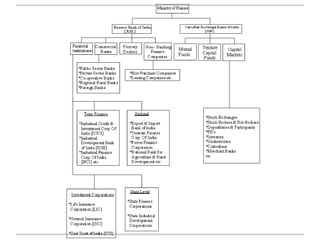
Financial System in India
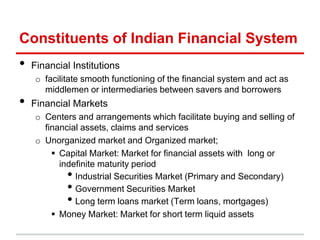
Constituents of Indian Financial System
•   Financial Institutions
    o facilitate smooth functioning of the financial system and act as
      middlemen or intermediaries between savers and borrowers
•   Financial Markets
    o Centers and arrangements which facilitate buying and selling of
      financial assets, claims and services
    o Unorganized market and Organized market;
         Capital Market: Market for financial assets with long or
          indefinite maturity period
            • Industrial Securities Market (Primary and Secondary)
            • Government Securities Market
            • Long term loans market (Term loans, mortgages)
         Money Market: Market for short term liquid assets
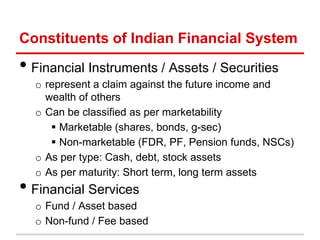
Constituents of Indian Financial System
• Financial Instruments / Assets / Securities
  o represent a claim against the future income and
    wealth of others
  o Can be classified as per marketability
      Marketable (shares, bonds, g-sec)
      Non-marketable (FDR, PF, Pension funds, NSCs)
  o As per type: Cash, debt, stock assets
  o As per maturity: Short term, long term assets
• Financial Services
  o Fund / Asset based
  o Non-fund / Fee based
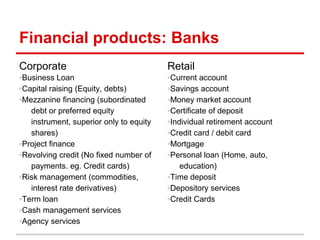
Financial products: Banks
Corporate                                Retail
◦Business Loan                           ◦Current account
◦Capital raising (Equity, debts)         ◦Savings account
◦Mezzanine financing (subordinated       ◦Money market account
   debt or preferred equity              ◦Certificate of deposit
   instrument, superior only to equity   ◦Individual retirement account
   shares)                               ◦Credit card / debit card
◦Project finance                         ◦Mortgage
◦Revolving credit (No fixed number of    ◦Personal loan (Home, auto,
   payments. eg. Credit cards)               education)
◦Risk management (commodities,           ◦Time deposit
   interest rate derivatives)            ◦Depository services
◦Term loan                               ◦Credit Cards
◦Cash management services
◦Agency services
Financial Products: Money Market
•   Treasury bill: short term borrowings of the government
    (14 days, 91 days, 182 days, 364 days)
•   Commercial bills: banks make advances to customers
    against these
•   Inter bank call money: source for banks for getting
    overnight and short term funds
•   Commercial paper: short term unsecured instrument
    issued by a company via promissory notes with fixed
    maturities
•   Certificate of Deposit: issued by commercial banks at
    a discount on face value
Financial Products: Capital Market
•   Derivatives: forwards, futures, options, swaps
•   Shares, right, bonus, preference
•   Debentures
•   Bonds
    o   Euro convertible bonds
    o   Deep discount bonds
Financial Products: Fund based
o Underwriting (shares, debentures, bonds, etc.) of new
  issue
o Equipment Leasing
o Hire Purchase
o Bill discounting
o Venture capital
o Housing finance
o Insurance services
o Factoring, etc
Financial Products: Fee Based
o   Corporate advisory services
o   Merchant banking
o   Issue management
o   Loan syndication
o   Credit rating
o   Stock Broking
o   M&A
o   Capital restructuring
How are financial products managed?
Financial Planning Process
o Financial planning is the process of managing your funds to
  achieve your desired goals in the required time frame.
o It involves analyzing your existing financial position,
  expected future cash flows, inflation and identified financial
  objectives to develop a comprehensive financial planning
  roadmap.
o This is aimed at making available the right amounts of funds
  at the right time in the future
o Insurance planning is an integral part of financial planning.
  An insurance plan takes care of the unforeseeable demands
  on your finances.
o For instance, an unfortunate illness requiring a surgery can
  be covered under a medical insurance plan and you need
  not dig into your savings and other investments to pay for it.
o In effect, insurance helps to keep your financial plan on
  track.
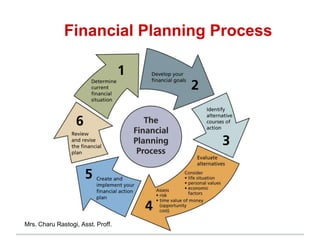
Financial Planning Process


Mrs. Charu Rastogi, Asst. Proff.
How an Individual Manages Financial
Products?
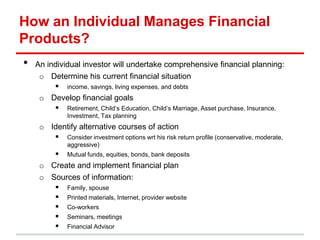
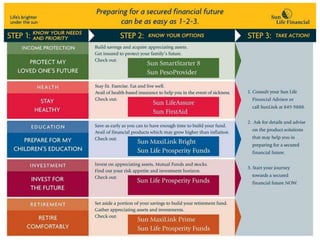
•   An individual investor will undertake comprehensive financial planning:
     o Determine his current financial situation
          income, savings, living expenses, and debts
     o Develop financial goals
          Retirement, Child’s Education, Child’s Marriage, Asset purchase, Insurance,
              Investment, Tax planning
     o Identify alternative courses of action
         Consider investment options wrt his risk return profile (conservative, moderate,
              aggressive)
         Mutual funds, equities, bonds, bank deposits
     o Create and implement financial plan
     o Sources of information:
         Family, spouse
         Printed materials, Internet, provider website
         Co-workers
         Seminars, meetings
         Financial Advisor
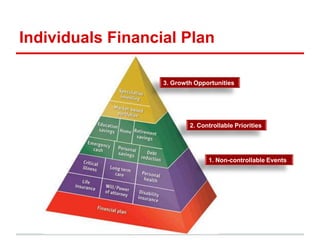
Individuals Financial Plan

                   3. Growth Opportunities


                           2. Controllable Priorities


                                 1. Non-controllable Events
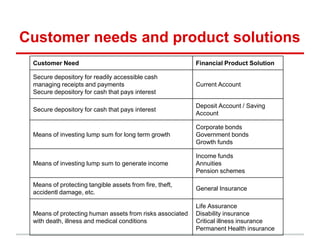
Customer needs and product solutions
 Customer Need                                            Financial Product Solution

 Secure depository for readily accessible cash
 managing receipts and payments                           Current Account
 Secure depository for cash that pays interest

                                                          Deposit Account / Saving
 Secure depository for cash that pays interest
                                                          Account

                                                          Corporate bonds
 Means of investing lump sum for long term growth         Government bonds
                                                          Growth funds

                                                          Income funds
 Means of investing lump sum to generate income           Annuities
                                                          Pension schemes

 Means of protecting tangible assets from fire, theft,
                                                          General Insurance
 accidentl damage, etc.

                                                          Life Assurance
 Means of protecting human assets from risks associated   Disability insurance
 with death, illness and medical conditions               Critical illness insurance
                                                          Permanent Health insurance
Possible Questions
•   Discuss various Financial Products and how these
    products are being managed?
•   Explain different Financial Products? How are they
    managed?
•   How Financial Planning of Individual is done through
    Financial Products? How it is managed?

Understanding Financial Products

  • 1.
    Understanding Financial Products Financial ServicesMarketing (303) Mrs. Charu Rastogi, Asst. Proff.
  • 2.
    Agenda • What are Financial Products? • What are Financial Services? • Financial System, its functions • Indian Financial System • Financial Products o Banks o Money market o Capital market o Asset / Fund based o Fee based • How are financial products managed? o Financial Planning Process o Individual Financial Plan o Customer needs and product solutions
  • 3.
    Financial Product • A financial product is a facility (arrangement or intangible property) through which, or through the acquisition of which, a person o makes a financial investment  the investor gives money to another person and the person uses the contribution to generate a financial return, or other benefit, for the investor  the investor has no day-to-day control over the use of the contribution to generate the return or benefit  Eg: a person paying money to a company for the issue of shares (the company uses the money to generate dividends for the person and the person, as a shareholder, does not have control over the day-to-day affairs of the company) o manages financial risk  manage, avoid or limit the financial consequences to them of particular circumstances happening  Eg. taking out insurance and hedging a liability by acquiring a futures contract or entering into a currency swap o makes non-cash payments  by ways other than making physical delivery of a domestic or foreign currency in the form of notes / coins  Eg: facility for direct debit of a deposit account, a facility for the use of cheques
  • 4.
    Financial Service • A person provides a financial service if they o provide financial product advice  to influence a person in making a decision in relation to a particular financial product o deal in a financial product  acquiring/issuing/varying/disposing a financial product  underwriting the securities or interests o make a market for a financial product  through a facility, at a place or otherwise, the person regularly states the prices at which they propose to acquire or dispose of financial products on their own behalf o provide a custodial or depository service  a financial product, or a beneficial interest in a financial product, is held by the provider in trust for the client
  • 5.
    Financial System • Financialsystem supplies the necessary financial inputs for the production of goods and services which in turn promotes the well being and standard of living of the people of a country • Efficient functioning of the financial system facilitates free flow of funds to more productive activities and thus promotes investment • It the intermediation between savers and investors and promotes faster economic development
  • 6.
    Functions of FinancialSystem • It serves as a link between savers and investors. • It channelizes flow of saving into productive investment. • It provides payment mechanism for exchange of goods and services. • It provides a mechanism for the transfer of resources across geographic boundaries • It provides a mechanism for managing and controlling the risk involved in mobilizing savings and allocating credit. • It promotes the process of capital formation by bringing together the supply of saving and the demand for investible funds.
  • 7.
  • 8.
    Constituents of IndianFinancial System • Financial Institutions o facilitate smooth functioning of the financial system and act as middlemen or intermediaries between savers and borrowers • Financial Markets o Centers and arrangements which facilitate buying and selling of financial assets, claims and services o Unorganized market and Organized market;  Capital Market: Market for financial assets with long or indefinite maturity period • Industrial Securities Market (Primary and Secondary) • Government Securities Market • Long term loans market (Term loans, mortgages)  Money Market: Market for short term liquid assets
  • 9.
    Constituents of IndianFinancial System • Financial Instruments / Assets / Securities o represent a claim against the future income and wealth of others o Can be classified as per marketability  Marketable (shares, bonds, g-sec)  Non-marketable (FDR, PF, Pension funds, NSCs) o As per type: Cash, debt, stock assets o As per maturity: Short term, long term assets • Financial Services o Fund / Asset based o Non-fund / Fee based
  • 11.
    Financial products: Banks Corporate Retail ◦Business Loan ◦Current account ◦Capital raising (Equity, debts) ◦Savings account ◦Mezzanine financing (subordinated ◦Money market account debt or preferred equity ◦Certificate of deposit instrument, superior only to equity ◦Individual retirement account shares) ◦Credit card / debit card ◦Project finance ◦Mortgage ◦Revolving credit (No fixed number of ◦Personal loan (Home, auto, payments. eg. Credit cards) education) ◦Risk management (commodities, ◦Time deposit interest rate derivatives) ◦Depository services ◦Term loan ◦Credit Cards ◦Cash management services ◦Agency services
  • 12.
    Financial Products: MoneyMarket • Treasury bill: short term borrowings of the government (14 days, 91 days, 182 days, 364 days) • Commercial bills: banks make advances to customers against these • Inter bank call money: source for banks for getting overnight and short term funds • Commercial paper: short term unsecured instrument issued by a company via promissory notes with fixed maturities • Certificate of Deposit: issued by commercial banks at a discount on face value
  • 13.
    Financial Products: CapitalMarket • Derivatives: forwards, futures, options, swaps • Shares, right, bonus, preference • Debentures • Bonds o Euro convertible bonds o Deep discount bonds
  • 14.
    Financial Products: Fundbased o Underwriting (shares, debentures, bonds, etc.) of new issue o Equipment Leasing o Hire Purchase o Bill discounting o Venture capital o Housing finance o Insurance services o Factoring, etc
  • 15.
    Financial Products: FeeBased o Corporate advisory services o Merchant banking o Issue management o Loan syndication o Credit rating o Stock Broking o M&A o Capital restructuring
  • 16.
    How are financialproducts managed?
  • 17.
    Financial Planning Process oFinancial planning is the process of managing your funds to achieve your desired goals in the required time frame. o It involves analyzing your existing financial position, expected future cash flows, inflation and identified financial objectives to develop a comprehensive financial planning roadmap. o This is aimed at making available the right amounts of funds at the right time in the future o Insurance planning is an integral part of financial planning. An insurance plan takes care of the unforeseeable demands on your finances. o For instance, an unfortunate illness requiring a surgery can be covered under a medical insurance plan and you need not dig into your savings and other investments to pay for it. o In effect, insurance helps to keep your financial plan on track.
  • 18.
    Financial Planning Process Mrs.Charu Rastogi, Asst. Proff.
  • 19.
    How an IndividualManages Financial Products? • An individual investor will undertake comprehensive financial planning: o Determine his current financial situation  income, savings, living expenses, and debts o Develop financial goals  Retirement, Child’s Education, Child’s Marriage, Asset purchase, Insurance, Investment, Tax planning o Identify alternative courses of action  Consider investment options wrt his risk return profile (conservative, moderate, aggressive)  Mutual funds, equities, bonds, bank deposits o Create and implement financial plan o Sources of information:  Family, spouse  Printed materials, Internet, provider website  Co-workers  Seminars, meetings  Financial Advisor
  • 20.
    Individuals Financial Plan 3. Growth Opportunities 2. Controllable Priorities 1. Non-controllable Events
  • 21.
    Customer needs andproduct solutions Customer Need Financial Product Solution Secure depository for readily accessible cash managing receipts and payments Current Account Secure depository for cash that pays interest Deposit Account / Saving Secure depository for cash that pays interest Account Corporate bonds Means of investing lump sum for long term growth Government bonds Growth funds Income funds Means of investing lump sum to generate income Annuities Pension schemes Means of protecting tangible assets from fire, theft, General Insurance accidentl damage, etc. Life Assurance Means of protecting human assets from risks associated Disability insurance with death, illness and medical conditions Critical illness insurance Permanent Health insurance
  • 23.
    Possible Questions • Discuss various Financial Products and how these products are being managed? • Explain different Financial Products? How are they managed? • How Financial Planning of Individual is done through Financial Products? How it is managed?