


Unit 3.1: Regulatory Framework of
International Finance
 FEMA
 Foreign Trade Policy
 Role of RBI
 Rupee Convertibility
 EOU/STPI
 SEZ
 EPZ
2
Mrs. Charu Rastogi, Asst.
Professor
3
Mrs. Charu Rastogi, Asst.
Professor
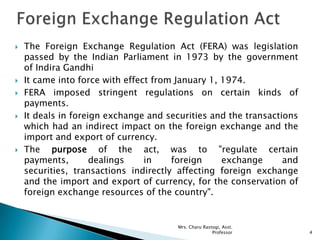
 The Foreign Exchange Regulation Act (FERA) was legislation
passed by the Indian Parliament in 1973 by the government
of Indira Gandhi
 It came into force with effect from January 1, 1974.
 FERA imposed stringent regulations on certain kinds of
payments.
 It deals in foreign exchange and securities and the transactions
which had an indirect impact on the foreign exchange and the
import and export of currency.
 The purpose of the act, was to "regulate certain
payments, dealings in foreign exchange and
securities, transactions indirectly affecting foreign exchange
and the import and export of currency, for the conservation of
foreign exchange resources of the country".
4
Mrs. Charu Rastogi, Asst.
Professor
 In 1999, FERA was replaced by the Foreign Exchange Management Act, which
liberalised foreign exchange controls and restrictions on foreign investment.
 It had become the need of the hour since FERA had become incompatible
with the pro-liberalisation policies of the Government of India.
 It was formulated to:
◦ facilitate external trade and payments
◦ promote the orderly development and maintenance of foreign exchange market in
India
 FEMA is applicable to all parts of India. The act is also applicable to all
branches, offices and agencies outside India owned or controlled by a person
who is a resident of India.
 The FEMA head-office, also known as Enforcement Directorate is situated in
New Delhi and is headed by a Director. The Directorate is further divided into
5 zonal offices in Delhi, Mumbai, Kolkata, Chennai and Jalandhar and each
office is headed by a Deputy Director.
5
Mrs. Charu Rastogi, Asst.
Professor
Fera Fema
 Object to conserve and
prevent misuse
 Violation was Criminal
Offence and was non
compoundable
 It was a draconian police
law
 To facilitate external trade
and payments
 Violation is a civil offence
and is compoundable
 It is a civil law
6
Mrs. Charu Rastogi, Asst.
Professor
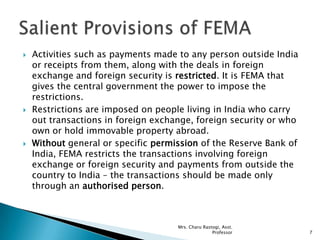
 Activities such as payments made to any person outside India
or receipts from them, along with the deals in foreign
exchange and foreign security is restricted. It is FEMA that
gives the central government the power to impose the
restrictions.
 Restrictions are imposed on people living in India who carry
out transactions in foreign exchange, foreign security or who
own or hold immovable property abroad.
 Without general or specific permission of the Reserve Bank of
India, FEMA restricts the transactions involving foreign
exchange or foreign security and payments from outside the
country to India – the transactions should be made only
through an authorised person.
7
Mrs. Charu Rastogi, Asst.
Professor
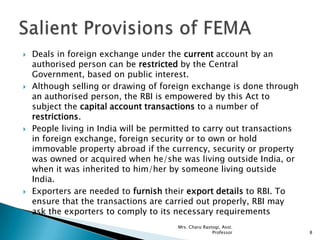
 Deals in foreign exchange under the current account by an
authorised person can be restricted by the Central
Government, based on public interest.
 Although selling or drawing of foreign exchange is done through
an authorised person, the RBI is empowered by this Act to
subject the capital account transactions to a number of
restrictions.
 People living in India will be permitted to carry out transactions
in foreign exchange, foreign security or to own or hold
immovable property abroad if the currency, security or property
was owned or acquired when he/she was living outside India, or
when it was inherited to him/her by someone living outside
India.
 Exporters are needed to furnish their export details to RBI. To
ensure that the transactions are carried out properly, RBI may
ask the exporters to comply to its necessary requirements
8
Mrs. Charu Rastogi, Asst.
Professor
 Under the FEMA, the emphasis is on the management of foreign
exchange resources.
 FEMA has formally recognized the distinction between current
account and capital account transactions.
 Two golden rules or principles in FEMA are mentioned as follows:
◦ all current account transactions are permitted unless otherwise
prohibited.
◦ all capital account transactions are prohibited unless otherwise
permitted.
More details at:
(http://www.rbi.org.in/scripts/BS_FemaNotifications.aspx?Id=155)
9
Mrs. Charu Rastogi, Asst.
Professor
 The Penalty could be up to thrice the sum involved
where amount is quantifiable
 If the Amount is not quantifiable , penalty up to Rs
2 lakhs can be imposed
 If contravention is of continuing nature, further
penalty up to Rs 5000 per day during which the
contravention continues can be imposed
10
Mrs. Charu Rastogi, Asst.
Professor
11
Mrs. Charu Rastogi, Asst.
Professor
 Exim policy is a set of guidelines and
instructions issued by Directorate General of
Foreign Trade (DGFT) for matters related to
the import and export of goods in India.
 The policy is guided by Foreign Trade
Development and Regulation Act, 1992.
 Exim policy is issued for a period of 5 years.
The current policy covers the period 2009-14
12
Mrs. Charu Rastogi, Asst.
Professor
 Control import of non-essential items
 Export Promotion
 To accelerate the level of economic activities to derive
maximum benefits from expanding global market
opportunities
 To stimulate sustained economic growth by providing access
to essential raw materials, intermediates, components,'
consumables and capital goods required for augmenting
production
 To enhance the techno local strength and efficiency of Indian
agriculture, industry and services, thereby, improving their
competitiveness
 To generate new employment opportunities and encourage
the attainment of internationally accepted standards of
quality
 To provide quality consumer products at reasonable prices
13
Mrs. Charu Rastogi, Asst.
Professor
 The year 2009 witnessed one of the most severe global
recessions in the post-war period.
 Exports suffered a decline in the last 10 months of 2009
 To arrest and reverse the declining trend of exports and to
provide additional support especially to those sectors which
have been hit badly by recession in the developed world
 Policy objective of achieving an annual export growth of 15%
with an annual export target of US$ 200 billion by March
2011.
 In the remaining three years of this Foreign Trade Policy i.e.
upto 2014, the country should be able to come back on the
high export growth path of around 25% per annum.
 By 2014, we expect to double India‟s exports of goods and
services. The long term policy objective for the Government is
to double India‟s share in global trade by 2020.
14
Mrs. Charu Rastogi, Asst.
Professor
 In order to meet these objectives, the Government would
follow a mix of policy measures including fiscal
incentives, institutional changes, procedural
rationalization, enhanced market access across the world and
diversification of export markets.
 Improvement in infrastructure related to exports
 Bringing down transaction costs, and providing full refund
of all indirect taxes and levies, would be the three pillars.
 Goods and Services Tax rebates all indirect taxes and levies
on exports
 Technological up gradation of exports is sought to
◦ be achieved by promoting imports of capital goods for
certain sectors under EPCG at zero percent duty.
◦ encourage production and export of „green products‟
through scheme and incentives for exports.
15
Mrs. Charu Rastogi, Asst.
Professor
 In order to reduce the transaction cost and institutional
bottlenecks, the e-trade project would be implemented in a
time bound manner to bring all stake holders on a common
platform.
 Additional ports/locations would be enabled on the Electronic
Data Interchange over the next few years.
 An Inter-Ministerial Committee has been established to serve
as a single window mechanism for resolution of trade related
grievances.
 The industry and the Government, working in tandem, will be
able to ensure that the Indian exports become globally
competitive and that we are able to achieve the target, which
we have set for ourselves.
16
Mrs. Charu Rastogi, Asst.
Professor
17
Mrs. Charu Rastogi, Asst.
Professor
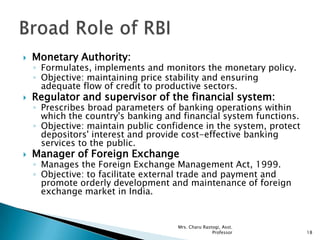
 Monetary Authority:
◦ Formulates, implements and monitors the monetary policy.
◦ Objective: maintaining price stability and ensuring
adequate flow of credit to productive sectors.
 Regulator and supervisor of the financial system:
◦ Prescribes broad parameters of banking operations within
which the country's banking and financial system functions.
◦ Objective: maintain public confidence in the system, protect
depositors' interest and provide cost-effective banking
services to the public.
 Manager of Foreign Exchange
◦ Manages the Foreign Exchange Management Act, 1999.
◦ Objective: to facilitate external trade and payment and
promote orderly development and maintenance of foreign
exchange market in India.
18
Mrs. Charu Rastogi, Asst.
Professor
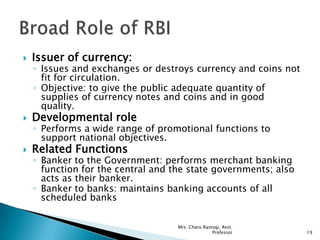
 Issuer of currency:
◦ Issues and exchanges or destroys currency and coins not
fit for circulation.
◦ Objective: to give the public adequate quantity of
supplies of currency notes and coins and in good
quality.
 Developmental role
◦ Performs a wide range of promotional functions to
support national objectives.
 Related Functions
◦ Banker to the Government: performs merchant banking
function for the central and the state governments; also
acts as their banker.
◦ Banker to banks: maintains banking accounts of all
scheduled banks
19
Mrs. Charu Rastogi, Asst.
Professor
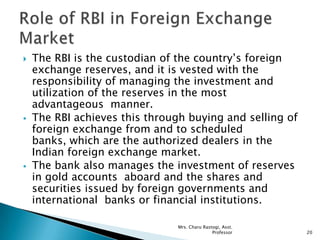
 The RBI is the custodian of the country‟s foreign
exchange reserves, and it is vested with the
responsibility of managing the investment and
utilization of the reserves in the most
advantageous manner.
 The RBI achieves this through buying and selling of
foreign exchange from and to scheduled
banks, which are the authorized dealers in the
Indian foreign exchange market.
 The bank also manages the investment of reserves
in gold accounts aboard and the shares and
securities issued by foreign governments and
international banks or financial institutions.
20
Mrs. Charu Rastogi, Asst.
Professor
21
Mrs. Charu Rastogi, Asst.
Professor
 Currency convertibility refers to the freedom to convert the domestic
currency into other internationally accepted currencies and vice versa
 It is defined as “The freedom to convert local financial assets into foreign
financial assets and vice versa.”
 A currency is said to be convertible if residents and non-residents are free to
use and exchange the domestic currency for any purpose
 The need to convert domestic currency into foreign currency or to convert
foreign currency into domestic currency arises due to:
◦ Current Account Transactions (trade, tourism, factor and transfer receipts and
payments)
◦ Capital Account Transactions (FDI, FII, private or govt. lending or borrowing)
 Article VIII of the IMF defines convertibility on the current account and states
that a member cannot impose restrictions on making of payments and
transfers on currency transactions.
 Article VI (3) of IMF allows members to exercise such controls as are
necessary to regulate international capital movements.
22
Mrs. Charu Rastogi, Asst.
Professor
 Capital account convertibility or CAC is said to
exist when domestic currency can be freely
converted into foreign currency (and vice versa) for
capital account transactions
 When the domestic currency is convertible only on
the current account, it is known as partial
convertibility.
 When the domestic currency is convertible on the
current account as well as the capital account, it is
known as full convertibility.
23
Mrs. Charu Rastogi, Asst.
Professor
 Rupee is Partially Convertibility because the
rupee is
◦ Fully convertible on the current account
 all current account transactions are permitted unless otherwise
prohibited.
◦ Moving towards progressively liberalizing capital
account transactions
 all capital account transactions are prohibited unless
otherwise permitted.
24
Mrs. Charu Rastogi, Asst.
Professor
 Convertibility of the rupee was recommended by
three reports, namely the:
 Report of The High Level Committee on Balance Of
payments, 1993 (referred to as the Rangarajan Committee
Report, after its Chairman),
 Report on Capital Account Convertibility, 1997 (referred to
as the Tarapore Committee Report after its Chairman), and
 Report on Fuller Capital Account Convertibility, 2006 (or the
FCAC Report, whose Chairman was SS Tarapore).
25
Mrs. Charu Rastogi, Asst.
Professor
26
Mrs. Charu Rastogi, Asst.
Professor
 The Export Oriented Units (EOUs)
scheme, introduced in early 1981, is
complementary to the SEZ scheme.
 It adopts the same production regime but offers a
wide option in locations with reference to factors
like source of raw materials, ports of export, land
facilities, availability of technological
skills, existence of an industrial base and the need
for a larger area of land for the project.
27
Mrs. Charu Rastogi, Asst.
Professor
 To increase exports
 Earn foreign exchange to the country,
 Transfer of latest technologies,
 Stimulate direct foreign investment
 To generate aditional employment.
28
Mrs. Charu Rastogi, Asst.
Professor
 Granite
 Textiles / Garments
 Food Processing
 Chemicals
 Computer Software
 Coffee
 Pharmaceuticals
 Gem & Jewellery
 Engineering Goods
 Electrical & Electronics
29
Mrs. Charu Rastogi, Asst.
Professor
 The EOUs are required to achieve the minimum NFEP
(Net Foreign Exchange Earning as a Percentage of
Exports) and the minimum EP (Export Performance) as
per the provisions of EXIM Policy which vary from sector
to sector.
 For instance, the units with investment in plant and
machinery of Rs.5 crore and above are required to
achieve positive NFEP and export US$ 3.5 million or 3
times the Cost Insurance and Freight (CIF) value of
imported capital goods, whichever is higher, for 5 years
 For electronics hardware sector, minimum NFEP has to
be „positive‟ and minimum EP for 5 years is US$ 1
million or 3 times the CIF value of imported capital
goods, whichever is higher.
30
Mrs. Charu Rastogi, Asst.
Professor
 Software Technology Parks of India was established
and registered as an Autonomous Society under the
Societies Registration Act 1860, under the
Department of Information Technology, Ministry of
Communications and Information
Technology, Government of India on 5th June 1991.
 Its objective was to set-up and manage
infrastructure facilities and provide other services
like technology assessment and professional
training.
31
Mrs. Charu Rastogi, Asst.
Professor
 A Special Economic Zone (SEZ) is a geographical
region that has economic and other laws that are
more free-market-oriented than a country's typical
or national laws. "Nationwide" laws may be
suspended inside a special economic zone.
 The category 'SEZ' covers , including Free Trade
Zones (FTZ), Export Processing Zones (EPZ), Free
Zones (FZ), Industrial parks or Industrial Estates
(IE), Free Ports, Urban Enterprise Zones and others.
 Usually the goal of a structure is to increase foreign
direct investment by foreign investors, typically an
international business or a multinational
corporation (MNC).
32
Mrs. Charu Rastogi, Asst.
Professor
 India was one of the first in Asia to recognize the
effectiveness of the Export Processing Zone (EPZ)
model in promoting exports, with Asia's first EPZ
set up in Kandla in 1965.
 In order to overcome the shortcomings
experienced on account of the multiplicity of
controls and clearances; absence of world-class
infrastructure, and an unstable fiscal regime and
with a view to attract larger foreign investments in
India, the Special Economic Zones (SEZs) Policy was
announced in April 2000
33
Mrs. Charu Rastogi, Asst.
Professor
 The objectives of SEZs can be clearly explained as
the following:
◦ generation of additional economic activity
◦ promotion of exports of goods and services;
◦ promotion of investment from domestic and foreign
sources;
◦ creation of employment opportunities;
◦ development of infrastructure facilities.
34
Mrs. Charu Rastogi, Asst.
Professor
 Exemption from customs/excise duties for development
of SEZs for authorized operations approved by the
Board of Approval (BOA).
 Income Tax exemption on income derived from the
business of development of the SEZ in a block of 10
years in 15 years under Section 80-IAB of the Income
Tax Act.
 Exemption from minimum alternate tax under Section
115 JB of the Income Tax Act.
 Exemption from dividend distribution tax under Section
115O of the Income Tax Act.
 Exemption from Central Sales Tax (CST).
 Exemption from Service Tax (Section 7, 26 and Second
Schedule of the SEZ Act)
35
Mrs. Charu Rastogi, Asst.
Professor
36
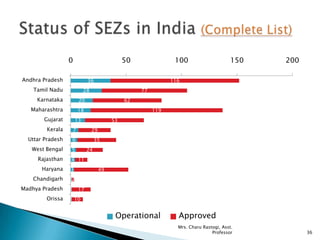
28
20
18
13
7
6
5
4
3
1
1
1
116
77
62
119
53
29
35
24
11
49
2
17
10
0 50 100 150 200
Andhra Pradesh
Tamil Nadu
Karnataka
Maharashtra
Gujarat
Kerala
Uttar Pradesh
West Bengal
Rajasthan
Haryana
Chandigarh
Madhya Pradesh
Orissa
Operational Approved
36
Mrs. Charu Rastogi, Asst.
Professor
 Resource transfer from the domestic sector to
SEZs with no net addition to economic
activities ( relocation and substitution effect)
 Land Acquisition without adequate
compensation
 Impoverishment of farmers
 Loss of agricultural land
 Misuse of land for real estate
 Regional disparities
 Unequal treatment
37
Mrs. Charu Rastogi, Asst.
Professor
 Export Processing Zones (EPZs) can be defined as a
unit bearing clusters of specially designed zones of
aggressive economic activity for the promotion of
export.
 The main concept of export processing zones was
conceived in the early 1970s to promote the
growth of the sickening export business of India
 Further, the meaning of Export Processing Zones
(EPZs) can be broadly defined as an area enjoying
special Government of India support with respect
to fiscal incentives, tax rebates and other exclusive
benefits for growth of export
38
Mrs. Charu Rastogi, Asst.
Professor
 Encourage and generate the economic development.
 Encourage Foreign Direct Investments (FDI).
 To channel the sources of foreign exchange within the system in a
phased manner.
 Foster the establishment and development of industrial enterprises
within the said zones.
 Encourage and generate wider economic activities by encouraging
foreign investments for the development of the zones
 To channel the foreign exchange earnings for the further development
of these zones and explore new areas for the development of India
exports.
 Encourage establishment and development of India industries and
business enterprises and facilitate with proper infrastructure generate
employment opportunity.
 Upgrade labor and management skills.
 Acquire advanced technology for increased productivity.
 Ensure world class quality of products
39
Mrs. Charu Rastogi, Asst.
Professor
40
Mrs. Charu Rastogi, Asst.
Professor

Unit 3.1 Regulatory Framework - Indian Perspective

  • 1.
    Unit 3.1: RegulatoryFramework of International Finance
  • 2.
     FEMA  ForeignTrade Policy  Role of RBI  Rupee Convertibility  EOU/STPI  SEZ  EPZ 2 Mrs. Charu Rastogi, Asst. Professor
  • 3.
    3 Mrs. Charu Rastogi,Asst. Professor
  • 4.
     The ForeignExchange Regulation Act (FERA) was legislation passed by the Indian Parliament in 1973 by the government of Indira Gandhi  It came into force with effect from January 1, 1974.  FERA imposed stringent regulations on certain kinds of payments.  It deals in foreign exchange and securities and the transactions which had an indirect impact on the foreign exchange and the import and export of currency.  The purpose of the act, was to "regulate certain payments, dealings in foreign exchange and securities, transactions indirectly affecting foreign exchange and the import and export of currency, for the conservation of foreign exchange resources of the country". 4 Mrs. Charu Rastogi, Asst. Professor
  • 5.
     In 1999,FERA was replaced by the Foreign Exchange Management Act, which liberalised foreign exchange controls and restrictions on foreign investment.  It had become the need of the hour since FERA had become incompatible with the pro-liberalisation policies of the Government of India.  It was formulated to: ◦ facilitate external trade and payments ◦ promote the orderly development and maintenance of foreign exchange market in India  FEMA is applicable to all parts of India. The act is also applicable to all branches, offices and agencies outside India owned or controlled by a person who is a resident of India.  The FEMA head-office, also known as Enforcement Directorate is situated in New Delhi and is headed by a Director. The Directorate is further divided into 5 zonal offices in Delhi, Mumbai, Kolkata, Chennai and Jalandhar and each office is headed by a Deputy Director. 5 Mrs. Charu Rastogi, Asst. Professor
  • 6.
    Fera Fema  Objectto conserve and prevent misuse  Violation was Criminal Offence and was non compoundable  It was a draconian police law  To facilitate external trade and payments  Violation is a civil offence and is compoundable  It is a civil law 6 Mrs. Charu Rastogi, Asst. Professor
  • 7.
     Activities suchas payments made to any person outside India or receipts from them, along with the deals in foreign exchange and foreign security is restricted. It is FEMA that gives the central government the power to impose the restrictions.  Restrictions are imposed on people living in India who carry out transactions in foreign exchange, foreign security or who own or hold immovable property abroad.  Without general or specific permission of the Reserve Bank of India, FEMA restricts the transactions involving foreign exchange or foreign security and payments from outside the country to India – the transactions should be made only through an authorised person. 7 Mrs. Charu Rastogi, Asst. Professor
  • 8.
     Deals inforeign exchange under the current account by an authorised person can be restricted by the Central Government, based on public interest.  Although selling or drawing of foreign exchange is done through an authorised person, the RBI is empowered by this Act to subject the capital account transactions to a number of restrictions.  People living in India will be permitted to carry out transactions in foreign exchange, foreign security or to own or hold immovable property abroad if the currency, security or property was owned or acquired when he/she was living outside India, or when it was inherited to him/her by someone living outside India.  Exporters are needed to furnish their export details to RBI. To ensure that the transactions are carried out properly, RBI may ask the exporters to comply to its necessary requirements 8 Mrs. Charu Rastogi, Asst. Professor
  • 9.
     Under theFEMA, the emphasis is on the management of foreign exchange resources.  FEMA has formally recognized the distinction between current account and capital account transactions.  Two golden rules or principles in FEMA are mentioned as follows: ◦ all current account transactions are permitted unless otherwise prohibited. ◦ all capital account transactions are prohibited unless otherwise permitted. More details at: (http://www.rbi.org.in/scripts/BS_FemaNotifications.aspx?Id=155) 9 Mrs. Charu Rastogi, Asst. Professor
  • 10.
     The Penaltycould be up to thrice the sum involved where amount is quantifiable  If the Amount is not quantifiable , penalty up to Rs 2 lakhs can be imposed  If contravention is of continuing nature, further penalty up to Rs 5000 per day during which the contravention continues can be imposed 10 Mrs. Charu Rastogi, Asst. Professor
  • 11.
    11 Mrs. Charu Rastogi,Asst. Professor
  • 12.
     Exim policyis a set of guidelines and instructions issued by Directorate General of Foreign Trade (DGFT) for matters related to the import and export of goods in India.  The policy is guided by Foreign Trade Development and Regulation Act, 1992.  Exim policy is issued for a period of 5 years. The current policy covers the period 2009-14 12 Mrs. Charu Rastogi, Asst. Professor
  • 13.
     Control importof non-essential items  Export Promotion  To accelerate the level of economic activities to derive maximum benefits from expanding global market opportunities  To stimulate sustained economic growth by providing access to essential raw materials, intermediates, components,' consumables and capital goods required for augmenting production  To enhance the techno local strength and efficiency of Indian agriculture, industry and services, thereby, improving their competitiveness  To generate new employment opportunities and encourage the attainment of internationally accepted standards of quality  To provide quality consumer products at reasonable prices 13 Mrs. Charu Rastogi, Asst. Professor
  • 14.
     The year2009 witnessed one of the most severe global recessions in the post-war period.  Exports suffered a decline in the last 10 months of 2009  To arrest and reverse the declining trend of exports and to provide additional support especially to those sectors which have been hit badly by recession in the developed world  Policy objective of achieving an annual export growth of 15% with an annual export target of US$ 200 billion by March 2011.  In the remaining three years of this Foreign Trade Policy i.e. upto 2014, the country should be able to come back on the high export growth path of around 25% per annum.  By 2014, we expect to double India‟s exports of goods and services. The long term policy objective for the Government is to double India‟s share in global trade by 2020. 14 Mrs. Charu Rastogi, Asst. Professor
  • 15.
     In orderto meet these objectives, the Government would follow a mix of policy measures including fiscal incentives, institutional changes, procedural rationalization, enhanced market access across the world and diversification of export markets.  Improvement in infrastructure related to exports  Bringing down transaction costs, and providing full refund of all indirect taxes and levies, would be the three pillars.  Goods and Services Tax rebates all indirect taxes and levies on exports  Technological up gradation of exports is sought to ◦ be achieved by promoting imports of capital goods for certain sectors under EPCG at zero percent duty. ◦ encourage production and export of „green products‟ through scheme and incentives for exports. 15 Mrs. Charu Rastogi, Asst. Professor
  • 16.
     In orderto reduce the transaction cost and institutional bottlenecks, the e-trade project would be implemented in a time bound manner to bring all stake holders on a common platform.  Additional ports/locations would be enabled on the Electronic Data Interchange over the next few years.  An Inter-Ministerial Committee has been established to serve as a single window mechanism for resolution of trade related grievances.  The industry and the Government, working in tandem, will be able to ensure that the Indian exports become globally competitive and that we are able to achieve the target, which we have set for ourselves. 16 Mrs. Charu Rastogi, Asst. Professor
  • 17.
    17 Mrs. Charu Rastogi,Asst. Professor
  • 18.
     Monetary Authority: ◦Formulates, implements and monitors the monetary policy. ◦ Objective: maintaining price stability and ensuring adequate flow of credit to productive sectors.  Regulator and supervisor of the financial system: ◦ Prescribes broad parameters of banking operations within which the country's banking and financial system functions. ◦ Objective: maintain public confidence in the system, protect depositors' interest and provide cost-effective banking services to the public.  Manager of Foreign Exchange ◦ Manages the Foreign Exchange Management Act, 1999. ◦ Objective: to facilitate external trade and payment and promote orderly development and maintenance of foreign exchange market in India. 18 Mrs. Charu Rastogi, Asst. Professor
  • 19.
     Issuer ofcurrency: ◦ Issues and exchanges or destroys currency and coins not fit for circulation. ◦ Objective: to give the public adequate quantity of supplies of currency notes and coins and in good quality.  Developmental role ◦ Performs a wide range of promotional functions to support national objectives.  Related Functions ◦ Banker to the Government: performs merchant banking function for the central and the state governments; also acts as their banker. ◦ Banker to banks: maintains banking accounts of all scheduled banks 19 Mrs. Charu Rastogi, Asst. Professor
  • 20.
     The RBIis the custodian of the country‟s foreign exchange reserves, and it is vested with the responsibility of managing the investment and utilization of the reserves in the most advantageous manner.  The RBI achieves this through buying and selling of foreign exchange from and to scheduled banks, which are the authorized dealers in the Indian foreign exchange market.  The bank also manages the investment of reserves in gold accounts aboard and the shares and securities issued by foreign governments and international banks or financial institutions. 20 Mrs. Charu Rastogi, Asst. Professor
  • 21.
    21 Mrs. Charu Rastogi,Asst. Professor
  • 22.
     Currency convertibilityrefers to the freedom to convert the domestic currency into other internationally accepted currencies and vice versa  It is defined as “The freedom to convert local financial assets into foreign financial assets and vice versa.”  A currency is said to be convertible if residents and non-residents are free to use and exchange the domestic currency for any purpose  The need to convert domestic currency into foreign currency or to convert foreign currency into domestic currency arises due to: ◦ Current Account Transactions (trade, tourism, factor and transfer receipts and payments) ◦ Capital Account Transactions (FDI, FII, private or govt. lending or borrowing)  Article VIII of the IMF defines convertibility on the current account and states that a member cannot impose restrictions on making of payments and transfers on currency transactions.  Article VI (3) of IMF allows members to exercise such controls as are necessary to regulate international capital movements. 22 Mrs. Charu Rastogi, Asst. Professor
  • 23.
     Capital accountconvertibility or CAC is said to exist when domestic currency can be freely converted into foreign currency (and vice versa) for capital account transactions  When the domestic currency is convertible only on the current account, it is known as partial convertibility.  When the domestic currency is convertible on the current account as well as the capital account, it is known as full convertibility. 23 Mrs. Charu Rastogi, Asst. Professor
  • 24.
     Rupee isPartially Convertibility because the rupee is ◦ Fully convertible on the current account  all current account transactions are permitted unless otherwise prohibited. ◦ Moving towards progressively liberalizing capital account transactions  all capital account transactions are prohibited unless otherwise permitted. 24 Mrs. Charu Rastogi, Asst. Professor
  • 25.
     Convertibility ofthe rupee was recommended by three reports, namely the:  Report of The High Level Committee on Balance Of payments, 1993 (referred to as the Rangarajan Committee Report, after its Chairman),  Report on Capital Account Convertibility, 1997 (referred to as the Tarapore Committee Report after its Chairman), and  Report on Fuller Capital Account Convertibility, 2006 (or the FCAC Report, whose Chairman was SS Tarapore). 25 Mrs. Charu Rastogi, Asst. Professor
  • 26.
    26 Mrs. Charu Rastogi,Asst. Professor
  • 27.
     The ExportOriented Units (EOUs) scheme, introduced in early 1981, is complementary to the SEZ scheme.  It adopts the same production regime but offers a wide option in locations with reference to factors like source of raw materials, ports of export, land facilities, availability of technological skills, existence of an industrial base and the need for a larger area of land for the project. 27 Mrs. Charu Rastogi, Asst. Professor
  • 28.
     To increaseexports  Earn foreign exchange to the country,  Transfer of latest technologies,  Stimulate direct foreign investment  To generate aditional employment. 28 Mrs. Charu Rastogi, Asst. Professor
  • 29.
     Granite  Textiles/ Garments  Food Processing  Chemicals  Computer Software  Coffee  Pharmaceuticals  Gem & Jewellery  Engineering Goods  Electrical & Electronics 29 Mrs. Charu Rastogi, Asst. Professor
  • 30.
     The EOUsare required to achieve the minimum NFEP (Net Foreign Exchange Earning as a Percentage of Exports) and the minimum EP (Export Performance) as per the provisions of EXIM Policy which vary from sector to sector.  For instance, the units with investment in plant and machinery of Rs.5 crore and above are required to achieve positive NFEP and export US$ 3.5 million or 3 times the Cost Insurance and Freight (CIF) value of imported capital goods, whichever is higher, for 5 years  For electronics hardware sector, minimum NFEP has to be „positive‟ and minimum EP for 5 years is US$ 1 million or 3 times the CIF value of imported capital goods, whichever is higher. 30 Mrs. Charu Rastogi, Asst. Professor
  • 31.
     Software TechnologyParks of India was established and registered as an Autonomous Society under the Societies Registration Act 1860, under the Department of Information Technology, Ministry of Communications and Information Technology, Government of India on 5th June 1991.  Its objective was to set-up and manage infrastructure facilities and provide other services like technology assessment and professional training. 31 Mrs. Charu Rastogi, Asst. Professor
  • 32.
     A SpecialEconomic Zone (SEZ) is a geographical region that has economic and other laws that are more free-market-oriented than a country's typical or national laws. "Nationwide" laws may be suspended inside a special economic zone.  The category 'SEZ' covers , including Free Trade Zones (FTZ), Export Processing Zones (EPZ), Free Zones (FZ), Industrial parks or Industrial Estates (IE), Free Ports, Urban Enterprise Zones and others.  Usually the goal of a structure is to increase foreign direct investment by foreign investors, typically an international business or a multinational corporation (MNC). 32 Mrs. Charu Rastogi, Asst. Professor
  • 33.
     India wasone of the first in Asia to recognize the effectiveness of the Export Processing Zone (EPZ) model in promoting exports, with Asia's first EPZ set up in Kandla in 1965.  In order to overcome the shortcomings experienced on account of the multiplicity of controls and clearances; absence of world-class infrastructure, and an unstable fiscal regime and with a view to attract larger foreign investments in India, the Special Economic Zones (SEZs) Policy was announced in April 2000 33 Mrs. Charu Rastogi, Asst. Professor
  • 34.
     The objectivesof SEZs can be clearly explained as the following: ◦ generation of additional economic activity ◦ promotion of exports of goods and services; ◦ promotion of investment from domestic and foreign sources; ◦ creation of employment opportunities; ◦ development of infrastructure facilities. 34 Mrs. Charu Rastogi, Asst. Professor
  • 35.
     Exemption fromcustoms/excise duties for development of SEZs for authorized operations approved by the Board of Approval (BOA).  Income Tax exemption on income derived from the business of development of the SEZ in a block of 10 years in 15 years under Section 80-IAB of the Income Tax Act.  Exemption from minimum alternate tax under Section 115 JB of the Income Tax Act.  Exemption from dividend distribution tax under Section 115O of the Income Tax Act.  Exemption from Central Sales Tax (CST).  Exemption from Service Tax (Section 7, 26 and Second Schedule of the SEZ Act) 35 Mrs. Charu Rastogi, Asst. Professor
  • 36.
    36 28 20 18 13 7 6 5 4 3 1 1 1 116 77 62 119 53 29 35 24 11 49 2 17 10 0 50 100150 200 Andhra Pradesh Tamil Nadu Karnataka Maharashtra Gujarat Kerala Uttar Pradesh West Bengal Rajasthan Haryana Chandigarh Madhya Pradesh Orissa Operational Approved 36 Mrs. Charu Rastogi, Asst. Professor
  • 37.
     Resource transferfrom the domestic sector to SEZs with no net addition to economic activities ( relocation and substitution effect)  Land Acquisition without adequate compensation  Impoverishment of farmers  Loss of agricultural land  Misuse of land for real estate  Regional disparities  Unequal treatment 37 Mrs. Charu Rastogi, Asst. Professor
  • 38.
     Export ProcessingZones (EPZs) can be defined as a unit bearing clusters of specially designed zones of aggressive economic activity for the promotion of export.  The main concept of export processing zones was conceived in the early 1970s to promote the growth of the sickening export business of India  Further, the meaning of Export Processing Zones (EPZs) can be broadly defined as an area enjoying special Government of India support with respect to fiscal incentives, tax rebates and other exclusive benefits for growth of export 38 Mrs. Charu Rastogi, Asst. Professor
  • 39.
     Encourage andgenerate the economic development.  Encourage Foreign Direct Investments (FDI).  To channel the sources of foreign exchange within the system in a phased manner.  Foster the establishment and development of industrial enterprises within the said zones.  Encourage and generate wider economic activities by encouraging foreign investments for the development of the zones  To channel the foreign exchange earnings for the further development of these zones and explore new areas for the development of India exports.  Encourage establishment and development of India industries and business enterprises and facilitate with proper infrastructure generate employment opportunity.  Upgrade labor and management skills.  Acquire advanced technology for increased productivity.  Ensure world class quality of products 39 Mrs. Charu Rastogi, Asst. Professor
  • 40.
    40 Mrs. Charu Rastogi,Asst. Professor