MASTERY MARKETING TOOL
Strategy is...
Key terms come from the definition.
Now-state — defines the state of now.
Goal — desired future, formulated into written form
under SMART criteria.
Available resources — time, money, etc.
Strategy itself — route to the goal. (Let’s say any
route is a strategy. Some are just very very bad.)
The essence of planning is defining the right goals
and finding the most effective ways to achieve them.
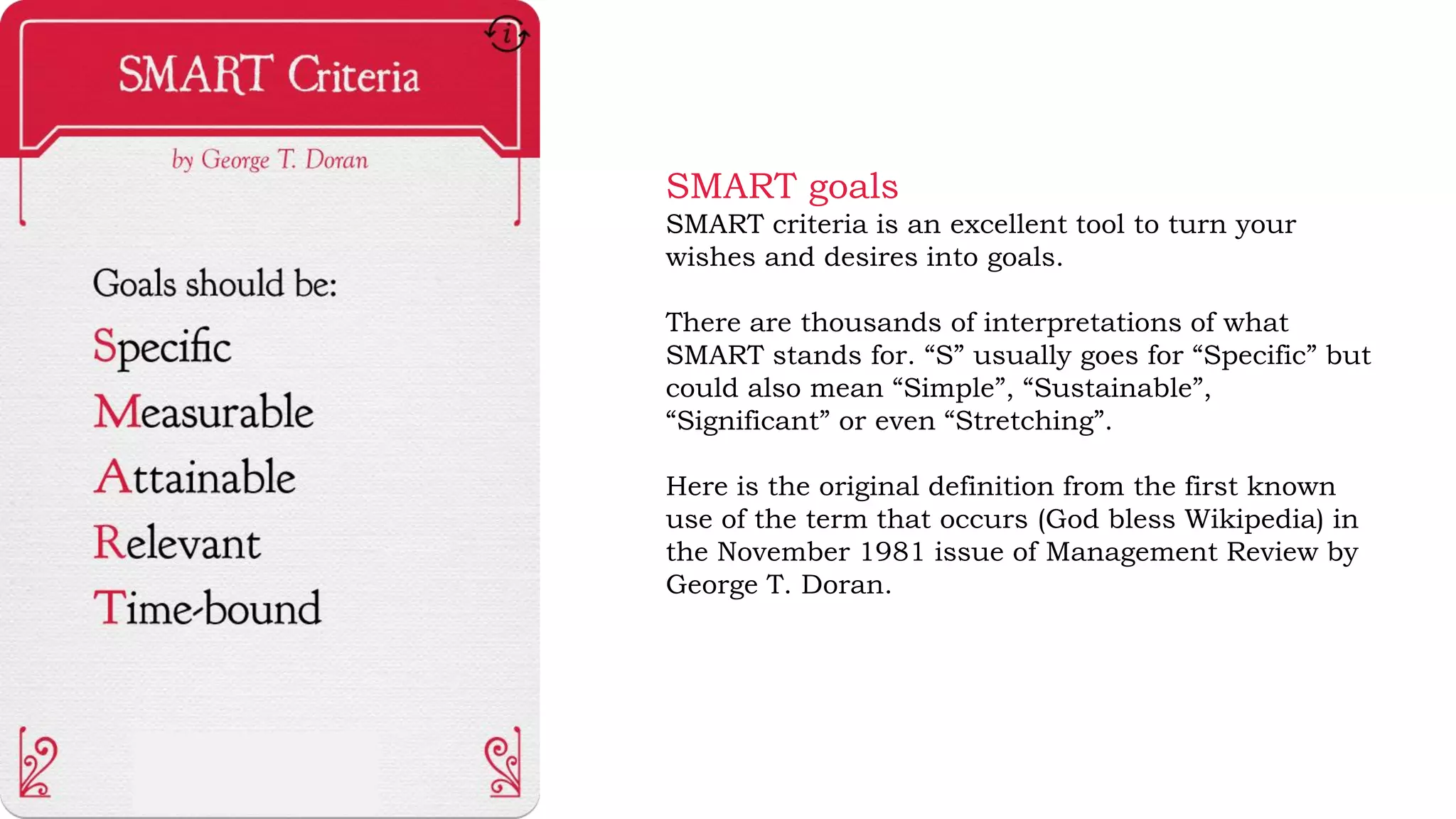
SMART goals
SMART criteria is an excellent tool to turn your
wishes and desires into goals.
There are thousands of interpretations of what
SMART stands for. “S” usually goes for “Specific” but
could also mean “Simple”, “Sustainable”,
“Significant” or even “Stretching”.
Here is the original definition from the first known
use of the term that occurs (God bless Wikipedia) in
the November 1981 issue of Management Review by
George T. Doran.
Communication process
Planning is essential. Just keep in mind it’s not a
plan you need, it's results.
So, strategy should be implemented in a list of
specific action steps.
Actions have to be executed. Place your ads, launch
the campaign. Whatever.
Here comes the interesting part. Evalute the results.
Did your actions bring you closer to your goal? What
was good? What went wrong?
Do you still have money and believe in a bright
future? Go for another round.
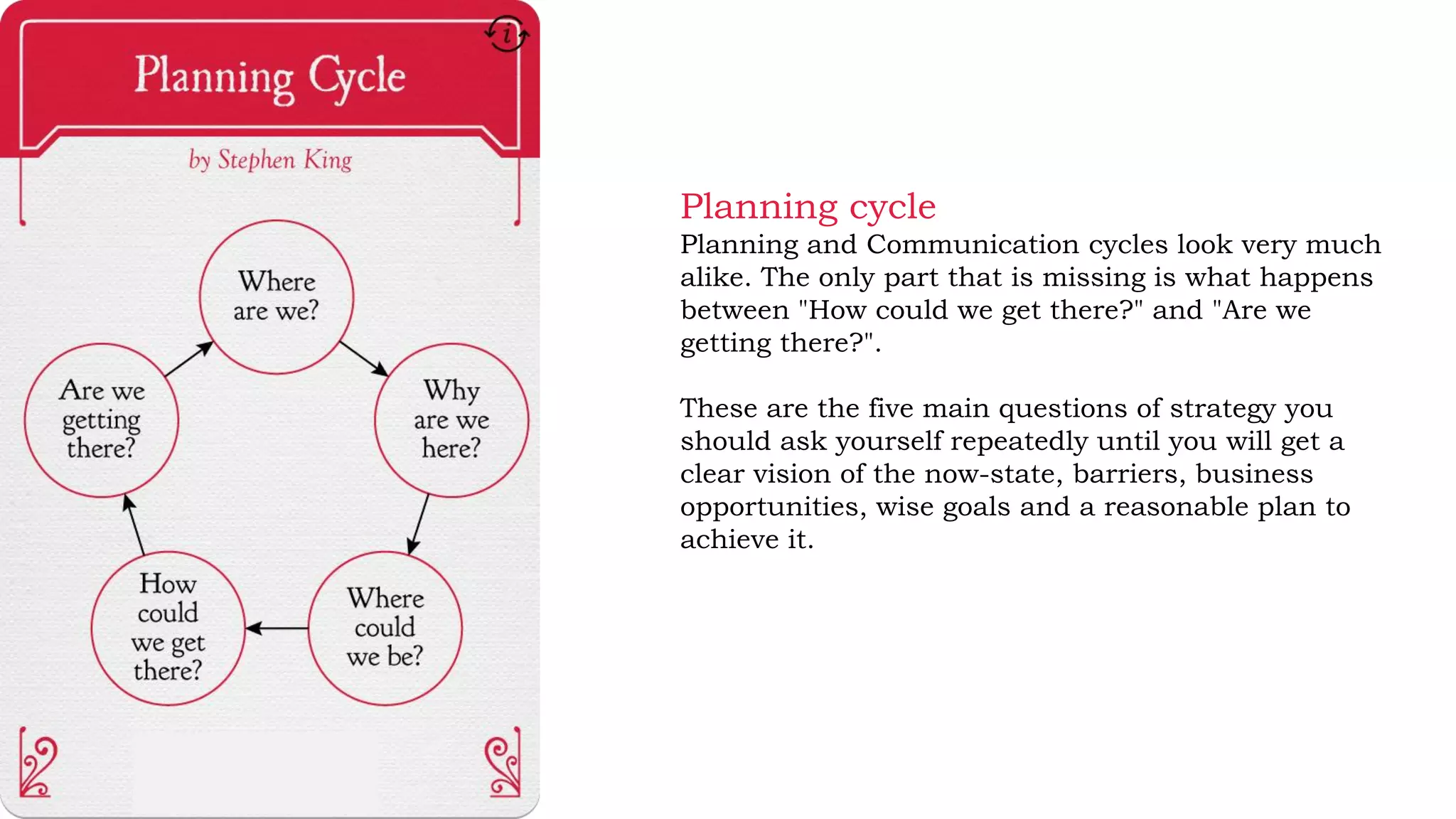
Planning cycle
Planning and Communication cycles look very much
alike. The only part that is missing is what happens
between "How could we get there?" and "Are we
getting there?".
These are the five main questions of strategy you
should ask yourself repeatedly until you will get a
clear vision of the now-state, barriers, business
opportunities, wise goals and a reasonable plan to
achieve it.
InciteWork
Marketing has different ways to impact on company
goals. Communications are always about
communicating. This isinseparably connected with
the concept of receptor — target audience associated
with desirable business results.
So, communication strategy is a strategy of
changing the perception of the audience through
communicating in a way that will lead it to a new
behavior favorable to the company
Cascade Goals
The first question of strategy is “What for”, meaning
“what do we want to achieve”. Evaluate goals.
Redefine them if necessary. Get as close to the
business as possible.
Then “How”. Connect your goals with actions
through the system of embedded objectives.
Business goals. How will you accomplish them?
Business strategy. Where will profit come from?
Marketing goals. How? Marketing strategy.
Necessities. Opportunities. Who will be your profit
source? How do we need to change their behavior?
Communication goals. How? What, where and
when?
Profit Sources
Define the audience you will target and the action
shift connected to it that will influence company
profit growth (which is usually the overall goal).
Sell more by attracting more consumers, meaning
generate a first trial: by communicating either
competitive advantages of your product or category
benefits.
Sell more to every consumer: increase purchase
value (more per purchase or more expensive
product), make people come back (build loyalty) and
increase consumption (increase volume or frequency
by, let's say, providing new occasions).
Need-To-Purchase
The idea is that every purchase starts with a human
need and the need-to-purchase process goes
through an evaluation of available solutions.
The formula for increasing the profit (sell more) now
sounds like “more needs, more people, feel more
often, consider us and choose us, spending more”.
“More needs” is something new. It’s about
associating the product with attributes of new
categories. E.g. Snickers as a chocolate competes on
something-sweet-need level but as a brand plays on
hunger (snacks) territory.
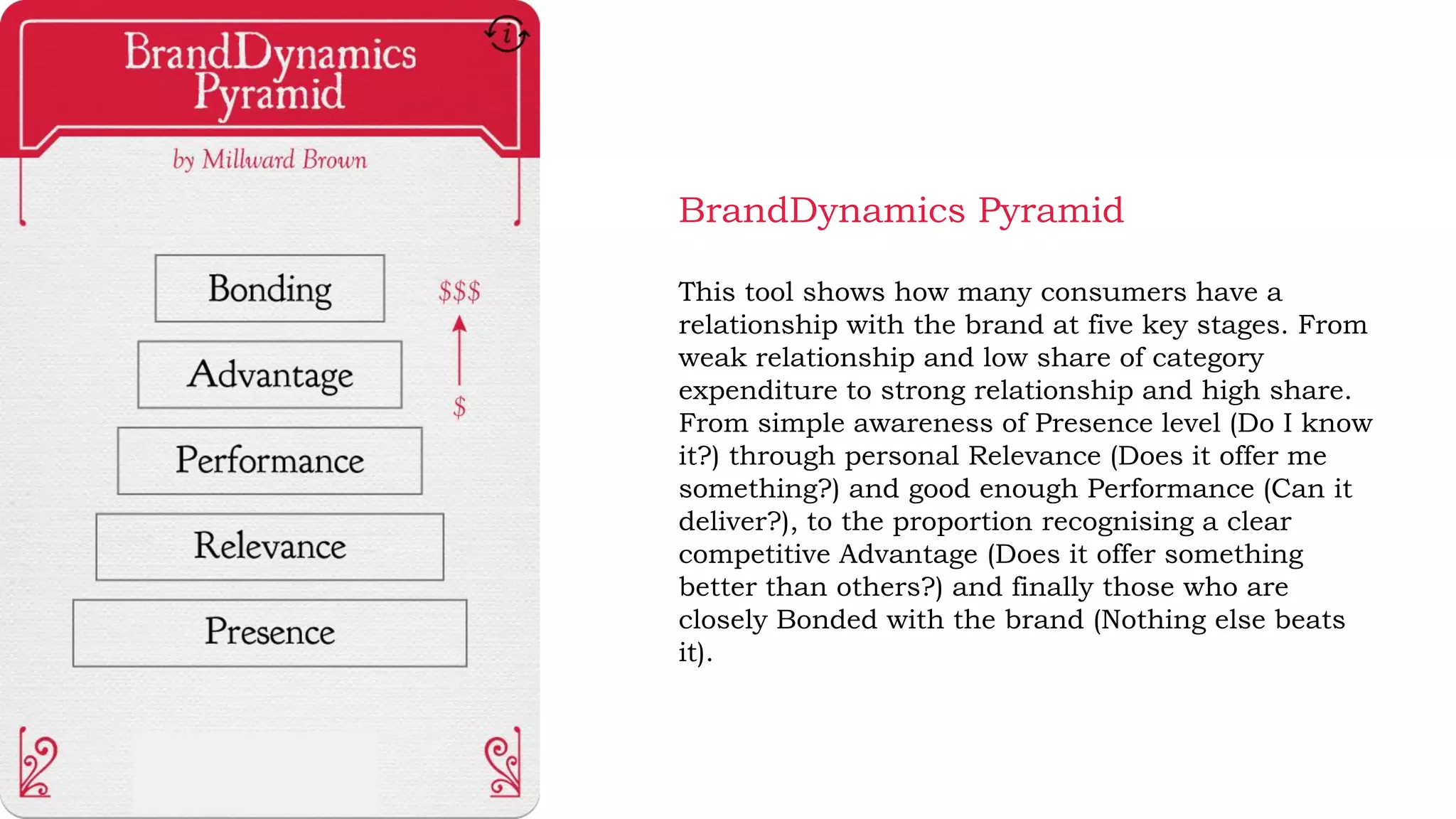
BrandDynamics Pyramid
This tool shows how many consumers have a
relationship with the brand at five key stages. From
weak relationship and low share of category
expenditure to strong relationship and high share.
From simple awareness of Presence level (Do I know
it?) through personal Relevance (Does it offer me
something?) and good enough Performance (Can it
deliver?), to the proportion recognising a clear
competitive Advantage (Does it offer something
better than others?) and finally those who are
closely Bonded with the brand (Nothing else beats
it).
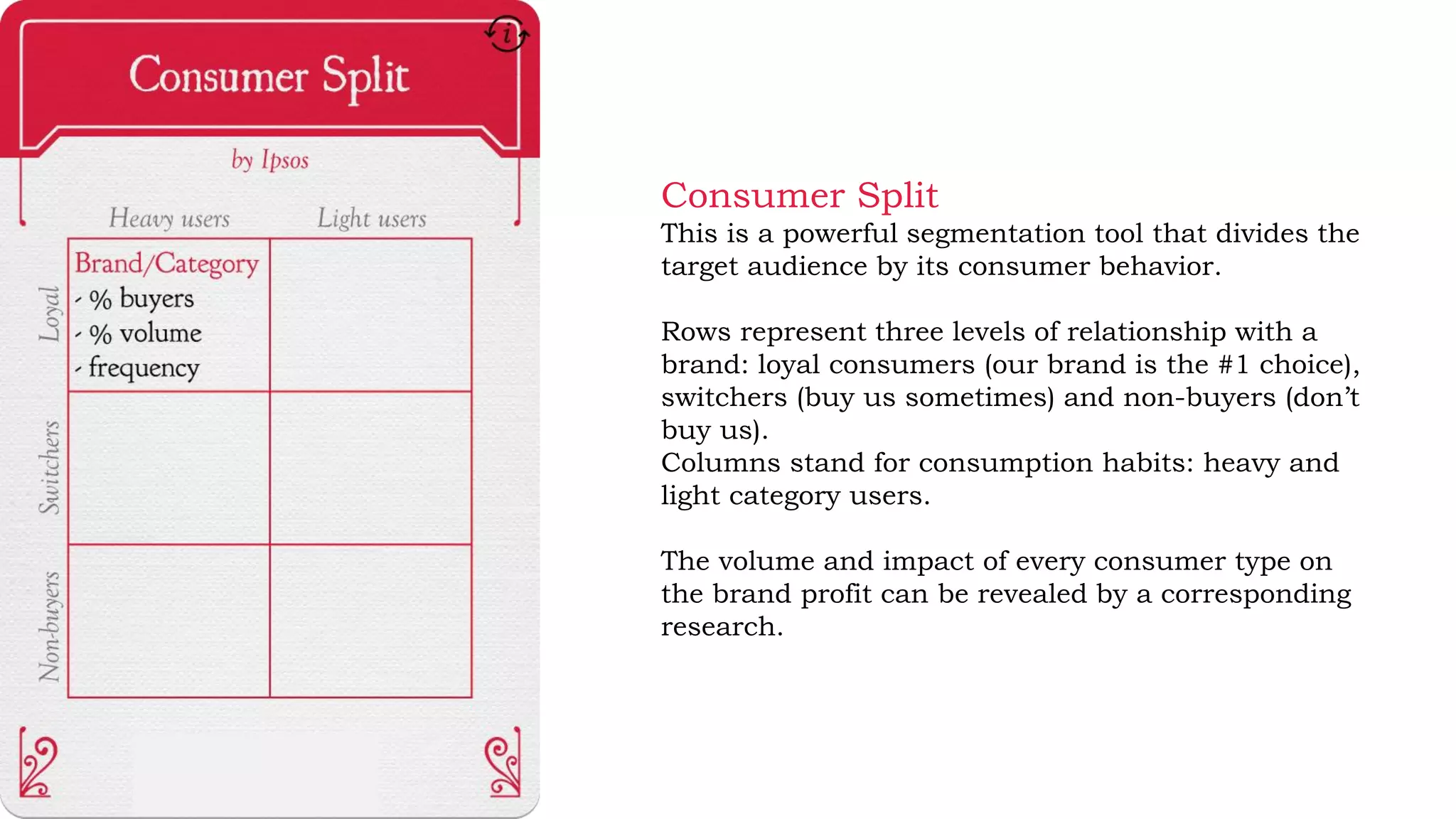
Consumer Split
This is a powerful segmentation tool that divides the
target audience by its consumer behavior.
Rows represent three levels of relationship with a
brand: loyal consumers (our brand is the #1 choice),
switchers (buy us sometimes) and non-buyers (don’t
buy us).
Columns stand for consumption habits: heavy and
light category users.
The volume and impact of every consumer type on
the brand profit can be revealed by a corresponding
research.
Purchase Funnel
The purchase funnel describes the consumer's path
leading to a purchase.
The most important point of the tool is
consideration. To get onto a consideration list we
need to create an awareness of our product and
make sure the audience is familiar with our
brand/product promise.
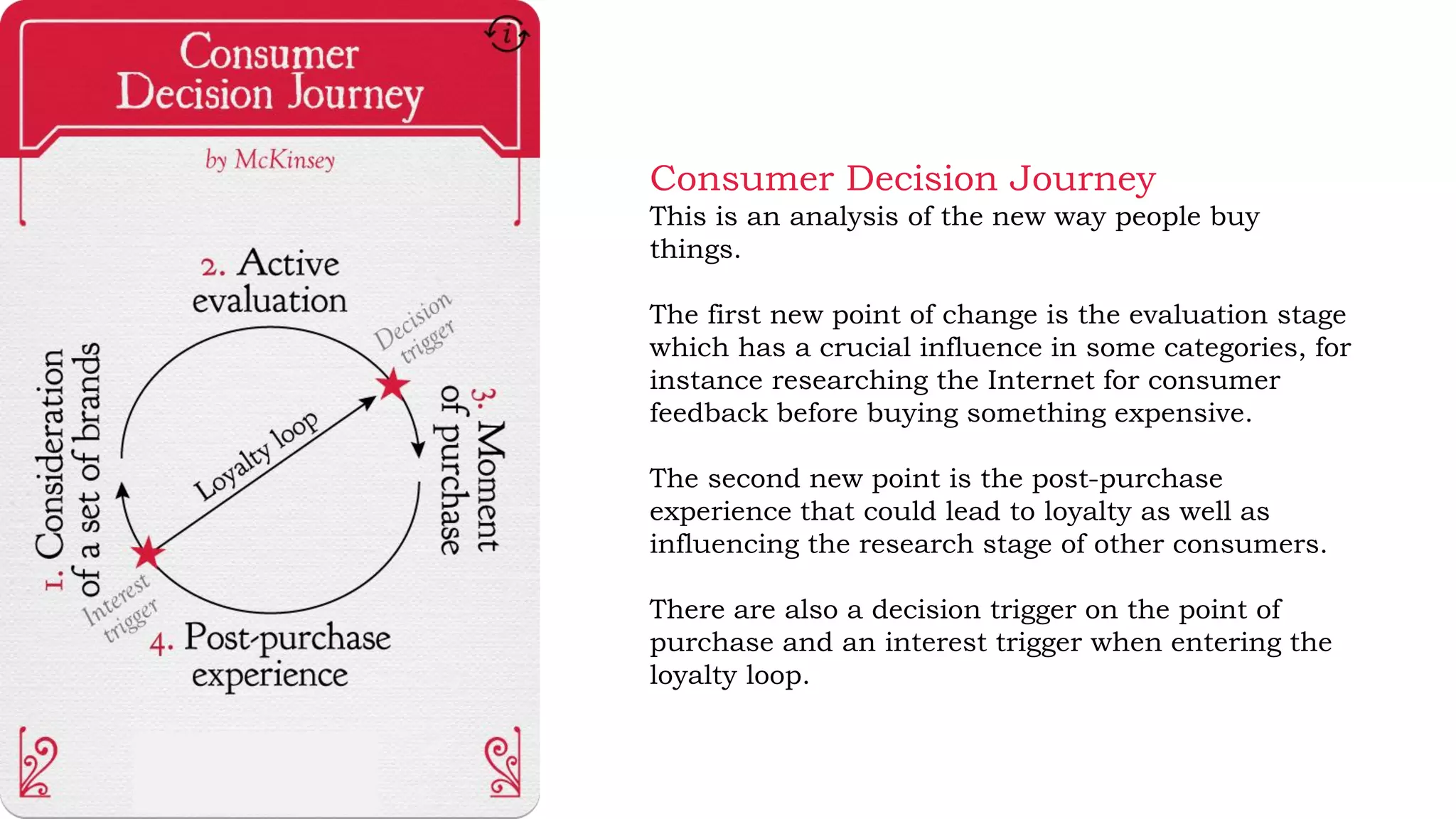
Consumer Decision Journey
This is an analysis of the new way people buy
things.
The first new point of change is the evaluation stage
which has a crucial influence in some categories, for
instance researching the Internet for consumer
feedback before buying something expensive.
The second new point is the post-purchase
experience that could lead to loyalty as well as
influencing the research stage of other consumers.
There are also a decision trigger on the point of
purchase and an interest trigger when entering the
loyalty loop.
Communication Channels
There are four main channelsthat form a person's
opinion of a product or a company. These channels
differ according to personal perception and
influences.
Advertising — everything that is recognized as an
advertisement.
Information — mass media messages that are not
recognized as advertising.
Feedback — other people's opinions on products or
companies.
Experience — a personal experience of a product or
communication.
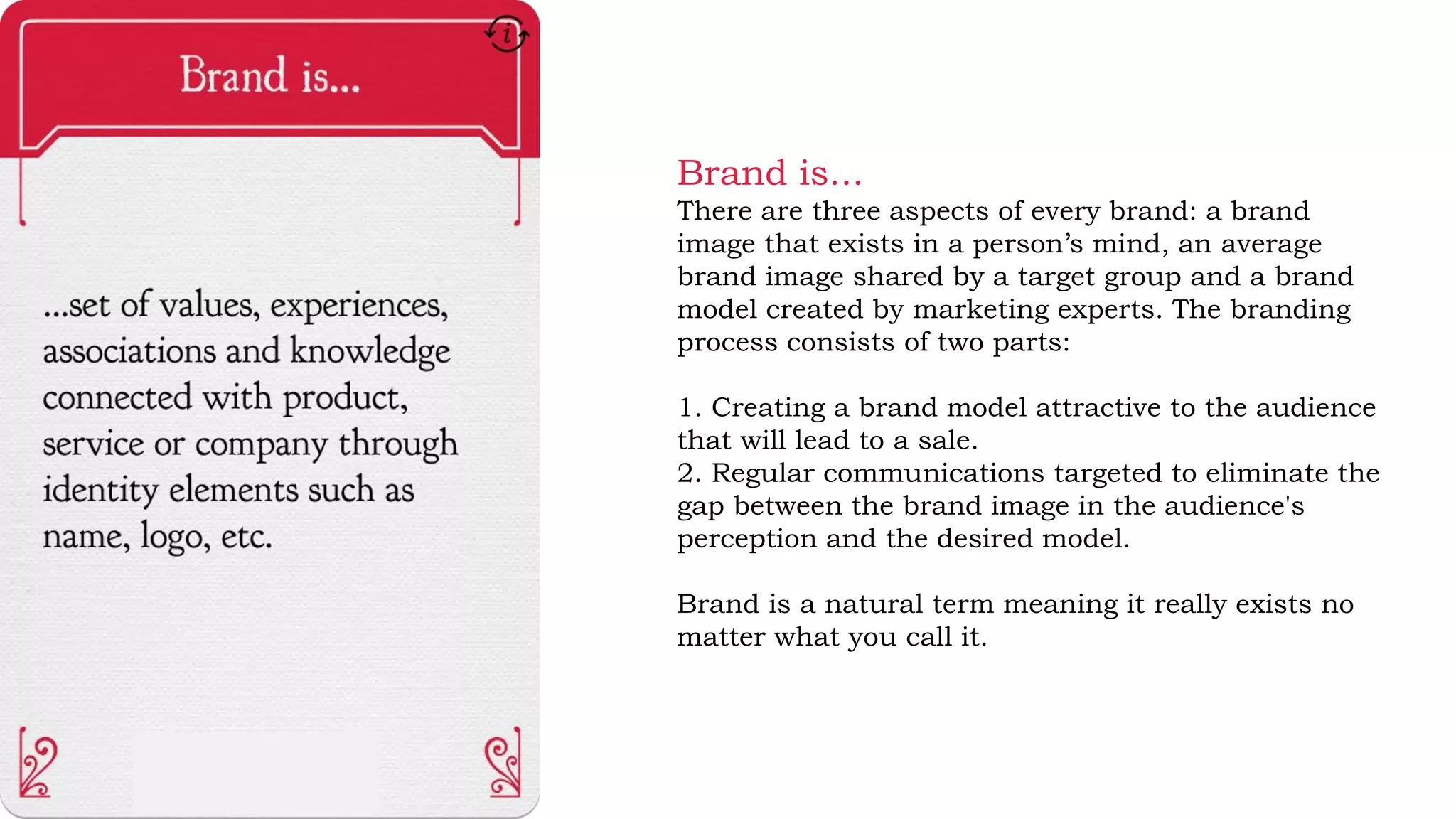
Brand is...
There are three aspects of every brand: a brand
image that exists in a person’s mind, an average
brand image shared by a target group and a brand
model created by marketing experts. The branding
process consists of two parts:
1. Creating a brand model attractive to the audience
that will lead to a sale.
2. Regular communications targeted to eliminate the
gap between the brand image in the audience's
perception and the desired model.
Brand is a natural term meaning it really exists no
matter what you call it.
Brand Core
Brand Core is one of the tools designed to describe
the brand model.
The essence of the brand lies in the intersection of
three factors — audience (represented by audience
insight), product (represented by brand equities) and
business vision (meaning desired future of the
brand).
Look into Audience Insights and Brand Equities for
more details.
Brand Equity Sandglass
Brand Equity Sandglass is another way to describe
the brand model.
Like all models it says that brand promise lies at the
point where brand essence meets target insights.
Look into Brand Equity Pyramid and Consumer
Pyramid for details
Consumer Pyramid
Consumer Pyramid describes the consumer part of
Brand Essence.
It starts with a description of the target consumer
(prime prospect). Then it tells us about occasions of
brand/product usage and the needs that refer to
them. That leads to the consumer insight which
serves as a base for the brand statement.
Benefit Ladder
This tool describes different levels of product
benefits.
At the first level you are writing down product
attributes. At the second level you turn attributes
into benefits, e.g. a new formula of toothpaste
(attribute) improves its whitening effect (benefit). At
the third level, product benefits transform into
consumer benefits, e.g. your teeth will get whiter.
And at the fourth level it goes up to emotional
benefit — a feeling caused by consumer benefits,
e.g. a white smile will give you confidence and make
you attractive to the opposite sex.
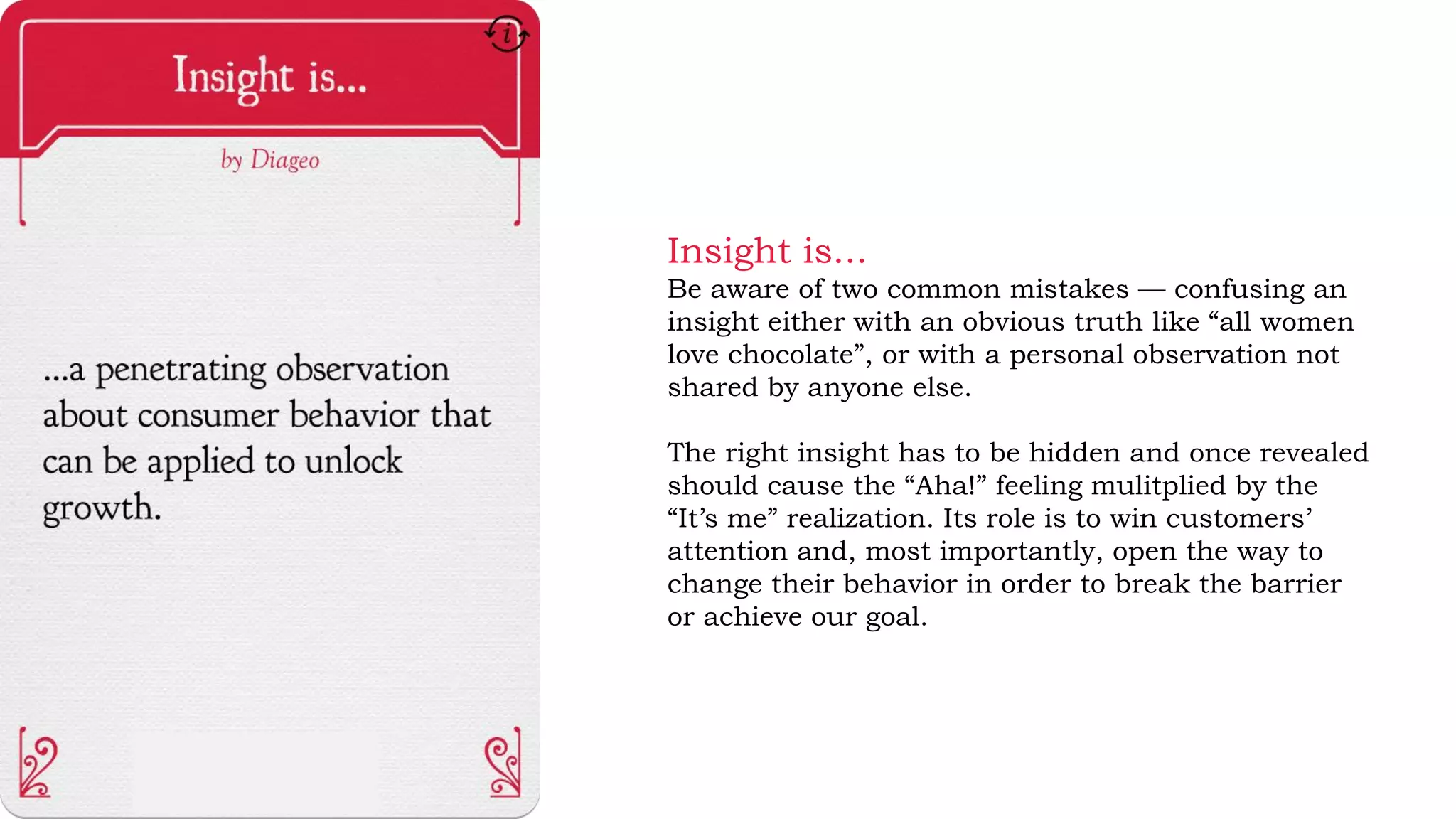
Insight is...
Be aware of two common mistakes — confusing an
insight either with an obvious truth like “all women
love chocolate”, or with a personal observation not
shared by anyone else.
The right insight has to be hidden and once revealed
should cause the “Aha!” feeling mulitplied by the
“It’s me” realization. Its role is to win customers’
attention and, most importantly, open the way to
change their behavior in order to break the barrier
or achieve our goal.
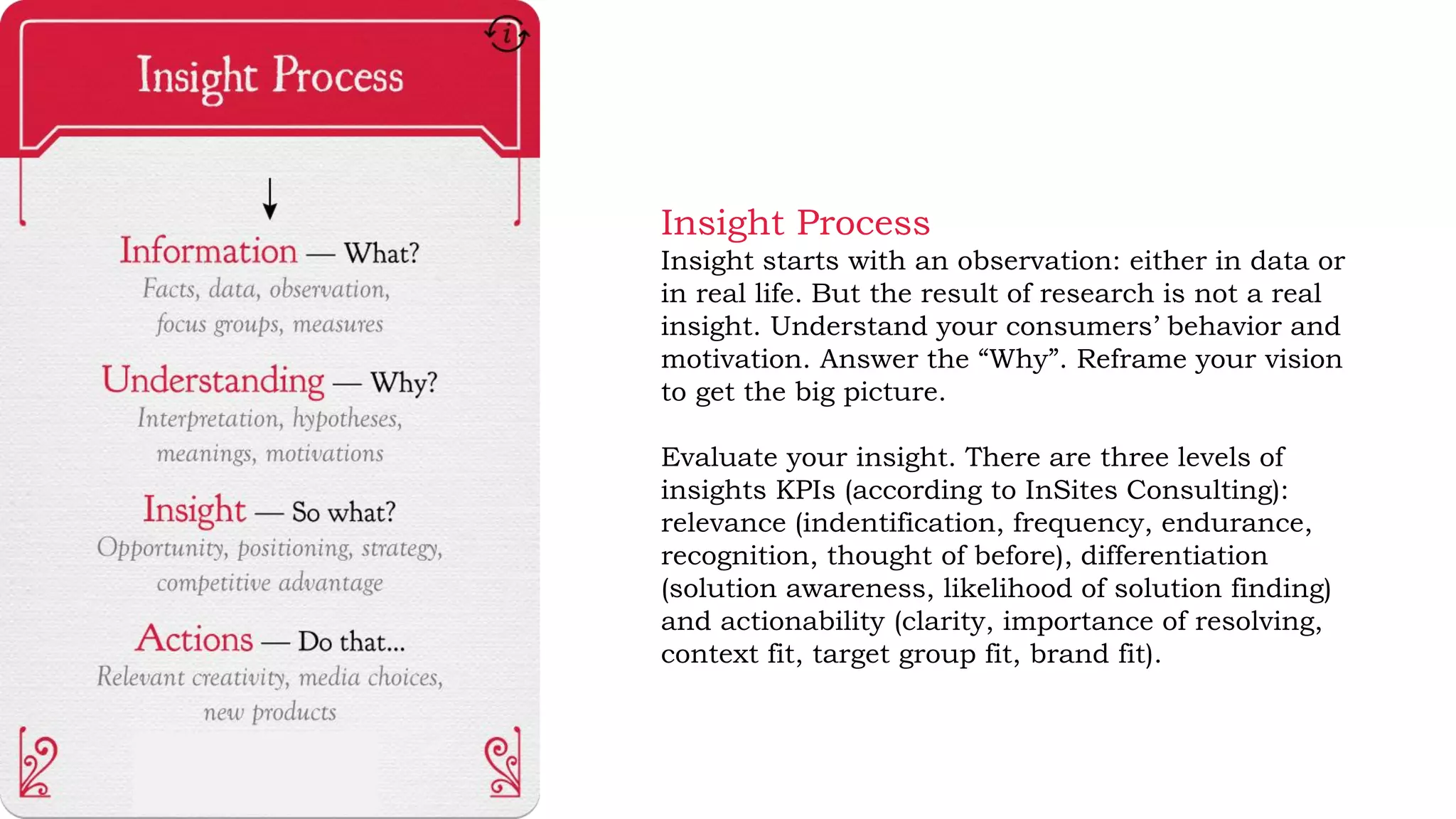
Insight Process
Insight starts with an observation: either in data or
in real life. But the result of research is not a real
insight. Understand your consumers’ behavior and
motivation. Answer the “Why”. Reframe your vision
to get the big picture.
Evaluate your insight. There are three levels of
insights KPIs (according to InSites Consulting):
relevance (indentification, frequency, endurance,
recognition, thought of before), differentiation
(solution awareness, likelihood of solution finding)
and actionability (clarity, importance of resolving,
context fit, target group fit, brand fit).
Insight Types
This matrix represents the multitude of different
types of insight that exist.
Actually, the author of the tool, Simon Law, says he
is not really sure if he agrees with the concept of
insight types overall. Therefore this list may not
even be exhaustive and definitely contains some
areas that don’t make for particularly good types of
insight. Despite that fact, it could be a good start for
understanding the nature of insight, or as a map for
digging further into the subject.
Brand Equity Pyramid
Brand Equity Pyramid describes the product part of
the Brand Core.
It starts with product attributes and transforms it
into brand benefits with the Benefit Ladder tool.
Then itdescribes the personality of the brand based
on the Censydiam or Archetypes model. Then it goes
to the upper level and describes values the brand
stands for or would like to be associated with based
on its attributes (reasons to believe) and benefits it
provides.
Brand Resonance Model
To build a strong brand you must shape how
customers think and feel about your product.
Within the pyramid model, four key levels are
highlighted that you can work through to create a
successful brand.
These are identity, meaning, response and
relationships. Your objectives on each level should
be: ensure broad awareness, define points of parity
and difference, provide positive, accessible reactions
and build intense, active loyalty.
Google “Heineken resonance model” to get an
example.
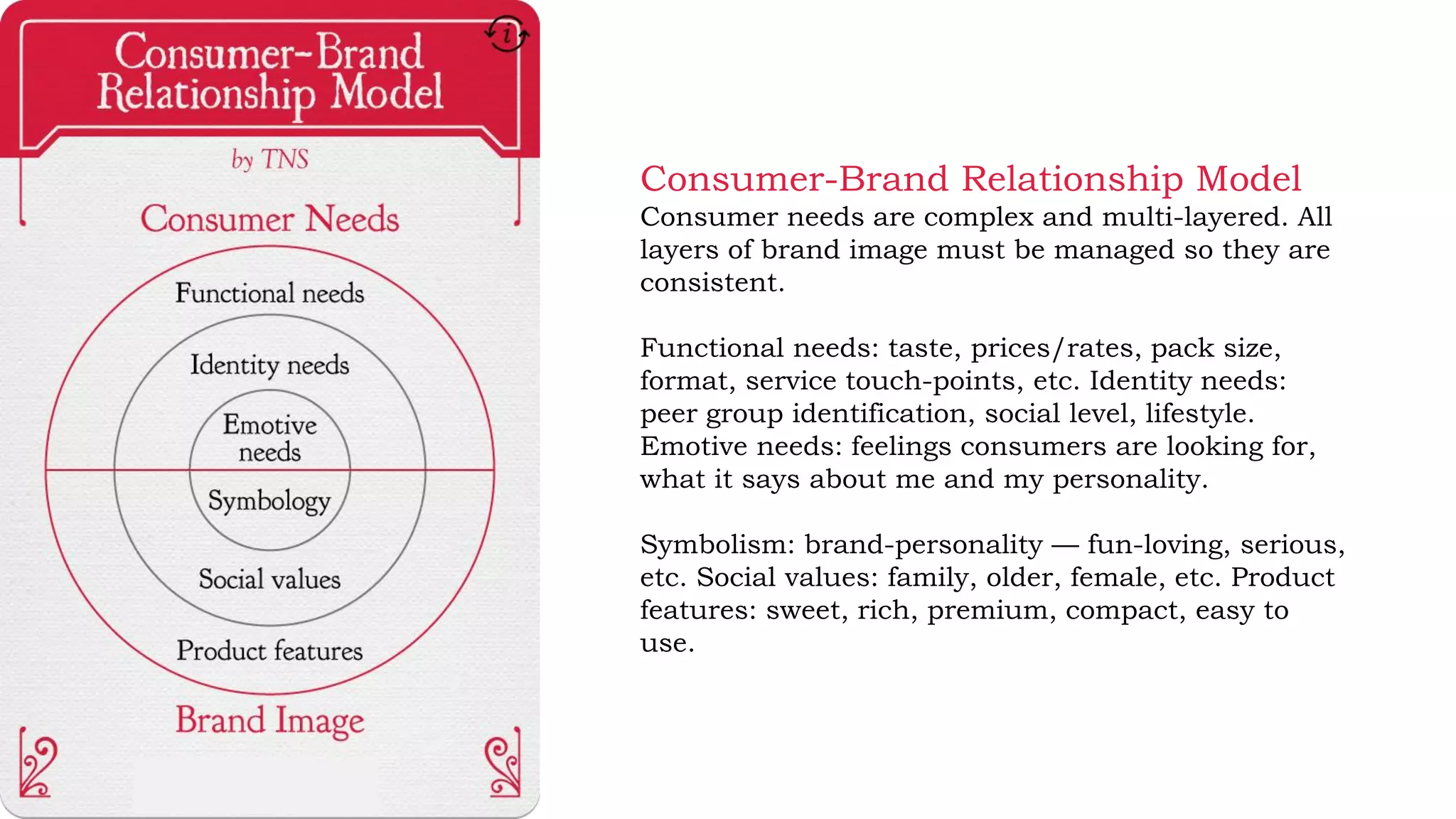
Consumer-Brand Relationship Model
Consumer needs are complex and multi-layered. All
layers of brand image must be managed so they are
consistent.
Functional needs: taste, prices/rates, pack size,
format, service touch-points, etc. Identity needs:
peer group identification, social level, lifestyle.
Emotive needs: feelings consumers are looking for,
what it says about me and my personality.
Symbolism: brand-personality — fun-loving, serious,
etc. Social values: family, older, female, etc. Product
features: sweet, rich, premium, compact, easy to
use.
Maslow's Pyramid
Maslow's theory suggests that the most basic level of
needs must be met before the individual strongly
desires the secondary or higher level needs.
Instead of stating that the person focuses on one
specific need at any given time, Maslow stated that
one specific need "dominates" the human organism.
Interesting fact: while the pyramid has become the
de facto way to represent the hierarchy, Maslow
himself never used a pyramid to describe these
levels in any of his writings on the subject.
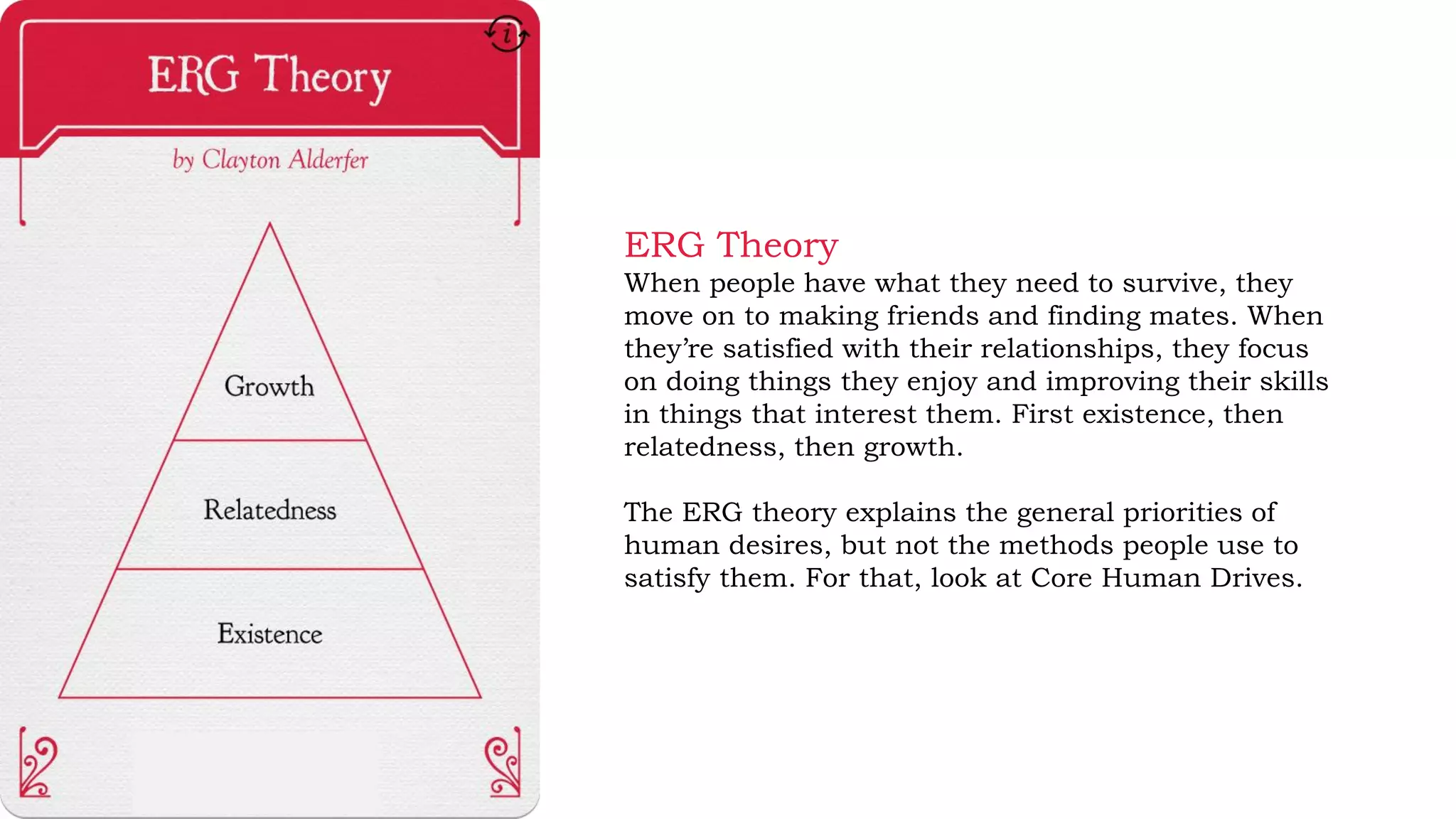
ERG Theory
When people have what they need to survive, they
move on to making friends and finding mates. When
they’re satisfied with their relationships, they focus
on doing things they enjoy and improving their skills
in things that interest them. First existence, then
relatedness, then growth.
The ERG theory explains the general priorities of
human desires, but not the methods people use to
satisfy them. For that, look at Core Human Drives.
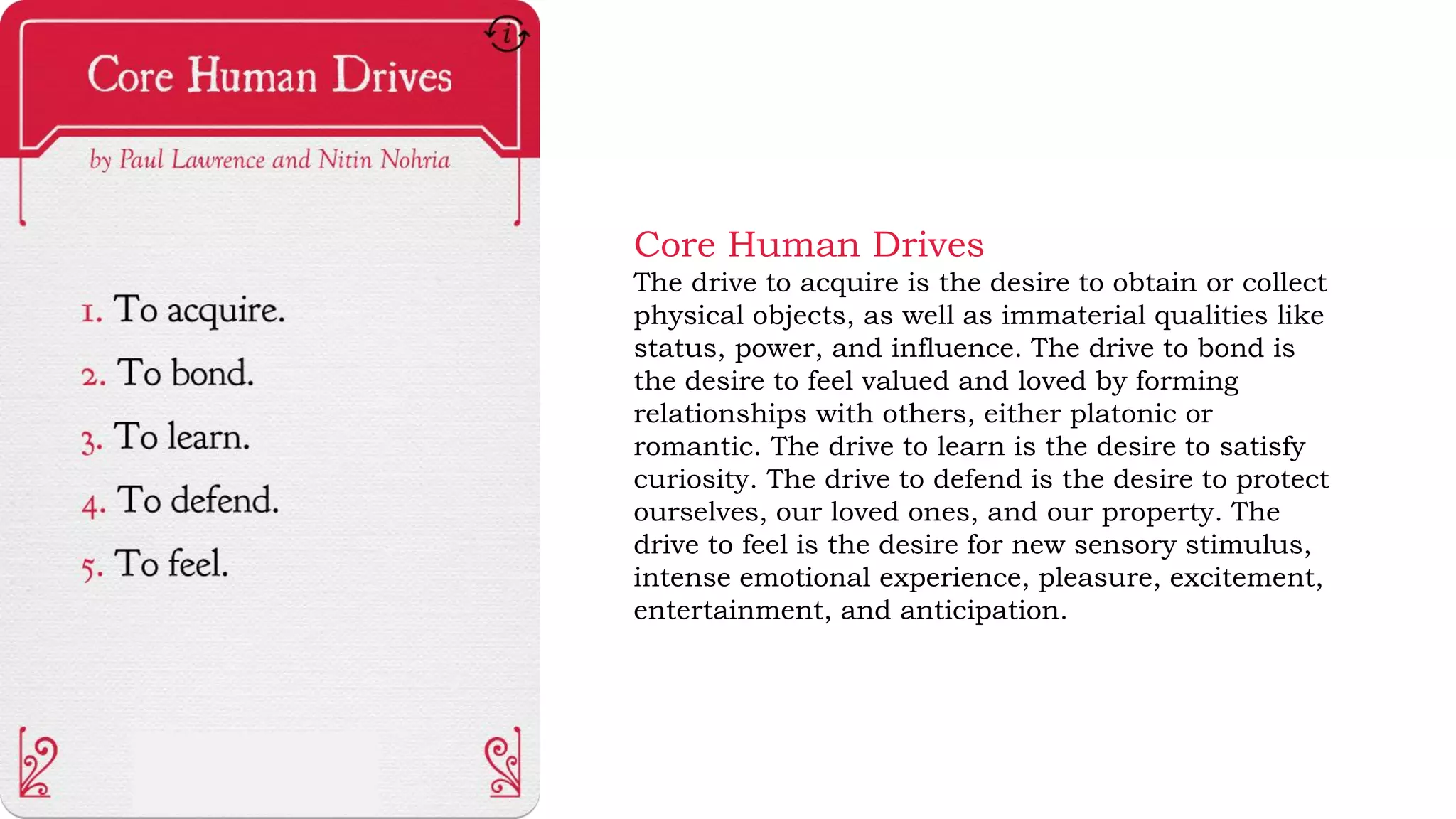
Core Human Drives
The drive to acquire is the desire to obtain or collect
physical objects, as well as immaterial qualities like
status, power, and influence. The drive to bond is
the desire to feel valued and loved by forming
relationships with others, either platonic or
romantic. The drive to learn is the desire to satisfy
curiosity. The drive to defend is the desire to protect
ourselves, our loved ones, and our property. The
drive to feel is the desire for new sensory stimulus,
intense emotional experience, pleasure, excitement,
entertainment, and anticipation.
Censydiam Model
Censydiam is a “human compas” that guides you
around the world of human motivations. There are
eight motivations aligned in a circle, driven by two
dimensions — personal and social.
This tool could be used to redefine the category
based on the needs that your product fulfills, to
create the positioning to establish a much deeper
connection with your consumers, to manage a
brand portfolio by motivational segmentation or to
stay ahead of the competition and find new
opportunities for growth.
Learn more at www.censydiam.com
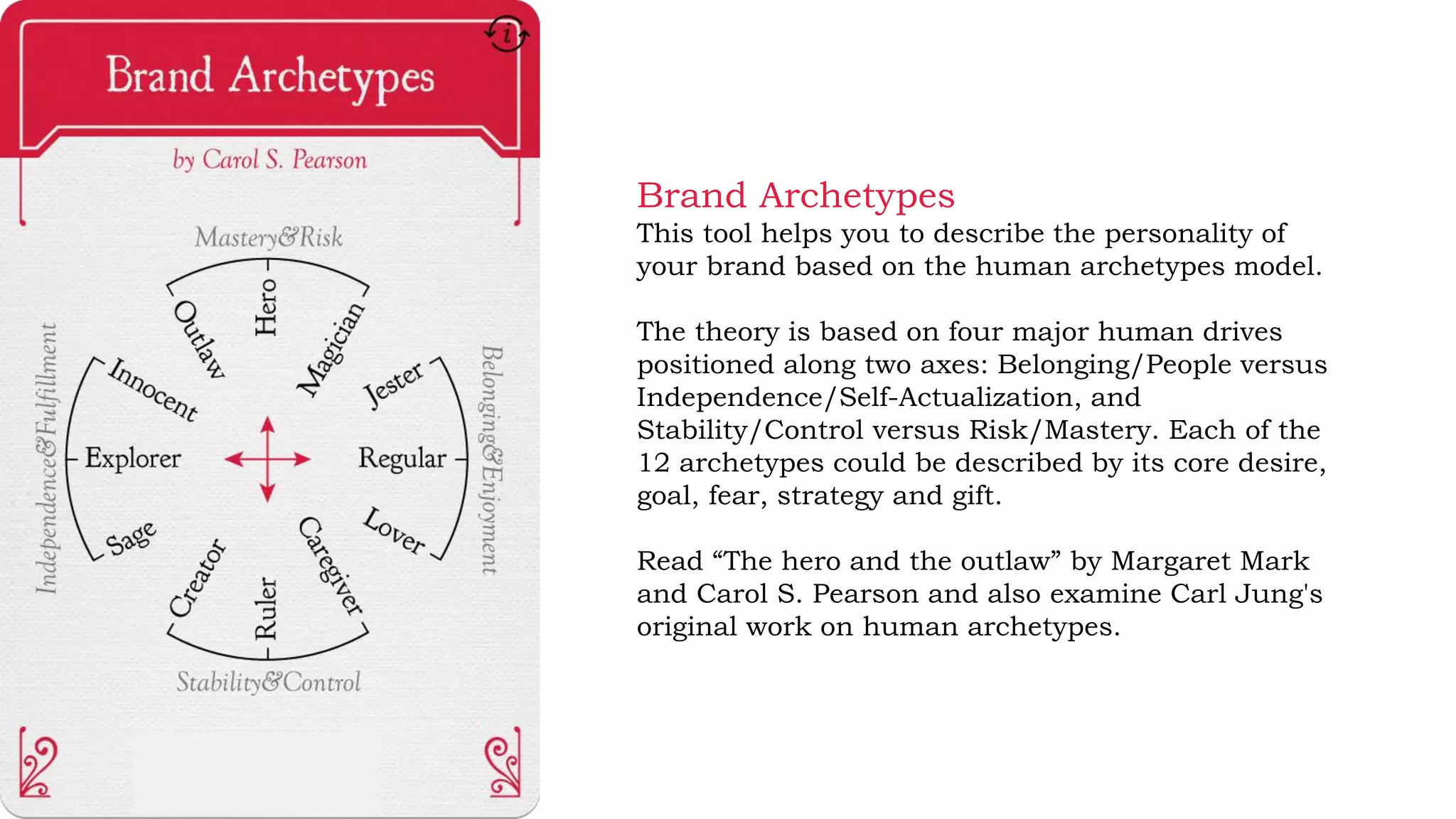
Brand Archetypes
This tool helps you to describe the personality of
your brand based on the human archetypes model.
The theory is based on four major human drives
positioned along two axes: Belonging/People versus
Independence/Self-Actualization, and
Stability/Control versus Risk/Mastery. Each of the
12 archetypes could be described by its core desire,
goal, fear, strategy and gift.
Read “The hero and the outlaw” by Margaret Mark
and Carol S. Pearson and also examine Carl Jung's
original work on human archetypes.
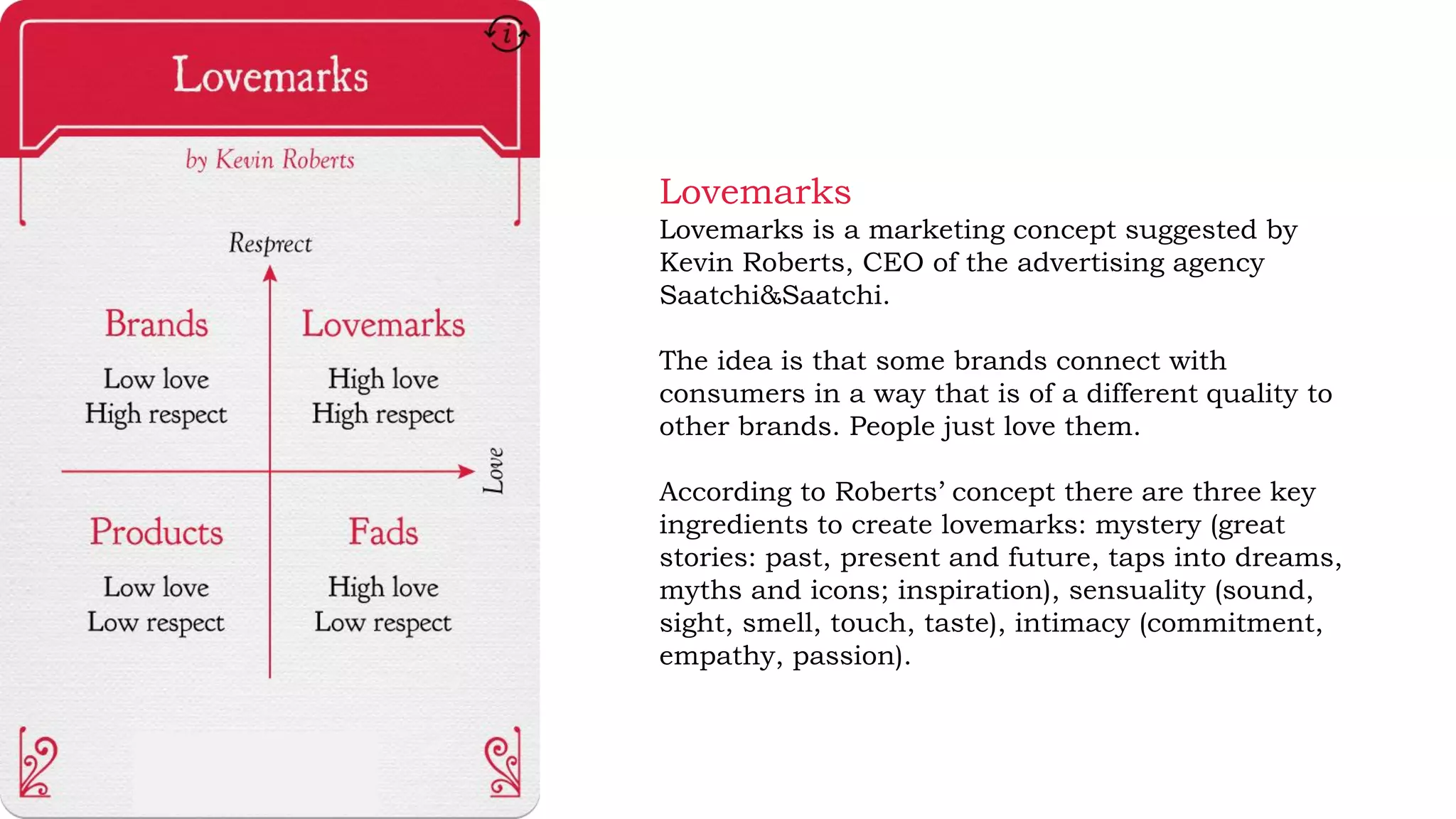
Lovemarks
Lovemarks is a marketing concept suggested by
Kevin Roberts, CEO of the advertising agency
Saatchi&Saatchi.
The idea is that some brands connect with
consumers in a way that is of a different quality to
other brands. People just love them.
According to Roberts’ concept there are three key
ingredients to create lovemarks: mystery (great
stories: past, present and future, taps into dreams,
myths and icons; inspiration), sensuality (sound,
sight, smell, touch, taste), intimacy (commitment,
empathy, passion).
Belief Map
In order to change people’s behavior you need to
change their beliefs first.
Belief map is establishing the connection between
consumers' beliefs and actions, current and desired
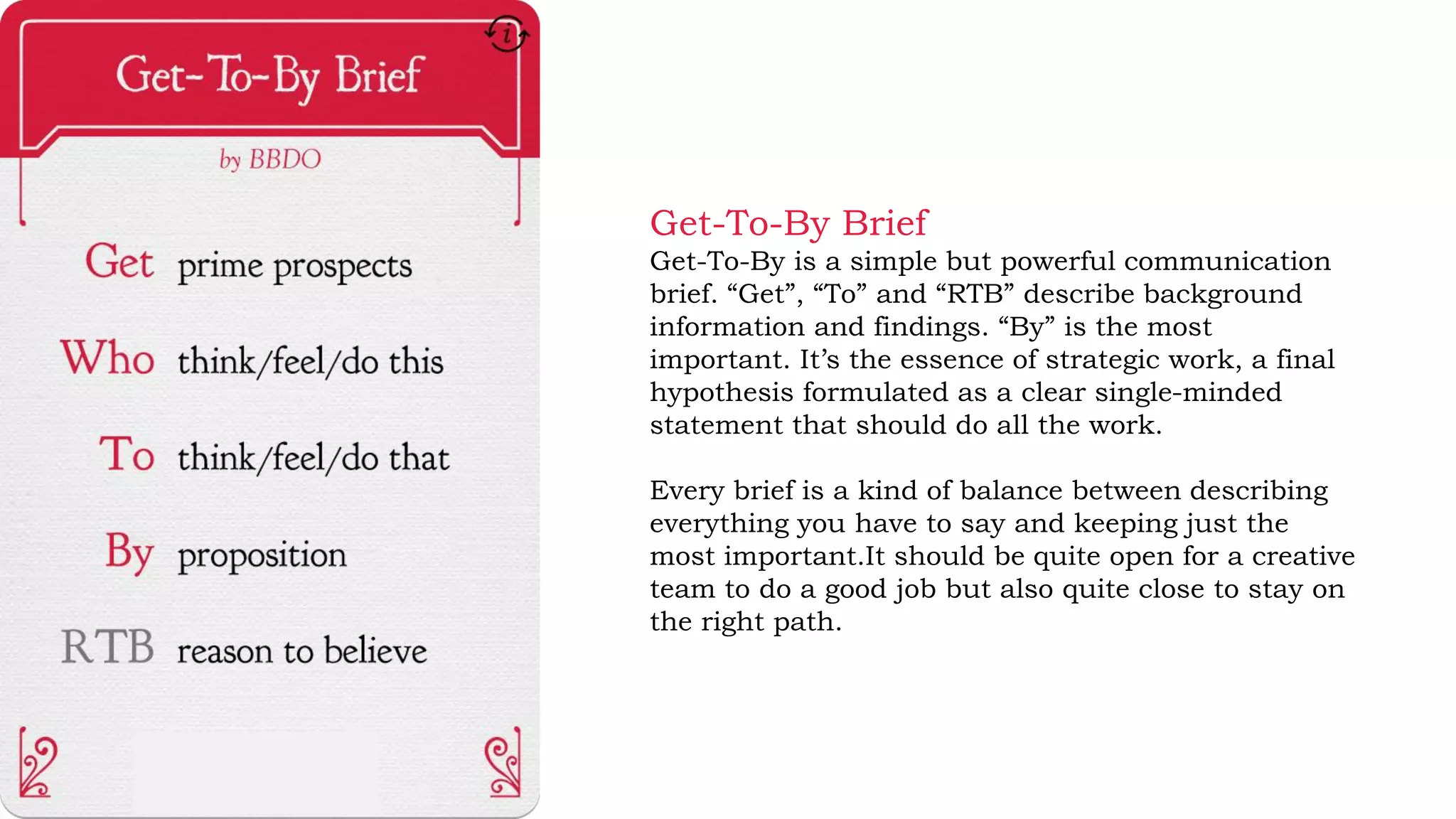
Get-To-By Brief
Get-To-By is a simple but powerful communication
brief. “Get”, “To” and “RTB” describe background
information and findings. “By” is the most
important. It’s the essence of strategic work, a final
hypothesis formulated as a clear single-minded
statement that should do all the work.
Every brief is a kind of balance between describing
everything you have to say and keeping just the
most important.It should be quite open for a creative
team to do a good job but also quite close to stay on
the right path.
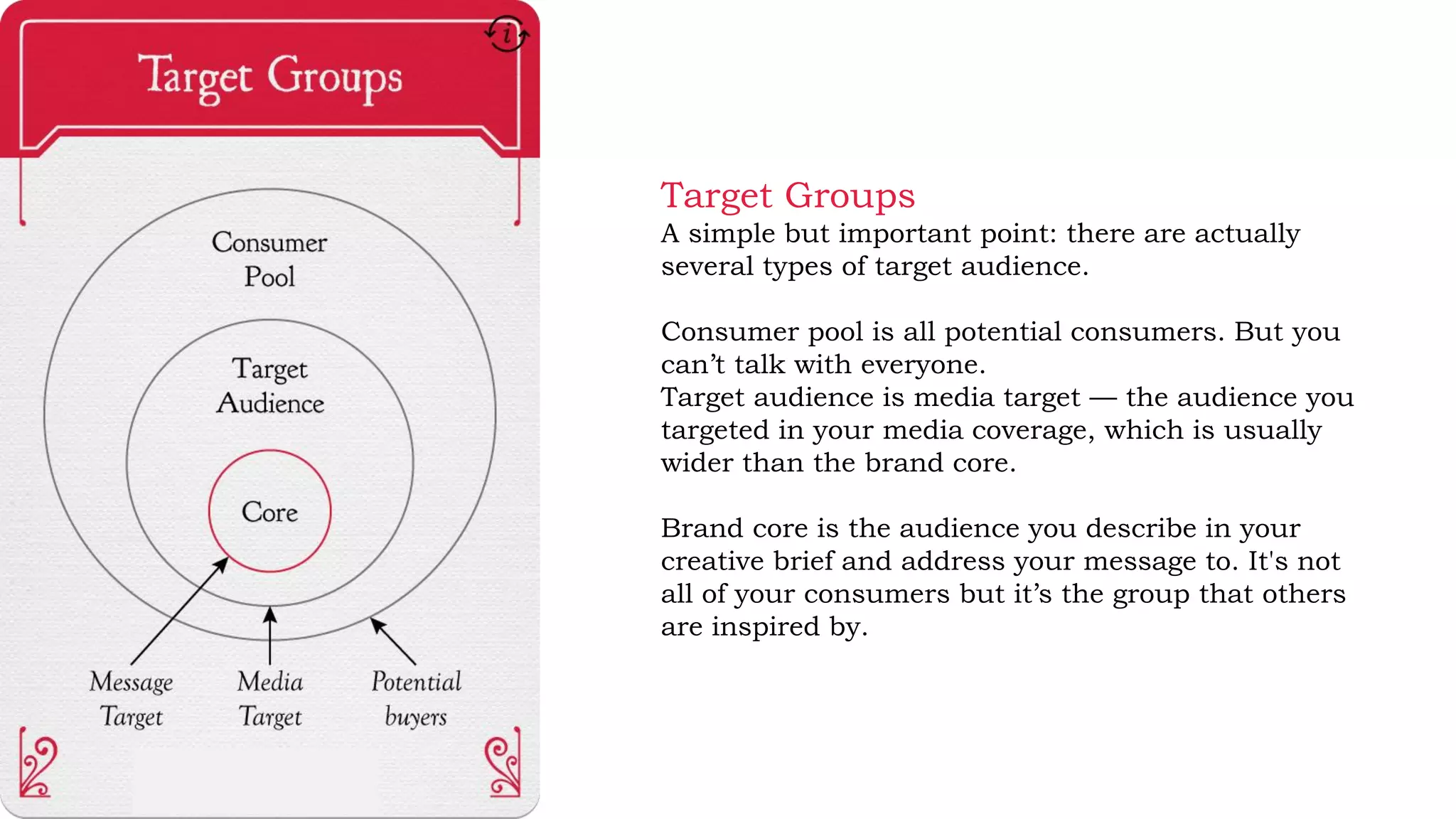
Target Groups
A simple but important point: there are actually
several types of target audience.
Consumer pool is all potential consumers. But you
can’t talk with everyone.
Target audience is media target — the audience you
targeted in your media coverage, which is usually
wider than the brand core.
Brand core is the audience you describe in your
creative brief and address your message to. It's not
all of your consumers but it’s the group that others
are inspired by.
Attention Funnel
This tool is more known as AIDA. As it has been
around a long time, it has undeservedly lost some
respect.
AIDA is perfect for evaluating your execution.
Whatever you do, you should check whether it
attracts attention (will your banner be visible on the
page). Will it cause interest? Because attention
alone is not enough. It's a pity, but today there is a
lot of creativity that works just on these two levels.
The most important objective to achieve is to create
desire which leads to further action: not just
obligitary purchase but also digging for information,
etc.
Feedback Form
The right feedback is one of the most important
things in the creative process. Evaluating creativity
is hard enough by itself. What makes it even harder
is when the wrong feedback hurts and demotivates
creatives.
The formula for the right feedback is avoiding
personal judgment and staying objective. This form
with four simple questions will help with that.
Brand Health Pyramid
At any one time, every person could be linked to one
level of relationship with a brand: awareness,
familiarity, preference or best choice.
The important thing is conversion between the
levels. Low awareness means no-one knows your
brand. A low conversion rate to familiarity tells us
people have heard about you but don't really know
what you have promised them. A low conversion
rate to preference means that what you are saying is
not interesting to your audience. A low conversion
rate to loyalty means you don't provide an extra
reason to stick with you.
5W Framework
5Ws Frameworks is useful to describe your
consumer. It’s also good to start thinking about
segmentation first of all.
The Who — consumer insights.
The What — brand, product and portfolio strategy.
The When — occasions-based marketing.
The Where — market opportunity landscape,
locations of purchase and use.
The Why and The Why Not — drivers and barriers to
consumer choice.
Campaign Logic
Every campaign has pretty much the same logic:
announcement, platform and echo. There are five
main questions:
Announcement
1. Cheap and wide coverage.
2. High conversion rate to the platform.
Platform
3. Right message and experience that will influence
on consumer behaviour.
Echo
4. Loud echo. Think twice!
5. (usually most neglected) High conversion rate
from echo back to the platform.
Purchase Journey
Purchase Journey will help you to evaluate
consumer path to make sure every person step on it
will get to the purhcase.
Start with awareness of need and think in terms of
audience actions and decision points. “A person
want to drink. What opportunities he has? What will
he do? Will search for alternatives? Go direct to a
shop? How will he choose a shop? How will he
choose the drink?” — stay close to something like
that.
Try different routes. Find out every place where your
consumers fall off and come up with the right way to
correct it.
Brand Platforms
Platform is the long-term fundament for all your
communication activities. There are three types of
platforms and you will usually use all of them.
Communication platform is the essence of your
long-term communication strategy. It’s about your
message and big idea.
Media platform is a set of tools to accumulate your
audience. Website, social media page, email base —
everything owned and on-going.
Service platform is communications beyond
advertising: social listening, call-center, online
support, etc.
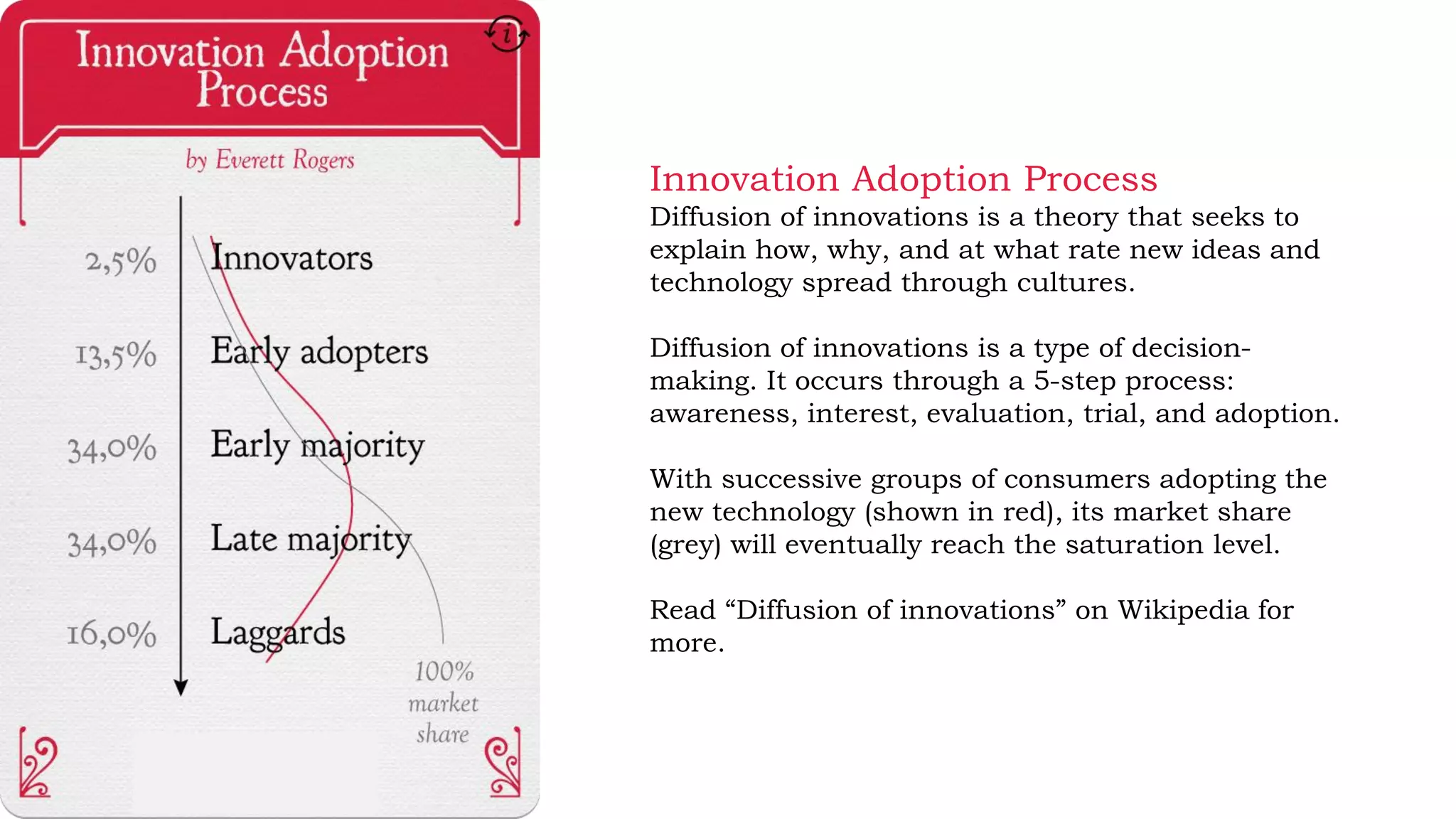
Innovation Adoption Process
Diffusion of innovations is a theory that seeks to
explain how, why, and at what rate new ideas and
technology spread through cultures.
Diffusion of innovations is a type of decision-
making. It occurs through a 5-step process:
awareness, interest, evaluation, trial, and adoption.
With successive groups of consumers adopting the
new technology (shown in red), its market share
(grey) will eventually reach the saturation level.
Read “Diffusion of innovations” on Wikipedia for
more.
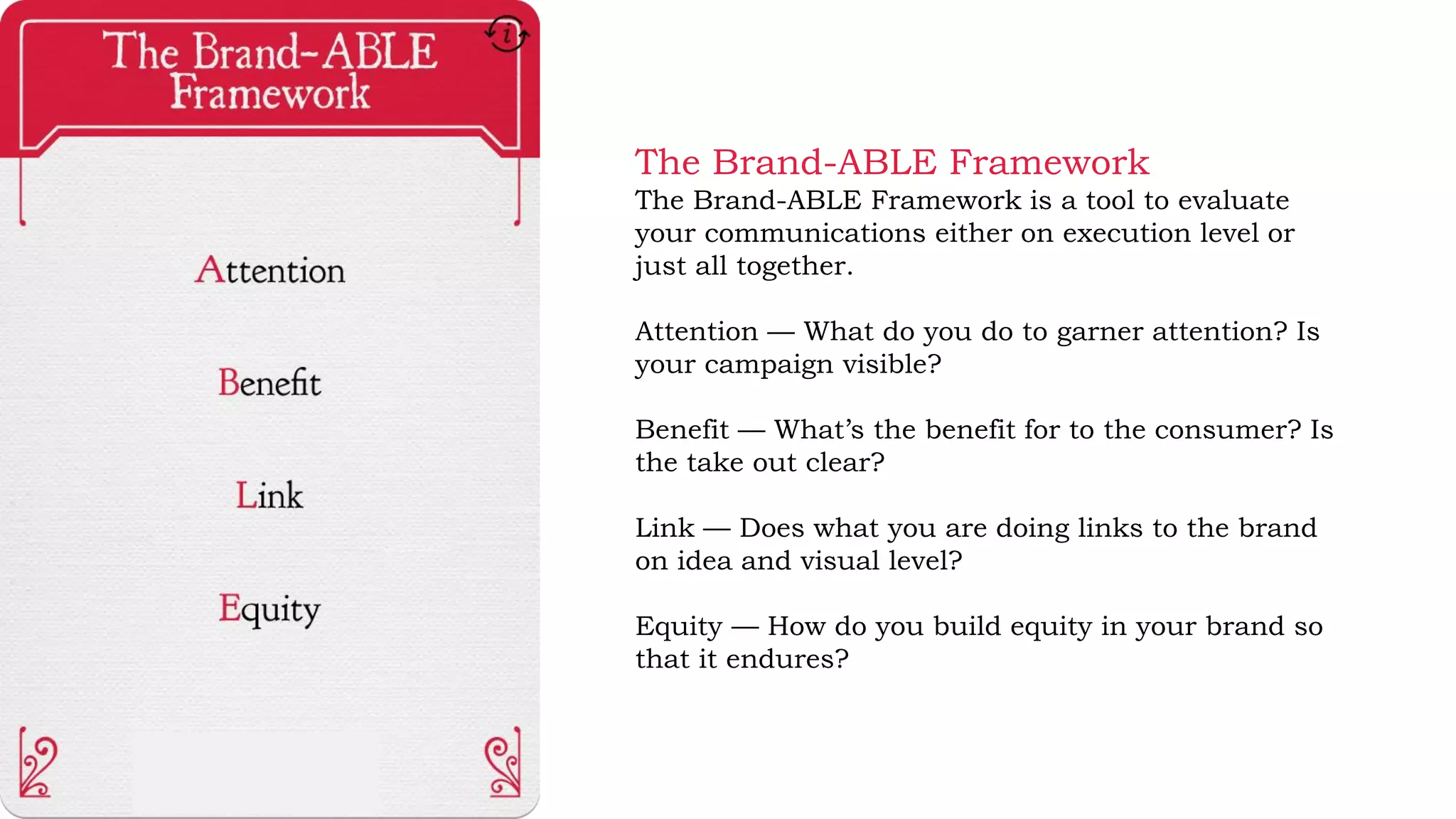
The Brand-ABLE Framework
The Brand-ABLE Framework is a tool to evaluate
your communications either on execution level or
just all together.
Attention — What do you do to garner attention? Is
your campaign visible?
Benefit — What’s the benefit for to the consumer? Is
the take out clear?
Link — Does what you are doing links to the brand
on idea and visual level?
Equity — How do you build equity in your brand so
that it endures?
Brand Key
The “Brand-Key” model – originally created for
Unilever’s brand-planning – now universally used in
academicpractice. It’s different from other brand
frameworks by three main points:
Root strengths — the basic attributes we want to
build on and be known for.
Competitive environment — competitive
environment. :)
Discriminator — the single (or a maximum of 3)
compelling reasons for the target customer to
choose us over the competition.
S.T.E.P.P.S.
S.T.E.P.P.S. are the six keys to made ideas and
products more contagious.
Social currency — we share things that make us
look good. Does talking about your idea make people
look good?
Triggers — top of mind, tip of tongue. Consider the
context and reminders.
Emotion — when we care, we share.
Public — built to show, built to grow. Can people see
when others are using your idea or product?
Practical value — news you can use.
Stories — information travels under the guise of idle
chatter.
Content Strategy Framework
Start with branded content strategy by finding your
territory and core message. Think about values you
will deliver to the target audience through the
content.
Define content creation strategy: choose how will
you create content and fill in hygiene (always-on
‘pull’ content), hub (regularly scheduled ‘push’
content) and hero (large-scale, tent-pole events or
‘go big’ moments) content types in the framework.
Describe your distribution strategy: where you will
store the content, how you will deliver it and how
will activate.

Marketing Strategy - Mastery Tool

  • 1.
  • 2.
    Strategy is... Key termscome from the definition. Now-state — defines the state of now. Goal — desired future, formulated into written form under SMART criteria. Available resources — time, money, etc. Strategy itself — route to the goal. (Let’s say any route is a strategy. Some are just very very bad.) The essence of planning is defining the right goals and finding the most effective ways to achieve them.
  • 3.
    SMART goals SMART criteriais an excellent tool to turn your wishes and desires into goals. There are thousands of interpretations of what SMART stands for. “S” usually goes for “Specific” but could also mean “Simple”, “Sustainable”, “Significant” or even “Stretching”. Here is the original definition from the first known use of the term that occurs (God bless Wikipedia) in the November 1981 issue of Management Review by George T. Doran.
  • 4.
    Communication process Planning isessential. Just keep in mind it’s not a plan you need, it's results. So, strategy should be implemented in a list of specific action steps. Actions have to be executed. Place your ads, launch the campaign. Whatever. Here comes the interesting part. Evalute the results. Did your actions bring you closer to your goal? What was good? What went wrong? Do you still have money and believe in a bright future? Go for another round.
  • 5.
    Planning cycle Planning andCommunication cycles look very much alike. The only part that is missing is what happens between "How could we get there?" and "Are we getting there?". These are the five main questions of strategy you should ask yourself repeatedly until you will get a clear vision of the now-state, barriers, business opportunities, wise goals and a reasonable plan to achieve it.
  • 6.
    InciteWork Marketing has differentways to impact on company goals. Communications are always about communicating. This isinseparably connected with the concept of receptor — target audience associated with desirable business results. So, communication strategy is a strategy of changing the perception of the audience through communicating in a way that will lead it to a new behavior favorable to the company
  • 7.
    Cascade Goals The firstquestion of strategy is “What for”, meaning “what do we want to achieve”. Evaluate goals. Redefine them if necessary. Get as close to the business as possible. Then “How”. Connect your goals with actions through the system of embedded objectives. Business goals. How will you accomplish them? Business strategy. Where will profit come from? Marketing goals. How? Marketing strategy. Necessities. Opportunities. Who will be your profit source? How do we need to change their behavior? Communication goals. How? What, where and when?
  • 8.
    Profit Sources Define theaudience you will target and the action shift connected to it that will influence company profit growth (which is usually the overall goal). Sell more by attracting more consumers, meaning generate a first trial: by communicating either competitive advantages of your product or category benefits. Sell more to every consumer: increase purchase value (more per purchase or more expensive product), make people come back (build loyalty) and increase consumption (increase volume or frequency by, let's say, providing new occasions).
  • 9.
    Need-To-Purchase The idea isthat every purchase starts with a human need and the need-to-purchase process goes through an evaluation of available solutions. The formula for increasing the profit (sell more) now sounds like “more needs, more people, feel more often, consider us and choose us, spending more”. “More needs” is something new. It’s about associating the product with attributes of new categories. E.g. Snickers as a chocolate competes on something-sweet-need level but as a brand plays on hunger (snacks) territory.
  • 10.
    BrandDynamics Pyramid This toolshows how many consumers have a relationship with the brand at five key stages. From weak relationship and low share of category expenditure to strong relationship and high share. From simple awareness of Presence level (Do I know it?) through personal Relevance (Does it offer me something?) and good enough Performance (Can it deliver?), to the proportion recognising a clear competitive Advantage (Does it offer something better than others?) and finally those who are closely Bonded with the brand (Nothing else beats it).
  • 11.
    Consumer Split This isa powerful segmentation tool that divides the target audience by its consumer behavior. Rows represent three levels of relationship with a brand: loyal consumers (our brand is the #1 choice), switchers (buy us sometimes) and non-buyers (don’t buy us). Columns stand for consumption habits: heavy and light category users. The volume and impact of every consumer type on the brand profit can be revealed by a corresponding research.
  • 12.
    Purchase Funnel The purchasefunnel describes the consumer's path leading to a purchase. The most important point of the tool is consideration. To get onto a consideration list we need to create an awareness of our product and make sure the audience is familiar with our brand/product promise.
  • 13.
    Consumer Decision Journey Thisis an analysis of the new way people buy things. The first new point of change is the evaluation stage which has a crucial influence in some categories, for instance researching the Internet for consumer feedback before buying something expensive. The second new point is the post-purchase experience that could lead to loyalty as well as influencing the research stage of other consumers. There are also a decision trigger on the point of purchase and an interest trigger when entering the loyalty loop.
  • 14.
    Communication Channels There arefour main channelsthat form a person's opinion of a product or a company. These channels differ according to personal perception and influences. Advertising — everything that is recognized as an advertisement. Information — mass media messages that are not recognized as advertising. Feedback — other people's opinions on products or companies. Experience — a personal experience of a product or communication.
  • 15.
    Brand is... There arethree aspects of every brand: a brand image that exists in a person’s mind, an average brand image shared by a target group and a brand model created by marketing experts. The branding process consists of two parts: 1. Creating a brand model attractive to the audience that will lead to a sale. 2. Regular communications targeted to eliminate the gap between the brand image in the audience's perception and the desired model. Brand is a natural term meaning it really exists no matter what you call it.
  • 16.
    Brand Core Brand Coreis one of the tools designed to describe the brand model. The essence of the brand lies in the intersection of three factors — audience (represented by audience insight), product (represented by brand equities) and business vision (meaning desired future of the brand). Look into Audience Insights and Brand Equities for more details.
  • 17.
    Brand Equity Sandglass BrandEquity Sandglass is another way to describe the brand model. Like all models it says that brand promise lies at the point where brand essence meets target insights. Look into Brand Equity Pyramid and Consumer Pyramid for details
  • 18.
    Consumer Pyramid Consumer Pyramiddescribes the consumer part of Brand Essence. It starts with a description of the target consumer (prime prospect). Then it tells us about occasions of brand/product usage and the needs that refer to them. That leads to the consumer insight which serves as a base for the brand statement.
  • 19.
    Benefit Ladder This tooldescribes different levels of product benefits. At the first level you are writing down product attributes. At the second level you turn attributes into benefits, e.g. a new formula of toothpaste (attribute) improves its whitening effect (benefit). At the third level, product benefits transform into consumer benefits, e.g. your teeth will get whiter. And at the fourth level it goes up to emotional benefit — a feeling caused by consumer benefits, e.g. a white smile will give you confidence and make you attractive to the opposite sex.
  • 20.
    Insight is... Be awareof two common mistakes — confusing an insight either with an obvious truth like “all women love chocolate”, or with a personal observation not shared by anyone else. The right insight has to be hidden and once revealed should cause the “Aha!” feeling mulitplied by the “It’s me” realization. Its role is to win customers’ attention and, most importantly, open the way to change their behavior in order to break the barrier or achieve our goal.
  • 21.
    Insight Process Insight startswith an observation: either in data or in real life. But the result of research is not a real insight. Understand your consumers’ behavior and motivation. Answer the “Why”. Reframe your vision to get the big picture. Evaluate your insight. There are three levels of insights KPIs (according to InSites Consulting): relevance (indentification, frequency, endurance, recognition, thought of before), differentiation (solution awareness, likelihood of solution finding) and actionability (clarity, importance of resolving, context fit, target group fit, brand fit).
  • 22.
    Insight Types This matrixrepresents the multitude of different types of insight that exist. Actually, the author of the tool, Simon Law, says he is not really sure if he agrees with the concept of insight types overall. Therefore this list may not even be exhaustive and definitely contains some areas that don’t make for particularly good types of insight. Despite that fact, it could be a good start for understanding the nature of insight, or as a map for digging further into the subject.
  • 23.
    Brand Equity Pyramid BrandEquity Pyramid describes the product part of the Brand Core. It starts with product attributes and transforms it into brand benefits with the Benefit Ladder tool. Then itdescribes the personality of the brand based on the Censydiam or Archetypes model. Then it goes to the upper level and describes values the brand stands for or would like to be associated with based on its attributes (reasons to believe) and benefits it provides.
  • 24.
    Brand Resonance Model Tobuild a strong brand you must shape how customers think and feel about your product. Within the pyramid model, four key levels are highlighted that you can work through to create a successful brand. These are identity, meaning, response and relationships. Your objectives on each level should be: ensure broad awareness, define points of parity and difference, provide positive, accessible reactions and build intense, active loyalty. Google “Heineken resonance model” to get an example.
  • 25.
    Consumer-Brand Relationship Model Consumerneeds are complex and multi-layered. All layers of brand image must be managed so they are consistent. Functional needs: taste, prices/rates, pack size, format, service touch-points, etc. Identity needs: peer group identification, social level, lifestyle. Emotive needs: feelings consumers are looking for, what it says about me and my personality. Symbolism: brand-personality — fun-loving, serious, etc. Social values: family, older, female, etc. Product features: sweet, rich, premium, compact, easy to use.
  • 26.
    Maslow's Pyramid Maslow's theorysuggests that the most basic level of needs must be met before the individual strongly desires the secondary or higher level needs. Instead of stating that the person focuses on one specific need at any given time, Maslow stated that one specific need "dominates" the human organism. Interesting fact: while the pyramid has become the de facto way to represent the hierarchy, Maslow himself never used a pyramid to describe these levels in any of his writings on the subject.
  • 27.
    ERG Theory When peoplehave what they need to survive, they move on to making friends and finding mates. When they’re satisfied with their relationships, they focus on doing things they enjoy and improving their skills in things that interest them. First existence, then relatedness, then growth. The ERG theory explains the general priorities of human desires, but not the methods people use to satisfy them. For that, look at Core Human Drives.
  • 28.
    Core Human Drives Thedrive to acquire is the desire to obtain or collect physical objects, as well as immaterial qualities like status, power, and influence. The drive to bond is the desire to feel valued and loved by forming relationships with others, either platonic or romantic. The drive to learn is the desire to satisfy curiosity. The drive to defend is the desire to protect ourselves, our loved ones, and our property. The drive to feel is the desire for new sensory stimulus, intense emotional experience, pleasure, excitement, entertainment, and anticipation.
  • 29.
    Censydiam Model Censydiam isa “human compas” that guides you around the world of human motivations. There are eight motivations aligned in a circle, driven by two dimensions — personal and social. This tool could be used to redefine the category based on the needs that your product fulfills, to create the positioning to establish a much deeper connection with your consumers, to manage a brand portfolio by motivational segmentation or to stay ahead of the competition and find new opportunities for growth. Learn more at www.censydiam.com
  • 30.
    Brand Archetypes This toolhelps you to describe the personality of your brand based on the human archetypes model. The theory is based on four major human drives positioned along two axes: Belonging/People versus Independence/Self-Actualization, and Stability/Control versus Risk/Mastery. Each of the 12 archetypes could be described by its core desire, goal, fear, strategy and gift. Read “The hero and the outlaw” by Margaret Mark and Carol S. Pearson and also examine Carl Jung's original work on human archetypes.
  • 31.
    Lovemarks Lovemarks is amarketing concept suggested by Kevin Roberts, CEO of the advertising agency Saatchi&Saatchi. The idea is that some brands connect with consumers in a way that is of a different quality to other brands. People just love them. According to Roberts’ concept there are three key ingredients to create lovemarks: mystery (great stories: past, present and future, taps into dreams, myths and icons; inspiration), sensuality (sound, sight, smell, touch, taste), intimacy (commitment, empathy, passion).
  • 32.
    Belief Map In orderto change people’s behavior you need to change their beliefs first. Belief map is establishing the connection between consumers' beliefs and actions, current and desired
  • 33.
    Get-To-By Brief Get-To-By isa simple but powerful communication brief. “Get”, “To” and “RTB” describe background information and findings. “By” is the most important. It’s the essence of strategic work, a final hypothesis formulated as a clear single-minded statement that should do all the work. Every brief is a kind of balance between describing everything you have to say and keeping just the most important.It should be quite open for a creative team to do a good job but also quite close to stay on the right path.
  • 34.
    Target Groups A simplebut important point: there are actually several types of target audience. Consumer pool is all potential consumers. But you can’t talk with everyone. Target audience is media target — the audience you targeted in your media coverage, which is usually wider than the brand core. Brand core is the audience you describe in your creative brief and address your message to. It's not all of your consumers but it’s the group that others are inspired by.
  • 35.
    Attention Funnel This toolis more known as AIDA. As it has been around a long time, it has undeservedly lost some respect. AIDA is perfect for evaluating your execution. Whatever you do, you should check whether it attracts attention (will your banner be visible on the page). Will it cause interest? Because attention alone is not enough. It's a pity, but today there is a lot of creativity that works just on these two levels. The most important objective to achieve is to create desire which leads to further action: not just obligitary purchase but also digging for information, etc.
  • 36.
    Feedback Form The rightfeedback is one of the most important things in the creative process. Evaluating creativity is hard enough by itself. What makes it even harder is when the wrong feedback hurts and demotivates creatives. The formula for the right feedback is avoiding personal judgment and staying objective. This form with four simple questions will help with that.
  • 37.
    Brand Health Pyramid Atany one time, every person could be linked to one level of relationship with a brand: awareness, familiarity, preference or best choice. The important thing is conversion between the levels. Low awareness means no-one knows your brand. A low conversion rate to familiarity tells us people have heard about you but don't really know what you have promised them. A low conversion rate to preference means that what you are saying is not interesting to your audience. A low conversion rate to loyalty means you don't provide an extra reason to stick with you.
  • 38.
    5W Framework 5Ws Frameworksis useful to describe your consumer. It’s also good to start thinking about segmentation first of all. The Who — consumer insights. The What — brand, product and portfolio strategy. The When — occasions-based marketing. The Where — market opportunity landscape, locations of purchase and use. The Why and The Why Not — drivers and barriers to consumer choice.
  • 39.
    Campaign Logic Every campaignhas pretty much the same logic: announcement, platform and echo. There are five main questions: Announcement 1. Cheap and wide coverage. 2. High conversion rate to the platform. Platform 3. Right message and experience that will influence on consumer behaviour. Echo 4. Loud echo. Think twice! 5. (usually most neglected) High conversion rate from echo back to the platform.
  • 40.
    Purchase Journey Purchase Journeywill help you to evaluate consumer path to make sure every person step on it will get to the purhcase. Start with awareness of need and think in terms of audience actions and decision points. “A person want to drink. What opportunities he has? What will he do? Will search for alternatives? Go direct to a shop? How will he choose a shop? How will he choose the drink?” — stay close to something like that. Try different routes. Find out every place where your consumers fall off and come up with the right way to correct it.
  • 41.
    Brand Platforms Platform isthe long-term fundament for all your communication activities. There are three types of platforms and you will usually use all of them. Communication platform is the essence of your long-term communication strategy. It’s about your message and big idea. Media platform is a set of tools to accumulate your audience. Website, social media page, email base — everything owned and on-going. Service platform is communications beyond advertising: social listening, call-center, online support, etc.
  • 42.
    Innovation Adoption Process Diffusionof innovations is a theory that seeks to explain how, why, and at what rate new ideas and technology spread through cultures. Diffusion of innovations is a type of decision- making. It occurs through a 5-step process: awareness, interest, evaluation, trial, and adoption. With successive groups of consumers adopting the new technology (shown in red), its market share (grey) will eventually reach the saturation level. Read “Diffusion of innovations” on Wikipedia for more.
  • 43.
    The Brand-ABLE Framework TheBrand-ABLE Framework is a tool to evaluate your communications either on execution level or just all together. Attention — What do you do to garner attention? Is your campaign visible? Benefit — What’s the benefit for to the consumer? Is the take out clear? Link — Does what you are doing links to the brand on idea and visual level? Equity — How do you build equity in your brand so that it endures?
  • 44.
    Brand Key The “Brand-Key”model – originally created for Unilever’s brand-planning – now universally used in academicpractice. It’s different from other brand frameworks by three main points: Root strengths — the basic attributes we want to build on and be known for. Competitive environment — competitive environment. :) Discriminator — the single (or a maximum of 3) compelling reasons for the target customer to choose us over the competition.
  • 45.
    S.T.E.P.P.S. S.T.E.P.P.S. are thesix keys to made ideas and products more contagious. Social currency — we share things that make us look good. Does talking about your idea make people look good? Triggers — top of mind, tip of tongue. Consider the context and reminders. Emotion — when we care, we share. Public — built to show, built to grow. Can people see when others are using your idea or product? Practical value — news you can use. Stories — information travels under the guise of idle chatter.
  • 46.
    Content Strategy Framework Startwith branded content strategy by finding your territory and core message. Think about values you will deliver to the target audience through the content. Define content creation strategy: choose how will you create content and fill in hygiene (always-on ‘pull’ content), hub (regularly scheduled ‘push’ content) and hero (large-scale, tent-pole events or ‘go big’ moments) content types in the framework. Describe your distribution strategy: where you will store the content, how you will deliver it and how will activate.