Understanding Computers: Today and Tomorrow, 13th Edition
Chapter 3:
Storage
Understanding Computers: Today and Tomorrow, 13th Edition
2
Learning Objectives
1. Name several general properties of storage systems.
2. Describe the two most common types of hard drives
and what they are used for today.
3. Discuss the various types of optical discs available and
how they differ from each other.
4. Identify some flash-memory-based storage devices and
media and explain how they are used today.
5. List at least three other types of storage systems.
6. Summarize the storage alternatives for a typical
personal computer.
Understanding Computers: Today and Tomorrow, 13th Edition
3
Storage System Characteristics
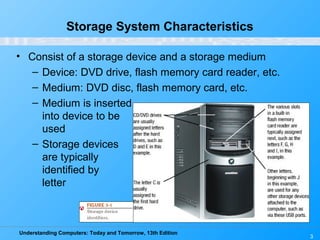
• Consist of a storage device and a storage medium
– Device: DVD drive, flash memory card reader, etc.
– Medium: DVD disc, flash memory card, etc.
– Medium is inserted
into device to be
used
– Storage devices
are typically
identified by
letter
Understanding Computers: Today and Tomorrow, 13th Edition
4
Storage System Characteristics
• Can be internal, external, or remote
• Are nonvolatile
• Usually use random access; can be sequential
• Logical file representation: The user’s view of the way
data is stored
• Physical file representation: The actual physical way the
data is stored on the storage media as viewed by the
computer
• Storage technologies:
– Magnetic (conventional hard drives)
– Optical (optical discs)
– Electrons (flash memory media)(solid-state)
Understanding Computers: Today and Tomorrow, 13th Edition
5
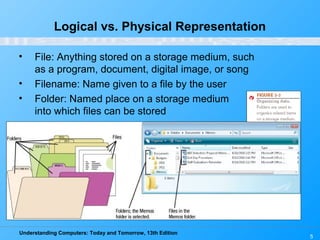
Logical vs. Physical Representation
• File: Anything stored on a storage medium, such
as a program, document, digital image, or song
• Filename: Name given to a file by the user
• Folder: Named place on a storage medium
into which files can be stored
Understanding Computers: Today and Tomorrow, 13th Edition
6
Hard Drives
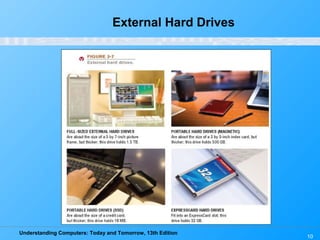
• Hard drive: Used to store most programs and data
– Can be internal and external
– Can be encrypted
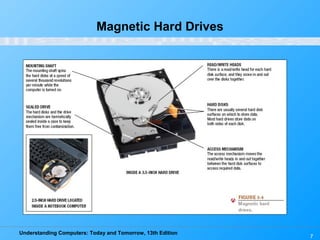
• Magnetic hard drives
– Use metal hard disks
– Read/write heads magnetize particles to represent
the data’s 0s and 1s
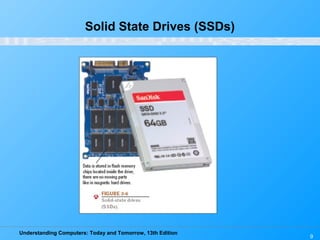
• Solid-state drives (SSDs)
– Use flash memory technology
– Use less power and have no moving parts
– Particularly appropriate for portable computers
Understanding Computers: Today and Tomorrow, 13th Edition
7
Magnetic Hard Drives
Understanding Computers: Today and Tomorrow, 13th Edition
8
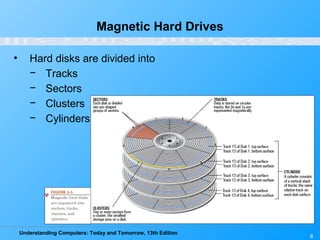
Magnetic Hard Drives
• Hard disks are divided into
− Tracks
− Sectors
− Clusters
− Cylinders
Understanding Computers: Today and Tomorrow, 13th Edition
9
Solid State Drives (SSDs)
Understanding Computers: Today and Tomorrow, 13th Edition
10
External Hard Drives
Understanding Computers: Today and Tomorrow, 13th Edition
11
Hard Drive Speed and Caching
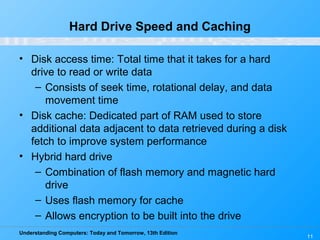
• Disk access time: Total time that it takes for a hard
drive to read or write data
– Consists of seek time, rotational delay, and data
movement time
• Disk cache: Dedicated part of RAM used to store
additional data adjacent to data retrieved during a disk
fetch to improve system performance
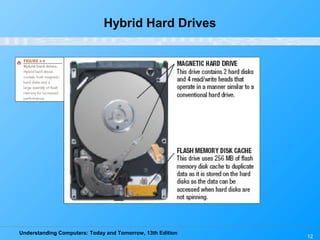
• Hybrid hard drive
– Combination of flash memory and magnetic hard
drive
– Uses flash memory for cache
– Allows encryption to be built into the drive
Understanding Computers: Today and Tomorrow, 13th Edition
Hybrid Hard Drives
12
Understanding Computers: Today and Tomorrow, 13th Edition
13
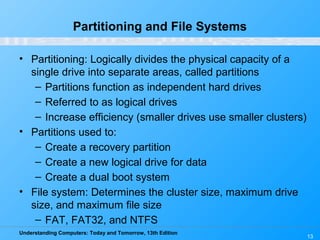
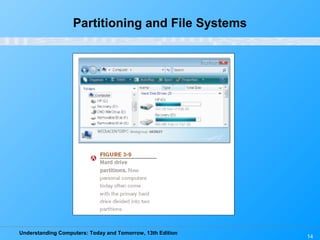
Partitioning and File Systems
• Partitioning: Logically divides the physical capacity of a
single drive into separate areas, called partitions
– Partitions function as independent hard drives
– Referred to as logical drives
– Increase efficiency (smaller drives use smaller clusters)
• Partitions used to:
– Create a recovery partition
– Create a new logical drive for data
– Create a dual boot system
• File system: Determines the cluster size, maximum drive
size, and maximum file size
– FAT, FAT32, and NTFS
Understanding Computers: Today and Tomorrow, 13th Edition
Partitioning and File Systems
14
Understanding Computers: Today and Tomorrow, 13th Edition
15
Hard Drive Interface Standards
• Hard drive interface standards: Determine how a drive
connects to the computer
• Common standards:
– Parallel ATA (PATA): older, slower standard
– Serial ATA (SATA)
– eSATA: uses USB or Firewire via expansion card for
faster speeds
– SCSI and the newer serial attached SCSI (SAS)
– Fibre Channel
– Fibre Channel over Ethernet (FCoE)
– Internet SCSI (iSCSI)
Understanding Computers: Today and Tomorrow, 13th Edition
16
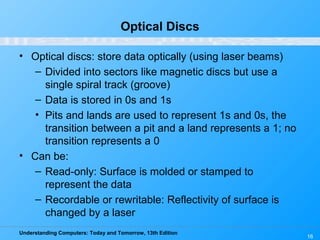
Optical Discs
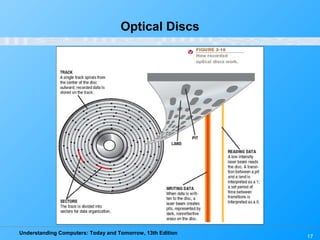
• Optical discs: store data optically (using laser beams)
– Divided into sectors like magnetic discs but use a
single spiral track (groove)
– Data is stored in 0s and 1s
• Pits and lands are used to represent 1s and 0s, the
transition between a pit and a land represents a 1; no
transition represents a 0
• Can be:
– Read-only: Surface is molded or stamped to
represent the data
– Recordable or rewritable: Reflectivity of surface is
changed by a laser
Understanding Computers: Today and Tomorrow, 13th Edition
17
Optical Discs
Understanding Computers: Today and Tomorrow, 13th Edition
Optical Drives
• Optical drives: Designed for type of disc: CD, DVD, or
Blu-Ray Disc (BD)
– Can be read-only, recordable, or rewritable
– Downward compatible
– Can support single or dual layer discs
• Burning: Recording data onto disc
– CD discs: Use infrared lasers; hold 650 MB
– DVD discs: Use red lasers; hold 4.7 GB (single-layer)
– BD discs: Use blue-violet lasers; hold 25 GB (single-
layer)
• Can be internal or external drives
– External drives typically USB
18
Understanding Computers: Today and Tomorrow, 13th Edition
Types of Optical Recording Surfaces
• ROM
- Pressed into land and pits
- Used for distribution of material
• Recordable – read many, write once
- Uses laser to change reflectivity of surface
- Makes cheap backups
• Rewritable – read many, write many
- Uses laser to change reflectivity of surface back and
forth
- Limited number of rewrites
Understanding Computers: Today and Tomorrow, 13th Edition
20
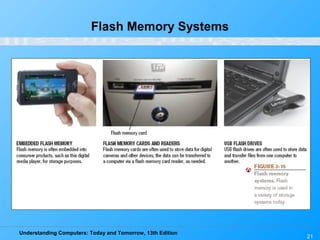
Flash Memory Systems
• Chip-based storage medium
– No moving parts so more resistant to shock and vibration,
require less power, make no sound
– Solid-state storage system
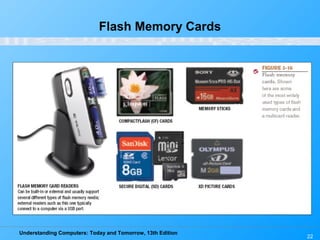
• Most often found in the form of:
– Flash memory cards
– USB flash drives
– Solid-state drives
– Hybrid hard drives
• Very small and so are very appropriate for use with
digital cameras, digital music players, GPS devices,
notebook computers, mobile devices, etc.
Understanding Computers: Today and Tomorrow, 13th Edition
21
Flash Memory Systems
Understanding Computers: Today and Tomorrow, 13th Edition
22
Flash Memory Cards
Understanding Computers: Today and Tomorrow, 13th Edition
23
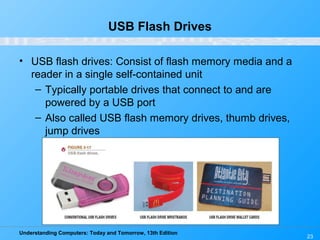
USB Flash Drives
• USB flash drives: Consist of flash memory media and a
reader in a single self-contained unit
– Typically portable drives that connect to and are
powered by a USB port
– Also called USB flash memory drives, thumb drives,
jump drives
Understanding Computers: Today and Tomorrow, 13th Edition
24
Other Types of Storage Systems
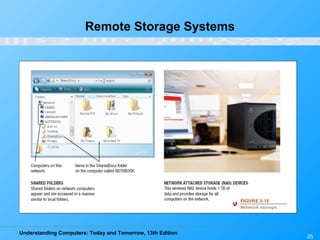
• Remote storage: Using a storage device not directly a
part of the computer being used
– Network storage: Via a local network
• Network attached storage (NAS): Connected
directly to a network
– Storage area network (SAN): Separate network of
hard drives or other storage devices which is attached
to the main network
– Online storage or cloud storage: Accessed via the
Internet
• Via Web sites (Flickr, Facebook, Google Docs, etc.)
• Via online storage sites (Box.net, SkyDrive, etc.)
Understanding Computers: Today and Tomorrow, 13th Edition
25
Remote Storage Systems
Understanding Computers: Today and Tomorrow, 13th Edition
26
Online Video
“A Look at Network Storage”
(click below to start video)
Reminder: The complete set of online videos and video podcasts are available at:
www.cengage.com/computerconcepts/np/uc13
Courtesy D-Link Systems,
Inc.
Understanding Computers: Today and Tomorrow, 13th Edition
27
Smart Cards
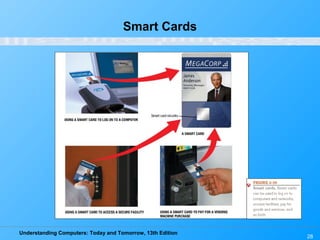
• Smart card: Credit card-sized piece of plastic that
contains some computer circuitry (processor, memory,
and storage)
– Stores small amount of data (about 64 KB or less)
– Commonly used to store prepaid amounts of digital
cash or personal information
– Smart card readers are built into or attached to a
computer, keyboard, vending machine, or other
device
– Some smart cards store biometric data
– Can be used in conjunction with encryption and other
security technologies
Understanding Computers: Today and Tomorrow, 13th Edition
28
Smart Cards
Understanding Computers: Today and Tomorrow, 13th Edition
29
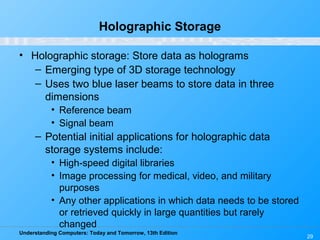
Holographic Storage
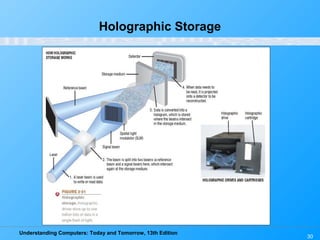
• Holographic storage: Store data as holograms
– Emerging type of 3D storage technology
– Uses two blue laser beams to store data in three
dimensions
• Reference beam
• Signal beam
– Potential initial applications for holographic data
storage systems include:
• High-speed digital libraries
• Image processing for medical, video, and military
purposes
• Any other applications in which data needs to be stored
or retrieved quickly in large quantities but rarely
changed
Understanding Computers: Today and Tomorrow, 13th Edition
30
Holographic Storage
Understanding Computers: Today and Tomorrow, 13th Edition
31
Storage Systems for Large Computer
Systems and Networks
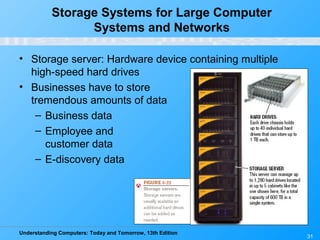
• Storage server: Hardware device containing multiple
high-speed hard drives
• Businesses have to store
tremendous amounts of data
– Business data
– Employee and
customer data
– E-discovery data
Understanding Computers: Today and Tomorrow, 13th Edition
32
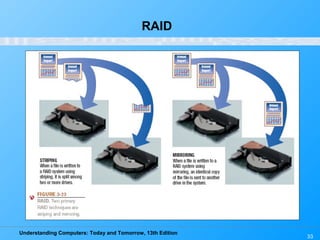
RAID
• RAID (redundant arrays of independent discs): Method
of storing data on two or more hard drives that work
together to do the job of a larger drive
– Usually involves recording redundant copies of stored
data
– Helps to increase fault tolerance
– Different levels of RAID:
• RAID 0 = disk striping (spread files over two or
more hard drives)
• RAID 1 = disk mirroring (duplicate copy)
• Other level use a combination or striping and
mirroring
Understanding Computers: Today and Tomorrow, 13th Edition
33
RAID
Understanding Computers: Today and Tomorrow, 13th Edition
34
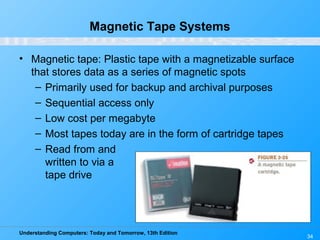
Magnetic Tape Systems
• Magnetic tape: Plastic tape with a magnetizable surface
that stores data as a series of magnetic spots
– Primarily used for backup and archival purposes
– Sequential access only
– Low cost per megabyte
– Most tapes today are in the form of cartridge tapes
– Read from and
written to via a
tape drive
Understanding Computers: Today and Tomorrow, 13th Edition
35
Evaluating Your Storage Alternatives
• Factors to consider:
– Speed
– Compatibility
– Storage capacity
– Convenience
– Portability
• Most users require:
– Hard drive
– CD or DVD drive
– Flash memory card reader
– USB port connecting USB devices

Understanding Computers: Today and Tomorrow, 13th Edition Chapter 3 - Storage

  • 1.
    Understanding Computers: Todayand Tomorrow, 13th Edition Chapter 3: Storage
  • 2.
    Understanding Computers: Todayand Tomorrow, 13th Edition 2 Learning Objectives 1. Name several general properties of storage systems. 2. Describe the two most common types of hard drives and what they are used for today. 3. Discuss the various types of optical discs available and how they differ from each other. 4. Identify some flash-memory-based storage devices and media and explain how they are used today. 5. List at least three other types of storage systems. 6. Summarize the storage alternatives for a typical personal computer.
  • 3.
    Understanding Computers: Todayand Tomorrow, 13th Edition 3 Storage System Characteristics • Consist of a storage device and a storage medium – Device: DVD drive, flash memory card reader, etc. – Medium: DVD disc, flash memory card, etc. – Medium is inserted into device to be used – Storage devices are typically identified by letter
  • 4.
    Understanding Computers: Todayand Tomorrow, 13th Edition 4 Storage System Characteristics • Can be internal, external, or remote • Are nonvolatile • Usually use random access; can be sequential • Logical file representation: The user’s view of the way data is stored • Physical file representation: The actual physical way the data is stored on the storage media as viewed by the computer • Storage technologies: – Magnetic (conventional hard drives) – Optical (optical discs) – Electrons (flash memory media)(solid-state)
  • 5.
    Understanding Computers: Todayand Tomorrow, 13th Edition 5 Logical vs. Physical Representation • File: Anything stored on a storage medium, such as a program, document, digital image, or song • Filename: Name given to a file by the user • Folder: Named place on a storage medium into which files can be stored
  • 6.
    Understanding Computers: Todayand Tomorrow, 13th Edition 6 Hard Drives • Hard drive: Used to store most programs and data – Can be internal and external – Can be encrypted • Magnetic hard drives – Use metal hard disks – Read/write heads magnetize particles to represent the data’s 0s and 1s • Solid-state drives (SSDs) – Use flash memory technology – Use less power and have no moving parts – Particularly appropriate for portable computers
  • 7.
    Understanding Computers: Todayand Tomorrow, 13th Edition 7 Magnetic Hard Drives
  • 8.
    Understanding Computers: Todayand Tomorrow, 13th Edition 8 Magnetic Hard Drives • Hard disks are divided into − Tracks − Sectors − Clusters − Cylinders
  • 9.
    Understanding Computers: Todayand Tomorrow, 13th Edition 9 Solid State Drives (SSDs)
  • 10.
    Understanding Computers: Todayand Tomorrow, 13th Edition 10 External Hard Drives
  • 11.
    Understanding Computers: Todayand Tomorrow, 13th Edition 11 Hard Drive Speed and Caching • Disk access time: Total time that it takes for a hard drive to read or write data – Consists of seek time, rotational delay, and data movement time • Disk cache: Dedicated part of RAM used to store additional data adjacent to data retrieved during a disk fetch to improve system performance • Hybrid hard drive – Combination of flash memory and magnetic hard drive – Uses flash memory for cache – Allows encryption to be built into the drive
  • 12.
    Understanding Computers: Todayand Tomorrow, 13th Edition Hybrid Hard Drives 12
  • 13.
    Understanding Computers: Todayand Tomorrow, 13th Edition 13 Partitioning and File Systems • Partitioning: Logically divides the physical capacity of a single drive into separate areas, called partitions – Partitions function as independent hard drives – Referred to as logical drives – Increase efficiency (smaller drives use smaller clusters) • Partitions used to: – Create a recovery partition – Create a new logical drive for data – Create a dual boot system • File system: Determines the cluster size, maximum drive size, and maximum file size – FAT, FAT32, and NTFS
  • 14.
    Understanding Computers: Todayand Tomorrow, 13th Edition Partitioning and File Systems 14
  • 15.
    Understanding Computers: Todayand Tomorrow, 13th Edition 15 Hard Drive Interface Standards • Hard drive interface standards: Determine how a drive connects to the computer • Common standards: – Parallel ATA (PATA): older, slower standard – Serial ATA (SATA) – eSATA: uses USB or Firewire via expansion card for faster speeds – SCSI and the newer serial attached SCSI (SAS) – Fibre Channel – Fibre Channel over Ethernet (FCoE) – Internet SCSI (iSCSI)
  • 16.
    Understanding Computers: Todayand Tomorrow, 13th Edition 16 Optical Discs • Optical discs: store data optically (using laser beams) – Divided into sectors like magnetic discs but use a single spiral track (groove) – Data is stored in 0s and 1s • Pits and lands are used to represent 1s and 0s, the transition between a pit and a land represents a 1; no transition represents a 0 • Can be: – Read-only: Surface is molded or stamped to represent the data – Recordable or rewritable: Reflectivity of surface is changed by a laser
  • 17.
    Understanding Computers: Todayand Tomorrow, 13th Edition 17 Optical Discs
  • 18.
    Understanding Computers: Todayand Tomorrow, 13th Edition Optical Drives • Optical drives: Designed for type of disc: CD, DVD, or Blu-Ray Disc (BD) – Can be read-only, recordable, or rewritable – Downward compatible – Can support single or dual layer discs • Burning: Recording data onto disc – CD discs: Use infrared lasers; hold 650 MB – DVD discs: Use red lasers; hold 4.7 GB (single-layer) – BD discs: Use blue-violet lasers; hold 25 GB (single- layer) • Can be internal or external drives – External drives typically USB 18
  • 19.
    Understanding Computers: Todayand Tomorrow, 13th Edition Types of Optical Recording Surfaces • ROM - Pressed into land and pits - Used for distribution of material • Recordable – read many, write once - Uses laser to change reflectivity of surface - Makes cheap backups • Rewritable – read many, write many - Uses laser to change reflectivity of surface back and forth - Limited number of rewrites
  • 20.
    Understanding Computers: Todayand Tomorrow, 13th Edition 20 Flash Memory Systems • Chip-based storage medium – No moving parts so more resistant to shock and vibration, require less power, make no sound – Solid-state storage system • Most often found in the form of: – Flash memory cards – USB flash drives – Solid-state drives – Hybrid hard drives • Very small and so are very appropriate for use with digital cameras, digital music players, GPS devices, notebook computers, mobile devices, etc.
  • 21.
    Understanding Computers: Todayand Tomorrow, 13th Edition 21 Flash Memory Systems
  • 22.
    Understanding Computers: Todayand Tomorrow, 13th Edition 22 Flash Memory Cards
  • 23.
    Understanding Computers: Todayand Tomorrow, 13th Edition 23 USB Flash Drives • USB flash drives: Consist of flash memory media and a reader in a single self-contained unit – Typically portable drives that connect to and are powered by a USB port – Also called USB flash memory drives, thumb drives, jump drives
  • 24.
    Understanding Computers: Todayand Tomorrow, 13th Edition 24 Other Types of Storage Systems • Remote storage: Using a storage device not directly a part of the computer being used – Network storage: Via a local network • Network attached storage (NAS): Connected directly to a network – Storage area network (SAN): Separate network of hard drives or other storage devices which is attached to the main network – Online storage or cloud storage: Accessed via the Internet • Via Web sites (Flickr, Facebook, Google Docs, etc.) • Via online storage sites (Box.net, SkyDrive, etc.)
  • 25.
    Understanding Computers: Todayand Tomorrow, 13th Edition 25 Remote Storage Systems
  • 26.
    Understanding Computers: Todayand Tomorrow, 13th Edition 26 Online Video “A Look at Network Storage” (click below to start video) Reminder: The complete set of online videos and video podcasts are available at: www.cengage.com/computerconcepts/np/uc13 Courtesy D-Link Systems, Inc.
  • 27.
    Understanding Computers: Todayand Tomorrow, 13th Edition 27 Smart Cards • Smart card: Credit card-sized piece of plastic that contains some computer circuitry (processor, memory, and storage) – Stores small amount of data (about 64 KB or less) – Commonly used to store prepaid amounts of digital cash or personal information – Smart card readers are built into or attached to a computer, keyboard, vending machine, or other device – Some smart cards store biometric data – Can be used in conjunction with encryption and other security technologies
  • 28.
    Understanding Computers: Todayand Tomorrow, 13th Edition 28 Smart Cards
  • 29.
    Understanding Computers: Todayand Tomorrow, 13th Edition 29 Holographic Storage • Holographic storage: Store data as holograms – Emerging type of 3D storage technology – Uses two blue laser beams to store data in three dimensions • Reference beam • Signal beam – Potential initial applications for holographic data storage systems include: • High-speed digital libraries • Image processing for medical, video, and military purposes • Any other applications in which data needs to be stored or retrieved quickly in large quantities but rarely changed
  • 30.
    Understanding Computers: Todayand Tomorrow, 13th Edition 30 Holographic Storage
  • 31.
    Understanding Computers: Todayand Tomorrow, 13th Edition 31 Storage Systems for Large Computer Systems and Networks • Storage server: Hardware device containing multiple high-speed hard drives • Businesses have to store tremendous amounts of data – Business data – Employee and customer data – E-discovery data
  • 32.
    Understanding Computers: Todayand Tomorrow, 13th Edition 32 RAID • RAID (redundant arrays of independent discs): Method of storing data on two or more hard drives that work together to do the job of a larger drive – Usually involves recording redundant copies of stored data – Helps to increase fault tolerance – Different levels of RAID: • RAID 0 = disk striping (spread files over two or more hard drives) • RAID 1 = disk mirroring (duplicate copy) • Other level use a combination or striping and mirroring
  • 33.
    Understanding Computers: Todayand Tomorrow, 13th Edition 33 RAID
  • 34.
    Understanding Computers: Todayand Tomorrow, 13th Edition 34 Magnetic Tape Systems • Magnetic tape: Plastic tape with a magnetizable surface that stores data as a series of magnetic spots – Primarily used for backup and archival purposes – Sequential access only – Low cost per megabyte – Most tapes today are in the form of cartridge tapes – Read from and written to via a tape drive
  • 35.
    Understanding Computers: Todayand Tomorrow, 13th Edition 35 Evaluating Your Storage Alternatives • Factors to consider: – Speed – Compatibility – Storage capacity – Convenience – Portability • Most users require: – Hard drive – CD or DVD drive – Flash memory card reader – USB port connecting USB devices