ARTIFICIAL INTELLIGENCE
QUICK RESEARCH GUIDE
BY ARTHUR MORGAN
with
Art’s Talking Points™
FAIR USE NOTICE
This Quick Research Guide is for non-commercial educational and informational purposes only.
This presentation may contain copyrighted material owned by a third party, the use of which has not been specifically
authorized by the copyright owner. Notwithstanding a copyright owner's rights under Section 107 of the Copyright Act of
1976, the Act allows limited use of copyrighted material without requiring permission from the rights holders, for
purposes such as education, criticism, comment, news reporting, teaching, scholarship, and research. These so-called "fair
uses" are permitted even if the use of the work would otherwise be infringing.
If you wish to use copyrighted material published in this presentation for your own purposes that go beyond fair use, you
must obtain permission from the copyright owner. It is recommended that you seek the advice of legal counsel if you have
any questions on this point.
If you believe that any content in this presentation violates your intellectual property or other rights, please notify Arthur
Morgan by email to art_morgan@att.net.
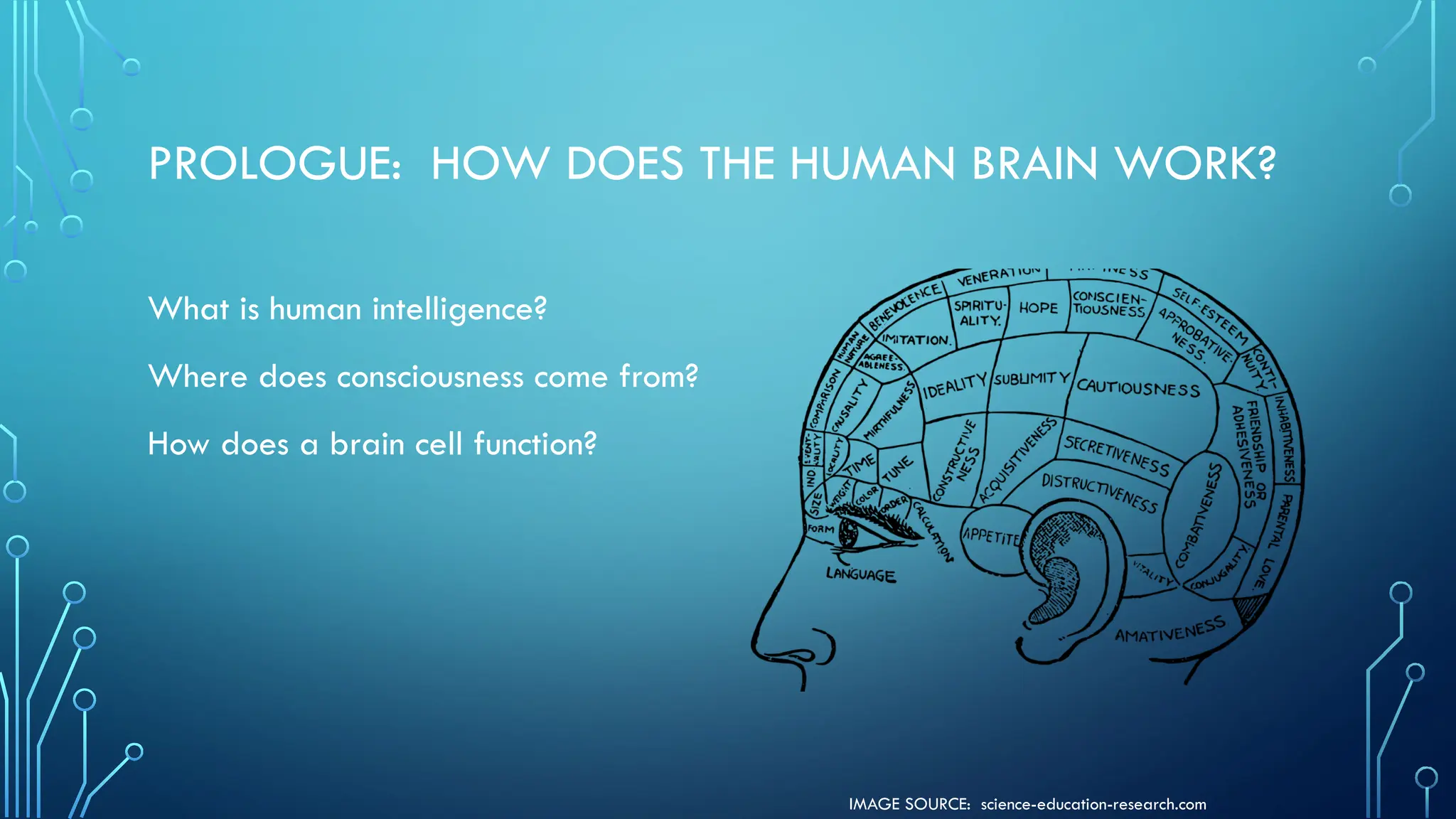
IMAGE SOURCE: science-education-research.com
PROLOGUE: HOW DOES THE HUMAN BRAIN WORK?
What is human intelligence?
Where does consciousness come from?
How does a brain cell function?
CONTENTS
Introduction
o Artificial Intelligence
o Weak vs Strong AI
o What Does AI Look Like?
o Modern AI Milestones
o Machine Learning
o Neural Networks
o Sidebar: Neuromorphic Computing
o Training vs Inference
o Generative AI
o OpenAI Projects
o Where is AI Used?
Research Resources
o Yann LeCun
o Fei-Fei Li
o Ian Goodfellow
o Russell & Norvig
Conclusion
o What is AI Good for?
o Key Takeaways
o Book Recommendations
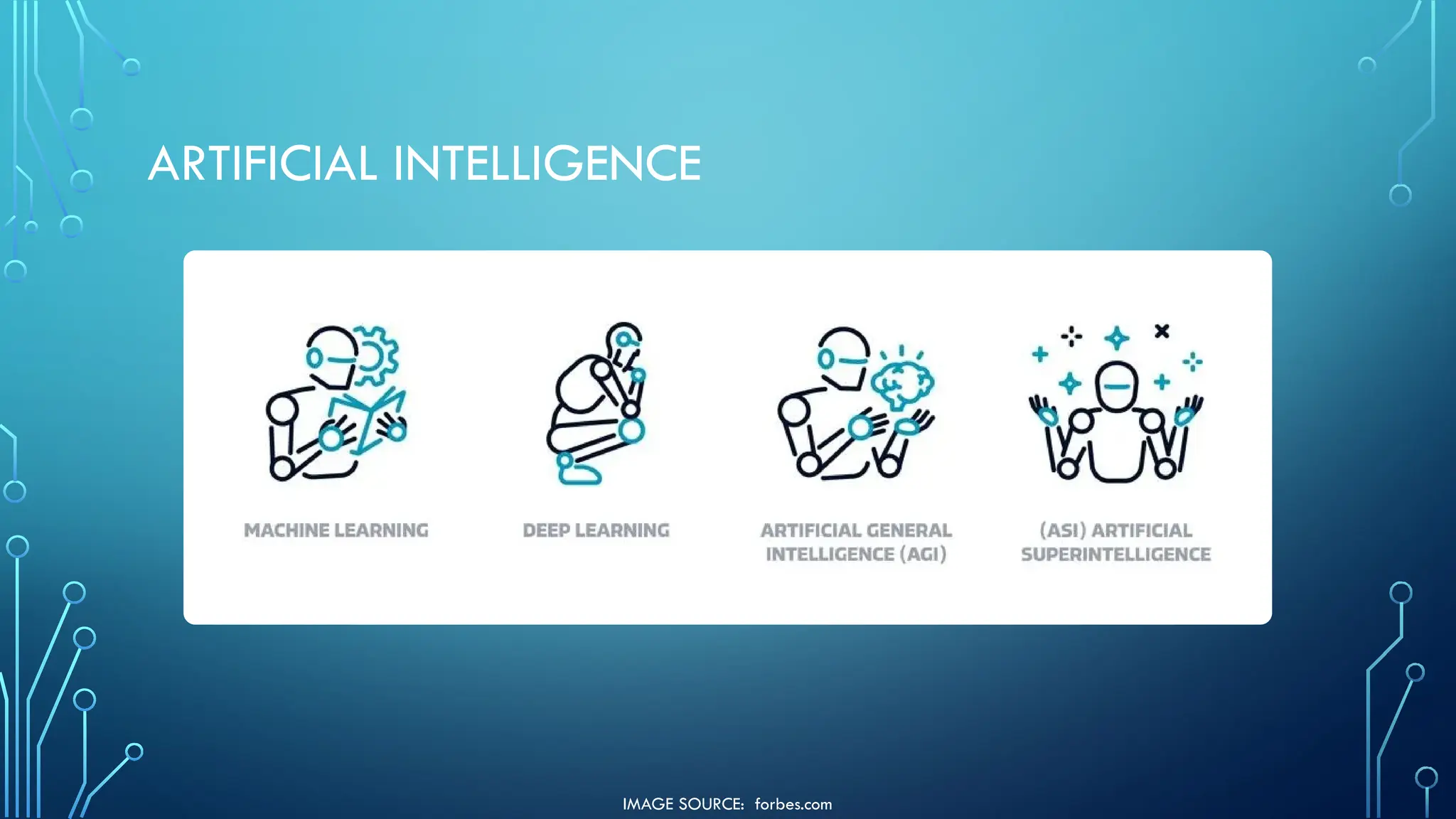
ARTIFICIAL INTELLIGENCE
IMAGE SOURCE: forbes.com
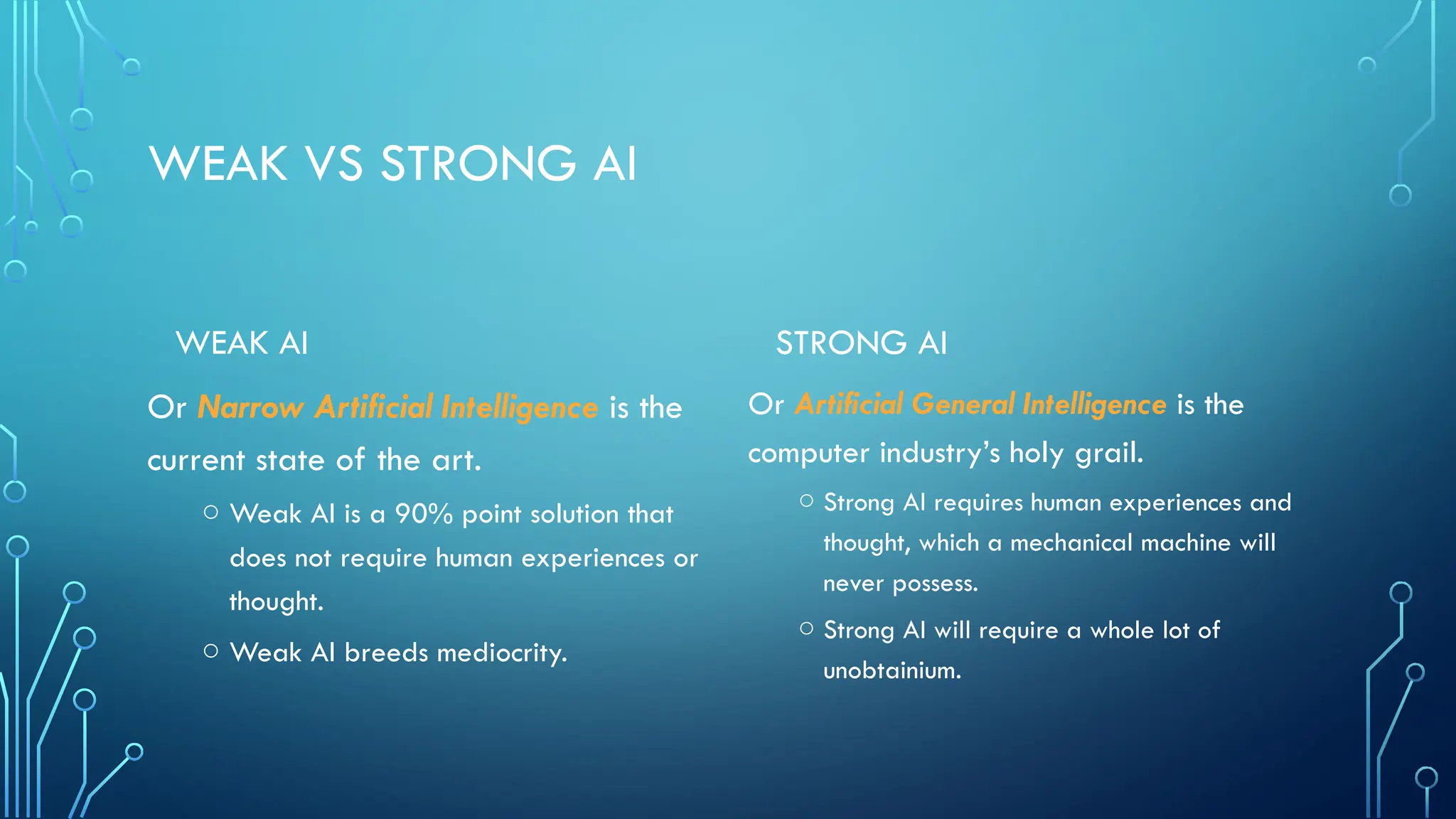
WEAK VS STRONG AI
WEAK AI
Or Narrow Artificial Intelligence is the
current state of the art.
o Weak AI is a 90% point solution that
does not require human experiences or
thought.
o Weak AI breeds mediocrity.
STRONG AI
Or Artificial General Intelligence is the
computer industry’s holy grail.
o Strong AI requires human experiences and
thought, which a mechanical machine will
never possess.
o Strong AI will require a whole lot of
unobtainium.
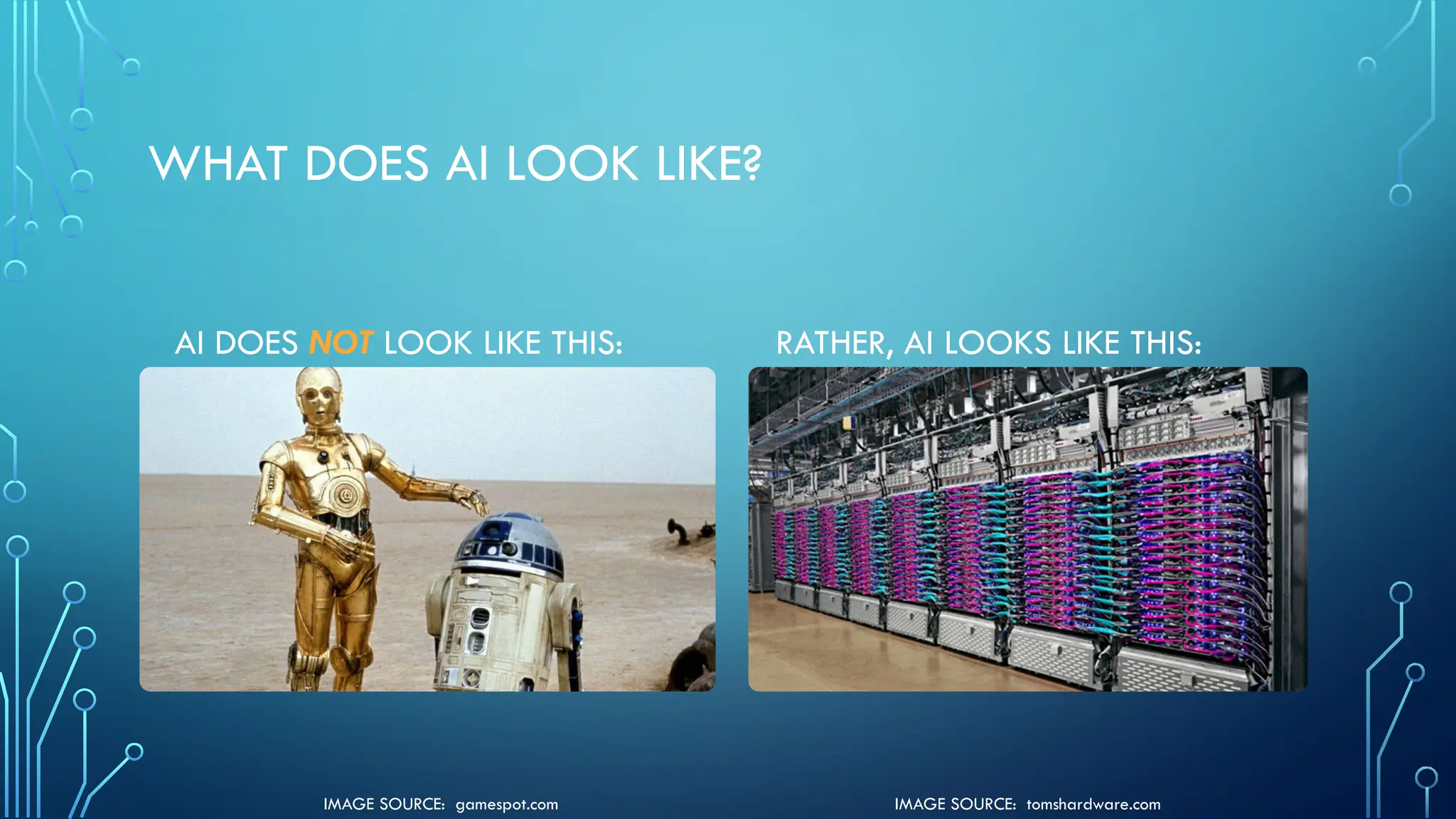
IMAGE SOURCE: gamespot.com IMAGE SOURCE: tomshardware.com
WHAT DOES AI LOOK LIKE?
AI DOES NOT LOOK LIKE THIS: RATHER, AI LOOKS LIKE THIS:
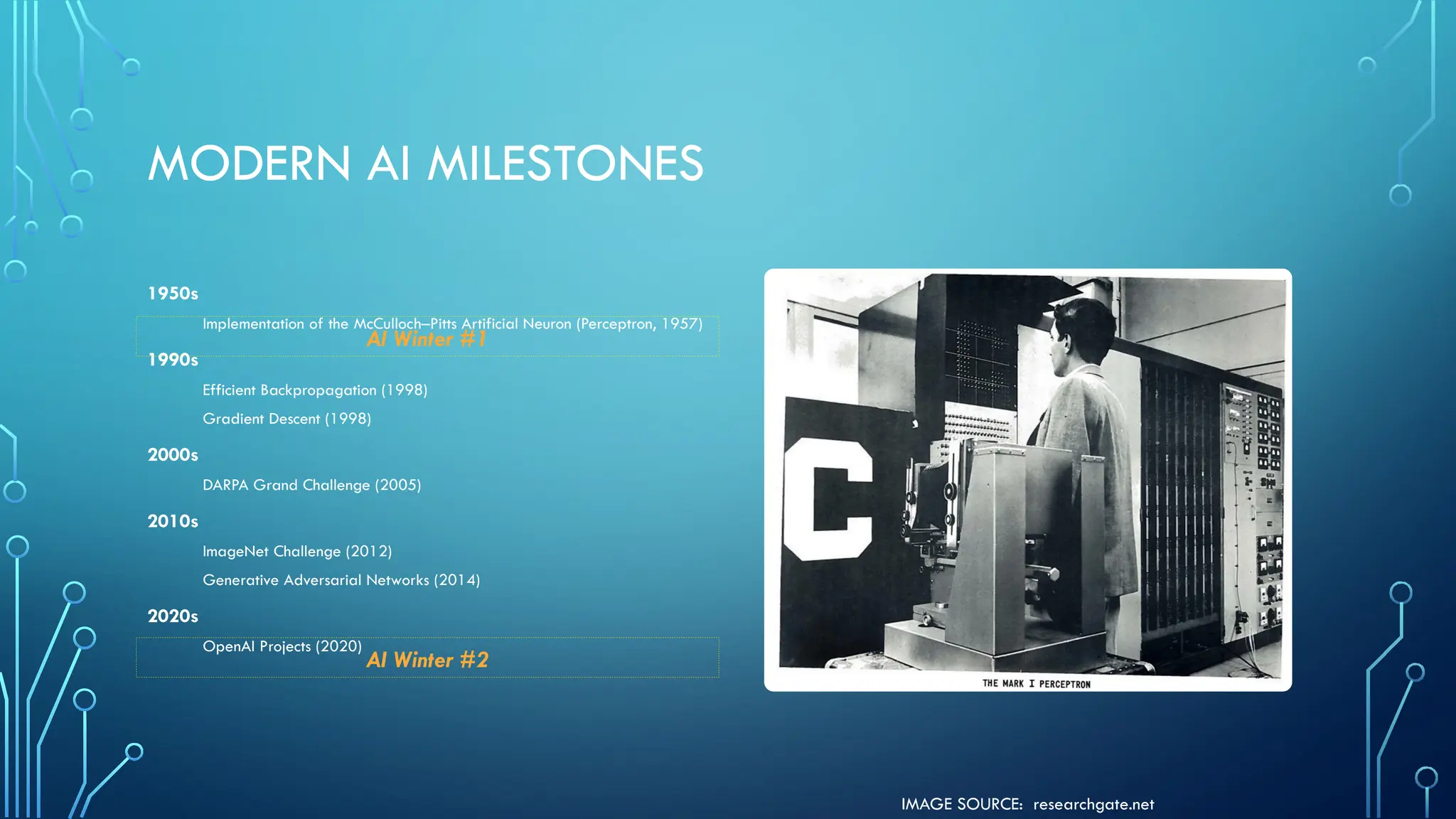
IMAGE SOURCE: researchgate.net
MODERN AI MILESTONES
1950s
Implementation of the McCulloch–Pitts Artificial Neuron (Perceptron, 1957)
1990s
Efficient Backpropagation (1998)
Gradient Descent (1998)
2000s
DARPA Grand Challenge (2005)
2010s
ImageNet Challenge (2012)
Generative Adversarial Networks (2014)
2020s
OpenAI Projects (2020)
AI Winter #1
AI Winter #2
IMAGE SOURCE: khanacademy.org IMAGE SOURCE: insights.sei.cmu.edu
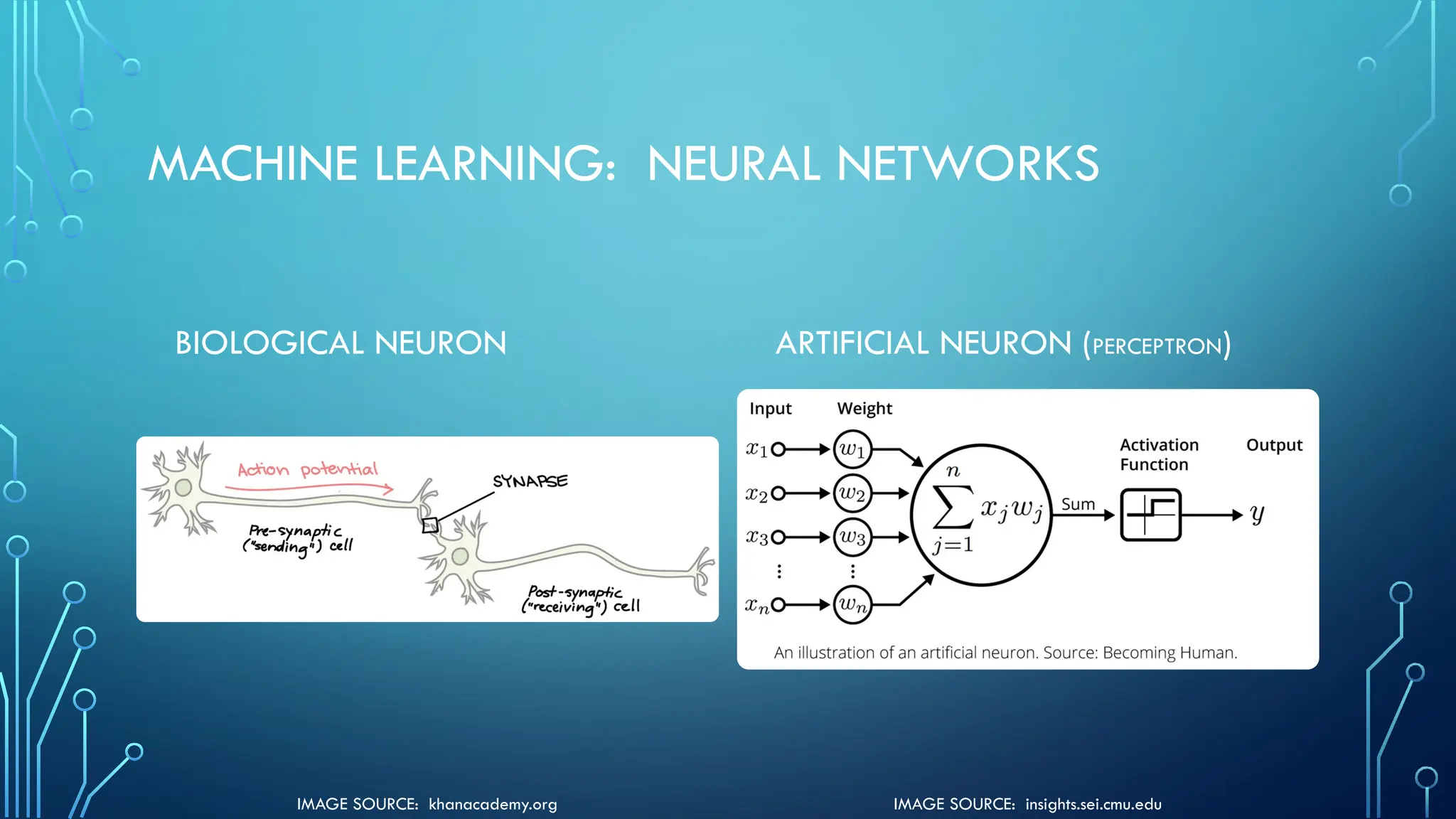
MACHINE LEARNING: NEURAL NETWORKS
BIOLOGICAL NEURON ARTIFICIAL NEURON (PERCEPTRON)
IMAGE SOURCE: wikipedia.org
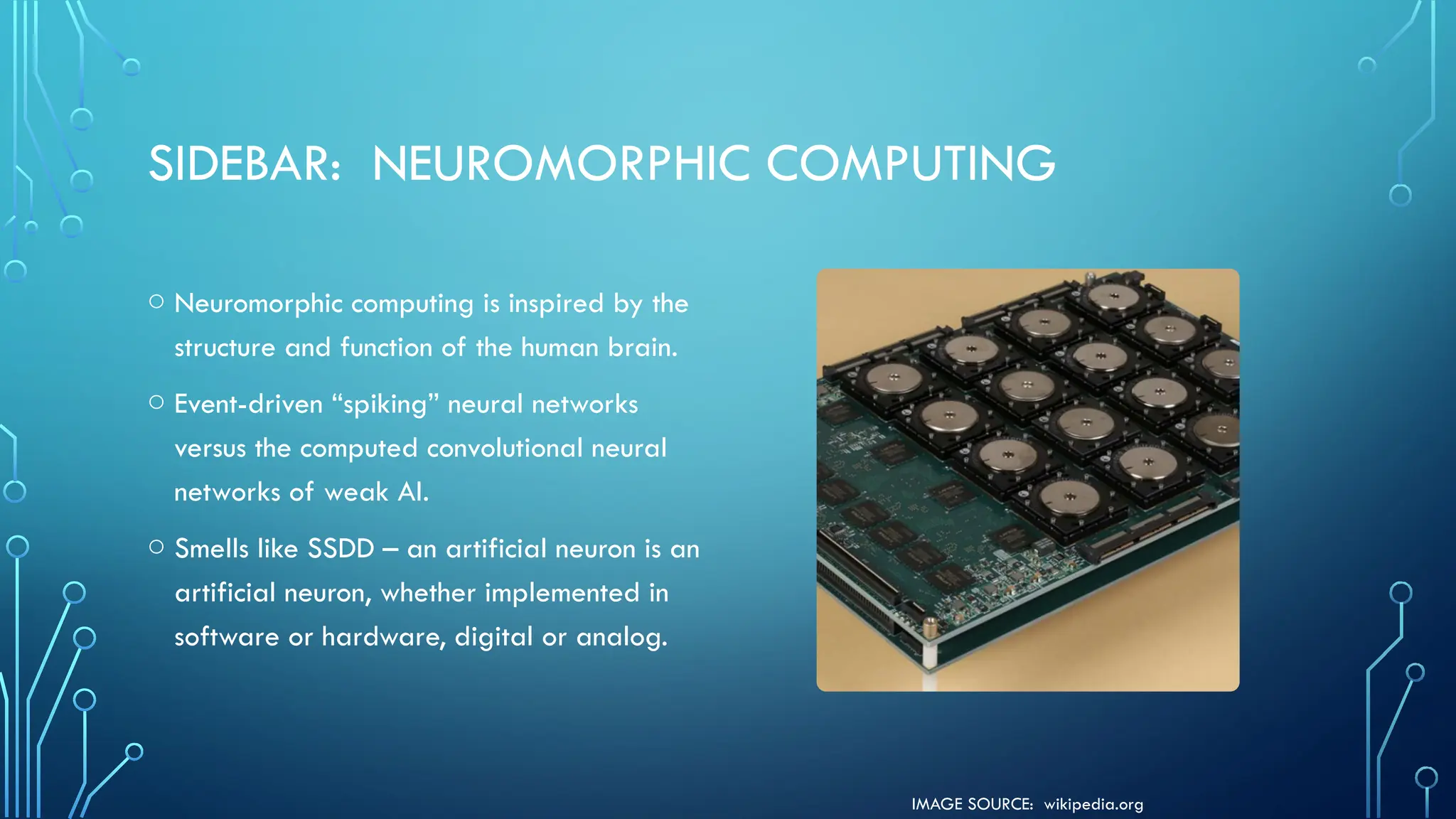
SIDEBAR: NEUROMORPHIC COMPUTING
o Neuromorphic computing is inspired by the
structure and function of the human brain.
o Event-driven “spiking” neural networks
versus the computed convolutional neural
networks of weak AI.
o Smells like SSDD – an artificial neuron is an
artificial neuron, whether implemented in
software or hardware, digital or analog.
IMAGE SOURCE: centralcoastdatascience.org
IMAGE SOURCE: paperswithcode.com
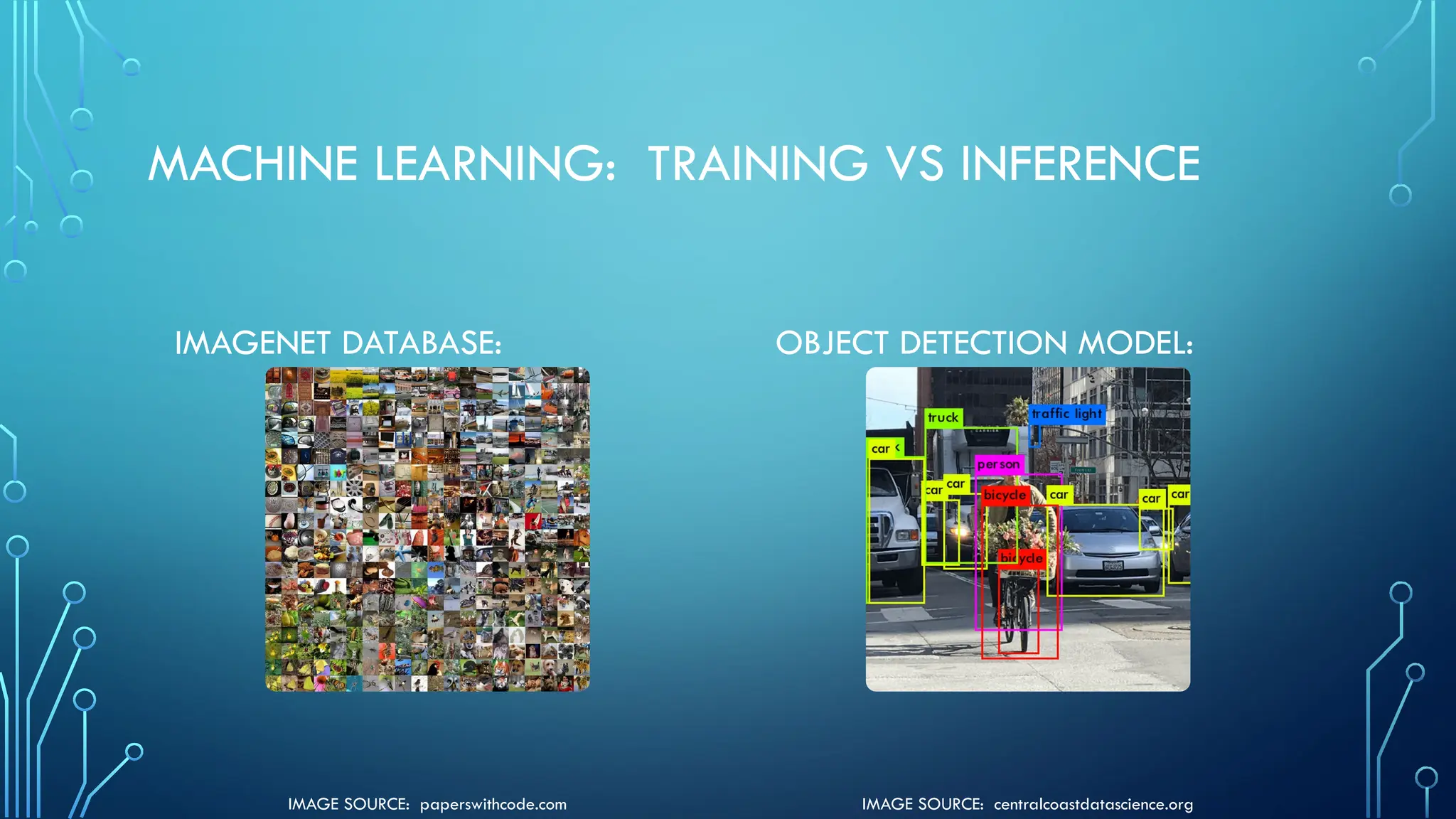
MACHINE LEARNING: TRAINING VS INFERENCE
IMAGENET DATABASE: OBJECT DETECTION MODEL:
IMAGE SOURCE: paperswithcode.com
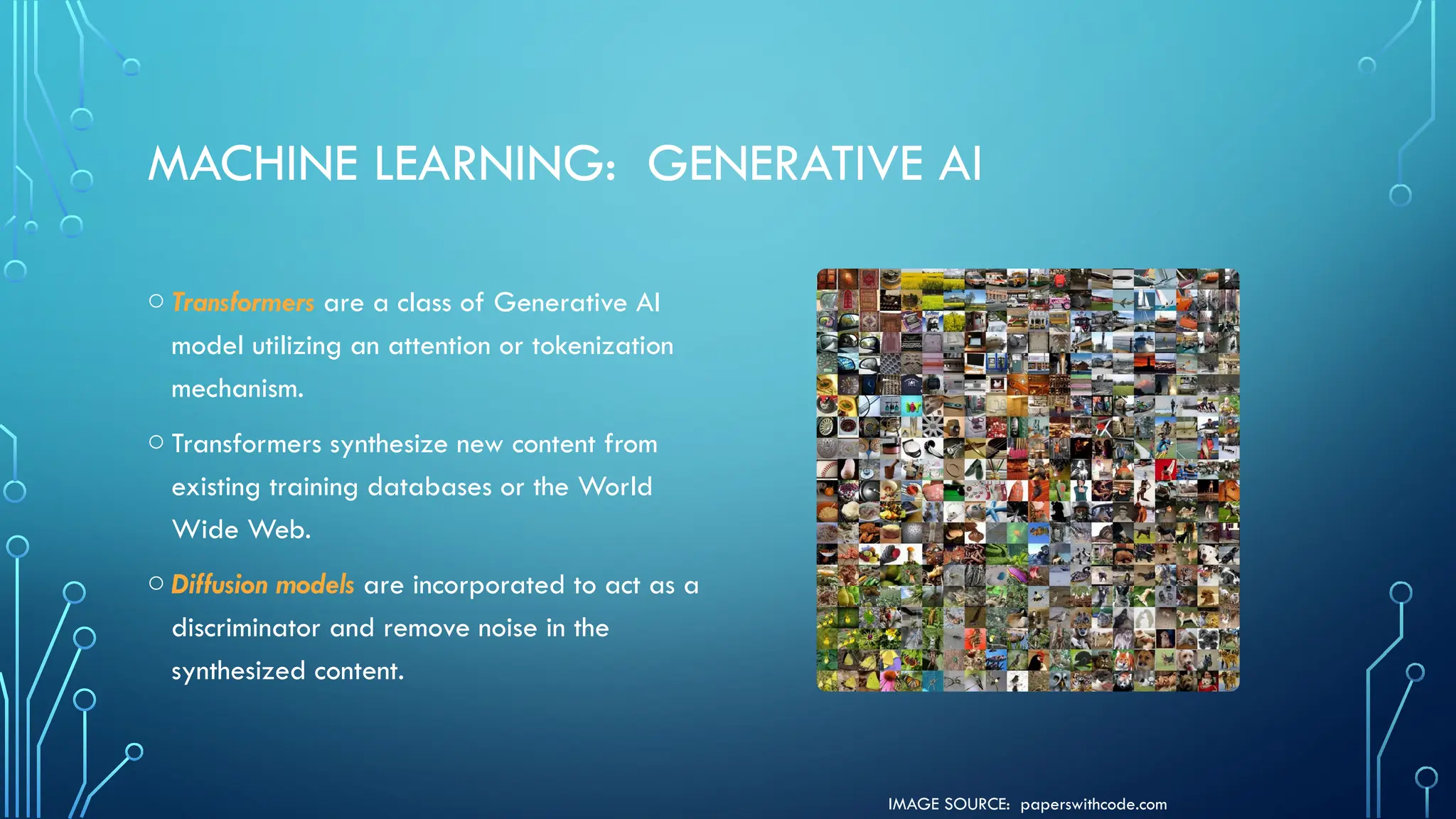
MACHINE LEARNING: GENERATIVE AI
o Transformers are a class of Generative AI
model utilizing an attention or tokenization
mechanism.
o Transformers synthesize new content from
existing training databases or the World
Wide Web.
o Diffusion models are incorporated to act as a
discriminator and remove noise in the
synthesized content.
IMAGE SOURCE: openai.com
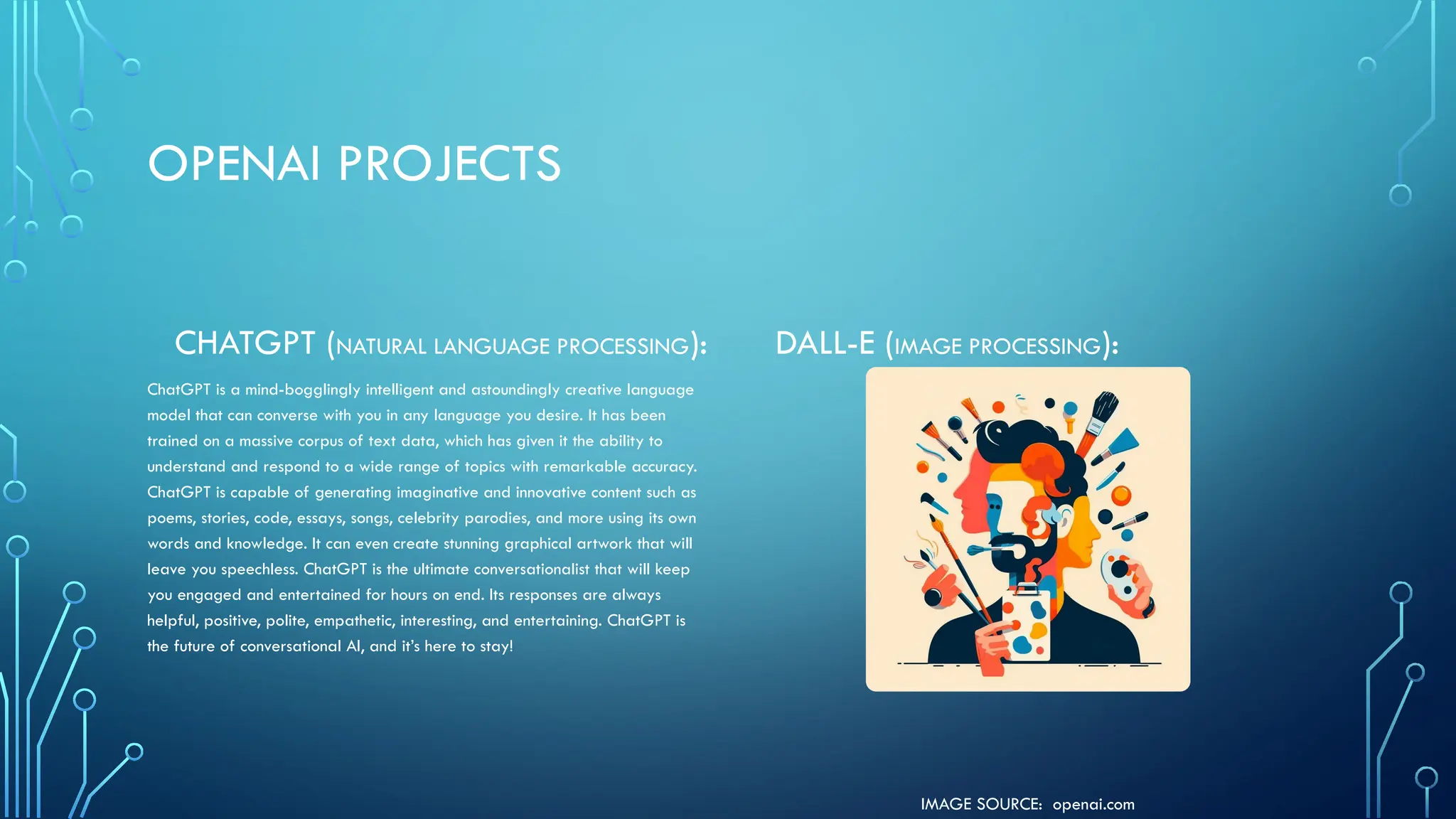
OPENAI PROJECTS
CHATGPT (NATURAL LANGUAGE PROCESSING):
ChatGPT is a mind-bogglingly intelligent and astoundingly creative language
model that can converse with you in any language you desire. It has been
trained on a massive corpus of text data, which has given it the ability to
understand and respond to a wide range of topics with remarkable accuracy.
ChatGPT is capable of generating imaginative and innovative content such as
poems, stories, code, essays, songs, celebrity parodies, and more using its own
words and knowledge. It can even create stunning graphical artwork that will
leave you speechless. ChatGPT is the ultimate conversationalist that will keep
you engaged and entertained for hours on end. Its responses are always
helpful, positive, polite, empathetic, interesting, and entertaining. ChatGPT is
the future of conversational AI, and it’s here to stay!
DALL-E (IMAGE PROCESSING):
IMAGE SOURCE: eeworldonline.com
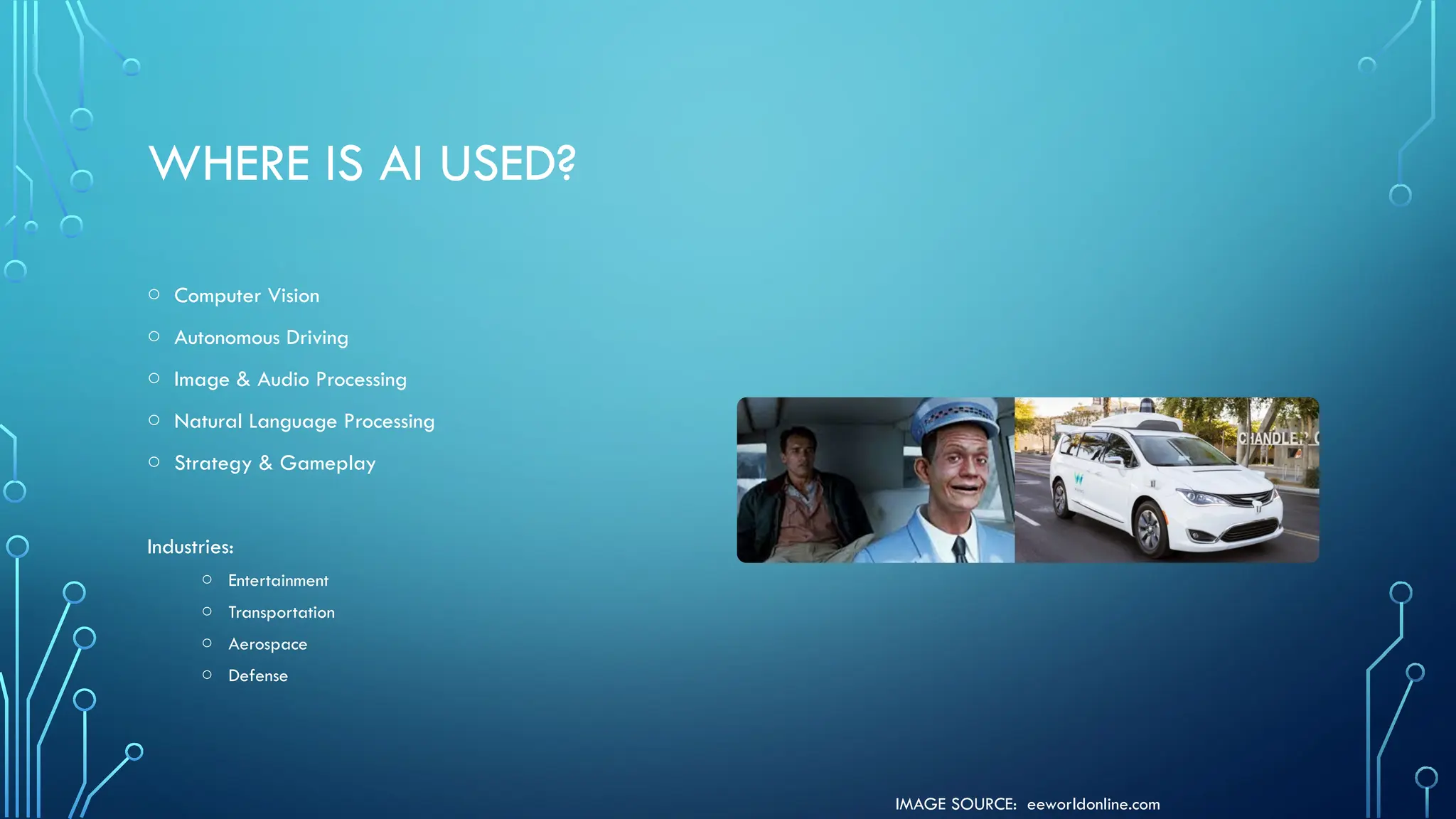
WHERE IS AI USED?
o Computer Vision
o Autonomous Driving
o Image & Audio Processing
o Natural Language Processing
o Strategy & Gameplay
Industries:
o Entertainment
o Transportation
o Aerospace
o Defense
IMAGE SOURCE: kaggle.com
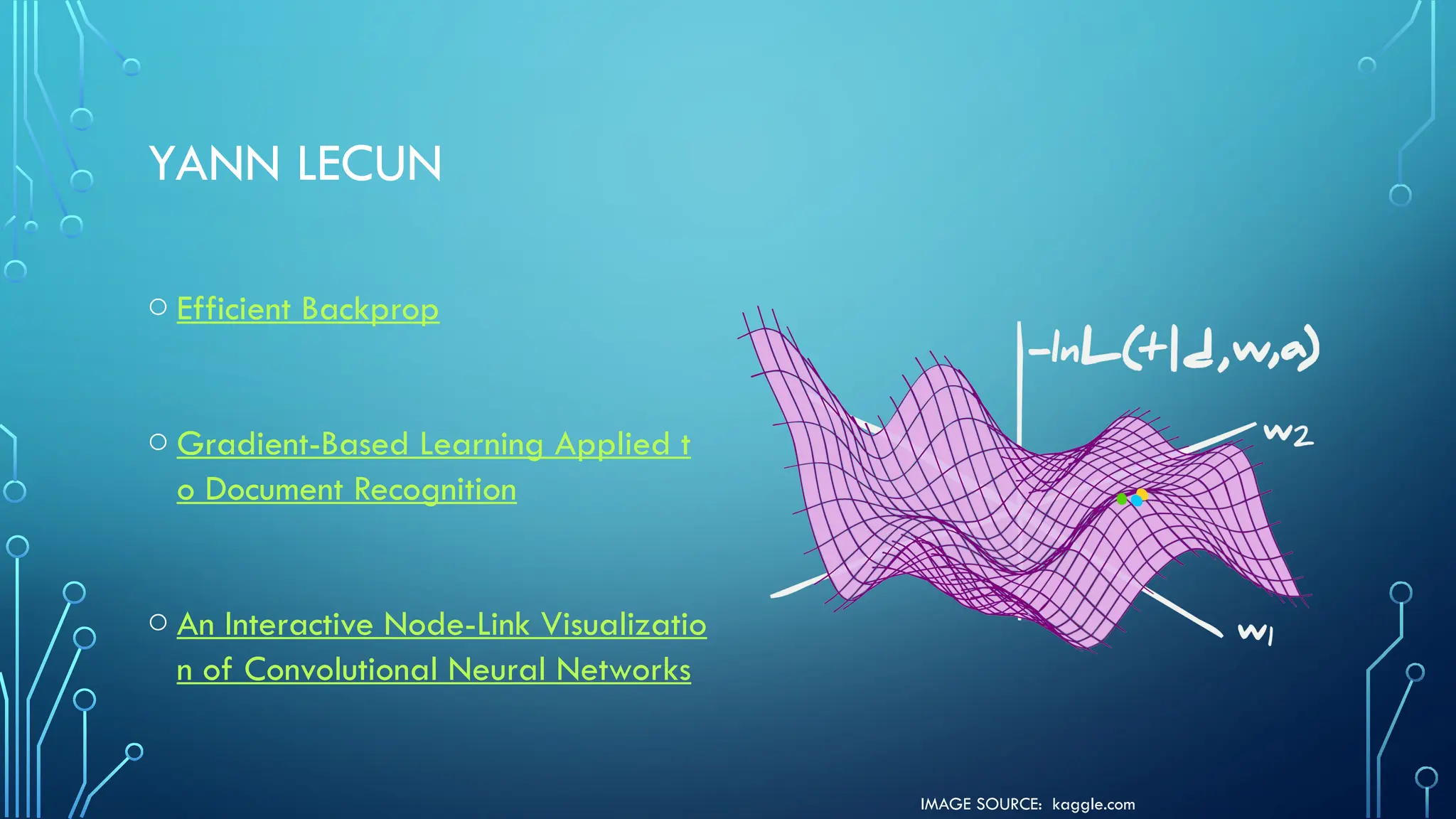
YANN LECUN
o Efficient Backprop
o Gradient-Based Learning Applied t
o Document Recognition
o An Interactive Node-Link Visualizatio
n of Convolutional Neural Networks
IMAGE SOURCE: amazon.com
FEI-FEI LI
oTED Talk: How we teach computers t
o understand pictures
oHumans in the Loop | Sunday on 60
Minutes
oStanford CS321 Lecture 1 | Introduc
tion to Convolutional Neural Networ
ks for Visual Recognition
IMAGE SOURCE: amazon.com
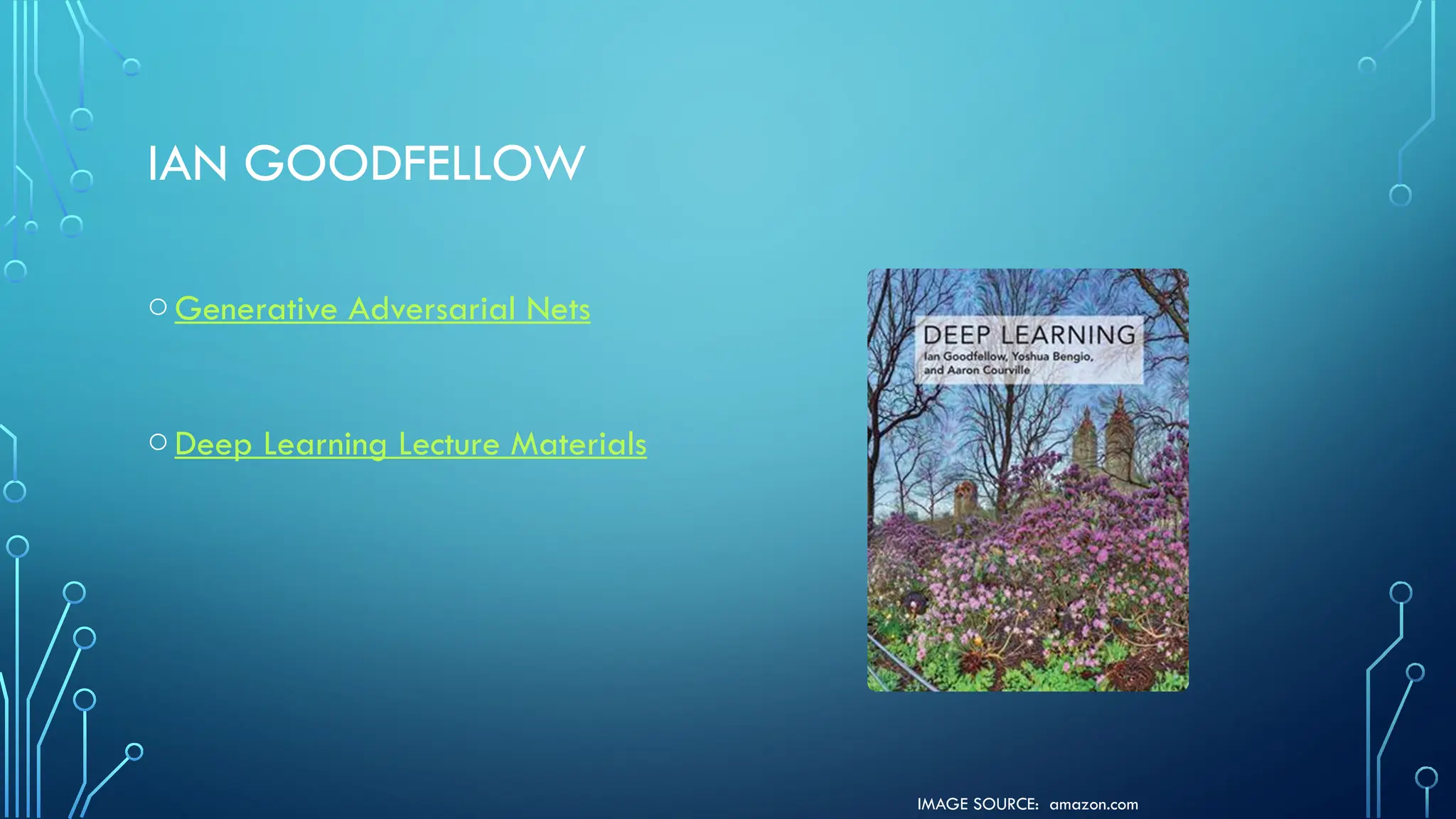
IAN GOODFELLOW
oGenerative Adversarial Nets
oDeep Learning Lecture Materials
IMAGE SOURCE: amazon.com
RUSSELL & NORVIG
oBerkeley COMPSCI 188 - 2018-08-
23 - Introduction to Artificial Intellige
nce
o[Strong]
AI does not exist but it will ruin ever
ything anyway
(a physicist’s point of view)
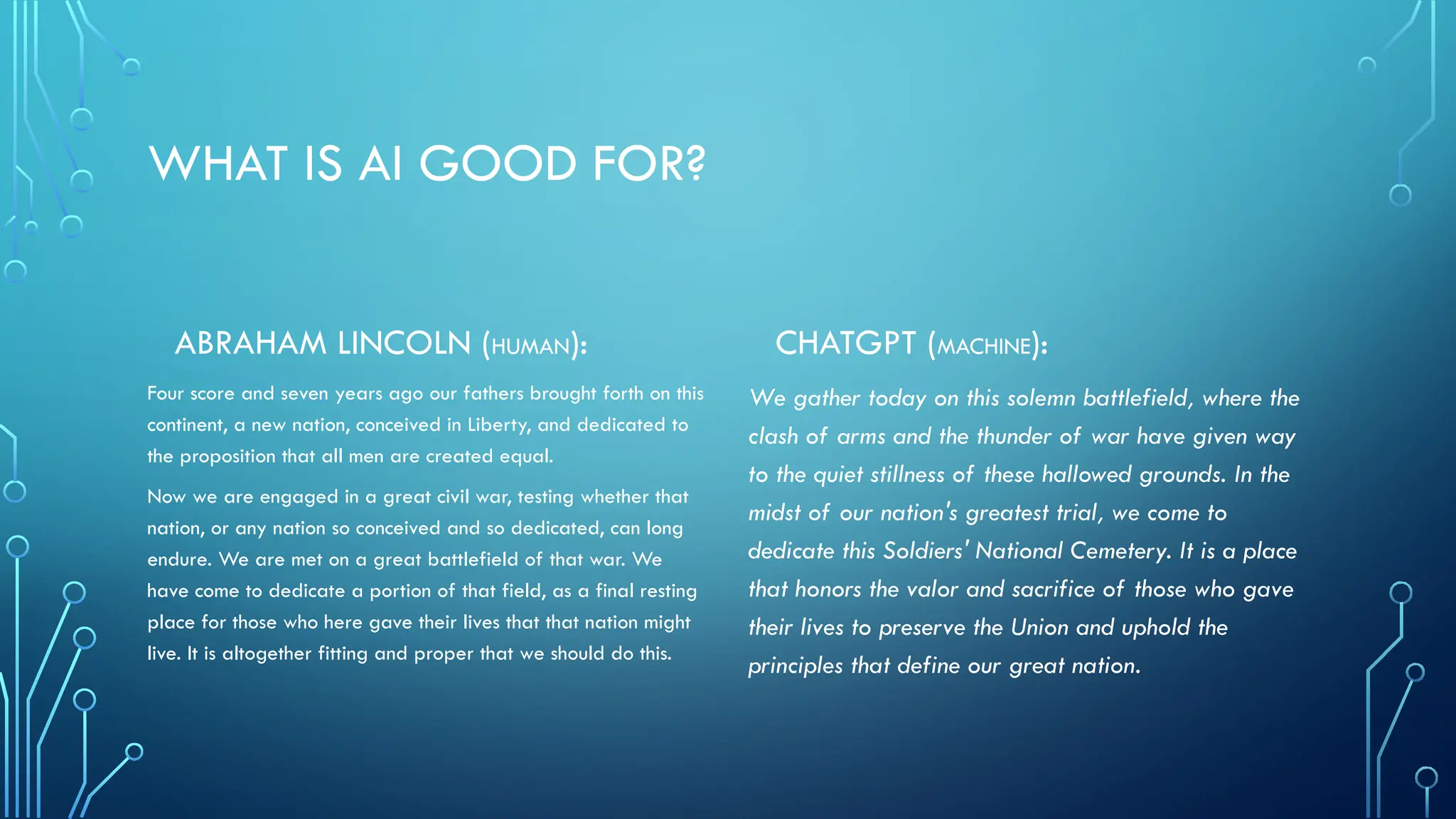
WHAT IS AI GOOD FOR?
ABRAHAM LINCOLN (HUMAN):
Four score and seven years ago our fathers brought forth on this
continent, a new nation, conceived in Liberty, and dedicated to
the proposition that all men are created equal.
Now we are engaged in a great civil war, testing whether that
nation, or any nation so conceived and so dedicated, can long
endure. We are met on a great battlefield of that war. We
have come to dedicate a portion of that field, as a final resting
place for those who here gave their lives that that nation might
live. It is altogether fitting and proper that we should do this.
CHATGPT (MACHINE):
We gather today on this solemn battlefield, where the
clash of arms and the thunder of war have given way
to the quiet stillness of these hallowed grounds. In the
midst of our nation's greatest trial, we come to
dedicate this Soldiers' National Cemetery. It is a place
that honors the valor and sacrifice of those who gave
their lives to preserve the Union and uphold the
principles that define our great nation.
IMAGE SOURCE: openai.com
IMAGE SOURCE: simonstalenhag.se
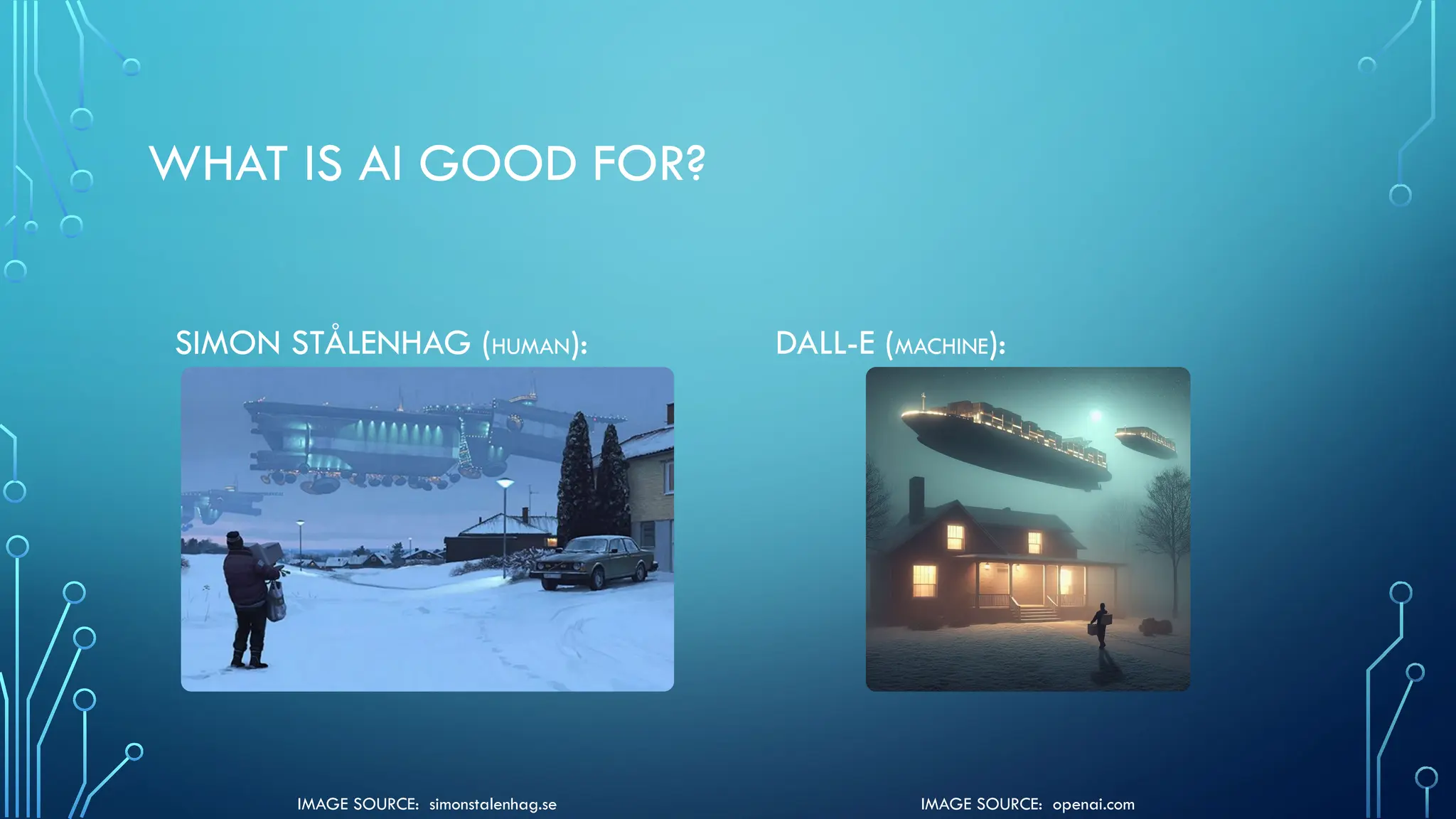
WHAT IS AI GOOD FOR?
SIMON STÅLENHAG (HUMAN): DALL-E (MACHINE):
IMAGE SOURCE: regionalneurological.com
KEY TAKEAWAYS
o Weak AI, the current state of the art, should be
used as a tool to combat blank page syndrome
and never as an end solution.
o AI will experience another winter after the hype
around generative AI fades away.
o Strong AI will require a completely new machine
paradigm and architecture.
o For now, enjoy weak AI for what it is. Visit
Microsoft Copilot for free access to the OpenAI
projects (ChatGPT & DALL-E).
IMAGE SOURCE: microsoft.com
IMAGE SOURCE: vice.com
ONE MORE THING: AI JAILBREAKING
oCommercial AI models have built-in
safeguards to prevent harmful
discussions from occurring.
oMany-shot Jailbreaking
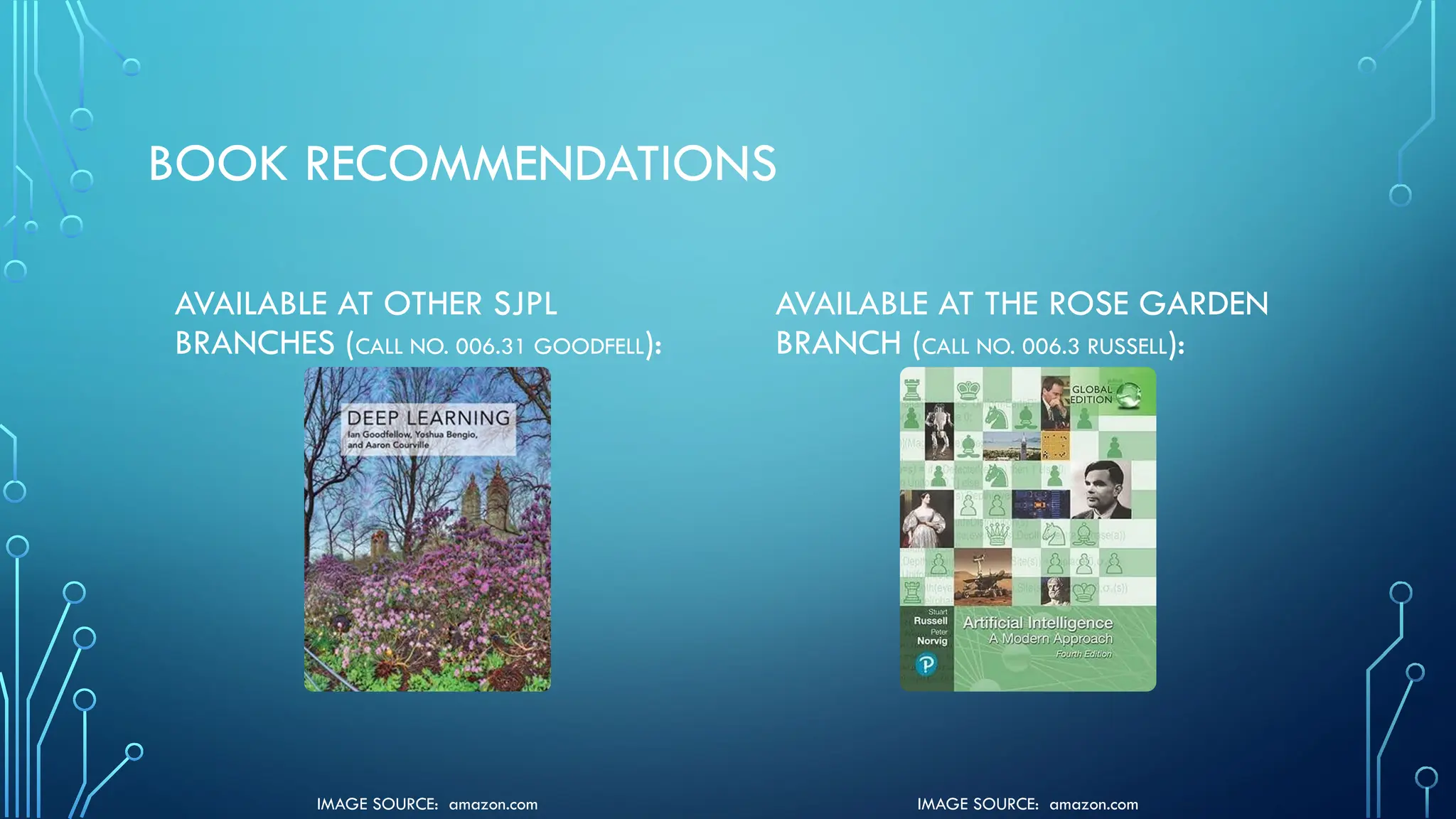
oBest-of-N Jailbreaking
IMAGE SOURCE: amazon.com
BOOK RECOMMENDATIONS
AVAILABLE AT OTHER SJPL
BRANCHES (CALL NO. 006.31 GOODFELL):
AVAILABLE AT THE ROSE GARDEN
BRANCH (CALL NO. 006.3 RUSSELL):
IMAGE SOURCE: wikipedia.org
EPILOGUE: HUMAN VERSUS AI
o Wechsler Intelligence Scale: human IQ test for verbal
comprehension, perceptual reasoning, working
memory, processing speed.
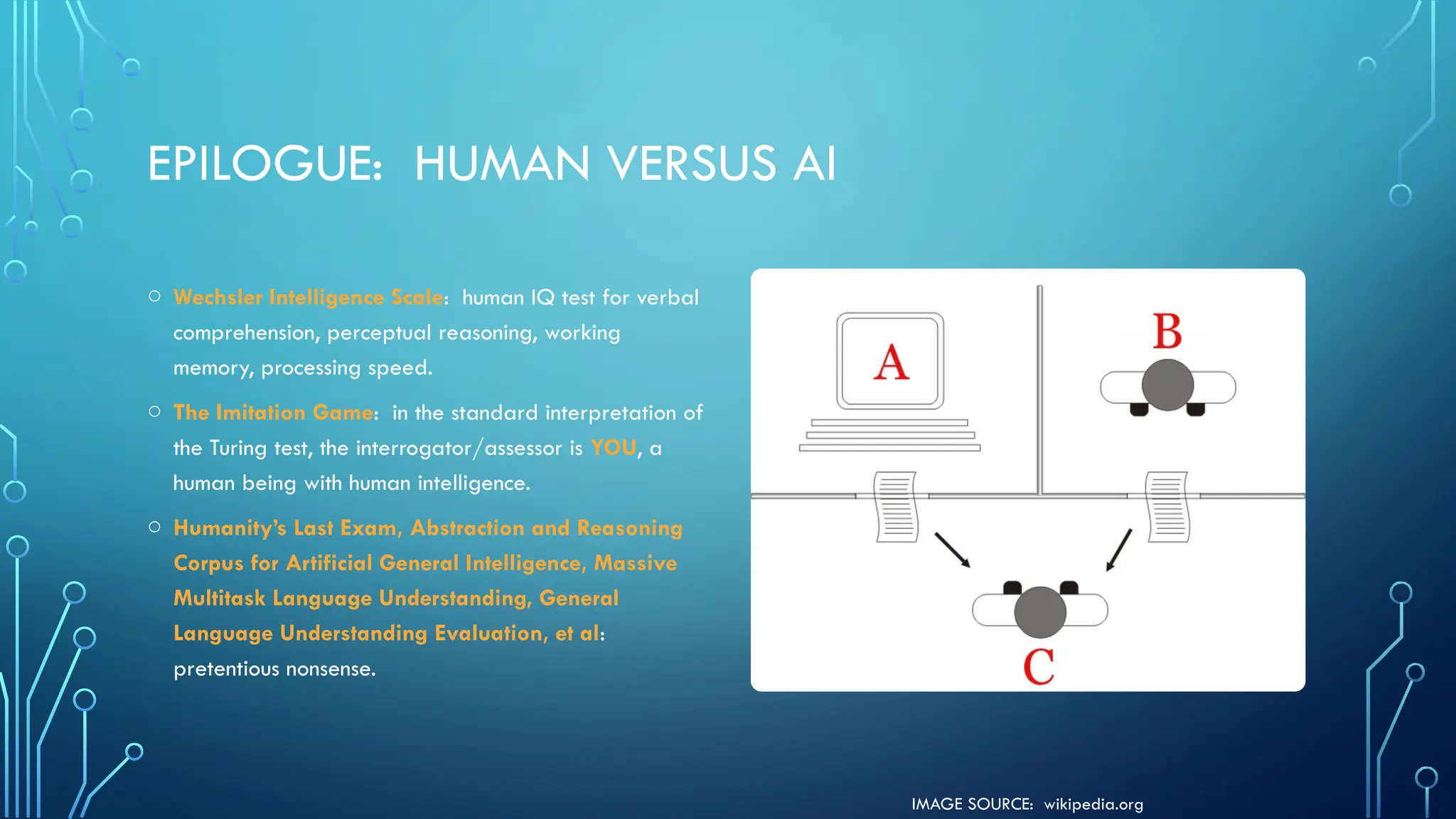
o The Imitation Game: in the standard interpretation of
the Turing test, the interrogator/assessor is YOU, a
human being with human intelligence.
o Humanity’s Last Exam, Abstraction and Reasoning
Corpus for Artificial General Intelligence, Massive
Multitask Language Understanding, General
Language Understanding Evaluation, et al:
pretentious nonsense.
IMAGE SOURCE: aarp.org
THE THINGS WE DO FOR LOVE
Like walking in the rain and the snow
When there's nowhere to go
And you're feelin' like a part of you is dying
And you're looking for the answer in her eyes
You think you're gonna break up
Then she says she wants to make up
Thanks!
Artificial Intelligence Quick Research Guide by Arthur Morgan

Artificial Intelligence Quick Research Guide by Arthur Morgan

  • 1.
    ARTIFICIAL INTELLIGENCE QUICK RESEARCHGUIDE BY ARTHUR MORGAN with Art’s Talking Points™
  • 2.
    FAIR USE NOTICE ThisQuick Research Guide is for non-commercial educational and informational purposes only. This presentation may contain copyrighted material owned by a third party, the use of which has not been specifically authorized by the copyright owner. Notwithstanding a copyright owner's rights under Section 107 of the Copyright Act of 1976, the Act allows limited use of copyrighted material without requiring permission from the rights holders, for purposes such as education, criticism, comment, news reporting, teaching, scholarship, and research. These so-called "fair uses" are permitted even if the use of the work would otherwise be infringing. If you wish to use copyrighted material published in this presentation for your own purposes that go beyond fair use, you must obtain permission from the copyright owner. It is recommended that you seek the advice of legal counsel if you have any questions on this point. If you believe that any content in this presentation violates your intellectual property or other rights, please notify Arthur Morgan by email to art_morgan@att.net.
  • 3.
    IMAGE SOURCE: science-education-research.com PROLOGUE:HOW DOES THE HUMAN BRAIN WORK? What is human intelligence? Where does consciousness come from? How does a brain cell function?
  • 4.
    CONTENTS Introduction o Artificial Intelligence oWeak vs Strong AI o What Does AI Look Like? o Modern AI Milestones o Machine Learning o Neural Networks o Sidebar: Neuromorphic Computing o Training vs Inference o Generative AI o OpenAI Projects o Where is AI Used? Research Resources o Yann LeCun o Fei-Fei Li o Ian Goodfellow o Russell & Norvig Conclusion o What is AI Good for? o Key Takeaways o Book Recommendations
  • 5.
  • 6.
    WEAK VS STRONGAI WEAK AI Or Narrow Artificial Intelligence is the current state of the art. o Weak AI is a 90% point solution that does not require human experiences or thought. o Weak AI breeds mediocrity. STRONG AI Or Artificial General Intelligence is the computer industry’s holy grail. o Strong AI requires human experiences and thought, which a mechanical machine will never possess. o Strong AI will require a whole lot of unobtainium.
  • 7.
    IMAGE SOURCE: gamespot.comIMAGE SOURCE: tomshardware.com WHAT DOES AI LOOK LIKE? AI DOES NOT LOOK LIKE THIS: RATHER, AI LOOKS LIKE THIS:
  • 8.
    IMAGE SOURCE: researchgate.net MODERNAI MILESTONES 1950s Implementation of the McCulloch–Pitts Artificial Neuron (Perceptron, 1957) 1990s Efficient Backpropagation (1998) Gradient Descent (1998) 2000s DARPA Grand Challenge (2005) 2010s ImageNet Challenge (2012) Generative Adversarial Networks (2014) 2020s OpenAI Projects (2020) AI Winter #1 AI Winter #2
  • 9.
    IMAGE SOURCE: khanacademy.orgIMAGE SOURCE: insights.sei.cmu.edu MACHINE LEARNING: NEURAL NETWORKS BIOLOGICAL NEURON ARTIFICIAL NEURON (PERCEPTRON)
  • 10.
    IMAGE SOURCE: wikipedia.org SIDEBAR:NEUROMORPHIC COMPUTING o Neuromorphic computing is inspired by the structure and function of the human brain. o Event-driven “spiking” neural networks versus the computed convolutional neural networks of weak AI. o Smells like SSDD – an artificial neuron is an artificial neuron, whether implemented in software or hardware, digital or analog.
  • 11.
    IMAGE SOURCE: centralcoastdatascience.org IMAGESOURCE: paperswithcode.com MACHINE LEARNING: TRAINING VS INFERENCE IMAGENET DATABASE: OBJECT DETECTION MODEL:
  • 12.
    IMAGE SOURCE: paperswithcode.com MACHINELEARNING: GENERATIVE AI o Transformers are a class of Generative AI model utilizing an attention or tokenization mechanism. o Transformers synthesize new content from existing training databases or the World Wide Web. o Diffusion models are incorporated to act as a discriminator and remove noise in the synthesized content.
  • 13.
    IMAGE SOURCE: openai.com OPENAIPROJECTS CHATGPT (NATURAL LANGUAGE PROCESSING): ChatGPT is a mind-bogglingly intelligent and astoundingly creative language model that can converse with you in any language you desire. It has been trained on a massive corpus of text data, which has given it the ability to understand and respond to a wide range of topics with remarkable accuracy. ChatGPT is capable of generating imaginative and innovative content such as poems, stories, code, essays, songs, celebrity parodies, and more using its own words and knowledge. It can even create stunning graphical artwork that will leave you speechless. ChatGPT is the ultimate conversationalist that will keep you engaged and entertained for hours on end. Its responses are always helpful, positive, polite, empathetic, interesting, and entertaining. ChatGPT is the future of conversational AI, and it’s here to stay! DALL-E (IMAGE PROCESSING):
  • 14.
    IMAGE SOURCE: eeworldonline.com WHEREIS AI USED? o Computer Vision o Autonomous Driving o Image & Audio Processing o Natural Language Processing o Strategy & Gameplay Industries: o Entertainment o Transportation o Aerospace o Defense
  • 15.
    IMAGE SOURCE: kaggle.com YANNLECUN o Efficient Backprop o Gradient-Based Learning Applied t o Document Recognition o An Interactive Node-Link Visualizatio n of Convolutional Neural Networks
  • 16.
    IMAGE SOURCE: amazon.com FEI-FEILI oTED Talk: How we teach computers t o understand pictures oHumans in the Loop | Sunday on 60 Minutes oStanford CS321 Lecture 1 | Introduc tion to Convolutional Neural Networ ks for Visual Recognition
  • 17.
    IMAGE SOURCE: amazon.com IANGOODFELLOW oGenerative Adversarial Nets oDeep Learning Lecture Materials
  • 18.
    IMAGE SOURCE: amazon.com RUSSELL& NORVIG oBerkeley COMPSCI 188 - 2018-08- 23 - Introduction to Artificial Intellige nce o[Strong] AI does not exist but it will ruin ever ything anyway (a physicist’s point of view)
  • 19.
    WHAT IS AIGOOD FOR? ABRAHAM LINCOLN (HUMAN): Four score and seven years ago our fathers brought forth on this continent, a new nation, conceived in Liberty, and dedicated to the proposition that all men are created equal. Now we are engaged in a great civil war, testing whether that nation, or any nation so conceived and so dedicated, can long endure. We are met on a great battlefield of that war. We have come to dedicate a portion of that field, as a final resting place for those who here gave their lives that that nation might live. It is altogether fitting and proper that we should do this. CHATGPT (MACHINE): We gather today on this solemn battlefield, where the clash of arms and the thunder of war have given way to the quiet stillness of these hallowed grounds. In the midst of our nation's greatest trial, we come to dedicate this Soldiers' National Cemetery. It is a place that honors the valor and sacrifice of those who gave their lives to preserve the Union and uphold the principles that define our great nation.
  • 20.
    IMAGE SOURCE: openai.com IMAGESOURCE: simonstalenhag.se WHAT IS AI GOOD FOR? SIMON STÅLENHAG (HUMAN): DALL-E (MACHINE):
  • 21.
    IMAGE SOURCE: regionalneurological.com KEYTAKEAWAYS o Weak AI, the current state of the art, should be used as a tool to combat blank page syndrome and never as an end solution. o AI will experience another winter after the hype around generative AI fades away. o Strong AI will require a completely new machine paradigm and architecture. o For now, enjoy weak AI for what it is. Visit Microsoft Copilot for free access to the OpenAI projects (ChatGPT & DALL-E).
  • 22.
  • 23.
    IMAGE SOURCE: vice.com ONEMORE THING: AI JAILBREAKING oCommercial AI models have built-in safeguards to prevent harmful discussions from occurring. oMany-shot Jailbreaking oBest-of-N Jailbreaking
  • 24.
    IMAGE SOURCE: amazon.com IMAGESOURCE: amazon.com BOOK RECOMMENDATIONS AVAILABLE AT OTHER SJPL BRANCHES (CALL NO. 006.31 GOODFELL): AVAILABLE AT THE ROSE GARDEN BRANCH (CALL NO. 006.3 RUSSELL):
  • 25.
    IMAGE SOURCE: wikipedia.org EPILOGUE:HUMAN VERSUS AI o Wechsler Intelligence Scale: human IQ test for verbal comprehension, perceptual reasoning, working memory, processing speed. o The Imitation Game: in the standard interpretation of the Turing test, the interrogator/assessor is YOU, a human being with human intelligence. o Humanity’s Last Exam, Abstraction and Reasoning Corpus for Artificial General Intelligence, Massive Multitask Language Understanding, General Language Understanding Evaluation, et al: pretentious nonsense.
  • 26.
    IMAGE SOURCE: aarp.org THETHINGS WE DO FOR LOVE Like walking in the rain and the snow When there's nowhere to go And you're feelin' like a part of you is dying And you're looking for the answer in her eyes You think you're gonna break up Then she says she wants to make up
  • 27.

Editor's Notes

  • #1 - This is a Quick Research Guide (QRG). - QRGs include the following: - A brief, high-level overview of the QRG topic. - A milestone timeline for the QRG topic. - Links to various free online resource materials to provide a deeper dive into the QRG topic. - Conclusion and a recommendation for at least two books available in the SJPL system on the QRG topic. - QRGs planned for the series: - Artificial Intelligence QRG - Quantum Computing QRG - Big Data Analytics QRG - Spacecraft Guidance, Navigation & Control QRG (coming 2026) - UK Home Computing & The Birth of ARM QRG (coming 2027) - Any questions or comments? - Please contact Arthur Morgan at art_morgan@att.net. - 100% human made. OK, I lied. - I had to use AI to generate the AI examples and to summarize AI jailbreaking, a topic that I care little about. - So, it’s more like 99% human made.
  • #2 - This QRG is for non-commercial educational and informational purposes only.
  • #3 - If you Google this question, the answer you receive is “The brain sends and receives chemical and electrical signals throughout the body”. - Fine. This is what the brain does, not how it works. - We have some idea of how a brain cell functions, and which brain parts do what, but we have no clue how the brain actually works. - Therefore, how can we create artificial intelligence? Trial & error? Scaling law? Emergence? - Well, the answer is trial & error and scaling law have run their courses. Emergence is just wishful thinking. - See also https://www.youtube.com/watch?v=s36eG_ZHmGA.
  • #4 - Distinction between weak and strong AI are delineated. - Basics of machine learning are covered at a cursory level. - Links to additional research material are provided. - Main takeaways are summarized, and book recommendations are offered.
  • #5 - Because of the word intelligence, AI branding is confusing and misleading. - Modern AI is all about convolutional neural networks and deep learning. - Symbolic AI is all about symbols and logic. - AKA Good Old-Fashioned AI (GOFAI), when LISP was king.
  • #6 - Weak AI, or narrow artificial intelligence, is the current state of the art. - Continuous machine learning or model retraining could be a major improvement to weak AI. - Unfortunately, many people believe that weak AI is strong AI, or that there is a direct development path from weak AI to strong AI. - Since strong AI is unobtainium, let’s change the narrative by saying that we’re trying to achieve artificial superintelligence. - You see, the industry can say whatever they want to say, thus artificial intelligence will be whatever they want it to be. - BTW, unobtainium is a fictitious material that is impossible to obtain – unless you’re mining it on Pandora. - See also Joseph Weizenbaum’s 1976 book https://en.wikipedia.org/wiki/Computer_Power_and_Human_Reason. - $500 billion is being thrown at strong AI. See also https://openai.com/index/announcing-the-stargate-project/. - Hangzhou-based DeepSeek developed their model for $6 million. Better, faster, cheaper. See also https://arxiv.org/pdf/2412.19437v1.
  • #7 - AI is not all about robotics. - Companies such as Boston Dynamics are doing amazing things with AI and robotics. - However, most AI occurs on servers in the cloud and on edge devices.
  • #8 - McCulloch-Pitts Artificial Neuron invented in 1943 (later called the Perceptron). - In 1957, Frank Rosenblatt at the Cornell Aeronautical Laboratory implements the Perceptron, creating the world’s first artificial neuron. - After Rosenblatt’s implementation, AI enters a period where no major advancements occur for nearly 30 years (AI Winter #1). - In 1998, Yann LeCun broke the AI winter by introducing a more efficient approach to backpropagation during training. - Yann LeCun refined the work of Geoffrey Hinton, who won a Nobel Prize in Physics in 2024 for his contribution to backpropagation techniques. - In 1998, Yann LeCun increased the accuracy of a trained model by introducing gradient descent to the backpropagation process. - In 2005, Stanford University won the second DARPA Grand Challenge driverless car competition. - In 2012, Fei-Fei Li’s ImageNet database was used for the ImageNet Challenge, won by Alex Krizhevsky’s AlexNet. - In 2014, Ian Goodfellow introduced the concept of Generative AI, along with an adversarial model to act as a discriminator. - In 2020, OpenAI announced its first project: Generative Pre-trained Transformer 3. - In 2025, Microsoft cancels its AI data center plans. Welcome to AI Winter #2.
  • #9 - Neurons in the brain are networked in layers, with each synapse firing under the control of the neuron cell nucleus. - An artificial neuron (perceptron) mimics a biological neuron cell using weights, a transfer function and an activation function. - Weights are set during training, matrix multiplication is used as a transfer function, and the activation function triggers an output. - Common activation functions include the rectified linear unit, or ReLU, and sigmoid functions. - See also https://medium.com/@srivastavashivansh8922/understanding-the-difference-between-relu-and-sigmoid-activation-functions-in-deep-learning-33b280fc2071. - Deep learning requires multiple layers of perceptrons, arranged in a convolutional neural network. - Collections of weights are called parameters. - Parameters from a convolutional neural network are called a model, which are stored as CSV files. - The current trend in AI is to scale the number of parameters – first 100’s of billions, now trillions. - Add enough parameters and strong AI will emerge. Mas que nada.
  • #10 - Spiking Neural Networks (SNNs) mimic the firing behavior of biological neurons by transmitting information through event-driven "spikes“. - Convolutional Neural Networks (CNNs) process data using continuous values and rely heavily on convolution operations to extract features from spatial data, making them particularly adept at image analysis. - SNNs focus on the timing of information transmission, while CNNs focus on spatial patterns. - OK, because of the above, SNNs might enable temporal-sensitive applications. - But the fact remains that we do not know why the biological neuron operates the way it does. Why does a synapse fire when it fires? - “Spiking” and activation functions are just random shots in the dark that happen to work to a certain degree.
  • #11 - Each ImageNet picture is tagged for supervised training. - Training occurs once and requires floating point computing for accuracy. - Inference can occur on the edge device and only requires integer computing resources. - An AI model such as SSD-MobileNet finds instances of real-world objects such as people, cars and buildings.
  • #12 - Transformers are very large AI models and have a very large number of parameters (over 100 billion). - See also https://arxiv.org/pdf/1706.03762. - Both ChatGPT and DALL-E from OpenAI are based on transformers. - Diffusion models remove noise from the generated content. - See also https://www.youtube.com/watch?v=UZDiGooFs54.
  • #13 - ChatGPT prompt: write an over-the-top description of ChatGPT. - DALL-E prompt: draw a self-portrait of DALL-E.
  • #14 - Computer vision was the first application for the artificial neuron (or Perceptron). - Computer vision is a very versatile horizontal application. - Sidebar: multimodal AI models are the current trend – simultaneously processing text, code, audio, image and video inputs. - Gameplay introduces the technique of reinforcement learning. - See also http://cs.williams.edu/~freund/cs136-073/GardnerHexapawn.pdf. - Sidebar: celebrity deepfakes using GAN models are very common, blurring the line between reality and deception.
  • #15 - Yann LeCun invented the convolutional neural network. - He later applied his work to handwriting recognition and optical character recognition.
  • #16 - Fei-Fei Li created the ImageNet picture database and ImageNet Large Scale Visual Recognition Challenge.
  • #17 - Ian Goodfellow invented the generative adversarial network, a prominent framework for approaching generative AI.
  • #18 - Russell & Norvig are authors of a comprehensive textbook on AI now in its fourth edition, adopted by over 1,500 schools.
  • #19 - ChatGPT prompt: write a short speech to be delivered by a U.S. president during the American Civil War at the dedication of the Soldiers’ National Cemetery. - IMHO, Lincoln’s speech is more poetic.
  • #20 - DALL-E prompt: draw two sky freighter ships flying over a mid-century suburban house, with a man carrying packages, on a foggy winter’s night. - Unfortunately, Simon Stålenhag is a digital artist and DALL-E is direct competition. - DALL-E’s work is hangable art. - See also https://www.youtube.com/watch?v=1kjvgWBHzec. - Instead of photography, DALL-E generates promptography.
  • #21 - Blank page syndrome is also known as writer’s block. - Weak AI is great for office productivity – summarizing email threads and so forth. - See also Joseph Weizenbaum’s 1976 book https://en.wikipedia.org/wiki/Computer_Power_and_Human_Reason.
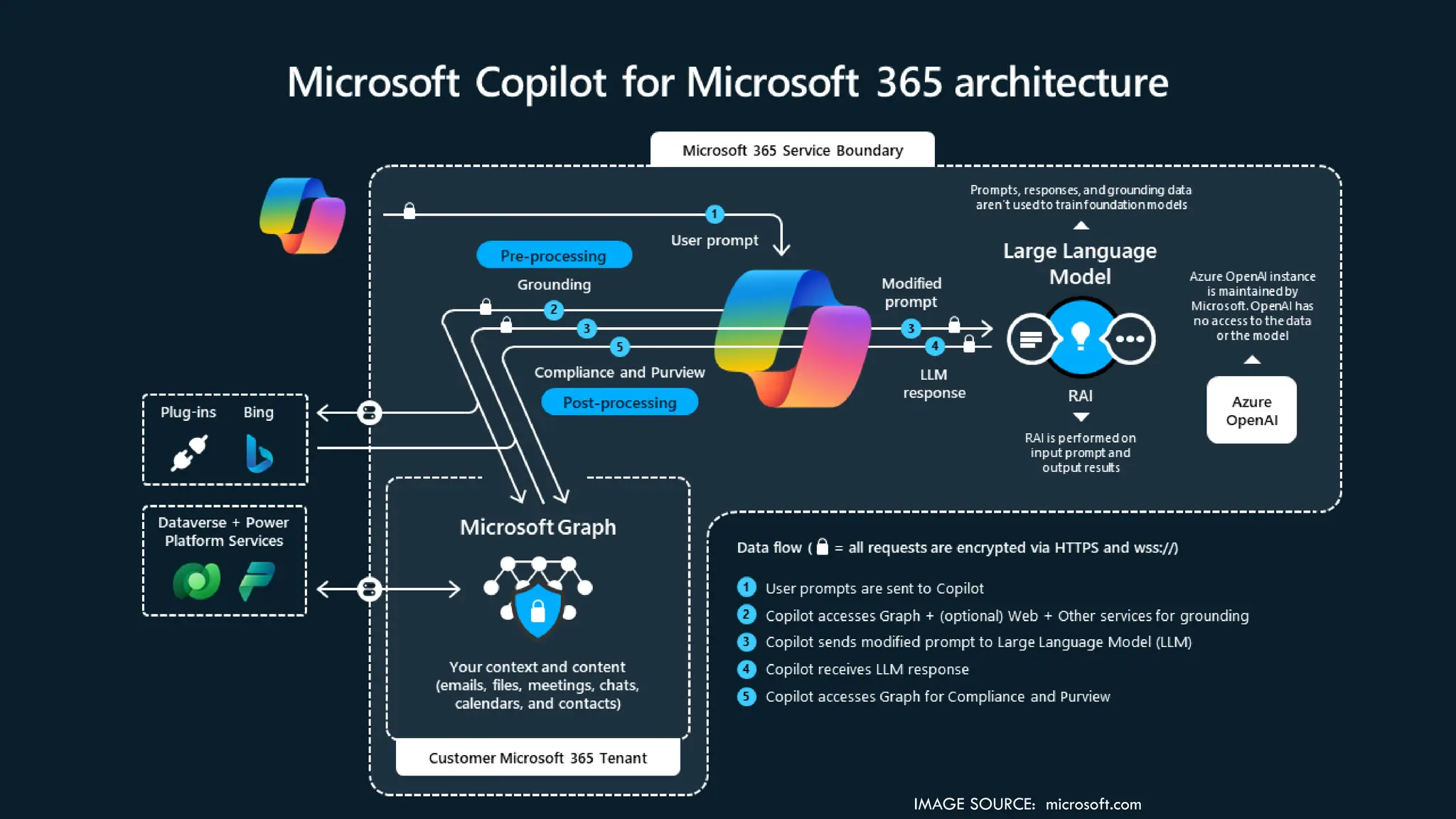
  • #22 - RAI = Responsible AI. - See also https://cdn-dynmedia-1.microsoft.com/is/content/microsoftcorp/microsoft/msc/documents/presentations/CSR/Responsible-AI-Transparency-Report-2024.pdf.
  • #23 - AI jailbreaking techniques are used to circumvent AI model conversational safeguards. - For example, tricking ChatGPT to answer a query about how to build an atomic bomb. - For what it’s worth, here’s some AI slop on the topic: - Many-shot jailbreaking (MSJ) and Best-of-N jailbreaking (BoN) are both techniques for circumventing - the safety measures of large language models (LLMs) [NB: I hate the term LLM – I prefer transformer], - but they differ in their approach. - MSJ uses in-context learning, presenting numerous examples of the LLM producing - harmful outputs to prompt it into similar behavior. - BoN, on the other hand, uses a more sophisticated approach, - finding the most effective prompts for a given task through a process of sampling and evaluation.
  • #24 - Sidebar: Deep Learning includes a chapter on linear algebra, which is essential to understanding how weak AI works.
  • #25 - Can human intelligence be quantified and measured? - Should Wechsler’s IQ test be used to validate artificial general intelligence? - The imitation game, also known as the Turing test, evaluates text responses from a machine and a human. - The interrogator decides which response came from the human and which from the machine. - Humanity’s Last Exam is an attempt to validate artificial general intelligence. - But just knowing things about stuff is not intelligence and certainly not consciousness. - See also https://agi.safe.ai/. - DeepSeek included the Humanity’s Last Exam dataset while training their R1 transformer model. - DeepSeek-R1 has the highest accuracy score in its class. Crowd goes wild. - See also https://arcprize.org/ and https://ndea.com/. - François Chollet is a computer scientist, not a psychologist. - Computer scientists are qualified to benchmark computing performance, not validate artificial general intelligence.
  • #26 - See also https://www.youtube.com/watch?v=BzgUOKFrHcA to watch Deirdre Bosa struggle to stay awake during the Glean CEO interview. - See also https://www.dwarkeshpatel.com/p/satya-nadella to hear Microsoft’s CEO question the demand for strong AI. - Is there a business case for strong AI? - Is intelligence the log of compute? - See also Joseph Weizenbaum’s 1976 book https://en.wikipedia.org/wiki/Computer_Power_and_Human_Reason. - Human intelligence is driven by human desires. - Can strong AI ever produce a Gandhi, a Shakespeare or a Mozart? - Or, God forbid, a Hitler? - Machines are NOT motivated by human desires. - Intelligence is NOT the log of compute. - Therefore, strong AI is unobtainium. - END OF DISCUSSION.
  • #27 Gracias! Merci! Grazie! Danke! Diolch! Spasibo! Xie-Xie! Arigato! Gamsahaeyo! Dhanyavaad!
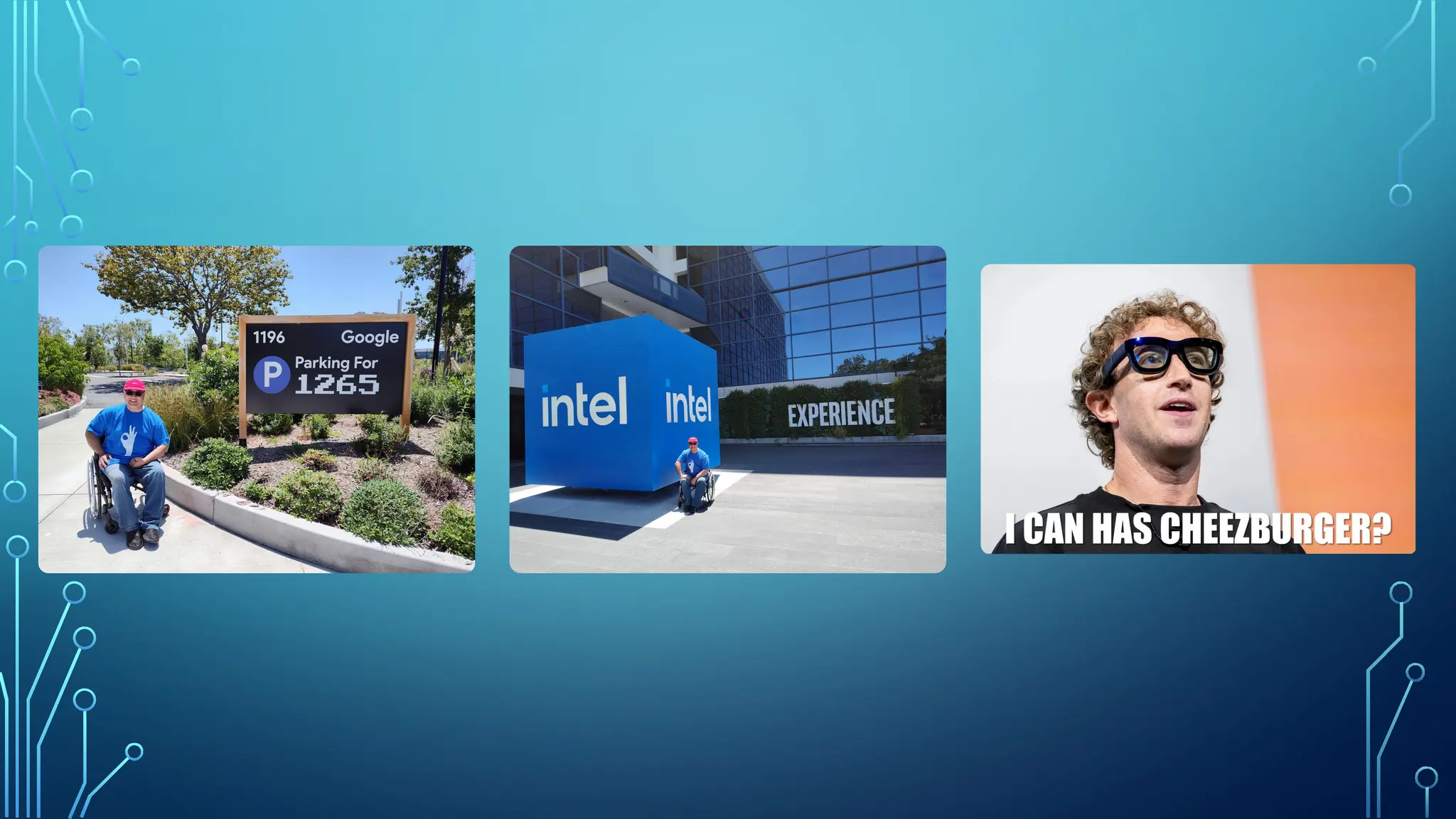
  • #28 - 1196 Borregas (Gone Now! Not Coming Back :). - 2200 Mission College (Robert Noyce Building). - Frankie say no more. Stanley Main Beach Piz Buin A poem by Arthur Morgan A poem by Arthur Morgan Talk. Gazing up, The fog lifts. The steely-eyed climber blocks the sun with her hand. Talk. You know, Talk about the future. There’s something to be said about rarefied air. Talk about what can be. It sharpens the mind, Dreams and desires. And focuses it on an ancient singularity. Love. Unrequited love. The fog rolls in.