Unang Digmaang
Pandaigdig
1914-1918
Jose S. Espina
Mga Pangyayaring Nagbunsod sa
Unang Digmaang Pandaigdig
• Pag-unlad ng Kakayahang Pangmilitar ng
mga Bansa sa Europa - Militarismo
• Pagbuo ng Alyansa
• Imperyalismo
• Nasyonalismo
• Pagpaslang kay Archduke Franz Ferdinand
ng Austria
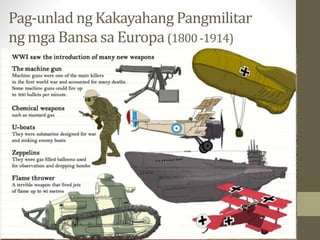
Pag-unlad ng Kakayahang Pangmilitar
ng mga Bansa sa Europa (1800-1914)
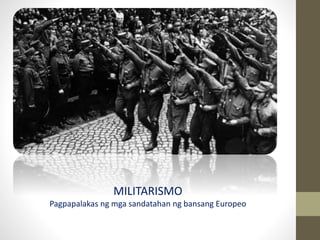
MILITARISMO
Pagpapalakas ng mga sandatahan ng bansang Europeo
Mga Unang Alyansa
• Germany and Austria-Hungary had been part of the Three
Emperors' League, formed in 1872, along with Russia. The
three emperors were Russian Tsar Alexander II, German
Kaiser Wilhelm I, and Austro-Hungarian Emperor
Franz Josef. That arrangement disintegrated because
Austria-Hungary and Russia came to be at odds over the
expansionary intentions of both countries, which overlapped
in the Balkans.
• In an effort to extend its borders and influence, Austria-
Hungary occupied Bosnia-Herzegovina in 1878. About the
same time, a nearby dispute between Russia and Turkey over
control of Serbia led to the Russo-Turkish War. Serbia gained
its independence as a result of this conflict, and Russia
pledged its support to the strong, newly independent country.
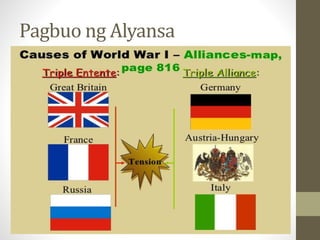
Pagbuo ng Alyansa
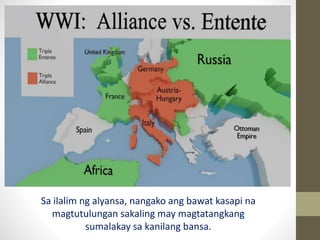
Sa ilalim ng alyansa, nangako ang bawat kasapi na
magtutulungan sakaling may magtatangkang
sumalakay sa kanilang bansa.
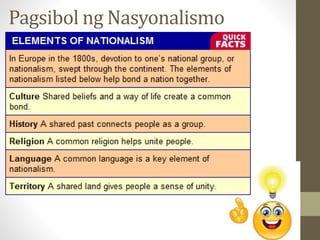
Pagsibol ng Nasyonalismo
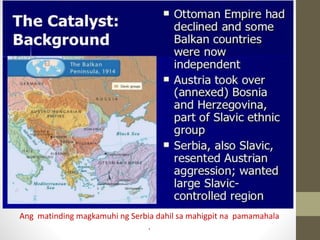
Ang matinding magkamuhi ng Serbia dahil sa mahigpit na pamamahala
.
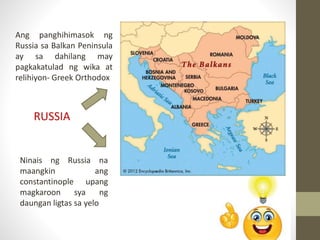
Ang panghihimasok ng
Russia sa Balkan Peninsula
ay sa dahilang may
pagkakatulad ng wika at
relihiyon- Greek Orthodox
Ninais ng Russia na
maangkin ang
constantinople upang
magkaroon sya ng
daungan ligtas sa yelo
RUSSIA
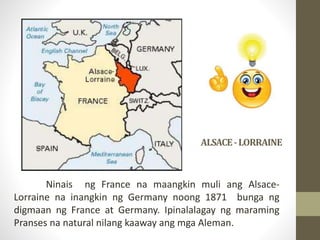
ALSACE-LORRAINE
Ninais ng France na maangkin muli ang Alsace-
Lorraine na inangkin ng Germany noong 1871 bunga ng
digmaan ng France at Germany. Ipinalalagay ng maraming
Pranses na natural nilang kaaway ang mga Aleman.
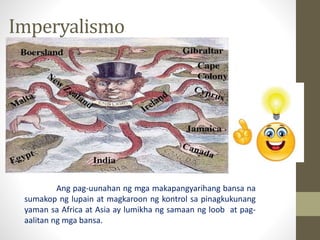
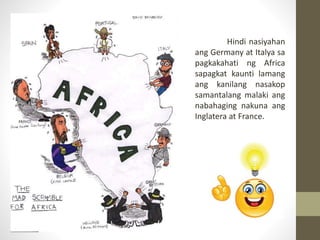
Imperyalismo
Ang pag-uunahan ng mga makapangyarihang bansa na
sumakop ng lupain at magkaroon ng kontrol sa pinagkukunang
yaman sa Africa at Asia ay lumikha ng samaan ng loob at pag-
aalitan ng mga bansa.
Hindi nasiyahan
ang Germany at Italya sa
pagkakahati ng Africa
sapagkat kaunti lamang
ang kanilang nasakop
samantalang malaki ang
nabahaging nakuna ang
Inglatera at France.
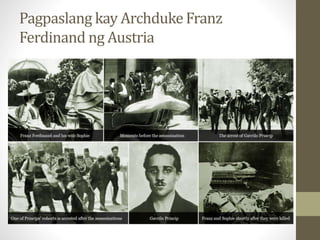
Pagpaslang kay ArchdukeFranz
Ferdinand ng Austria
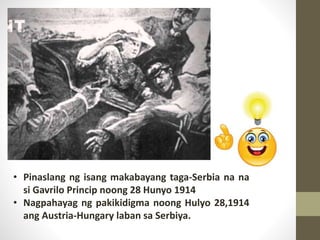
• Pinaslang ng isang makabayang taga-Serbia na na
si Gavrilo Princip noong 28 Hunyo 1914
• Nagpahayag ng pakikidigma noong Hulyo 28,1914
ang Austria-Hungary laban sa Serbiya.
Mga Pangyayari noong
Unang Digmaang
Pandaigdig
1914
June 28 - Archduke Franz Ferdinand, prince to the Austria-Hungary
throne, is assassinated in Sarajevo by a Serbian named Gavrilo Princip.
July 23 - Austria-Hungary makes demands on Serbia for retribution.
Serbia does not meet demands.
July 28 - Austria-Hungary declares war on Serbia. Russia begins
mobilizing its troops.
August 1 - Germany declares war on Russia.
August 3 - Germany declares war on France as part of the Schlieffen
Plan.
August 4 - Germany invades Belgium. Britain declares war on Germany.
1914
• August 23 to 30 - The Battle of Tannenberg is fought between
Germany and Russia. The Germans defeat the Russian Second Army.
• September 5 to 12 - The advancing German army is stopped before
Paris by the British and French at the First Battle of the Marne. The
Germans dig in and four years of trench warfare begins.
• October 19 to November 22 - The Allies defeat the Germans at the
First Battle of Ypres.
• November 2 - The British begin a naval blockade of Germany.
• November 11 - The Ottoman Empire declares war on the Allies.
• December 24 - An unofficial truce is declared between the two sides
at Christmas.
1915
• February 4 - The Germans begin to use submarines against
Allied merchant ships around the island of Britain.
• April 25 - The Allies attack the Ottoman Empire at the Battle of
Gallipoli. This campaign will last over eight months and will
end as a victory for the Ottomans and the retreat of the Allies.
• May 7 - The Lusitania, a luxury British passenger ship, is sunk
by a German submarine. 1,195 civilians were killed. This act
sparks international outrage and contributes to the United
States joining the war against Germany.
• October 14 - Bulgaria enters the war by declaring war on
Serbia.
1916
• February 21 - The Battle of Verdun begins between France and
Germany. This battle will last until December of 1916 and will
finally result in a French victory.
• May 31 - The largest naval battle of the war, the Battle of
Jutland, is fought between Britain and Germany in the North
Sea.
• July 1 - The Battle of the Somme begins. Over 1 million
soldiers will be wounded or killed.
1917
• January 19 - The British intercept the Zimmerman Telegram in which
Germany tries to convince Mexico to join the war. This will result in
the United States declaring war on Germany.
• March 8 - The Russian Revolution begins. Tsar Nicholas II is removed
from power on March 15.
• April 6 - The United States enters the war, declaring war on
Germany.
• November 7 - The Bolsheviks, led by Vladimir Lenin, overthrow the
Russian government.
• December 17 - The Russians agree to peace with the Central powers
and leave the war.
REBOLUSYONG RUSO
• A major event leading to the Russian Revolution took place on
January 22, 1905. A Large number of workers were marching
to the Tsar's palace in order to present a petition for better
working conditions. They were fired upon by soldiers and
many of them were killed or injured. This day is called Bloody
Sunday.
• Before Bloody Sunday many peasants and working class
people revered the Tsar and thought that he was on their side.
They blamed their troubles on the government, not on the
Tsar. However, after the shootings, the Tsar was perceived as
an enemy of the working class and the desire for revolution
began to spread.
The February Revolution
• The people of Russia first revolted in early 1917. The
revolution began when a number of workers decided to strike.
Many of these workers got together during the strike to
discuss politics. They began to riot. The Tsar, Nicholas II,
ordered the army to suppress the riot. However, many of the
soldiers refused to fire on the Russian people and the army
began to mutiny against the Tsar.
• After a few days of riots, the army turned against the Tsar. The
Tsar was forced to give up his throne and a new government
took over. The government was run by two political parties:
the Petrograd Soviet (representing the workers and soldiers)
and the Provisional Government (the traditional government
without the Tsar).
Bolshevik Revolution
Over the next several months the two sides ruled Russia.
One of the main factions of the Petrograd Soviet was a group
called the Bolsheviks. They were led by Vladimir Lenin and
believed that the new Russian government should be a Marxist
(communist) government. In October of 1917, Lenin took full
control of the government in what is called the Bolshevik
Revolution. Russia was now the first communist country in the
world.
RESULT
• After the revolution, Russia exited World War I by signing a
peace treaty with Germany called the Treaty of Brest-Litovsk.
The new government took control of all industry and moved
the Russian economy from a rural one to an industrial one. It
also seized farmland from landholders and distributed it
among the peasants. Women were given equal rights to those
of men and religion was banned from many aspects of society.
• From 1918 to 1920, Russia experienced a civil war between
the Bolsheviks (also called the Red Army) and the anti-
Bolsheviks (the White Army). The Bolsheviks won and the new
country was called the USSR (United Soviet Socialist Republic).
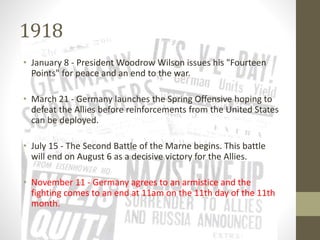
1918
• January 8 - President Woodrow Wilson issues his "Fourteen
Points" for peace and an end to the war.
• March 21 - Germany launches the Spring Offensive hoping to
defeat the Allies before reinforcements from the United States
can be deployed.
• July 15 - The Second Battle of the Marne begins. This battle
will end on August 6 as a decisive victory for the Allies.
• November 11 - Germany agrees to an armistice and the
fighting comes to an end at 11am on the 11th day of the 11th
month.
14 POINTS
• No more secret agreements between countries. Diplomacy shall be open to the
world.
• International seas shall be free to navigate during peace and war.
• There shall be free trade between the countries who accept the peace.
• There shall be a worldwide reduction in weapons and armies by all countries.
• Colonial claims over land and regions will be fair.
• Russia will be allowed to determine its own form of government. All German
troops will leave Russian soil.
• German troops will evacuate Belgium and Belgium will be an independent
country.
• France will regain all territory including the disputed land of Alsace-Lorraine.
• The borders of Italy will be established such that all Italians will be within the
country of Italy.
• Austria-Hungary will be allowed to continue to be an independent country.
• The Central Powers will evacuate Serbia, Montenegro, and Romania leaving
them as independent countries.
• The Turkish people of the Ottoman Empire will have their own country. Other
nationalities under the Ottoman rule will also have security.
• Poland shall be an independent country.
• A League of Nations will be formed that protects the independence of all
countries no matter how big or small.
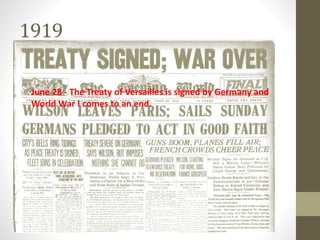
1919
• June 28 - The Treaty of Versailles is signed by Germany and
World War I comes to an end.
• nagsimula noong Hulyo 28, 1914 at nagtapos noong Nobyembre 11,
1918
• pinaslang si Archduke Franz Ferdinand ng Austria noong Hulyo 28,
1914
• agad na nagdeklara ng digmaan ang Austria laban sa Serbia
• pinalubog ng Germany ang Luisitania, barkong lulan ng mga
Amerikanong Sibilyan noong Mayo 17, 1915
• Lumahok ang Estados Unidos sa digmaan noong Abril 6, 1917
• Bumagsak ang hukbong Italyano noong Oktubre 1917
• umatras ang Russia sa paglahok sa digmaan dahil sa Rebolusyong
Bolshevik
• Nilagdaan ang Kasunduan sa Paris o Treaty of Versailles noong
Hunyo 28, 1919 na nagtakda sa opisyal at tuluyang pagtatapos ng
Unang Digmaang Pandaigdig
• Itinatag ang League of Nations na samahang pangkapayapaan ng
mga bansa noong Enero 10, 1920
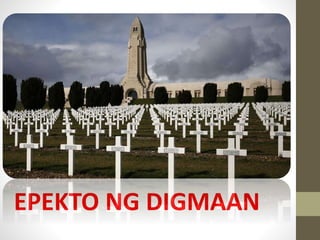
EPEKTO NG DIGMAAN
Paghina ng lipunan at kabuhayan ng
Europa
• naghatid ng pagkagutom at pagkakasakit
• nawasak ang maraming ari-arian at nasira ang
maraming bayan at lungsod
• nasira ang mga impraestruktura, bukirin, at mga
tahanan
• napinsala ang mga ari-arian at naantala ang
kalakalan, pagsasaka, at iba pang mga gawaing
pangkabuhayan
• gumastos ng tinatayang $338 bilyon ang mga
bansa sa digmaan
Pagwawakas ng apat na
dinastiya
• nagwakas ang apat na dinastiya ng
Hohenzollern ng Germany, Habsburg ng
Austria-Hungary, Romanov ng Russia, at
Osmanlis ng Ottoman sa Turkey.
• Nabigo ang binalak na pangmatagalang
kapayapaan sa daigdig.
• nagbinhi ng hinanakit at poot ang
pagkalupig ng Germany sa Kasunduan sa
Versailles upang muling magpalakas ito at
maghiganti
Pagtatag sa mga bagong bansa
• nabago ang mapa ng Europe sa takbo ng
kasaysayan
• naitatag ang mga bagong bansa sa Europe mula
sa dating Imperyo ng Austria-Hungary, Russia, at
Germany
• nabuo ang Finland, Latvia, Lithuania, Estonia,
Poland, Yugoslavia, at Czechoslovakia bilang mga
bagong bansa at naghiwalay rin ang Austria at
Hungary
Mga Kasunduang Pangkapayapaan
• Umisip ng paraan ang mga nanalong bansa upang maiwasan
ang muling pagsiklab ng digmaan na siyang nagiging salot sa
kapayapaan ng mundo
• Bumalangkas sila ng mga kasunduang pangkapayapaan sa iba't
ibang pagpupulong sa Paris noong 1919-1920
• Pinangunahan ang mga pagpupulong na ito ng tinatawag na
Big Four na kinabibilangan ng United States, Punong Ministro
Lloyd George ng England, Punong Ministro Georges
Clemenceau ng France at Punong Ministro Vittorio Orlando ng
Italy.
• Ibinatay ang mga pangunahing nilalaman ng kasunduan sa *14
Points ni Pangulong Wilson at sa mga lihim na kasunduang
ginawa ng mga Alyado noong kasalukuyang naglalabanan.
1. Kasunduan ng St. Germain
• Inatasan nito ang Austria na ibigay ang malaking
teritoryo nito sa Czechoslovakia, Poland, Yugoslavia,
at Italya.
• Matapos magawa ito, halos wala nang natira sa
Austria.
• Ang hiling nitong isapi na lamang siya sa Alemanya
bilang isang maliit na estado nito ay hindi pinayagan
ng magkakampi.
Kasunduan ng Trianon
Tatlong-kapat ng kaharian ng Ungriya ang kinuha
nito at ipinamahagi sa mga bagong-tatag na estado sa
may hangganan ng Ungriya (Hungary).
2. Kasunduan ng Neuilly
• Inalis nito ang lagusan ng Bulgaria (na kumampi sa mga natalo)
palabas sa Dagat Aegean.
3. Kasunduan ng Serves
• Kinumpiska nito ang mga lupaing Arabe ng dating Imperyong
Ottoman upang ibigay sa Pransya at Britanya.
• Kasama sa kasunduang ito ang pag-uka at pagpalit sa lupain ng
Turkiya; subalit nang malaman ito ng mga Turko ay nagwala
sila nang husto at naghanda para ipaglaban ang kanilang
bansa kaya't hindi ito natuloy.
Kasunduan sa Versailles
• Ito ang pinakamabigat na parusang ipinataw ng mga
nagtagumpay sa mga natalong bansa, at ang Alemanya ang
tumanggap nito.
• Naging mahirap para sa Alemanya na tanggapin ang mga
probinsyon nito.
• Ilan sa mga nilalaman ng Kasunduan ng Versailles ay ang mga
sumusunod:
• pagbibigay sa Pransya ng Saar, isang teritoryong Aleman na
mayroong deposito ng karon, bilang kapalit ng minahan ng
karbon sa Pransya na nasira noong digmaan;
• pagbabalik sa Pransya ng Alsace-Lorraine;
• pagpapawalang-bisa sa Kasunduan ng Brest-Litovsk na
pinirmahan ng Alemanya at Rusya noong kasalukuyang
nagaganap ang digmaan
Kasunduan sa Versailles
• pagbabawas ng hukbong sandatahan ng Alemanya sa
100,000 tao lamang, ng bilang ng mga barkong-pandigma
nito sa anim na malalaki lamang, at ilang maliliit
(karamihan ng mga barkong Aleman ay ibinigay sa
Britanya), at pagbabawal dito na magkaroon ng
submarino, tangke, at mga eroplano; at
• pagbabayad ng halagang 33 bilyong dolyar para sa mga
pinaslang inabot ng kanilang mga kaaway, lalo na ang
Pransya, noong digmaan; bukod dito, pinaamin din sa
Alemanya na siya ang may kasalanan kung bakit
nagkaroon ng giyera.
Naitatag din ang League of
Nations
• organisasyong nagnanais na magkaroon ng kinatawan ang mga
bansang kasapi upang mapag-usapan ang mga isyu ng hindi
pagkakaunawaan upang hindi na maulit ang mapinsalang
digmaan na naganap noong Unang Digmaang pandaigdig
• itinatag ni Woodrow Wilson
• itinatag sa Geneva, Switzerland noong taong 1919
• Ang mga kasaping bansa sa liga ay sumang-ayon na igalang at
panatilihin ang hangganan ng bawat miyembrong bansa at
magkakaroon ng arbitrasyon sa anumang uri ng sigalot sa pagitan
ng mga miyembrong bansa.
• Ang Estados Unidos ay hindi kasapi ng ligang ito.
• Naging kasapi ang bansang Rusya noong Setyembre 18,1934 at
Germany noong Setyembre 8.1926.
League of Nations
• Noong Hunyo 28, 1919, pinirmahan ang kasunduan sa
Versailles (Treaty of Versailles) na siyang nagtapos sa
mapaminsalang digmaan at humantong sa pagkatatag ng isang
organisasyong pangkapayapaan na League of Nations.
• Ang mga layunin ng Liga ay ang sumusunod:
1. Panatilihin ang pandaigdigang kapayapaan upang hindi
na maulit ang Unang Digmaang Pandaigdig.
2. Palakasin ang kondisyon ng Kasunduang Versailles.
3. Itaguyod ang pagtutulungan sa ikalulutas sa
pandaigdigang ekonomiya, panlipunan at makataong suliranin.
4. Ang Opisyal na wika ng Liga ay English, French, at
Spanish
• Apat na bansang permanenteng miyembro:
Britain Italy Japan France
• Ang Liga ay may konseho, asamblea, secretariat at pamdaigdigang
hukuman.
• Ang mga Miyembro ay nagkasundo na magbigay-parusa sa mga
mananalakay na hindi naghaharap ng kanilang hidwaan sa Liga.
• Nagbigay din ito ng tulong pananalapi sa mga bansang nasira ng
digmaan.
• Tumulong din ito sa pagpigil ng pang-aalipin at kalakalan ng bawal na
gamot.
• Nabigo ang Liga sapagkat wala itong pwersa na ipilit sa mga
miyembro na huwag kumalas kapag ang desisyon ay laban sa kanila.
• Kumalas ang Japan at Germany noong 1933
• Ang Italy noong 1937 at ang Russia ay pinaalis noong 1939.
• Nagkaroon ng huling pagpupulong ang Liga noong Abril 18,1946
nang isuko nito ang serbisyo-teknikal ng gusali sa United Nations
pagkaraan ng 16 taon.
• Hindi nagtagumpay ang Liga dahil sumiklab muli ang Ikalawang
Digmaang Pandaigdig.
http://www.ducksters.com/hi
story/world_war_i/timeline.ph
p

unangdigmaangpandaigdig-190624075735.pdf

  • 1.
  • 2.
    Mga Pangyayaring Nagbunsodsa Unang Digmaang Pandaigdig • Pag-unlad ng Kakayahang Pangmilitar ng mga Bansa sa Europa - Militarismo • Pagbuo ng Alyansa • Imperyalismo • Nasyonalismo • Pagpaslang kay Archduke Franz Ferdinand ng Austria
  • 3.
    Pag-unlad ng KakayahangPangmilitar ng mga Bansa sa Europa (1800-1914)
  • 4.
    MILITARISMO Pagpapalakas ng mgasandatahan ng bansang Europeo
  • 5.
    Mga Unang Alyansa •Germany and Austria-Hungary had been part of the Three Emperors' League, formed in 1872, along with Russia. The three emperors were Russian Tsar Alexander II, German Kaiser Wilhelm I, and Austro-Hungarian Emperor Franz Josef. That arrangement disintegrated because Austria-Hungary and Russia came to be at odds over the expansionary intentions of both countries, which overlapped in the Balkans. • In an effort to extend its borders and influence, Austria- Hungary occupied Bosnia-Herzegovina in 1878. About the same time, a nearby dispute between Russia and Turkey over control of Serbia led to the Russo-Turkish War. Serbia gained its independence as a result of this conflict, and Russia pledged its support to the strong, newly independent country.
  • 6.
  • 7.
    Sa ilalim ngalyansa, nangako ang bawat kasapi na magtutulungan sakaling may magtatangkang sumalakay sa kanilang bansa.
  • 8.
  • 9.
    Ang matinding magkamuhing Serbia dahil sa mahigpit na pamamahala .
  • 10.
    Ang panghihimasok ng Russiasa Balkan Peninsula ay sa dahilang may pagkakatulad ng wika at relihiyon- Greek Orthodox Ninais ng Russia na maangkin ang constantinople upang magkaroon sya ng daungan ligtas sa yelo RUSSIA
  • 11.
    ALSACE-LORRAINE Ninais ng Francena maangkin muli ang Alsace- Lorraine na inangkin ng Germany noong 1871 bunga ng digmaan ng France at Germany. Ipinalalagay ng maraming Pranses na natural nilang kaaway ang mga Aleman.
  • 12.
    Imperyalismo Ang pag-uunahan ngmga makapangyarihang bansa na sumakop ng lupain at magkaroon ng kontrol sa pinagkukunang yaman sa Africa at Asia ay lumikha ng samaan ng loob at pag- aalitan ng mga bansa.
  • 13.
    Hindi nasiyahan ang Germanyat Italya sa pagkakahati ng Africa sapagkat kaunti lamang ang kanilang nasakop samantalang malaki ang nabahaging nakuna ang Inglatera at France.
  • 14.
  • 15.
    • Pinaslang ngisang makabayang taga-Serbia na na si Gavrilo Princip noong 28 Hunyo 1914 • Nagpahayag ng pakikidigma noong Hulyo 28,1914 ang Austria-Hungary laban sa Serbiya.
  • 16.
    Mga Pangyayari noong UnangDigmaang Pandaigdig
  • 17.
    1914 June 28 -Archduke Franz Ferdinand, prince to the Austria-Hungary throne, is assassinated in Sarajevo by a Serbian named Gavrilo Princip. July 23 - Austria-Hungary makes demands on Serbia for retribution. Serbia does not meet demands. July 28 - Austria-Hungary declares war on Serbia. Russia begins mobilizing its troops. August 1 - Germany declares war on Russia. August 3 - Germany declares war on France as part of the Schlieffen Plan. August 4 - Germany invades Belgium. Britain declares war on Germany.
  • 18.
    1914 • August 23to 30 - The Battle of Tannenberg is fought between Germany and Russia. The Germans defeat the Russian Second Army. • September 5 to 12 - The advancing German army is stopped before Paris by the British and French at the First Battle of the Marne. The Germans dig in and four years of trench warfare begins. • October 19 to November 22 - The Allies defeat the Germans at the First Battle of Ypres. • November 2 - The British begin a naval blockade of Germany. • November 11 - The Ottoman Empire declares war on the Allies. • December 24 - An unofficial truce is declared between the two sides at Christmas.
  • 19.
    1915 • February 4- The Germans begin to use submarines against Allied merchant ships around the island of Britain. • April 25 - The Allies attack the Ottoman Empire at the Battle of Gallipoli. This campaign will last over eight months and will end as a victory for the Ottomans and the retreat of the Allies. • May 7 - The Lusitania, a luxury British passenger ship, is sunk by a German submarine. 1,195 civilians were killed. This act sparks international outrage and contributes to the United States joining the war against Germany. • October 14 - Bulgaria enters the war by declaring war on Serbia.
  • 20.
    1916 • February 21- The Battle of Verdun begins between France and Germany. This battle will last until December of 1916 and will finally result in a French victory. • May 31 - The largest naval battle of the war, the Battle of Jutland, is fought between Britain and Germany in the North Sea. • July 1 - The Battle of the Somme begins. Over 1 million soldiers will be wounded or killed.
  • 21.
    1917 • January 19- The British intercept the Zimmerman Telegram in which Germany tries to convince Mexico to join the war. This will result in the United States declaring war on Germany. • March 8 - The Russian Revolution begins. Tsar Nicholas II is removed from power on March 15. • April 6 - The United States enters the war, declaring war on Germany. • November 7 - The Bolsheviks, led by Vladimir Lenin, overthrow the Russian government. • December 17 - The Russians agree to peace with the Central powers and leave the war.
  • 22.
    REBOLUSYONG RUSO • Amajor event leading to the Russian Revolution took place on January 22, 1905. A Large number of workers were marching to the Tsar's palace in order to present a petition for better working conditions. They were fired upon by soldiers and many of them were killed or injured. This day is called Bloody Sunday. • Before Bloody Sunday many peasants and working class people revered the Tsar and thought that he was on their side. They blamed their troubles on the government, not on the Tsar. However, after the shootings, the Tsar was perceived as an enemy of the working class and the desire for revolution began to spread.
  • 23.
    The February Revolution •The people of Russia first revolted in early 1917. The revolution began when a number of workers decided to strike. Many of these workers got together during the strike to discuss politics. They began to riot. The Tsar, Nicholas II, ordered the army to suppress the riot. However, many of the soldiers refused to fire on the Russian people and the army began to mutiny against the Tsar. • After a few days of riots, the army turned against the Tsar. The Tsar was forced to give up his throne and a new government took over. The government was run by two political parties: the Petrograd Soviet (representing the workers and soldiers) and the Provisional Government (the traditional government without the Tsar).
  • 24.
    Bolshevik Revolution Over thenext several months the two sides ruled Russia. One of the main factions of the Petrograd Soviet was a group called the Bolsheviks. They were led by Vladimir Lenin and believed that the new Russian government should be a Marxist (communist) government. In October of 1917, Lenin took full control of the government in what is called the Bolshevik Revolution. Russia was now the first communist country in the world.
  • 25.
    RESULT • After therevolution, Russia exited World War I by signing a peace treaty with Germany called the Treaty of Brest-Litovsk. The new government took control of all industry and moved the Russian economy from a rural one to an industrial one. It also seized farmland from landholders and distributed it among the peasants. Women were given equal rights to those of men and religion was banned from many aspects of society. • From 1918 to 1920, Russia experienced a civil war between the Bolsheviks (also called the Red Army) and the anti- Bolsheviks (the White Army). The Bolsheviks won and the new country was called the USSR (United Soviet Socialist Republic).
  • 26.
    1918 • January 8- President Woodrow Wilson issues his "Fourteen Points" for peace and an end to the war. • March 21 - Germany launches the Spring Offensive hoping to defeat the Allies before reinforcements from the United States can be deployed. • July 15 - The Second Battle of the Marne begins. This battle will end on August 6 as a decisive victory for the Allies. • November 11 - Germany agrees to an armistice and the fighting comes to an end at 11am on the 11th day of the 11th month.
  • 27.
    14 POINTS • Nomore secret agreements between countries. Diplomacy shall be open to the world. • International seas shall be free to navigate during peace and war. • There shall be free trade between the countries who accept the peace. • There shall be a worldwide reduction in weapons and armies by all countries. • Colonial claims over land and regions will be fair. • Russia will be allowed to determine its own form of government. All German troops will leave Russian soil. • German troops will evacuate Belgium and Belgium will be an independent country. • France will regain all territory including the disputed land of Alsace-Lorraine. • The borders of Italy will be established such that all Italians will be within the country of Italy. • Austria-Hungary will be allowed to continue to be an independent country. • The Central Powers will evacuate Serbia, Montenegro, and Romania leaving them as independent countries. • The Turkish people of the Ottoman Empire will have their own country. Other nationalities under the Ottoman rule will also have security. • Poland shall be an independent country. • A League of Nations will be formed that protects the independence of all countries no matter how big or small.
  • 28.
    1919 • June 28- The Treaty of Versailles is signed by Germany and World War I comes to an end.
  • 29.
    • nagsimula noongHulyo 28, 1914 at nagtapos noong Nobyembre 11, 1918 • pinaslang si Archduke Franz Ferdinand ng Austria noong Hulyo 28, 1914 • agad na nagdeklara ng digmaan ang Austria laban sa Serbia • pinalubog ng Germany ang Luisitania, barkong lulan ng mga Amerikanong Sibilyan noong Mayo 17, 1915 • Lumahok ang Estados Unidos sa digmaan noong Abril 6, 1917 • Bumagsak ang hukbong Italyano noong Oktubre 1917 • umatras ang Russia sa paglahok sa digmaan dahil sa Rebolusyong Bolshevik • Nilagdaan ang Kasunduan sa Paris o Treaty of Versailles noong Hunyo 28, 1919 na nagtakda sa opisyal at tuluyang pagtatapos ng Unang Digmaang Pandaigdig • Itinatag ang League of Nations na samahang pangkapayapaan ng mga bansa noong Enero 10, 1920
  • 30.
  • 31.
    Paghina ng lipunanat kabuhayan ng Europa • naghatid ng pagkagutom at pagkakasakit • nawasak ang maraming ari-arian at nasira ang maraming bayan at lungsod • nasira ang mga impraestruktura, bukirin, at mga tahanan • napinsala ang mga ari-arian at naantala ang kalakalan, pagsasaka, at iba pang mga gawaing pangkabuhayan • gumastos ng tinatayang $338 bilyon ang mga bansa sa digmaan
  • 32.
    Pagwawakas ng apatna dinastiya • nagwakas ang apat na dinastiya ng Hohenzollern ng Germany, Habsburg ng Austria-Hungary, Romanov ng Russia, at Osmanlis ng Ottoman sa Turkey. • Nabigo ang binalak na pangmatagalang kapayapaan sa daigdig. • nagbinhi ng hinanakit at poot ang pagkalupig ng Germany sa Kasunduan sa Versailles upang muling magpalakas ito at maghiganti
  • 33.
    Pagtatag sa mgabagong bansa • nabago ang mapa ng Europe sa takbo ng kasaysayan • naitatag ang mga bagong bansa sa Europe mula sa dating Imperyo ng Austria-Hungary, Russia, at Germany • nabuo ang Finland, Latvia, Lithuania, Estonia, Poland, Yugoslavia, at Czechoslovakia bilang mga bagong bansa at naghiwalay rin ang Austria at Hungary
  • 34.
    Mga Kasunduang Pangkapayapaan •Umisip ng paraan ang mga nanalong bansa upang maiwasan ang muling pagsiklab ng digmaan na siyang nagiging salot sa kapayapaan ng mundo • Bumalangkas sila ng mga kasunduang pangkapayapaan sa iba't ibang pagpupulong sa Paris noong 1919-1920 • Pinangunahan ang mga pagpupulong na ito ng tinatawag na Big Four na kinabibilangan ng United States, Punong Ministro Lloyd George ng England, Punong Ministro Georges Clemenceau ng France at Punong Ministro Vittorio Orlando ng Italy. • Ibinatay ang mga pangunahing nilalaman ng kasunduan sa *14 Points ni Pangulong Wilson at sa mga lihim na kasunduang ginawa ng mga Alyado noong kasalukuyang naglalabanan.
  • 35.
    1. Kasunduan ngSt. Germain • Inatasan nito ang Austria na ibigay ang malaking teritoryo nito sa Czechoslovakia, Poland, Yugoslavia, at Italya. • Matapos magawa ito, halos wala nang natira sa Austria. • Ang hiling nitong isapi na lamang siya sa Alemanya bilang isang maliit na estado nito ay hindi pinayagan ng magkakampi. Kasunduan ng Trianon Tatlong-kapat ng kaharian ng Ungriya ang kinuha nito at ipinamahagi sa mga bagong-tatag na estado sa may hangganan ng Ungriya (Hungary).
  • 36.
    2. Kasunduan ngNeuilly • Inalis nito ang lagusan ng Bulgaria (na kumampi sa mga natalo) palabas sa Dagat Aegean. 3. Kasunduan ng Serves • Kinumpiska nito ang mga lupaing Arabe ng dating Imperyong Ottoman upang ibigay sa Pransya at Britanya. • Kasama sa kasunduang ito ang pag-uka at pagpalit sa lupain ng Turkiya; subalit nang malaman ito ng mga Turko ay nagwala sila nang husto at naghanda para ipaglaban ang kanilang bansa kaya't hindi ito natuloy.
  • 37.
    Kasunduan sa Versailles •Ito ang pinakamabigat na parusang ipinataw ng mga nagtagumpay sa mga natalong bansa, at ang Alemanya ang tumanggap nito. • Naging mahirap para sa Alemanya na tanggapin ang mga probinsyon nito. • Ilan sa mga nilalaman ng Kasunduan ng Versailles ay ang mga sumusunod: • pagbibigay sa Pransya ng Saar, isang teritoryong Aleman na mayroong deposito ng karon, bilang kapalit ng minahan ng karbon sa Pransya na nasira noong digmaan; • pagbabalik sa Pransya ng Alsace-Lorraine; • pagpapawalang-bisa sa Kasunduan ng Brest-Litovsk na pinirmahan ng Alemanya at Rusya noong kasalukuyang nagaganap ang digmaan
  • 38.
    Kasunduan sa Versailles •pagbabawas ng hukbong sandatahan ng Alemanya sa 100,000 tao lamang, ng bilang ng mga barkong-pandigma nito sa anim na malalaki lamang, at ilang maliliit (karamihan ng mga barkong Aleman ay ibinigay sa Britanya), at pagbabawal dito na magkaroon ng submarino, tangke, at mga eroplano; at • pagbabayad ng halagang 33 bilyong dolyar para sa mga pinaslang inabot ng kanilang mga kaaway, lalo na ang Pransya, noong digmaan; bukod dito, pinaamin din sa Alemanya na siya ang may kasalanan kung bakit nagkaroon ng giyera.
  • 39.
    Naitatag din angLeague of Nations • organisasyong nagnanais na magkaroon ng kinatawan ang mga bansang kasapi upang mapag-usapan ang mga isyu ng hindi pagkakaunawaan upang hindi na maulit ang mapinsalang digmaan na naganap noong Unang Digmaang pandaigdig • itinatag ni Woodrow Wilson • itinatag sa Geneva, Switzerland noong taong 1919 • Ang mga kasaping bansa sa liga ay sumang-ayon na igalang at panatilihin ang hangganan ng bawat miyembrong bansa at magkakaroon ng arbitrasyon sa anumang uri ng sigalot sa pagitan ng mga miyembrong bansa. • Ang Estados Unidos ay hindi kasapi ng ligang ito. • Naging kasapi ang bansang Rusya noong Setyembre 18,1934 at Germany noong Setyembre 8.1926.
  • 40.
    League of Nations •Noong Hunyo 28, 1919, pinirmahan ang kasunduan sa Versailles (Treaty of Versailles) na siyang nagtapos sa mapaminsalang digmaan at humantong sa pagkatatag ng isang organisasyong pangkapayapaan na League of Nations. • Ang mga layunin ng Liga ay ang sumusunod: 1. Panatilihin ang pandaigdigang kapayapaan upang hindi na maulit ang Unang Digmaang Pandaigdig. 2. Palakasin ang kondisyon ng Kasunduang Versailles. 3. Itaguyod ang pagtutulungan sa ikalulutas sa pandaigdigang ekonomiya, panlipunan at makataong suliranin. 4. Ang Opisyal na wika ng Liga ay English, French, at Spanish
  • 41.
    • Apat nabansang permanenteng miyembro: Britain Italy Japan France • Ang Liga ay may konseho, asamblea, secretariat at pamdaigdigang hukuman. • Ang mga Miyembro ay nagkasundo na magbigay-parusa sa mga mananalakay na hindi naghaharap ng kanilang hidwaan sa Liga. • Nagbigay din ito ng tulong pananalapi sa mga bansang nasira ng digmaan. • Tumulong din ito sa pagpigil ng pang-aalipin at kalakalan ng bawal na gamot. • Nabigo ang Liga sapagkat wala itong pwersa na ipilit sa mga miyembro na huwag kumalas kapag ang desisyon ay laban sa kanila. • Kumalas ang Japan at Germany noong 1933 • Ang Italy noong 1937 at ang Russia ay pinaalis noong 1939. • Nagkaroon ng huling pagpupulong ang Liga noong Abril 18,1946 nang isuko nito ang serbisyo-teknikal ng gusali sa United Nations pagkaraan ng 16 taon. • Hindi nagtagumpay ang Liga dahil sumiklab muli ang Ikalawang Digmaang Pandaigdig.
  • 42.