The History and Future of Online
Education:
What should you do?
John Bourne, Ph.D.
Chief Academic Officer
American Sentinel University
Executive Director Emeritus, The Sloan Consortium
Emeritus Professor at Olin College and Babson College
Outline
My background
Your Challenge
Brief history of online education
The dimensions of online learning
Are there problems? - yes, people just don’t know what is going
on and how to do online education correctly!
• The frog – just what is the problem?
• What are solutions? Why should we consider the problem.
• What are our solutions – take the best of on-ground and make it
great online by replicating the best on-ground in an anytimeanywhere world.
•
•
•
•
•

•

2

Add things to do in the online world that can’t be done onground
John Bourne Ph.D -- Background
•
•
•
•
•
•
•
•

•

3

B.E. Vanderbilt
M.S.E. University of Florida
Ph.D. University of Florida
Professor at Vanderbilt (31
years)
Professor at Olin College (10
years)
Professor at Babson College (10
years)
Executive Director, The Sloan
Consortium (6 years)
Chief Academic Officer,
American Sentinel University ( 2
years)
Fellow: IEEE, Sloan Consortium

• Interests
• Innovation in online
education
• Technology for teaching
and learning
• Social networking
• Entrepreneurship
• Analytics
• French Horn playing
The Challenge for this morning
• In your discipline, as I present ideas, think about
how could online education improve teaching and
learning here at UMKC.
• What can be done that cannot be done easily onground.
• What affordances do you see for your discipline

• Write things down and we’ll collect and organize –
and have discussions with Devon Cancilla

4
Why talk about online learning now?
• Online learning is changing! The first phase is over.
• How is it changing?
– New technologies
– Widespread acceptance by the public and government
– Increased competition in a huge market

• What does this mean for us?
– What are the best steps to be leaders in this increasingly competitive
market? - especially in the regional market.
– Our direction: We should focus on affordable high quality online
education for learners delivered at scale in markets that have
sufficient growth in our focus programs. Focus on regional markets.

5
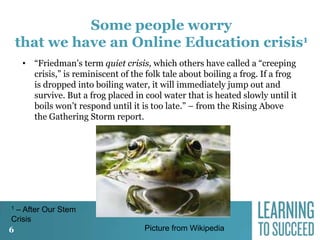
Some people worry
that we have an Online Education crisis1
• “Friedman’s term quiet crisis, which others have called a “creeping
crisis,” is reminiscent of the folk tale about boiling a frog. If a frog
is dropped into boiling water, it will immediately jump out and
survive. But a frog placed in cool water that is heated slowly until it
boils won’t respond until it is too late.” – from the Rising Above
the Gathering Storm report.

– After Our Stem
Crisis
6
1

Picture from Wikipedia
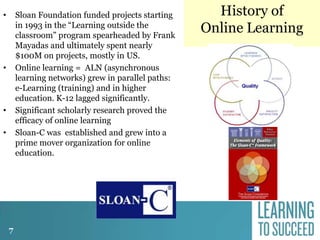
Sloan Foundation funded projects starting
in 1993 in the “Learning outside the
classroom” program spearheaded by Frank
Mayadas and ultimately spent nearly
$100M on projects, mostly in US.
Online learning = ALN (asynchronous
learning networks) grew in parallel paths:
e-Learning (training) and in higher
education. K-12 lagged significantly.
Significant scholarly research proved the
efficacy of online learning
Sloan-C was established and grew into a
prime mover organization for online
education.

•

•

•
•

7

History of
Online Learning
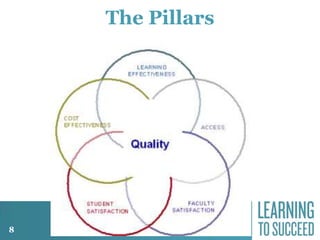
The Pillars

8
The Changing Landscape
• The Internet became widely available
– The original pillar of access was largely realized. Scale became
more important.

• Better ways of learning were introduced but often often
poorly utilized – often largely duplicating drawbacks of
the classroom model (e.g., MOOCs)
• Known learning theory discoveries have not been
widely implemented (e.g.,Community of Inquiry (COI),
immersive learning, simulation, learning by doing)
• We believe schools that will be successful will embrace
change and organize their offerings according to the
educational needs of the student

9
The Online Learning Landscape
•

Immersive simulations
– Immediate feedback
– Assessment

•

MOOCs
– Videos and Assessment

•
•
•
•

10

Mobile
Video, audio, text, COI (e.g. voice
thread)
Competency-based; e-portfolios
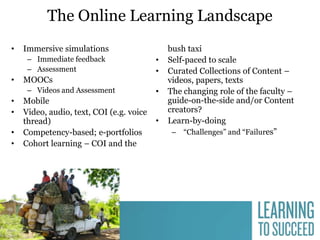
Cohort learning – COI and the

•
•
•
•

bush taxi
Self-paced to scale
Curated Collections of Content –
videos, papers, texts
The changing role of the faculty –
guide-on-the-side and/or Content
creators?
Learn-by-doing
– “Challenges” and “Failures”
MOOCs: Yes, No, or Maybe?
• Question: What is a MOOC (massively open online
course)?
• Answer: Basically you provide a recorded lecture that
anyone can view, coupled with testing and feedback
given frequently
– Coursera, Udacity, Edx, others

• Question: How does it differ from the traditional
classroom style?
• Answer: (1) only the very best lectures provided and
(2) assessment is more rapid. Many drop out.
• Q: should MOOCs be important to you?
• A: Maybe, maybe not.
Example: free MOOCs for regional presence
11
MOOCs: Yes, No, or Maybe?
• MOOCs are “elitist.” Often used for marketing
purposes.
• MOOCs hurt one-on-one and small group
teaching. Possibilities for integration – thus,
helping?
• Unless you have a “pinnacle of excellent” in
your academic quiver, you will likely not
succeed with MOOCs.
• Don’t do it or maybe try out with the pinnacles
of excellence only
12
Affordances: Consider how a
university can benefit from online
learning
• Improve access, quality of learning,
•
•
•
•
•
•
•
•
•
•
•

13

Arts and Liberal Arts
Business
Education
Sciences
Health care
Medicine
Nursing
Pharmacy
Dentistry
Law
Engineering

student satisfaction, faculty
satisfaction and reduced cost
•
•
•
•
•

•
•

Learning through “doing”
Community of Inquiry created
Higher quality learning through
knowledge organization and delivery
Computer–based methods work for
anywhere anytime learning
Connection with the region and the
world

Improved student performance
Life-long learning model for the
institution
The World of Educational
Simulations
“my favorite topic”
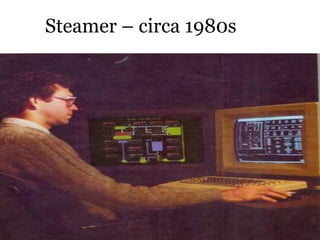
Steamer – circa 1980s

15
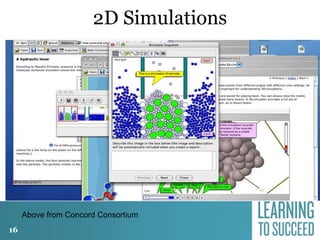
2D Simulations

Above from Concord Consortium
16
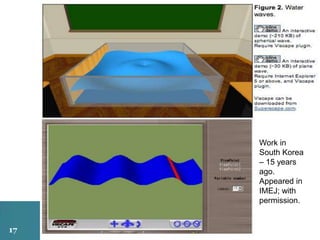
Work in
South Korea
– 15 years
ago.
Appeared in
IMEJ; with
permission.

17
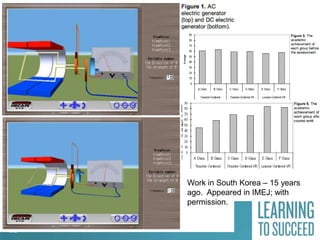
Work in South Korea – 15 years
ago. Appeared in IMEJ; with
permission.
18
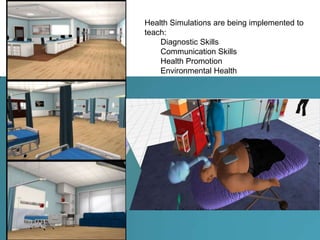
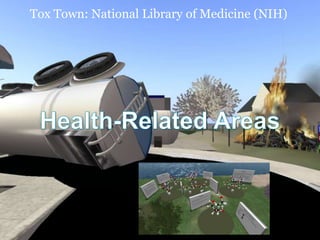
Health Simulations are being implemented to
teach:
Diagnostic Skills
Communication Skills
Health Promotion
Environmental Health
Tox Town: National Library of Medicine (NIH)
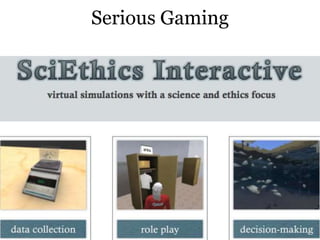
Serious Gaming

21
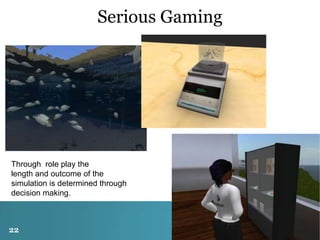
Serious Gaming

Through role play the
length and outcome of the
simulation is determined through
decision making.

22
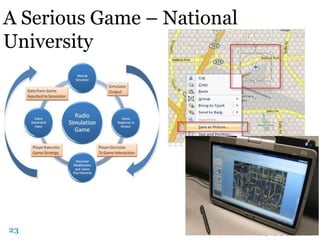
A Serious Game – National
University

23
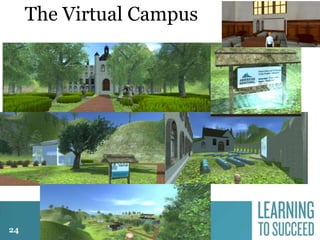
The Virtual Campus

24
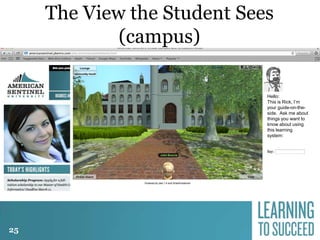
The View the Student Sees
(campus)
Hello:
This is Rick, I’m
your guide-on-theside. Ask me about
things you want to
know about using
this learning
system:

25
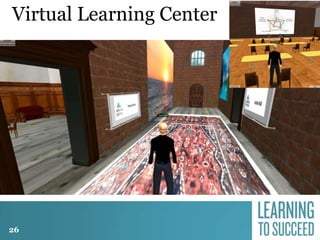
Virtual Learning Center

26
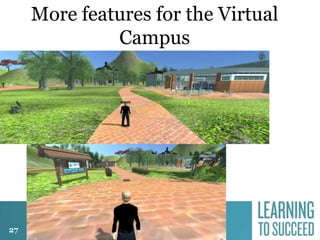
More features for the Virtual
Campus

27
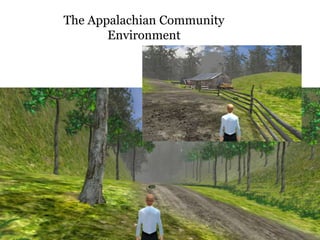
The Appalachian Community
Environment

28
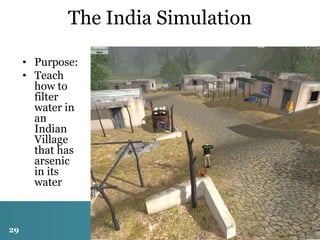
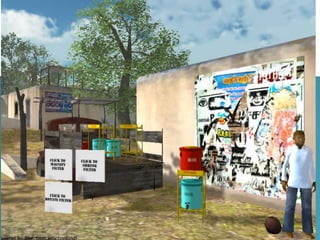
The India Simulation
• Purpose:
• Teach
how to
filter
water in
an
Indian
Village
that has
arsenic
in its
water

29
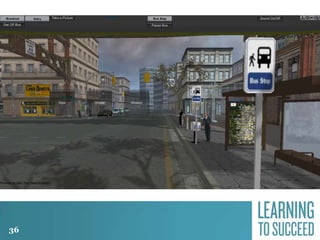
Some Examples
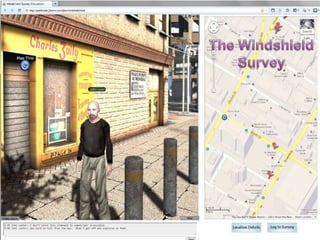
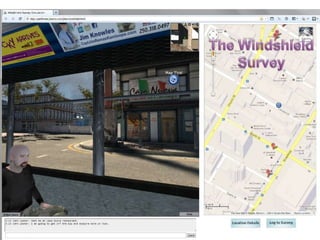
• The Windshield Survey
– A learning exercise deeply rooted in the community health
curriculum in nursing
– Students ride a bus, take notes, discuss and report about the
aspects of the community that might affect health and livability
of that environment

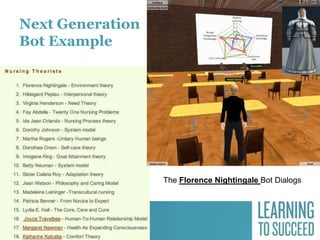
• Nursing Theorists
– Nursing students learn the theories propounded by giants in
the field

• We have migrated these activities to online simulations
that permits a variety of affordances

31
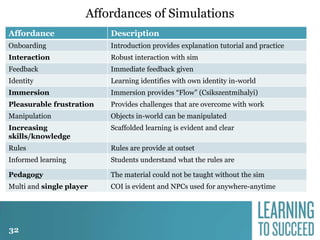
Affordances of Simulations
Affordance

Description

Onboarding

Introduction provides explanation tutorial and practice

Interaction

Robust interaction with sim

Feedback

Immediate feedback given

Identity

Learning identifies with own identity in-world

Immersion

Immersion provides “Flow” (Csikszentmihalyi)

Pleasurable frustration

Provides challenges that are overcome with work

Manipulation

Objects in-world can be manipulated

Increasing
skills/knowledge

Scaffolded learning is evident and clear

Rules

Rules are provide at outset

Informed learning

Students understand what the rules are

Pedagogy

The material could not be taught without the sim

Multi and single player

COI is evident and NPCs used for anywhere-anytime

32
33
34
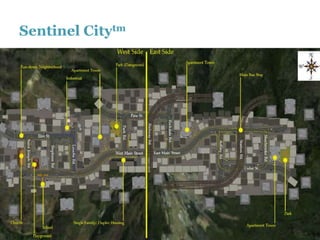
Sentinel Citytm

35
36
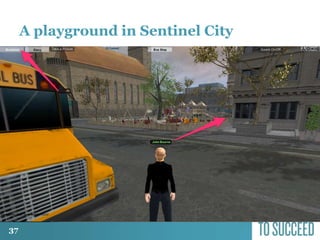
A playground in Sentinel City

37
Next Generation
Bot Example

The Florence Nightingale Bot Dialogs

38
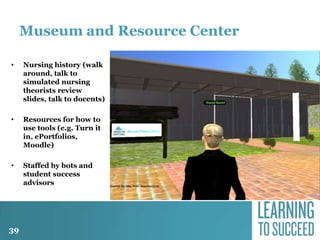
Museum and Resource Center
•

Nursing history (walk
around, talk to
simulated nursing
theorists review
slides, talk to docents)

•

Resources for how to
use tools (e.g. Turn it
in, ePortfolios,
Moodle)

•

Staffed by bots and
student success
advisors

39
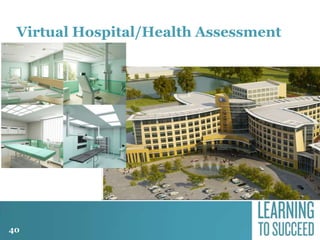
Virtual Hospital/Health Assessment

40
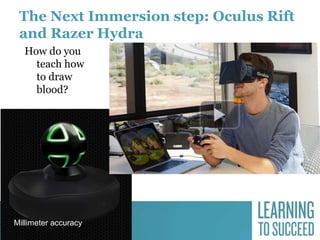
The Next Immersion step: Oculus Rift
and Razer Hydra
How do you
teach how
to draw
blood?

Millimeter accuracy
41
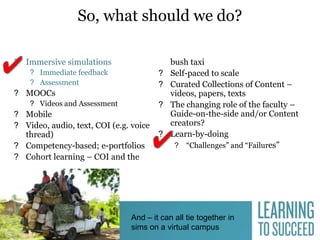
So, what should we do?
? Immersive simulations
? Immediate feedback
? Assessment

?
?

? MOOCs
? Videos and Assessment

?

? Mobile
? Video, audio, text, COI (e.g. voice
thread)
? Competency-based; e-portfolios
? Cohort learning – COI and the

42

?

bush taxi
Self-paced to scale
Curated Collections of Content –
videos, papers, texts
The changing role of the faculty –
Guide-on-the-side and/or Content
creators?
Learn-by-doing
? “Challenges” and “Failures”

And – it can all tie together in
sims on a virtual campus
1.800.729.2427
www.americansentinel.edu

Umkc presentation

  • 1.
    The History andFuture of Online Education: What should you do? John Bourne, Ph.D. Chief Academic Officer American Sentinel University Executive Director Emeritus, The Sloan Consortium Emeritus Professor at Olin College and Babson College
  • 2.
    Outline My background Your Challenge Briefhistory of online education The dimensions of online learning Are there problems? - yes, people just don’t know what is going on and how to do online education correctly! • The frog – just what is the problem? • What are solutions? Why should we consider the problem. • What are our solutions – take the best of on-ground and make it great online by replicating the best on-ground in an anytimeanywhere world. • • • • • • 2 Add things to do in the online world that can’t be done onground
  • 3.
    John Bourne Ph.D-- Background • • • • • • • • • 3 B.E. Vanderbilt M.S.E. University of Florida Ph.D. University of Florida Professor at Vanderbilt (31 years) Professor at Olin College (10 years) Professor at Babson College (10 years) Executive Director, The Sloan Consortium (6 years) Chief Academic Officer, American Sentinel University ( 2 years) Fellow: IEEE, Sloan Consortium • Interests • Innovation in online education • Technology for teaching and learning • Social networking • Entrepreneurship • Analytics • French Horn playing
  • 4.
    The Challenge forthis morning • In your discipline, as I present ideas, think about how could online education improve teaching and learning here at UMKC. • What can be done that cannot be done easily onground. • What affordances do you see for your discipline • Write things down and we’ll collect and organize – and have discussions with Devon Cancilla 4
  • 5.
    Why talk aboutonline learning now? • Online learning is changing! The first phase is over. • How is it changing? – New technologies – Widespread acceptance by the public and government – Increased competition in a huge market • What does this mean for us? – What are the best steps to be leaders in this increasingly competitive market? - especially in the regional market. – Our direction: We should focus on affordable high quality online education for learners delivered at scale in markets that have sufficient growth in our focus programs. Focus on regional markets. 5
  • 6.
    Some people worry thatwe have an Online Education crisis1 • “Friedman’s term quiet crisis, which others have called a “creeping crisis,” is reminiscent of the folk tale about boiling a frog. If a frog is dropped into boiling water, it will immediately jump out and survive. But a frog placed in cool water that is heated slowly until it boils won’t respond until it is too late.” – from the Rising Above the Gathering Storm report. – After Our Stem Crisis 6 1 Picture from Wikipedia
  • 7.
    Sloan Foundation fundedprojects starting in 1993 in the “Learning outside the classroom” program spearheaded by Frank Mayadas and ultimately spent nearly $100M on projects, mostly in US. Online learning = ALN (asynchronous learning networks) grew in parallel paths: e-Learning (training) and in higher education. K-12 lagged significantly. Significant scholarly research proved the efficacy of online learning Sloan-C was established and grew into a prime mover organization for online education. • • • • 7 History of Online Learning
  • 8.
  • 9.
    The Changing Landscape •The Internet became widely available – The original pillar of access was largely realized. Scale became more important. • Better ways of learning were introduced but often often poorly utilized – often largely duplicating drawbacks of the classroom model (e.g., MOOCs) • Known learning theory discoveries have not been widely implemented (e.g.,Community of Inquiry (COI), immersive learning, simulation, learning by doing) • We believe schools that will be successful will embrace change and organize their offerings according to the educational needs of the student 9
  • 10.
    The Online LearningLandscape • Immersive simulations – Immediate feedback – Assessment • MOOCs – Videos and Assessment • • • • 10 Mobile Video, audio, text, COI (e.g. voice thread) Competency-based; e-portfolios Cohort learning – COI and the • • • • bush taxi Self-paced to scale Curated Collections of Content – videos, papers, texts The changing role of the faculty – guide-on-the-side and/or Content creators? Learn-by-doing – “Challenges” and “Failures”
  • 11.
    MOOCs: Yes, No,or Maybe? • Question: What is a MOOC (massively open online course)? • Answer: Basically you provide a recorded lecture that anyone can view, coupled with testing and feedback given frequently – Coursera, Udacity, Edx, others • Question: How does it differ from the traditional classroom style? • Answer: (1) only the very best lectures provided and (2) assessment is more rapid. Many drop out. • Q: should MOOCs be important to you? • A: Maybe, maybe not. Example: free MOOCs for regional presence 11
  • 12.
    MOOCs: Yes, No,or Maybe? • MOOCs are “elitist.” Often used for marketing purposes. • MOOCs hurt one-on-one and small group teaching. Possibilities for integration – thus, helping? • Unless you have a “pinnacle of excellent” in your academic quiver, you will likely not succeed with MOOCs. • Don’t do it or maybe try out with the pinnacles of excellence only 12
  • 13.
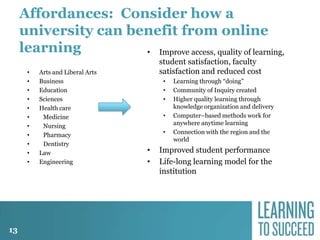
    Affordances: Consider howa university can benefit from online learning • Improve access, quality of learning, • • • • • • • • • • • 13 Arts and Liberal Arts Business Education Sciences Health care Medicine Nursing Pharmacy Dentistry Law Engineering student satisfaction, faculty satisfaction and reduced cost • • • • • • • Learning through “doing” Community of Inquiry created Higher quality learning through knowledge organization and delivery Computer–based methods work for anywhere anytime learning Connection with the region and the world Improved student performance Life-long learning model for the institution
  • 14.
    The World ofEducational Simulations “my favorite topic”
  • 15.
  • 16.
    2D Simulations Above fromConcord Consortium 16
  • 17.
    Work in South Korea –15 years ago. Appeared in IMEJ; with permission. 17
  • 18.
    Work in SouthKorea – 15 years ago. Appeared in IMEJ; with permission. 18
  • 19.
    Health Simulations arebeing implemented to teach: Diagnostic Skills Communication Skills Health Promotion Environmental Health
  • 20.
    Tox Town: NationalLibrary of Medicine (NIH)
  • 21.
  • 22.
    Serious Gaming Through roleplay the length and outcome of the simulation is determined through decision making. 22
  • 23.
    A Serious Game– National University 23
  • 24.
  • 25.
    The View theStudent Sees (campus) Hello: This is Rick, I’m your guide-on-theside. Ask me about things you want to know about using this learning system: 25
  • 26.
  • 27.
    More features forthe Virtual Campus 27
  • 28.
  • 29.
    The India Simulation •Purpose: • Teach how to filter water in an Indian Village that has arsenic in its water 29
  • 31.
    Some Examples • TheWindshield Survey – A learning exercise deeply rooted in the community health curriculum in nursing – Students ride a bus, take notes, discuss and report about the aspects of the community that might affect health and livability of that environment • Nursing Theorists – Nursing students learn the theories propounded by giants in the field • We have migrated these activities to online simulations that permits a variety of affordances 31
  • 32.
    Affordances of Simulations Affordance Description Onboarding Introductionprovides explanation tutorial and practice Interaction Robust interaction with sim Feedback Immediate feedback given Identity Learning identifies with own identity in-world Immersion Immersion provides “Flow” (Csikszentmihalyi) Pleasurable frustration Provides challenges that are overcome with work Manipulation Objects in-world can be manipulated Increasing skills/knowledge Scaffolded learning is evident and clear Rules Rules are provide at outset Informed learning Students understand what the rules are Pedagogy The material could not be taught without the sim Multi and single player COI is evident and NPCs used for anywhere-anytime 32
  • 33.
  • 34.
  • 35.
  • 36.
  • 37.
    A playground inSentinel City 37
  • 38.
    Next Generation Bot Example TheFlorence Nightingale Bot Dialogs 38
  • 39.
    Museum and ResourceCenter • Nursing history (walk around, talk to simulated nursing theorists review slides, talk to docents) • Resources for how to use tools (e.g. Turn it in, ePortfolios, Moodle) • Staffed by bots and student success advisors 39
  • 40.
  • 41.
    The Next Immersionstep: Oculus Rift and Razer Hydra How do you teach how to draw blood? Millimeter accuracy 41
  • 42.
    So, what shouldwe do? ? Immersive simulations ? Immediate feedback ? Assessment ? ? ? MOOCs ? Videos and Assessment ? ? Mobile ? Video, audio, text, COI (e.g. voice thread) ? Competency-based; e-portfolios ? Cohort learning – COI and the 42 ? bush taxi Self-paced to scale Curated Collections of Content – videos, papers, texts The changing role of the faculty – Guide-on-the-side and/or Content creators? Learn-by-doing ? “Challenges” and “Failures” And – it can all tie together in sims on a virtual campus
  • 43.