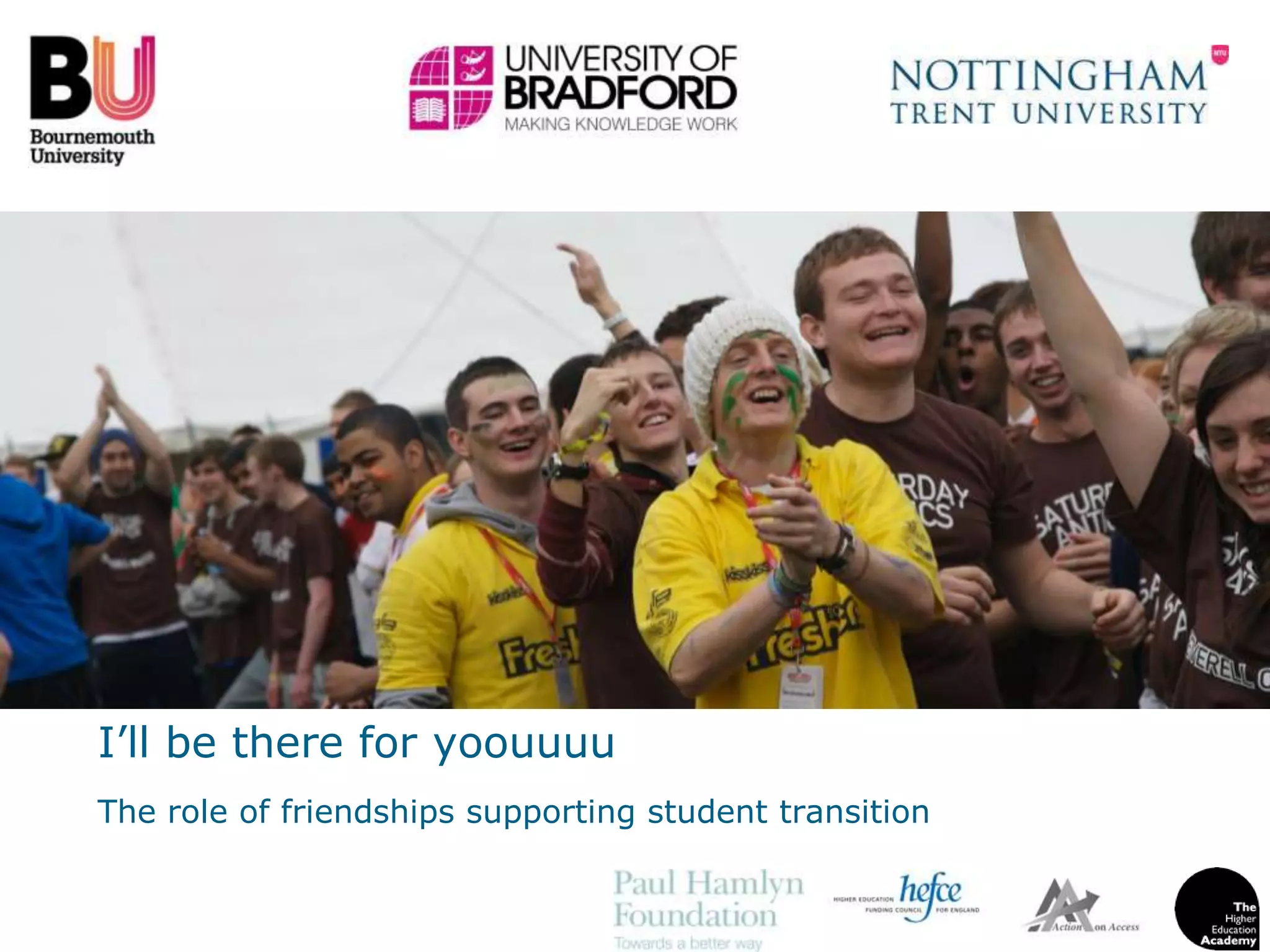
I’ll be there for yoouuuuThe role of friendships supporting student transition
StructureFriendship & Social integrationAn ice breakerHERE Project findings into the impact of friendship on student doubtersDiscussion
Friendships & social integrationWhy important“Students tend to change their values , behavior and academic plans in the direction of the dominant orientation of their peer group.”Astin (1993)Institutional habitus presented through behaviours of students Do we collude with low expectations?
Friendships in retentionTinto (1993)Students are more likely to remain if they are integrated into the institutionAcademic sphereSocial sphereCombination of prior factorsEducation, background, goals etcTransition obviously more than retentionRetention evidence is potentially stronger for social integrationChristie, Munro & Fisher (2004) leavers – more problems making friendsCastles (2004) – support (from anyone) most important predictor of persistence
Where are friends made?Halls Braxton & Hirschy (2004) Halls most important environment for making friendsWilcox, Winn & Fyvie-Gauld (2005) – not being in halls creates barrier to making friendshipsCan’t break into cliquesImpact on retention
Perceptions of being a studentKuh – no single student identityKember, Li & Lee – associations very local level (groups, programme & outwards)But Holdsworth (2006)Strong stereotypes of what a student isWhen don’t fit image, can lead to othering
What is a student?	Welcome Week Survey (October 2009)What words or phrases come to mind when we use the word ‘student’?1059 students  398 mention intellect/ education321 mention social life278 mention money154 mention alcoholTwo student anecdotes
IcebreakerM&M GameFree sweetiesToilet roll version
The HERE ProjectOne of seven projects funded by HEFCE/ Paul Hamlyn FoundationWhat Works? Student Success & RetentionTwo threadsStudent doubtersProgramme level actions
Ice breakers
Workshop OutcomesExplore some of the friendship-making processes for new studentsHarpoon course cheese and wine events Explore strategies for developing friendships within the courseDiscuss ways of improving friendships for new studentsWe may even have a go at some favourite icebreakers
Friendship makingWhy is friendship making important?Tinto’s model of transitionDestination retentionJourney across two domainsAcademicSocialThomas (2002) increases robustness – friends can insulate students against ‘knocks’Percy – space to feel comfortableRole in retention
The RulesFor every sweet chosenone idea/ thing that will help engender friendshipsRed/ Brown: During inductionYellow: After ChristmasBlue: in a lectureOrange: for students not in hallsGreen: in the CourseWrite it down on post-its and discuss 10 minutes
The HERE ProjectOne of 7 projects funded by HEFCE/ PHFWhat Works? Student Retention & SuccessNTU, Bournemouth & BradfordTwo areas Why do more students have doubts than leave?  What can we learn from the doubters?Why is there variation between rates of retention amongst ostensibly similar programmes?
Transitions Survey (March – May 2009)NTU 656 respondents37% doubters 16 eventual withdrawalsMore female doubters, more male withdrawersDoubters tended to score the experience more lowlyWhy doubt?263 responses from 219 students112 told us it was course related38 student lifestyle
Why did doubters stay?198 responses from 171 doubters55 cite Friends & familyFriends at university most important subgroupWilcox, Winn & Fyvie-GauldUniversity friends become increasingly important over timeThen future goals and ambitionsDetermination/ other personal factors
Focus groups21 participants in small groups1 control group of non-doubtersNon-doubtersFelt they belonged“I think it starts when you walk down the street and you see someone and you go ‘hey … I know them from university’ and it made me feel like I belonged’Non doubters less satisfied with friendships“Our course is mainly group work, a lot of friendship groups had already been formed and trying to fit in afterwards” was hard(similar to Wilcox, Winn & Fyvie-Gauld)Frustration with peers drinking & partying
Welcome Week	Change of culture away from FreshersProgramme of social activityChange induction programmesOpportunities to make friendsGood pre-arrival communicationTo be reminded about future goals and benefits of the courseTo gain some understanding about what learning and teaching would be likeTo have a reasonable timetable
Friendship strategiesPre-arrival message boardsFresher reps in hallsMeeting places for Mature, International & Local studentsWider range of activities (ghost walk, go ape etc)Ice breakersSmall group workIndependent learningBattering down % of lecturesNo cheese & wine Increase seminars and small group activity
Second ActivityPost it notesTake a lookHave a think about 1 activity that you can/ could embedWe’ll share some ideas at the end
Conclusion (FWIW)Friendships can act as a insulator against the knocksOpportunities can be manufacturedAnd for non-traditional students, should be	May also be important as a route to changing expectations and habitus

Uk transitions conference 2010

  • 1.
    I’ll be therefor yoouuuuThe role of friendships supporting student transition
  • 2.
    StructureFriendship & SocialintegrationAn ice breakerHERE Project findings into the impact of friendship on student doubtersDiscussion
  • 3.
    Friendships & socialintegrationWhy important“Students tend to change their values , behavior and academic plans in the direction of the dominant orientation of their peer group.”Astin (1993)Institutional habitus presented through behaviours of students Do we collude with low expectations?
  • 4.
    Friendships in retentionTinto(1993)Students are more likely to remain if they are integrated into the institutionAcademic sphereSocial sphereCombination of prior factorsEducation, background, goals etcTransition obviously more than retentionRetention evidence is potentially stronger for social integrationChristie, Munro & Fisher (2004) leavers – more problems making friendsCastles (2004) – support (from anyone) most important predictor of persistence
  • 5.
    Where are friendsmade?Halls Braxton & Hirschy (2004) Halls most important environment for making friendsWilcox, Winn & Fyvie-Gauld (2005) – not being in halls creates barrier to making friendshipsCan’t break into cliquesImpact on retention
  • 6.
    Perceptions of beinga studentKuh – no single student identityKember, Li & Lee – associations very local level (groups, programme & outwards)But Holdsworth (2006)Strong stereotypes of what a student isWhen don’t fit image, can lead to othering
  • 7.
    What is astudent? Welcome Week Survey (October 2009)What words or phrases come to mind when we use the word ‘student’?1059 students  398 mention intellect/ education321 mention social life278 mention money154 mention alcoholTwo student anecdotes
  • 8.
  • 9.
    The HERE ProjectOneof seven projects funded by HEFCE/ Paul Hamlyn FoundationWhat Works? Student Success & RetentionTwo threadsStudent doubtersProgramme level actions
  • 10.
  • 11.
    Workshop OutcomesExplore someof the friendship-making processes for new studentsHarpoon course cheese and wine events Explore strategies for developing friendships within the courseDiscuss ways of improving friendships for new studentsWe may even have a go at some favourite icebreakers
  • 12.
    Friendship makingWhy isfriendship making important?Tinto’s model of transitionDestination retentionJourney across two domainsAcademicSocialThomas (2002) increases robustness – friends can insulate students against ‘knocks’Percy – space to feel comfortableRole in retention
  • 13.
    The RulesFor everysweet chosenone idea/ thing that will help engender friendshipsRed/ Brown: During inductionYellow: After ChristmasBlue: in a lectureOrange: for students not in hallsGreen: in the CourseWrite it down on post-its and discuss 10 minutes
  • 14.
    The HERE ProjectOneof 7 projects funded by HEFCE/ PHFWhat Works? Student Retention & SuccessNTU, Bournemouth & BradfordTwo areas Why do more students have doubts than leave? What can we learn from the doubters?Why is there variation between rates of retention amongst ostensibly similar programmes?
  • 15.
    Transitions Survey (March– May 2009)NTU 656 respondents37% doubters 16 eventual withdrawalsMore female doubters, more male withdrawersDoubters tended to score the experience more lowlyWhy doubt?263 responses from 219 students112 told us it was course related38 student lifestyle
  • 16.
    Why did doubtersstay?198 responses from 171 doubters55 cite Friends & familyFriends at university most important subgroupWilcox, Winn & Fyvie-GauldUniversity friends become increasingly important over timeThen future goals and ambitionsDetermination/ other personal factors
  • 17.
    Focus groups21 participantsin small groups1 control group of non-doubtersNon-doubtersFelt they belonged“I think it starts when you walk down the street and you see someone and you go ‘hey … I know them from university’ and it made me feel like I belonged’Non doubters less satisfied with friendships“Our course is mainly group work, a lot of friendship groups had already been formed and trying to fit in afterwards” was hard(similar to Wilcox, Winn & Fyvie-Gauld)Frustration with peers drinking & partying
  • 18.
    Welcome Week Change ofculture away from FreshersProgramme of social activityChange induction programmesOpportunities to make friendsGood pre-arrival communicationTo be reminded about future goals and benefits of the courseTo gain some understanding about what learning and teaching would be likeTo have a reasonable timetable
  • 19.
    Friendship strategiesPre-arrival messageboardsFresher reps in hallsMeeting places for Mature, International & Local studentsWider range of activities (ghost walk, go ape etc)Ice breakersSmall group workIndependent learningBattering down % of lecturesNo cheese & wine Increase seminars and small group activity
  • 20.
    Second ActivityPost itnotesTake a lookHave a think about 1 activity that you can/ could embedWe’ll share some ideas at the end
  • 21.
    Conclusion (FWIW)Friendships canact as a insulator against the knocksOpportunities can be manufacturedAnd for non-traditional students, should be May also be important as a route to changing expectations and habitus