Welcome to
Nottingham
Trent
University
David Woolley
Head of Schools, Colleges and
Community Outreach
Nottingham Trent University
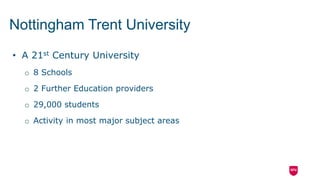
• A 21st Century University
o 8 Schools
o 2 Further Education providers
o 29,000 students
o Activity in most major subject areas
Nottingham Trent University
Animal, Rural &
Environmental
Sciences
Architecture, Design & the
Built Environment
Art & Design
Nottingham Business
School
Nottingham Law School
Social Sciences
Arts & Humanities
Science &
Technology
Confetti
• A successful university. Award-winning expertise in:
o Data
o Pedagogy
o Research
Nottingham Trent University
Creating Opportunity
Valuing Ideas
Enriching Society
Connecting Globally
Empowering People
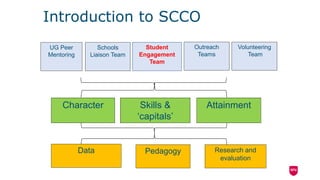
Introduction to SCCO
Outreach
Teams
Volunteering
Team
Character Skills &
‘capitals’
Attainment
Schools
Liaison Team
UG Peer
Mentoring
Data Research and
evaluation
Pedagogy
Student
Engagement
Team
Learning Analytics at Nottingham Trent University
Ed Foster, Student Engagement Manager, SCCO
ABLE Project 2015-1-BE-EPPKA3-PI-FORWARD
STELA Project: 562167-EPP-1-2015-1-BE-EPPKA3-PI-FORWARD
Learning Analytics at NTU
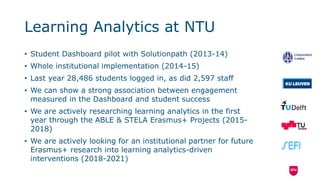
• Student Dashboard pilot with Solutionpath (2013-14)
• Whole institutional implementation (2014-15)
• Last year 28,486 students logged in, as did 2,597 staff
• We can show a strong association between engagement
measured in the Dashboard and student success
• We are actively researching learning analytics in the first
year through the ABLE & STELA Erasmus+ Projects (2015-
2018)
• We are actively looking for an institutional partner for future
Erasmus+ research into learning analytics-driven
interventions (2018-2021)
NTU Student Dashboard
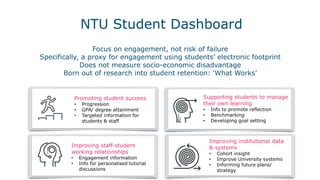
Improving institutional data
& systems
• Cohort insight
• Improve University systems
• Informing future plans/
strategy
Promoting student success
• Progression
• GPA/ degree attainment
• Targeted information for
students & staff
Improving staff-student
working relationships
• Engagement information
• Info for personalised tutorial
discussions
Supporting students to manage
their own learning
• Info to promote reflection
• Benchmarking
• Developing goal setting
Focus on engagement, not risk of failure
Specifically, a proxy for engagement using students’ electronic footprint
Does not measure socio-economic disadvantage
Born out of research into student retention: ‘What Works’
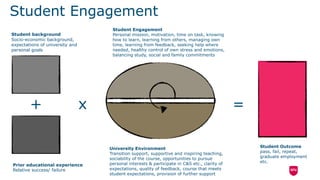
Student Engagement
Student background
Socio-economic background,
expectations of university and
personal goals
University Environment
Transition support, supportive and inspiring teaching,
sociability of the course, opportunities to pursue
personal interests & participate in C&S etc., clarity of
expectations, quality of feedback, course that meets
student expectations, provision of further support
Student Engagement
Personal mission, motivation, time on task, knowing
how to learn, learning from others, managing own
time, learning from feedback, seeking help where
needed, healthy control of own stress and emotions,
balancing study, social and family commitments
x =
Student Outcome
pass, fail, repeat,
graduate employment
etc.
Prior educational experience
Relative success/ failure
+
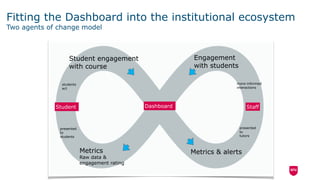
Dashboard StaffStudent
Metrics
Raw data &
engagement rating
Student engagement
with course
Metrics & alerts
Engagement
with students
presented
to
students
students
act
presented
to
tutors
more-informed
interactions
Fitting the Dashboard into the institutional ecosystem
Two agents of change model
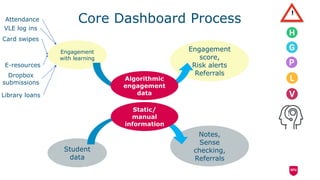
Core Dashboard Process
Student
data
Engagement
with learning
Engagement
score,
Risk alerts
Referrals
Notes,
Sense
checking,
Referrals
Static/
manual
information
Algorithmic
engagement
data
Attendance
E-resources
Card swipes
VLE log ins
Dropbox
submissions
Library loans
!
Ethics of using learning analytics
• Privacy & GDPR
• Difference between ‘legitimate interest’ & ‘consent’
• Algorithms are not neutral or bias-free
• Ethics of not acting
• Limits to support available
• Free will & the right to ‘mess up’
• Using activity, not demographics
• Assessing performativity
• Is this empowering, or stress-inducing?
• Popular with ‘winners’
• ’Sophisticated stereotyping’
• Isn’t this just about spying on staff anyway?
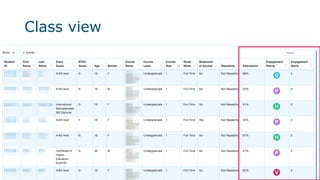
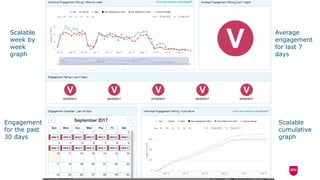
NTU Student Dashboard
Class view
Average
engagement
for last 7
days
Scalable
cumulative
graph
Scalable
week by
week
graph
Engagement
for the past
30 days
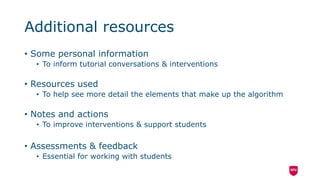
Additional resources
• Some personal information
• To inform tutorial conversations & interventions
• Resources used
• To help see more detail the elements that make up the algorithm
• Notes and actions
• To improve interventions & support students
• Assessments & feedback
• Essential for working with students
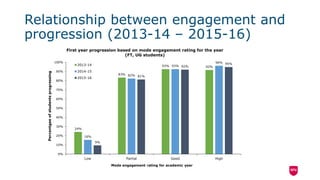
Testing the accuracy of the Dashboard
24%
83%
93% 92%
16%
82%
93%
96%
9%
81%
92%
95%
0%
10%
20%
30%
40%
50%
60%
70%
80%
90%
100%
Low Partial Good High
Percentgaeofstudentsprogressing
Mode engagement rating for academic year
First year progression based on mode engagement rating for the year
(FT, UG students)
2013-14
2014-15
2015-16
Relationship between engagement and
progression (2013-14 – 2015-16)
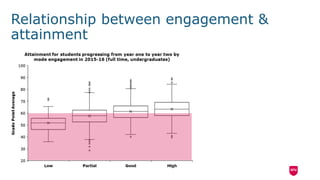
Relationship between engagement &
attainment
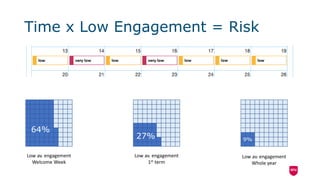
9%
Low av. engagement
Whole year
9%
Low av. engagement
1st term
27%
Low av. engagement
Welcome Week
64%
Time x Low Engagement = Risk
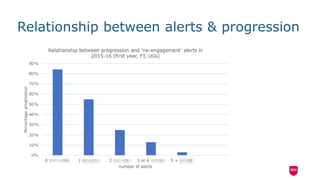
Relationship between alerts & progression
How usage has changed
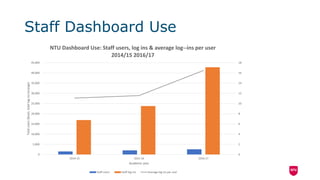
Staff Dashboard Use
0
2
4
6
8
10
12
14
16
18
0
5,000
10,000
15,000
20,000
25,000
30,000
35,000
40,000
45,000
2014-15 2015-16 2016-17
Totalusers(blue),totallogins(orange)
Academic year
NTU Dashboard Use: Staff users, log ins & average log--ins per user
2014/15 2016/17
Staff users Staff log-ins Average log ins per user
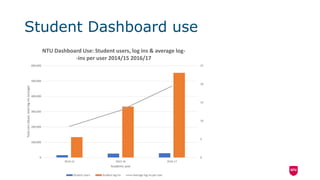
Student Dashboard use
0
5
10
15
20
25
0
100,000
200,000
300,000
400,000
500,000
600,000
2014-15 2015-16 2016-17
Totaluers(blue),totallog-ins(orange)
Academic year
NTU Dashboard Use: Student users, log ins & average log-
-ins per user 2014/15 2016/17
Student users Student log-ins Average log ins per user
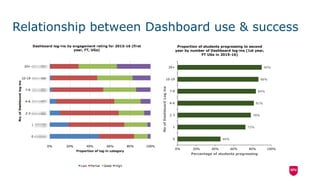
46%
72%
78%
81%
84%
86%
90%
0% 20% 40% 60% 80% 100%
0
1
2-3
4-6
7-9
10-19
20+
Percentage of students progressing
NoofDashboardLogins
Proportion of students progressing to second
year by number of Dashboard log-ins (1st year,
FT UGs in 2015-16)
Relationship between Dashboard use & success
Thank you
Any questions?
Session 2
Implementing learning analytics
Rebecca Edwards
How do students
use the Dashboard?
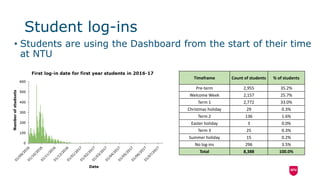
Student log-ins
Timeframe Count of students % of students
Pre-term 2,955 35.2%
Welcome Week 2,157 25.7%
Term 1 2,772 33.0%
Christmas holiday 29 0.3%
Term 2 136 1.6%
Easter holiday 3 0.0%
Term 3 25 0.3%
Summer holiday 15 0.2%
No log-ins 296 3.5%
Total 8,388 100.0%
• Students are using the Dashboard from the start of their time
at NTU
Student Transition Survey
• Since 2012-13, over 2,700 first year students have
provided feedback on different aspects of the
Dashboard
• Conducted Feb/ March each year
• Response rate = 5-7% of first year
• Provides valuable feedback
• We use it to test out ideas for improvements
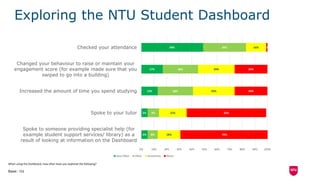
Exploring the NTU Student Dashboard
When using the Dashboard, how often have you explored the following?
Base: 753
5%
5%
13%
17%
49%
8%
9%
28%
28%
34%
18%
22%
33%
29%
16%
70%
63%
26%
26%
1%
0% 10% 20% 30% 40% 50% 60% 70% 80% 90% 100%
Spoke to someone providing specialist help (for
example student support services/ library) as a
result of looking at information on the Dashboard
Spoke to your tutor
Increased the amount of time you spend studying
Changed your behaviour to raise or maintain your
engagement score (for example made sure that you
swiped to go into a building)
Checked your attendance
Very Often Often Sometimes Never
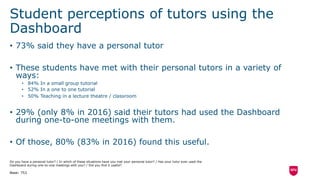
Student perceptions of tutors using the
Dashboard
• 73% said they have a personal tutor
• These students have met with their personal tutors in a variety of
ways:
• 84% In a small group tutorial
• 52% In a one to one tutorial
• 50% Teaching in a lecture theatre / classroom
• 29% (only 8% in 2016) said their tutors had used the Dashboard
during one-to-one meetings with them.
• Of those, 80% (83% in 2016) found this useful.
Do you have a personal tutor? / In which of these situations have you met your personal tutor? / Has your tutor ever used the
Dashboard during one-to-one meetings with you? / Did you find it useful?
Base: 753
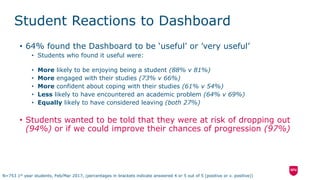
Student Reactions to Dashboard
• 64% found the Dashboard to be ‘useful’ or ’very useful’
• Students who found it useful were:
• More likely to be enjoying being a student (88% v 81%)
• More engaged with their studies (73% v 66%)
• More confident about coping with their studies (61% v 54%)
• Less likely to have encountered an academic problem (64% v 69%)
• Equally likely to have considered leaving (both 27%)
• Students wanted to be told that they were at risk of dropping out
(94%) or if we could improve their chances of progression (97%)
N=753 1st year students, Feb/Mar 2017, (percentages in brackets indicate answered 4 or 5 out of 5 (positive or v. positive))
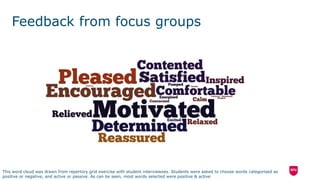
This word cloud was drawn from repertory grid exercise with student interviewees. Students were asked to choose words categorised as
positive or negative, and active or passive. As can be seen, most words selected were positive & active
Feedback from focus groups
How do staff use the Dashboard?
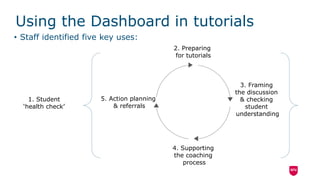
Using the Dashboard in tutorials
2. Preparing
for tutorials
3. Framing
the discussion
& checking
student
understanding
4. Supporting
the coaching
process
5. Action planning
& referrals
• Staff identified five key uses:
1. Student
‘health check’
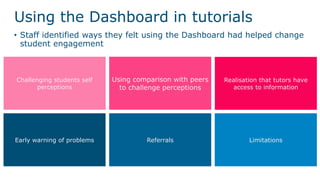
Challenging students self
perceptions
Realisation that tutors have
access to information
Using comparison with peers
to challenge perceptions
Early warning of problems Referrals Limitations
Using the Dashboard in tutorials
• Staff identified ways they felt using the Dashboard had helped change
student engagement
Embedding into practice
• Pilot activities 2015/16 – iPad pilot, student induction,
referrals
• Pilot activities 2016/17 – student alerting, staff notes
• Mid-term review Social Sciences 2016/17 and 2017/18
• Mid-term review Business School 2017/18
• Supporting other initiatives: Scale-up, Academic
Librarians, GRIT training
• Internal events/conferences
Challenges
• Dashboard is used regularly by approx. 40% of
students
• Association between use and higher engagement
• In turn to success
• Two challenges
• Increase student use
• & capacity to benefit from it
• Increase staff use
• & capacity to bring about change
Barriers to staff using the Dashboard
• Barriers in tutorials:
• Frequency and duration of tutorials
• Problems with space and time
• Topics covered
• Broader barriers
• Competing priorities
• Changing expectations of students and staff in HE
• Concerns about methodology
Overcoming barriers
• Communications
• Staff
• Student
• Staff development
• Policy
• Product development
• Partnership working
Ongoing/future developments
• Increasingly complete picture of student journey
through HE
• New data visualisations (individual and group)
• Different forms of alerting
• Further sophistication
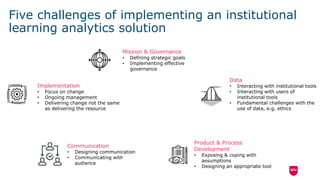
Five challenges of implementing an institutional
learning analytics solution
Mission & Governance
• Defining strategic goals
• Implementing effective
governance
Data
• Interacting with institutional tools
• Interacting with users of
institutional tools
• Fundamental challenges with the
use of data, e.g. ethics
Product & Process
Development
• Exposing & coping with
assumptions
• Designing an appropriate tool
Communication
• Designing communication
• Communicating with
audience
Implementation
• Focus on change
• Ongoing management
• Delivering change not the same
as delivering the resource
Thank you
Any questions?
Session 3
Working with learning analytics
Supporting Student Engagement
School of Social Sciences
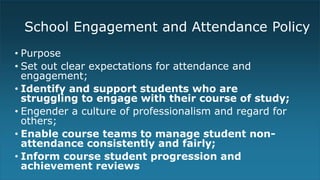
School Engagement and Attendance Policy
• Purpose
• Set out clear expectations for attendance and
engagement;
• Identify and support students who are
struggling to engage with their course of study;
• Engender a culture of professionalism and regard for
others;
• Enable course teams to manage student non-
attendance consistently and fairly;
• Inform course student progression and
achievement reviews
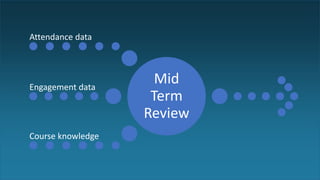
Mid
Term
Review
Attendance data
Engagement data
Course knowledge
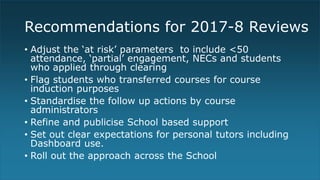
Recommendations for 2017-8 Reviews
• Adjust the ‘at risk’ parameters to include <50
attendance, ‘partial’ engagement, NECs and students
who applied through clearing
• Flag students who transferred courses for course
induction purposes
• Standardise the follow up actions by course
administrators
• Refine and publicise School based support
• Set out clear expectations for personal tutors including
Dashboard use.
• Roll out the approach across the School
NTU Library and the Student Dashboard
Heather Shaw, Learning and Teaching Team
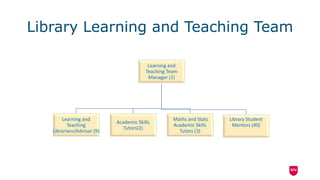
Library Learning and Teaching Team
Learning and
Teaching Team
Manager (1)
Learning and
Teaching
Librarians/Advisor (9)
Academic Skills
Tutors(2)
Maths and Stats
Academic Skills
Tutors (3)
Library Student
Mentors (40)
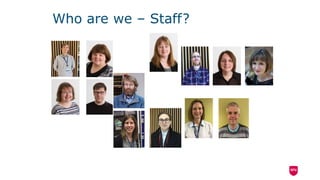
Who are we – Staff?
What do we do?
• We provide a range of services to support staff with their learning and teaching and students on taught
courses (UG/PG) throughout their studies.
• Working with others, we support the development of the curriculum, new pedagogy, resources, induction,
employability and transferable life long learning academic skills.
• We deliver induction and academic skills support to the Academy and local FE/Schools.
• We engage in staff student partnerships to co-develop an agenda for change, drive innovative practices and
peer review.
• We participate in the development of strategy to engage with learning technologies and provide direct support
for developing digital literacy skills and online resources.
• We contribute to library strategic planning, projects, library resources and professional development
opportunities.
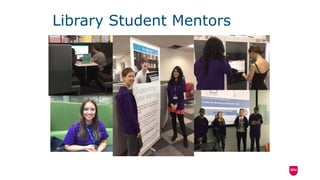
Library Student Mentors
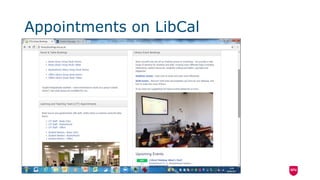
Appointments on LibCal
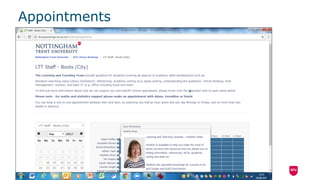
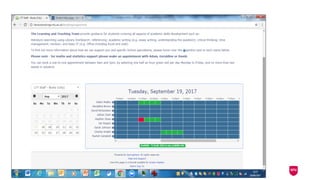
Appointments
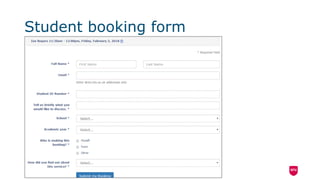
Student booking form
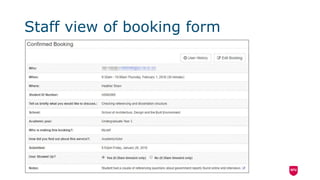
Staff view of booking form
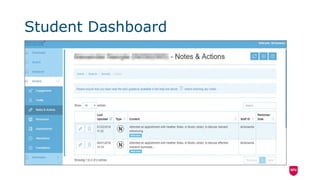
Student Dashboard
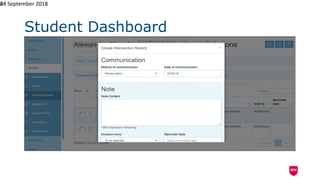
Student Dashboard
24 September 201864
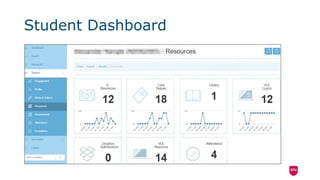
Student Dashboard
Thank you
Any questions?

ABLE - NTU Danish visit February 2018

  • 1.
    Welcome to Nottingham Trent University David Woolley Headof Schools, Colleges and Community Outreach
  • 2.
  • 3.
    • A 21stCentury University o 8 Schools o 2 Further Education providers o 29,000 students o Activity in most major subject areas Nottingham Trent University
  • 4.
    Animal, Rural & Environmental Sciences Architecture,Design & the Built Environment Art & Design Nottingham Business School Nottingham Law School Social Sciences Arts & Humanities Science & Technology Confetti
  • 5.
    • A successfuluniversity. Award-winning expertise in: o Data o Pedagogy o Research Nottingham Trent University
  • 6.
    Creating Opportunity Valuing Ideas EnrichingSociety Connecting Globally Empowering People
  • 7.
    Introduction to SCCO Outreach Teams Volunteering Team CharacterSkills & ‘capitals’ Attainment Schools Liaison Team UG Peer Mentoring Data Research and evaluation Pedagogy Student Engagement Team
  • 8.
    Learning Analytics atNottingham Trent University Ed Foster, Student Engagement Manager, SCCO ABLE Project 2015-1-BE-EPPKA3-PI-FORWARD STELA Project: 562167-EPP-1-2015-1-BE-EPPKA3-PI-FORWARD
  • 9.
    Learning Analytics atNTU • Student Dashboard pilot with Solutionpath (2013-14) • Whole institutional implementation (2014-15) • Last year 28,486 students logged in, as did 2,597 staff • We can show a strong association between engagement measured in the Dashboard and student success • We are actively researching learning analytics in the first year through the ABLE & STELA Erasmus+ Projects (2015- 2018) • We are actively looking for an institutional partner for future Erasmus+ research into learning analytics-driven interventions (2018-2021)
  • 10.
    NTU Student Dashboard Improvinginstitutional data & systems • Cohort insight • Improve University systems • Informing future plans/ strategy Promoting student success • Progression • GPA/ degree attainment • Targeted information for students & staff Improving staff-student working relationships • Engagement information • Info for personalised tutorial discussions Supporting students to manage their own learning • Info to promote reflection • Benchmarking • Developing goal setting Focus on engagement, not risk of failure Specifically, a proxy for engagement using students’ electronic footprint Does not measure socio-economic disadvantage Born out of research into student retention: ‘What Works’
  • 11.
    Student Engagement Student background Socio-economicbackground, expectations of university and personal goals University Environment Transition support, supportive and inspiring teaching, sociability of the course, opportunities to pursue personal interests & participate in C&S etc., clarity of expectations, quality of feedback, course that meets student expectations, provision of further support Student Engagement Personal mission, motivation, time on task, knowing how to learn, learning from others, managing own time, learning from feedback, seeking help where needed, healthy control of own stress and emotions, balancing study, social and family commitments x = Student Outcome pass, fail, repeat, graduate employment etc. Prior educational experience Relative success/ failure +
  • 12.
    Dashboard StaffStudent Metrics Raw data& engagement rating Student engagement with course Metrics & alerts Engagement with students presented to students students act presented to tutors more-informed interactions Fitting the Dashboard into the institutional ecosystem Two agents of change model
  • 13.
    Core Dashboard Process Student data Engagement withlearning Engagement score, Risk alerts Referrals Notes, Sense checking, Referrals Static/ manual information Algorithmic engagement data Attendance E-resources Card swipes VLE log ins Dropbox submissions Library loans !
  • 14.
    Ethics of usinglearning analytics • Privacy & GDPR • Difference between ‘legitimate interest’ & ‘consent’ • Algorithms are not neutral or bias-free • Ethics of not acting • Limits to support available • Free will & the right to ‘mess up’ • Using activity, not demographics • Assessing performativity • Is this empowering, or stress-inducing? • Popular with ‘winners’ • ’Sophisticated stereotyping’ • Isn’t this just about spying on staff anyway?
  • 15.
  • 16.
  • 17.
  • 18.
    Additional resources • Somepersonal information • To inform tutorial conversations & interventions • Resources used • To help see more detail the elements that make up the algorithm • Notes and actions • To improve interventions & support students • Assessments & feedback • Essential for working with students
  • 19.
    Testing the accuracyof the Dashboard
  • 20.
    24% 83% 93% 92% 16% 82% 93% 96% 9% 81% 92% 95% 0% 10% 20% 30% 40% 50% 60% 70% 80% 90% 100% Low PartialGood High Percentgaeofstudentsprogressing Mode engagement rating for academic year First year progression based on mode engagement rating for the year (FT, UG students) 2013-14 2014-15 2015-16 Relationship between engagement and progression (2013-14 – 2015-16)
  • 21.
  • 22.
    9% Low av. engagement Wholeyear 9% Low av. engagement 1st term 27% Low av. engagement Welcome Week 64% Time x Low Engagement = Risk
  • 23.
  • 24.
  • 25.
    Staff Dashboard Use 0 2 4 6 8 10 12 14 16 18 0 5,000 10,000 15,000 20,000 25,000 30,000 35,000 40,000 45,000 2014-152015-16 2016-17 Totalusers(blue),totallogins(orange) Academic year NTU Dashboard Use: Staff users, log ins & average log--ins per user 2014/15 2016/17 Staff users Staff log-ins Average log ins per user
  • 26.
    Student Dashboard use 0 5 10 15 20 25 0 100,000 200,000 300,000 400,000 500,000 600,000 2014-152015-16 2016-17 Totaluers(blue),totallog-ins(orange) Academic year NTU Dashboard Use: Student users, log ins & average log- -ins per user 2014/15 2016/17 Student users Student log-ins Average log ins per user
  • 27.
    46% 72% 78% 81% 84% 86% 90% 0% 20% 40%60% 80% 100% 0 1 2-3 4-6 7-9 10-19 20+ Percentage of students progressing NoofDashboardLogins Proportion of students progressing to second year by number of Dashboard log-ins (1st year, FT UGs in 2015-16) Relationship between Dashboard use & success
  • 28.
  • 29.
    Session 2 Implementing learninganalytics Rebecca Edwards
  • 30.
    How do students usethe Dashboard?
  • 31.
    Student log-ins Timeframe Countof students % of students Pre-term 2,955 35.2% Welcome Week 2,157 25.7% Term 1 2,772 33.0% Christmas holiday 29 0.3% Term 2 136 1.6% Easter holiday 3 0.0% Term 3 25 0.3% Summer holiday 15 0.2% No log-ins 296 3.5% Total 8,388 100.0% • Students are using the Dashboard from the start of their time at NTU
  • 32.
    Student Transition Survey •Since 2012-13, over 2,700 first year students have provided feedback on different aspects of the Dashboard • Conducted Feb/ March each year • Response rate = 5-7% of first year • Provides valuable feedback • We use it to test out ideas for improvements
  • 33.
    Exploring the NTUStudent Dashboard When using the Dashboard, how often have you explored the following? Base: 753 5% 5% 13% 17% 49% 8% 9% 28% 28% 34% 18% 22% 33% 29% 16% 70% 63% 26% 26% 1% 0% 10% 20% 30% 40% 50% 60% 70% 80% 90% 100% Spoke to someone providing specialist help (for example student support services/ library) as a result of looking at information on the Dashboard Spoke to your tutor Increased the amount of time you spend studying Changed your behaviour to raise or maintain your engagement score (for example made sure that you swiped to go into a building) Checked your attendance Very Often Often Sometimes Never
  • 34.
    Student perceptions oftutors using the Dashboard • 73% said they have a personal tutor • These students have met with their personal tutors in a variety of ways: • 84% In a small group tutorial • 52% In a one to one tutorial • 50% Teaching in a lecture theatre / classroom • 29% (only 8% in 2016) said their tutors had used the Dashboard during one-to-one meetings with them. • Of those, 80% (83% in 2016) found this useful. Do you have a personal tutor? / In which of these situations have you met your personal tutor? / Has your tutor ever used the Dashboard during one-to-one meetings with you? / Did you find it useful? Base: 753
  • 35.
    Student Reactions toDashboard • 64% found the Dashboard to be ‘useful’ or ’very useful’ • Students who found it useful were: • More likely to be enjoying being a student (88% v 81%) • More engaged with their studies (73% v 66%) • More confident about coping with their studies (61% v 54%) • Less likely to have encountered an academic problem (64% v 69%) • Equally likely to have considered leaving (both 27%) • Students wanted to be told that they were at risk of dropping out (94%) or if we could improve their chances of progression (97%) N=753 1st year students, Feb/Mar 2017, (percentages in brackets indicate answered 4 or 5 out of 5 (positive or v. positive))
  • 36.
    This word cloudwas drawn from repertory grid exercise with student interviewees. Students were asked to choose words categorised as positive or negative, and active or passive. As can be seen, most words selected were positive & active Feedback from focus groups
  • 37.
    How do staffuse the Dashboard?
  • 38.
    Using the Dashboardin tutorials 2. Preparing for tutorials 3. Framing the discussion & checking student understanding 4. Supporting the coaching process 5. Action planning & referrals • Staff identified five key uses: 1. Student ‘health check’
  • 39.
    Challenging students self perceptions Realisationthat tutors have access to information Using comparison with peers to challenge perceptions Early warning of problems Referrals Limitations Using the Dashboard in tutorials • Staff identified ways they felt using the Dashboard had helped change student engagement
  • 40.
    Embedding into practice •Pilot activities 2015/16 – iPad pilot, student induction, referrals • Pilot activities 2016/17 – student alerting, staff notes • Mid-term review Social Sciences 2016/17 and 2017/18 • Mid-term review Business School 2017/18 • Supporting other initiatives: Scale-up, Academic Librarians, GRIT training • Internal events/conferences
  • 41.
    Challenges • Dashboard isused regularly by approx. 40% of students • Association between use and higher engagement • In turn to success • Two challenges • Increase student use • & capacity to benefit from it • Increase staff use • & capacity to bring about change
  • 42.
    Barriers to staffusing the Dashboard • Barriers in tutorials: • Frequency and duration of tutorials • Problems with space and time • Topics covered • Broader barriers • Competing priorities • Changing expectations of students and staff in HE • Concerns about methodology
  • 43.
    Overcoming barriers • Communications •Staff • Student • Staff development • Policy • Product development • Partnership working
  • 44.
    Ongoing/future developments • Increasinglycomplete picture of student journey through HE • New data visualisations (individual and group) • Different forms of alerting • Further sophistication
  • 45.
    Five challenges ofimplementing an institutional learning analytics solution Mission & Governance • Defining strategic goals • Implementing effective governance Data • Interacting with institutional tools • Interacting with users of institutional tools • Fundamental challenges with the use of data, e.g. ethics Product & Process Development • Exposing & coping with assumptions • Designing an appropriate tool Communication • Designing communication • Communicating with audience Implementation • Focus on change • Ongoing management • Delivering change not the same as delivering the resource
  • 46.
  • 47.
    Session 3 Working withlearning analytics
  • 48.
  • 49.
    School Engagement andAttendance Policy • Purpose • Set out clear expectations for attendance and engagement; • Identify and support students who are struggling to engage with their course of study; • Engender a culture of professionalism and regard for others; • Enable course teams to manage student non- attendance consistently and fairly; • Inform course student progression and achievement reviews
  • 50.
  • 51.
    Recommendations for 2017-8Reviews • Adjust the ‘at risk’ parameters to include <50 attendance, ‘partial’ engagement, NECs and students who applied through clearing • Flag students who transferred courses for course induction purposes • Standardise the follow up actions by course administrators • Refine and publicise School based support • Set out clear expectations for personal tutors including Dashboard use. • Roll out the approach across the School
  • 52.
    NTU Library andthe Student Dashboard Heather Shaw, Learning and Teaching Team
  • 53.
    Library Learning andTeaching Team Learning and Teaching Team Manager (1) Learning and Teaching Librarians/Advisor (9) Academic Skills Tutors(2) Maths and Stats Academic Skills Tutors (3) Library Student Mentors (40)
  • 54.
    Who are we– Staff?
  • 55.
    What do wedo? • We provide a range of services to support staff with their learning and teaching and students on taught courses (UG/PG) throughout their studies. • Working with others, we support the development of the curriculum, new pedagogy, resources, induction, employability and transferable life long learning academic skills. • We deliver induction and academic skills support to the Academy and local FE/Schools. • We engage in staff student partnerships to co-develop an agenda for change, drive innovative practices and peer review. • We participate in the development of strategy to engage with learning technologies and provide direct support for developing digital literacy skills and online resources. • We contribute to library strategic planning, projects, library resources and professional development opportunities.
  • 56.
  • 57.
  • 58.
  • 60.
  • 61.
    Staff view ofbooking form
  • 62.
  • 63.
  • 64.
  • 65.