The 5 Commandments of Social Media:
      Strategy, Tools and Culture

            Presented by Lisa Colton,
         Founder & President Darim Online
              lisa@darimonline.org
                   434.977.1170
Agenda

Communications Revolution
Social Media Basics
5 Stages of Social Media Participation
  –   Listening
  –   Engaging
  –   Social Content
  –   Generate Buzz
  –   Community Building
Tachlis Next Steps
Goals

Demystify social media
Help you think strategically
Build vocabulary
Show examples
Turn you on to resources

Warning: You may feel overwhelmed!
(And excited, and inspired.)
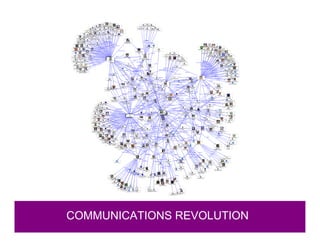
COMMUNICATIONS REVOLUTION
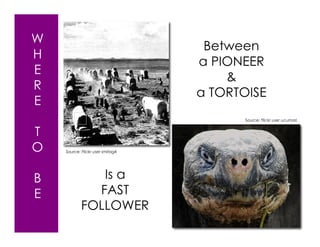
W
                                   Between
H
                                  a PIONEER
E
                                      &
R
                                  a TORTOISE
E
                                        Source: Flickr user ucumari


T
O   Source: Flickr user smitag4


B              Is a
E             FAST
            FOLLOWER
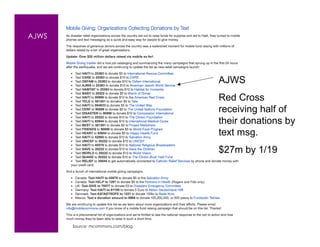
AJWS


                                   AJWS
                                   Red Cross
                                   receiving half of
                                   their donations by
                                   text msg.
                                   $27m by 1/19


       Source: mcommons.com/blog
Characteristics of Social Media

The Term “Social Media” refers to online tools (web sites) that depend
on user contributions and interactions between people to build shared
meaning and value. It is:

• Participatory: It blurs the line between producer and consumer,
  media and audience.
• Open and Democratic: It encourages voting, comments and the
  sharing of information. For this reason it is seen as authentic and
  trustworthy.
• Conversational: Two (or more) way conversation rather than one-
  directional broadcast. Is personal, specific, and engaging.
• Communal: Supports formation, growth and strength of communities
  around a particular shared interest.
• Connected: Thrives on being connected, making use of links to other
  sites, resources and people, rather than being territorial and
  proprietary.
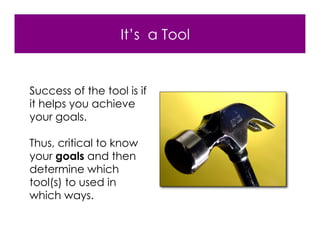
It’s a Tool


Success of the tool is if
it helps you achieve
your goals.

Thus, critical to know
your goals and then
determine which
tool(s) to used in
which ways.
GROUNDSWELL’s P.O.S.T.


1. PEOPLE: Identify audience(s)

2. OBJECTIVES
   – What are you goals and
     objectives for this audience?
   – What are your audience’s
     goals?

3. What is the STRATEGY to reach
   these goals?

4. Determine the specifics of the
   TECHNOLOGIES you’ll use.
   Implement, measure, refine!
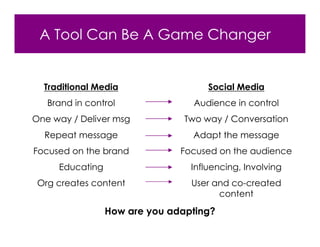
A Tool Can Be A Game Changer


  Traditional Media                  Social Media
   Brand in control              Audience in control
One way / Deliver msg           Two way / Conversation
  Repeat message                 Adapt the message
Focused on the brand           Focused on the audience
     Educating                   Influencing, Involving
 Org creates content             User and co-created
                                       content
                 How are you adapting?
LISTENING


            Source: Flickr user andyadontstop
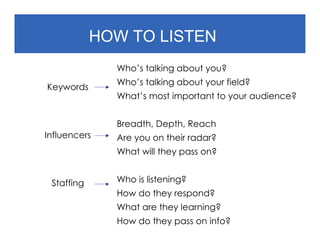
HOW TO LISTEN
              Who’s talking about you?
              Who’s talking about your field?
Keywords
              What’s most important to your audience?


              Breadth, Depth, Reach
Influencers   Are you on their radar?
              What will they pass on?


 Staffing     Who is listening?
              How do they respond?
              What are they learning?
              How do they pass on info?
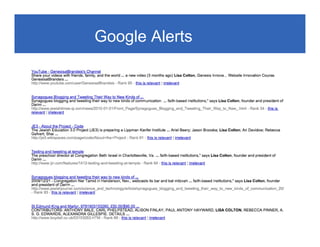
Google Alerts
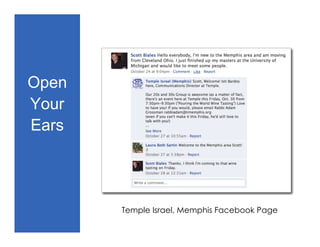
Open
Your
Ears


       Temple Israel, Memphis Facebook Page
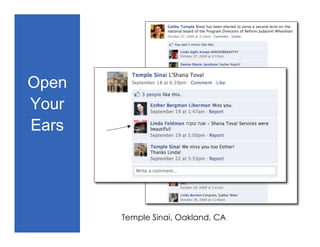
Open
Your
Ears


       Temple Sinai, Oakland, CA
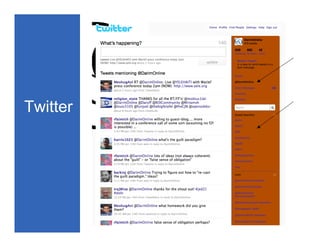
Twitter
• Identify Keywords
   • Key people’s names, URLs, related
   organizations, grantees, industry
   keywords, etc.
                                               How
• Identify Key Influencers
   • Who is sharing info on your industry
                                                 To
   • Who is connected to the                   Begin
   audiences you want to engage with
                                             Listening
   • Who are your online mavens and
   connectors (internal and external)

• Set up tools, people, communication

        SocialFish offers Listening Audits
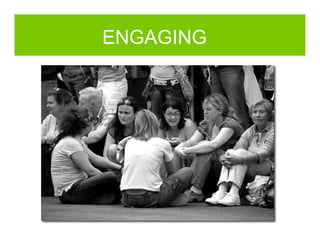
ENGAGING

                   #1
                Social
              media is
           continuing
            to evolve.
                 Fast.
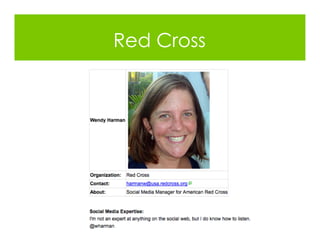
Red Cross
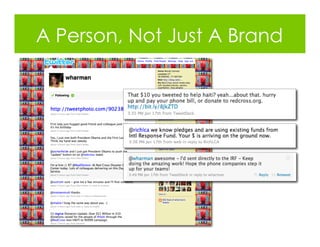
A Person, Not Just A Brand
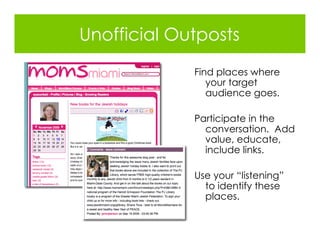
Unofficial Outposts
             Find places where
                your target
                audience goes.

             Participate in the
               conversation. Add
               value, educate,
               include links.

             Use your “listening”
               to identify these
               places.
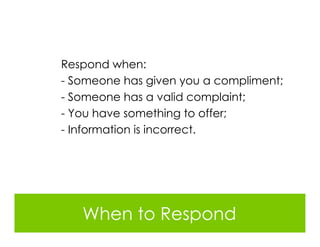
Respond when:
- Someone has given you a compliment;
- Someone has a valid complaint;
- You have something to offer;
- Information is incorrect.


   When to Respond
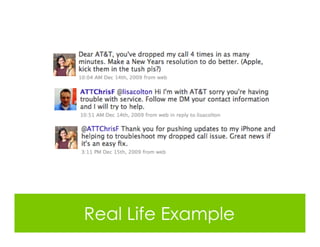
Real Life Example
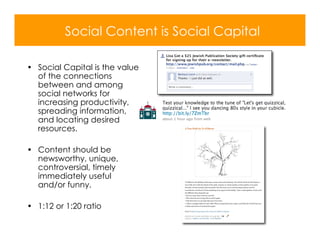
Social Content is Social Capital

• Social Capital is the value
  of the connections
  between and among
  social networks for
  increasing productivity,
  spreading information,
  and locating desired
  resources.

• Content should be
  newsworthy, unique,
  controversial, timely
  immediately useful
  and/or funny.

• 1:12 or 1:20 ratio
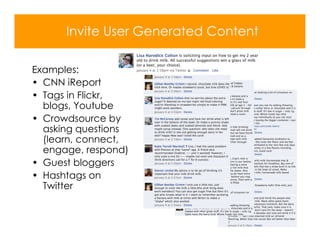
Invite User Generated Content

Examples:
• CNN iReport
• Tags in Flickr,
  blogs, Youtube
• Crowdsource by
  asking questions
  (learn, connect,
  engage, respond)
• Guest bloggers
• Hashtags on
  Twitter
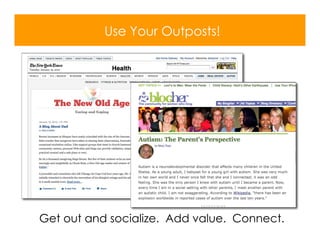
Use Your Outposts!


Get out and socialize. Add value. Connect.
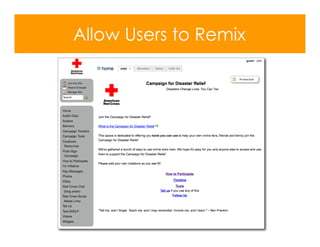
Allow Users to Remix
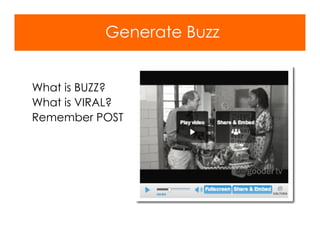
Generate Buzz


What is BUZZ?
What is VIRAL?
Remember POST
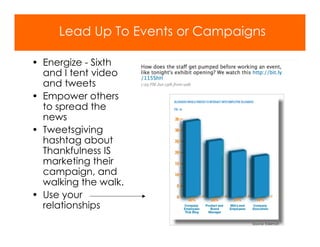
Lead Up To Events or Campaigns

• Energize - Sixth
  and I tent video
  and tweets
• Empower others
  to spread the
  news
• Tweetsgiving
  hashtag about
  Thankfulness IS
  marketing their
  campaign, and
  walking the walk.
• Use your
  relationships
                                 Source: Edelman
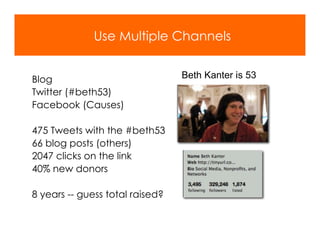
Use Multiple Channels


Blog                             Beth Kanter is 53
Twitter (#beth53)
Facebook (Causes)

475 Tweets with the #beth53
66 blog posts (others)
2047 clicks on the link
40% new donors

8 years -- guess total raised?
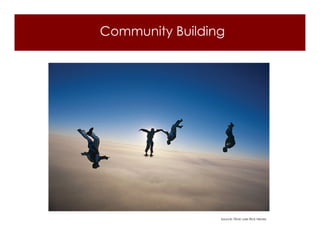
Community Building


                     Source: Flickr user JYRO
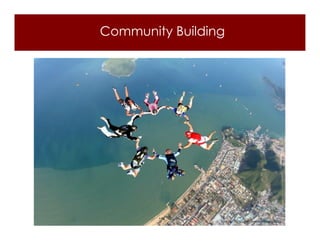
Community Building


                 Source: Flickr user Rick Neves
Community Building


                 Source: Flickr user divemasterking2000
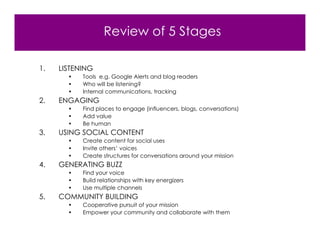
Review of 5 Stages

1.   LISTENING
       •   Tools e.g. Google Alerts and blog readers
       •   Who will be listening?
       •   Internal communications, tracking
2.   ENGAGING
       •   Find places to engage (influencers, blogs, conversations)
       •   Add value
       •   Be human
3.   USING SOCIAL CONTENT
       •   Create content for social uses
       •   Invite others’ voices
       •   Create structures for conversations around your mission
4.   GENERATING BUZZ
       •   Find your voice
       •   Build relationships with key energizers
       •   Use multiple channels
5.   COMMUNITY BUILDING
       •   Cooperative pursuit of your mission
       •   Empower your community and collaborate with them
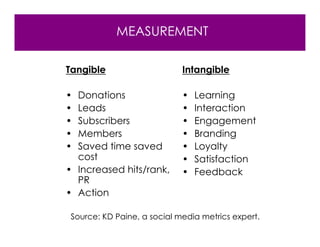
MEASUREMENT

Tangible                     Intangible

• Donations                  •   Learning
• Leads                      •   Interaction
• Subscribers                •   Engagement
• Members                    •   Branding
• Saved time saved           •   Loyalty
  cost                       •   Satisfaction
• Increased hits/rank,       •   Feedback
  PR
• Action

 Source: KD Paine, a social media metrics expert.
FINAL THOUGHTS


• Stay nimble - Change will continue
• Know what you want to measure
  and how you’ll know if you’re
  successful
• Think about staffing and guidelines
• Address your whole culture, not just
  marketing/PR.
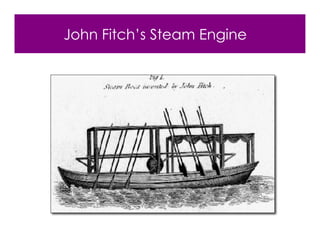
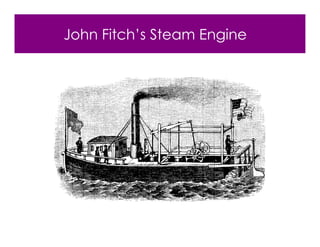
John Fitch’s Steam Engine
IT’S NOT ABOUT TECHNOLOGY

UJA Agencies

  • 1.
    The 5 Commandmentsof Social Media: Strategy, Tools and Culture Presented by Lisa Colton, Founder & President Darim Online lisa@darimonline.org 434.977.1170
  • 2.
    Agenda Communications Revolution Social MediaBasics 5 Stages of Social Media Participation – Listening – Engaging – Social Content – Generate Buzz – Community Building Tachlis Next Steps
  • 3.
    Goals Demystify social media Helpyou think strategically Build vocabulary Show examples Turn you on to resources Warning: You may feel overwhelmed! (And excited, and inspired.)
  • 4.
  • 5.
  • 6.
    W Between H a PIONEER E & R a TORTOISE E Source: Flickr user ucumari T O Source: Flickr user smitag4 B Is a E FAST FOLLOWER
  • 7.
    AJWS AJWS Red Cross receiving half of their donations by text msg. $27m by 1/19 Source: mcommons.com/blog
  • 8.
    Characteristics of SocialMedia The Term “Social Media” refers to online tools (web sites) that depend on user contributions and interactions between people to build shared meaning and value. It is: • Participatory: It blurs the line between producer and consumer, media and audience. • Open and Democratic: It encourages voting, comments and the sharing of information. For this reason it is seen as authentic and trustworthy. • Conversational: Two (or more) way conversation rather than one- directional broadcast. Is personal, specific, and engaging. • Communal: Supports formation, growth and strength of communities around a particular shared interest. • Connected: Thrives on being connected, making use of links to other sites, resources and people, rather than being territorial and proprietary.
  • 9.
    It’s a Tool Successof the tool is if it helps you achieve your goals. Thus, critical to know your goals and then determine which tool(s) to used in which ways.
  • 10.
    GROUNDSWELL’s P.O.S.T. 1. PEOPLE:Identify audience(s) 2. OBJECTIVES – What are you goals and objectives for this audience? – What are your audience’s goals? 3. What is the STRATEGY to reach these goals? 4. Determine the specifics of the TECHNOLOGIES you’ll use. Implement, measure, refine!
  • 11.
    A Tool CanBe A Game Changer Traditional Media Social Media Brand in control Audience in control One way / Deliver msg Two way / Conversation Repeat message Adapt the message Focused on the brand Focused on the audience Educating Influencing, Involving Org creates content User and co-created content How are you adapting?
  • 12.
    LISTENING Source: Flickr user andyadontstop
  • 13.
    HOW TO LISTEN Who’s talking about you? Who’s talking about your field? Keywords What’s most important to your audience? Breadth, Depth, Reach Influencers Are you on their radar? What will they pass on? Staffing Who is listening? How do they respond? What are they learning? How do they pass on info?
  • 14.
  • 15.
    Open Your Ears Temple Israel, Memphis Facebook Page
  • 16.
    Open Your Ears Temple Sinai, Oakland, CA
  • 17.
  • 18.
    • Identify Keywords • Key people’s names, URLs, related organizations, grantees, industry keywords, etc. How • Identify Key Influencers • Who is sharing info on your industry To • Who is connected to the Begin audiences you want to engage with Listening • Who are your online mavens and connectors (internal and external) • Set up tools, people, communication SocialFish offers Listening Audits
  • 19.
    ENGAGING #1 Social media is continuing to evolve. Fast.
  • 20.
  • 21.
    A Person, NotJust A Brand
  • 22.
    Unofficial Outposts Find places where your target audience goes. Participate in the conversation. Add value, educate, include links. Use your “listening” to identify these places.
  • 23.
    Respond when: - Someonehas given you a compliment; - Someone has a valid complaint; - You have something to offer; - Information is incorrect. When to Respond
  • 24.
  • 25.
    Social Content isSocial Capital • Social Capital is the value of the connections between and among social networks for increasing productivity, spreading information, and locating desired resources. • Content should be newsworthy, unique, controversial, timely immediately useful and/or funny. • 1:12 or 1:20 ratio
  • 26.
    Invite User GeneratedContent Examples: • CNN iReport • Tags in Flickr, blogs, Youtube • Crowdsource by asking questions (learn, connect, engage, respond) • Guest bloggers • Hashtags on Twitter
  • 27.
    Use Your Outposts! Getout and socialize. Add value. Connect.
  • 28.
  • 29.
    Generate Buzz What isBUZZ? What is VIRAL? Remember POST
  • 30.
    Lead Up ToEvents or Campaigns • Energize - Sixth and I tent video and tweets • Empower others to spread the news • Tweetsgiving hashtag about Thankfulness IS marketing their campaign, and walking the walk. • Use your relationships Source: Edelman
  • 31.
    Use Multiple Channels Blog Beth Kanter is 53 Twitter (#beth53) Facebook (Causes) 475 Tweets with the #beth53 66 blog posts (others) 2047 clicks on the link 40% new donors 8 years -- guess total raised?
  • 32.
    Community Building Source: Flickr user JYRO
  • 33.
    Community Building Source: Flickr user Rick Neves
  • 34.
    Community Building Source: Flickr user divemasterking2000
  • 35.
    Review of 5Stages 1. LISTENING • Tools e.g. Google Alerts and blog readers • Who will be listening? • Internal communications, tracking 2. ENGAGING • Find places to engage (influencers, blogs, conversations) • Add value • Be human 3. USING SOCIAL CONTENT • Create content for social uses • Invite others’ voices • Create structures for conversations around your mission 4. GENERATING BUZZ • Find your voice • Build relationships with key energizers • Use multiple channels 5. COMMUNITY BUILDING • Cooperative pursuit of your mission • Empower your community and collaborate with them
  • 36.
    MEASUREMENT Tangible Intangible • Donations • Learning • Leads • Interaction • Subscribers • Engagement • Members • Branding • Saved time saved • Loyalty cost • Satisfaction • Increased hits/rank, • Feedback PR • Action Source: KD Paine, a social media metrics expert.
  • 37.
    FINAL THOUGHTS • Staynimble - Change will continue • Know what you want to measure and how you’ll know if you’re successful • Think about staffing and guidelines • Address your whole culture, not just marketing/PR.
  • 38.
  • 39.
  • 40.
    IT’S NOT ABOUTTECHNOLOGY