The Importance of Social Media


  A deeper look into the benefits
  of social media for independent
         recording studios.
                                    Emily Young
• Rewired the process
                  by which consumers
                  share experiences,
Socialization     expertise, and
                  opinions
  of Media      • Broadened the
                  channels available to
                  consumers who seek
                  information
                • Changed how
                  companies approach
                  markets
                • Altered how
                  companies develop
                  products
Socialization of Media
• Remodeled the process by which companies
  connect with and show appreciation for their
  customers
• Transformed the method of influence
• Facilitated customers’ direct engagement in
  the conversations that were previously taking
  place without their participation
“ Content is the new
   democracy, and
 we, the people, are
  ensuring that our
 voices are heard.”
    – Brian Solis
Influence of
 Social Media
• It begins with respect
  and an understanding of
  how you connect with
  and benefit those whom
  you’re hoping to help.
• Intent is defined by a
  genuine desire to evolve
  into a resource.
• Meaningful content can
  earn the creator trust,
  authority, and influence.
Influence of Social Media
• Genuine participation is a form of new marketing,
  but is not reminiscent of traditional marketing
  formats and techniques.
• Conversations can forge relationships, which are
  measured by social capital and trust.
• It acts as a blueprint for “unmarketing.”
Making the Case for Social
       Media: The Five Ws+H+E
1. WHO: Define the brand
   personality and what it
   symbolizes. Give it a
   persona, personality,
   voice, and presence.
Developing “WHO”
• As an independent recording studio, you want
  your “personality” to reflect those of your
  demographic- musicians.
• It is crucial to give your studio a voice and
  reputation to maintain mutually beneficial
  relations with your patrons.
Developing “WHO”
• Social media provides excellent outlets for
  developing your voice and personality:

  – Blogging
  – Micro-blogging
  – Online newsletter
The Five Ws+H+E
2. WHAT: Listen to online conversations and learn from
   what’s said.

  Because you are a small
  business, competition is very
  high. Your presence on social
  media sites will allow you to
  listen to the audience and find
  out what they want. This
  presence will give you a leg-up
  on the competition.
The Five Ws+H+E
3. WHEN: Pinpoint when your opportunities arise.
   Surface any conversations that represent
   opportunities for positive engagement and also
   negative impressions.
Developing “WHEN”
• Social media allows you to monitor anything
  and everything happening the music world.
• An online presence provides opportunities to
  put your studio’s name out there.
• It also provides a way to “clean up” any
  negative impressions made.
The Five
Ws+H+E
Developing “WHERE”
• Social Media allows you to pinpoint your targeted
  demographic.

• You can find music-specific social networks to
  become a part of or music blogs to subscribe to.

• You can discover artists on sites such as YouTube or
  Good Music All Day.

• You can share projects you have worked on in order
  to gain to clients.
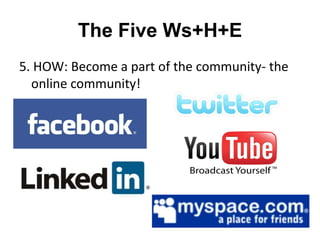
The Five Ws+H+E
5. HOW: Become a part of the community- the
  online community!
The Five Ws+H+E
6. WHY: Find the reasons that warrant your
  participation. Pay attention to recurring
  themes, topics, questions, insights, or lack
  thereof.

7. TO WHAT EXTENT: Identify the individuals
  who can help you tell your story.
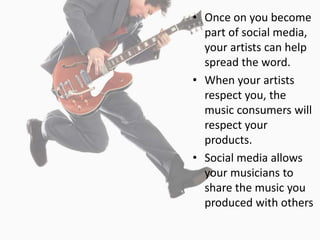
• Once on you become
  part of social media,
  your artists can help
  spread the word.
• When your artists
  respect you, the
  music consumers will
  respect your
  products.
• Social media allows
  your musicians to
  share the music you
  produced with others
Social Media Users
• 68% are Spectators- reads blogs, watches videos, and
  participates in other social media for business
  purposes
• 31% are conversation lists- those who update their
  status on social networks
• 33% are Critics- contribute comments or react to
  content they see in social formats
Social Media Users
• 19 % are Collectors- use social technology to
  collect information and stay on top of trends
• 59% are Joiners- participate in social networks
• 19 % are Inactives- nonparticipants
• More than 800 million active users
• More than 50% of our active users log on to
  Facebook in any given day
• Average user has 130 friends
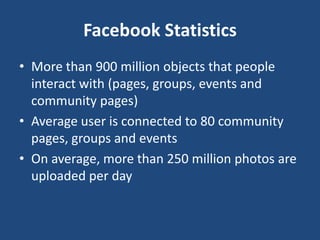
Facebook Statistics
• More than 900 million objects that people
  interact with (pages, groups, events and
  community pages)
• Average user is connected to 80 community
  pages, groups and events
• On average, more than 250 million photos are
  uploaded per day
• 175 million registered
  users
• 50 million tweets per
  day
• 90% of users follow
  specific brands
• 490 million unique users worldwide per
  month
• 92 billion page views each month
• 2.9 billion hours spent on YouTube in a month-
  over 325,000 years
• These stats don’t even include embedded
  videos or those viewed on mobile devices
How to Develop a Plan
1. Establish goals: Determine specific goals and
   objectives.
2. Listen: Study your audience. Who are they? What is
   their personality like? Where do they consume?
   How do they engage?
How to Develop a Plan
            3. Build: Use multiple
               channels and set up
               a home page.
            4. Engage: Ask
               questions and
               participate in
               conversation.
            5. Analyze and
               evaluate: Audit
               your online
               presence.
“All that’s separating you from where you
 are and where you want to be is time and
  experience. Your dedication, aspiration,
    and motivation already serve as the
   foundation for success.” – Brian Solis
Feel it.
          Breathe it.
          Live it.
          Be it.


ENGAGE!
References
• Statistics. (2011). Retrieved December 8, 2011, from Facebook website:
        http://www.facebook.com/press/info.php?statistics

• McGee, M. (2010, February 23). By The Numbers: Twitter Vs. Facebook Vs.
      Google Buzz. Retrieved December 8, 2011, from
      http://searchengineland.com/by-the-numbers-twitter-vs-facebook-
      vs-google-buzz-36709

• Finn, G. (2011, September 2). Nearly 90% Of Twitter Users Follow Brands &
        Just 10.9% Of Users Find Promoted Tweets To Be Annoying. Retrieved
        December 8, 2011, from http://searchengineland.com/ nearly-90-of-
        twitter-users-follow-brands-just-10-9-of-users-find-promoted-
        tweets-to-be-annoying-91532
References
• Elliot, A.-M. (2011, February 19). 10 Fascinating YouTube Facts That May
         Surprise You. Retrieved December 8, 2011, from Mashable website:
         http://mashable.com/2011/02/19/youtube-facts/

• Solis, B. (2011). Engage! Hoboken, NJ: John Wiley & Sons Inc.

• Social Network Icons courtesy of:
        http://www.socialnetworkingandyou.com/

• Twitter Bird Icon courtesy of: http://www.iconspedia.com/icon/twitter-
       bird-5-63.html

Social media

  • 1.
    The Importance ofSocial Media A deeper look into the benefits of social media for independent recording studios. Emily Young
  • 2.
    • Rewired theprocess by which consumers share experiences, Socialization expertise, and opinions of Media • Broadened the channels available to consumers who seek information • Changed how companies approach markets • Altered how companies develop products
  • 3.
    Socialization of Media •Remodeled the process by which companies connect with and show appreciation for their customers • Transformed the method of influence • Facilitated customers’ direct engagement in the conversations that were previously taking place without their participation
  • 4.
    “ Content isthe new democracy, and we, the people, are ensuring that our voices are heard.” – Brian Solis
  • 5.
    Influence of SocialMedia • It begins with respect and an understanding of how you connect with and benefit those whom you’re hoping to help. • Intent is defined by a genuine desire to evolve into a resource. • Meaningful content can earn the creator trust, authority, and influence.
  • 6.
    Influence of SocialMedia • Genuine participation is a form of new marketing, but is not reminiscent of traditional marketing formats and techniques. • Conversations can forge relationships, which are measured by social capital and trust. • It acts as a blueprint for “unmarketing.”
  • 7.
    Making the Casefor Social Media: The Five Ws+H+E 1. WHO: Define the brand personality and what it symbolizes. Give it a persona, personality, voice, and presence.
  • 8.
    Developing “WHO” • Asan independent recording studio, you want your “personality” to reflect those of your demographic- musicians. • It is crucial to give your studio a voice and reputation to maintain mutually beneficial relations with your patrons.
  • 9.
    Developing “WHO” • Socialmedia provides excellent outlets for developing your voice and personality: – Blogging – Micro-blogging – Online newsletter
  • 10.
    The Five Ws+H+E 2.WHAT: Listen to online conversations and learn from what’s said. Because you are a small business, competition is very high. Your presence on social media sites will allow you to listen to the audience and find out what they want. This presence will give you a leg-up on the competition.
  • 11.
    The Five Ws+H+E 3.WHEN: Pinpoint when your opportunities arise. Surface any conversations that represent opportunities for positive engagement and also negative impressions.
  • 12.
    Developing “WHEN” • Socialmedia allows you to monitor anything and everything happening the music world. • An online presence provides opportunities to put your studio’s name out there. • It also provides a way to “clean up” any negative impressions made.
  • 13.
  • 14.
    Developing “WHERE” • SocialMedia allows you to pinpoint your targeted demographic. • You can find music-specific social networks to become a part of or music blogs to subscribe to. • You can discover artists on sites such as YouTube or Good Music All Day. • You can share projects you have worked on in order to gain to clients.
  • 15.
    The Five Ws+H+E 5.HOW: Become a part of the community- the online community!
  • 16.
    The Five Ws+H+E 6.WHY: Find the reasons that warrant your participation. Pay attention to recurring themes, topics, questions, insights, or lack thereof. 7. TO WHAT EXTENT: Identify the individuals who can help you tell your story.
  • 17.
    • Once onyou become part of social media, your artists can help spread the word. • When your artists respect you, the music consumers will respect your products. • Social media allows your musicians to share the music you produced with others
  • 18.
    Social Media Users •68% are Spectators- reads blogs, watches videos, and participates in other social media for business purposes • 31% are conversation lists- those who update their status on social networks • 33% are Critics- contribute comments or react to content they see in social formats
  • 19.
    Social Media Users •19 % are Collectors- use social technology to collect information and stay on top of trends • 59% are Joiners- participate in social networks • 19 % are Inactives- nonparticipants
  • 20.
    • More than800 million active users • More than 50% of our active users log on to Facebook in any given day • Average user has 130 friends
  • 21.
    Facebook Statistics • Morethan 900 million objects that people interact with (pages, groups, events and community pages) • Average user is connected to 80 community pages, groups and events • On average, more than 250 million photos are uploaded per day
  • 22.
    • 175 millionregistered users • 50 million tweets per day • 90% of users follow specific brands
  • 23.
    • 490 millionunique users worldwide per month • 92 billion page views each month • 2.9 billion hours spent on YouTube in a month- over 325,000 years • These stats don’t even include embedded videos or those viewed on mobile devices
  • 24.
    How to Developa Plan 1. Establish goals: Determine specific goals and objectives. 2. Listen: Study your audience. Who are they? What is their personality like? Where do they consume? How do they engage?
  • 25.
    How to Developa Plan 3. Build: Use multiple channels and set up a home page. 4. Engage: Ask questions and participate in conversation. 5. Analyze and evaluate: Audit your online presence.
  • 26.
    “All that’s separatingyou from where you are and where you want to be is time and experience. Your dedication, aspiration, and motivation already serve as the foundation for success.” – Brian Solis
  • 27.
    Feel it. Breathe it. Live it. Be it. ENGAGE!
  • 28.
    References • Statistics. (2011).Retrieved December 8, 2011, from Facebook website: http://www.facebook.com/press/info.php?statistics • McGee, M. (2010, February 23). By The Numbers: Twitter Vs. Facebook Vs. Google Buzz. Retrieved December 8, 2011, from http://searchengineland.com/by-the-numbers-twitter-vs-facebook- vs-google-buzz-36709 • Finn, G. (2011, September 2). Nearly 90% Of Twitter Users Follow Brands & Just 10.9% Of Users Find Promoted Tweets To Be Annoying. Retrieved December 8, 2011, from http://searchengineland.com/ nearly-90-of- twitter-users-follow-brands-just-10-9-of-users-find-promoted- tweets-to-be-annoying-91532
  • 29.
    References • Elliot, A.-M.(2011, February 19). 10 Fascinating YouTube Facts That May Surprise You. Retrieved December 8, 2011, from Mashable website: http://mashable.com/2011/02/19/youtube-facts/ • Solis, B. (2011). Engage! Hoboken, NJ: John Wiley & Sons Inc. • Social Network Icons courtesy of: http://www.socialnetworkingandyou.com/ • Twitter Bird Icon courtesy of: http://www.iconspedia.com/icon/twitter- bird-5-63.html