Computer Modeling of the Proposed
   Kealakaha Stream Bridge


         Jennifer B.J. Chang

          Ian N. Robertson


   Research Report UHM/CEE/03-03
              May 2003
ABSTRACT

       The studies described in this report focus on the short-term structural performance

of a new replacement Kealakaha Bridge scheduled for construction in Fall 2003.

       A new three span, 220-meter concrete bridge will be built to replace an existing

six span concrete bridge spanning the Kealakaha Stream on the island of Hawaii. During

and after construction, fiber optic strain gages, accelerometers, Linear Variable

Displacement Transducers (LVDTs) and other instrumentation will be installed to

monitor the structural response during ambient traffic and future seismic activity. This

will be the first seismic instrumentation of a major bridge structure in the State of Hawaii.

       The studies reported here use computer modeling to predict bridge deformations

under thermal and static truck loading. Mode shapes and modal periods are also studied

to see how the bridge would react under seismic activity. Using SAP2000, a finite

element program, a 2-D bridge model was created to perform modal analysis, and study

vertical deformations due to static truck loads. A 3-D bridge model was also created in

SAP2000 to include the horizontal curve and vertical slope of the bridge. This model is

compared with the 2-D SAP2000 model to evaluate the effect of these and other

parameters on the structural response.

In addition, a 3-D Solid Finite Element Model was created using ANSYS to study

thermal loadings, longitudinal strains, modal analysis, and deformations. This model was

compared with the SAP2000 model and generally shows good agreement under static

truck loading and modal analysis. In addition, the 3-D ANSYS solid finite element model

gave reasonable predictions for the bridge under thermal loadings. These models will be

used as a reference for comparison with the measured response after the bridge is built.


                                             iii
ACKNOWLEDGEMENTS

       This report is based on a Masters Plan B report prepared by Jennifer Chang under

the direction of Ian Robertson. The authors wish to express their gratitude to Drs Si-

Hwan Park and Phillip Ooi for their effort in reviewing this report.

       This project was funded by the Hawaii Department of Transportation (HDOT)

and the Federal Highway Administration (FHWA) program for Innovative Bridge

Research and Construction (IBRC) as part of the seismic instrumentation of the

Kealakaha Stream Bridge. This support is gratefully acknowledged. The content of this

report reflects the views of the authors, who are responsible for the facts and the accuracy

of the data presented herein. The contents do not necessarily reflect the official views or

policies of the State of Hawaii, Department of Transportation, or the Federal Highway

Administration. This report does not constitute a standard, specification or regulation.


                                             iv
TABLE OF CONTENTS

Abstract………………………………………………………………………….                                        iii
Acknowledgements………………………………………………………………                                     iv
Table of Contents………………………………………………………………..                                  v
List of Tables……………………………………………………………….……                                    vii
List of Figures……………………………………………………………………                                    viii

Chapter 1     INTRODUCTION…..…………………………………………… 1
       1.1    Project Description……………………………………………….. 1
       1.2    Project Scope……………………………………………………… 5

Chapter 2     DESIGN CRITERIA FOR KEALAKAHA BRIDGE…………… 7
       2.1    Geometric Data…………………………………………………… 7
       2.2    Linear Soil Stiffness Data………………………………………… 7
       2.3    Material Properties………………………………………………… 11
       2.4    Boundary Conditions of Bridge…………………………………… 11
       2.5    Bridge Cross Section……………………………………………… 11

Chapter 3     SAP2000 FRAME ELEMENT MODELS ……………………… 13
       3.1    Development of SAP2000 Frame Element Models……………… 13
       3.2    Element Sizes used for SAP2000 Models………………………… 16
       3.3    Results of Frame Element Model Comparisons…………………… 18
              3.3.1 Natural Frequencies…………………………………………18
              3.3.2 Static Load Deformations………………………………….. 18

Chapter 4     ANSYS SOLID MODEL ………………………………………… 25
       4.1    ANSYS Solid Model Development………………………………. 25
       4.2    Finite Element Analysis: ANSYS, an Overview ..……………….. 26
       4.3    Solid Model Geometry…………………………………………… 26
       4.4    Development of Solid Model Geometry…………………………. 29
       4.5    Meshing in ANSYS………………………………………………. 33
       4.6    Test Beam: Determining Finite Element Type and Mesh for
              Thermal Loading…………………………………………………. 34
       4.7    Analytical Solution For Test Beam………………………………. 37
       4.8    Comparison of ANSYS to Theoretical Result: Thermal Loading… 38
       4.9    Comparison of ANSYS to Theoretical Result: Static Point Loading.39
       4.10   Mesh Generation for Kealakaha Bridge Model……………………. 42
       4.11   Convergence of 4 Meter Mesh…………………………………….. 42

Chapter 5     ANSYS SOLID MODEL ANALYSIS …………………………… 45
       5.1    Truck Loading Conditions…………………………………………. 45
       5.2    Truck Loading Results…………………………………………….. 46
              5.2.1 Single 320 kN (72 Kip) Point Load……………………….. 46
              5.2.2 Distributed Single Truck Load……………………………. 48
              5.2.3 2x2 Truck Loading……………………………………….. 50


                                         v
5.2.4   4 Truck Loading Creating Torsion Effects………………… 52

Chapter 6    TEMPERATURE ANALYSIS …………………………………… 57
       6.1   Temperature Gradient……………………………………………… 57
       6.2   Results of Temperature Gradient………………………………….. 58
       6.3   Strain Distribution…………………………………………………. 64

Chapter 7    MODAL ANALYSIS …………………………………………….. 67
       7.1   Modal Periods……………………………………………………… 67
             7.1.1 Modal Periods: 2-D vs. 3D Models…….…………………. 67
             7.1.2 Modal Periods: Gross Section vs. Transformed Section….. 68
             7.1.3 Modal Periods: Linear Soil Spring vs. Fixed Support….… 68
             7.1.4 Modal Periods: SAP2000 vs. ANSYS….…………………. 69
       7.2   Mode Shapes………………………………………………………. 70

Chapter 8    CONCLUSIONS AND SUMMARY……………………………… 79
       8.1   Summary………………….………………………………………. 79
       8.2   Conclusions……………………………………………………….. 79
       8.3   Sources of Possible Error………………………………………….. 80
       8.4   Suggestions for Further Study…………………………………….. 81

References   …………………………………………………………………….. 83

Appendix A – Model Input Data ………………………………………………… 85

       Coordinates of SAP2000 2-D Model ……………………………………..                  85
       Coordinates of SAP2000 3-D Model ……………………………………..                  86
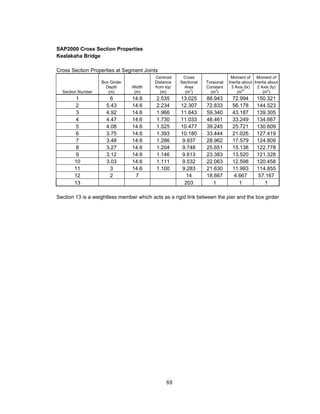
       SAP2000 Cross Section Properties ……………………………………….                  88
       Material Properties used in SAP2000 …………………………………….                89
       ANSYS Solid Model – Coordinates ………………………………………                    90
       ANSYS Solid Model – Cross-Section Depths ……………………………               91


                                       vi
LIST OF TABLES

2.1     Kealakaha Bridge Geometric Data……………….……………………….. 7
2.2     Linear Soil Stiffness Data………………………………………………….. 8
3.1     Comparison of Vertical Deflections For Fixed Support…………………… 21
3.2     Comparison between Fixed Supports and Soil Springs ..…………………. 24
4.1     Vertical Deflection at Midspan on Test Beam: Thermal Loading………….39
4.2     Vertical Deflection at Midspan on Test Beam: 10 N Point Load…………. 41
4.3     Comparison between Four and Six Meter Mesh for ANSYS Model……… 44
5.1     Results of Single 320 kN Truck Point Load ….…………………………… 46
5.2     Vertical Deflection at Center of Bridge due to Single Truck
        Load (Actual Wheels Modeled) .………………………………………….. 48
5.3     Vertical Deflection of Bridge due to 2x2 Truck Load
        (Actual Wheels Modeled)………………………………………………….. 50
5.4     Vertical Deflection of Bridge due to 4 Truck Loading at Edge of Bridge
        (Actual Wheels Modeled)…………………………………………………. 55
6.1     Vertical Deflection due to Temperature Gradient .……………………….. 62
7.1.1   Modal Periods: 2-D vs. 3D ……………………………………………… 67
7.1.2   Modal Periods: Gross Section vs. Transformed Section………………… 68
7.1.3   Modal Periods: Linear Soil Spring Support vs. Fixed Supports………… 69
7.1.4   Modal Periods: SAP2000 vs. ANSYS…………………………………… 69


                                        vii
LIST OF FIGURES

1.1   Location of Project………………………………………………………… 1
1.2   Elevation, Section and Plan of Kealakaha Bridge ..….……………………. 2
1.3   UBC 1997 Seismic Zonation ..…………………….….…………………… 3
1.4   Horizontal Ground Acceleration (% g) at a 0.2 Second Period with 2%
      Probability of Exceedance in 50 Years……………….……………………. 4
1.5   Horizontal Ground Accelerations (% g) at a 0.2 Second Period with 10%
      Probability of Exceedance in 50 Years……………………………………. 5
2.1   Lateral Stiffness (Longitudinal Direction)……………………..………….. 9
2.2   Lateral Stiffness (Transverse Direction)………………………..…………. 9
2.3   Rotational Stiffness (Longitudinal Direction)…………………..…………. 10
2.4   Rotational Stiffness (Transverse Direction)……………………..………….10
2.5   Design Cross Section of Kealakaha Bridge…………………….………….. 12
3.1   SAP2000 2-D Frame Element Model (Schematic)………………………… 14
3.2   SAP2000 2-D Frame Element Model (Screen Capture)..………………….. 14
3.3   SAP2000 3-D Frame Element Model (Schematic)………………………… 15
3.4   SAP2000 3-D Frame Element Model (Screen Capture).………………….. 15
3.5   Element Lengths in SAP2000 Models……………………………..….…… 17
3.6   Convergence of Original and Half Size Finite Elements………….…….…. 18
3.7   Schematic Drawing of a Single HS20 Truck Load ………………..……… 19
3.8   Single HS20 Truck Load used in Chapter 3 ………………………..……... 19
3.9   Deformed Shape due to Single Truck Load ..……………………………… 20
3.10 Comparisons Between 2-D and 3-D Model .…………………………….... 21
3.11 Comparison of Gross and Transformed Section Properties for 2-D
      Model Results ..……………………………………………………………. 22
3.12 Comparison of Gross and Transformed Section Properties for 3-D
      Model Results …..…………………………………………………………. 22
3.13 Difference Between Fixed Support and Soil Springs: 2-D Model …..…… 23
3.14 Difference Between Fixed Support and Soil Springs: 3-D Model …...…… 24
4.1   Side View of a Portion of the Kealakaha Bridge……………………….…. 28
4.2.1 Design Cross Section………………………………………………….…… 30
4.2.2 Simplified Cross Section……………………………………………….….. 30
4.3   ANSYS Solid Model Cross Section View before Meshing…………….…. 31
4.4   Kealakaha Bridge before Meshing, Elevation ……………………………. 32
4.5   Kealakaha Bridge before Meshing, Isometric View………………………. 32
4.6   Solid 45, Eight Node Structural Solid (ANSYS) ….……………………… 34
4.7   Solid 92, Ten Node Tetrahedral Structural Solid (ANSYS) ..…………….. 34
4.8   Square Test Beam – Thermal Loading ……………………………………. 35
4.9   Thermal Distribution in Test Beam……………………………………….. 36
4.10 Test Beam Deflection under 10° C Temperature Gradient (Auto Mesh) … 38
4.11 Square Test Beam – Point Loading .………………………………………. 39
4.12 Four Meter Mesh Size, Kealakaha Bridge (Part of Bridge)……………….. 43
4.13 Six Meter Mesh Size, Kealakaha Bridge (Part of Bridge)…………………. 43
4.14 Convergence of Four and Six Meter Mesh for ANSYS Model …………… 44
5.1   Distribution of Truck Loads…………………………………….…………. 45


                                      viii
5.2    ANSYS Layout of Single Truck Point Load…………………………….… 47
5.3    SAP2000 vs. ANSYS, Single Truck Point Load…………………...……… 47
5.4    Viaduct Section Showing Single Truck Load………………………………48
5.5    Layout of Wheel Placement for Single Truck………………………..……. 49
5.6    SAP2000 vs. ANSYS, Single Truck Modeled with Wheels…………...….. 49
5.7    Location of Axle Loads for the 2x2 Truck Configuration ……………..…. 50
5.8    Viaduct Section showing 2x2 Truck Configuration……………………..… 51
5.9    ANSYS Placement of 2x2 Truck Load ………………….………………… 51
5.10   SAP2000 vs. ANSYS, 2x2 Trucks Modeled with Wheels……………….... 52
5.11   Location of Axle Loads for Four Trucks in a Row………………………....52
5.12   Viaduct Section showing Four Trucks in a Row…………………..………. 53
5.13   ANSYS Layout of Four Trucks in a Row………………………….……… 53
5.14   Deflected and Non-Deflected Cross Section……………………….……… 54
5.15   Torsion Effects, Four Trucks in a Row………………………………….… 54
5.16   Isometric View of Vertical Deflection under Torsion Loading………..….. 55
6.1    ANSYS Applied Temperature Gradient………………………………….... 57
6.2    Bridge End Span Showing Effect of Thermal Gradient……………….…... 58
6.3    Deformation due to 10 Degrees Temperature Gradient……………….…... 59
6.4    Isometric View of Bridge Deformation due to Thermal Loading……....…. 59
6.5    Side View of Bridge Deformation due to Thermal Loading………..…..…. 60
6.6    Locations of Reported Deformation due to Thermal Loading…...………... 61
6.7    Vertical Deflection of Bridge due to Ten Degree Temperature Gradient…. 62
6.8    Combination of Temperature and Truck Loading…………………………. 63
6.9    Strain Distribution through Box Girder Depth near Pier………………..… 64
6.10   Strain Distribution through Box Girder Depth near Midspan……………... 64
6.11   Strain Output Locations……………………………………………….…… 65
6.12   Longitudinal Strains at Locations A and B …………………………..…… 66
6.13   Longitudinal Strains at Locations C and D …………………………..……. 66
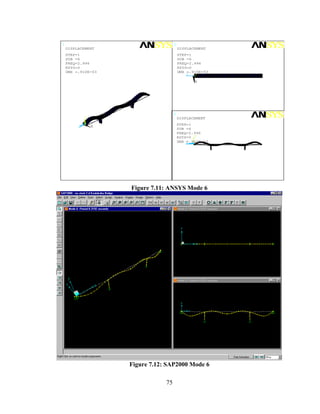
7.1    ANSYS Mode 2……………………………………………………….…… 70
7.2    SAP2000 Mode 1………………………………………………………..…. 70
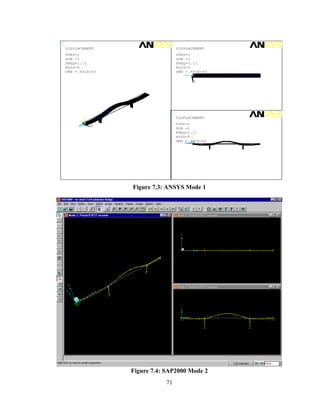
7.3    ANSYS Mode 1………………………………………………………….… 71
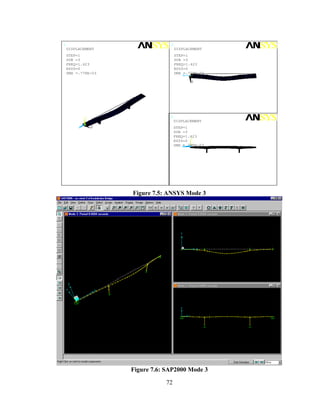
7.4    SAP2000 Mode 2……………………………………………………….….. 71
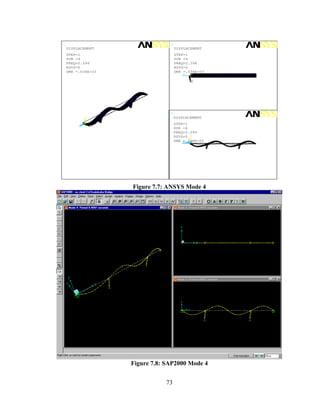
7.5    ANSYS Mode 3……………………………………………………………. 72
7.6    SAP2000 Mode 3……………………………………….……………….…. 72
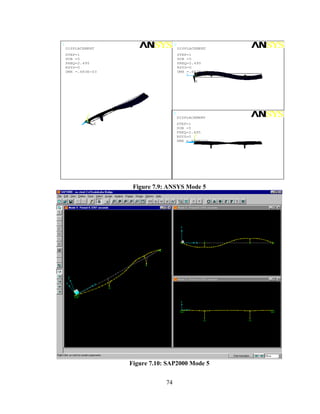
7.7    ANSYS Mode 4………………………………………….………………… 73
7.8    SAP2000 Mode 4………………………………………….…………….…. 73
7.9    ANSYS Mode 5…………………………………………….……………… 74
7.10   SAP2000 Mode 5…………………………………………….………….…. 74
7.11   ANSYS Mode 6……………………………………………….…………… 75
7.12   SAP2000 Mode 6………………………………………………………..…. 75
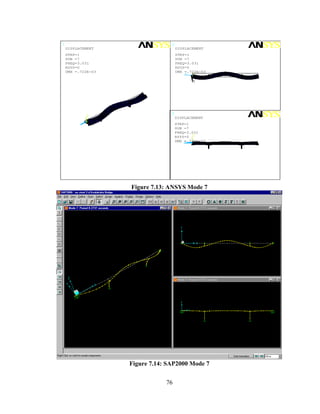
7.13   ANSYS Mode 7……………………………………………….…………… 76
7.14   SAP2000 Mode 7……………………………………………….……….…. 76
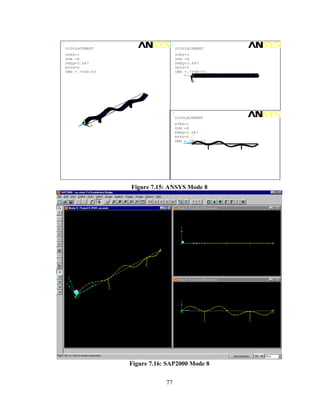
7.15   ANSYS Mode 8………………………………………………….………… 77
7.16   SAP2000 Mode 8………………………………………….…………….…. 77
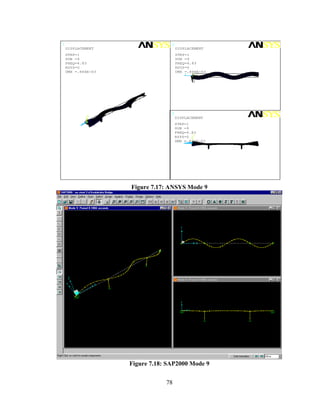
7.17   ANSYS Mode 9………………………………………….………………… 78
7.18   SAP 2000 Mode 9……………………………………….……………….… 78


                                         ix
x
CHAPTER 1

                                   INTRODUCTION

1.1    Project Description

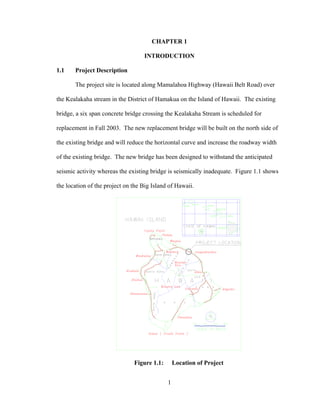
       The project site is located along Mamalahoa Highway (Hawaii Belt Road) over

the Kealakaha stream in the District of Hamakua on the Island of Hawaii. The existing

bridge, a six span concrete bridge crossing the Kealakaha Stream is scheduled for

replacement in Fall 2003. The new replacement bridge will be built on the north side of

the existing bridge and will reduce the horizontal curve and increase the roadway width

of the existing bridge. The new bridge has been designed to withstand the anticipated

seismic activity whereas the existing bridge is seismically inadequate. Figure 1.1 shows

the location of the project on the Big Island of Hawaii.


                               Figure 1.1:       Location of Project


                                             1
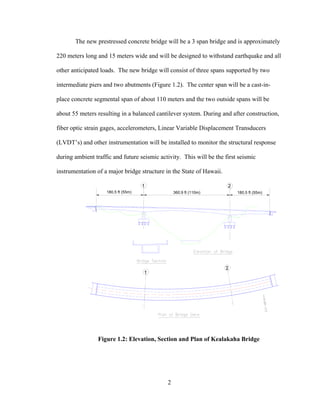
The new prestressed concrete bridge will be a 3 span bridge and is approximately

220 meters long and 15 meters wide and will be designed to withstand earthquake and all

other anticipated loads. The new bridge will consist of three spans supported by two

intermediate piers and two abutments (Figure 1.2). The center span will be a cast-in-

place concrete segmental span of about 110 meters and the two outside spans will be

about 55 meters resulting in a balanced cantilever system. During and after construction,

fiber optic strain gages, accelerometers, Linear Variable Displacement Transducers

(LVDT’s) and other instrumentation will be installed to monitor the structural response

during ambient traffic and future seismic activity. This will be the first seismic

instrumentation of a major bridge structure in the State of Hawaii.


                 Figure 1.2: Elevation, Section and Plan of Kealakaha Bridge


                                             2
The new bridge is in an ideal location for a seismic study because of the

earthquake activity on the island of Hawaii. The Island of Hawaii is in zone 4, the

highest zone of seismic activity categorized in the “1997 Uniform Building Code.”

Figure 1.3 shows the map of the “UBC 1997 Seismic Zonation” for the State of Hawaii.


                           Figure 1.3: UBC 1997 Seismic Zonation

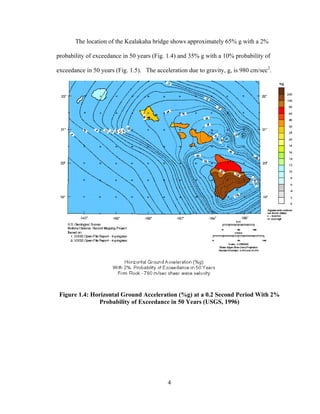
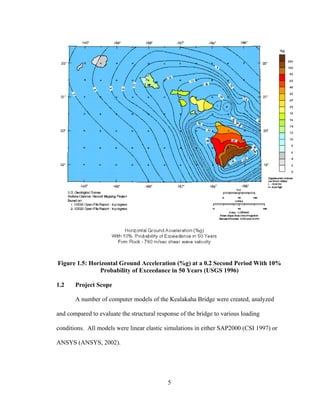
       Figures 1.4 and 1.5 show the peak ground acceleration maps included in the

International Building Code, IBC (2000). These maps are based on the USGS National

Seismic Hazard Mapping Project (USGS 1996). The maps show earthquake ground

motions that have a specified probability of being exceeded in 50 years. These ground

motion values are used for reference in construction design for earthquake resistance.

The maps show peak horizontal ground acceleration (PGA) at a 0.2 second period with

5% of critical damping. There are two probability levels: 2% (Fig. 1.4) and 10% (Fig.

1.5) probabilities of exceedence (PE) in 50 years. These correspond to return periods of

about 500 and 2500 years, respectively. The maps assume that the earthquake hazard is

independent of time.


                                            3
The location of the Kealakaha bridge shows approximately 65% g with a 2%

probability of exceedance in 50 years (Fig. 1.4) and 35% g with a 10% probability of

exceedance in 50 years (Fig. 1.5). The acceleration due to gravity, g, is 980 cm/sec2.


 Figure 1.4: Horizontal Ground Acceleration (%g) at a 0.2 Second Period With 2%
               Probability of Exceedance in 50 Years (USGS, 1996)


                                            4
Figure 1.5: Horizontal Ground Acceleration (%g) at a 0.2 Second Period With 10%
                Probability of Exceedance in 50 Years (USGS 1996)

1.2    Project Scope

       A number of computer models of the Kealakaha Bridge were created, analyzed

and compared to evaluate the structural response of the bridge to various loading

conditions. All models were linear elastic simulations in either SAP2000 (CSI 1997) or

ANSYS (ANSYS, 2002).


                                            5
Frame element models were created in SAP2000 to determine the following:

       1)     Vertical deflection of the viaduct due to static truck loads.

       2)     Mode shapes and modal periods.

       3)     Effects of different degrees of modeling accuracy:

              a. 3-D model compared with 2-D model.

              b. Inclusion of linear soil stiffness properties (soil springs vs. fixed

                 supports.)

              c. Inclusion of prestressing steel (transformed section vs. gross section

                 properties.)

              d. Beam element size to produce convergence of results.

       A three-dimensional solid model was created in ANSYS to determine the

following:

       1)     Deformation and strains of the viaduct due to thermal loads.

       2)     Deformation and strains of the viaduct due to truck loads.

       3)     Comparison of mode shapes and modal periods, and vertical deformations

              under truck loads, with the SAP2000 frame element models.


                                             6
CHAPTER 2

                   DESIGN CRITERIA FOR KEALAKAHA BRIDGE

         The design specifications used for the Kealakaha bridge are the AASHTO LRFD

Bridge Design Specification – Second Edition (1998) including the 1999 and 2000

interim revisions (AASHTO, 1998). A geotechnical investigation was performed by

Geolabs, Inc. in 2001 and the report was available for this study (Geolabs, 2001a)..

      Structural bridge data was obtained from Sato and Associates, the bridge design

engineers, and from the State of Hawaii project plans titled “Kealakaha Stream Bridge

Replacement, Federal Aid Project No. BR-019 2(26)” dated July 2001.

2.1      Geometric Data

         The geometric data of the Kealakaha bridge are shown in Table 2.1. The bridge

radius and slopes were not modeled in the 2-D SAP2000 and the ANSYS models. The

bridge radius, longitudinal slope, and cross slope were included in the SAP2000 3-D

model.

Table 2.1: Kealakaha Bridge Geometric Data
Design Speed                                      80 km/hour
Span Lengths                                      55 m – 110 m – 55m
Typical Overall Structure Width                   14.90 m (constant width)
Bridge Radius                                     constant radius of 548.64 m
Bridge Deck                                       constant cross slope of 6.2%
Vertical Longitudinal Slope                       Vertical curve changing to a constant
                                                  longitudinal slope of -3.46%


2.2      Linear Soil Stiffness Data

         The only geotechnical information available for this study was the data provided

by Geolabs, Inc. in the project geotechnical report (Geolabs-Hawaii W.O. 3885-00

November 17, 1998). The study was done for Sato and Associates, Inc. and the State of

                                              7
Hawaii Department of Transportation. The report summarized the findings and

geotechnical recommendations based on field exploration, laboratory testing, and

engineering analyses for the proposed bridge replacement project. The recommendations

were intended for the design of foundations, retaining structures, site grading and

pavements.

       Geolabs, Inc. provided the design engineers with linear soil stiffness during

service conditions and extreme earthquake events using the secant modulus (Geolabs,

2001). A future proposed soil investigation and a soil-structure interaction-modeling

program will determine the non-linear and dynamic properties of the foundation material.

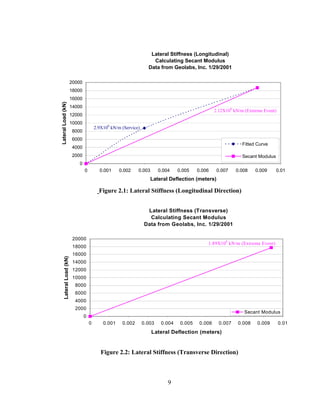
       Figures 2.1 to 2.4 show plots of the secant modulus used to determine these linear

soil spring stiffness. Figure 2.1 shows the estimated secant modulus for lateral soil

stiffness in the bridge longitudinal direction with a lateral deflection of 0.0088 meters and

a lateral load of 18,750 kN. Figure 2.2 shows the secant modulus for the transverse

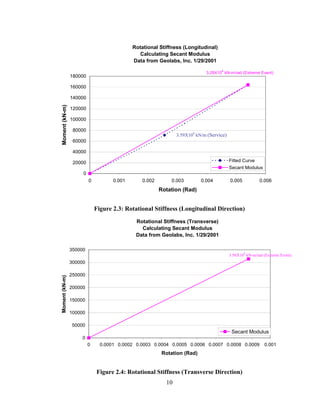
direction. The rotational stiffness in the bridge longitudinal direction was determined
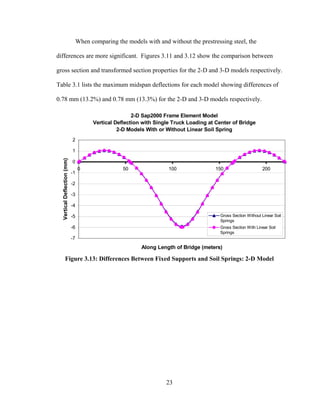
from the secant modulus at a rotational displacement of 0.0054 rad and a moment of

165,000 kN-m (Figure 2.3). Figure 2.4 shows the secant modulus for the rotational

stiffness in the bridge transverse direction. These stiffness values are used for the soil
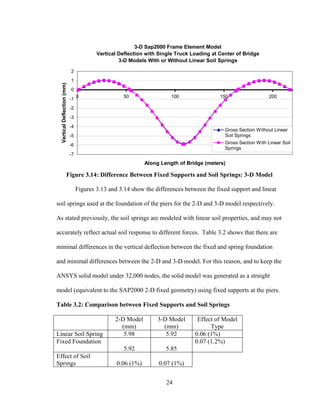
springs in the SAP2000 frame element models at the base of both piers. The values are

shown in Table 2.2.

Table 2.2: Linear Soil Stiffness Data
Lateral Stiffness
Longitudinal                                      2.12 X 10⁶ kN/m
Transverse                                        1.89 X 10⁶ kN/m
Rotational Stiffness
Longitudinal                                      3.29 X 10⁸ kN-m/rad
Transverse                                        3.56 X 10⁸ kN-m/rad

                                              8
Lateral Stiffness (Longitudinal)
                                                                     Calculating Secant Modulus
                                                                   Data from Geolabs, Inc. 1/29/2001

                         20000
                         18000
                         16000
Lateral Load (kN)


                         14000                                                                             6
                                                                                                    2.12X10 kN/m (Extreme Event)
                         12000
                         10000                 6
                                         2.9X10 kN/m (Service)
                         8000
                         6000
                                                                                                                Fitted Curve
                         4000
                         2000                                                                                   Secant Modulus
                            0
                                 0         0.001     0.002    0.003      0.004    0.005    0.006     0.007    0.008   0.009      0.01
                                                                      Lateral Deflection (meters)

                                           Figure 2.1: Lateral Stiffness (Longitudinal Direction)


                                                                  Lateral Stiffness (Transverse)
                                                                   Calculating Secant Modulus
                                                                 Data from Geolabs, Inc. 1/29/2001

                          20000                                                                          6
                                                                                               1.89X10 kN/m (Extreme Event)
                          18000
                          16000
     Lateral Load (kN)


                          14000
                          12000
                          10000
                           8000
                           6000
                           4000
                           2000
                                                                                                                 Secant Modulus
                                 0
                                     0       0.001    0.002      0.003    0.004    0.005    0.006     0.007   0.008    0.009       0.01
                                                                      Lateral Deflection (meters)


                                            Figure 2.2: Lateral Stiffness (Transverse Direction)


                                                                             9
Rotational Stiffness (Longitudinal)
                                               Calculating Secant Modulus
                                            Data from Geolabs, Inc. 1/29/2001

                                                                            3.29X10⁸ kN-m/rad (Extreme Event)
                180000

                160000

                140000
Moment (kN-m)


                120000

                100000

                 80000
                                                               3.59X10⁸ kN/m (Service)
                 60000

                 40000

                 20000                                                                   Fitted Curve
                                                                                         Secant Modulus
                     0
                         0          0.001       0.002       0.003         0.004          0.005          0.006
                                                        Rotation (Rad)


                             Figure 2.3: Rotational Stiffness (Longitudinal Direction)

                                             Rotational Stiffness (Transverse)
                                               Calculating Secant Modulus
                                             Data from Geolabs, Inc. 1/29/2001

                350000
                                                                                                 8
                                                                                         3.56X10 kN-m/rad (Extreme Event)
                300000

                250000
Moment (kN-m)


                200000

                150000

                100000

                 50000
                                                                                          Secant Modulus
                     0
                         0     0.0001 0.0002 0.0003 0.0004 0.0005 0.0006 0.0007 0.0008 0.0009              0.001
                                                         Rotation (Rad)


                             Figure 2.4: Rotational Stiffness (Transverse Direction)
                                                          10
2.3    Material Properties

       Based on the design documents obtained from Sato and Associates, three different

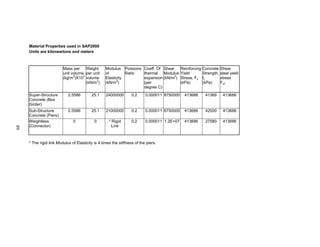
types of concrete were used to model the structure in the frame element models. Super-

structure concrete was used for the bridge span, sub-structure concrete was used for the

concrete piers and abutments, and weightless concrete was used for the dummy

connectors between the pier and the bridge girder in the SAP2000 frame element models.

Poisson’s ratio of 0.20 was used throughout the bridge. The Elastic Modulus was taken

as 2.4 x 10⁷ kN/m2 for the bridge superstructure and 2.1 x 10⁷ kN/m2 for the piers and

abutments.

2.4    Boundary Conditions of Bridge

       For most computer models, the bases of the two piers were modeled as fully

fixed. In the SAP2000 soil spring model, rotational, horizontal, and vertical linear soil

springs were incorporated at the base of the piers. In all computer models, the abutments

at each end of the bridge were modeled as roller supports in the bridge longitudinal

direction, free to rotate about all axes, but restrained against vertical and transverse

displacement.

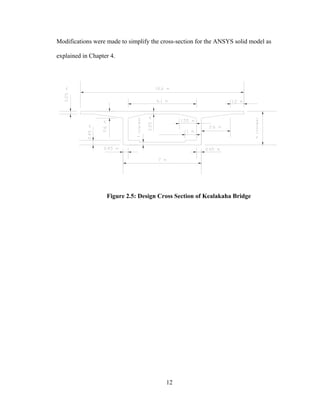
2.5    Bridge Cross Section

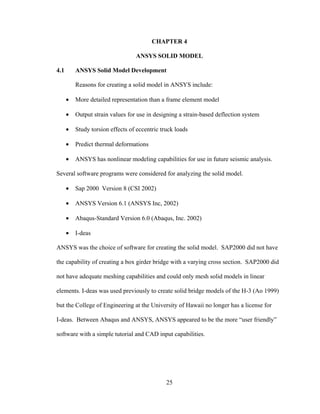
       Figure 2.5 shows the design cross section of the Kealakaha bridge box girder.

From this cross section, centroidal coordinates, moments of inertia, torsion constants, and

cross-sectional areas were calculated for the SAP2000 models. All dimensions are

constant throughout the length of the bridge except the box girder depth, h, and the

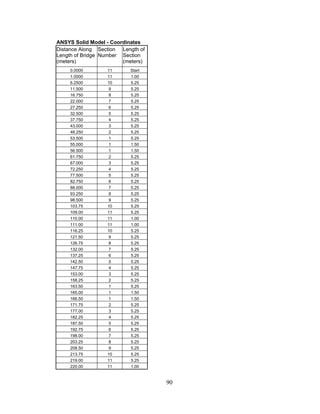
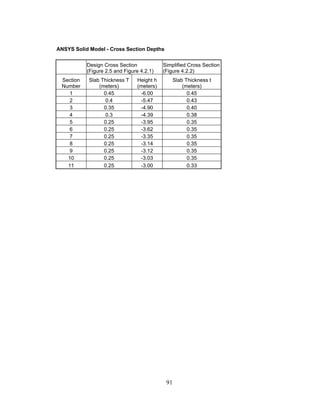
bottom slab thickness, T. These values are listed in Appendix A for the end of each

bridge segment. The cross section in Figure 2.5 is referred to as the design cross section.

                                              11
Modifications were made to simplify the cross-section for the ANSYS solid model as

explained in Chapter 4.


                   Figure 2.5: Design Cross Section of Kealakaha Bridge


                                         12
CHAPTER 3

                       SAP2000 FRAME ELEMENT MODELS

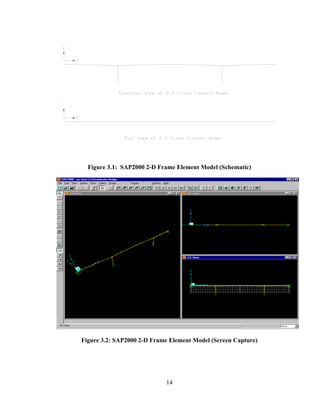
3.1 Development of SAP2000 Frame Element Models

       SAP2000 (CSI, 1997) was used to create the frame element models. Figures 3.1

and 3.2 show elevation, plan and isometric views of the 2-D model. This model ignores

the horizontal curve, longitudinal slope and cross slope. Note that although the roadway

is horizontal, the girder frame elements follow the centerline of the varying depth box

girder and are therefore curved in the vertical plane.

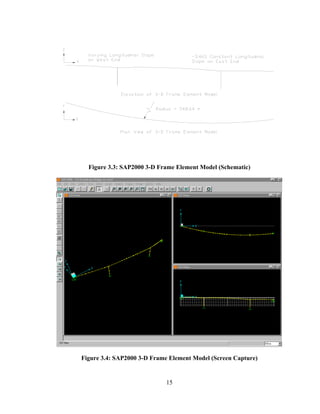
       Figures 3.3 and 3.4 show elevation, plan and isometric 3-D views of the 3-D

model. In the 3-D model, the horizontal curve with radius of 548.64 m and the vertical

curve are modeled. The vertical curve begins as a varying slope until the center of the

bridge where it becomes a constant slope of –3.46 %. To model the bridge deck constant

cross slope of 6.2%, moments of inertia, and centerline coordinates were recalculated for

the 3-D model.


                                             13
Figure 3.1: SAP2000 2-D Frame Element Model (Schematic)


Figure 3.2: SAP2000 2-D Frame Element Model (Screen Capture)


                            14
Figure 3.3: SAP2000 3-D Frame Element Model (Schematic)


Figure 3.4: SAP2000 3-D Frame Element Model (Screen Capture)


                            15
Eight frame element models were created based on these 2-D and 3-D geometries.

      •   2-D frame element model (slopes and curve of bridge not considered)

          1) Gross section properties neglecting the effect of prestressing steel

                           a) Fixed Supports

                           b) With linear soil springs at base of piers

          2) Transformed section properties including prestressing steel

                           a) Fixed Supports

                           b) With linear soil springs at base of piers

      •   3-D frame element model (slopes and curve of bridge included).

          1) Gross section properties neglecting the effect of prestressing steel

                           a) Fixed Supports

                           b) With linear soil springs at base of piers

          2) Transformed section properties including prestressing steel

                           a) Fixed Supports

                           b) With linear soil springs at base of piers

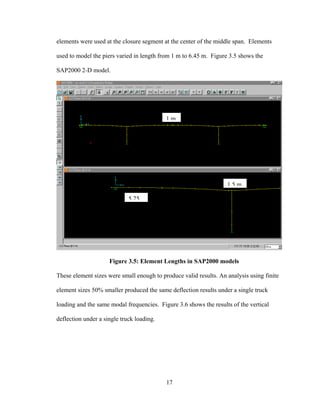
3.2       Element Sizes used for SAP2000 Models

          To model the varying cross section along the length of the bridge, the box girder

was modeled using frame element segments. Each segment had the same section and

properties. The mass of each segment was computed automatically by SAP2000 based

the cross sectional area, concrete density, and frame element length.

      The frame element size was based on the construction segment length throughout the

bridge. For the majority of the bridge length, 5.25 meter long elements were used. Three

1.5 meter long elements were used above each pier and abutment, and three 1 meter long


                                               16
elements were used at the closure segment at the center of the middle span. Elements

used to model the piers varied in length from 1 m to 6.45 m. Figure 3.5 shows the

SAP2000 2-D model.


                                           1m


                                                                   1.5 m

                             5.25


                     Figure 3.5: Element Lengths in SAP2000 models

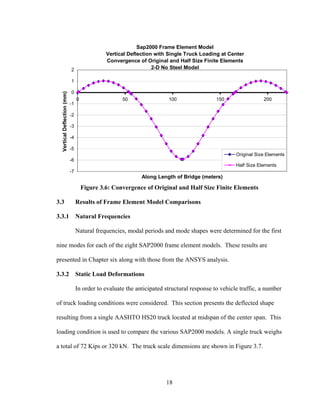
These element sizes were small enough to produce valid results. An analysis using finite

element sizes 50% smaller produced the same deflection results under a single truck

loading and the same modal frequencies. Figure 3.6 shows the results of the vertical

deflection under a single truck loading.


                                           17
Sap2000 Frame Element Model
                                               Vertical Deflection with Single Truck Loading at Center
                                               Convergence of Original and Half Size Finite Elements
                             2                                    2-D No Steel Model

                             1

                             0
  Vertical Deflection (mm)


                                  0                  50                 100                 150                 200
                             -1

                             -2

                             -3

                             -4

                             -5
                                                                                                    Original Size Elements
                             -6
                                                                                                    Half Size Elements
                             -7
                                                             Along Length of Bridge (meters)

                                      Figure 3.6: Convergence of Original and Half Size Finite Elements

3.3                               Results of Frame Element Model Comparisons

3.3.1                             Natural Frequencies

                                  Natural frequencies, modal periods and mode shapes were determined for the first

nine modes for each of the eight SAP2000 frame element models. These results are

presented in Chapter six along with those from the ANSYS analysis.

3.3.2                             Static Load Deformations

                                  In order to evaluate the anticipated structural response to vehicle traffic, a number

of truck loading conditions were considered. This section presents the deflected shape

resulting from a single AASHTO HS20 truck located at midspan of the center span. This

loading condition is used to compare the various SAP2000 models. A single truck weighs

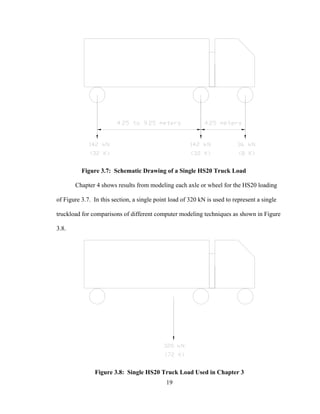
a total of 72 Kips or 320 kN. The truck scale dimensions are shown in Figure 3.7.


                                                                       18
Figure 3.7: Schematic Drawing of a Single HS20 Truck Load

       Chapter 4 shows results from modeling each axle or wheel for the HS20 loading

of Figure 3.7. In this section, a single point load of 320 kN is used to represent a single

truckload for comparisons of different computer modeling techniques as shown in Figure

3.8.


               Figure 3.8: Single HS20 Truck Load Used in Chapter 3
                                             19
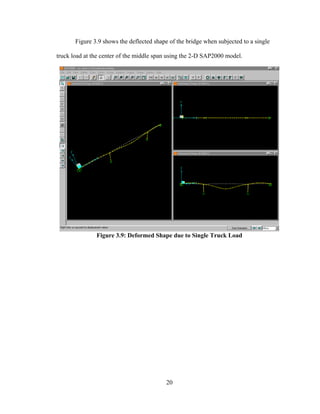
Figure 3.9 shows the deflected shape of the bridge when subjected to a single

truck load at the center of the middle span using the 2-D SAP2000 model.


               Figure 3.9: Deformed Shape due to Single Truck Load


                                           20
Sap2000 Frame Element Model
                                         Vertical Deflection with Single Truck loading at center of bridge
                                                             Fixed Foundation Support
                                                             Gross Section Properties
                            2

                            1
 Vertical Deflection (mm)


                            0
                                 0                 50                 100                 150                200
                            -1

                            -2

                            -3

                            -4

                            -5                                                                                     2-D

                            -6
                                                                                                                   3-D
                            -7
                                                            Along Length of Bridge (meters)

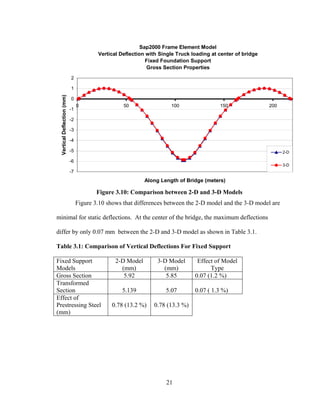
                                         Figure 3.10: Comparison between 2-D and 3-D Models
                                 Figure 3.10 shows that differences between the 2-D model and the 3-D model are

minimal for static deflections. At the center of the bridge, the maximum deflections

differ by only 0.07 mm between the 2-D and 3-D model as shown in Table 3.1.

Table 3.1: Comparison of Vertical Deflections For Fixed Support

Fixed Support                                   2-D Model        3-D Model       Effect of Model
Models                                            (mm)             (mm)               Type
Gross Section                                      5.92             5.85        0.07 (1.2 %)
Transformed
Section                                           5.139             5.07        0.07 ( 1.3 %)
Effect of
Prestressing Steel                            0.78 (13.2 %)    0.78 (13.3 %)
(mm)


                                                                    21
2-D Sap2000 Frame Element Model
                                                   Vertical Deflection With Single Truck Loading at Center
                                           Fixed Support Model With (Transformed) or Without (Gross) Prestressing
                                 2                                           Steel
                                 1
Vertical Deflection (mm)


                                 0
                                      0                 50                   100              150                    200
                                 -1

                                 -2

                                 -3

                                 -4
                                                                                                      2-D Model (Gross Section)
                                 -5

                                 -6                                                                   2-D Model (Transformed
                                                                                                      Section)
                                 -7
                                                                 Along Length of Bridge (meters)

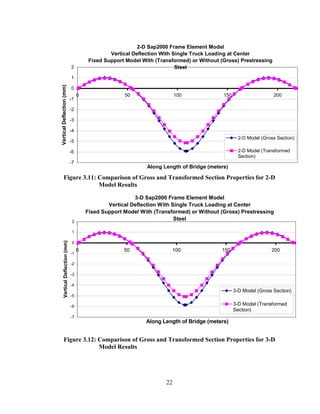
          Figure 3.11: Comparison of Gross and Transformed Section Properties for 2-D
                       Model Results

                                                            3-D Sap2000 Frame Element Model
                                                  Vertical Deflection With Single Truck Loading at Center
                                          Fixed Support Model With (Transformed) or Without (Gross) Prestressing
                                  2
                                                                            Steel

                                  1

                                  0
      Vertical Deflection (mm)


                                      0                 50                100                150                    200
                                 -1

                                 -2

                                 -3

                                 -4
                                                                                                    3-D Model (Gross Section)
                                 -5

                                 -6                                                                 3-D Model (Transformed
                                                                                                    Section)
                                 -7
                                                                 Along Length of Bridge (meters)


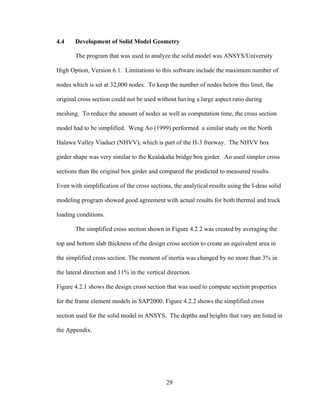
          Figure 3.12: Comparison of Gross and Transformed Section Properties for 3-D
                       Model Results


                                                                        22
When comparing the models with and without the prestressing steel, the

differences are more significant. Figures 3.11 and 3.12 show the comparison between

gross section and transformed section properties for the 2-D and 3-D models respectively.

Table 3.1 lists the maximum midspan deflections for each model showing differences of

0.78 mm (13.2%) and 0.78 mm (13.3%) for the 2-D and 3-D models respectively.

                                                        2-D Sap2000 Frame Element Model
                                        Vertical Deflection with Single Truck Loading at Center of Bridge
                                                  2-D Models With or Without Linear Soil Spring
                             2

                             1
  Vertical Deflection (mm)


                             0
                                  0                 50                100               150                     200
                             -1

                             -2

                             -3

                             -4

                             -5                                                           Gross Section Without Linear Soil
                                                                                          Springs
                             -6                                                           Gross Section With Linear Soil
                                                                                          Springs
                             -7
                                                           Along Length of Bridge (meters)

             Figure 3.13: Differences Between Fixed Supports and Soil Springs: 2-D Model


                                                                     23
3-D Sap2000 Frame Element Model
                                         Vertical Deflection with Single Truck Loading at Center of Bridge
                                                  3-D Models With or Without Linear Soil Springs
                            2
                            1
 Vertical Deflection (mm)


                            0
                                 0                 50                  100                150                   200
                            -1
                            -2
                            -3
                            -4
                                                                                            Gross Section Without Linear
                            -5                                                              Soil Springs
                            -6                                                              Gross Section With Linear Soil
                                                                                            Springs
                            -7
                                                             Along Length of Bridge (meters)

                       Figure 3.14: Difference Between Fixed Supports and Soil Springs: 3-D Model

                                 Figures 3.13 and 3.14 show the differences between the fixed support and linear

soil springs used at the foundation of the piers for the 2-D and 3-D model respectively.

As stated previously, the soil springs are modeled with linear soil properties, and may not

accurately reflect actual soil response to different forces. Table 3.2 shows that there are

minimal differences in the vertical deflection between the fixed and spring foundation

and minimal differences between the 2-D and 3-D model. For this reason, and to keep the

ANSYS solid model under 32,000 nodes, the solid model was generated as a straight

model (equivalent to the SAP2000 2-D fixed geometry) using fixed supports at the piers.

Table 3.2: Comparison between Fixed Supports and Soil Springs

                                                2-D Model         3-D Model      Effect of Model
                                                  (mm)              (mm)              Type
Linear Soil Spring                                 5.98              5.92       0.06 (1%)
Fixed Foundation                                                                0.07 (1.2%)
                                                    5.92             5.85
Effect of Soil
Springs                                          0.06 (1%)        0.07 (1%)


                                                                     24
CHAPTER 4

                                  ANSYS SOLID MODEL

4.1       ANSYS Solid Model Development

          Reasons for creating a solid model in ANSYS include:

      •   More detailed representation than a frame element model

      •   Output strain values for use in designing a strain-based deflection system

      •   Study torsion effects of eccentric truck loads

      •   Predict thermal deformations

      •   ANSYS has nonlinear modeling capabilities for use in future seismic analysis.

Several software programs were considered for analyzing the solid model.

      •   Sap 2000 Version 8 (CSI 2002)

      •   ANSYS Version 6.1 (ANSYS Inc, 2002)

      •   Abaqus-Standard Version 6.0 (Abaqus, Inc. 2002)

      •   I-deas

ANSYS was the choice of software for creating the solid model. SAP2000 did not have

the capability of creating a box girder bridge with a varying cross section. SAP2000 did
not have adequate meshing capabilities and could only mesh solid models in linear

elements. I-deas was used previously to create solid bridge models of the H-3 (Ao 1999)

but the College of Engineering at the University of Hawaii no longer has a license for

I-deas. Between Abaqus and ANSYS, ANSYS appeared to be the more “user friendly”

software with a simple tutorial and CAD input capabilities.


                                               25
4.2      Finite Element Analysis: ANSYS, an Overview

         ANSYS is a finite element analysis program used for solid modeling. It has

extensive capabilities in thermal, and structural analysis.

         The solid model consists of key points/nodes, lines, areas and volumes with

increasing complexity in that order. Careful thought needs to be put into the model

before building the entire model. Once the model is meshed, volumes, areas, or lines

cannot be deleted if they are connected to existing meshed elements. The aspect ratio and

type of mesh must also be decided depending on the size and shape of the complete solid

model.

      ANSYS contains many solid finite elements to choose from, each having its own

specialty. First, the type of analysis must be chosen which ranges from structural

analysis, thermal analysis, or fluid analysis. Once the type of analysis is determined, an

element type needs to be chosen ranging from beam, plate, shell, 2-D solid, 3-D solid,

contact, couple-field, specialty, and explicit dynamics. Each element has unique

capabilities and consists of tetrahedral, triangle, brick, 10 node, or 20 node finite

elements both in 2-D or 3-D analysis.

4.3      Solid Model Geometry

There are three ways to create a model in any finite element program for solid modeling.

         1)     Direct (manual) generation

                    •   Specify the location of nodes

                    •   Define which nodes make up an element

                    •   Used for simple problems that can be modeled with line elements

                        (links, beams, pipes)


                                                26
•   For objects made of simple geometry (rectangles)

                  •   Not recommended for complex solid structures

       2)     Importing Geometry

                  •   Geometry created in a CAD system like Autodesk Inventor

                  •   Saved as an import file such as an IGES file.

                  •   Inaccuracies occur during the import, and the model may not

                      import correctly.

       3)     Solid Modeling Approach

                  •   The model is created from simple primitives (rectangles, circles,

                      polygons, blocks, cylinders, etc.)

                  •   Boolean operations are used to combine primitives.

       Direct manual generation was the approach used to create the SAP2000 frame

element models. However when creating a solid model that contains over 20,000 nodes,

this approach is not recommended.

       Using a CAD program such as Autodesk Inventor to create the solid model was

also investigated. Autodesk Inventor had a very good CAD capability compared to

creating the model in the ANSYS CAD environment. However, attempts to import the

IGES file into ANSYS were unsuccessful. The model did not import correctly due to

software incompatibility.

       The solid modeling approach was used to create the Kealakaha Bridge. Creating

the top slab of the bridge with the “extrude” command was easy because it was the same

shape throughout the bridge. However, when creating the box girder, the cross section

varied throughout the length of the bridge. ANSYS did not have good CAD capabilities


                                           27
to create many volumes in 3-D space with a varying cross section. When creating the

solid volume for the box girder, each solid element had to be created using only 8 nodes

at a time by using the “create volumes arbitrary by nodes” command. Creation of the
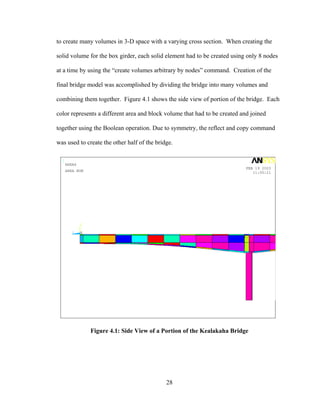
final bridge model was accomplished by dividing the bridge into many volumes and

combining them together. Figure 4.1 shows the side view of portion of the bridge. Each

color represents a different area and block volume that had to be created and joined

together using the Boolean operation. Due to symmetry, the reflect and copy command

was used to create the other half of the bridge.

  1
      AREAS
                                                                            FEB 19 2003
      AREA NUM                                                                 11:00:21


              Y
         Z    X


                  Figure 4.1: Side View of a Portion of the Kealakaha Bridge


                                             28
4.4    Development of Solid Model Geometry

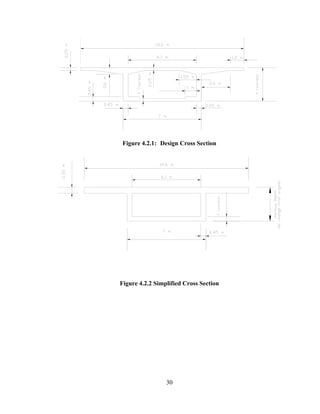
       The program that was used to analyze the solid model was ANSYS/University

High Option, Version 6.1. Limitations to this software include the maximum number of

nodes which is set at 32,000 nodes. To keep the number of nodes below this limit, the

original cross section could not be used without having a large aspect ratio during

meshing. To reduce the amount of nodes as well as computation time, the cross section

model had to be simplified. Weng Ao (1999) performed a similar study on the North

Halawa Valley Viaduct (NHVV), which is part of the H-3 freeway. The NHVV box

girder shape was very similar to the Kealakaha bridge box girder. Ao used simpler cross

sections than the original box girder and compared the predicted to measured results.

Even with simplification of the cross sections, the analytical results using the I-deas solid

modeling program showed good agreement with actual results for both thermal and truck

loading conditions.

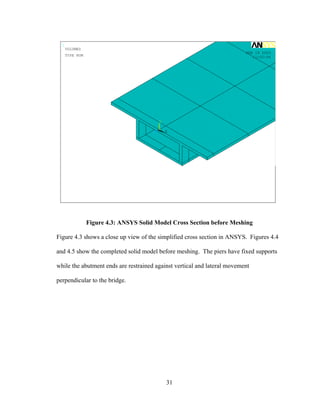
       The simplified cross section shown in Figure 4.2.2 was created by averaging the

top and bottom slab thickness of the design cross section to create an equivalent area in

the simplified cross section. The moment of inertia was changed by no more than 3% in

the lateral direction and 11% in the vertical direction.

Figure 4.2.1 shows the design cross section that was used to compute section properties

for the frame element models in SAP2000. Figure 4.2.2 shows the simplified cross

section used for the solid model in ANSYS. The depths and heights that vary are listed in

the Appendix.


                                             29
Figure 4.2.1: Design Cross Section


Figure 4.2.2 Simplified Cross Section


                 30
1
      VOLUMES
                                                                          FEB 19 2003
      TYPE NUM                                                               11:02:06


                                            Y

                                        Z       X


                 Figure 4.3: ANSYS Solid Model Cross Section before Meshing

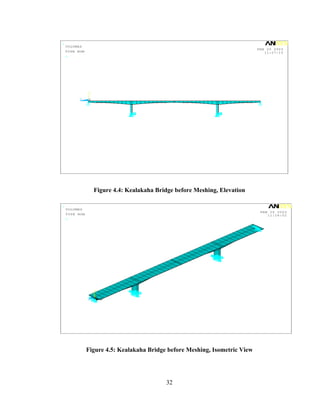
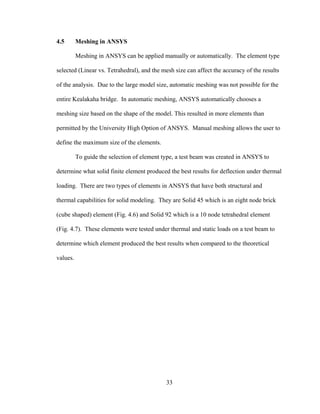
Figure 4.3 shows a close up view of the simplified cross section in ANSYS. Figures 4.4

and 4.5 show the completed solid model before meshing. The piers have fixed supports

while the abutment ends are restrained against vertical and lateral movement

perpendicular to the bridge.


                                                31
1
    VOLUMES
                                                                             FEB 20 2003
    TYPE NUM                                                                    11:27:15
    U


               Y
          Z    X


                   Figure 4.4: Kealakaha Bridge before Meshing, Elevation

1
    VOLUMES
                                                                              FEB 20 2003
    TYPE NUM                                                                     11:26:02
    U


                   Y

               Z       X


               Figure 4.5: Kealakaha Bridge before Meshing, Isometric View


                                            32
4.5       Meshing in ANSYS

          Meshing in ANSYS can be applied manually or automatically. The element type

selected (Linear vs. Tetrahedral), and the mesh size can affect the accuracy of the results

of the analysis. Due to the large model size, automatic meshing was not possible for the

entire Kealakaha bridge. In automatic meshing, ANSYS automatically chooses a

meshing size based on the shape of the model. This resulted in more elements than

permitted by the University High Option of ANSYS. Manual meshing allows the user to

define the maximum size of the elements.

          To guide the selection of element type, a test beam was created in ANSYS to

determine what solid finite element produced the best results for deflection under thermal

loading. There are two types of elements in ANSYS that have both structural and

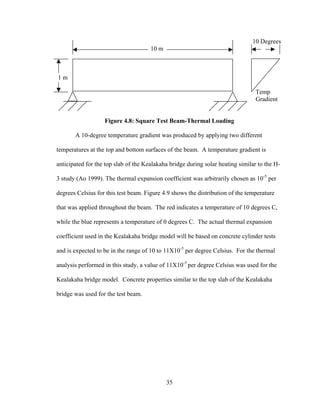
thermal capabilities for solid modeling. They are Solid 45 which is an eight node brick

(cube shaped) element (Fig. 4.6) and Solid 92 which is a 10 node tetrahedral element

(Fig. 4.7). These elements were tested under thermal and static loads on a test beam to

determine which element produced the best results when compared to the theoretical

values.


                                             33
Figure 4.6: Solid 45, Eight Node Structural Solid (ANSYS)


       Figure 4.7: Solid 92, Ten Node Tetrahedral Structural Solid (ANSYS)

4.6 Test Beam: Determining Finite Element Type and Mesh for Thermal Loading

       Solid 45 and Solid 92 were evaluated using a test beam that was 10 meters long

by one meter thick and one meter high. The sample test beam was also created to test the

performance of ANSYS under thermal loading conditions. Simply supported end

conditions were used for the test beam as shown in Figure 4.8.


                                           34
10 Degrees
                                      10 m


1m

                                                                                 Temp
                                                                                 Gradient


                   Figure 4.8: Square Test Beam-Thermal Loading

       A 10-degree temperature gradient was produced by applying two different

temperatures at the top and bottom surfaces of the beam. A temperature gradient is

anticipated for the top slab of the Kealakaha bridge during solar heating similar to the H-

3 study (Ao 1999). The thermal expansion coefficient was arbitrarily chosen as 10-5 per

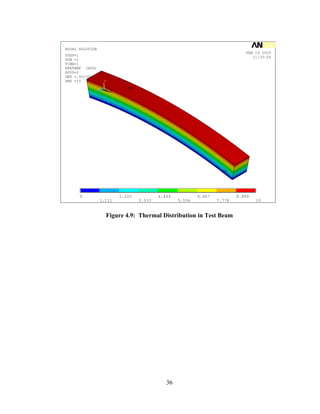
degrees Celsius for this test beam. Figure 4.9 shows the distribution of the temperature

that was applied throughout the beam. The red indicates a temperature of 10 degrees C,

while the blue represents a temperature of 0 degrees C. The actual thermal expansion

coefficient used in the Kealakaha bridge model will be based on concrete cylinder tests

and is expected to be in the range of 10 to 11X10-5 per degree Celsius. For the thermal

analysis performed in this study, a value of 11X10-5 per degree Celsius was used for the

Kealakaha bridge model. Concrete properties similar to the top slab of the Kealakaha

bridge was used for the test beam.


                                             35
1
    NODAL SOLUTION
                                                                                    FEB 19 2003
    STEP=1                                                                             11:33:04
    SUB =1
    TIME=1
    BFETEMP (AVG)
    RSYS=0
    DMX =.001304
    SMX =10              Y
                                    MX
                     Z       X


                                                                           MN


          0                      2.222           4.444           6.667           8.889
                     1.111               3.333           5.556           7.778           10


                         Figure 4.9: Thermal Distribution in Test Beam


                                                    36
4.7    Analytical Solution For Test Beam

       The deformation due to a linear temperature change can be expressed as:

                                      d dv α∆T
                                            =
                                      dx dx   h

              where   v      = Vertical Deflection

                      α      = Coefficient of Thermal Expansion

                             = 10-5/°C in the test beam

                      ∆T     = Change in temperature between top and bottom surfaces

                             = 10 °C in the test beam

                      h      = Depth of the beam

                             = 1 meter in the test beam

Therefore,

                                   dv α∆T x + A
                                      =
                                   dx   h

                                 1 α∆T 2
                            v=        x + Ax + B
                                 2 h
where A and B are integration constants.

Applying boundary conditions: At x=0, v(0)=0 and at x=10, v(10)=0 and substituting the

numerical values into the equation, we obtain:

                                     v = (50-5x)x*10-5
       At the midspan, x = 5 meters therefore:

                                      v = 0.00125 meters
There should be a maximum deflection of 0.00125 meters at the center of the test beam.


                                           37
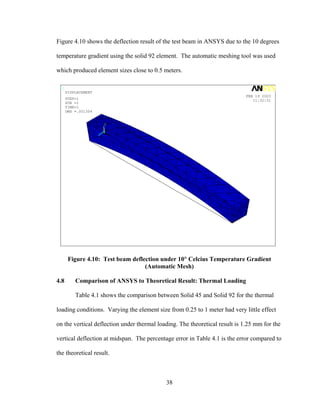
Figure 4.10 shows the deflection result of the test beam in ANSYS due to the 10 degrees

temperature gradient using the solid 92 element. The automatic meshing tool was used

which produced element sizes close to 0.5 meters.

  1
      DISPLACEMENT
                                                                             FEB 19 2003
      STEP=1                                                                    11:32:31
      SUB =1
      TIME=1
      DMX =.001304


                         Y

                     Z       X


       Figure 4.10: Test beam deflection under 10° Celcius Temperature Gradient
                                   (Automatic Mesh)

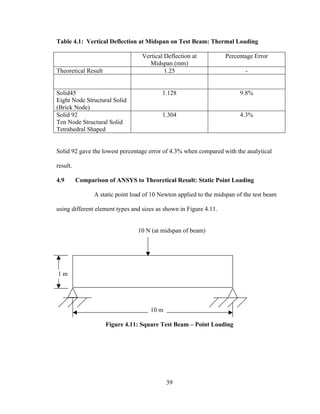
4.8       Comparison of ANSYS to Theoretical Result: Thermal Loading

          Table 4.1 shows the comparison between Solid 45 and Solid 92 for the thermal

loading conditions. Varying the element size from 0.25 to 1 meter had very little effect

on the vertical deflection under thermal loading. The theoretical result is 1.25 mm for the

vertical deflection at midspan. The percentage error in Table 4.1 is the error compared to

the theoretical result.


                                            38
Table 4.1: Vertical Deflection at Midspan on Test Beam: Thermal Loading

                                  Vertical Deflection at           Percentage Error
                                     Midspan (mm)
Theoretical Result                         1.25                            -


Solid45                                   1.128                          9.8%
Eight Node Structural Solid
(Brick Node)
Solid 92                                  1.304                          4.3%
Ten Node Structural Solid
Tetrahedral Shaped


Solid 92 gave the lowest percentage error of 4.3% when compared with the analytical

result.

4.9       Comparison of ANSYS to Theoretical Result: Static Point Loading

                A static point load of 10 Newton applied to the midspan of the test beam

using different element types and sizes as shown in Figure 4.11.


                                 10 N (at midspan of beam)


1m


                                      10 m

                     Figure 4.11: Square Test Beam – Point Loading


                                             39
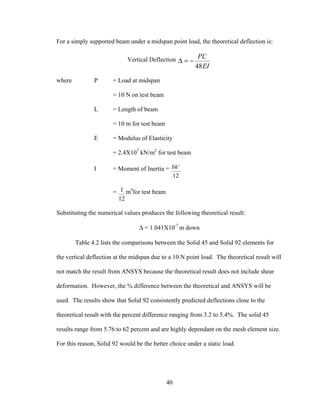
For a simply supported beam under a midspan point load, the theoretical deflection is:

                             Vertical Deflection ∆ = − PL
                                                         3


                                                        48 EI

where          P       = Load at midspan

                       = 10 N on test beam

               L       = Length of beam

                       = 10 m for test beam

               E       = Modulus of Elasticity

                       = 2.4X10⁷ kN/m2 for test beam

                       = Moment of Inertia = bh
                                                3
               I
                                             12

                       = 1 m4for test beam
                         12

Substituting the numerical values produces the following theoretical result:

                                 ∆ = 1.041X10⁻⁷ m down

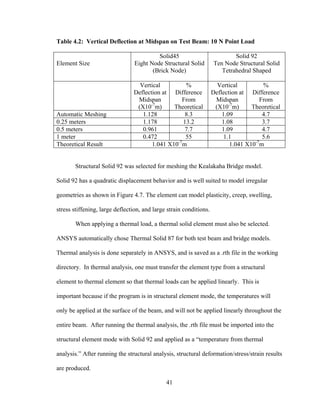
        Table 4.2 lists the comparisons between the Solid 45 and Solid 92 elements for

the vertical deflection at the midspan due to a 10 N point load. The theoretical result will

not match the result from ANSYS because the theoretical result does not include shear

deformation. However, the % difference between the theoretical and ANSYS will be
used. The results show that Solid 92 consistently predicted deflections close to the

theoretical result with the percent difference ranging from 3.2 to 5.4%. The solid 45

results range from 5.76 to 62 percent and are highly dependant on the mesh element size.

For this reason, Solid 92 would be the better choice under a static load.


                                              40
Table 4.2: Vertical Deflection at Midspan on Test Beam: 10 N Point Load

                                          Solid45                           Solid 92
Element Size                     Eight Node Structural Solid        Ten Node Structural Solid
                                        (Brick Node)                   Tetrahedral Shaped

                                  Vertical         %                  Vertical         %
                                Deflection at Difference            Deflection at Difference
                                 Midspan          From               Midspan          From
                                      -7                                   -7
                                 (X10 m)       Theoretical           (X10 m)       Theoretical
Automatic Meshing                  1.128           8.3                  1.09           4.7
0.25 meters                        1.178          13.2                  1.08           3.7
0.5 meters                         0.961           7.7                  1.09           4.7
1 meter                            0.472           55                    1.1           5.6
Theoretical Result                     1.041 X10⁻⁷m                        1.041 X10⁻⁷m


       Structural Solid 92 was selected for meshing the Kealakaha Bridge model.

Solid 92 has a quadratic displacement behavior and is well suited to model irregular

geometries as shown in Figure 4.7. The element can model plasticity, creep, swelling,

stress stiffening, large deflection, and large strain conditions.

       When applying a thermal load, a thermal solid element must also be selected.

ANSYS automatically chose Thermal Solid 87 for both test beam and bridge models.

Thermal analysis is done separately in ANSYS, and is saved as a .rth file in the working

directory. In thermal analysis, one must transfer the element type from a structural

element to thermal element so that thermal loads can be applied linearly. This is

important because if the program is in structural element mode, the temperatures will

only be applied at the surface of the beam, and will not be applied linearly throughout the

entire beam. After running the thermal analysis, the .rth file must be imported into the

structural element mode with Solid 92 and applied as a “temperature from thermal

analysis.” After running the structural analysis, structural deformation/stress/strain results

are produced.

                                              41
4.10   Mesh Generation for Kealakaha Bridge Model

       ANSYS has the capability of doing automatic meshing where it automatically

picks an element size. However, automatic meshing may not produce the best results and

cannot be used for the 220 meter Kealakaha bridge because it will produce over 32,000

nodes which exceeds the University program capability. The “mesh tool” command must

be used to specify the element size.

       Based on the specified element size, ANSYS will mesh the model to produce the

best results. The element size will not be the same for all elements, but all elements will

be smaller than the specified size.

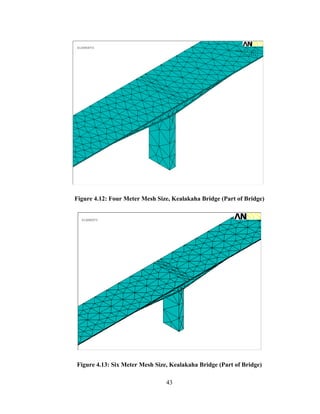
       The mesh size used for the Kealakaha bridge was 4 meters. A similar mesh size

of 12 feet was used in the NHVV study by Weng Ao (1999), and produced good results

when compared with measured deflections. Figure 4.12 shows the 4 meter mesh for a

portion of the bridge. The full bridge consisted of 24,576 nodes and 12,246 elements.

4.11   Convergence of 4 Meter Mesh

       To confirm that the four-meter mesh converges with a larger size mesh, a six

meter mesh was created and the response to a single truck load was compared. See

Figure 3.8 for a description of the single truck load. The four-meter mesh is seen in

Figure 4.12 and the six-meter mesh is shown in Figure 4.13.


                                            42
1
    ELEMENTS
                                                             FEB 20 2003
                                                                11:14:11


Figure 4.12: Four Meter Mesh Size, Kealakaha Bridge (Part of Bridge)

     1
         ELEMENTS


    Figure 4.13: Six Meter Mesh Size, Kealakaha Bridge (Part of Bridge)

                                    43
ANSYS Solid Model
                                       Vertical Deflection with Single Truck loading at center of bridge
                                             Convergence of Four Meter Mesh Vs. Six Meter Mesh
                             2

                             1
  Vertical Deflection (mm)


                             0
                                  0              50                   100                150                   200
                             -1

                             -2

                             -3

                             -4

                             -5                                                                            4 Meter Mesh
                             -6
                                                                                                           6 Meter Mesh
                             -7
                                                          Distance Along Bridge (meters)

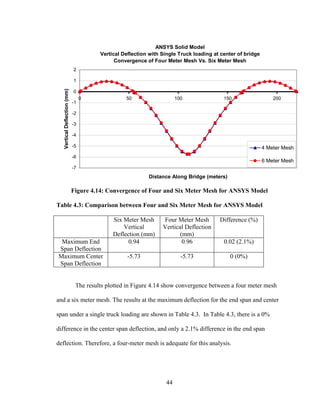
                             Figure 4.14: Convergence of Four and Six Meter Mesh for ANSYS Model

Table 4.3: Comparison between Four and Six Meter Mesh for ANSYS Model

                                            Six Meter Mesh      Four Meter Mesh        Difference (%)
                                                Vertical        Vertical Deflection
                                            Deflection (mm)            (mm)
 Maximum End                                      0.94                  0.96             0.02 (2.1%)
Span Deflection
Maximum Center                                    -5.73                 -5.73              0 (0%)
Span Deflection


                              The results plotted in Figure 4.14 show convergence between a four meter mesh

and a six meter mesh. The results at the maximum deflection for the end span and center

span under a single truck loading are shown in Table 4.3. In Table 4.3, there is a 0%

difference in the center span deflection, and only a 2.1% difference in the end span

deflection. Therefore, a four-meter mesh is adequate for this analysis.
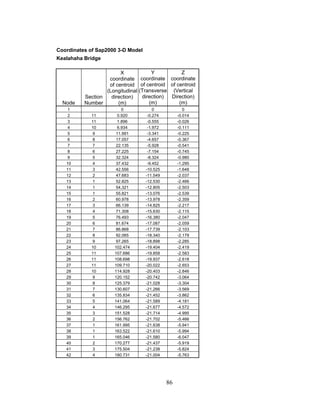


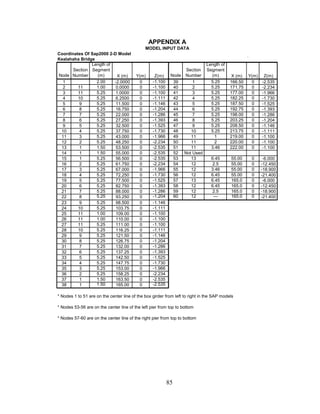
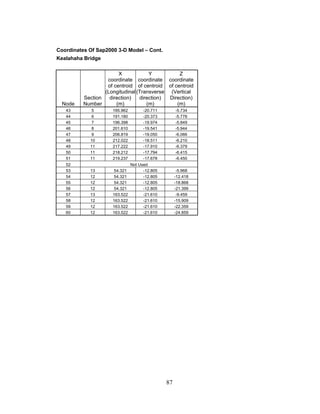
                                                                 44
CHAPTER 5


                         ANSYS SOLID MODEL ANALYSIS


5.1    Truck Loading Conditions
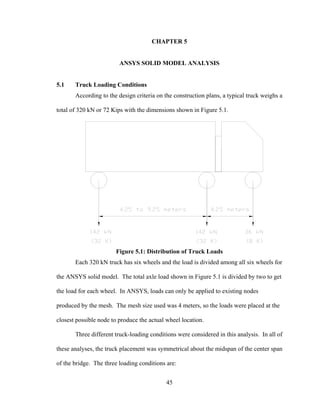
       According to the design criteria on the construction plans, a typical truck weighs a

total of 320 kN or 72 Kips with the dimensions shown in Figure 5.1.


                       Figure 5.1: Distribution of Truck Loads
       Each 320 kN truck has six wheels and the load is divided among all six wheels for

the ANSYS solid model. The total axle load shown in Figure 5.1 is divided by two to get

the load for each wheel. In ANSYS, loads can only be applied to existing nodes

produced by the mesh. The mesh size used was 4 meters, so the loads were placed at the

closest possible node to produce the actual wheel location.
       Three different truck-loading conditions were considered in this analysis. In all of
these analyses, the truck placement was symmetrical about the midspan of the center span

of the bridge. The three loading conditions are:


                                            45
•   Single Truck Load on centerline of roadway

           •   Four Trucks (Two rows of two trucks each, 2x2 Truck Load) on centerline

               of roadway

           •   Four Trucks (All four trucks in a single line) at edge of roadway

        In ANSYS, each wheel was modeled as a load, however in the SAP2000 frame

element analysis, each axle was modeled as a load. ANSYS and SAP2000 model results

are compared in the following sections.

        In addition, the SAP2000 frame element model and the ANSYS solid model were

also compared when a single 320 kN point load was applied at the center of the roadway

at midspan of the center span.

5.2     Truck Loading Results

5.2.1   Single 320 kN (72 Kip) Point Load

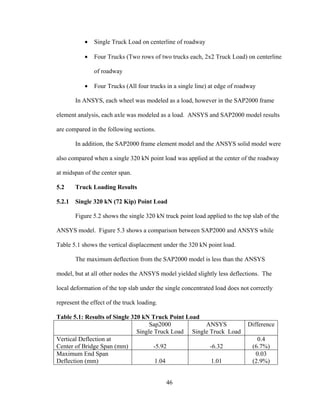
        Figure 5.2 shows the single 320 kN truck point load applied to the top slab of the

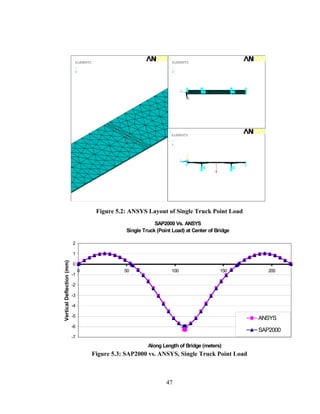
ANSYS model. Figure 5.3 shows a comparison between SAP2000 and ANSYS while

Table 5.1 shows the vertical displacement under the 320 kN point load.

        The maximum deflection from the SAP2000 model is less than the ANSYS

model, but at all other nodes the ANSYS model yielded slightly less deflections. The

local deformation of the top slab under the single concentrated load does not correctly

represent the effect of the truck loading.

Table 5.1: Results of Single 320 kN Truck Point Load
                                    Sap2000           ANSYS                  Difference
                               Single Truck Load Single Truck Load
Vertical Deflection at                                                           0.4
Center of Bridge Span (mm)            -5.92             -6.32                  (6.7%)
Maximum End Span                                                                0.03
Deflection (mm)                        1.04              1.01                  (2.9%)


                                             46
1                                            2
                               ELEMENTS                                     ELEMENTS
                               U                                            U
                               F                                            F


                                                                                  Z   Y
                                                                                      X


                                                                        3
                                                                            ELEMENTS
                                                                            U
                                                                            F

                                                                                      Y
                                                                                  Z   X


                                           Figure 5.2: ANSYS Layout of Single Truck Point Load
                                                                  SAP2000 Vs. ANSYS
                                                      Single Truck (Point Load) at Center of Bridge

                           2

                           1
Vertical Deflection (mm)


                           0
                                0                    50                     100               150        200
                           -1

                           -2

                           -3

                           -4

                           -5                                                                         ANSYS
                           -6
                                                                                                      SAP2000
                           -7
                                                               Along Length of Bridge (meters)
                                          Figure 5.3: SAP2000 vs. ANSYS, Single Truck Point Load


                                                                       47
5.2.2   Distributed Single Truck Load

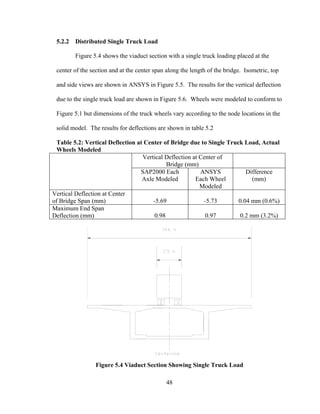
         Figure 5.4 shows the viaduct section with a single truck loading placed at the

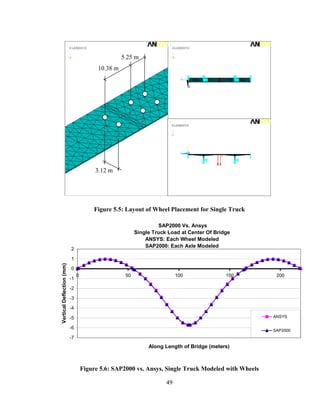
 center of the section and at the center span along the length of the bridge. Isometric, top

 and side views are shown in ANSYS in Figure 5.5. The results for the vertical deflection

 due to the single truck load are shown in Figure 5.6. Wheels were modeled to conform to

 Figure 5.1 but dimensions of the truck wheels vary according to the node locations in the

 solid model. The results for deflections are shown in table 5.2

  Table 5.2: Vertical Deflection at Center of Bridge due to Single Truck Load, Actual
  Wheels Modeled
                                   Vertical Deflection at Center of
                                             Bridge (mm)
                                  SAP2000 Each            ANSYS           Difference
                                   Axle Modeled         Each Wheel          (mm)
                                                          Modeled
Vertical Deflection at Center
of Bridge Span (mm)                    -5.69               -5.73       0.04 mm (0.6%)
Maximum End Span
Deflection (mm)                         0.98                0.97       0.2 mm (3.2%)


                 Figure 5.4 Viaduct Section Showing Single Truck Load

                                             48
1                                                2
                           ELEMENTS                                        ELEMENTS
                           U                                               U
                           F                        5.25 m                 F


                                          10.38 m
                                                                                 Z   Y
                                                                                     X


                                                                       3
                                                                           ELEMENTS
                                                                           U
                                                                           F

                                                                                     Y
                                                                                Z    X


                                         3.12 m


                                        Figure 5.5: Layout of Wheel Placement for Single Truck

                                                                   SAP2000 Vs. Ansys
                                                          Single Truck Load at Center Of Bridge
                                                              ANSYS: Each Wheel Modeled
                                                              SAP2000: Each Axle Modeled
                           2

                           1
Vertical Deflection (mm)


                           0
                                0                    50                        100           150       200
                           -1

                           -2

                           -3

                           -4

                           -5                                                                         ANSYS

                           -6
                                                                                                      SAP2000
                           -7
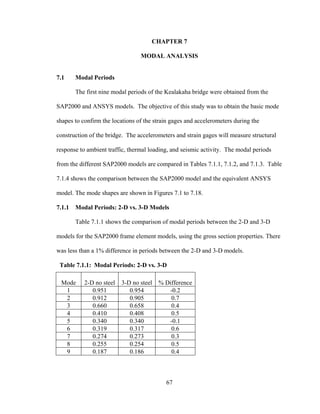
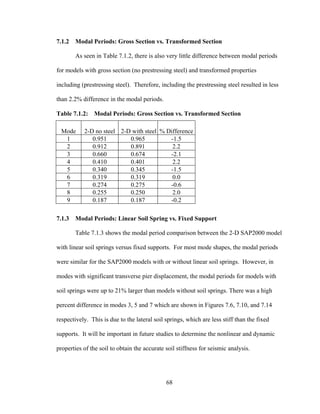
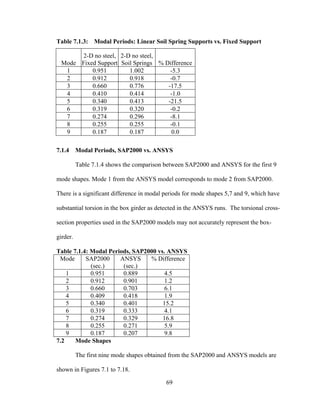
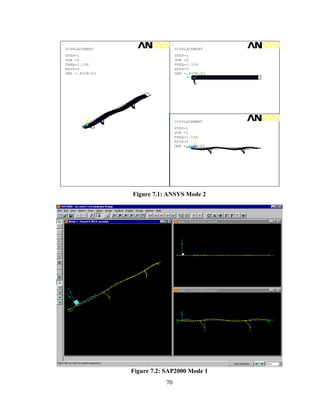
                                                               Along Length of Bridge (meters)


                                    Figure 5.6: SAP2000 vs. Ansys, Single Truck Modeled with Wheels

                                                                      49
5.2.3   2x2 Truck Loading

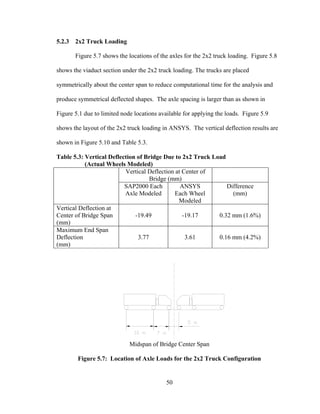
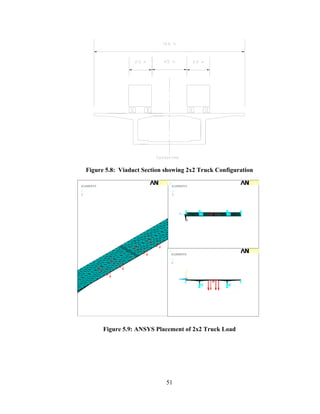
        Figure 5.7 shows the locations of the axles for the 2x2 truck loading. Figure 5.8

shows the viaduct section under the 2x2 truck loading. The trucks are placed

symmetrically about the center span to reduce computational time for the analysis and

produce symmetrical deflected shapes. The axle spacing is larger than as shown in

Figure 5.1 due to limited node locations available for applying the loads. Figure 5.9

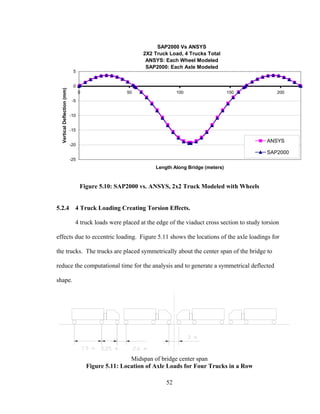
shows the layout of the 2x2 truck loading in ANSYS. The vertical deflection results are

shown in Figure 5.10 and Table 5.3.

Table 5.3: Vertical Deflection of Bridge Due to 2x2 Truck Load
           (Actual Wheels Modeled)
                          Vertical Deflection at Center of
                                    Bridge (mm)
                          SAP2000 Each          ANSYS          Difference
                          Axle Modeled        Each Wheel         (mm)
                                               Modeled
Vertical Deflection at
Center of Bridge Span         -19.49             -19.17     0.32 mm (1.6%)
(mm)
Maximum End Span
Deflection                     3.77               3.61      0.16 mm (4.2%)
(mm)


                             Midspan of Bridge Center Span

         Figure 5.7: Location of Axle Loads for the 2x2 Truck Configuration


                                            50
Figure 5.8: Viaduct Section showing 2x2 Truck Configuration
1                                    2
    ELEMENTS                             ELEMENTS
    U                                    U
    F                                    F


                                             Z   Y
                                                 X


                                     3
                                         ELEMENTS
                                         U
                                         F

                                                 Y
                                             Z   X


               Figure 5.9: ANSYS Placement of 2x2 Truck Load


                                    51
SAP2000 Vs ANSYS
                                                           2X2 Truck Load, 4 Trucks Total
                                                            ANSYS: Each Wheel Modeled
                                                            SAP2000: Each Axle Modeled
                              5


                              0
  Vertical Deflection (mm)


                                   0                 50                  100                   150               200
                              -5


                             -10


                             -15

                                                                                                             ANSYS
                             -20
                                                                                                             SAP2000
                             -25
                                                                Length Along Bridge (meters)


                                   Figure 5.10: SAP2000 vs. ANSYS, 2x2 Truck Modeled with Wheels


5.2.4                          4 Truck Loading Creating Torsion Effects.

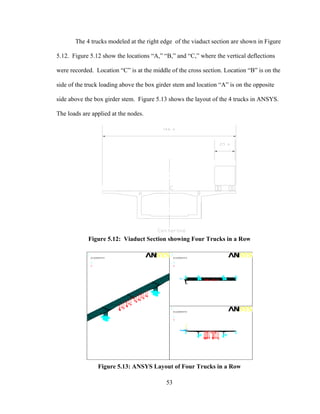
                               4 truck loads were placed at the edge of the viaduct cross section to study torsion

effects due to eccentric loading. Figure 5.11 shows the locations of the axle loadings for

the trucks. The trucks are placed symmetrically about the center span of the bridge to

reduce the computational time for the analysis and to generate a symmetrical deflected

shape.


                                                       Midspan of bridge center span
                                       Figure 5.11: Location of Axle Loads for Four Trucks in a Row

                                                                    52
The 4 trucks modeled at the right edge of the viaduct section are shown in Figure

5.12. Figure 5.12 show the locations “A,” “B,” and “C,” where the vertical deflections

were recorded. Location “C” is at the middle of the cross section. Location “B” is on the

side of the truck loading above the box girder stem and location “A” is on the opposite

side above the box girder stem. Figure 5.13 shows the layout of the 4 trucks in ANSYS.

The loads are applied at the nodes.


            Figure 5.12: Viaduct Section showing Four Trucks in a Row

            1                                2
                ELEMENTS                         ELEMENTS
                U                                U
                F                                F


                                                     Z   Y
                                                         X


                                             3
                                                 ELEMENTS
                                                 U
                                                 F
                                                         Y
                                                     Z   X


                    Figure 5.13: ANSYS Layout of Four Trucks in a Row

                                           53
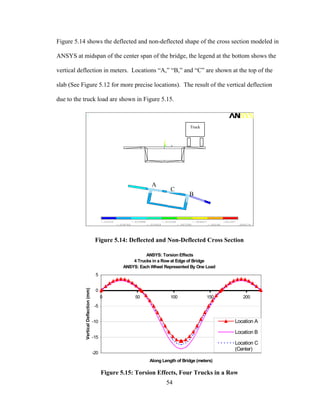
Figure 5.14 shows the deflected and non-deflected shape of the cross section modeled in

ANSYS at midspan of the center span of the bridge, the legend at the bottom shows the

vertical deflection in meters. Locations “A,” “B,” and “C” are shown at the top of the

slab (See Figure 5.12 for more precise locations). The result of the vertical deflection

due to the truck load are shown in Figure 5.15.

                    1


                                                                                                         Truck


                                                                                        Y
                                                                                        Z   X


                                                                              A
                                                                                            C
                                                                                                        B


                                            -.02163              -.015896              -.010162              -.004427             .001307
                                                      -.018763              -.013029              -.007295              -.00156             .004174


                                       Figure 5.14: Deflected and Non-Deflected Cross Section

                                                                   ANSYS: Torsion Effects
                                                             4 Trucks in a Row at Edge of Bridge
                                                         ANSYS: Each Wheel Represented By One Load
                                       5


                                       0
           Vertical Deflection (mm)


                                            0                      50                       100                         150                   200

                                       -5


                                      -10                                                                                               Location A

                                                                                                                                        Location B
                                      -15
                                                                                                                                        Location C
                                                                                                                                        (Center)
                                      -20
                                                                             Along Length of Bridge (meters)

                                            Figure 5.15: Torsion Effects, Four Trucks in a Row
                                                                                         54
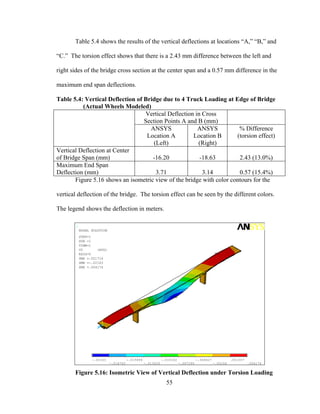
Table 5.4 shows the results of the vertical deflections at locations “A,” “B,” and

“C.” The torsion effect shows that there is a 2.43 mm difference between the left and

right sides of the bridge cross section at the center span and a 0.57 mm difference in the

maximum end span deflections.

Table 5.4: Vertical Deflection of Bridge due to 4 Truck Loading at Edge of Bridge
          (Actual Wheels Modeled)
                                  Vertical Deflection in Cross
                                  Section Points A and B (mm)
                                    ANSYS              ANSYS           % Difference
                                   Location A        Location B       (torsion effect)
                                     (Left)            (Right)
Vertical Deflection at Center
of Bridge Span (mm)                  -16.20             -18.63         2.43 (13.0%)
Maximum End Span
Deflection (mm)                        3.71              3.14          0.57 (15.4%)
       Figure 5.16 shows an isometric view of the bridge with color contours for the

vertical deflection of the bridge. The torsion effect can be seen by the different colors.

The legend shows the deflection in meters.

        1
            NODAL SOLUTION
            STEP=1
            SUB =1
            TIME=1
            UY       (AVG)
            RSYS=0                                                                               MX
            DMX =.021714
            SMN =-.02163
            SMX =.004174


                                                                     MN


                         Y

                     Z       X


                  -.02163               -.015896              -.010162               -.004427             .001307
                             -.018763              -.013029               -.007295              -.00156             .004174


       Figure 5.16: Isometric View of Vertical Deflection under Torsion Loading
                                                                55
56
CHAPTER 6

                             TEMPERATURE ANALYSIS


6.1    Temperature Gradient


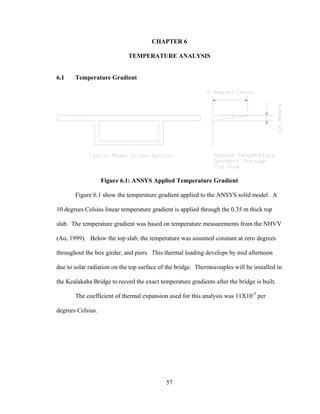
                   Figure 6.1: ANSYS Applied Temperature Gradient

       Figure 6.1 show the temperature gradient applied to the ANSYS solid model. A

10 degrees Celsius linear temperature gradient is applied through the 0.35 m thick top

slab. The temperature gradient was based on temperature measurements from the NHVV

(Ao, 1999). Below the top slab, the temperature was assumed constant at zero degrees

throughout the box girder, and piers. This thermal loading develops by mid afternoon

due to solar radiation on the top surface of the bridge. Thermocouples will be installed in

the Kealakaha Bridge to record the exact temperature gradients after the bridge is built.

       The coefficient of thermal expansion used for this analysis was 11X10-5 per

degrees Celsius.


                                            57
1
      NODAL SOLUTION
      STEP=1
      SUB =1
      TIME=1
      BFETEMP (AVG)
      RSYS=0
      DMX =.008688
      SMX =10

                                 MX


            0                  2.222           4.444           6.667           8.889
                       1.111           3.333           5.556           7.778           10


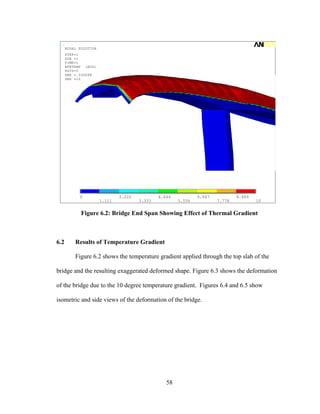
             Figure 6.2: Bridge End Span Showing Effect of Thermal Gradient


6.2       Results of Temperature Gradient

          Figure 6.2 shows the temperature gradient applied through the top slab of the

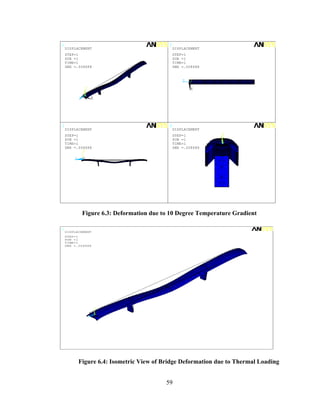
bridge and the resulting exaggerated deformed shape. Figure 6.3 shows the deformation

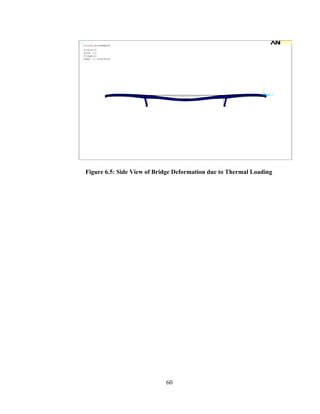
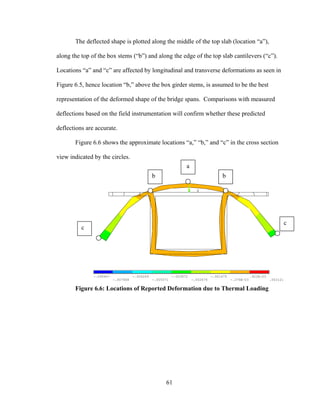
of the bridge due to the 10 degree temperature gradient. Figures 6.4 and 6.5 show

isometric and side views of the deformation of the bridge.


                                                  58
1                                             2
    DISPLACEMENT                                  DISPLACEMENT
    STEP=1                                        STEP=1
    SUB =1                                        SUB =1
    TIME=1                                        TIME=1
    DMX =.008688                                  DMX =.008688


                                                      Z   Y
                Y                                         X

            Z       X


3                                             4
    DISPLACEMENT                                  DISPLACEMENT
    STEP=1                                        STEP=1         Y
    SUB =1                                        SUB =1
    TIME=1                                        TIME=1         Z   X
    DMX =.008688                                  DMX =.008688
                Y
        Z       X


                Figure 6.3: Deformation due to 10 Degree Temperature Gradient

1
    DISPLACEMENT
    STEP=1
    SUB =1
    TIME=1
    DMX =.008688


                        Y

                    Z       X


            Figure 6.4: Isometric View of Bridge Deformation due to Thermal Loading


                                             59
1
    DISPLACEMENT
    STEP=1
    SUB =1
    TIME=1
    DMX =.008688


                                                                  Y
                                                                  X   Z


    Figure 6.5: Side View of Bridge Deformation due to Thermal Loading


                                60
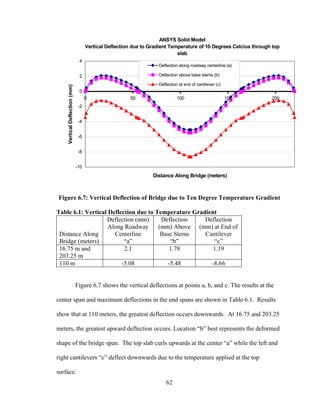
The deflected shape is plotted along the middle of the top slab (location “a”),

along the top of the box stems (“b”) and along the edge of the top slab cantilevers (“c”).

Locations “a” and “c” are affected by longitudinal and transverse deformations as seen in

Figure 6.5, hence location “b,” above the box girder stems, is assumed to be the best

representation of the deformed shape of the bridge spans. Comparisons with measured

deflections based on the field instrumentation will confirm whether these predicted

deflections are accurate.

       Figure 6.6 shows the approximate locations “a,” “b,” and “c” in the cross section

view indicated by the circles.
                                                                  a
                                                b                                         b
                                                                      Y
                                                                      Z     X


                                                                                                                                 c
          c


               -.008667              -.006269              -.003872                  -.001475               .922E-03
                          -.007468              -.005071                  -.002674              -.276E-03              .002121

       Figure 6.6: Locations of Reported Deformation due to Thermal Loading


                                                      61
ANSYS Solid Model
                                     Vertical Deflection due to Gradient Temperature of 10 Degrees Celcius through top
                                                                            slab
                                4
                                                                   Deflection along roadway centerline (a)

                                2                                  Deflection above base stems (b)

                                                                   Deflection at end of cantilever (c)
    Vertical Deflection (mm)


                                0
                                     0                 50                    100                         150      200
                                -2


                                -4


                                -6


                                -8


                               -10
                                                                 Distance Along Bridge (meters)


Figure 6.7: Vertical Deflection of Bridge due to Ten Degree Temperature Gradient

Table 6.1: Vertical Deflection due to Temperature Gradient
                   Deflection (mm)      Deflection    Deflection
                    Along Roadway      (mm) Above (mm) at End of
 Distance Along       Centerline        Base Stems    Cantilever
 Bridge (meters)          “a”              “b”           “c”
 16.75 m and              2.1              1.79          1.19
 203.25 m
 110 m                   -5.08            -5.48         -8.66


                               Figure 6.7 shows the vertical deflections at points a, b, and c. The results at the

center span and maximum deflections in the end spans are shown in Table 6.1. Results

show that at 110 meters, the greatest deflection occurs downwards. At 16.75 and 203.25

meters, the greatest upward deflection occurs. Location “b” best represents the deformed

shape of the bridge span. The top slab curls upwards at the center “a” while the left and

right cantilevers “c” deflect downwards due to the temperature applied at the top

surface.
                                                                       62
ANSYS Solid Model
                                                Combination of Temperature and Truck Loading
                              4

                              2

                              0
  Vertical Deflection (mm)


                                   0              50                  100               150                  200
                              -2

                              -4

                              -6

                              -8

                             -10                                                        Temperature Only (10 Degrees
                                                                                        Celcius)
                                                                                        One Truck Loading Only
                             -12
                                                                                        Combined
                             -14
                                                          Along Length Of Bridge (meters)

Figure 6.8: Combination of Temperature and Truck Loading

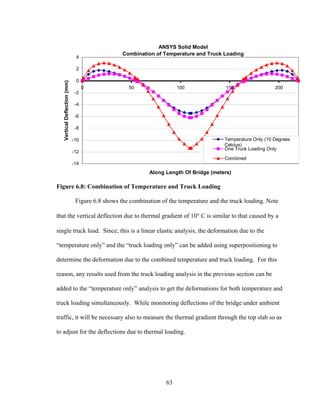
                              Figure 6.8 shows the combination of the temperature and the truck loading. Note

that the vertical deflection due to thermal gradient of 10° C is similar to that caused by a

single truck load. Since, this is a linear elastic analysis, the deformation due to the

“temperature only” and the “truck loading only” can be added using superpositioning to

determine the deformation due to the combined temperature and truck loading. For this

reason, any results used from the truck loading analysis in the previous section can be

added to the “temperature only” analysis to get the deformations for both temperature and

truck loading simultaneously. While monitoring deflections of the bridge under ambient

traffic, it will be necessary also to measure the thermal gradient through the top slab so as

to adjust for the deflections due to thermal loading.


                                                                 63
6.3                        Strain Distribution

                           The strain distribution through the box girder depth under a single truck load is

shown near the pier support in Figure 6.9 and at the midspan of the center span in Figure

6.10.

                                                      Strain Distribution Through Box Girder Depth
                                                   Near Pier Along Length of Bridge (Single Truck Load)
                                                                        0

                                                    Tension
                                                                        -1
  Depth of Bridge (m)


                                                                        -2

                                                                        -3

                                                                        -4

                                                                        -5
                                                                                                           Compression
                                                                        -6
                          -6            -4                    -2             0                 2           4                 6   8
                                                                                 Microstrain

                                Figure 6.9: Strain Distribution through Box Girder Depth near Pier
                                                    Strain Distribution Through Box Girder Depth
                                             Near Centerspan Along Length of Bridge (Single Truck load)
                                                                                                   0
                                                                                                           Compression
                                                                                            -0.5
    Depth of Bridge (m)


                                                                                                -1


                                                                                            -1.5


                                                                                                -2


                                                                                            -2.5

                                                   Tension
                                                                                                -3
                          -18                -13                   -8                 -3               2                 7       12
                                                                                  Microstrain


                          Figure 6.10: Strain Distribution through Box Girder Depth near Midspan

                                                                             64
Figure 6.11: Strain Output Locations


       Figure 6.11 shows the locations where future strain gages will be installed after

the bridge is built to monitor longitudinal strain in the box girder. These gages will be

used in a strain based deflection system under development at the University of Hawaii

(Fung, 2003). The gages selected for this system must have sufficient resolution to

monitor the anticipated strains.

       The locations are represented with the letters A, B, C, and D. Locations A and B

are at the inside top of the box girder, while locations C and D are located at the inside

bottom of the box girder. The longitudinal strains due to a single truck at midspan of the

center span and due to a 10 degree temperature gradient throughout the top slab are

shown in Figures 6.12 and 6.13.

        In order to measure these strains, the gages will need a production of 1

microstrain. It will also be important to monitor the slab temperature so as to separate the

thermal effects from the loading effects.


                                             65
ANSYS Solid Model
                                                     Longitudinal Strain at Location A and B Along Length of Bridge
                                        70
                                                                                                     Temperature Only (10 Degrees
                                                                                                     Celcius)
                                        60
Longitudinal Strain (Compression +)


                                                                                                     One Truck Loading Only
                                        50
                                                                                                     Combined
                                        40
           (microstrain)


                                        30

                                        20

                                        10

                                        0
                                             0                50                   100                150                200
                                      -10

                                      -20
                                                                        Along Length of Bridge (meters)


                                                  Figure 6.12: Longitudinal Strains at Locations A and B


                                                                             ANSYS Solid Model
                                                      Longitudinal Strain at Location C and D Along Length Of Bridge
                                        50
                                                                              Temperature Only (10 Degrees Celcius)
                                                                              Truck Loading Only
                                        40
  Longitudinal Strain (compression +)


                                                                              Combined

                                        30
              microstrain


                                        20


                                        10


                                         0
                                              0                50                  100                150               200

                                        -10


                                        -20
                                                                        Along Length of Bridge (meters)

                                                  Figure 6.13: Longitudinal Strains at Locations C and D


                                                                              66
CHAPTER 7

                                 MODAL ANALYSIS


7.1     Modal Periods

        The first nine modal periods of the Kealakaha bridge were obtained from the

SAP2000 and ANSYS models. The objective of this study was to obtain the basic mode

shapes to confirm the locations of the strain gages and accelerometers during the

construction of the bridge. The accelerometers and strain gages will measure structural

response to ambient traffic, thermal loading, and seismic activity. The modal periods

from the different SAP2000 models are compared in Tables 7.1.1, 7.1.2, and 7.1.3. Table

7.1.4 shows the comparison between the SAP2000 model and the equivalent ANSYS

model. The mode shapes are shown in Figures 7.1 to 7.18.

7.1.1   Modal Periods: 2-D vs. 3-D Models

        Table 7.1.1 shows the comparison of modal periods between the 2-D and 3-D

models for the SAP2000 frame element models, using the gross section properties. There

was less than a 1% difference in periods between the 2-D and 3-D models.

 Table 7.1.1: Modal Periods: 2-D vs. 3-D

 Mode      2-D no steel   3-D no steel   % Difference
  1           0.951          0.954          -0.2
  2           0.912          0.905           0.7
  3           0.660          0.658           0.4
  4           0.410          0.408           0.5
  5           0.340          0.340          -0.1
  6           0.319          0.317           0.6
  7           0.274          0.273           0.3
  8           0.255          0.254           0.5
  9           0.187          0.186           0.4


                                           67
7.1.2   Modal Periods: Gross Section vs. Transformed Section

        As seen in Table 7.1.2, there is also very little difference between modal periods

for models with gross section (no prestressing steel) and transformed properties

including (prestressing steel). Therefore, including the prestressing steel resulted in less

than 2.2% difference in the modal periods.

Table 7.1.2: Modal Periods: Gross Section vs. Transformed Section

  Mode     2-D no steel 2-D with steel % Difference
   1          0.951        0.965          -1.5
   2          0.912        0.891           2.2
   3          0.660        0.674          -2.1
   4          0.410        0.401           2.2
   5          0.340        0.345          -1.5
   6          0.319        0.319           0.0
   7          0.274        0.275          -0.6
   8          0.255        0.250           2.0
   9          0.187        0.187          -0.2

7.1.3   Modal Periods: Linear Soil Spring vs. Fixed Support

        Table 7.1.3 shows the modal period comparison between the 2-D SAP2000 model

with linear soil springs versus fixed supports. For most mode shapes, the modal periods

were similar for the SAP2000 models with or without linear soil springs. However, in

modes with significant transverse pier displacement, the modal periods for models with

soil springs were up to 21% larger than models without soil springs. There was a high

percent difference in modes 3, 5 and 7 which are shown in Figures 7.6, 7.10, and 7.14

respectively. This is due to the lateral soil springs, which are less stiff than the fixed

supports. It will be important in future studies to determine the nonlinear and dynamic

properties of the soil to obtain the accurate soil stiffness for seismic analysis.


                                              68
Table 7.1.3: Modal Periods: Linear Soil Spring Supports vs. Fixed Support

        2-D no steel, 2-D no steel,
  Mode Fixed Support Soil Springs % Difference
   1       0.951         1.002        -5.3
   2       0.912         0.918        -0.7
   3       0.660         0.776       -17.5
   4       0.410         0.414        -1.0
   5       0.340         0.413       -21.5
   6       0.319         0.320        -0.2
   7       0.274         0.296        -8.1
   8       0.255         0.255        -0.1
   9       0.187         0.187         0.0

7.1.4 Modal Periods, SAP2000 vs. ANSYS

          Table 7.1.4 shows the comparison between SAP2000 and ANSYS for the first 9

mode shapes. Mode 1 from the ANSYS model corresponds to mode 2 from SAP2000.

There is a significant difference in modal periods for mode shapes 5,7 and 9, which have

substantial torsion in the box girder as detected in the ANSYS runs. The torsional cross-

section properties used in the SAP2000 models may not accurately represent the box-

girder.

Table 7.1.4: Modal Periods, SAP2000 vs. ANSYS
 Mode      SAP2000     ANSYS     % Difference
             (sec.)     (sec.)
    1        0.951      0.889          4.5
    2        0.912      0.901          1.2
    3        0.660      0.703          6.1
    4        0.409      0.418          1.9
    5        0.340      0.401         15.2
    6        0.319      0.333          4.1
    7        0.274      0.329         16.8
    8        0.255      0.271          5.9
    9        0.187      0.207          9.8
7.2    Mode Shapes

          The first nine mode shapes obtained from the SAP2000 and ANSYS models are

shown in Figures 7.1 to 7.18.

                                           69
1                                  2
    DISPLACEMENT                       DISPLACEMENT
    STEP=1                             STEP=1
    SUB =2                             SUB =2
    FREQ=1.124                         FREQ=1.124
    RSYS=0                             RSYS=0
    DMX =.420E-03                      DMX =.420E-03
                                            Z   Y
                                                X


              Y                    3
                                       DISPLACEMENT
          Z       X                    STEP=1
                                       SUB =2
                                       FREQ=1.124
                                                Y
                                       RSYS=0
                                       DMX =.420E-03
                                            Z X


                      Figure 7.1: ANSYS Mode 2


                      Figure 7.2: SAP2000 Mode 1
                                 70
1                                    2
    DISPLACEMENT                         DISPLACEMENT
    STEP=1                               STEP=1
    SUB =1                               SUB =1
    FREQ=1.11                            FREQ=1.11
    RSYS=0                               RSYS=0
    DMX =.931E-03                        DMX =.931E-03
                                            Z   Y
                                                X


                                   3
             Y                           DISPLACEMENT

         Z       X                       STEP=1
                                         SUB =1
                                         FREQ=1.11
                                         RSYS=0 Y
                                         DMX Z
                                             =.931E-03
                                                X


                     Figure 7.3: ANSYS Mode 1


                     Figure 7.4: SAP2000 Mode 2
                                71
1                                 2
    DISPLACEMENT                      DISPLACEMENT
    STEP=1                            STEP=1
    SUB =3                            SUB =3
    FREQ=1.423                        FREQ=1.423
    RSYS=0                            RSYS=0
    DMX =.778E-03                     DMX Z
                                          =.778E-03
                                             Y
                                             X


             Y                    3
                                      DISPLACEMENT
         Z       X                    STEP=1
                                      SUB =3
                                      FREQ=1.423
                                             Y
                                      RSYS=0
                                      DMX Z
                                          =.778E-03
                                             X


                     Figure 7.5: ANSYS Mode 3


                     Figure 7.6: SAP2000 Mode 3

                                72
1                                 2
    DISPLACEMENT                      DISPLACEMENT
    STEP=1                            STEP=1
    SUB =4                            SUB =4
    FREQ=2.394                        FREQ=2.394
    RSYS=0                            RSYS=0
    DMX =.636E-03                     DMX =.636E-03
                                         Z   Y
                                             X


                                  3
             Y                        DISPLACEMENT

         Z       X                    STEP=1
                                      SUB =4
                                      FREQ=2.394
                                      RSYS=0 Y
                                      DMX Z
                                          =.636E-03
                                             X


                     Figure 7.7: ANSYS Mode 4


                     Figure 7.8: SAP2000 Mode 4


                                73
1                                      2
    DISPLACEMENT                           DISPLACEMENT
    STEP=1                                 STEP=1
    SUB =5                                 SUB =5
    FREQ=2.495                             FREQ=2.495
    RSYS=0                                 RSYS=0
    DMX =.683E-03                          DMX =.683E-03
                                              Z   Y
                                                  X


              Y                        3
                                           DISPLACEMENT
          Z       X                        STEP=1
                                           SUB =5
                                           FREQ=2.495
                                           RSYS=0 Y
                                           DMX Z
                                               =.683E-03
                                                  X


                       Figure 7.9: ANSYS Mode 5


                      Figure 7.10: SAP2000 Mode 5


                                  74
1                                     2
    DISPLACEMENT                          DISPLACEMENT
    STEP=1                                STEP=1
    SUB =6                                SUB =6
    FREQ=2.996                            FREQ=2.996
    RSYS=0                                RSYS=0
    DMX =.910E-03                         DMX =.910E-03
                                             Z   Y
                                                 X


                                      3
             Y                            DISPLACEMENT

         Z       X                        STEP=1
                                          SUB =6
                                          FREQ=2.996
                                          RSYS=0 Y
                                          DMX Z
                                              =.910E-03
                                                 X


                     Figure 7.11: ANSYS Mode 6


                     Figure 7.12: SAP2000 Mode 6

                                 75
1                                   2
    DISPLACEMENT                        DISPLACEMENT
    STEP=1                              STEP=1
    SUB =7                              SUB =7
    FREQ=3.031                          FREQ=3.031
    RSYS=0                              RSYS=0
    DMX =.722E-03                       DMX =.722E-03
                                            Z   Y
                                                X


              Y                     3
                                        DISPLACEMENT
          Z       X                     STEP=1
                                        SUB =7
                                        FREQ=3.031
                                        RSYS=0 Y
                                        DMX Z
                                            =.722E-03
                                               X


                      Figure 7.13: ANSYS Mode 7


                      Figure 7.14: SAP2000 Mode 7


                                  76
1                                  2
    DISPLACEMENT                       DISPLACEMENT
    STEP=1                             STEP=1
    SUB =8                             SUB =8
    FREQ=3.687                         FREQ=3.687
    RSYS=0                             RSYS=0
    DMX =.754E-03                      DMX =.754E-03
                                          Z   Y
                                              X


                                   3
             Y                         DISPLACEMENT

         Z       X                     STEP=1
                                       SUB =8
                                       FREQ=3.687
                                       RSYS=0 Y
                                       DMX Z
                                           =.754E-03
                                              X


                     Figure 7.15: ANSYS Mode 8


                     Figure 7.16: SAP2000 Mode 8


                                 77
1                                   2
    DISPLACEMENT                        DISPLACEMENT
    STEP=1                              STEP=1
    SUB =9                              SUB =9
    FREQ=4.83                           FREQ=4.83
    RSYS=0                              RSYS=0
    DMX =.846E-03                       DMX =.846E-03
                                           Z   Y
                                               X


                                    3
              Y                         DISPLACEMENT
          Z       X                     STEP=1
                                        SUB =9
                                        FREQ=4.83
                                        RSYS=0 Y
                                        DMX Z
                                            =.846E-03
                                               X


                      Figure 7.17: ANSYS Mode 9


                      Figure 7.18: SAP2000 Mode 9


                                  78
CHAPTER 8

                          SUMMARY AND CONCLUSIONS

8.1    Summary

       The studies described in this report focus on the short-term structural performance

of a new replacement Kealakaha Bridge scheduled for construction in Fall 2003.

       A new three span, 220-meter concrete bridge will be built to replace an existing

six span concrete bridge spanning the Kealakaha Stream on the island of Hawaii. During

and after construction, fiber optic strain gages, accelerometers, Linear Variable

Displacement Transducers (LVDT’s) and other instrumentation will be installed to

monitor the structural response during ambient traffic and future seismic activity. This

will be the first seismic instrumentation of a major bridge structure in the State of Hawaii.

The studies reported here use computer modeling to predict bridge deformations under

thermal and static truck loading. Mode shapes and modal periods are also studied to see

how the bridge would react under seismic activity.

       SAP2000 was used to generate 2-D and 3-D frame element models while ANSYS

was used to generate a full 3-D solid model of the bridge structure.

       Results from this study will be used to confirm the locations of the strain gages

and accelerometers during the construction of the bridge. The accelerometers and strain

gages will measure structural response to ambient traffic, thermal loading and seismic

activity. Various computer modeling techniques were investigated in this study to aid in

the development of future models of the bridge for dynamic and nonlinear analysis.


                                             79
8.2       Conclusions

      Conclusions from the SAP2000 frame element analysis include the following:

      •   Differences between the SAP2000 2-D and 3-D models are minimal therefore a

          2-D model is sufficient for estimating deflections under static loads and for modal

          analysis.

      •   Including prestressing steel in the SAP2000 models has a significant effect on

          vertical deflections under static truck loads but little effect on the modal analysis.

      •   Including linear soil springs in place of fixed supports did not affect vertical

          deflections due to static loads but did affect certain modal periods and will

          therefore affect modal analysis of seismic response.

      •   Further soil investigation should provide non-linear soil properties which will

          enhance soil spring modeling.

      Conclusions from the ANSYS Solid modeling include the following:

      •   ANSYS and SAP2000 produced similar deflections under static truck load with

          less than a 4% difference.

      •   Thermal loading of a 10° Celsius gradient through the top slab of the box girder

          produced significant deformations of both the top slab and overall box girder.

          Thermal effects should therefore be considered in all future analysis of the bridge

          and when processing measured deformations.

      •   Strain gages installed to monitor longitudinal strains must have a 1 microstrain

          resolution in order to record the full effects of a single truck load or 10° Celsius

          thermal gradient.


                                                80
Conclusions from the modal analysis include the following:

      •   ANSYS and SAP2000 produced equivalent modal shapes and modal periods for

          all modes. Differences of up to 16 % were noted in modes with significant

          torsion in the box girder.

      •   Including the prestressing steel had little effect on the modal periods.

      •   For most mode shapes, the modal periods were similar for the SAP2000 models

          with or without linear soil springs. However, in modes with significant transverse

          pier displacement, the modal periods for models with soil springs were up to 21%

          larger than models without soil springs.

8.3       Sources of Possible Error

          Several assumptions were made in the computer modeling.

      •   All models assume linear elastic material properties for both concrete and soil

          elements.

      •   For the thermal analysis, a linear temperature gradient of 10 ° Celsius was

          assumed through the top 0.35 meter thick slab. This temperature gradient was

          estimated based on monitoring of the H-3 Freeway.

      •   Material properties were based on the design plans. The actual material

          properties used during construction should be investigated and included in these

          models for post construction analysis.

      •   Abutment supports were assumed as rollers, while the actual bridge bearings will

          develop frictional forces.


                                               81
8.4       Suggestions for Further Study

      •   Include nonlinear and dynamic soil properties for bridge modeling.

      •   Obtain exact temperatures from the bridge thermocouples after bridge

          construction to study thermal loading.

      •   Use the accelerometers for system identification to determine the actual modal

          periods.

      •   Perform truck loading and thermal studies on the bridge after construction to

          compare with computer modeling predictions.


                                              82
REFERENCES

AASHTO “LRFD Bridge Design Specification-Metric Units” First Edition (1994)
including the 1996 and 1997 Interm Revisions.

ANSYS. ANSYS Inc (1970-2002) Version 6.1, Canonsburg, PA.

Ao, Weng and Robertson, Ian (1999), “Investigation of Thermal Effects and Truck
Loading on the North Halawa Valley Viaduct”, Report UHM/CE/99-05, Honolulu, HI.

Computers and Structures, Inc., SAP2000 NonLinear Version 7.40, Berkeley, CA, 2000.

Department of Transportation, “Highways Division, Plans for Hawaii Belt Road
Kealakaha Stream Bridge Replacement,” Federal Aid Project No. BR-019-2(26), District
of North Hilo, HI, July 2001.

Fung, Stephanie S.Y. and Robertson, Ian (2003), “Seismic Monitoring of Dynamic
Bridge Deformations using Strain Measurements”, Research Report UHM/CEE/03-02,
May 2003, Honolulu, HI.

Geolabs (2001), “Correspondence with Sato and Associates dated January 29, 2001”,
Geolabs Inc. Honolulu, HI.

Geolabs-Hawaii, Geotechnical Engineering Exploration, Kealakaha Stream Bridge
Replacement, Project No. BR-19-2(24), Kealakaha, Hamakua, Hawaii, November 17,
1998.

Sato and Associates, Kealakaha Bridge Seismic Instrumentation, Job No. 96048.02,
“Design Criteria Document, Bruco Model and Section Properties, Seisab Model and
Section Properties, Pier Springs”, Feb. 14, 2002 Correspondence.

USGS (1996) Earthquake Hazards Program, National Seismic Mapping Project,
http://geohazards.cr.usgs.gov/eq/.

UBC (1997), “Uniform Building Code, 1997,” International Conference of Building
Officials, ICBO, Los Angeles, CA.


                                         83
84
APPENDIX A
                                              MODEL INPUT DATA
Coordinates Of Sap2000 2-D Model
Kealahaha Bridge                                                                                    `
               Length of                                                      Length of
      Section Segment                                            Section      Segment
Node Number       (m)      X (m)         Y(m)      Z(m)     Node Number         (m)         X (m)   Y(m)     Z(m)
  1              2.00    -2.0000          0       -1.100     39     1           5.25       166.50    0      -2.535
  2      11      1.00     0.0000          0       -1.100     40     2           5.25       171.75    0      -2.234
  3      11      5.25     1.0000          0       -1.100     41     3           5.25       177.00    0      -1.966
  4      10      5.25     6.2500          0       -1.111     42     4           5.25       182.25    0      -1.730
  5       9      5.25     11.500          0       -1.146     43     5           5.25       187.50    0      -1.525
  6       8      5.25     16.750          0       -1.204     44     6           5.25       192.75    0      -1.393
  7       7      5.25     22.000          0       -1.286     45     7           5.25       198.00    0      -1.286
  8       6      5.25     27.250          0       -1.393     46     8           5.25       203.25    0      -1.204
  9       5      5.25     32.500          0       -1.525     47     9           5.25       208.50    0      -1.146
 10      4       5.25     37.750          0       -1.730     48    10           5.25       213.75    0      -1.111
 11      3       5.25     43.000          0       -1.966     49    11             1        219.00    0      -1.100
 12      2       5.25     48.250          0       -2.234     50    11             2        220.00    0      -1.100
 13      1       1.50     53.500          0       -2.535     51    11           3.46       222.00    0      -1.100
 14       1      1.50     55.000          0       -2.535     52 Not Used
 15       1      5.25     56.500          0       -2.535     53    13            6.45      55.00        0    -6.000
 16       2      5.25     61.750          0       -2.234     54    12            2.5       55.00        0   -12.450
 17       3      5.25     67.000          0       -1.966     55    12            3.46      55.00        0   -18.900
 18       4      5.25     72.250          0       -1.730     56    12            6.45      55.00        0   -21.400
 19       5      5.25     77.500          0       -1.525     57    13            6.45      165.0        0    -6.000
 20       6      5.25     82.750          0       -1.393     58    12            6.45      165.0        0   -12.450
 21       7      5.25     88.000          0       -1.286     59    12             2.5      165.0        0   -18.900
 22       8      5.25     93.250          0       -1.204     60    12             ---      165.0        0   -21.400
 23       9      5.25     98.500          0       -1.146
 24      10      5.25     103.75          0       -1.111
 25      11      1.00     109.00          0       -1.100
 26      11      1.00     110.00          0       -1.100
 27      11      5.25     111.00          0       -1.100
 28      10      5.25     116.25          0       -1.111
 29       9      5.25     121.50          0       -1.146
 30       8      5.25     126.75          0       -1.204
 31       7      5.25     132.00          0       -1.286
 32       6      5.25     137.25          0       -1.393
 33       5      5.25     142.50          0       -1.525
 34       4      5.25     147.75          0       -1.730
 35       3      5.25     153.00          0       -1.966
 36       2      5.25     158.25          0       -2.234
 37       1      1.50     163.50          0       -2.535
 38       1      1.50     165.00          0       -2.535

* Nodes 1 to 51 are on the center line of the box girder from left to right in the SAP models

* Nodes 53-56 are on the center line of the left pier from top to bottom

* Nodes 57-60 are on the center line of the right pier from top to bottom


                                                           85
Coordinates of Sap2000 3-D Model
Kealahaha Bridge

                        X               Y           Z
                   coordinate      coordinate coordinate
                   of centroid     of centroid of centroid
                  (Longitudinal   (Transverse (Vertical
          Section   direction)      direction) Direction)
  Node    Number       (m)             (m)         (m)
    1                     0             0             0
    2       11          0.920        -0.274        -0.014
    3       11          1.896        -0.555        -0.026
    4       10          6.934        -1.972        -0.111
    5        9         11.991        -3.341        -0.225
    6        8         17.057        -4.657        -0.367
    7        7         22.135        -5.928        -0.541
    8        6         27.225        -7.154        -0.745
    9        5         32.324        -8.324        -0.980
   10       4          37.432        -9.452        -1.295
   11       3          42.556       -10.525        -1.648
   12       2          47.683       -11.549        -2.037
   13       1          52.825       -12.530        -2.466
   14       1          54.321       -12.805        -2.503
   15       1          55.821       -13.076        -2.539
   16       2          60.978       -13.978        -2.359
   17       3          66.139       -14.825        -2.217
   18       4          71.308       -15.630        -2.115
   19       5          76.493       -16.380        -2.047
   20       6          81.674       -17.087        -2.059
   21       7          86.868       -17.739        -2.103
   22       8          92.065       -18.340        -2.179
   23       9          97.265       -18.898        -2.285
   24       10        102.474       -19.404        -2.419
   25       11        107.686       -19.858        -2.583
   26       11        108.698       -19.937        -2.618
   27       11        109.710       -20.022        -2.653
   28       10        114.928       -20.403        -2.846
   29        9        120.152       -20.742        -3.064
   30        8        125.379       -21.028        -3.304
   31        7        130.607       -21.266        -3.569
   32        6        135.834       -21.452        -3.862
   33        5        141.064       -21.589        -4.181
   34        4        146.295       -21.677        -4.572
   35        3        151.528       -21.714        -4.995
   36        2        156.762       -21.702        -5.466
   37        1        161.995       -21.638        -5.941
   38        1        163.522       -21.610        -5.994
   39        1        165.046       -21.580        -6.047
   40        2        170.277       -21.437        -5.919
   41        3        175.504       -21.238        -5.824
   42        4        180.731       -21.004        -5.763


                                              86
Coordinates Of Sap2000 3-D Model – Cont.
Kealahaha Bridge

                        X            Y          Z
                   coordinate coordinate coordinate
                   of centroid of centroid of centroid
                  (Longitudinal (Transverse (Vertical
          Section   direction)   direction) Direction)
  Node    Number       (m)          (m)        (m)
   43        5       185.962         -20.711        -5.734
   44        6       191.180         -20.373        -5.778
   45        7       196.398         -19.974        -5.849
   46        8       201.610         -19.541        -5.944
   47        9       206.819         -19.050        -6.066
   48       10       212.022         -18.511        -6.210
   49       11       217.222         -17.910        -6.379
   50       11       218.212         -17.794        -6.415
   51       11       219.237         -17.678        -6.450
   52                          Not Used
   53       13        54.321         -12.805         -5.968
   54       12        54.321         -12.805        -12.418
   55       12        54.321         -12.805        -18.868
   56       12        54.321         -12.805        -21.399
   57       13       163.522         -21.610         -9.459
   58       12       163.522         -21.610        -15.909
   59       12       163.522         -21.610        -22.359
   60       12       163.522         -21.610        -24.859


                                               87
SAP2000 Cross Section Properties
Kealakaha Bridge

Cross Section Properties at Segment Joints
                                          Centroid    Cross                   Moment of Moment of
                   Box Girder             Distance   Sectional   Torsional   Inertia about Inertia about
                     Depth      Width     from top     Area      Constant      3 Axis (Ix)   2 Axis (Iy)
                                                          2           4              4)            4
  Section Number      (m)        (m)         (m)       (m )        (m )           (m            (m )
       1               6        14.6       2.535     13.025      88.943       72.994        150.321
       2             5.43       14.6       2.234     12.307      72.833       56.178        144.523
       3             4.92       14.6       1.966     11.643      59.340       43.187        139.305
       4             4.47       14.6       1.730     11.033      48.461       33.249        134.667
       5             4.08       14.6       1.525     10.477      39.245       25.721        130.609
       6             3.75       14.6       1.393     10.180      33.444       21.026        127.419
       7             3.48       14.6       1.286     9.937       28.962       17.579        124.809
       8             3.27       14.6       1.204     9.748       25.651       15.138        122.778
       9             3.12       14.6       1.146     9.613       23.383       13.520        121.328
       10            3.03       14.6       1.111     9.532       22.063       12.598        120.458
       11             3         14.6       1.100     9.283       21.630       11.993        114.855
       12             2          7                     14        18.667       4.667          57.167
       13                                             203          1            1              1

Section 13 is a weightless member which acts as a rigid link between the pier and the box girder


                                               88
Material Properties used in SAP2000
     Units are kilonewtons and meters


                         Mass per    Weight        Modulus Poissons Coeff. Of Shear           Reinforcing   Concrete    Shear
                         unit volume per unit      of         Ratio thermal Modulus           Yield         Strength,   steel yield
                         (kg/m3)X103 volume        Elasticity       expansion (kN/m2)         Stress, Fy    fc          stress
                                     (kN/m3)             2
                                                   (kN/m )          (per                      (kPa)         (kPa)       Fyv
                                                                    degree C)
     Super-Structure        2.5586        25.1     24000000        0.2     0.000011 8750000     413686       41369       413686
     Concrete (Box
     Girder)
     Sub-Structure          2.5586        25.1     21000000        0.2     0.000011 8750000     413686       42000       413686
     Concrete (Piers)
     Weightless                0            0        * Rigid       0.2     0.000011 1.2E+07     413686       27580       413686
     (Connector)                                       Link
89


     * The rigid link Modulus of Elasticity is 4 times the stiffness of the piers.
ANSYS Solid Model - Coordinates
Distance Along Section Length of
Length of Bridge Number Section
(meters)                (meters)
    0.0000        11      Start
    1.0000        11      1.00
    6.2500        10      5.25
    11.500         9      5.25
    16.750         8      5.25
    22.000         7      5.25
    27.250         6      5.25
    32.500         5      5.25
    37.750         4      5.25
    43.000         3      5.25
    48.250         2      5.25
    53.500         1      5.25
    55.000         1      1.50
    56.500         1      1.50
    61.750         2      5.25
    67.000         3      5.25
    72.250         4      5.25
    77.500         5      5.25
    82.750         6      5.25
    88.000         7      5.25
    93.250         8      5.25
    98.500         9      5.25
    103.75        10      5.25
    109.00        11      5.25
    110.00        11      1.00
    111.00        11      1.00
    116.25        10      5.25
    121.50         9      5.25
    126.75         8      5.25
    132.00         7      5.25
    137.25         6      5.25
    142.50         5      5.25
    147.75         4      5.25
    153.00         3      5.25
    158.25         2      5.25
    163.50         1      5.25
    165.00         1      1.50
    166.50         1      1.50
    171.75         2      5.25
    177.00         3      5.25
    182.25         4      5.25
    187.50         5      5.25
    192.75         6      5.25
    198.00         7      5.25
    203.25         8      5.25
    208.50         9      5.25
    213.75        10      5.25
    219.00        11      5.25
    220.00        11      1.00


                                   90
ANSYS Solid Model - Cross Section Depths


           Design Cross Section            Simplified Cross Section
           (Figure 2.5 and Figure 4.2.1)   (Figure 4.2.2)
 Section    Slab Thickness T    Height h       Slab Thickness t
 Number         (meters)        (meters)           (meters)
    1             0.45           -6.00               0.45
    2             0.4            -5.47               0.43
    3             0.35           -4.90               0.40
    4             0.3            -4.39               0.38
    5             0.25           -3.95               0.35
    6             0.25           -3.62               0.35
    7             0.25           -3.35               0.35
    8             0.25           -3.14               0.35
    9             0.25           -3.12               0.35
   10             0.25           -3.03               0.35
   11             0.25           -3.00               0.33


                                            91

Uhm cee-03-03

  • 1.
    Computer Modeling ofthe Proposed Kealakaha Stream Bridge Jennifer B.J. Chang Ian N. Robertson Research Report UHM/CEE/03-03 May 2003
  • 3.
    ABSTRACT The studies described in this report focus on the short-term structural performance of a new replacement Kealakaha Bridge scheduled for construction in Fall 2003. A new three span, 220-meter concrete bridge will be built to replace an existing six span concrete bridge spanning the Kealakaha Stream on the island of Hawaii. During and after construction, fiber optic strain gages, accelerometers, Linear Variable Displacement Transducers (LVDTs) and other instrumentation will be installed to monitor the structural response during ambient traffic and future seismic activity. This will be the first seismic instrumentation of a major bridge structure in the State of Hawaii. The studies reported here use computer modeling to predict bridge deformations under thermal and static truck loading. Mode shapes and modal periods are also studied to see how the bridge would react under seismic activity. Using SAP2000, a finite element program, a 2-D bridge model was created to perform modal analysis, and study vertical deformations due to static truck loads. A 3-D bridge model was also created in SAP2000 to include the horizontal curve and vertical slope of the bridge. This model is compared with the 2-D SAP2000 model to evaluate the effect of these and other parameters on the structural response. In addition, a 3-D Solid Finite Element Model was created using ANSYS to study thermal loadings, longitudinal strains, modal analysis, and deformations. This model was compared with the SAP2000 model and generally shows good agreement under static truck loading and modal analysis. In addition, the 3-D ANSYS solid finite element model gave reasonable predictions for the bridge under thermal loadings. These models will be used as a reference for comparison with the measured response after the bridge is built. iii
  • 4.
    ACKNOWLEDGEMENTS This report is based on a Masters Plan B report prepared by Jennifer Chang under the direction of Ian Robertson. The authors wish to express their gratitude to Drs Si- Hwan Park and Phillip Ooi for their effort in reviewing this report. This project was funded by the Hawaii Department of Transportation (HDOT) and the Federal Highway Administration (FHWA) program for Innovative Bridge Research and Construction (IBRC) as part of the seismic instrumentation of the Kealakaha Stream Bridge. This support is gratefully acknowledged. The content of this report reflects the views of the authors, who are responsible for the facts and the accuracy of the data presented herein. The contents do not necessarily reflect the official views or policies of the State of Hawaii, Department of Transportation, or the Federal Highway Administration. This report does not constitute a standard, specification or regulation. iv
  • 5.
    TABLE OF CONTENTS Abstract…………………………………………………………………………. iii Acknowledgements……………………………………………………………… iv Table of Contents……………………………………………………………….. v List of Tables……………………………………………………………….…… vii List of Figures…………………………………………………………………… viii Chapter 1 INTRODUCTION…..…………………………………………… 1 1.1 Project Description……………………………………………….. 1 1.2 Project Scope……………………………………………………… 5 Chapter 2 DESIGN CRITERIA FOR KEALAKAHA BRIDGE…………… 7 2.1 Geometric Data…………………………………………………… 7 2.2 Linear Soil Stiffness Data………………………………………… 7 2.3 Material Properties………………………………………………… 11 2.4 Boundary Conditions of Bridge…………………………………… 11 2.5 Bridge Cross Section……………………………………………… 11 Chapter 3 SAP2000 FRAME ELEMENT MODELS ……………………… 13 3.1 Development of SAP2000 Frame Element Models……………… 13 3.2 Element Sizes used for SAP2000 Models………………………… 16 3.3 Results of Frame Element Model Comparisons…………………… 18 3.3.1 Natural Frequencies…………………………………………18 3.3.2 Static Load Deformations………………………………….. 18 Chapter 4 ANSYS SOLID MODEL ………………………………………… 25 4.1 ANSYS Solid Model Development………………………………. 25 4.2 Finite Element Analysis: ANSYS, an Overview ..……………….. 26 4.3 Solid Model Geometry…………………………………………… 26 4.4 Development of Solid Model Geometry…………………………. 29 4.5 Meshing in ANSYS………………………………………………. 33 4.6 Test Beam: Determining Finite Element Type and Mesh for Thermal Loading…………………………………………………. 34 4.7 Analytical Solution For Test Beam………………………………. 37 4.8 Comparison of ANSYS to Theoretical Result: Thermal Loading… 38 4.9 Comparison of ANSYS to Theoretical Result: Static Point Loading.39 4.10 Mesh Generation for Kealakaha Bridge Model……………………. 42 4.11 Convergence of 4 Meter Mesh…………………………………….. 42 Chapter 5 ANSYS SOLID MODEL ANALYSIS …………………………… 45 5.1 Truck Loading Conditions…………………………………………. 45 5.2 Truck Loading Results…………………………………………….. 46 5.2.1 Single 320 kN (72 Kip) Point Load……………………….. 46 5.2.2 Distributed Single Truck Load……………………………. 48 5.2.3 2x2 Truck Loading……………………………………….. 50 v
  • 6.
    5.2.4 4 Truck Loading Creating Torsion Effects………………… 52 Chapter 6 TEMPERATURE ANALYSIS …………………………………… 57 6.1 Temperature Gradient……………………………………………… 57 6.2 Results of Temperature Gradient………………………………….. 58 6.3 Strain Distribution…………………………………………………. 64 Chapter 7 MODAL ANALYSIS …………………………………………….. 67 7.1 Modal Periods……………………………………………………… 67 7.1.1 Modal Periods: 2-D vs. 3D Models…….…………………. 67 7.1.2 Modal Periods: Gross Section vs. Transformed Section….. 68 7.1.3 Modal Periods: Linear Soil Spring vs. Fixed Support….… 68 7.1.4 Modal Periods: SAP2000 vs. ANSYS….…………………. 69 7.2 Mode Shapes………………………………………………………. 70 Chapter 8 CONCLUSIONS AND SUMMARY……………………………… 79 8.1 Summary………………….………………………………………. 79 8.2 Conclusions……………………………………………………….. 79 8.3 Sources of Possible Error………………………………………….. 80 8.4 Suggestions for Further Study…………………………………….. 81 References …………………………………………………………………….. 83 Appendix A – Model Input Data ………………………………………………… 85 Coordinates of SAP2000 2-D Model …………………………………….. 85 Coordinates of SAP2000 3-D Model …………………………………….. 86 SAP2000 Cross Section Properties ………………………………………. 88 Material Properties used in SAP2000 ……………………………………. 89 ANSYS Solid Model – Coordinates ……………………………………… 90 ANSYS Solid Model – Cross-Section Depths …………………………… 91 vi
  • 7.
    LIST OF TABLES 2.1 Kealakaha Bridge Geometric Data……………….……………………….. 7 2.2 Linear Soil Stiffness Data………………………………………………….. 8 3.1 Comparison of Vertical Deflections For Fixed Support…………………… 21 3.2 Comparison between Fixed Supports and Soil Springs ..…………………. 24 4.1 Vertical Deflection at Midspan on Test Beam: Thermal Loading………….39 4.2 Vertical Deflection at Midspan on Test Beam: 10 N Point Load…………. 41 4.3 Comparison between Four and Six Meter Mesh for ANSYS Model……… 44 5.1 Results of Single 320 kN Truck Point Load ….…………………………… 46 5.2 Vertical Deflection at Center of Bridge due to Single Truck Load (Actual Wheels Modeled) .………………………………………….. 48 5.3 Vertical Deflection of Bridge due to 2x2 Truck Load (Actual Wheels Modeled)………………………………………………….. 50 5.4 Vertical Deflection of Bridge due to 4 Truck Loading at Edge of Bridge (Actual Wheels Modeled)…………………………………………………. 55 6.1 Vertical Deflection due to Temperature Gradient .……………………….. 62 7.1.1 Modal Periods: 2-D vs. 3D ……………………………………………… 67 7.1.2 Modal Periods: Gross Section vs. Transformed Section………………… 68 7.1.3 Modal Periods: Linear Soil Spring Support vs. Fixed Supports………… 69 7.1.4 Modal Periods: SAP2000 vs. ANSYS…………………………………… 69 vii
  • 8.
    LIST OF FIGURES 1.1 Location of Project………………………………………………………… 1 1.2 Elevation, Section and Plan of Kealakaha Bridge ..….……………………. 2 1.3 UBC 1997 Seismic Zonation ..…………………….….…………………… 3 1.4 Horizontal Ground Acceleration (% g) at a 0.2 Second Period with 2% Probability of Exceedance in 50 Years……………….……………………. 4 1.5 Horizontal Ground Accelerations (% g) at a 0.2 Second Period with 10% Probability of Exceedance in 50 Years……………………………………. 5 2.1 Lateral Stiffness (Longitudinal Direction)……………………..………….. 9 2.2 Lateral Stiffness (Transverse Direction)………………………..…………. 9 2.3 Rotational Stiffness (Longitudinal Direction)…………………..…………. 10 2.4 Rotational Stiffness (Transverse Direction)……………………..………….10 2.5 Design Cross Section of Kealakaha Bridge…………………….………….. 12 3.1 SAP2000 2-D Frame Element Model (Schematic)………………………… 14 3.2 SAP2000 2-D Frame Element Model (Screen Capture)..………………….. 14 3.3 SAP2000 3-D Frame Element Model (Schematic)………………………… 15 3.4 SAP2000 3-D Frame Element Model (Screen Capture).………………….. 15 3.5 Element Lengths in SAP2000 Models……………………………..….…… 17 3.6 Convergence of Original and Half Size Finite Elements………….…….…. 18 3.7 Schematic Drawing of a Single HS20 Truck Load ………………..……… 19 3.8 Single HS20 Truck Load used in Chapter 3 ………………………..……... 19 3.9 Deformed Shape due to Single Truck Load ..……………………………… 20 3.10 Comparisons Between 2-D and 3-D Model .…………………………….... 21 3.11 Comparison of Gross and Transformed Section Properties for 2-D Model Results ..……………………………………………………………. 22 3.12 Comparison of Gross and Transformed Section Properties for 3-D Model Results …..…………………………………………………………. 22 3.13 Difference Between Fixed Support and Soil Springs: 2-D Model …..…… 23 3.14 Difference Between Fixed Support and Soil Springs: 3-D Model …...…… 24 4.1 Side View of a Portion of the Kealakaha Bridge……………………….…. 28 4.2.1 Design Cross Section………………………………………………….…… 30 4.2.2 Simplified Cross Section……………………………………………….….. 30 4.3 ANSYS Solid Model Cross Section View before Meshing…………….…. 31 4.4 Kealakaha Bridge before Meshing, Elevation ……………………………. 32 4.5 Kealakaha Bridge before Meshing, Isometric View………………………. 32 4.6 Solid 45, Eight Node Structural Solid (ANSYS) ….……………………… 34 4.7 Solid 92, Ten Node Tetrahedral Structural Solid (ANSYS) ..…………….. 34 4.8 Square Test Beam – Thermal Loading ……………………………………. 35 4.9 Thermal Distribution in Test Beam……………………………………….. 36 4.10 Test Beam Deflection under 10° C Temperature Gradient (Auto Mesh) … 38 4.11 Square Test Beam – Point Loading .………………………………………. 39 4.12 Four Meter Mesh Size, Kealakaha Bridge (Part of Bridge)……………….. 43 4.13 Six Meter Mesh Size, Kealakaha Bridge (Part of Bridge)…………………. 43 4.14 Convergence of Four and Six Meter Mesh for ANSYS Model …………… 44 5.1 Distribution of Truck Loads…………………………………….…………. 45 viii
  • 9.
    5.2 ANSYS Layout of Single Truck Point Load…………………………….… 47 5.3 SAP2000 vs. ANSYS, Single Truck Point Load…………………...……… 47 5.4 Viaduct Section Showing Single Truck Load………………………………48 5.5 Layout of Wheel Placement for Single Truck………………………..……. 49 5.6 SAP2000 vs. ANSYS, Single Truck Modeled with Wheels…………...….. 49 5.7 Location of Axle Loads for the 2x2 Truck Configuration ……………..…. 50 5.8 Viaduct Section showing 2x2 Truck Configuration……………………..… 51 5.9 ANSYS Placement of 2x2 Truck Load ………………….………………… 51 5.10 SAP2000 vs. ANSYS, 2x2 Trucks Modeled with Wheels……………….... 52 5.11 Location of Axle Loads for Four Trucks in a Row………………………....52 5.12 Viaduct Section showing Four Trucks in a Row…………………..………. 53 5.13 ANSYS Layout of Four Trucks in a Row………………………….……… 53 5.14 Deflected and Non-Deflected Cross Section……………………….……… 54 5.15 Torsion Effects, Four Trucks in a Row………………………………….… 54 5.16 Isometric View of Vertical Deflection under Torsion Loading………..….. 55 6.1 ANSYS Applied Temperature Gradient………………………………….... 57 6.2 Bridge End Span Showing Effect of Thermal Gradient……………….…... 58 6.3 Deformation due to 10 Degrees Temperature Gradient……………….…... 59 6.4 Isometric View of Bridge Deformation due to Thermal Loading……....…. 59 6.5 Side View of Bridge Deformation due to Thermal Loading………..…..…. 60 6.6 Locations of Reported Deformation due to Thermal Loading…...………... 61 6.7 Vertical Deflection of Bridge due to Ten Degree Temperature Gradient…. 62 6.8 Combination of Temperature and Truck Loading…………………………. 63 6.9 Strain Distribution through Box Girder Depth near Pier………………..… 64 6.10 Strain Distribution through Box Girder Depth near Midspan……………... 64 6.11 Strain Output Locations……………………………………………….…… 65 6.12 Longitudinal Strains at Locations A and B …………………………..…… 66 6.13 Longitudinal Strains at Locations C and D …………………………..……. 66 7.1 ANSYS Mode 2……………………………………………………….…… 70 7.2 SAP2000 Mode 1………………………………………………………..…. 70 7.3 ANSYS Mode 1………………………………………………………….… 71 7.4 SAP2000 Mode 2……………………………………………………….….. 71 7.5 ANSYS Mode 3……………………………………………………………. 72 7.6 SAP2000 Mode 3……………………………………….……………….…. 72 7.7 ANSYS Mode 4………………………………………….………………… 73 7.8 SAP2000 Mode 4………………………………………….…………….…. 73 7.9 ANSYS Mode 5…………………………………………….……………… 74 7.10 SAP2000 Mode 5…………………………………………….………….…. 74 7.11 ANSYS Mode 6……………………………………………….…………… 75 7.12 SAP2000 Mode 6………………………………………………………..…. 75 7.13 ANSYS Mode 7……………………………………………….…………… 76 7.14 SAP2000 Mode 7……………………………………………….……….…. 76 7.15 ANSYS Mode 8………………………………………………….………… 77 7.16 SAP2000 Mode 8………………………………………….…………….…. 77 7.17 ANSYS Mode 9………………………………………….………………… 78 7.18 SAP 2000 Mode 9……………………………………….……………….… 78 ix
  • 10.
  • 11.
    CHAPTER 1 INTRODUCTION 1.1 Project Description The project site is located along Mamalahoa Highway (Hawaii Belt Road) over the Kealakaha stream in the District of Hamakua on the Island of Hawaii. The existing bridge, a six span concrete bridge crossing the Kealakaha Stream is scheduled for replacement in Fall 2003. The new replacement bridge will be built on the north side of the existing bridge and will reduce the horizontal curve and increase the roadway width of the existing bridge. The new bridge has been designed to withstand the anticipated seismic activity whereas the existing bridge is seismically inadequate. Figure 1.1 shows the location of the project on the Big Island of Hawaii. Figure 1.1: Location of Project 1
  • 12.
    The new prestressedconcrete bridge will be a 3 span bridge and is approximately 220 meters long and 15 meters wide and will be designed to withstand earthquake and all other anticipated loads. The new bridge will consist of three spans supported by two intermediate piers and two abutments (Figure 1.2). The center span will be a cast-in- place concrete segmental span of about 110 meters and the two outside spans will be about 55 meters resulting in a balanced cantilever system. During and after construction, fiber optic strain gages, accelerometers, Linear Variable Displacement Transducers (LVDT’s) and other instrumentation will be installed to monitor the structural response during ambient traffic and future seismic activity. This will be the first seismic instrumentation of a major bridge structure in the State of Hawaii. Figure 1.2: Elevation, Section and Plan of Kealakaha Bridge 2
  • 13.
    The new bridgeis in an ideal location for a seismic study because of the earthquake activity on the island of Hawaii. The Island of Hawaii is in zone 4, the highest zone of seismic activity categorized in the “1997 Uniform Building Code.” Figure 1.3 shows the map of the “UBC 1997 Seismic Zonation” for the State of Hawaii. Figure 1.3: UBC 1997 Seismic Zonation Figures 1.4 and 1.5 show the peak ground acceleration maps included in the International Building Code, IBC (2000). These maps are based on the USGS National Seismic Hazard Mapping Project (USGS 1996). The maps show earthquake ground motions that have a specified probability of being exceeded in 50 years. These ground motion values are used for reference in construction design for earthquake resistance. The maps show peak horizontal ground acceleration (PGA) at a 0.2 second period with 5% of critical damping. There are two probability levels: 2% (Fig. 1.4) and 10% (Fig. 1.5) probabilities of exceedence (PE) in 50 years. These correspond to return periods of about 500 and 2500 years, respectively. The maps assume that the earthquake hazard is independent of time. 3
  • 14.
    The location ofthe Kealakaha bridge shows approximately 65% g with a 2% probability of exceedance in 50 years (Fig. 1.4) and 35% g with a 10% probability of exceedance in 50 years (Fig. 1.5). The acceleration due to gravity, g, is 980 cm/sec2. Figure 1.4: Horizontal Ground Acceleration (%g) at a 0.2 Second Period With 2% Probability of Exceedance in 50 Years (USGS, 1996) 4
  • 15.
    Figure 1.5: HorizontalGround Acceleration (%g) at a 0.2 Second Period With 10% Probability of Exceedance in 50 Years (USGS 1996) 1.2 Project Scope A number of computer models of the Kealakaha Bridge were created, analyzed and compared to evaluate the structural response of the bridge to various loading conditions. All models were linear elastic simulations in either SAP2000 (CSI 1997) or ANSYS (ANSYS, 2002). 5
  • 16.
    Frame element modelswere created in SAP2000 to determine the following: 1) Vertical deflection of the viaduct due to static truck loads. 2) Mode shapes and modal periods. 3) Effects of different degrees of modeling accuracy: a. 3-D model compared with 2-D model. b. Inclusion of linear soil stiffness properties (soil springs vs. fixed supports.) c. Inclusion of prestressing steel (transformed section vs. gross section properties.) d. Beam element size to produce convergence of results. A three-dimensional solid model was created in ANSYS to determine the following: 1) Deformation and strains of the viaduct due to thermal loads. 2) Deformation and strains of the viaduct due to truck loads. 3) Comparison of mode shapes and modal periods, and vertical deformations under truck loads, with the SAP2000 frame element models. 6
  • 17.
    CHAPTER 2 DESIGN CRITERIA FOR KEALAKAHA BRIDGE The design specifications used for the Kealakaha bridge are the AASHTO LRFD Bridge Design Specification – Second Edition (1998) including the 1999 and 2000 interim revisions (AASHTO, 1998). A geotechnical investigation was performed by Geolabs, Inc. in 2001 and the report was available for this study (Geolabs, 2001a).. Structural bridge data was obtained from Sato and Associates, the bridge design engineers, and from the State of Hawaii project plans titled “Kealakaha Stream Bridge Replacement, Federal Aid Project No. BR-019 2(26)” dated July 2001. 2.1 Geometric Data The geometric data of the Kealakaha bridge are shown in Table 2.1. The bridge radius and slopes were not modeled in the 2-D SAP2000 and the ANSYS models. The bridge radius, longitudinal slope, and cross slope were included in the SAP2000 3-D model. Table 2.1: Kealakaha Bridge Geometric Data Design Speed 80 km/hour Span Lengths 55 m – 110 m – 55m Typical Overall Structure Width 14.90 m (constant width) Bridge Radius constant radius of 548.64 m Bridge Deck constant cross slope of 6.2% Vertical Longitudinal Slope Vertical curve changing to a constant longitudinal slope of -3.46% 2.2 Linear Soil Stiffness Data The only geotechnical information available for this study was the data provided by Geolabs, Inc. in the project geotechnical report (Geolabs-Hawaii W.O. 3885-00 November 17, 1998). The study was done for Sato and Associates, Inc. and the State of 7
  • 18.
    Hawaii Department ofTransportation. The report summarized the findings and geotechnical recommendations based on field exploration, laboratory testing, and engineering analyses for the proposed bridge replacement project. The recommendations were intended for the design of foundations, retaining structures, site grading and pavements. Geolabs, Inc. provided the design engineers with linear soil stiffness during service conditions and extreme earthquake events using the secant modulus (Geolabs, 2001). A future proposed soil investigation and a soil-structure interaction-modeling program will determine the non-linear and dynamic properties of the foundation material. Figures 2.1 to 2.4 show plots of the secant modulus used to determine these linear soil spring stiffness. Figure 2.1 shows the estimated secant modulus for lateral soil stiffness in the bridge longitudinal direction with a lateral deflection of 0.0088 meters and a lateral load of 18,750 kN. Figure 2.2 shows the secant modulus for the transverse direction. The rotational stiffness in the bridge longitudinal direction was determined from the secant modulus at a rotational displacement of 0.0054 rad and a moment of 165,000 kN-m (Figure 2.3). Figure 2.4 shows the secant modulus for the rotational stiffness in the bridge transverse direction. These stiffness values are used for the soil springs in the SAP2000 frame element models at the base of both piers. The values are shown in Table 2.2. Table 2.2: Linear Soil Stiffness Data Lateral Stiffness Longitudinal 2.12 X 10⁶ kN/m Transverse 1.89 X 10⁶ kN/m Rotational Stiffness Longitudinal 3.29 X 10⁸ kN-m/rad Transverse 3.56 X 10⁸ kN-m/rad 8
  • 19.
    Lateral Stiffness (Longitudinal) Calculating Secant Modulus Data from Geolabs, Inc. 1/29/2001 20000 18000 16000 Lateral Load (kN) 14000 6 2.12X10 kN/m (Extreme Event) 12000 10000 6 2.9X10 kN/m (Service) 8000 6000 Fitted Curve 4000 2000 Secant Modulus 0 0 0.001 0.002 0.003 0.004 0.005 0.006 0.007 0.008 0.009 0.01 Lateral Deflection (meters) Figure 2.1: Lateral Stiffness (Longitudinal Direction) Lateral Stiffness (Transverse) Calculating Secant Modulus Data from Geolabs, Inc. 1/29/2001 20000 6 1.89X10 kN/m (Extreme Event) 18000 16000 Lateral Load (kN) 14000 12000 10000 8000 6000 4000 2000 Secant Modulus 0 0 0.001 0.002 0.003 0.004 0.005 0.006 0.007 0.008 0.009 0.01 Lateral Deflection (meters) Figure 2.2: Lateral Stiffness (Transverse Direction) 9
  • 20.
    Rotational Stiffness (Longitudinal) Calculating Secant Modulus Data from Geolabs, Inc. 1/29/2001 3.29X10⁸ kN-m/rad (Extreme Event) 180000 160000 140000 Moment (kN-m) 120000 100000 80000 3.59X10⁸ kN/m (Service) 60000 40000 20000 Fitted Curve Secant Modulus 0 0 0.001 0.002 0.003 0.004 0.005 0.006 Rotation (Rad) Figure 2.3: Rotational Stiffness (Longitudinal Direction) Rotational Stiffness (Transverse) Calculating Secant Modulus Data from Geolabs, Inc. 1/29/2001 350000 8 3.56X10 kN-m/rad (Extreme Event) 300000 250000 Moment (kN-m) 200000 150000 100000 50000 Secant Modulus 0 0 0.0001 0.0002 0.0003 0.0004 0.0005 0.0006 0.0007 0.0008 0.0009 0.001 Rotation (Rad) Figure 2.4: Rotational Stiffness (Transverse Direction) 10
  • 21.
    2.3 Material Properties Based on the design documents obtained from Sato and Associates, three different types of concrete were used to model the structure in the frame element models. Super- structure concrete was used for the bridge span, sub-structure concrete was used for the concrete piers and abutments, and weightless concrete was used for the dummy connectors between the pier and the bridge girder in the SAP2000 frame element models. Poisson’s ratio of 0.20 was used throughout the bridge. The Elastic Modulus was taken as 2.4 x 10⁷ kN/m2 for the bridge superstructure and 2.1 x 10⁷ kN/m2 for the piers and abutments. 2.4 Boundary Conditions of Bridge For most computer models, the bases of the two piers were modeled as fully fixed. In the SAP2000 soil spring model, rotational, horizontal, and vertical linear soil springs were incorporated at the base of the piers. In all computer models, the abutments at each end of the bridge were modeled as roller supports in the bridge longitudinal direction, free to rotate about all axes, but restrained against vertical and transverse displacement. 2.5 Bridge Cross Section Figure 2.5 shows the design cross section of the Kealakaha bridge box girder. From this cross section, centroidal coordinates, moments of inertia, torsion constants, and cross-sectional areas were calculated for the SAP2000 models. All dimensions are constant throughout the length of the bridge except the box girder depth, h, and the bottom slab thickness, T. These values are listed in Appendix A for the end of each bridge segment. The cross section in Figure 2.5 is referred to as the design cross section. 11
  • 22.
    Modifications were madeto simplify the cross-section for the ANSYS solid model as explained in Chapter 4. Figure 2.5: Design Cross Section of Kealakaha Bridge 12
  • 23.
    CHAPTER 3 SAP2000 FRAME ELEMENT MODELS 3.1 Development of SAP2000 Frame Element Models SAP2000 (CSI, 1997) was used to create the frame element models. Figures 3.1 and 3.2 show elevation, plan and isometric views of the 2-D model. This model ignores the horizontal curve, longitudinal slope and cross slope. Note that although the roadway is horizontal, the girder frame elements follow the centerline of the varying depth box girder and are therefore curved in the vertical plane. Figures 3.3 and 3.4 show elevation, plan and isometric 3-D views of the 3-D model. In the 3-D model, the horizontal curve with radius of 548.64 m and the vertical curve are modeled. The vertical curve begins as a varying slope until the center of the bridge where it becomes a constant slope of –3.46 %. To model the bridge deck constant cross slope of 6.2%, moments of inertia, and centerline coordinates were recalculated for the 3-D model. 13
  • 24.
    Figure 3.1: SAP20002-D Frame Element Model (Schematic) Figure 3.2: SAP2000 2-D Frame Element Model (Screen Capture) 14
  • 25.
    Figure 3.3: SAP20003-D Frame Element Model (Schematic) Figure 3.4: SAP2000 3-D Frame Element Model (Screen Capture) 15
  • 26.
    Eight frame elementmodels were created based on these 2-D and 3-D geometries. • 2-D frame element model (slopes and curve of bridge not considered) 1) Gross section properties neglecting the effect of prestressing steel a) Fixed Supports b) With linear soil springs at base of piers 2) Transformed section properties including prestressing steel a) Fixed Supports b) With linear soil springs at base of piers • 3-D frame element model (slopes and curve of bridge included). 1) Gross section properties neglecting the effect of prestressing steel a) Fixed Supports b) With linear soil springs at base of piers 2) Transformed section properties including prestressing steel a) Fixed Supports b) With linear soil springs at base of piers 3.2 Element Sizes used for SAP2000 Models To model the varying cross section along the length of the bridge, the box girder was modeled using frame element segments. Each segment had the same section and properties. The mass of each segment was computed automatically by SAP2000 based the cross sectional area, concrete density, and frame element length. The frame element size was based on the construction segment length throughout the bridge. For the majority of the bridge length, 5.25 meter long elements were used. Three 1.5 meter long elements were used above each pier and abutment, and three 1 meter long 16
  • 27.
    elements were usedat the closure segment at the center of the middle span. Elements used to model the piers varied in length from 1 m to 6.45 m. Figure 3.5 shows the SAP2000 2-D model. 1m 1.5 m 5.25 Figure 3.5: Element Lengths in SAP2000 models These element sizes were small enough to produce valid results. An analysis using finite element sizes 50% smaller produced the same deflection results under a single truck loading and the same modal frequencies. Figure 3.6 shows the results of the vertical deflection under a single truck loading. 17
  • 28.
    Sap2000 Frame ElementModel Vertical Deflection with Single Truck Loading at Center Convergence of Original and Half Size Finite Elements 2 2-D No Steel Model 1 0 Vertical Deflection (mm) 0 50 100 150 200 -1 -2 -3 -4 -5 Original Size Elements -6 Half Size Elements -7 Along Length of Bridge (meters) Figure 3.6: Convergence of Original and Half Size Finite Elements 3.3 Results of Frame Element Model Comparisons 3.3.1 Natural Frequencies Natural frequencies, modal periods and mode shapes were determined for the first nine modes for each of the eight SAP2000 frame element models. These results are presented in Chapter six along with those from the ANSYS analysis. 3.3.2 Static Load Deformations In order to evaluate the anticipated structural response to vehicle traffic, a number of truck loading conditions were considered. This section presents the deflected shape resulting from a single AASHTO HS20 truck located at midspan of the center span. This loading condition is used to compare the various SAP2000 models. A single truck weighs a total of 72 Kips or 320 kN. The truck scale dimensions are shown in Figure 3.7. 18
  • 29.
    Figure 3.7: SchematicDrawing of a Single HS20 Truck Load Chapter 4 shows results from modeling each axle or wheel for the HS20 loading of Figure 3.7. In this section, a single point load of 320 kN is used to represent a single truckload for comparisons of different computer modeling techniques as shown in Figure 3.8. Figure 3.8: Single HS20 Truck Load Used in Chapter 3 19
  • 30.
    Figure 3.9 showsthe deflected shape of the bridge when subjected to a single truck load at the center of the middle span using the 2-D SAP2000 model. Figure 3.9: Deformed Shape due to Single Truck Load 20
  • 31.
    Sap2000 Frame ElementModel Vertical Deflection with Single Truck loading at center of bridge Fixed Foundation Support Gross Section Properties 2 1 Vertical Deflection (mm) 0 0 50 100 150 200 -1 -2 -3 -4 -5 2-D -6 3-D -7 Along Length of Bridge (meters) Figure 3.10: Comparison between 2-D and 3-D Models Figure 3.10 shows that differences between the 2-D model and the 3-D model are minimal for static deflections. At the center of the bridge, the maximum deflections differ by only 0.07 mm between the 2-D and 3-D model as shown in Table 3.1. Table 3.1: Comparison of Vertical Deflections For Fixed Support Fixed Support 2-D Model 3-D Model Effect of Model Models (mm) (mm) Type Gross Section 5.92 5.85 0.07 (1.2 %) Transformed Section 5.139 5.07 0.07 ( 1.3 %) Effect of Prestressing Steel 0.78 (13.2 %) 0.78 (13.3 %) (mm) 21
  • 32.
    2-D Sap2000 FrameElement Model Vertical Deflection With Single Truck Loading at Center Fixed Support Model With (Transformed) or Without (Gross) Prestressing 2 Steel 1 Vertical Deflection (mm) 0 0 50 100 150 200 -1 -2 -3 -4 2-D Model (Gross Section) -5 -6 2-D Model (Transformed Section) -7 Along Length of Bridge (meters) Figure 3.11: Comparison of Gross and Transformed Section Properties for 2-D Model Results 3-D Sap2000 Frame Element Model Vertical Deflection With Single Truck Loading at Center Fixed Support Model With (Transformed) or Without (Gross) Prestressing 2 Steel 1 0 Vertical Deflection (mm) 0 50 100 150 200 -1 -2 -3 -4 3-D Model (Gross Section) -5 -6 3-D Model (Transformed Section) -7 Along Length of Bridge (meters) Figure 3.12: Comparison of Gross and Transformed Section Properties for 3-D Model Results 22
  • 33.
    When comparing themodels with and without the prestressing steel, the differences are more significant. Figures 3.11 and 3.12 show the comparison between gross section and transformed section properties for the 2-D and 3-D models respectively. Table 3.1 lists the maximum midspan deflections for each model showing differences of 0.78 mm (13.2%) and 0.78 mm (13.3%) for the 2-D and 3-D models respectively. 2-D Sap2000 Frame Element Model Vertical Deflection with Single Truck Loading at Center of Bridge 2-D Models With or Without Linear Soil Spring 2 1 Vertical Deflection (mm) 0 0 50 100 150 200 -1 -2 -3 -4 -5 Gross Section Without Linear Soil Springs -6 Gross Section With Linear Soil Springs -7 Along Length of Bridge (meters) Figure 3.13: Differences Between Fixed Supports and Soil Springs: 2-D Model 23
  • 34.
    3-D Sap2000 FrameElement Model Vertical Deflection with Single Truck Loading at Center of Bridge 3-D Models With or Without Linear Soil Springs 2 1 Vertical Deflection (mm) 0 0 50 100 150 200 -1 -2 -3 -4 Gross Section Without Linear -5 Soil Springs -6 Gross Section With Linear Soil Springs -7 Along Length of Bridge (meters) Figure 3.14: Difference Between Fixed Supports and Soil Springs: 3-D Model Figures 3.13 and 3.14 show the differences between the fixed support and linear soil springs used at the foundation of the piers for the 2-D and 3-D model respectively. As stated previously, the soil springs are modeled with linear soil properties, and may not accurately reflect actual soil response to different forces. Table 3.2 shows that there are minimal differences in the vertical deflection between the fixed and spring foundation and minimal differences between the 2-D and 3-D model. For this reason, and to keep the ANSYS solid model under 32,000 nodes, the solid model was generated as a straight model (equivalent to the SAP2000 2-D fixed geometry) using fixed supports at the piers. Table 3.2: Comparison between Fixed Supports and Soil Springs 2-D Model 3-D Model Effect of Model (mm) (mm) Type Linear Soil Spring 5.98 5.92 0.06 (1%) Fixed Foundation 0.07 (1.2%) 5.92 5.85 Effect of Soil Springs 0.06 (1%) 0.07 (1%) 24
  • 35.
    CHAPTER 4 ANSYS SOLID MODEL 4.1 ANSYS Solid Model Development Reasons for creating a solid model in ANSYS include: • More detailed representation than a frame element model • Output strain values for use in designing a strain-based deflection system • Study torsion effects of eccentric truck loads • Predict thermal deformations • ANSYS has nonlinear modeling capabilities for use in future seismic analysis. Several software programs were considered for analyzing the solid model. • Sap 2000 Version 8 (CSI 2002) • ANSYS Version 6.1 (ANSYS Inc, 2002) • Abaqus-Standard Version 6.0 (Abaqus, Inc. 2002) • I-deas ANSYS was the choice of software for creating the solid model. SAP2000 did not have the capability of creating a box girder bridge with a varying cross section. SAP2000 did not have adequate meshing capabilities and could only mesh solid models in linear elements. I-deas was used previously to create solid bridge models of the H-3 (Ao 1999) but the College of Engineering at the University of Hawaii no longer has a license for I-deas. Between Abaqus and ANSYS, ANSYS appeared to be the more “user friendly” software with a simple tutorial and CAD input capabilities. 25
  • 36.
    4.2 Finite Element Analysis: ANSYS, an Overview ANSYS is a finite element analysis program used for solid modeling. It has extensive capabilities in thermal, and structural analysis. The solid model consists of key points/nodes, lines, areas and volumes with increasing complexity in that order. Careful thought needs to be put into the model before building the entire model. Once the model is meshed, volumes, areas, or lines cannot be deleted if they are connected to existing meshed elements. The aspect ratio and type of mesh must also be decided depending on the size and shape of the complete solid model. ANSYS contains many solid finite elements to choose from, each having its own specialty. First, the type of analysis must be chosen which ranges from structural analysis, thermal analysis, or fluid analysis. Once the type of analysis is determined, an element type needs to be chosen ranging from beam, plate, shell, 2-D solid, 3-D solid, contact, couple-field, specialty, and explicit dynamics. Each element has unique capabilities and consists of tetrahedral, triangle, brick, 10 node, or 20 node finite elements both in 2-D or 3-D analysis. 4.3 Solid Model Geometry There are three ways to create a model in any finite element program for solid modeling. 1) Direct (manual) generation • Specify the location of nodes • Define which nodes make up an element • Used for simple problems that can be modeled with line elements (links, beams, pipes) 26
  • 37.
    For objects made of simple geometry (rectangles) • Not recommended for complex solid structures 2) Importing Geometry • Geometry created in a CAD system like Autodesk Inventor • Saved as an import file such as an IGES file. • Inaccuracies occur during the import, and the model may not import correctly. 3) Solid Modeling Approach • The model is created from simple primitives (rectangles, circles, polygons, blocks, cylinders, etc.) • Boolean operations are used to combine primitives. Direct manual generation was the approach used to create the SAP2000 frame element models. However when creating a solid model that contains over 20,000 nodes, this approach is not recommended. Using a CAD program such as Autodesk Inventor to create the solid model was also investigated. Autodesk Inventor had a very good CAD capability compared to creating the model in the ANSYS CAD environment. However, attempts to import the IGES file into ANSYS were unsuccessful. The model did not import correctly due to software incompatibility. The solid modeling approach was used to create the Kealakaha Bridge. Creating the top slab of the bridge with the “extrude” command was easy because it was the same shape throughout the bridge. However, when creating the box girder, the cross section varied throughout the length of the bridge. ANSYS did not have good CAD capabilities 27
  • 38.
    to create manyvolumes in 3-D space with a varying cross section. When creating the solid volume for the box girder, each solid element had to be created using only 8 nodes at a time by using the “create volumes arbitrary by nodes” command. Creation of the final bridge model was accomplished by dividing the bridge into many volumes and combining them together. Figure 4.1 shows the side view of portion of the bridge. Each color represents a different area and block volume that had to be created and joined together using the Boolean operation. Due to symmetry, the reflect and copy command was used to create the other half of the bridge. 1 AREAS FEB 19 2003 AREA NUM 11:00:21 Y Z X Figure 4.1: Side View of a Portion of the Kealakaha Bridge 28
  • 39.
    4.4 Development of Solid Model Geometry The program that was used to analyze the solid model was ANSYS/University High Option, Version 6.1. Limitations to this software include the maximum number of nodes which is set at 32,000 nodes. To keep the number of nodes below this limit, the original cross section could not be used without having a large aspect ratio during meshing. To reduce the amount of nodes as well as computation time, the cross section model had to be simplified. Weng Ao (1999) performed a similar study on the North Halawa Valley Viaduct (NHVV), which is part of the H-3 freeway. The NHVV box girder shape was very similar to the Kealakaha bridge box girder. Ao used simpler cross sections than the original box girder and compared the predicted to measured results. Even with simplification of the cross sections, the analytical results using the I-deas solid modeling program showed good agreement with actual results for both thermal and truck loading conditions. The simplified cross section shown in Figure 4.2.2 was created by averaging the top and bottom slab thickness of the design cross section to create an equivalent area in the simplified cross section. The moment of inertia was changed by no more than 3% in the lateral direction and 11% in the vertical direction. Figure 4.2.1 shows the design cross section that was used to compute section properties for the frame element models in SAP2000. Figure 4.2.2 shows the simplified cross section used for the solid model in ANSYS. The depths and heights that vary are listed in the Appendix. 29
  • 40.
    Figure 4.2.1: DesignCross Section Figure 4.2.2 Simplified Cross Section 30
  • 41.
    1 VOLUMES FEB 19 2003 TYPE NUM 11:02:06 Y Z X Figure 4.3: ANSYS Solid Model Cross Section before Meshing Figure 4.3 shows a close up view of the simplified cross section in ANSYS. Figures 4.4 and 4.5 show the completed solid model before meshing. The piers have fixed supports while the abutment ends are restrained against vertical and lateral movement perpendicular to the bridge. 31
  • 42.
    1 VOLUMES FEB 20 2003 TYPE NUM 11:27:15 U Y Z X Figure 4.4: Kealakaha Bridge before Meshing, Elevation 1 VOLUMES FEB 20 2003 TYPE NUM 11:26:02 U Y Z X Figure 4.5: Kealakaha Bridge before Meshing, Isometric View 32
  • 43.
    4.5 Meshing in ANSYS Meshing in ANSYS can be applied manually or automatically. The element type selected (Linear vs. Tetrahedral), and the mesh size can affect the accuracy of the results of the analysis. Due to the large model size, automatic meshing was not possible for the entire Kealakaha bridge. In automatic meshing, ANSYS automatically chooses a meshing size based on the shape of the model. This resulted in more elements than permitted by the University High Option of ANSYS. Manual meshing allows the user to define the maximum size of the elements. To guide the selection of element type, a test beam was created in ANSYS to determine what solid finite element produced the best results for deflection under thermal loading. There are two types of elements in ANSYS that have both structural and thermal capabilities for solid modeling. They are Solid 45 which is an eight node brick (cube shaped) element (Fig. 4.6) and Solid 92 which is a 10 node tetrahedral element (Fig. 4.7). These elements were tested under thermal and static loads on a test beam to determine which element produced the best results when compared to the theoretical values. 33
  • 44.
    Figure 4.6: Solid45, Eight Node Structural Solid (ANSYS) Figure 4.7: Solid 92, Ten Node Tetrahedral Structural Solid (ANSYS) 4.6 Test Beam: Determining Finite Element Type and Mesh for Thermal Loading Solid 45 and Solid 92 were evaluated using a test beam that was 10 meters long by one meter thick and one meter high. The sample test beam was also created to test the performance of ANSYS under thermal loading conditions. Simply supported end conditions were used for the test beam as shown in Figure 4.8. 34
  • 45.
    10 Degrees 10 m 1m Temp Gradient Figure 4.8: Square Test Beam-Thermal Loading A 10-degree temperature gradient was produced by applying two different temperatures at the top and bottom surfaces of the beam. A temperature gradient is anticipated for the top slab of the Kealakaha bridge during solar heating similar to the H- 3 study (Ao 1999). The thermal expansion coefficient was arbitrarily chosen as 10-5 per degrees Celsius for this test beam. Figure 4.9 shows the distribution of the temperature that was applied throughout the beam. The red indicates a temperature of 10 degrees C, while the blue represents a temperature of 0 degrees C. The actual thermal expansion coefficient used in the Kealakaha bridge model will be based on concrete cylinder tests and is expected to be in the range of 10 to 11X10-5 per degree Celsius. For the thermal analysis performed in this study, a value of 11X10-5 per degree Celsius was used for the Kealakaha bridge model. Concrete properties similar to the top slab of the Kealakaha bridge was used for the test beam. 35
  • 46.
    1 NODAL SOLUTION FEB 19 2003 STEP=1 11:33:04 SUB =1 TIME=1 BFETEMP (AVG) RSYS=0 DMX =.001304 SMX =10 Y MX Z X MN 0 2.222 4.444 6.667 8.889 1.111 3.333 5.556 7.778 10 Figure 4.9: Thermal Distribution in Test Beam 36
  • 47.
    4.7 Analytical Solution For Test Beam The deformation due to a linear temperature change can be expressed as: d dv α∆T = dx dx h where v = Vertical Deflection α = Coefficient of Thermal Expansion = 10-5/°C in the test beam ∆T = Change in temperature between top and bottom surfaces = 10 °C in the test beam h = Depth of the beam = 1 meter in the test beam Therefore, dv α∆T x + A = dx h 1 α∆T 2 v= x + Ax + B 2 h where A and B are integration constants. Applying boundary conditions: At x=0, v(0)=0 and at x=10, v(10)=0 and substituting the numerical values into the equation, we obtain: v = (50-5x)x*10-5 At the midspan, x = 5 meters therefore: v = 0.00125 meters There should be a maximum deflection of 0.00125 meters at the center of the test beam. 37
  • 48.
    Figure 4.10 showsthe deflection result of the test beam in ANSYS due to the 10 degrees temperature gradient using the solid 92 element. The automatic meshing tool was used which produced element sizes close to 0.5 meters. 1 DISPLACEMENT FEB 19 2003 STEP=1 11:32:31 SUB =1 TIME=1 DMX =.001304 Y Z X Figure 4.10: Test beam deflection under 10° Celcius Temperature Gradient (Automatic Mesh) 4.8 Comparison of ANSYS to Theoretical Result: Thermal Loading Table 4.1 shows the comparison between Solid 45 and Solid 92 for the thermal loading conditions. Varying the element size from 0.25 to 1 meter had very little effect on the vertical deflection under thermal loading. The theoretical result is 1.25 mm for the vertical deflection at midspan. The percentage error in Table 4.1 is the error compared to the theoretical result. 38
  • 49.
    Table 4.1: VerticalDeflection at Midspan on Test Beam: Thermal Loading Vertical Deflection at Percentage Error Midspan (mm) Theoretical Result 1.25 - Solid45 1.128 9.8% Eight Node Structural Solid (Brick Node) Solid 92 1.304 4.3% Ten Node Structural Solid Tetrahedral Shaped Solid 92 gave the lowest percentage error of 4.3% when compared with the analytical result. 4.9 Comparison of ANSYS to Theoretical Result: Static Point Loading A static point load of 10 Newton applied to the midspan of the test beam using different element types and sizes as shown in Figure 4.11. 10 N (at midspan of beam) 1m 10 m Figure 4.11: Square Test Beam – Point Loading 39
  • 50.
    For a simplysupported beam under a midspan point load, the theoretical deflection is: Vertical Deflection ∆ = − PL 3 48 EI where P = Load at midspan = 10 N on test beam L = Length of beam = 10 m for test beam E = Modulus of Elasticity = 2.4X10⁷ kN/m2 for test beam = Moment of Inertia = bh 3 I 12 = 1 m4for test beam 12 Substituting the numerical values produces the following theoretical result: ∆ = 1.041X10⁻⁷ m down Table 4.2 lists the comparisons between the Solid 45 and Solid 92 elements for the vertical deflection at the midspan due to a 10 N point load. The theoretical result will not match the result from ANSYS because the theoretical result does not include shear deformation. However, the % difference between the theoretical and ANSYS will be used. The results show that Solid 92 consistently predicted deflections close to the theoretical result with the percent difference ranging from 3.2 to 5.4%. The solid 45 results range from 5.76 to 62 percent and are highly dependant on the mesh element size. For this reason, Solid 92 would be the better choice under a static load. 40
  • 51.
    Table 4.2: VerticalDeflection at Midspan on Test Beam: 10 N Point Load Solid45 Solid 92 Element Size Eight Node Structural Solid Ten Node Structural Solid (Brick Node) Tetrahedral Shaped Vertical % Vertical % Deflection at Difference Deflection at Difference Midspan From Midspan From -7 -7 (X10 m) Theoretical (X10 m) Theoretical Automatic Meshing 1.128 8.3 1.09 4.7 0.25 meters 1.178 13.2 1.08 3.7 0.5 meters 0.961 7.7 1.09 4.7 1 meter 0.472 55 1.1 5.6 Theoretical Result 1.041 X10⁻⁷m 1.041 X10⁻⁷m Structural Solid 92 was selected for meshing the Kealakaha Bridge model. Solid 92 has a quadratic displacement behavior and is well suited to model irregular geometries as shown in Figure 4.7. The element can model plasticity, creep, swelling, stress stiffening, large deflection, and large strain conditions. When applying a thermal load, a thermal solid element must also be selected. ANSYS automatically chose Thermal Solid 87 for both test beam and bridge models. Thermal analysis is done separately in ANSYS, and is saved as a .rth file in the working directory. In thermal analysis, one must transfer the element type from a structural element to thermal element so that thermal loads can be applied linearly. This is important because if the program is in structural element mode, the temperatures will only be applied at the surface of the beam, and will not be applied linearly throughout the entire beam. After running the thermal analysis, the .rth file must be imported into the structural element mode with Solid 92 and applied as a “temperature from thermal analysis.” After running the structural analysis, structural deformation/stress/strain results are produced. 41
  • 52.
    4.10 Mesh Generation for Kealakaha Bridge Model ANSYS has the capability of doing automatic meshing where it automatically picks an element size. However, automatic meshing may not produce the best results and cannot be used for the 220 meter Kealakaha bridge because it will produce over 32,000 nodes which exceeds the University program capability. The “mesh tool” command must be used to specify the element size. Based on the specified element size, ANSYS will mesh the model to produce the best results. The element size will not be the same for all elements, but all elements will be smaller than the specified size. The mesh size used for the Kealakaha bridge was 4 meters. A similar mesh size of 12 feet was used in the NHVV study by Weng Ao (1999), and produced good results when compared with measured deflections. Figure 4.12 shows the 4 meter mesh for a portion of the bridge. The full bridge consisted of 24,576 nodes and 12,246 elements. 4.11 Convergence of 4 Meter Mesh To confirm that the four-meter mesh converges with a larger size mesh, a six meter mesh was created and the response to a single truck load was compared. See Figure 3.8 for a description of the single truck load. The four-meter mesh is seen in Figure 4.12 and the six-meter mesh is shown in Figure 4.13. 42
  • 53.
    1 ELEMENTS FEB 20 2003 11:14:11 Figure 4.12: Four Meter Mesh Size, Kealakaha Bridge (Part of Bridge) 1 ELEMENTS Figure 4.13: Six Meter Mesh Size, Kealakaha Bridge (Part of Bridge) 43
  • 54.
    ANSYS Solid Model Vertical Deflection with Single Truck loading at center of bridge Convergence of Four Meter Mesh Vs. Six Meter Mesh 2 1 Vertical Deflection (mm) 0 0 50 100 150 200 -1 -2 -3 -4 -5 4 Meter Mesh -6 6 Meter Mesh -7 Distance Along Bridge (meters) Figure 4.14: Convergence of Four and Six Meter Mesh for ANSYS Model Table 4.3: Comparison between Four and Six Meter Mesh for ANSYS Model Six Meter Mesh Four Meter Mesh Difference (%) Vertical Vertical Deflection Deflection (mm) (mm) Maximum End 0.94 0.96 0.02 (2.1%) Span Deflection Maximum Center -5.73 -5.73 0 (0%) Span Deflection The results plotted in Figure 4.14 show convergence between a four meter mesh and a six meter mesh. The results at the maximum deflection for the end span and center span under a single truck loading are shown in Table 4.3. In Table 4.3, there is a 0% difference in the center span deflection, and only a 2.1% difference in the end span deflection. Therefore, a four-meter mesh is adequate for this analysis. 44
  • 55.
    CHAPTER 5 ANSYS SOLID MODEL ANALYSIS 5.1 Truck Loading Conditions According to the design criteria on the construction plans, a typical truck weighs a total of 320 kN or 72 Kips with the dimensions shown in Figure 5.1. Figure 5.1: Distribution of Truck Loads Each 320 kN truck has six wheels and the load is divided among all six wheels for the ANSYS solid model. The total axle load shown in Figure 5.1 is divided by two to get the load for each wheel. In ANSYS, loads can only be applied to existing nodes produced by the mesh. The mesh size used was 4 meters, so the loads were placed at the closest possible node to produce the actual wheel location. Three different truck-loading conditions were considered in this analysis. In all of these analyses, the truck placement was symmetrical about the midspan of the center span of the bridge. The three loading conditions are: 45
  • 56.
    Single Truck Load on centerline of roadway • Four Trucks (Two rows of two trucks each, 2x2 Truck Load) on centerline of roadway • Four Trucks (All four trucks in a single line) at edge of roadway In ANSYS, each wheel was modeled as a load, however in the SAP2000 frame element analysis, each axle was modeled as a load. ANSYS and SAP2000 model results are compared in the following sections. In addition, the SAP2000 frame element model and the ANSYS solid model were also compared when a single 320 kN point load was applied at the center of the roadway at midspan of the center span. 5.2 Truck Loading Results 5.2.1 Single 320 kN (72 Kip) Point Load Figure 5.2 shows the single 320 kN truck point load applied to the top slab of the ANSYS model. Figure 5.3 shows a comparison between SAP2000 and ANSYS while Table 5.1 shows the vertical displacement under the 320 kN point load. The maximum deflection from the SAP2000 model is less than the ANSYS model, but at all other nodes the ANSYS model yielded slightly less deflections. The local deformation of the top slab under the single concentrated load does not correctly represent the effect of the truck loading. Table 5.1: Results of Single 320 kN Truck Point Load Sap2000 ANSYS Difference Single Truck Load Single Truck Load Vertical Deflection at 0.4 Center of Bridge Span (mm) -5.92 -6.32 (6.7%) Maximum End Span 0.03 Deflection (mm) 1.04 1.01 (2.9%) 46
  • 57.
    1 2 ELEMENTS ELEMENTS U U F F Z Y X 3 ELEMENTS U F Y Z X Figure 5.2: ANSYS Layout of Single Truck Point Load SAP2000 Vs. ANSYS Single Truck (Point Load) at Center of Bridge 2 1 Vertical Deflection (mm) 0 0 50 100 150 200 -1 -2 -3 -4 -5 ANSYS -6 SAP2000 -7 Along Length of Bridge (meters) Figure 5.3: SAP2000 vs. ANSYS, Single Truck Point Load 47
  • 58.
    5.2.2 Distributed Single Truck Load Figure 5.4 shows the viaduct section with a single truck loading placed at the center of the section and at the center span along the length of the bridge. Isometric, top and side views are shown in ANSYS in Figure 5.5. The results for the vertical deflection due to the single truck load are shown in Figure 5.6. Wheels were modeled to conform to Figure 5.1 but dimensions of the truck wheels vary according to the node locations in the solid model. The results for deflections are shown in table 5.2 Table 5.2: Vertical Deflection at Center of Bridge due to Single Truck Load, Actual Wheels Modeled Vertical Deflection at Center of Bridge (mm) SAP2000 Each ANSYS Difference Axle Modeled Each Wheel (mm) Modeled Vertical Deflection at Center of Bridge Span (mm) -5.69 -5.73 0.04 mm (0.6%) Maximum End Span Deflection (mm) 0.98 0.97 0.2 mm (3.2%) Figure 5.4 Viaduct Section Showing Single Truck Load 48
  • 59.
    1 2 ELEMENTS ELEMENTS U U F 5.25 m F 10.38 m Z Y X 3 ELEMENTS U F Y Z X 3.12 m Figure 5.5: Layout of Wheel Placement for Single Truck SAP2000 Vs. Ansys Single Truck Load at Center Of Bridge ANSYS: Each Wheel Modeled SAP2000: Each Axle Modeled 2 1 Vertical Deflection (mm) 0 0 50 100 150 200 -1 -2 -3 -4 -5 ANSYS -6 SAP2000 -7 Along Length of Bridge (meters) Figure 5.6: SAP2000 vs. Ansys, Single Truck Modeled with Wheels 49
  • 60.
    5.2.3 2x2 Truck Loading Figure 5.7 shows the locations of the axles for the 2x2 truck loading. Figure 5.8 shows the viaduct section under the 2x2 truck loading. The trucks are placed symmetrically about the center span to reduce computational time for the analysis and produce symmetrical deflected shapes. The axle spacing is larger than as shown in Figure 5.1 due to limited node locations available for applying the loads. Figure 5.9 shows the layout of the 2x2 truck loading in ANSYS. The vertical deflection results are shown in Figure 5.10 and Table 5.3. Table 5.3: Vertical Deflection of Bridge Due to 2x2 Truck Load (Actual Wheels Modeled) Vertical Deflection at Center of Bridge (mm) SAP2000 Each ANSYS Difference Axle Modeled Each Wheel (mm) Modeled Vertical Deflection at Center of Bridge Span -19.49 -19.17 0.32 mm (1.6%) (mm) Maximum End Span Deflection 3.77 3.61 0.16 mm (4.2%) (mm) Midspan of Bridge Center Span Figure 5.7: Location of Axle Loads for the 2x2 Truck Configuration 50
  • 61.
    Figure 5.8: ViaductSection showing 2x2 Truck Configuration 1 2 ELEMENTS ELEMENTS U U F F Z Y X 3 ELEMENTS U F Y Z X Figure 5.9: ANSYS Placement of 2x2 Truck Load 51
  • 62.
    SAP2000 Vs ANSYS 2X2 Truck Load, 4 Trucks Total ANSYS: Each Wheel Modeled SAP2000: Each Axle Modeled 5 0 Vertical Deflection (mm) 0 50 100 150 200 -5 -10 -15 ANSYS -20 SAP2000 -25 Length Along Bridge (meters) Figure 5.10: SAP2000 vs. ANSYS, 2x2 Truck Modeled with Wheels 5.2.4 4 Truck Loading Creating Torsion Effects. 4 truck loads were placed at the edge of the viaduct cross section to study torsion effects due to eccentric loading. Figure 5.11 shows the locations of the axle loadings for the trucks. The trucks are placed symmetrically about the center span of the bridge to reduce the computational time for the analysis and to generate a symmetrical deflected shape. Midspan of bridge center span Figure 5.11: Location of Axle Loads for Four Trucks in a Row 52
  • 63.
    The 4 trucksmodeled at the right edge of the viaduct section are shown in Figure 5.12. Figure 5.12 show the locations “A,” “B,” and “C,” where the vertical deflections were recorded. Location “C” is at the middle of the cross section. Location “B” is on the side of the truck loading above the box girder stem and location “A” is on the opposite side above the box girder stem. Figure 5.13 shows the layout of the 4 trucks in ANSYS. The loads are applied at the nodes. Figure 5.12: Viaduct Section showing Four Trucks in a Row 1 2 ELEMENTS ELEMENTS U U F F Z Y X 3 ELEMENTS U F Y Z X Figure 5.13: ANSYS Layout of Four Trucks in a Row 53
  • 64.
    Figure 5.14 showsthe deflected and non-deflected shape of the cross section modeled in ANSYS at midspan of the center span of the bridge, the legend at the bottom shows the vertical deflection in meters. Locations “A,” “B,” and “C” are shown at the top of the slab (See Figure 5.12 for more precise locations). The result of the vertical deflection due to the truck load are shown in Figure 5.15. 1 Truck Y Z X A C B -.02163 -.015896 -.010162 -.004427 .001307 -.018763 -.013029 -.007295 -.00156 .004174 Figure 5.14: Deflected and Non-Deflected Cross Section ANSYS: Torsion Effects 4 Trucks in a Row at Edge of Bridge ANSYS: Each Wheel Represented By One Load 5 0 Vertical Deflection (mm) 0 50 100 150 200 -5 -10 Location A Location B -15 Location C (Center) -20 Along Length of Bridge (meters) Figure 5.15: Torsion Effects, Four Trucks in a Row 54
  • 65.
    Table 5.4 showsthe results of the vertical deflections at locations “A,” “B,” and “C.” The torsion effect shows that there is a 2.43 mm difference between the left and right sides of the bridge cross section at the center span and a 0.57 mm difference in the maximum end span deflections. Table 5.4: Vertical Deflection of Bridge due to 4 Truck Loading at Edge of Bridge (Actual Wheels Modeled) Vertical Deflection in Cross Section Points A and B (mm) ANSYS ANSYS % Difference Location A Location B (torsion effect) (Left) (Right) Vertical Deflection at Center of Bridge Span (mm) -16.20 -18.63 2.43 (13.0%) Maximum End Span Deflection (mm) 3.71 3.14 0.57 (15.4%) Figure 5.16 shows an isometric view of the bridge with color contours for the vertical deflection of the bridge. The torsion effect can be seen by the different colors. The legend shows the deflection in meters. 1 NODAL SOLUTION STEP=1 SUB =1 TIME=1 UY (AVG) RSYS=0 MX DMX =.021714 SMN =-.02163 SMX =.004174 MN Y Z X -.02163 -.015896 -.010162 -.004427 .001307 -.018763 -.013029 -.007295 -.00156 .004174 Figure 5.16: Isometric View of Vertical Deflection under Torsion Loading 55
  • 66.
  • 67.
    CHAPTER 6 TEMPERATURE ANALYSIS 6.1 Temperature Gradient Figure 6.1: ANSYS Applied Temperature Gradient Figure 6.1 show the temperature gradient applied to the ANSYS solid model. A 10 degrees Celsius linear temperature gradient is applied through the 0.35 m thick top slab. The temperature gradient was based on temperature measurements from the NHVV (Ao, 1999). Below the top slab, the temperature was assumed constant at zero degrees throughout the box girder, and piers. This thermal loading develops by mid afternoon due to solar radiation on the top surface of the bridge. Thermocouples will be installed in the Kealakaha Bridge to record the exact temperature gradients after the bridge is built. The coefficient of thermal expansion used for this analysis was 11X10-5 per degrees Celsius. 57
  • 68.
    1 NODAL SOLUTION STEP=1 SUB =1 TIME=1 BFETEMP (AVG) RSYS=0 DMX =.008688 SMX =10 MX 0 2.222 4.444 6.667 8.889 1.111 3.333 5.556 7.778 10 Figure 6.2: Bridge End Span Showing Effect of Thermal Gradient 6.2 Results of Temperature Gradient Figure 6.2 shows the temperature gradient applied through the top slab of the bridge and the resulting exaggerated deformed shape. Figure 6.3 shows the deformation of the bridge due to the 10 degree temperature gradient. Figures 6.4 and 6.5 show isometric and side views of the deformation of the bridge. 58
  • 69.
    1 2 DISPLACEMENT DISPLACEMENT STEP=1 STEP=1 SUB =1 SUB =1 TIME=1 TIME=1 DMX =.008688 DMX =.008688 Z Y Y X Z X 3 4 DISPLACEMENT DISPLACEMENT STEP=1 STEP=1 Y SUB =1 SUB =1 TIME=1 TIME=1 Z X DMX =.008688 DMX =.008688 Y Z X Figure 6.3: Deformation due to 10 Degree Temperature Gradient 1 DISPLACEMENT STEP=1 SUB =1 TIME=1 DMX =.008688 Y Z X Figure 6.4: Isometric View of Bridge Deformation due to Thermal Loading 59
  • 70.
    1 DISPLACEMENT STEP=1 SUB =1 TIME=1 DMX =.008688 Y X Z Figure 6.5: Side View of Bridge Deformation due to Thermal Loading 60
  • 71.
    The deflected shapeis plotted along the middle of the top slab (location “a”), along the top of the box stems (“b”) and along the edge of the top slab cantilevers (“c”). Locations “a” and “c” are affected by longitudinal and transverse deformations as seen in Figure 6.5, hence location “b,” above the box girder stems, is assumed to be the best representation of the deformed shape of the bridge spans. Comparisons with measured deflections based on the field instrumentation will confirm whether these predicted deflections are accurate. Figure 6.6 shows the approximate locations “a,” “b,” and “c” in the cross section view indicated by the circles. a b b Y Z X c c -.008667 -.006269 -.003872 -.001475 .922E-03 -.007468 -.005071 -.002674 -.276E-03 .002121 Figure 6.6: Locations of Reported Deformation due to Thermal Loading 61
  • 72.
    ANSYS Solid Model Vertical Deflection due to Gradient Temperature of 10 Degrees Celcius through top slab 4 Deflection along roadway centerline (a) 2 Deflection above base stems (b) Deflection at end of cantilever (c) Vertical Deflection (mm) 0 0 50 100 150 200 -2 -4 -6 -8 -10 Distance Along Bridge (meters) Figure 6.7: Vertical Deflection of Bridge due to Ten Degree Temperature Gradient Table 6.1: Vertical Deflection due to Temperature Gradient Deflection (mm) Deflection Deflection Along Roadway (mm) Above (mm) at End of Distance Along Centerline Base Stems Cantilever Bridge (meters) “a” “b” “c” 16.75 m and 2.1 1.79 1.19 203.25 m 110 m -5.08 -5.48 -8.66 Figure 6.7 shows the vertical deflections at points a, b, and c. The results at the center span and maximum deflections in the end spans are shown in Table 6.1. Results show that at 110 meters, the greatest deflection occurs downwards. At 16.75 and 203.25 meters, the greatest upward deflection occurs. Location “b” best represents the deformed shape of the bridge span. The top slab curls upwards at the center “a” while the left and right cantilevers “c” deflect downwards due to the temperature applied at the top surface. 62
  • 73.
    ANSYS Solid Model Combination of Temperature and Truck Loading 4 2 0 Vertical Deflection (mm) 0 50 100 150 200 -2 -4 -6 -8 -10 Temperature Only (10 Degrees Celcius) One Truck Loading Only -12 Combined -14 Along Length Of Bridge (meters) Figure 6.8: Combination of Temperature and Truck Loading Figure 6.8 shows the combination of the temperature and the truck loading. Note that the vertical deflection due to thermal gradient of 10° C is similar to that caused by a single truck load. Since, this is a linear elastic analysis, the deformation due to the “temperature only” and the “truck loading only” can be added using superpositioning to determine the deformation due to the combined temperature and truck loading. For this reason, any results used from the truck loading analysis in the previous section can be added to the “temperature only” analysis to get the deformations for both temperature and truck loading simultaneously. While monitoring deflections of the bridge under ambient traffic, it will be necessary also to measure the thermal gradient through the top slab so as to adjust for the deflections due to thermal loading. 63
  • 74.
    6.3 Strain Distribution The strain distribution through the box girder depth under a single truck load is shown near the pier support in Figure 6.9 and at the midspan of the center span in Figure 6.10. Strain Distribution Through Box Girder Depth Near Pier Along Length of Bridge (Single Truck Load) 0 Tension -1 Depth of Bridge (m) -2 -3 -4 -5 Compression -6 -6 -4 -2 0 2 4 6 8 Microstrain Figure 6.9: Strain Distribution through Box Girder Depth near Pier Strain Distribution Through Box Girder Depth Near Centerspan Along Length of Bridge (Single Truck load) 0 Compression -0.5 Depth of Bridge (m) -1 -1.5 -2 -2.5 Tension -3 -18 -13 -8 -3 2 7 12 Microstrain Figure 6.10: Strain Distribution through Box Girder Depth near Midspan 64
  • 75.
    Figure 6.11: StrainOutput Locations Figure 6.11 shows the locations where future strain gages will be installed after the bridge is built to monitor longitudinal strain in the box girder. These gages will be used in a strain based deflection system under development at the University of Hawaii (Fung, 2003). The gages selected for this system must have sufficient resolution to monitor the anticipated strains. The locations are represented with the letters A, B, C, and D. Locations A and B are at the inside top of the box girder, while locations C and D are located at the inside bottom of the box girder. The longitudinal strains due to a single truck at midspan of the center span and due to a 10 degree temperature gradient throughout the top slab are shown in Figures 6.12 and 6.13. In order to measure these strains, the gages will need a production of 1 microstrain. It will also be important to monitor the slab temperature so as to separate the thermal effects from the loading effects. 65
  • 76.
    ANSYS Solid Model Longitudinal Strain at Location A and B Along Length of Bridge 70 Temperature Only (10 Degrees Celcius) 60 Longitudinal Strain (Compression +) One Truck Loading Only 50 Combined 40 (microstrain) 30 20 10 0 0 50 100 150 200 -10 -20 Along Length of Bridge (meters) Figure 6.12: Longitudinal Strains at Locations A and B ANSYS Solid Model Longitudinal Strain at Location C and D Along Length Of Bridge 50 Temperature Only (10 Degrees Celcius) Truck Loading Only 40 Longitudinal Strain (compression +) Combined 30 microstrain 20 10 0 0 50 100 150 200 -10 -20 Along Length of Bridge (meters) Figure 6.13: Longitudinal Strains at Locations C and D 66
  • 77.
    CHAPTER 7 MODAL ANALYSIS 7.1 Modal Periods The first nine modal periods of the Kealakaha bridge were obtained from the SAP2000 and ANSYS models. The objective of this study was to obtain the basic mode shapes to confirm the locations of the strain gages and accelerometers during the construction of the bridge. The accelerometers and strain gages will measure structural response to ambient traffic, thermal loading, and seismic activity. The modal periods from the different SAP2000 models are compared in Tables 7.1.1, 7.1.2, and 7.1.3. Table 7.1.4 shows the comparison between the SAP2000 model and the equivalent ANSYS model. The mode shapes are shown in Figures 7.1 to 7.18. 7.1.1 Modal Periods: 2-D vs. 3-D Models Table 7.1.1 shows the comparison of modal periods between the 2-D and 3-D models for the SAP2000 frame element models, using the gross section properties. There was less than a 1% difference in periods between the 2-D and 3-D models. Table 7.1.1: Modal Periods: 2-D vs. 3-D Mode 2-D no steel 3-D no steel % Difference 1 0.951 0.954 -0.2 2 0.912 0.905 0.7 3 0.660 0.658 0.4 4 0.410 0.408 0.5 5 0.340 0.340 -0.1 6 0.319 0.317 0.6 7 0.274 0.273 0.3 8 0.255 0.254 0.5 9 0.187 0.186 0.4 67
  • 78.
    7.1.2 Modal Periods: Gross Section vs. Transformed Section As seen in Table 7.1.2, there is also very little difference between modal periods for models with gross section (no prestressing steel) and transformed properties including (prestressing steel). Therefore, including the prestressing steel resulted in less than 2.2% difference in the modal periods. Table 7.1.2: Modal Periods: Gross Section vs. Transformed Section Mode 2-D no steel 2-D with steel % Difference 1 0.951 0.965 -1.5 2 0.912 0.891 2.2 3 0.660 0.674 -2.1 4 0.410 0.401 2.2 5 0.340 0.345 -1.5 6 0.319 0.319 0.0 7 0.274 0.275 -0.6 8 0.255 0.250 2.0 9 0.187 0.187 -0.2 7.1.3 Modal Periods: Linear Soil Spring vs. Fixed Support Table 7.1.3 shows the modal period comparison between the 2-D SAP2000 model with linear soil springs versus fixed supports. For most mode shapes, the modal periods were similar for the SAP2000 models with or without linear soil springs. However, in modes with significant transverse pier displacement, the modal periods for models with soil springs were up to 21% larger than models without soil springs. There was a high percent difference in modes 3, 5 and 7 which are shown in Figures 7.6, 7.10, and 7.14 respectively. This is due to the lateral soil springs, which are less stiff than the fixed supports. It will be important in future studies to determine the nonlinear and dynamic properties of the soil to obtain the accurate soil stiffness for seismic analysis. 68
  • 79.
    Table 7.1.3: ModalPeriods: Linear Soil Spring Supports vs. Fixed Support 2-D no steel, 2-D no steel, Mode Fixed Support Soil Springs % Difference 1 0.951 1.002 -5.3 2 0.912 0.918 -0.7 3 0.660 0.776 -17.5 4 0.410 0.414 -1.0 5 0.340 0.413 -21.5 6 0.319 0.320 -0.2 7 0.274 0.296 -8.1 8 0.255 0.255 -0.1 9 0.187 0.187 0.0 7.1.4 Modal Periods, SAP2000 vs. ANSYS Table 7.1.4 shows the comparison between SAP2000 and ANSYS for the first 9 mode shapes. Mode 1 from the ANSYS model corresponds to mode 2 from SAP2000. There is a significant difference in modal periods for mode shapes 5,7 and 9, which have substantial torsion in the box girder as detected in the ANSYS runs. The torsional cross- section properties used in the SAP2000 models may not accurately represent the box- girder. Table 7.1.4: Modal Periods, SAP2000 vs. ANSYS Mode SAP2000 ANSYS % Difference (sec.) (sec.) 1 0.951 0.889 4.5 2 0.912 0.901 1.2 3 0.660 0.703 6.1 4 0.409 0.418 1.9 5 0.340 0.401 15.2 6 0.319 0.333 4.1 7 0.274 0.329 16.8 8 0.255 0.271 5.9 9 0.187 0.207 9.8 7.2 Mode Shapes The first nine mode shapes obtained from the SAP2000 and ANSYS models are shown in Figures 7.1 to 7.18. 69
  • 80.
    1 2 DISPLACEMENT DISPLACEMENT STEP=1 STEP=1 SUB =2 SUB =2 FREQ=1.124 FREQ=1.124 RSYS=0 RSYS=0 DMX =.420E-03 DMX =.420E-03 Z Y X Y 3 DISPLACEMENT Z X STEP=1 SUB =2 FREQ=1.124 Y RSYS=0 DMX =.420E-03 Z X Figure 7.1: ANSYS Mode 2 Figure 7.2: SAP2000 Mode 1 70
  • 81.
    1 2 DISPLACEMENT DISPLACEMENT STEP=1 STEP=1 SUB =1 SUB =1 FREQ=1.11 FREQ=1.11 RSYS=0 RSYS=0 DMX =.931E-03 DMX =.931E-03 Z Y X 3 Y DISPLACEMENT Z X STEP=1 SUB =1 FREQ=1.11 RSYS=0 Y DMX Z =.931E-03 X Figure 7.3: ANSYS Mode 1 Figure 7.4: SAP2000 Mode 2 71
  • 82.
    1 2 DISPLACEMENT DISPLACEMENT STEP=1 STEP=1 SUB =3 SUB =3 FREQ=1.423 FREQ=1.423 RSYS=0 RSYS=0 DMX =.778E-03 DMX Z =.778E-03 Y X Y 3 DISPLACEMENT Z X STEP=1 SUB =3 FREQ=1.423 Y RSYS=0 DMX Z =.778E-03 X Figure 7.5: ANSYS Mode 3 Figure 7.6: SAP2000 Mode 3 72
  • 83.
    1 2 DISPLACEMENT DISPLACEMENT STEP=1 STEP=1 SUB =4 SUB =4 FREQ=2.394 FREQ=2.394 RSYS=0 RSYS=0 DMX =.636E-03 DMX =.636E-03 Z Y X 3 Y DISPLACEMENT Z X STEP=1 SUB =4 FREQ=2.394 RSYS=0 Y DMX Z =.636E-03 X Figure 7.7: ANSYS Mode 4 Figure 7.8: SAP2000 Mode 4 73
  • 84.
    1 2 DISPLACEMENT DISPLACEMENT STEP=1 STEP=1 SUB =5 SUB =5 FREQ=2.495 FREQ=2.495 RSYS=0 RSYS=0 DMX =.683E-03 DMX =.683E-03 Z Y X Y 3 DISPLACEMENT Z X STEP=1 SUB =5 FREQ=2.495 RSYS=0 Y DMX Z =.683E-03 X Figure 7.9: ANSYS Mode 5 Figure 7.10: SAP2000 Mode 5 74
  • 85.
    1 2 DISPLACEMENT DISPLACEMENT STEP=1 STEP=1 SUB =6 SUB =6 FREQ=2.996 FREQ=2.996 RSYS=0 RSYS=0 DMX =.910E-03 DMX =.910E-03 Z Y X 3 Y DISPLACEMENT Z X STEP=1 SUB =6 FREQ=2.996 RSYS=0 Y DMX Z =.910E-03 X Figure 7.11: ANSYS Mode 6 Figure 7.12: SAP2000 Mode 6 75
  • 86.
    1 2 DISPLACEMENT DISPLACEMENT STEP=1 STEP=1 SUB =7 SUB =7 FREQ=3.031 FREQ=3.031 RSYS=0 RSYS=0 DMX =.722E-03 DMX =.722E-03 Z Y X Y 3 DISPLACEMENT Z X STEP=1 SUB =7 FREQ=3.031 RSYS=0 Y DMX Z =.722E-03 X Figure 7.13: ANSYS Mode 7 Figure 7.14: SAP2000 Mode 7 76
  • 87.
    1 2 DISPLACEMENT DISPLACEMENT STEP=1 STEP=1 SUB =8 SUB =8 FREQ=3.687 FREQ=3.687 RSYS=0 RSYS=0 DMX =.754E-03 DMX =.754E-03 Z Y X 3 Y DISPLACEMENT Z X STEP=1 SUB =8 FREQ=3.687 RSYS=0 Y DMX Z =.754E-03 X Figure 7.15: ANSYS Mode 8 Figure 7.16: SAP2000 Mode 8 77
  • 88.
    1 2 DISPLACEMENT DISPLACEMENT STEP=1 STEP=1 SUB =9 SUB =9 FREQ=4.83 FREQ=4.83 RSYS=0 RSYS=0 DMX =.846E-03 DMX =.846E-03 Z Y X 3 Y DISPLACEMENT Z X STEP=1 SUB =9 FREQ=4.83 RSYS=0 Y DMX Z =.846E-03 X Figure 7.17: ANSYS Mode 9 Figure 7.18: SAP2000 Mode 9 78
  • 89.
    CHAPTER 8 SUMMARY AND CONCLUSIONS 8.1 Summary The studies described in this report focus on the short-term structural performance of a new replacement Kealakaha Bridge scheduled for construction in Fall 2003. A new three span, 220-meter concrete bridge will be built to replace an existing six span concrete bridge spanning the Kealakaha Stream on the island of Hawaii. During and after construction, fiber optic strain gages, accelerometers, Linear Variable Displacement Transducers (LVDT’s) and other instrumentation will be installed to monitor the structural response during ambient traffic and future seismic activity. This will be the first seismic instrumentation of a major bridge structure in the State of Hawaii. The studies reported here use computer modeling to predict bridge deformations under thermal and static truck loading. Mode shapes and modal periods are also studied to see how the bridge would react under seismic activity. SAP2000 was used to generate 2-D and 3-D frame element models while ANSYS was used to generate a full 3-D solid model of the bridge structure. Results from this study will be used to confirm the locations of the strain gages and accelerometers during the construction of the bridge. The accelerometers and strain gages will measure structural response to ambient traffic, thermal loading and seismic activity. Various computer modeling techniques were investigated in this study to aid in the development of future models of the bridge for dynamic and nonlinear analysis. 79
  • 90.
    8.2 Conclusions Conclusions from the SAP2000 frame element analysis include the following: • Differences between the SAP2000 2-D and 3-D models are minimal therefore a 2-D model is sufficient for estimating deflections under static loads and for modal analysis. • Including prestressing steel in the SAP2000 models has a significant effect on vertical deflections under static truck loads but little effect on the modal analysis. • Including linear soil springs in place of fixed supports did not affect vertical deflections due to static loads but did affect certain modal periods and will therefore affect modal analysis of seismic response. • Further soil investigation should provide non-linear soil properties which will enhance soil spring modeling. Conclusions from the ANSYS Solid modeling include the following: • ANSYS and SAP2000 produced similar deflections under static truck load with less than a 4% difference. • Thermal loading of a 10° Celsius gradient through the top slab of the box girder produced significant deformations of both the top slab and overall box girder. Thermal effects should therefore be considered in all future analysis of the bridge and when processing measured deformations. • Strain gages installed to monitor longitudinal strains must have a 1 microstrain resolution in order to record the full effects of a single truck load or 10° Celsius thermal gradient. 80
  • 91.
    Conclusions from themodal analysis include the following: • ANSYS and SAP2000 produced equivalent modal shapes and modal periods for all modes. Differences of up to 16 % were noted in modes with significant torsion in the box girder. • Including the prestressing steel had little effect on the modal periods. • For most mode shapes, the modal periods were similar for the SAP2000 models with or without linear soil springs. However, in modes with significant transverse pier displacement, the modal periods for models with soil springs were up to 21% larger than models without soil springs. 8.3 Sources of Possible Error Several assumptions were made in the computer modeling. • All models assume linear elastic material properties for both concrete and soil elements. • For the thermal analysis, a linear temperature gradient of 10 ° Celsius was assumed through the top 0.35 meter thick slab. This temperature gradient was estimated based on monitoring of the H-3 Freeway. • Material properties were based on the design plans. The actual material properties used during construction should be investigated and included in these models for post construction analysis. • Abutment supports were assumed as rollers, while the actual bridge bearings will develop frictional forces. 81
  • 92.
    8.4 Suggestions for Further Study • Include nonlinear and dynamic soil properties for bridge modeling. • Obtain exact temperatures from the bridge thermocouples after bridge construction to study thermal loading. • Use the accelerometers for system identification to determine the actual modal periods. • Perform truck loading and thermal studies on the bridge after construction to compare with computer modeling predictions. 82
  • 93.
    REFERENCES AASHTO “LRFD BridgeDesign Specification-Metric Units” First Edition (1994) including the 1996 and 1997 Interm Revisions. ANSYS. ANSYS Inc (1970-2002) Version 6.1, Canonsburg, PA. Ao, Weng and Robertson, Ian (1999), “Investigation of Thermal Effects and Truck Loading on the North Halawa Valley Viaduct”, Report UHM/CE/99-05, Honolulu, HI. Computers and Structures, Inc., SAP2000 NonLinear Version 7.40, Berkeley, CA, 2000. Department of Transportation, “Highways Division, Plans for Hawaii Belt Road Kealakaha Stream Bridge Replacement,” Federal Aid Project No. BR-019-2(26), District of North Hilo, HI, July 2001. Fung, Stephanie S.Y. and Robertson, Ian (2003), “Seismic Monitoring of Dynamic Bridge Deformations using Strain Measurements”, Research Report UHM/CEE/03-02, May 2003, Honolulu, HI. Geolabs (2001), “Correspondence with Sato and Associates dated January 29, 2001”, Geolabs Inc. Honolulu, HI. Geolabs-Hawaii, Geotechnical Engineering Exploration, Kealakaha Stream Bridge Replacement, Project No. BR-19-2(24), Kealakaha, Hamakua, Hawaii, November 17, 1998. Sato and Associates, Kealakaha Bridge Seismic Instrumentation, Job No. 96048.02, “Design Criteria Document, Bruco Model and Section Properties, Seisab Model and Section Properties, Pier Springs”, Feb. 14, 2002 Correspondence. USGS (1996) Earthquake Hazards Program, National Seismic Mapping Project, http://geohazards.cr.usgs.gov/eq/. UBC (1997), “Uniform Building Code, 1997,” International Conference of Building Officials, ICBO, Los Angeles, CA. 83
  • 94.
  • 95.
    APPENDIX A MODEL INPUT DATA Coordinates Of Sap2000 2-D Model Kealahaha Bridge ` Length of Length of Section Segment Section Segment Node Number (m) X (m) Y(m) Z(m) Node Number (m) X (m) Y(m) Z(m) 1 2.00 -2.0000 0 -1.100 39 1 5.25 166.50 0 -2.535 2 11 1.00 0.0000 0 -1.100 40 2 5.25 171.75 0 -2.234 3 11 5.25 1.0000 0 -1.100 41 3 5.25 177.00 0 -1.966 4 10 5.25 6.2500 0 -1.111 42 4 5.25 182.25 0 -1.730 5 9 5.25 11.500 0 -1.146 43 5 5.25 187.50 0 -1.525 6 8 5.25 16.750 0 -1.204 44 6 5.25 192.75 0 -1.393 7 7 5.25 22.000 0 -1.286 45 7 5.25 198.00 0 -1.286 8 6 5.25 27.250 0 -1.393 46 8 5.25 203.25 0 -1.204 9 5 5.25 32.500 0 -1.525 47 9 5.25 208.50 0 -1.146 10 4 5.25 37.750 0 -1.730 48 10 5.25 213.75 0 -1.111 11 3 5.25 43.000 0 -1.966 49 11 1 219.00 0 -1.100 12 2 5.25 48.250 0 -2.234 50 11 2 220.00 0 -1.100 13 1 1.50 53.500 0 -2.535 51 11 3.46 222.00 0 -1.100 14 1 1.50 55.000 0 -2.535 52 Not Used 15 1 5.25 56.500 0 -2.535 53 13 6.45 55.00 0 -6.000 16 2 5.25 61.750 0 -2.234 54 12 2.5 55.00 0 -12.450 17 3 5.25 67.000 0 -1.966 55 12 3.46 55.00 0 -18.900 18 4 5.25 72.250 0 -1.730 56 12 6.45 55.00 0 -21.400 19 5 5.25 77.500 0 -1.525 57 13 6.45 165.0 0 -6.000 20 6 5.25 82.750 0 -1.393 58 12 6.45 165.0 0 -12.450 21 7 5.25 88.000 0 -1.286 59 12 2.5 165.0 0 -18.900 22 8 5.25 93.250 0 -1.204 60 12 --- 165.0 0 -21.400 23 9 5.25 98.500 0 -1.146 24 10 5.25 103.75 0 -1.111 25 11 1.00 109.00 0 -1.100 26 11 1.00 110.00 0 -1.100 27 11 5.25 111.00 0 -1.100 28 10 5.25 116.25 0 -1.111 29 9 5.25 121.50 0 -1.146 30 8 5.25 126.75 0 -1.204 31 7 5.25 132.00 0 -1.286 32 6 5.25 137.25 0 -1.393 33 5 5.25 142.50 0 -1.525 34 4 5.25 147.75 0 -1.730 35 3 5.25 153.00 0 -1.966 36 2 5.25 158.25 0 -2.234 37 1 1.50 163.50 0 -2.535 38 1 1.50 165.00 0 -2.535 * Nodes 1 to 51 are on the center line of the box girder from left to right in the SAP models * Nodes 53-56 are on the center line of the left pier from top to bottom * Nodes 57-60 are on the center line of the right pier from top to bottom 85
  • 96.
    Coordinates of Sap20003-D Model Kealahaha Bridge X Y Z coordinate coordinate coordinate of centroid of centroid of centroid (Longitudinal (Transverse (Vertical Section direction) direction) Direction) Node Number (m) (m) (m) 1 0 0 0 2 11 0.920 -0.274 -0.014 3 11 1.896 -0.555 -0.026 4 10 6.934 -1.972 -0.111 5 9 11.991 -3.341 -0.225 6 8 17.057 -4.657 -0.367 7 7 22.135 -5.928 -0.541 8 6 27.225 -7.154 -0.745 9 5 32.324 -8.324 -0.980 10 4 37.432 -9.452 -1.295 11 3 42.556 -10.525 -1.648 12 2 47.683 -11.549 -2.037 13 1 52.825 -12.530 -2.466 14 1 54.321 -12.805 -2.503 15 1 55.821 -13.076 -2.539 16 2 60.978 -13.978 -2.359 17 3 66.139 -14.825 -2.217 18 4 71.308 -15.630 -2.115 19 5 76.493 -16.380 -2.047 20 6 81.674 -17.087 -2.059 21 7 86.868 -17.739 -2.103 22 8 92.065 -18.340 -2.179 23 9 97.265 -18.898 -2.285 24 10 102.474 -19.404 -2.419 25 11 107.686 -19.858 -2.583 26 11 108.698 -19.937 -2.618 27 11 109.710 -20.022 -2.653 28 10 114.928 -20.403 -2.846 29 9 120.152 -20.742 -3.064 30 8 125.379 -21.028 -3.304 31 7 130.607 -21.266 -3.569 32 6 135.834 -21.452 -3.862 33 5 141.064 -21.589 -4.181 34 4 146.295 -21.677 -4.572 35 3 151.528 -21.714 -4.995 36 2 156.762 -21.702 -5.466 37 1 161.995 -21.638 -5.941 38 1 163.522 -21.610 -5.994 39 1 165.046 -21.580 -6.047 40 2 170.277 -21.437 -5.919 41 3 175.504 -21.238 -5.824 42 4 180.731 -21.004 -5.763 86
  • 97.
    Coordinates Of Sap20003-D Model – Cont. Kealahaha Bridge X Y Z coordinate coordinate coordinate of centroid of centroid of centroid (Longitudinal (Transverse (Vertical Section direction) direction) Direction) Node Number (m) (m) (m) 43 5 185.962 -20.711 -5.734 44 6 191.180 -20.373 -5.778 45 7 196.398 -19.974 -5.849 46 8 201.610 -19.541 -5.944 47 9 206.819 -19.050 -6.066 48 10 212.022 -18.511 -6.210 49 11 217.222 -17.910 -6.379 50 11 218.212 -17.794 -6.415 51 11 219.237 -17.678 -6.450 52 Not Used 53 13 54.321 -12.805 -5.968 54 12 54.321 -12.805 -12.418 55 12 54.321 -12.805 -18.868 56 12 54.321 -12.805 -21.399 57 13 163.522 -21.610 -9.459 58 12 163.522 -21.610 -15.909 59 12 163.522 -21.610 -22.359 60 12 163.522 -21.610 -24.859 87
  • 98.
    SAP2000 Cross SectionProperties Kealakaha Bridge Cross Section Properties at Segment Joints Centroid Cross Moment of Moment of Box Girder Distance Sectional Torsional Inertia about Inertia about Depth Width from top Area Constant 3 Axis (Ix) 2 Axis (Iy) 2 4 4) 4 Section Number (m) (m) (m) (m ) (m ) (m (m ) 1 6 14.6 2.535 13.025 88.943 72.994 150.321 2 5.43 14.6 2.234 12.307 72.833 56.178 144.523 3 4.92 14.6 1.966 11.643 59.340 43.187 139.305 4 4.47 14.6 1.730 11.033 48.461 33.249 134.667 5 4.08 14.6 1.525 10.477 39.245 25.721 130.609 6 3.75 14.6 1.393 10.180 33.444 21.026 127.419 7 3.48 14.6 1.286 9.937 28.962 17.579 124.809 8 3.27 14.6 1.204 9.748 25.651 15.138 122.778 9 3.12 14.6 1.146 9.613 23.383 13.520 121.328 10 3.03 14.6 1.111 9.532 22.063 12.598 120.458 11 3 14.6 1.100 9.283 21.630 11.993 114.855 12 2 7 14 18.667 4.667 57.167 13 203 1 1 1 Section 13 is a weightless member which acts as a rigid link between the pier and the box girder 88
  • 99.
    Material Properties usedin SAP2000 Units are kilonewtons and meters Mass per Weight Modulus Poissons Coeff. Of Shear Reinforcing Concrete Shear unit volume per unit of Ratio thermal Modulus Yield Strength, steel yield (kg/m3)X103 volume Elasticity expansion (kN/m2) Stress, Fy fc stress (kN/m3) 2 (kN/m ) (per (kPa) (kPa) Fyv degree C) Super-Structure 2.5586 25.1 24000000 0.2 0.000011 8750000 413686 41369 413686 Concrete (Box Girder) Sub-Structure 2.5586 25.1 21000000 0.2 0.000011 8750000 413686 42000 413686 Concrete (Piers) Weightless 0 0 * Rigid 0.2 0.000011 1.2E+07 413686 27580 413686 (Connector) Link 89 * The rigid link Modulus of Elasticity is 4 times the stiffness of the piers.
  • 100.
    ANSYS Solid Model- Coordinates Distance Along Section Length of Length of Bridge Number Section (meters) (meters) 0.0000 11 Start 1.0000 11 1.00 6.2500 10 5.25 11.500 9 5.25 16.750 8 5.25 22.000 7 5.25 27.250 6 5.25 32.500 5 5.25 37.750 4 5.25 43.000 3 5.25 48.250 2 5.25 53.500 1 5.25 55.000 1 1.50 56.500 1 1.50 61.750 2 5.25 67.000 3 5.25 72.250 4 5.25 77.500 5 5.25 82.750 6 5.25 88.000 7 5.25 93.250 8 5.25 98.500 9 5.25 103.75 10 5.25 109.00 11 5.25 110.00 11 1.00 111.00 11 1.00 116.25 10 5.25 121.50 9 5.25 126.75 8 5.25 132.00 7 5.25 137.25 6 5.25 142.50 5 5.25 147.75 4 5.25 153.00 3 5.25 158.25 2 5.25 163.50 1 5.25 165.00 1 1.50 166.50 1 1.50 171.75 2 5.25 177.00 3 5.25 182.25 4 5.25 187.50 5 5.25 192.75 6 5.25 198.00 7 5.25 203.25 8 5.25 208.50 9 5.25 213.75 10 5.25 219.00 11 5.25 220.00 11 1.00 90
  • 101.
    ANSYS Solid Model- Cross Section Depths Design Cross Section Simplified Cross Section (Figure 2.5 and Figure 4.2.1) (Figure 4.2.2) Section Slab Thickness T Height h Slab Thickness t Number (meters) (meters) (meters) 1 0.45 -6.00 0.45 2 0.4 -5.47 0.43 3 0.35 -4.90 0.40 4 0.3 -4.39 0.38 5 0.25 -3.95 0.35 6 0.25 -3.62 0.35 7 0.25 -3.35 0.35 8 0.25 -3.14 0.35 9 0.25 -3.12 0.35 10 0.25 -3.03 0.35 11 0.25 -3.00 0.33 91