
Instructor:
Erik Deutsch (@erikdeutsch)
#SocMedUCLA
Best Practices in Social Media
for the Communications
Professional
Meeting 3 (April 16):
• Final Project – Additional Info
• Objections to Social Media
• ROI, KPIs and Measuring Success
• Working with Bloggers, Influencers
and Empowered Consumers
• Dealing with Negativity
• FTC Disclosure, Copyright and Other
Legal Issues
Guest speaker:
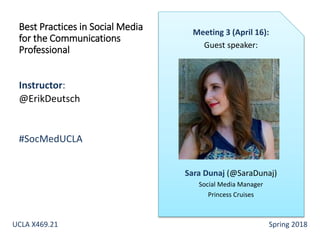
Sara Dunaj (@SaraDunaj)
Social Media Manager,
Princess Cruises
UCLA X469.21 Spring 2018
1. Situation Analysis (a few paragraphs – no boilerplate)
2. Goals (bullet points – well defined)
3. Target Audiences (bullet points – demo/psycho)
4. Competitive Analysis (a few paragraphs)
5. Strategies (bullets)
6. Tactics (bullets)
7. Measurement (starting point + benchmarks)
The Final Project
UCLA X469.21 Spring 2018
• Ask yourself “why?” – then ask again
• Tied to core (bottom line) objectives
(expanding social media presence is not an underlying goal)
• Be specific
Vague Goals: Increase awareness, enhance image,
promote products/services
Specific Goals: Drive website traffic, engage with
existing/new customers and generate sales,
expand company’s leads database, position
company leaders as experts in their field
UCLA X469.21 Spring 2018
• Be specific:
• Think beyond “customers/donors”
and “the public at large”
• B2B and/or B2C
• Demographic, geographic,
psychographic, behavioristic, etc.
• Basic demographics include age, gender,
income, profession, education, family
size, homeowner, marital status, etc.
• Basic psychographics include personality,
value, attitudes and lifestyle
UCLA X469.21 Spring 2018
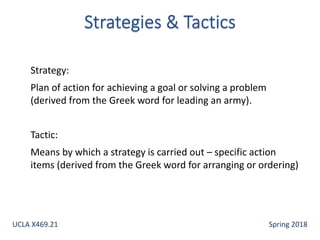
Strategy:
Plan of action for achieving a goal or solving a problem
(derived from the Greek word for leading an army).
Tactic:
Means by which a strategy is carried out – specific action
items (derived from the Greek word for arranging or ordering)
UCLA X469.21 Spring 2018
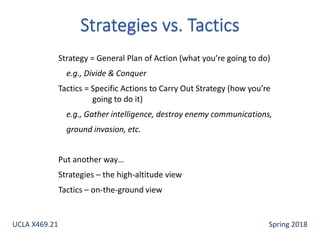
Strategy = General Plan of Action (what you’re going to do)
e.g., Divide & Conquer
Tactics = Specific Actions to Carry Out Strategy (how you’re
going to do it)
e.g., Gather intelligence, destroy enemy communications,
ground invasion, etc.
Put another way…
Strategies – the high-altitude view
Tactics – on-the-ground view
UCLA X469.21 Spring 2018
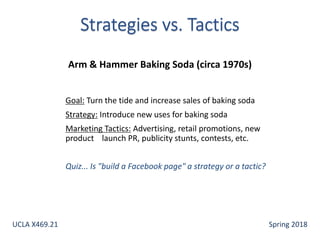
Goal: Turn the tide and increase sales of baking soda
Strategy: Introduce new uses for baking soda
Marketing Tactics: Advertising, retail promotions, new
product launch PR, publicity stunts, contests, etc.
Quiz... Is "build a Facebook page" a strategy or a tactic?
Arm & Hammer Baking Soda (circa 1970s)
UCLA X469.21 Spring 2018
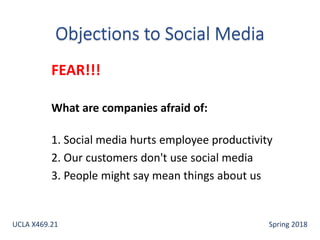
FEAR!!!
What are companies afraid of:
1. Social media hurts employee productivity
2. Our customers don't use social media
3. People might say mean things about us
UCLA X469.21 Spring 2018
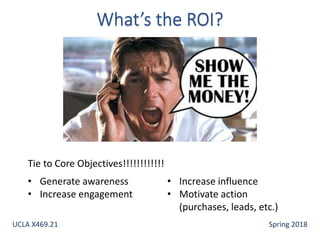
• Generate awareness
• Increase engagement
• Increase influence
• Motivate action
(purchases, leads, etc.)
Tie to Core Objectives!!!!!!!!!!!!
UCLA X469.21 Spring 2018
• Awareness: Website visitors, page views, fans/followers
(tangible metrics)
• Engagement: Comments, retweets, time spent on site
• Influence: Third-party mentions, inbound links
• Action: Conversions, sign-ups, downloads, sales
UCLA X469.21 Spring 2018
• Reach/Impressions – # of individuals who saw your content
• Clickthrus – # of times a link you posted was used
• Unique Visitors –# of different individuals visiting your website
• Page Views – # of times a particular page on your website was viewed
• Time on Page/Site – length of time spent on your page or website
• Bounce Rate – % of visitors who leave your site after viewing just one page
• Comments – # of responses submitted regarding your content
• Downloads – # of times your content was downloaded
• Conversions – # of times a visitors responded to your call to action.
UCLA X469.21 Spring 2018
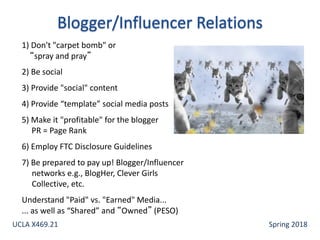
1) Don't "carpet bomb" or
“spray and pray”
2) Be social
3) Provide "social" content
4) Provide “template” social media posts
5) Make it "profitable" for the blogger
PR = Page Rank
6) Employ FTC Disclosure Guidelines
7) Be prepared to pay up! Blogger/Influencer
networks e.g., BlogHer, Clever Girls
Collective, etc.
Understand "Paid" vs. "Earned" Media...
... as well as “Shared” and “Owned” (PESO)
UCLA X469.21 Spring 2018
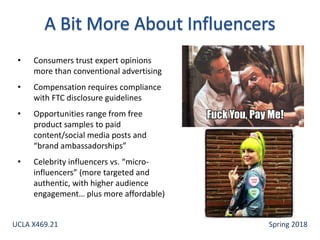
• Consumers trust expert opinions
more than conventional advertising
• Compensation requires compliance
with FTC disclosure guidelines
• Opportunities range from free
product samples to paid
content/social media posts and
“brand ambassadorships”
• Celebrity influencers vs. “micro-
influencers” (more targeted and
authentic, with higher audience
engagement… plus more affordable)
UCLA X469.21 Spring 2018
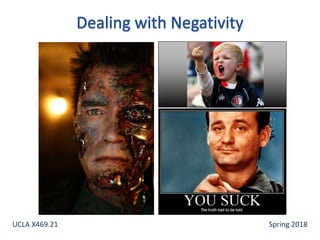
Social media is a complaint machine people gleefully share with friends.
UCLA X469.21 Spring 2018
If, When and How to Respond to Negativity…
and Ways to Avoid it In the First Place
• Do the right thing
• Offer a “pressure valve” for negative feedback
• Institute a “comments policy”
• Be accessible – turn problems into solutions
• Have your defenders in place before you need them
• Assess each detractor’s influence and legitimacy before
deciding if/how to respond
UCLA X469.21 Spring 2018
Instructor:
@ErikDeutsch
#SocMedUCLA
Best Practices in Social Media
for the Communications
Professional
Meeting 3 (April 16):
Guest speaker:
Sara Dunaj (@SaraDunaj)
Social Media Manager
Princess Cruises
UCLA X469.21 Spring 2018

UCLA X469.21 - SPRING '18 WEEK 3

  • 1.
    Instructor: Erik Deutsch (@erikdeutsch) #SocMedUCLA BestPractices in Social Media for the Communications Professional Meeting 3 (April 16): • Final Project – Additional Info • Objections to Social Media • ROI, KPIs and Measuring Success • Working with Bloggers, Influencers and Empowered Consumers • Dealing with Negativity • FTC Disclosure, Copyright and Other Legal Issues Guest speaker: Sara Dunaj (@SaraDunaj) Social Media Manager, Princess Cruises UCLA X469.21 Spring 2018
  • 2.
    1. Situation Analysis(a few paragraphs – no boilerplate) 2. Goals (bullet points – well defined) 3. Target Audiences (bullet points – demo/psycho) 4. Competitive Analysis (a few paragraphs) 5. Strategies (bullets) 6. Tactics (bullets) 7. Measurement (starting point + benchmarks) The Final Project UCLA X469.21 Spring 2018
  • 3.
    • Ask yourself“why?” – then ask again • Tied to core (bottom line) objectives (expanding social media presence is not an underlying goal) • Be specific Vague Goals: Increase awareness, enhance image, promote products/services Specific Goals: Drive website traffic, engage with existing/new customers and generate sales, expand company’s leads database, position company leaders as experts in their field UCLA X469.21 Spring 2018
  • 4.
    • Be specific: •Think beyond “customers/donors” and “the public at large” • B2B and/or B2C • Demographic, geographic, psychographic, behavioristic, etc. • Basic demographics include age, gender, income, profession, education, family size, homeowner, marital status, etc. • Basic psychographics include personality, value, attitudes and lifestyle UCLA X469.21 Spring 2018
  • 5.
    Strategy: Plan of actionfor achieving a goal or solving a problem (derived from the Greek word for leading an army). Tactic: Means by which a strategy is carried out – specific action items (derived from the Greek word for arranging or ordering) UCLA X469.21 Spring 2018
  • 6.
    Strategy = GeneralPlan of Action (what you’re going to do) e.g., Divide & Conquer Tactics = Specific Actions to Carry Out Strategy (how you’re going to do it) e.g., Gather intelligence, destroy enemy communications, ground invasion, etc. Put another way… Strategies – the high-altitude view Tactics – on-the-ground view UCLA X469.21 Spring 2018
  • 7.
    Goal: Turn thetide and increase sales of baking soda Strategy: Introduce new uses for baking soda Marketing Tactics: Advertising, retail promotions, new product launch PR, publicity stunts, contests, etc. Quiz... Is "build a Facebook page" a strategy or a tactic? Arm & Hammer Baking Soda (circa 1970s) UCLA X469.21 Spring 2018
  • 8.
    FEAR!!! What are companiesafraid of: 1. Social media hurts employee productivity 2. Our customers don't use social media 3. People might say mean things about us UCLA X469.21 Spring 2018
  • 9.
    • Generate awareness •Increase engagement • Increase influence • Motivate action (purchases, leads, etc.) Tie to Core Objectives!!!!!!!!!!!! UCLA X469.21 Spring 2018
  • 10.
    • Awareness: Websitevisitors, page views, fans/followers (tangible metrics) • Engagement: Comments, retweets, time spent on site • Influence: Third-party mentions, inbound links • Action: Conversions, sign-ups, downloads, sales UCLA X469.21 Spring 2018
  • 11.
    • Reach/Impressions –# of individuals who saw your content • Clickthrus – # of times a link you posted was used • Unique Visitors –# of different individuals visiting your website • Page Views – # of times a particular page on your website was viewed • Time on Page/Site – length of time spent on your page or website • Bounce Rate – % of visitors who leave your site after viewing just one page • Comments – # of responses submitted regarding your content • Downloads – # of times your content was downloaded • Conversions – # of times a visitors responded to your call to action. UCLA X469.21 Spring 2018
  • 12.
  • 13.
    1) Don't "carpetbomb" or “spray and pray” 2) Be social 3) Provide "social" content 4) Provide “template” social media posts 5) Make it "profitable" for the blogger PR = Page Rank 6) Employ FTC Disclosure Guidelines 7) Be prepared to pay up! Blogger/Influencer networks e.g., BlogHer, Clever Girls Collective, etc. Understand "Paid" vs. "Earned" Media... ... as well as “Shared” and “Owned” (PESO) UCLA X469.21 Spring 2018
  • 14.
    • Consumers trustexpert opinions more than conventional advertising • Compensation requires compliance with FTC disclosure guidelines • Opportunities range from free product samples to paid content/social media posts and “brand ambassadorships” • Celebrity influencers vs. “micro- influencers” (more targeted and authentic, with higher audience engagement… plus more affordable) UCLA X469.21 Spring 2018
  • 15.
  • 16.
    Social media isa complaint machine people gleefully share with friends. UCLA X469.21 Spring 2018
  • 17.
    If, When andHow to Respond to Negativity… and Ways to Avoid it In the First Place • Do the right thing • Offer a “pressure valve” for negative feedback • Institute a “comments policy” • Be accessible – turn problems into solutions • Have your defenders in place before you need them • Assess each detractor’s influence and legitimacy before deciding if/how to respond UCLA X469.21 Spring 2018
  • 18.
    Instructor: @ErikDeutsch #SocMedUCLA Best Practices inSocial Media for the Communications Professional Meeting 3 (April 16): Guest speaker: Sara Dunaj (@SaraDunaj) Social Media Manager Princess Cruises UCLA X469.21 Spring 2018