Best Practices in Social Media
for the Communications
Professional
Instructor:
Erik Deutsch (@ErikDeutsch)
#SocMedUCLA
Meeting 3 (April 19):
 Objections to Social Media
 Finding Your Voice
 Brands as Publishers
 Types of Social Media Content
 “Feeding the Beast”
 Revisiting the Final Project
Template
 The Social Media “Toolkit”
 Guest speaker:
Ruben Ochoa (@rubenochoa1)
Director of Digital
Allison + Partners
UCLA X469.21 Spring 2016
FEAR!!!
What are companies afraid of:
1. Social media hurts employee productivity
2. Our customers don't use social media
3. People might say mean things about us
UCLA X469.21 Spring 2016
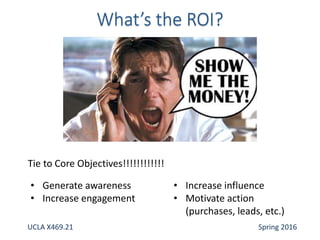
• Generate awareness
• Increase engagement
• Increase influence
• Motivate action
(purchases, leads, etc.)
Tie to Core Objectives!!!!!!!!!!!!
UCLA X469.21 Spring 2016
• Awareness - Website visitors, page views,
fans/followers
• Engagement - Comments (blog, Facebook), retweets,
time spent on website
• Influence - Third-party mentions, inbound links
• Action - Conversions, sign-ups, downloads, purchases
UCLA X469.21 Spring 2016
• Reach/Impressions – # of individuals who saw your content
• Clickthrus – # of times someone used a link you posted
• Unique Visitors –# of distinct individuals visiting your website
• Page Views – # of times a user visited a particular page on your website
• Time on Page/Site – length of time spent on your page or website
• Bounce Rate – % of visitors who leave your site after viewing just one page
• Comments – # of responses submitted regarding your content
• Downloads – # of times your content was downloaded
• Conversions – # of times a user responded to your call to action.
UCLA X469.21 Spring 2016
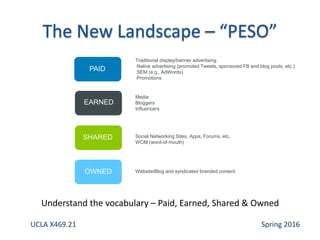
Traditional display/banner advertising
Native advertising (promoted Tweets, sponsored FB and blog posts, etc.)
SEM (e.g., AdWords)
Promotions
Media
Bloggers
Influencers
Social Networking Sites, Apps, Forums, etc.
WOM (word-of-mouth)
Website/Blog and syndicated branded content
PAID
EARNED
SHARED
OWNED
Understand the vocabulary – Paid, Earned, Shared & Owned
UCLA X469.21 Spring 2016
• Everyone (individual, brand,
organization) is now in the content
creation business.
• Shared and owned media.
• Distributed directly to target audiences –
no implied third-party endorsement via
coverage in traditional news media.
• Sponsored posts, blogs, infographics,
videos, podcasts, ebooks, mobile apps,
etc.
• It’s time to become adept at content
creation – text, images, video, audio, etc.
Content Marketing - Brand Journalism - Native Advertising
UCLA X469.21 Spring 2016
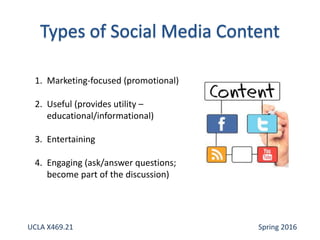
1. Marketing-focused (promotional)
2. Useful (provides utility –
educational/informational)
3. Entertaining
4. Engaging (ask/answer questions;
become part of the discussion)
UCLA X469.21 Spring 2016
• Assess content assets – build inventory
• Original content (data, interviews,
event coverage, presentations, white
papers, lists, infographics, timely topics,
how-to/instructional, etc.)
• Repackage/repurpose/recycle
• Curate
• Co-create – partner with others, invite
guest posts
• Develop and maintain a social media
editorial calendar
UCLA X469.21 Spring 2016
• Tradeshow/conference appearances
• Seasonal topics/relevant "holidays” (e.g., “national
cupcake day”)
• Company milestones, product launches
• Promotions, contests, special offers
• “Evergreen” content (e.g., tips, how-to, lists)
UCLA X469.21 Spring 2016
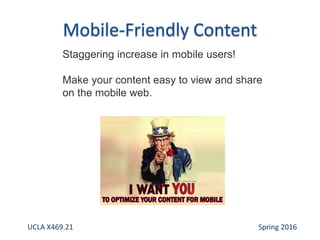
Staggering increase in mobile users!
Make your content easy to view and share
on the mobile web.
UCLA X469.21 Spring 2016
1. Situation Analysis (a few paragraphs – no boilerplate)
2. Goals (bullet points – no metrics/strategies/tactics)
3. Target Audiences (bullet points – demo/psycho)
4. Competitive Analysis (a few paragraphs)
5. Strategies (bullets)
6. Tactics (bullets)
7. Measurement (starting point/benchmarks/tools)
The Final Project
UCLA X469.21 Spring 2016
• Ask yourself “why?” – then ask it again
• Tied to core (bottom line) objectives
• Be specific
Vague Goals:
Increase awareness, enhance image, promote products/services
Specific Goals:
Drive website traffic and attract new customers, engage with
current/prospective customers and generate sales, expand company’s
leads database
UCLA X469.21 Spring 2016
Tied directly to Goals
Don’t be vague:
• Think beyond “customers/donors” and
“the public at large”
• B2C and/or B2C
• Demographic, geographic, psychographic,
behavioristic
• Basic demographics include age, gender,
income, profession, education, family
size, homeowner, marital status, etc.
UCLA X469.21 Fall 2015
Strategy:
A plan of action designed to achieve a goal or solve a problem
(derived from the Greek word for leading an army).
Tactic:
The means by which a strategy is carried out – i.e., the specific
action items (derived from the Greek word for arranging or
ordering)
UCLA X469.21 Spring 2016
Strategy = General Plan of Action
e.g., Divide & Conquer
Tactics = Specific Actions to Carry Out Strategy
e.g., Gather intelligence, destroy enemy communications,
ground invasion, etc.
Or put another way...
A strategy is an idea or conceptualization of how a goal will
be achieved.
A tactic is an action to execute the strategy
UCLA X469.21 Spring 2016
Goal: Turn the tide and increase sales of baking soda
Strategy: Introduce new uses for baking soda
Tactics: Advertising, retail promotions, new product
launch PR, publicity stunts, contests, etc.
Quiz... Is "build a Facebook page" a strategy or a tactic?
Arm & Hammer Baking Soda (circa 1970s)
UCLA X469.21 Spring 2016
Instructor:
@ErikDeutsch
#SocMedUCLA
Best Practices in Social Media
for the Communications
Professional
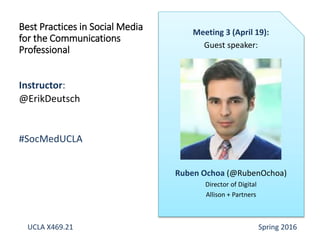
Meeting 3 (April 19):
Guest speaker:
Ruben Ochoa (@RubenOchoa)
Director of Digital
Allison + Partners
UCLA X469.21 Spring 2016

UCLA X469.21 - SPRING '16 WEEK 3

  • 1.
    Best Practices inSocial Media for the Communications Professional Instructor: Erik Deutsch (@ErikDeutsch) #SocMedUCLA Meeting 3 (April 19):  Objections to Social Media  Finding Your Voice  Brands as Publishers  Types of Social Media Content  “Feeding the Beast”  Revisiting the Final Project Template  The Social Media “Toolkit”  Guest speaker: Ruben Ochoa (@rubenochoa1) Director of Digital Allison + Partners UCLA X469.21 Spring 2016
  • 2.
    FEAR!!! What are companiesafraid of: 1. Social media hurts employee productivity 2. Our customers don't use social media 3. People might say mean things about us UCLA X469.21 Spring 2016
  • 3.
    • Generate awareness •Increase engagement • Increase influence • Motivate action (purchases, leads, etc.) Tie to Core Objectives!!!!!!!!!!!! UCLA X469.21 Spring 2016
  • 4.
    • Awareness -Website visitors, page views, fans/followers • Engagement - Comments (blog, Facebook), retweets, time spent on website • Influence - Third-party mentions, inbound links • Action - Conversions, sign-ups, downloads, purchases UCLA X469.21 Spring 2016
  • 5.
    • Reach/Impressions –# of individuals who saw your content • Clickthrus – # of times someone used a link you posted • Unique Visitors –# of distinct individuals visiting your website • Page Views – # of times a user visited a particular page on your website • Time on Page/Site – length of time spent on your page or website • Bounce Rate – % of visitors who leave your site after viewing just one page • Comments – # of responses submitted regarding your content • Downloads – # of times your content was downloaded • Conversions – # of times a user responded to your call to action. UCLA X469.21 Spring 2016
  • 6.
  • 7.
    Traditional display/banner advertising Nativeadvertising (promoted Tweets, sponsored FB and blog posts, etc.) SEM (e.g., AdWords) Promotions Media Bloggers Influencers Social Networking Sites, Apps, Forums, etc. WOM (word-of-mouth) Website/Blog and syndicated branded content PAID EARNED SHARED OWNED Understand the vocabulary – Paid, Earned, Shared & Owned UCLA X469.21 Spring 2016
  • 8.
  • 9.
    • Everyone (individual,brand, organization) is now in the content creation business. • Shared and owned media. • Distributed directly to target audiences – no implied third-party endorsement via coverage in traditional news media. • Sponsored posts, blogs, infographics, videos, podcasts, ebooks, mobile apps, etc. • It’s time to become adept at content creation – text, images, video, audio, etc. Content Marketing - Brand Journalism - Native Advertising UCLA X469.21 Spring 2016
  • 10.
    1. Marketing-focused (promotional) 2.Useful (provides utility – educational/informational) 3. Entertaining 4. Engaging (ask/answer questions; become part of the discussion) UCLA X469.21 Spring 2016
  • 11.
    • Assess contentassets – build inventory • Original content (data, interviews, event coverage, presentations, white papers, lists, infographics, timely topics, how-to/instructional, etc.) • Repackage/repurpose/recycle • Curate • Co-create – partner with others, invite guest posts • Develop and maintain a social media editorial calendar UCLA X469.21 Spring 2016
  • 12.
    • Tradeshow/conference appearances •Seasonal topics/relevant "holidays” (e.g., “national cupcake day”) • Company milestones, product launches • Promotions, contests, special offers • “Evergreen” content (e.g., tips, how-to, lists) UCLA X469.21 Spring 2016
  • 13.
    Staggering increase inmobile users! Make your content easy to view and share on the mobile web. UCLA X469.21 Spring 2016
  • 14.
    1. Situation Analysis(a few paragraphs – no boilerplate) 2. Goals (bullet points – no metrics/strategies/tactics) 3. Target Audiences (bullet points – demo/psycho) 4. Competitive Analysis (a few paragraphs) 5. Strategies (bullets) 6. Tactics (bullets) 7. Measurement (starting point/benchmarks/tools) The Final Project UCLA X469.21 Spring 2016
  • 15.
    • Ask yourself“why?” – then ask it again • Tied to core (bottom line) objectives • Be specific Vague Goals: Increase awareness, enhance image, promote products/services Specific Goals: Drive website traffic and attract new customers, engage with current/prospective customers and generate sales, expand company’s leads database UCLA X469.21 Spring 2016
  • 16.
    Tied directly toGoals Don’t be vague: • Think beyond “customers/donors” and “the public at large” • B2C and/or B2C • Demographic, geographic, psychographic, behavioristic • Basic demographics include age, gender, income, profession, education, family size, homeowner, marital status, etc. UCLA X469.21 Fall 2015
  • 17.
    Strategy: A plan ofaction designed to achieve a goal or solve a problem (derived from the Greek word for leading an army). Tactic: The means by which a strategy is carried out – i.e., the specific action items (derived from the Greek word for arranging or ordering) UCLA X469.21 Spring 2016
  • 18.
    Strategy = GeneralPlan of Action e.g., Divide & Conquer Tactics = Specific Actions to Carry Out Strategy e.g., Gather intelligence, destroy enemy communications, ground invasion, etc. Or put another way... A strategy is an idea or conceptualization of how a goal will be achieved. A tactic is an action to execute the strategy UCLA X469.21 Spring 2016
  • 19.
    Goal: Turn thetide and increase sales of baking soda Strategy: Introduce new uses for baking soda Tactics: Advertising, retail promotions, new product launch PR, publicity stunts, contests, etc. Quiz... Is "build a Facebook page" a strategy or a tactic? Arm & Hammer Baking Soda (circa 1970s) UCLA X469.21 Spring 2016
  • 20.
    Instructor: @ErikDeutsch #SocMedUCLA Best Practices inSocial Media for the Communications Professional Meeting 3 (April 19): Guest speaker: Ruben Ochoa (@RubenOchoa) Director of Digital Allison + Partners UCLA X469.21 Spring 2016