Best Practices in Social Media
for the Communications
Professional
Instructor:
Erik Deutsch (@erikdeutsch)
#SocMedUCLA
Meeting 2 (April 15):
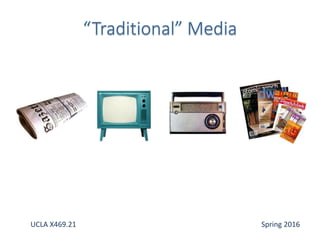
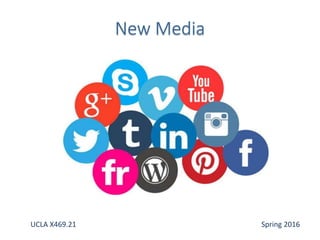
 Traditional vs. Social Media
 Paid, Earned, Shared & Owned
 Can/Should Social Media
Supplant Traditional Websites
 ROI, KPIs and Measuring Success
 Developing a Social Media
“Playbook”
 Final Project Template – The
Social Media Plan Outline
 Guest speaker:
Clint Schaff (@ClintSchaff)
Senior Marketing Exec., Educator
and Entrepreneur
UCLA X469.21 Spring 2016
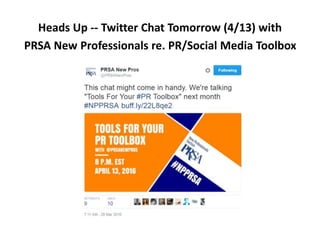
Heads Up -- Twitter Chat Tomorrow (4/13) with
PRSA New Professionals re. PR/Social Media Toolbox
UCLA X469.21 Spring 2016
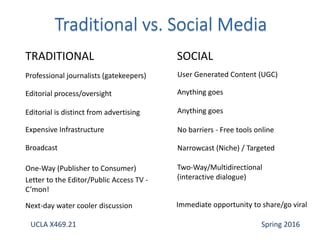
TRADITIONAL SOCIAL
Broadcast
Expensive Infrastructure
One-Way (Publisher to Consumer)
Letter to the Editor/Public Access TV -
C’mon!
Next-day water cooler discussion
No barriers - Free tools online
Narrowcast (Niche) / Targeted
Two-Way/Multidirectional
(interactive dialogue)
Immediate opportunity to share/go viral
Professional journalists (gatekeepers) User Generated Content (UGC)
Editorial process/oversight
Editorial is distinct from advertising
Anything goes
Anything goes
UCLA X469.21 Spring 2016
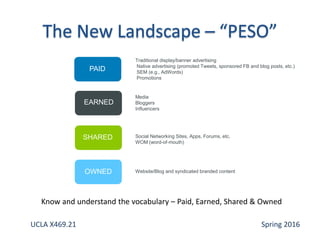
Traditional display/banner advertising
Native advertising (promoted Tweets, sponsored FB and blog posts, etc.)
SEM (e.g., AdWords)
Promotions
Media
Bloggers
Influencers
Social Networking Sites, Apps, Forums, etc.
WOM (word-of-mouth)
Website/Blog and syndicated branded content
PAID
EARNED
SHARED
OWNED
Know and understand the vocabulary – Paid, Earned, Shared & Owned
UCLA X469.21 Spring 2016
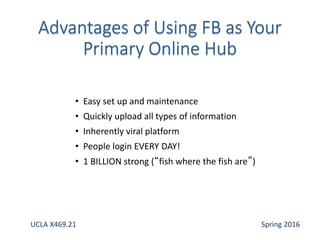
• Easy set up and maintenance
• Quickly upload all types of information
• Inherently viral platform
• People login EVERY DAY!
• 1 BILLION strong (“fish where the fish are”)
UCLA X469.21 Spring 2016
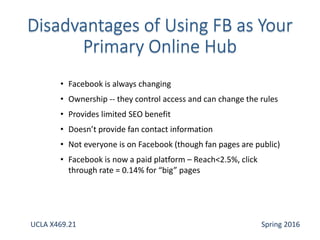
• Facebook is always changing
• Ownership -- they control access and can change the rules
• Provides limited SEO benefit
• Doesn’t provide fan contact information
• Not everyone is on Facebook (though fan pages are public)
• Facebook is now a paid platform – Reach<2.5%, click
through rate = 0.14% for “big” pages
UCLA X469.21 Spring 2016
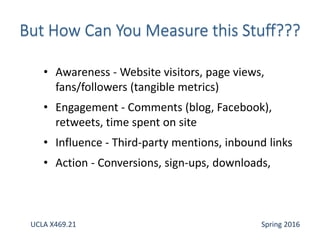
• Awareness - Website visitors, page views,
fans/followers (tangible metrics)
• Engagement - Comments (blog, Facebook),
retweets, time spent on site
• Influence - Third-party mentions, inbound links
• Action - Conversions, sign-ups, downloads,
UCLA X469.21 Spring 2016
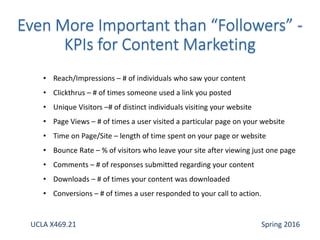
• Reach/Impressions – # of individuals who saw your content
• Clickthrus – # of times someone used a link you posted
• Unique Visitors –# of distinct individuals visiting your website
• Page Views – # of times a user visited a particular page on your website
• Time on Page/Site – length of time spent on your page or website
• Bounce Rate – % of visitors who leave your site after viewing just one page
• Comments – # of responses submitted regarding your content
• Downloads – # of times your content was downloaded
• Conversions – # of times a user responded to your call to action.
UCLA X469.21 Spring 2016
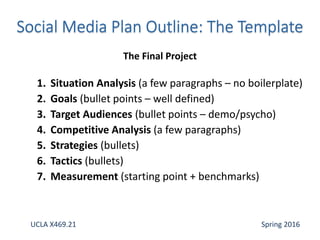
1. Situation Analysis (a few paragraphs – no boilerplate)
2. Goals (bullet points – well defined)
3. Target Audiences (bullet points – demo/psycho)
4. Competitive Analysis (a few paragraphs)
5. Strategies (bullets)
6. Tactics (bullets)
7. Measurement (starting point + benchmarks)
The Final Project
UCLA X469.21 Spring 2016
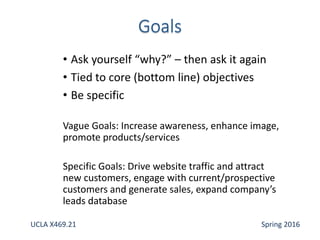
• Ask yourself “why?” – then ask it again
• Tied to core (bottom line) objectives
• Be specific
Vague Goals: Increase awareness, enhance image,
promote products/services
Specific Goals: Drive website traffic and attract
new customers, engage with current/prospective
customers and generate sales, expand company’s
leads database
UCLA X469.21 Spring 2016
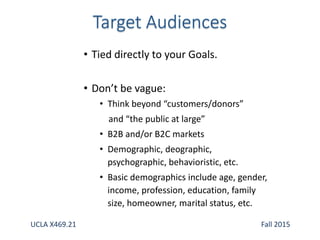
• Tied directly to your Goals.
• Don’t be vague:
• Think beyond “customers/donors”
and “the public at large”
• B2B and/or B2C markets
• Demographic, deographic,
psychographic, behavioristic, etc.
• Basic demographics include age, gender,
income, profession, education, family
size, homeowner, marital status, etc.
UCLA X469.21 Fall 2015
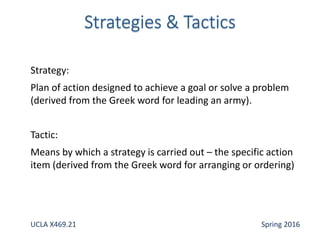
Strategy:
Plan of action designed to achieve a goal or solve a problem
(derived from the Greek word for leading an army).
Tactic:
Means by which a strategy is carried out – the specific action
item (derived from the Greek word for arranging or ordering)
UCLA X469.21 Spring 2016
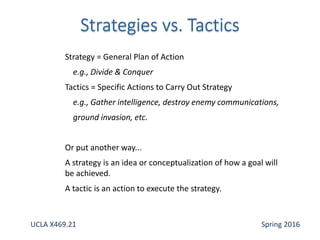
Strategy = General Plan of Action
e.g., Divide & Conquer
Tactics = Specific Actions to Carry Out Strategy
e.g., Gather intelligence, destroy enemy communications,
ground invasion, etc.
Or put another way...
A strategy is an idea or conceptualization of how a goal will
be achieved.
A tactic is an action to execute the strategy.
UCLA X469.21 Spring 2016
Goal: Turn the tide and increase sales of baking soda
Strategy: Introduce new uses for baking soda
Tactics: Advertising, retail promotions, new product
launch PR, publicity stunts, contests, etc.
Quiz... Is "build a Facebook page" a strategy or a tactic?
Arm & Hammer Baking Soda (circa 1970s)
UCLA X469.21 Spring 2016
Instructor:
Erik Deutsch
(@ErikDeutsch)
#SocMedUCLA
Best Practices in Social Media
for the Communications
Professional
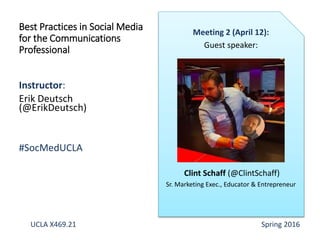
Meeting 2 (April 12):
Guest speaker:
Clint Schaff (@ClintSchaff)
Sr. Marketing Exec., Educator & Entrepreneur
UCLA X469.21 Spring 2016

UCLA X469.21 - SPRING '16 WEEK 2

  • 1.
    Best Practices inSocial Media for the Communications Professional Instructor: Erik Deutsch (@erikdeutsch) #SocMedUCLA Meeting 2 (April 15):  Traditional vs. Social Media  Paid, Earned, Shared & Owned  Can/Should Social Media Supplant Traditional Websites  ROI, KPIs and Measuring Success  Developing a Social Media “Playbook”  Final Project Template – The Social Media Plan Outline  Guest speaker: Clint Schaff (@ClintSchaff) Senior Marketing Exec., Educator and Entrepreneur UCLA X469.21 Spring 2016
  • 2.
    Heads Up --Twitter Chat Tomorrow (4/13) with PRSA New Professionals re. PR/Social Media Toolbox
  • 3.
  • 4.
  • 5.
    TRADITIONAL SOCIAL Broadcast Expensive Infrastructure One-Way(Publisher to Consumer) Letter to the Editor/Public Access TV - C’mon! Next-day water cooler discussion No barriers - Free tools online Narrowcast (Niche) / Targeted Two-Way/Multidirectional (interactive dialogue) Immediate opportunity to share/go viral Professional journalists (gatekeepers) User Generated Content (UGC) Editorial process/oversight Editorial is distinct from advertising Anything goes Anything goes UCLA X469.21 Spring 2016
  • 6.
    Traditional display/banner advertising Nativeadvertising (promoted Tweets, sponsored FB and blog posts, etc.) SEM (e.g., AdWords) Promotions Media Bloggers Influencers Social Networking Sites, Apps, Forums, etc. WOM (word-of-mouth) Website/Blog and syndicated branded content PAID EARNED SHARED OWNED Know and understand the vocabulary – Paid, Earned, Shared & Owned UCLA X469.21 Spring 2016
  • 7.
  • 8.
    • Easy setup and maintenance • Quickly upload all types of information • Inherently viral platform • People login EVERY DAY! • 1 BILLION strong (“fish where the fish are”) UCLA X469.21 Spring 2016
  • 9.
    • Facebook isalways changing • Ownership -- they control access and can change the rules • Provides limited SEO benefit • Doesn’t provide fan contact information • Not everyone is on Facebook (though fan pages are public) • Facebook is now a paid platform – Reach<2.5%, click through rate = 0.14% for “big” pages UCLA X469.21 Spring 2016
  • 10.
    • Awareness -Website visitors, page views, fans/followers (tangible metrics) • Engagement - Comments (blog, Facebook), retweets, time spent on site • Influence - Third-party mentions, inbound links • Action - Conversions, sign-ups, downloads, UCLA X469.21 Spring 2016
  • 11.
    • Reach/Impressions –# of individuals who saw your content • Clickthrus – # of times someone used a link you posted • Unique Visitors –# of distinct individuals visiting your website • Page Views – # of times a user visited a particular page on your website • Time on Page/Site – length of time spent on your page or website • Bounce Rate – % of visitors who leave your site after viewing just one page • Comments – # of responses submitted regarding your content • Downloads – # of times your content was downloaded • Conversions – # of times a user responded to your call to action. UCLA X469.21 Spring 2016
  • 12.
    1. Situation Analysis(a few paragraphs – no boilerplate) 2. Goals (bullet points – well defined) 3. Target Audiences (bullet points – demo/psycho) 4. Competitive Analysis (a few paragraphs) 5. Strategies (bullets) 6. Tactics (bullets) 7. Measurement (starting point + benchmarks) The Final Project UCLA X469.21 Spring 2016
  • 13.
    • Ask yourself“why?” – then ask it again • Tied to core (bottom line) objectives • Be specific Vague Goals: Increase awareness, enhance image, promote products/services Specific Goals: Drive website traffic and attract new customers, engage with current/prospective customers and generate sales, expand company’s leads database UCLA X469.21 Spring 2016
  • 14.
    • Tied directlyto your Goals. • Don’t be vague: • Think beyond “customers/donors” and “the public at large” • B2B and/or B2C markets • Demographic, deographic, psychographic, behavioristic, etc. • Basic demographics include age, gender, income, profession, education, family size, homeowner, marital status, etc. UCLA X469.21 Fall 2015
  • 15.
    Strategy: Plan of actiondesigned to achieve a goal or solve a problem (derived from the Greek word for leading an army). Tactic: Means by which a strategy is carried out – the specific action item (derived from the Greek word for arranging or ordering) UCLA X469.21 Spring 2016
  • 16.
    Strategy = GeneralPlan of Action e.g., Divide & Conquer Tactics = Specific Actions to Carry Out Strategy e.g., Gather intelligence, destroy enemy communications, ground invasion, etc. Or put another way... A strategy is an idea or conceptualization of how a goal will be achieved. A tactic is an action to execute the strategy. UCLA X469.21 Spring 2016
  • 17.
    Goal: Turn thetide and increase sales of baking soda Strategy: Introduce new uses for baking soda Tactics: Advertising, retail promotions, new product launch PR, publicity stunts, contests, etc. Quiz... Is "build a Facebook page" a strategy or a tactic? Arm & Hammer Baking Soda (circa 1970s) UCLA X469.21 Spring 2016
  • 18.
    Instructor: Erik Deutsch (@ErikDeutsch) #SocMedUCLA Best Practicesin Social Media for the Communications Professional Meeting 2 (April 12): Guest speaker: Clint Schaff (@ClintSchaff) Sr. Marketing Exec., Educator & Entrepreneur UCLA X469.21 Spring 2016