Instructor:
Erik Deutsch (@erikdeutsch)
#SocMedUCLA
Best Practices in Social Media
for the Communications
Professional
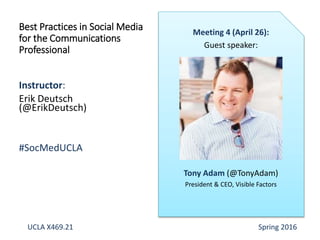
Meeting 4 (April 26):
• Facebook & Twitter Best Practices
• Nothing is “Off-the-Record”
• SEO for the PR pro
• Online reputation management
• Guest speaker:
Tony Adam (@TonyAdam)
President & CEO, Visible Factors
UCLA X469.21 Spring 2016
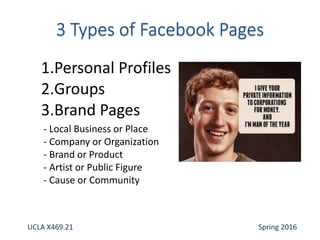
1.Personal Profiles
2.Groups
3.Brand Pages
UCLA X469.21 Spring 2016
- Local Business or Place
- Company or Organization
- Brand or Product
- Artist or Public Figure
- Cause or Community
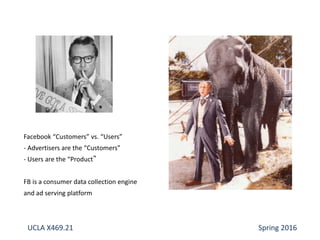
Facebook “Customers” vs. “Users”
- Advertisers are the “Customers”
- Users are the “Product”
FB is a consumer data collection engine
and ad serving platform
UCLA X469.21 Spring 2016
• Organic vs. paid (sponsored posts)
• Edgerank algorythm (affinity, weight and
recency)
• Facebook insights (publisher analytics)
UCLA X469.21 Spring 2016
• Quality over quantity.
• Shorter posts (to generate more engagement).
• Provide a link (and hashtag)
• Ask questions (to ignite a dialogue).
• Use photos, links and videos (particularly
native video) for higher edgegrank.
• Get creative.
• Pay to expand reach
UCLA X469.21 Spring 2016
1.General Status Update
2.The Retweet (RT and MT)
3.The @Mention
4.The @Reply
5.Direct Messages (DM)
6.Hashtag Tweet (#)
UCLA X469.21 Spring 2016
Tweet Structure
Dissecting the semantics of a tweet
gives us a sense of best practice, but
keep in mind this isn't a one-size-fits-
all deal. Keep it real and get in your
own groove.
Start with:
- Headline or phrase
- Link
- Hashtag
UCLA X469.21 Spring 2016
• Tweets with image and video links have 5 times the
engagement rate
• Tens of millions of fake Twitter users – plus 44 percent
of users have never sent a single tweet
• The cost of a 24 hour promoted trend costs
about $200K
• Katy Perry is the queen of Twitter with nearly 70 million
followers
• Ellen’s photo of celebs at the Oscars generated 3.4
million retweets within hours
UCLA X469.21 Spring 2016
• Follow others (reciprocity)
• Complete your profile and look “legit” (photo, keyword and links)
• Engage!
• Leverage what’s trending (#hashtags/keywords)
• Post when/where your target followers hang out
• Attend events (online/offline; e.g., Twitter chats)
• Mention other users in your posts (“ego bait”)
• Promote everywhere (email sig, website, marketing collateral, etc.)
• Buy them... literally (but don’t)
UCLA X469.21 Spring 2016
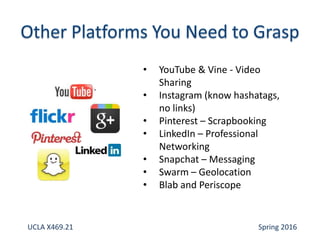
• YouTube & Vine - Video
Sharing
• Instagram (know hashatags,
no links)
• Pinterest – Scrapbooking
• LinkedIn – Professional
Networking
• Snapchat – Messaging
• Swarm – Geolocation
• Blab and Periscope
UCLA X469.21 Spring 2016
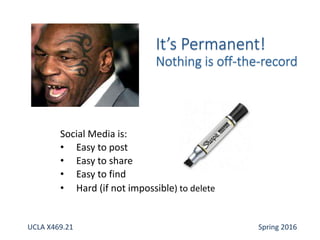
Social Media is:
• Easy to post
• Easy to share
• Easy to find
• Hard (if not impossible) to delete
UCLA X469.21 Spring 2016
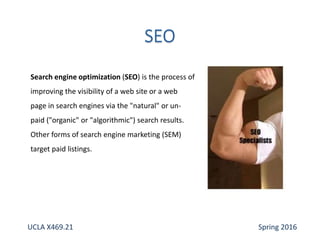
Search engine optimization (SEO) is the process of
improving the visibility of a web site or a web
page in search engines via the "natural" or un-
paid ("organic" or "algorithmic") search results.
Other forms of search engine marketing (SEM)
target paid listings.
UCLA X469.21 Spring 2016
1) Relevance - How relevant is your page content to
the keyword query of your visitor?
2) Authority – Based on the company you keep. In
other words, which sites link to your site, and who
shares your links on social media
UCLA X469.21 Spring 2016
• Visible (on-page) and non-visible (source code) content
• Meta Tags - Optimize your Title and Description tags
• Alt Tags - Alternative text attached to images (to provide
search engines crawlable text in the webpage code)
• Headings - Titles and subtitles (e.g. H1 and H2 tags) on the
page help break blocks of content into smaller, clearly labeled
sections.
• Body Text - Focus on 2 or 3 keywords per page and write for
users, not the search engines (avoid “keyword stuffing”)
UCLA X469.21 Spring 2016
• External inbound links – Value depends on credibility and
popularity of sites that link to your site. Note .edu and .gov
trump the rest, and the NY Times trumps a small-time blogger
(links from spammy sites can actually reduce authority).
• “Anchor” text – The visible, clickable text in a hyperlink should
be keyword-focused.
• Link relevancy – How relevant is the content on the linking
page and the target page?
• Popularity & Trustworthiness – What’s the “Page Rank” of the
linking page?
UCLA X469.21 Spring 2016
SEM - Search Engine Marketing
• Purchasing links
• Akin (in PR speak) to "Earned" vs. "Paid" media
UCLA X469.21 Spring 2016
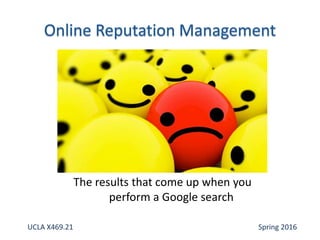
The results that come up when you
perform a Google search
UCLA X469.21 Spring 2016
And remember...
all content and links are not created equal.
"The solution to pollution is dilution."
UCLA X469.21 Spring 2016
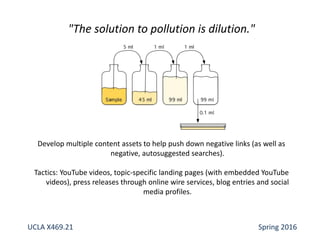
Develop multiple content assets to help push down negative links (as well as
negative, autosuggested searches).
Tactics: YouTube videos, topic-specific landing pages (with embedded YouTube
videos), press releases through online wire services, blog entries and social
media profiles.
"The solution to pollution is dilution."
UCLA X469.21 Spring 2016
Instructor:
Erik Deutsch
(@ErikDeutsch)
#SocMedUCLA
Best Practices in Social Media
for the Communications
Professional
Meeting 4 (April 26):
Guest speaker:
Tony Adam (@TonyAdam)
President & CEO, Visible Factors
UCLA X469.21 Spring 2016

UCLA X469.21 - SPRING '16 WEEK 4

  • 1.
    Instructor: Erik Deutsch (@erikdeutsch) #SocMedUCLA BestPractices in Social Media for the Communications Professional Meeting 4 (April 26): • Facebook & Twitter Best Practices • Nothing is “Off-the-Record” • SEO for the PR pro • Online reputation management • Guest speaker: Tony Adam (@TonyAdam) President & CEO, Visible Factors UCLA X469.21 Spring 2016
  • 2.
    1.Personal Profiles 2.Groups 3.Brand Pages UCLAX469.21 Spring 2016 - Local Business or Place - Company or Organization - Brand or Product - Artist or Public Figure - Cause or Community
  • 3.
    Facebook “Customers” vs.“Users” - Advertisers are the “Customers” - Users are the “Product” FB is a consumer data collection engine and ad serving platform UCLA X469.21 Spring 2016
  • 4.
    • Organic vs.paid (sponsored posts) • Edgerank algorythm (affinity, weight and recency) • Facebook insights (publisher analytics) UCLA X469.21 Spring 2016
  • 5.
  • 6.
    • Quality overquantity. • Shorter posts (to generate more engagement). • Provide a link (and hashtag) • Ask questions (to ignite a dialogue). • Use photos, links and videos (particularly native video) for higher edgegrank. • Get creative. • Pay to expand reach UCLA X469.21 Spring 2016
  • 7.
    1.General Status Update 2.TheRetweet (RT and MT) 3.The @Mention 4.The @Reply 5.Direct Messages (DM) 6.Hashtag Tweet (#) UCLA X469.21 Spring 2016
  • 8.
    Tweet Structure Dissecting thesemantics of a tweet gives us a sense of best practice, but keep in mind this isn't a one-size-fits- all deal. Keep it real and get in your own groove. Start with: - Headline or phrase - Link - Hashtag UCLA X469.21 Spring 2016
  • 9.
    • Tweets withimage and video links have 5 times the engagement rate • Tens of millions of fake Twitter users – plus 44 percent of users have never sent a single tweet • The cost of a 24 hour promoted trend costs about $200K • Katy Perry is the queen of Twitter with nearly 70 million followers • Ellen’s photo of celebs at the Oscars generated 3.4 million retweets within hours UCLA X469.21 Spring 2016
  • 10.
    • Follow others(reciprocity) • Complete your profile and look “legit” (photo, keyword and links) • Engage! • Leverage what’s trending (#hashtags/keywords) • Post when/where your target followers hang out • Attend events (online/offline; e.g., Twitter chats) • Mention other users in your posts (“ego bait”) • Promote everywhere (email sig, website, marketing collateral, etc.) • Buy them... literally (but don’t) UCLA X469.21 Spring 2016
  • 11.
    • YouTube &Vine - Video Sharing • Instagram (know hashatags, no links) • Pinterest – Scrapbooking • LinkedIn – Professional Networking • Snapchat – Messaging • Swarm – Geolocation • Blab and Periscope UCLA X469.21 Spring 2016
  • 12.
    Social Media is: •Easy to post • Easy to share • Easy to find • Hard (if not impossible) to delete UCLA X469.21 Spring 2016
  • 13.
    Search engine optimization(SEO) is the process of improving the visibility of a web site or a web page in search engines via the "natural" or un- paid ("organic" or "algorithmic") search results. Other forms of search engine marketing (SEM) target paid listings. UCLA X469.21 Spring 2016
  • 14.
    1) Relevance -How relevant is your page content to the keyword query of your visitor? 2) Authority – Based on the company you keep. In other words, which sites link to your site, and who shares your links on social media UCLA X469.21 Spring 2016
  • 15.
    • Visible (on-page)and non-visible (source code) content • Meta Tags - Optimize your Title and Description tags • Alt Tags - Alternative text attached to images (to provide search engines crawlable text in the webpage code) • Headings - Titles and subtitles (e.g. H1 and H2 tags) on the page help break blocks of content into smaller, clearly labeled sections. • Body Text - Focus on 2 or 3 keywords per page and write for users, not the search engines (avoid “keyword stuffing”) UCLA X469.21 Spring 2016
  • 16.
    • External inboundlinks – Value depends on credibility and popularity of sites that link to your site. Note .edu and .gov trump the rest, and the NY Times trumps a small-time blogger (links from spammy sites can actually reduce authority). • “Anchor” text – The visible, clickable text in a hyperlink should be keyword-focused. • Link relevancy – How relevant is the content on the linking page and the target page? • Popularity & Trustworthiness – What’s the “Page Rank” of the linking page? UCLA X469.21 Spring 2016
  • 17.
    SEM - SearchEngine Marketing • Purchasing links • Akin (in PR speak) to "Earned" vs. "Paid" media UCLA X469.21 Spring 2016
  • 18.
    The results thatcome up when you perform a Google search UCLA X469.21 Spring 2016
  • 19.
    And remember... all contentand links are not created equal. "The solution to pollution is dilution." UCLA X469.21 Spring 2016
  • 20.
    Develop multiple contentassets to help push down negative links (as well as negative, autosuggested searches). Tactics: YouTube videos, topic-specific landing pages (with embedded YouTube videos), press releases through online wire services, blog entries and social media profiles. "The solution to pollution is dilution." UCLA X469.21 Spring 2016
  • 21.
    Instructor: Erik Deutsch (@ErikDeutsch) #SocMedUCLA Best Practicesin Social Media for the Communications Professional Meeting 4 (April 26): Guest speaker: Tony Adam (@TonyAdam) President & CEO, Visible Factors UCLA X469.21 Spring 2016