Best Practices in Social Media
for the Communications
Professional
Instructor:
Erik Deutsch (@erikdeutsch)
#SocMedUCLA
Meeting 2 (October 17):
 Traditional vs. Social Media
 Paid, Earned, Shared & Owned
 Can/Should Social Media
Supplant Traditional Websites
 ROI, KPIs and Measuring Success
 Developing a Social Media
“Playbook”
 Final Project Template –
Social Media Plan Outline
 Guest speaker:
Clint Schaff (@ClintSchaff)
VP of Strategy & Development
Los Angeles Times
UCLA X469.21 Fall 2016
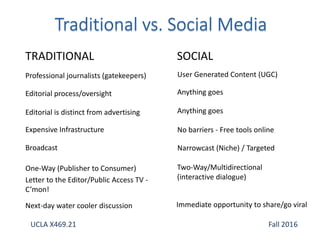
TRADITIONAL SOCIAL
Broadcast
Expensive Infrastructure
One-Way (Publisher to Consumer)
Letter to the Editor/Public Access TV -
C’mon!
Next-day water cooler discussion
No barriers - Free tools online
Narrowcast (Niche) / Targeted
Two-Way/Multidirectional
(interactive dialogue)
Immediate opportunity to share/go viral
Professional journalists (gatekeepers) User Generated Content (UGC)
Editorial process/oversight
Editorial is distinct from advertising
Anything goes
Anything goes
UCLA X469.21 Fall 2016
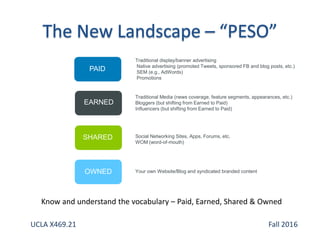
Traditional display/banner advertising
Native advertising (promoted Tweets, sponsored FB and blog posts, etc.)
SEM (e.g., AdWords)
Promotions
Traditional Media (news coverage, feature segments, appearances, etc.)
Bloggers (but shifting from Earned to Paid)
Influencers (but shifting from Earned to Paid)
Social Networking Sites, Apps, Forums, etc.
WOM (word-of-mouth)
Your own Website/Blog and syndicated branded content
PAID
EARNED
SHARED
OWNED
Know and understand the vocabulary – Paid, Earned, Shared & Owned
UCLA X469.21 Fall 2016
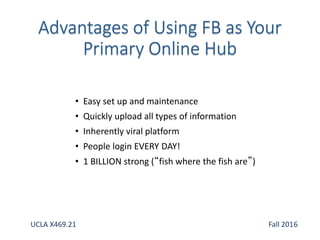
• Easy set up and maintenance
• Quickly upload all types of information
• Inherently viral platform
• People login EVERY DAY!
• 1 BILLION strong (“fish where the fish are”)
UCLA X469.21 Fall 2016
• Facebook is always changing
• Ownership -- they control access and can change the rules
• Provides limited SEO benefit
• Doesn’t provide fan contact information
• Not everyone is on Facebook (though fan pages are public)
• Facebook is now a paid platform – Reach<2.5%, click
through rate = 0.14% for “big” pages
UCLA X469.21 Fall 2016
• Awareness - Website visitors, page views,
fans/followers (tangible metrics)
• Engagement - Comments (blog, Facebook),
retweets, time spent on site
• Influence - Third-party mentions, inbound links
• Action - Conversions, sign-ups, downloads, sales
UCLA X469.21 Fall 2016
• Reach/Impressions – # of individuals who saw your content
• Clickthrus – # of times a link you posted was used
• Unique Visitors –# of different individuals visiting your website
• Page Views – # of times a particular page on your website was viewed
• Time on Page/Site – length of time spent on your page or website
• Bounce Rate – % of visitors who leave your site after viewing just one page
• Comments – # of responses submitted regarding your content
• Downloads – # of times your content was downloaded
• Conversions – # of times a visitors responded to your call to action.
UCLA X469.21 Fall 2016
• A guide for managing all of your ongoing social
media efforts
• Describes the look, tone and feel of your brand’s
online persona to ensure consistent style and
messages
• Guiding principles for using various social media
channels
• How you will allocate resources and measure
success
UCLA X469.21 Fall 2016
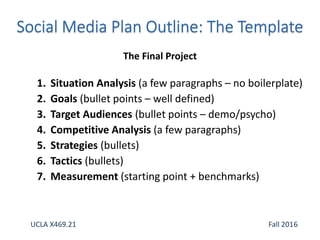
1. Situation Analysis (a few paragraphs – no boilerplate)
2. Goals (bullet points – well defined)
3. Target Audiences (bullet points – demo/psycho)
4. Competitive Analysis (a few paragraphs)
5. Strategies (bullets)
6. Tactics (bullets)
7. Measurement (starting point + benchmarks)
The Final Project
UCLA X469.21 Fall 2016
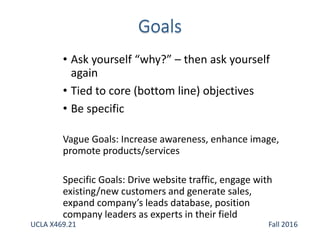
• Ask yourself “why?” – then ask yourself
again
• Tied to core (bottom line) objectives
• Be specific
Vague Goals: Increase awareness, enhance image,
promote products/services
Specific Goals: Drive website traffic, engage with
existing/new customers and generate sales,
expand company’s leads database, position
company leaders as experts in their field
UCLA X469.21 Fall 2016
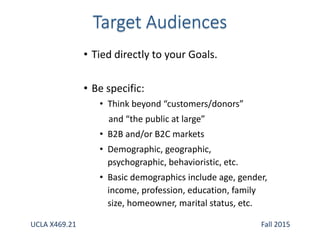
• Tied directly to your Goals.
• Be specific:
• Think beyond “customers/donors”
and “the public at large”
• B2B and/or B2C markets
• Demographic, geographic,
psychographic, behavioristic, etc.
• Basic demographics include age, gender,
income, profession, education, family
size, homeowner, marital status, etc.
UCLA X469.21 Fall 2015
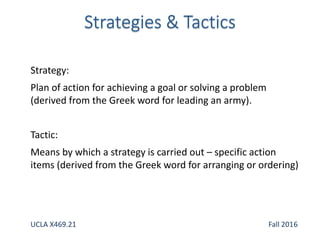
Strategy:
Plan of action for achieving a goal or solving a problem
(derived from the Greek word for leading an army).
Tactic:
Means by which a strategy is carried out – specific action
items (derived from the Greek word for arranging or ordering)
UCLA X469.21 Fall 2016
Strategy = General Plan of Action (what you’re going to do)
e.g., Divide & Conquer
Tactics = Specific Actions to Carry Out Strategy (how you’re
going to do it)
e.g., Gather intelligence, destroy enemy communications,
ground invasion, etc.
Put another way…
Strategy – the high-altitude view
Tactic – on-the-ground view
UCLA X469.21 Fall 2016
Goal: Turn the tide and increase sales of baking soda
Strategy: Introduce new uses for baking soda
Tactics: Advertising, retail promotions, new product
launch PR, publicity stunts, contests, etc.
Quiz... Is "build a Facebook page" a strategy or a tactic?
Arm & Hammer Baking Soda (circa 1970s)
UCLA X469.21 Fall 2016
Instructor:
Erik Deutsch
(@ErikDeutsch)
#SocMedUCLA
Best Practices in Social Media
for the Communications
Professional
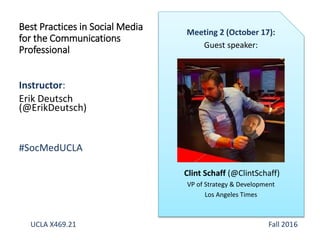
Meeting 2 (October 17):
Guest speaker:
Clint Schaff (@ClintSchaff)
VP of Strategy & Development
Los Angeles Times
UCLA X469.21 Fall 2016

UCLA X469.21 - FALL '16 WEEK 2

  • 1.
    Best Practices inSocial Media for the Communications Professional Instructor: Erik Deutsch (@erikdeutsch) #SocMedUCLA Meeting 2 (October 17):  Traditional vs. Social Media  Paid, Earned, Shared & Owned  Can/Should Social Media Supplant Traditional Websites  ROI, KPIs and Measuring Success  Developing a Social Media “Playbook”  Final Project Template – Social Media Plan Outline  Guest speaker: Clint Schaff (@ClintSchaff) VP of Strategy & Development Los Angeles Times UCLA X469.21 Fall 2016
  • 2.
  • 3.
  • 4.
    TRADITIONAL SOCIAL Broadcast Expensive Infrastructure One-Way(Publisher to Consumer) Letter to the Editor/Public Access TV - C’mon! Next-day water cooler discussion No barriers - Free tools online Narrowcast (Niche) / Targeted Two-Way/Multidirectional (interactive dialogue) Immediate opportunity to share/go viral Professional journalists (gatekeepers) User Generated Content (UGC) Editorial process/oversight Editorial is distinct from advertising Anything goes Anything goes UCLA X469.21 Fall 2016
  • 5.
    Traditional display/banner advertising Nativeadvertising (promoted Tweets, sponsored FB and blog posts, etc.) SEM (e.g., AdWords) Promotions Traditional Media (news coverage, feature segments, appearances, etc.) Bloggers (but shifting from Earned to Paid) Influencers (but shifting from Earned to Paid) Social Networking Sites, Apps, Forums, etc. WOM (word-of-mouth) Your own Website/Blog and syndicated branded content PAID EARNED SHARED OWNED Know and understand the vocabulary – Paid, Earned, Shared & Owned UCLA X469.21 Fall 2016
  • 6.
  • 7.
  • 8.
    • Easy setup and maintenance • Quickly upload all types of information • Inherently viral platform • People login EVERY DAY! • 1 BILLION strong (“fish where the fish are”) UCLA X469.21 Fall 2016
  • 9.
    • Facebook isalways changing • Ownership -- they control access and can change the rules • Provides limited SEO benefit • Doesn’t provide fan contact information • Not everyone is on Facebook (though fan pages are public) • Facebook is now a paid platform – Reach<2.5%, click through rate = 0.14% for “big” pages UCLA X469.21 Fall 2016
  • 10.
    • Awareness -Website visitors, page views, fans/followers (tangible metrics) • Engagement - Comments (blog, Facebook), retweets, time spent on site • Influence - Third-party mentions, inbound links • Action - Conversions, sign-ups, downloads, sales UCLA X469.21 Fall 2016
  • 11.
    • Reach/Impressions –# of individuals who saw your content • Clickthrus – # of times a link you posted was used • Unique Visitors –# of different individuals visiting your website • Page Views – # of times a particular page on your website was viewed • Time on Page/Site – length of time spent on your page or website • Bounce Rate – % of visitors who leave your site after viewing just one page • Comments – # of responses submitted regarding your content • Downloads – # of times your content was downloaded • Conversions – # of times a visitors responded to your call to action. UCLA X469.21 Fall 2016
  • 12.
    • A guidefor managing all of your ongoing social media efforts • Describes the look, tone and feel of your brand’s online persona to ensure consistent style and messages • Guiding principles for using various social media channels • How you will allocate resources and measure success UCLA X469.21 Fall 2016
  • 13.
    1. Situation Analysis(a few paragraphs – no boilerplate) 2. Goals (bullet points – well defined) 3. Target Audiences (bullet points – demo/psycho) 4. Competitive Analysis (a few paragraphs) 5. Strategies (bullets) 6. Tactics (bullets) 7. Measurement (starting point + benchmarks) The Final Project UCLA X469.21 Fall 2016
  • 14.
    • Ask yourself“why?” – then ask yourself again • Tied to core (bottom line) objectives • Be specific Vague Goals: Increase awareness, enhance image, promote products/services Specific Goals: Drive website traffic, engage with existing/new customers and generate sales, expand company’s leads database, position company leaders as experts in their field UCLA X469.21 Fall 2016
  • 15.
    • Tied directlyto your Goals. • Be specific: • Think beyond “customers/donors” and “the public at large” • B2B and/or B2C markets • Demographic, geographic, psychographic, behavioristic, etc. • Basic demographics include age, gender, income, profession, education, family size, homeowner, marital status, etc. UCLA X469.21 Fall 2015
  • 16.
    Strategy: Plan of actionfor achieving a goal or solving a problem (derived from the Greek word for leading an army). Tactic: Means by which a strategy is carried out – specific action items (derived from the Greek word for arranging or ordering) UCLA X469.21 Fall 2016
  • 17.
    Strategy = GeneralPlan of Action (what you’re going to do) e.g., Divide & Conquer Tactics = Specific Actions to Carry Out Strategy (how you’re going to do it) e.g., Gather intelligence, destroy enemy communications, ground invasion, etc. Put another way… Strategy – the high-altitude view Tactic – on-the-ground view UCLA X469.21 Fall 2016
  • 18.
    Goal: Turn thetide and increase sales of baking soda Strategy: Introduce new uses for baking soda Tactics: Advertising, retail promotions, new product launch PR, publicity stunts, contests, etc. Quiz... Is "build a Facebook page" a strategy or a tactic? Arm & Hammer Baking Soda (circa 1970s) UCLA X469.21 Fall 2016
  • 19.
    Instructor: Erik Deutsch (@ErikDeutsch) #SocMedUCLA Best Practicesin Social Media for the Communications Professional Meeting 2 (October 17): Guest speaker: Clint Schaff (@ClintSchaff) VP of Strategy & Development Los Angeles Times UCLA X469.21 Fall 2016