Adam Carr-Braint
Nour Hamad
Mursal Mohd Kabir
Mark Moskvitine
Geraldine Waffo
Agenda
01 - About Ubisoft
02 - Is Ubisoft an MNE?
03 - Reasons for going global
04 - Benefits of being an MNE
05 - Challenges
06 - Video
07 - Conclusion
01
Brief History
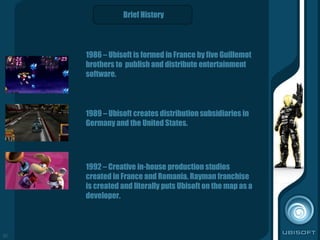
1986 – Ubisoft is formed in France by five Guillemot
brothers to publish and distribute entertainment
software.
1989 – Ubisoft creates distribution subsidiaries in
Germany and the United States.
1992 – Creative in-house production studios
created in France and Romania. Rayman franchise
is created and literally puts Ubisoft on the map as a
developer.
02
Brief History
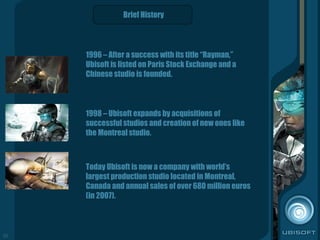
1996 – After a success with its title “Rayman,”
Ubisoft is listed on Paris Stock Exchange and a
Chinese studio is founded.
1998 – Ubisoft expands by acquisitions of
successful studios and creation of new ones like
the Montreal studio.
Today Ubisoft is now a company with world’s
largest production studio located in Montreal,
Canada and annual sales of over 680 million euros
(in 2007).
03
-France
-Germany
-Italy
-Spain
-United Kingdom
-Bulgaria
-China
-Morocco
-Romania
-Canada
-USA
Development Studios
04
Major Developers
01 - Nintendo
02 - Electronic Arts
03 - Activision
04 -
Ubisoft
05 - THQ
06 - Take-Two Interactive
07 - Sega (USA)
08 - Sega (Japan)
09 - Microsoft
10 - Eidos
05
Why go multinational?
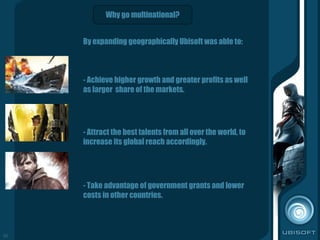
By expanding geographically Ubisoft was able to:
- Achieve higher growth and greater profits as well
as larger share of the markets.
- Attract the best talents from all over the world, to
increase its global reach accordingly.
- Take advantage of government grants and lower
costs in other countries.
06
Why go multinational?
By expanding geographically Ubisoft was able to:
- More efficiently transfer capital, managerial
skills, culture, technology, product design, brand
names, products and services across countries.
-To keep the average operating cost per employee
is $66,000 per year; about a third less than the
industry average, according to Ubisoft CFO Alain
Martinez.
- Produce innovative, high-quality labels and
acquire an in-depth knowledge of its consumers
and their expectations.
 
07
How the French videogame company recruits its
foreign legion:
Going Global
- Go where the talent and students are.
- Go where the competition isn’t.
- Go with the flat organizational chart.
08
Global success?
- Ubisoft’s strategy translated into €680 million in
2007 and growing.
- Its market share rose in all key markets, ranking
#4 worldwide.
- Also, it was ranked second leading international
publisher.
09
Global success?
- Ubisoft won more than 40 prestigious awards.
- Continues to grow and take advantage of
industry’s evolution.
- Projected sale for 2008 are €800 million.
10
Global success!
-Microsoft’s Xbox 360™ and Sony’s Playstation 3™
continue to gain ground and with their success
Ubisoft gains potential customers.
- Ubisoft seems a very compelling investment
according to various financial analysts.
- Ubisoft has amassed a number of top brands in
recent years and is one of the best publishers in
the business.
11
Challenges
Competition:
- Huge Budget for The "next generation" of games
- Ubisoft's cost savings a competitive advantage
- American firms profit margins at risk with
soaring labor costs
12
Challenges
Competition: Marketing shortcoming
- Limited Marketing efforts
- No top sellers in the United States in 2005
- Market research driving competitors like
Electronic Arts
- Low Volume sales result in poor operating
margins
13
Challenges
Managing its foreign labor:
- Managing young talent is crucial to the business
- Teams of 80 to 90 employees,
- with managers in a single "war room" to create a
game's core technology.
14
Challenges
Contingencies:
- Electronic Arts purchased an almost 20% share
of Ubisoft, which was viewed hostile.
- Ubisoft is struggling to compete with other large
publishers in the very profitable Massively
Multiplayer Online games market.
- Ubisoft constantly faces PR problems (support,
Starforce, conflict with EGM)
15
VIDEO
16
Conclusion
17
Ubisoft was able to benefit from becoming an MNE:
- Global reach allowed them to claim their share of
resources and markets.
- Significant financial benefits from settling in
countries where operating costs are lower.
- Possession and development of highly
successful franchises.
- Expansion into CGI animation markets with future
prospects in the movie industry.
Questions?
Thank you for your attention!
(please wake up your neighbour now)
18

ubisoftfinal

  • 1.
    Adam Carr-Braint Nour Hamad MursalMohd Kabir Mark Moskvitine Geraldine Waffo
  • 2.
    Agenda 01 - AboutUbisoft 02 - Is Ubisoft an MNE? 03 - Reasons for going global 04 - Benefits of being an MNE 05 - Challenges 06 - Video 07 - Conclusion 01
  • 3.
    Brief History 1986 –Ubisoft is formed in France by five Guillemot brothers to publish and distribute entertainment software. 1989 – Ubisoft creates distribution subsidiaries in Germany and the United States. 1992 – Creative in-house production studios created in France and Romania. Rayman franchise is created and literally puts Ubisoft on the map as a developer. 02
  • 4.
    Brief History 1996 –After a success with its title “Rayman,” Ubisoft is listed on Paris Stock Exchange and a Chinese studio is founded. 1998 – Ubisoft expands by acquisitions of successful studios and creation of new ones like the Montreal studio. Today Ubisoft is now a company with world’s largest production studio located in Montreal, Canada and annual sales of over 680 million euros (in 2007). 03
  • 5.
  • 6.
    Major Developers 01 -Nintendo 02 - Electronic Arts 03 - Activision 04 - Ubisoft 05 - THQ 06 - Take-Two Interactive 07 - Sega (USA) 08 - Sega (Japan) 09 - Microsoft 10 - Eidos 05
  • 7.
    Why go multinational? Byexpanding geographically Ubisoft was able to: - Achieve higher growth and greater profits as well as larger share of the markets. - Attract the best talents from all over the world, to increase its global reach accordingly. - Take advantage of government grants and lower costs in other countries. 06
  • 8.
    Why go multinational? Byexpanding geographically Ubisoft was able to: - More efficiently transfer capital, managerial skills, culture, technology, product design, brand names, products and services across countries. -To keep the average operating cost per employee is $66,000 per year; about a third less than the industry average, according to Ubisoft CFO Alain Martinez. - Produce innovative, high-quality labels and acquire an in-depth knowledge of its consumers and their expectations.   07
  • 9.
    How the Frenchvideogame company recruits its foreign legion: Going Global - Go where the talent and students are. - Go where the competition isn’t. - Go with the flat organizational chart. 08
  • 10.
    Global success? - Ubisoft’sstrategy translated into €680 million in 2007 and growing. - Its market share rose in all key markets, ranking #4 worldwide. - Also, it was ranked second leading international publisher. 09
  • 11.
    Global success? - Ubisoftwon more than 40 prestigious awards. - Continues to grow and take advantage of industry’s evolution. - Projected sale for 2008 are €800 million. 10
  • 12.
    Global success! -Microsoft’s Xbox360™ and Sony’s Playstation 3™ continue to gain ground and with their success Ubisoft gains potential customers. - Ubisoft seems a very compelling investment according to various financial analysts. - Ubisoft has amassed a number of top brands in recent years and is one of the best publishers in the business. 11
  • 13.
    Challenges Competition: - Huge Budgetfor The "next generation" of games - Ubisoft's cost savings a competitive advantage - American firms profit margins at risk with soaring labor costs 12
  • 14.
    Challenges Competition: Marketing shortcoming -Limited Marketing efforts - No top sellers in the United States in 2005 - Market research driving competitors like Electronic Arts - Low Volume sales result in poor operating margins 13
  • 15.
    Challenges Managing its foreignlabor: - Managing young talent is crucial to the business - Teams of 80 to 90 employees, - with managers in a single "war room" to create a game's core technology. 14
  • 16.
    Challenges Contingencies: - Electronic Artspurchased an almost 20% share of Ubisoft, which was viewed hostile. - Ubisoft is struggling to compete with other large publishers in the very profitable Massively Multiplayer Online games market. - Ubisoft constantly faces PR problems (support, Starforce, conflict with EGM) 15
  • 17.
  • 18.
    Conclusion 17 Ubisoft was ableto benefit from becoming an MNE: - Global reach allowed them to claim their share of resources and markets. - Significant financial benefits from settling in countries where operating costs are lower. - Possession and development of highly successful franchises. - Expansion into CGI animation markets with future prospects in the movie industry.
  • 19.
    Questions? Thank you foryour attention! (please wake up your neighbour now) 18