THE VIDEO GAME BUSINESS


                     www.videogamebusiness.wordpress.com


                                   @videogamebiz


                          videogamebuziness@gmail.com


            The Video Game Business ©                      2
The Video Game Business

Group Activities


                    The Video Game Business ©   3
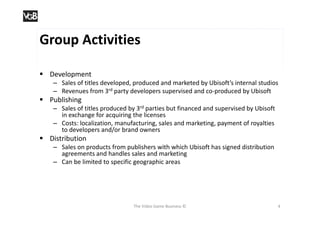
Group Activities

 Development
    – Sales of titles developed, produced and marketed by Ubisoft’s internal studios
    – Revenues from 3rd party developers supervised and co-produced by Ubisoft
 Publishing
    – Sales of titles produced by 3rd parties but financed and supervised by Ubisoft
      in exchange for acquiring the licenses
    – Costs: localization, manufacturing, sales and marketing, payment of royalties
      to developers and/or brand owners
 Distribution
    – Sales on products from publishers with which Ubisoft has signed distribution
      agreements and handles sales and marketing
    – Can be limited to specific geographic areas


                                 The Video Game Business ©                             4
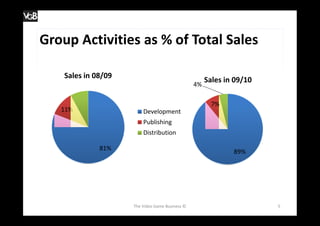
Group Activities as % of Total Sales

    Sales in 08/09
                                                      Sales in 09/10
                                                 4%

         8%
                                                        7%
   11%                   Development
                         Publishing
                         Distribution

              81%                                             89%


                     The Video Game Business ©                         5
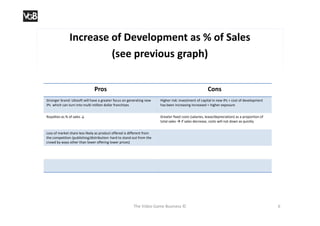
Increase of Development as % of Sales
                        (see previous graph)

                               Pros                                                                    Cons
Stronger brand: Ubisoft will have a greater focus on generating new     Higher risk: investment of capital in new IPs + cost of development
IPs which can turn into multi-million dollar franchises                 has been increasing increased = higher exposure


Royalties as % of sales ↓                                               Greater fixed costs (salaries, lease/depreciation) as a proportion of
                                                                        total sales  if sales decrease, costs will not down as quickly


Loss of market share less likely as product offered is different from
the competition (publishing/distribution: hard to stand out from the
crowd by ways other than lower offering lower prices)


                                                         The Video Game Business ©                                                              6
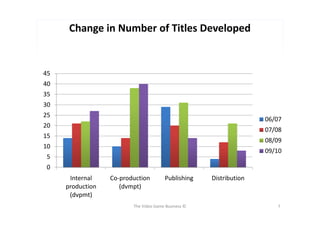
Change in Number of Titles Developed


45
40
35
30
25
                                                                    06/07
20
                                                                    07/08
15
                                                                    08/09
10
                                                                    09/10
5
0
      Internal    Co-production        Publishing    Distribution
     production      (dvmpt)
      (dvpmt)
                         The Video Game Business ©                     7
The Video Game Business

History


                    The Video Game Business ©   8
History
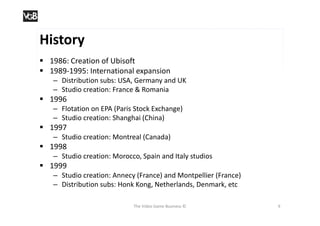
 1986: Creation of Ubisoft
 1989-1995: International expansion
   – Distribution subs: USA, Germany and UK
   – Studio creation: France & Romania
 1996
   – Flotation on EPA (Paris Stock Exchange)
   – Studio creation: Shanghai (China)
 1997
   – Studio creation: Montreal (Canada)
 1998
   – Studio creation: Morocco, Spain and Italy studios
 1999
   – Studio creation: Annecy (France) and Montpellier (France)
   – Distribution subs: Honk Kong, Netherlands, Denmark, etc

                            The Video Game Business ©            9
History (continued)
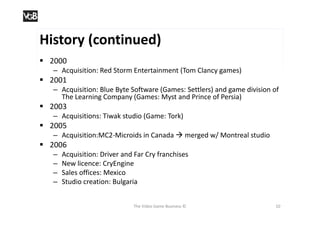
 2000
   – Acquisition: Red Storm Entertainment (Tom Clancy games)
 2001
   – Acquisition: Blue Byte Software (Games: Settlers) and game division of
     The Learning Company (Games: Myst and Prince of Persia)
 2003
   – Acquisitions: Tiwak studio (Game: Tork)
 2005
   – Acquisition:MC2-Microids in Canada  merged w/ Montreal studio
 2006
   –   Acquisition: Driver and Far Cry franchises
   –   New licence: CryEngine
   –   Sales offices: Mexico
   –   Studio creation: Bulgaria


                              The Video Game Business ©                  10
History (continued)
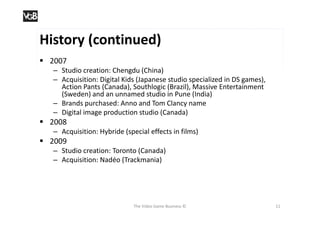
 2007
   – Studio creation: Chengdu (China)
   – Acquisition: Digital Kids (Japanese studio specialized in DS games),
     Action Pants (Canada), Southlogic (Brazil), Massive Entertainment
     (Sweden) and an unnamed studio in Pune (India)
   – Brands purchased: Anno and Tom Clancy name
   – Digital image production studio (Canada)
 2008
   – Acquisition: Hybride (special effects in films)
 2009
   – Studio creation: Toronto (Canada)
   – Acquisition: Nadéo (Trackmania)


                              The Video Game Business ©                     11
References
   Business Week:
     –   Management: http://investing.businessweek.com/research/stocks/people/people.asp?ticker=UBI:FP
   Ubisoft:
     –   Annual reports: http://www.ubisoftgroup.com/index.php?p=195
     –   Ubisoft Group: http://www.ubisoftgroup.com/
   Wikipedia:
     –   Yves Guillemot: http://fr.wikipedia.org/wiki/Yves_Guillemot
     –   MC2-Microids: http://fr.wikipedia.org/wiki/Micro%C3%AFds


                                               The Video Game Business ©                                 12

Ubisoft v1.0 - Analysis of the 3rd biggest game publisher

  • 2.
    THE VIDEO GAMEBUSINESS www.videogamebusiness.wordpress.com @videogamebiz videogamebuziness@gmail.com The Video Game Business © 2
  • 3.
    The Video GameBusiness Group Activities The Video Game Business © 3
  • 4.
    Group Activities  Development – Sales of titles developed, produced and marketed by Ubisoft’s internal studios – Revenues from 3rd party developers supervised and co-produced by Ubisoft  Publishing – Sales of titles produced by 3rd parties but financed and supervised by Ubisoft in exchange for acquiring the licenses – Costs: localization, manufacturing, sales and marketing, payment of royalties to developers and/or brand owners  Distribution – Sales on products from publishers with which Ubisoft has signed distribution agreements and handles sales and marketing – Can be limited to specific geographic areas The Video Game Business © 4
  • 5.
    Group Activities as% of Total Sales Sales in 08/09 Sales in 09/10 4% 8% 7% 11% Development Publishing Distribution 81% 89% The Video Game Business © 5
  • 6.
    Increase of Developmentas % of Sales (see previous graph) Pros Cons Stronger brand: Ubisoft will have a greater focus on generating new Higher risk: investment of capital in new IPs + cost of development IPs which can turn into multi-million dollar franchises has been increasing increased = higher exposure Royalties as % of sales ↓ Greater fixed costs (salaries, lease/depreciation) as a proportion of total sales  if sales decrease, costs will not down as quickly Loss of market share less likely as product offered is different from the competition (publishing/distribution: hard to stand out from the crowd by ways other than lower offering lower prices) The Video Game Business © 6
  • 7.
    Change in Numberof Titles Developed 45 40 35 30 25 06/07 20 07/08 15 08/09 10 09/10 5 0 Internal Co-production Publishing Distribution production (dvmpt) (dvpmt) The Video Game Business © 7
  • 8.
    The Video GameBusiness History The Video Game Business © 8
  • 9.
    History  1986: Creationof Ubisoft  1989-1995: International expansion – Distribution subs: USA, Germany and UK – Studio creation: France & Romania  1996 – Flotation on EPA (Paris Stock Exchange) – Studio creation: Shanghai (China)  1997 – Studio creation: Montreal (Canada)  1998 – Studio creation: Morocco, Spain and Italy studios  1999 – Studio creation: Annecy (France) and Montpellier (France) – Distribution subs: Honk Kong, Netherlands, Denmark, etc The Video Game Business © 9
  • 10.
    History (continued)  2000 – Acquisition: Red Storm Entertainment (Tom Clancy games)  2001 – Acquisition: Blue Byte Software (Games: Settlers) and game division of The Learning Company (Games: Myst and Prince of Persia)  2003 – Acquisitions: Tiwak studio (Game: Tork)  2005 – Acquisition:MC2-Microids in Canada  merged w/ Montreal studio  2006 – Acquisition: Driver and Far Cry franchises – New licence: CryEngine – Sales offices: Mexico – Studio creation: Bulgaria The Video Game Business © 10
  • 11.
    History (continued)  2007 – Studio creation: Chengdu (China) – Acquisition: Digital Kids (Japanese studio specialized in DS games), Action Pants (Canada), Southlogic (Brazil), Massive Entertainment (Sweden) and an unnamed studio in Pune (India) – Brands purchased: Anno and Tom Clancy name – Digital image production studio (Canada)  2008 – Acquisition: Hybride (special effects in films)  2009 – Studio creation: Toronto (Canada) – Acquisition: Nadéo (Trackmania) The Video Game Business © 11
  • 12.
    References  Business Week: – Management: http://investing.businessweek.com/research/stocks/people/people.asp?ticker=UBI:FP  Ubisoft: – Annual reports: http://www.ubisoftgroup.com/index.php?p=195 – Ubisoft Group: http://www.ubisoftgroup.com/  Wikipedia: – Yves Guillemot: http://fr.wikipedia.org/wiki/Yves_Guillemot – MC2-Microids: http://fr.wikipedia.org/wiki/Micro%C3%AFds The Video Game Business © 12