Learning Aims
In thisunit you will:
Understand the organisations
in the media industry
Understand professional
work practices
Know about employment in
the digital media sectors
4.
To revise thetopic media industry in context for the exam
on Thursday.
By the end of the lesson, we will
have:
Discussed all the elements on
the topic for revision sheet in
preparation for the exam.
5.
These may bea good technique to use when revising.
6.
State ownedand commercial broadcasters.
Responsibilities and requirements of State
owned and commercial broadcasters.
The difference between state owned and
commercial broadcasters.
Regulatory organisations.
The role of the BBC Trust.
Private broadcasting companies.
Responsibilities of a private broadcasting
company.
Public funding
Sources of public funding.
Benefits and drawbacks of public funding.
.
7.
Sources ofprivate funding.
Benefits and drawbacks of private funding
Types of media organisation - one example for each type of
organisation.
Media conglomerates
Parent companies
Subsidiaries
Characteristics on International media organisations
Characteristics of National media organisations
Characteristics of Local media organisations
Characteristics of community media organisations.
Synergies
Horizontal and vertical integration.
8.
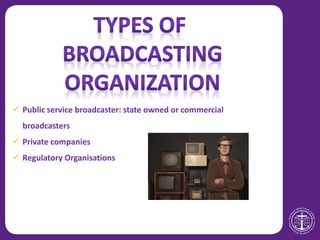
Public servicebroadcaster: state owned or commercial
broadcasters
Private companies
Regulatory Organisations
9.
Name a stateowned public service
broadcaster?
Name a commercial broadcaster?
What is the difference?
11.
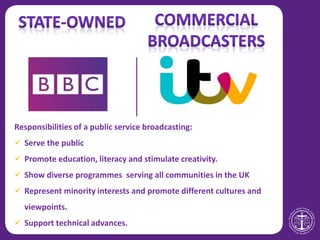
Responsibilities of apublic service broadcasting:
Serve the public
Promote education, literacy and stimulate creativity.
Show diverse programmes serving all communities in the UK
Represent minority interests and promote different cultures and
viewpoints.
Support technical advances.
12.
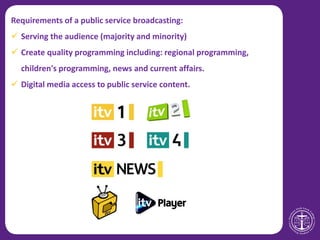
Requirements of apublic service broadcasting:
Serving the audience (majority and minority)
Create quality programming including: regional programming,
children's programming, news and current affairs.
Digital media access to public service content.
13.
One of themajor responsibilities and requirements of the BBC is to
serve the majority and the minority of its audience in the UK.
14.
A company whoseshares may not be
offered to the public for sale and which
operates under legal requirements less
strict than those for a public company.
Can you name a private media
company?
15.
Responsibilities of privatecompanies in
broadcasting:
Deliver profits
Identify new markets
Increase audience share
Lead technological innovation
Expand markets and market share
Eliminate competition
Commercial success
16.
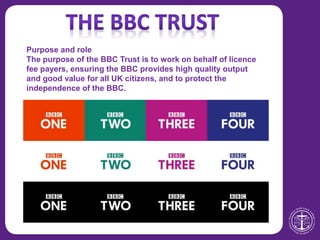
Purpose and role
Thepurpose of the BBC Trust is to work on behalf of licence
fee payers, ensuring the BBC provides high quality output
and good value for all UK citizens, and to protect the
independence of the BBC.
17.
Ofcom is thecommunications regulator
in the UK.
They regulate the TV and radio sectors,
fixed line telecoms, mobiles, postal
services, plus the airwaves over which
wireless devices operate.
18.
Our main legalduties are to ensure:
The UK has a wide range of electronic communications services,
including high-speed services such as broadband;
A wide range of high-quality television and radio programmes
are provided, appealing to a range of tastes and interests;
Television and radio services are provided by a range of different
organisations;
People who watch television and listen to the radio are protected
from harmful or offensive material;
People are protected from being treated unfairly in television and
radio programmes, and from having their privacy invaded;
A universal postal service is provided in the UK - this means a
six days a week, universally priced delivery and collection
service across the country; and
The radio spectrum (the airwaves used by everyone from taxi
firms and boat owners, to mobile-phone companies and
broadcasters) is used in the most effective way.
19.
We are notresponsible for regulating:
Disputes between you and your
telecoms provider;
Premium-rate services, including
mobile-phone text services and
ringtones;
The content of television and radio
adverts;
Complaints about accuracy in BBC
programmes;
The BBC TV licence fee;
post offices; or newspapers and
magazines.
21.
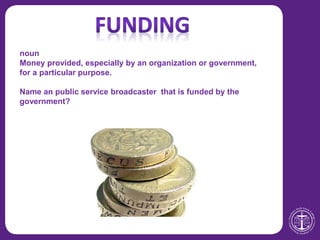
noun
Money provided, especiallyby an organization or government,
for a particular purpose.
Name an public service broadcaster that is funded by the
government?
22.
Public funded mediaorganisations need government
support to be able to function.
Government support aims to:
• Give public access to a diverse choice of media products
• Media literacy
• Give a sense of national identity
• Offer training and employment opportunities,
participation in media and creative arts
• Competition
Can you name a public funded organisation?
23.
Sources of publicfunding:
Licence fee
Taxpayers’ money
lottery funding
25.
Benefits of publicfunding are:
Guaranteed income
Prominence in TV listings and guides
Always available on digital- terrestrial television
Can cater for minority audiences
Offer cultural value
High-quality output
Access to national events
Audience appreciation
26.
Drawbacks of publicfunding are:
Compulsory licence fee
Privileged positions in the market place
Unfair competition for commercial origination
Reduced audience share
Does not represent value for money for the consumer
Lack of audience appreciation
27.
There are differentsources of private funding in the media
industry. Here are some of the following :
Sales
Competitions
Advertising
Sponsorship
Grants
Share floatation
Private investment incentives
28.
As there arebenefits government funding,
there are also benefits of private funding:
Increased revenue
Increased marketing
Wider international distribution
Guaranteed income
29.
Drawbacks of privatefunding:
Reliance on popularity for future productions
Budgetary considerations
30.
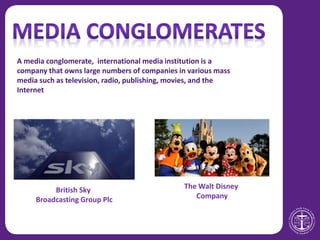
The Walt Disney
Company
BritishSky
Broadcasting Group Plc
A media conglomerate, international media institution is a
company that owns large numbers of companies in various mass
media such as television, radio, publishing, movies, and the
Internet
31.
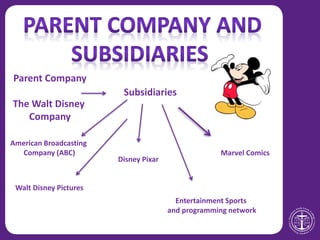
Parent Company
The WaltDisney
Company
Subsidiaries
American Broadcasting
Company (ABC)
Walt Disney Pictures
Disney Pixar
Entertainment Sports
and programming network
Marvel Comics
32.
You need tounderstand the different characteristics of media
organisations.
33.
The following aredifferent types of media organisations:
International media organisations
National media organisations
Local media organisations
Community media organisation
34.
The characteristics ofa International Media
Organisation are:
Global presence
Mainstream products
Market led
Profit driven
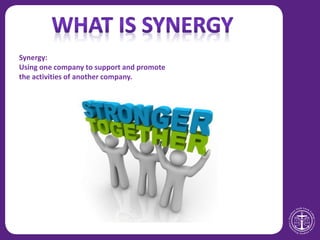
Use synergy - Using one company to
support and promote the activities of
another company.
Can you name an international media
organisation?
35.
The characteristics ofa National Media Organisation are:
National coverage and distribution
Wider recruitment and training
Compete with local markets
Compete with international markets
Can you name a national media
organisation?
36.
The characteristics ofa Local Media Organisation are:
provide local services
audiences defined by geographical location
focus on local issues and content
close relationship with audience
falling circulations
expansion into digital markets
Can you name a local media organisation?
37.
The characteristics ofa Community Media
Organisation are:
serving the needs of a community or particular
groups
wide community participation
audience defined by a small geographical area or
special interest
key role of volunteers within the organisation
not-for-profit organisation
diverse content, gives training opportunities
Community media organisations ensuring that a
diverse range
of views and opinions are presented through
the media.
38.
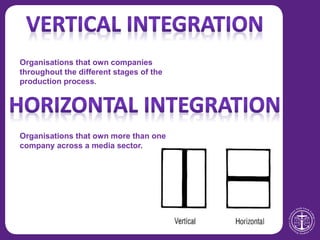
Organisations that owncompanies
throughout the different stages of the
production process.
Organisations that own more than one
company across a media sector.
39.
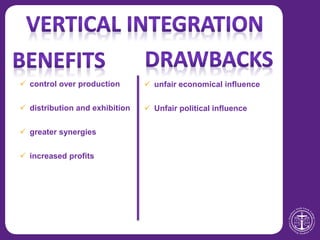
control overproduction
distribution and exhibition
greater synergies
increased profits
unfair economical influence
Unfair political influence
40.
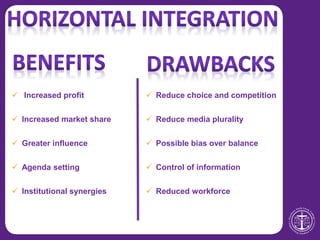
Increased profit
Increased market share
Greater influence
Agenda setting
Institutional synergies
Reduce choice and competition
Reduce media plurality
Possible bias over balance
Control of information
Reduced workforce
These may bea good technique to use when revising.
43.
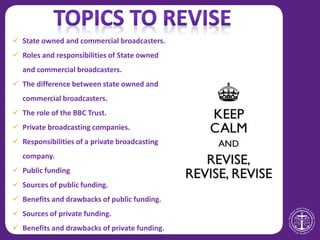
State ownedand commercial broadcasters.
Roles and responsibilities of State owned
and commercial broadcasters.
The difference between state owned and
commercial broadcasters.
The role of the BBC Trust.
Private broadcasting companies.
Responsibilities of a private broadcasting
company.
Public funding
Sources of public funding.
Benefits and drawbacks of public funding.
Sources of private funding.
Benefits and drawbacks of private funding.
44.
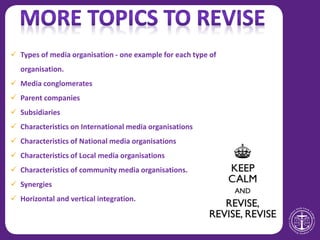
Types ofmedia organisation - one example for each type of
organisation.
Media conglomerates
Parent companies
Subsidiaries
Characteristics on International media organisations
Characteristics of National media organisations
Characteristics of Local media organisations
Characteristics of community media organisations.
Synergies
Horizontal and vertical integration.
45.
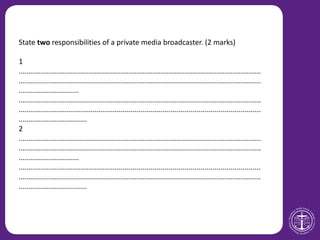
State two responsibilitiesof a private media broadcaster. (2 marks)
1
.........................................................................................................................
.........................................................................................................................
..............................
.........................................................................................................................
.........................................................................................................................
..................................
2
.........................................................................................................................
.........................................................................................................................
..............................
.........................................................................................................................
.........................................................................................................................
..................................
46.
Use your topicsto revise sheet to inform your
research and revision.
Participate in computer research.