Objective
 SWBAT analyze fundamental principles of the United
States Constitution in order to code text and analyze
                   text features.
                                Warm-Up
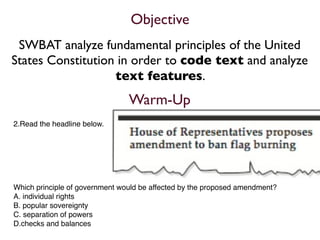
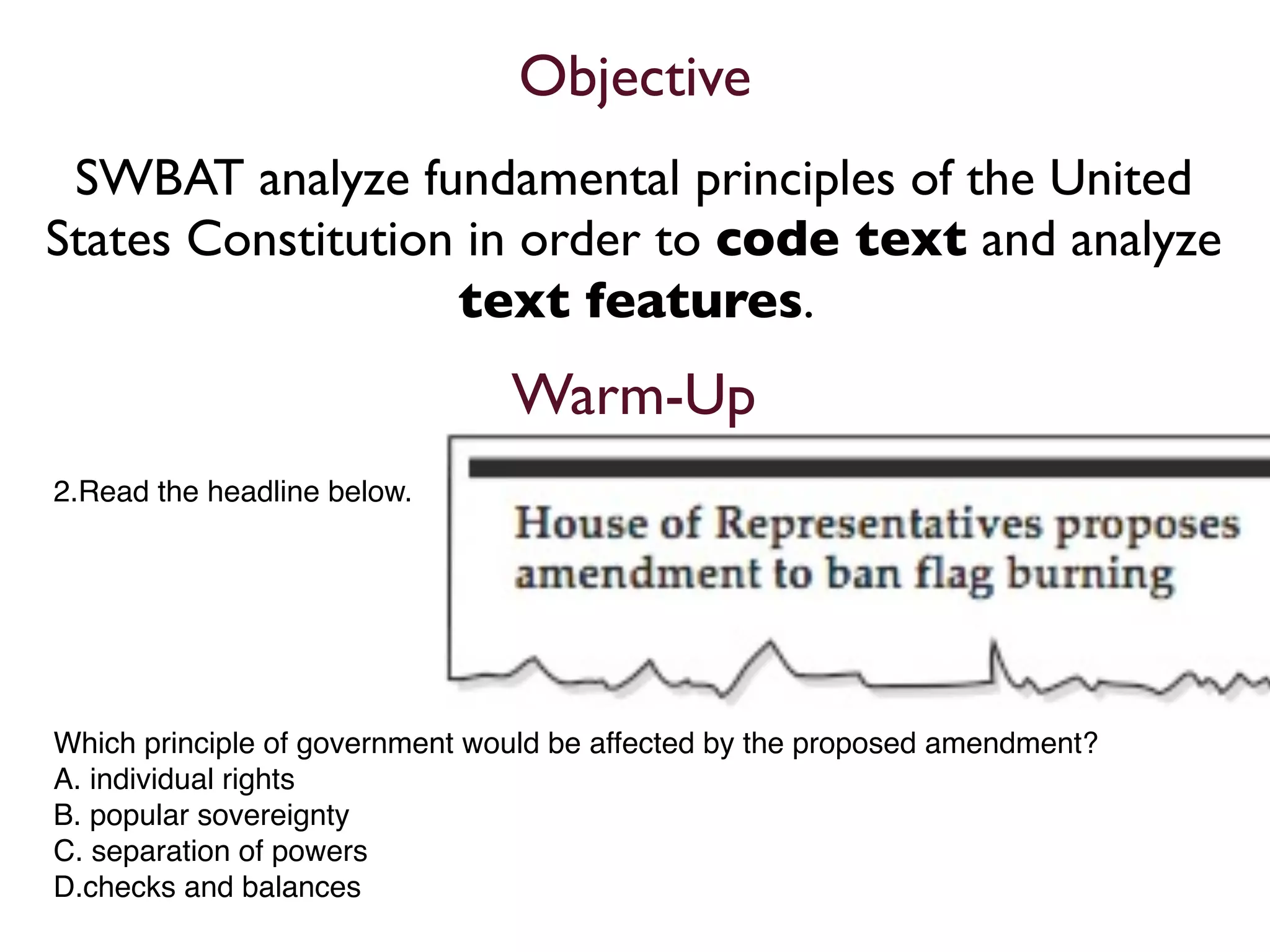
2.Read the headline below.


Which principle of government would be affected by the proposed amendment?
A. individual rights
B. popular sovereignty
C. separation of powers
D.checks and balances
The Homework Press

• You have until Thursday to get me any
  missing homework from the week of
  October 4th to the 8th
• If you don’t you will serve detention
• You will also miss out on homecoming
  activities
Folders
• You must remove everything from your
  folders except your bathroom pass and
  warm-up sheet.
• They will be used as a mailbox for handing
  back work from now on.
• You may keep a binder in the room if you
  wish.
Agenda

• Objective and Warm-Up
• INM: Principles of the Constitution
• GP: How to Text Code
• IP: Coding Text in order to describe the Principles
• Exit Slip
Agenda

• Objective and Warm-Up
• INM: Principles of the Constitution
• GP: How to Text Code
• IP: Coding Text in order to describe the Principles
• Exit Slip
The U.S. Constitution
• The U.S. Constitution was the solution to
  the problems in the Articles of
  Confederation.
The U.S. Constitution
• The U.S. Constitution was the solution to
  the problems in the Articles of
  Confederation.
• The U.S. Constitution was a compromise
  between
The U.S. Constitution
• The U.S. Constitution was the solution to
  the problems in the Articles of
  Confederation.
• The U.S. Constitution was a compromise
  between
 • Federalists (people who believed in a
    strong national government) and,
The U.S. Constitution
• The U.S. Constitution was the solution to
  the problems in the Articles of
  Confederation.
• The U.S. Constitution was a compromise
  between
 • Federalists (people who believed in a
    strong national government) and,
 • Antifederalists (people who believed in
    strong state governments)
Which group supported a
strong national government?

A. Federalists
B. Anti-Federalists
The U.S. Constitution Principles
   • The U.S. Constitution was based on the
     following principles:
     •   Popular Sovereignty
     •   Federalism
     •   Separation of Powers
     •   Checks and Balances
     •   Judicial Review
     •   Limited Government
     •   Individual rights
     •   Rule of Law
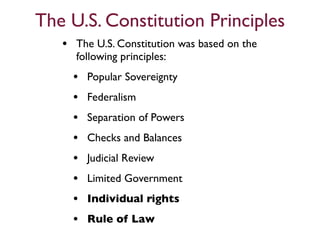
DEFINITION    DRAWING or
             DESCRIPTION


EXAMPLE      NON-EXAMPLE
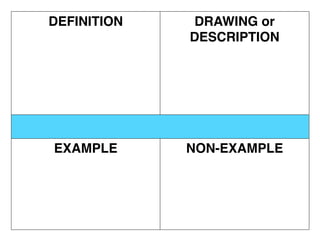
DEFINITION              DRAWING or
                             DESCRIPTION
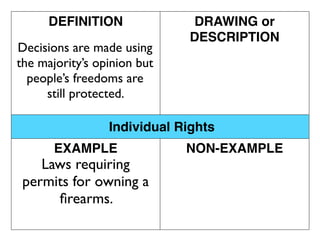
Decisions are made using
the majority’s opinion but
  people’s freedoms are
     still protected.


       EXAMPLE               NON-EXAMPLE
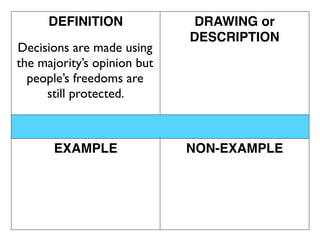
DEFINITION              DRAWING or
                             DESCRIPTION
Decisions are made using
the majority’s opinion but
  people’s freedoms are
     still protected.

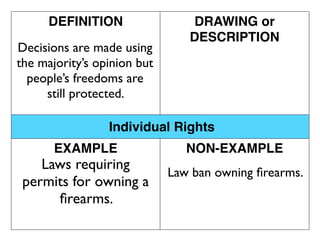
                 Individual Rights
       EXAMPLE               NON-EXAMPLE
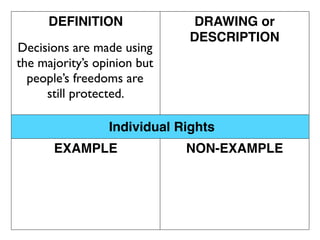
DEFINITION              DRAWING or
                             DESCRIPTION
Decisions are made using
the majority’s opinion but
  people’s freedoms are
     still protected.

                 Individual Rights
       EXAMPLE               NON-EXAMPLE
    Laws requiring
 permits for owning a
      firearms.
DEFINITION                 DRAWING or
                                DESCRIPTION
Decisions are made using
the majority’s opinion but
  people’s freedoms are
     still protected.

                 Individual Rights
       EXAMPLE                  NON-EXAMPLE
    Laws requiring
                             Law ban owning firearms.
 permits for owning a
      firearms.
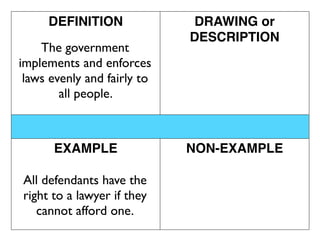
DEFINITION    DRAWING or
             DESCRIPTION


EXAMPLE      NON-EXAMPLE
DEFINITION               DRAWING or
                             DESCRIPTION
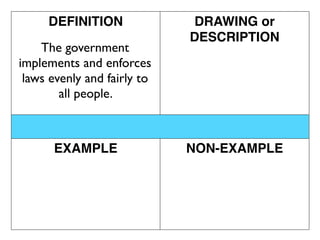
    The government
implements and enforces
 laws evenly and fairly to
        all people.


      EXAMPLE                NON-EXAMPLE
DEFINITION               DRAWING or
                             DESCRIPTION
    The government
implements and enforces
 laws evenly and fairly to
        all people.


      EXAMPLE                NON-EXAMPLE

All defendants have the
right to a lawyer if they
   cannot afford one.
DEFINITION                 DRAWING or
                               DESCRIPTION
    The government
implements and enforces
 laws evenly and fairly to
        all people.


      EXAMPLE                 NON-EXAMPLE
                             Only white males are
All defendants have the       given the right to a
right to a lawyer if they    lawyer if they cannot
   cannot afford one.             afford one.
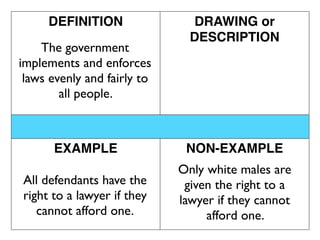
DEFINITION                 DRAWING or
                               DESCRIPTION
    The government
implements and enforces
 laws evenly and fairly to
        all people.

                    Rule of Law
      EXAMPLE                 NON-EXAMPLE
                             Only white males are
All defendants have the       given the right to a
right to a lawyer if they    lawyer if they cannot
   cannot afford one.             afford one.
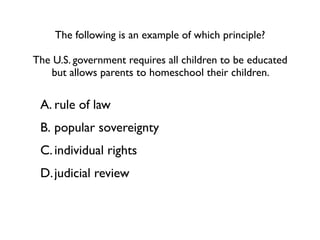
The following is an example of which principle?

The U.S. government requires all children to be educated
   but allows parents to homeschool their children.

 A. rule of law
 B. popular sovereignty
 C. individual rights
 D. judicial review
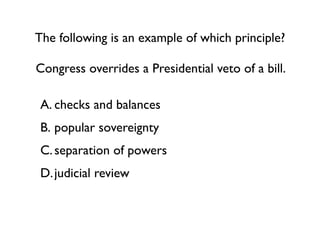
The following is an example of which principle?

Congress overrides a Presidential veto of a bill.

 A. checks and balances
 B. popular sovereignty
 C. separation of powers
 D. judicial review
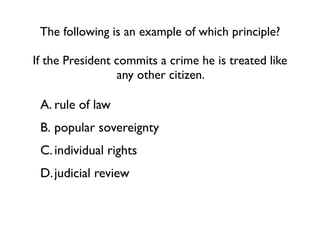
The following is an example of which principle?

If the President commits a crime he is treated like
                 any other citizen.

 A. rule of law
 B. popular sovereignty
 C. individual rights
 D. judicial review
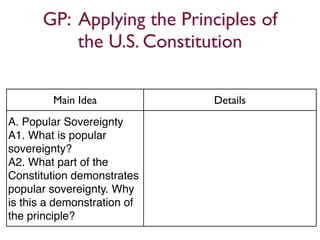
GP: Applying the Principles of
          the U.S. Constitution

        Main Idea            Details
A. Popular Sovereignty
A1. What is popular
sovereignty?
A2. What part of the
Constitution demonstrates
popular sovereignty. Why
is this a demonstration of
the principle?
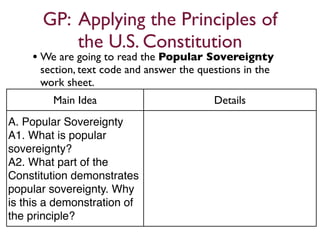
GP: Applying the Principles of
          the U.S. Constitution
    • We are going to read the Popular Sovereignty
      section, text code and answer the questions in the
      work sheet.
        Main Idea                          Details
A. Popular Sovereignty
A1. What is popular
sovereignty?
A2. What part of the
Constitution demonstrates
popular sovereignty. Why
is this a demonstration of
the principle?
Independent Practice


• You will work individually;
Independent Practice


• You will work individually;
• You must listen carefully for your instructions;
Independent Practice


• You will work individually;
• You must listen carefully for your instructions;
     • You are going to work on coding text and answering
        the questions on the worksheet.
Independent Practice


• You will work individually;
• You must listen carefully for your instructions;
     • You are going to work on coding text and answering
        the questions on the worksheet.
     • You have 25 minutes to complete the activity.
Boom Bag

We will now play a vocabulary
        review game.

 Watch the example closely.
Homework

  Complete the Worksheet
  Packet reviewing Unit I.

This WILL BE TESTED on next
  weekʼs FAST assessment.
Exit Slip:
1. You will have 5 minutes to complete today’s exit
   slip.
2. Please only write the letter of your answer in the
   appropriate blank.
3. Complete it in silence.
4. When you are done, carefully check over your
   answers.
5. After checking your answers, please begin your
   homework.
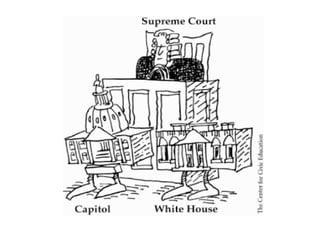
!    +77(56+2!54!VWX!54!=5%3('11!+%&!Y!54!,*'!1,+,'!2'3.12+,/('1!


                                                                    !
&!5%!,*'!-+(,55%!+@56'Z!:5/!-+%!.%4'(!,*+,!,*'!+(,.1,!.1!-500'%,.%3!5%!)*.-*!54
3, 2, 1, See Ya!


What are 3 things that you learned today?
What are 2 things that confused you?
What is 1 thing you want to know more
about?

U2.lp4.constitution

  • 1.
    Objective SWBAT analyzefundamental principles of the United States Constitution in order to code text and analyze text features. Warm-Up 2.Read the headline below. Which principle of government would be affected by the proposed amendment? A. individual rights B. popular sovereignty C. separation of powers D.checks and balances
  • 2.
    The Homework Press •You have until Thursday to get me any missing homework from the week of October 4th to the 8th • If you don’t you will serve detention • You will also miss out on homecoming activities
  • 3.
    Folders • You mustremove everything from your folders except your bathroom pass and warm-up sheet. • They will be used as a mailbox for handing back work from now on. • You may keep a binder in the room if you wish.
  • 4.
    Agenda • Objective andWarm-Up • INM: Principles of the Constitution • GP: How to Text Code • IP: Coding Text in order to describe the Principles • Exit Slip
  • 5.
    Agenda • Objective andWarm-Up • INM: Principles of the Constitution • GP: How to Text Code • IP: Coding Text in order to describe the Principles • Exit Slip
  • 6.
  • 7.
    The U.S. Constitution •The U.S. Constitution was the solution to the problems in the Articles of Confederation.
  • 8.
    The U.S. Constitution •The U.S. Constitution was the solution to the problems in the Articles of Confederation. • The U.S. Constitution was a compromise between
  • 9.
    The U.S. Constitution •The U.S. Constitution was the solution to the problems in the Articles of Confederation. • The U.S. Constitution was a compromise between • Federalists (people who believed in a strong national government) and,
  • 10.
    The U.S. Constitution •The U.S. Constitution was the solution to the problems in the Articles of Confederation. • The U.S. Constitution was a compromise between • Federalists (people who believed in a strong national government) and, • Antifederalists (people who believed in strong state governments)
  • 11.
    Which group supporteda strong national government? A. Federalists B. Anti-Federalists
  • 12.
    The U.S. ConstitutionPrinciples • The U.S. Constitution was based on the following principles: • Popular Sovereignty • Federalism • Separation of Powers • Checks and Balances • Judicial Review • Limited Government • Individual rights • Rule of Law
  • 13.
    DEFINITION DRAWING or DESCRIPTION EXAMPLE NON-EXAMPLE
  • 14.
    DEFINITION DRAWING or DESCRIPTION Decisions are made using the majority’s opinion but people’s freedoms are still protected. EXAMPLE NON-EXAMPLE
  • 15.
    DEFINITION DRAWING or DESCRIPTION Decisions are made using the majority’s opinion but people’s freedoms are still protected. Individual Rights EXAMPLE NON-EXAMPLE
  • 16.
    DEFINITION DRAWING or DESCRIPTION Decisions are made using the majority’s opinion but people’s freedoms are still protected. Individual Rights EXAMPLE NON-EXAMPLE Laws requiring permits for owning a firearms.
  • 17.
    DEFINITION DRAWING or DESCRIPTION Decisions are made using the majority’s opinion but people’s freedoms are still protected. Individual Rights EXAMPLE NON-EXAMPLE Laws requiring Law ban owning firearms. permits for owning a firearms.
  • 18.
    DEFINITION DRAWING or DESCRIPTION EXAMPLE NON-EXAMPLE
  • 19.
    DEFINITION DRAWING or DESCRIPTION The government implements and enforces laws evenly and fairly to all people. EXAMPLE NON-EXAMPLE
  • 20.
    DEFINITION DRAWING or DESCRIPTION The government implements and enforces laws evenly and fairly to all people. EXAMPLE NON-EXAMPLE All defendants have the right to a lawyer if they cannot afford one.
  • 21.
    DEFINITION DRAWING or DESCRIPTION The government implements and enforces laws evenly and fairly to all people. EXAMPLE NON-EXAMPLE Only white males are All defendants have the given the right to a right to a lawyer if they lawyer if they cannot cannot afford one. afford one.
  • 22.
    DEFINITION DRAWING or DESCRIPTION The government implements and enforces laws evenly and fairly to all people. Rule of Law EXAMPLE NON-EXAMPLE Only white males are All defendants have the given the right to a right to a lawyer if they lawyer if they cannot cannot afford one. afford one.
  • 23.
    The following isan example of which principle? The U.S. government requires all children to be educated but allows parents to homeschool their children. A. rule of law B. popular sovereignty C. individual rights D. judicial review
  • 24.
    The following isan example of which principle? Congress overrides a Presidential veto of a bill. A. checks and balances B. popular sovereignty C. separation of powers D. judicial review
  • 25.
    The following isan example of which principle? If the President commits a crime he is treated like any other citizen. A. rule of law B. popular sovereignty C. individual rights D. judicial review
  • 26.
    GP: Applying thePrinciples of the U.S. Constitution Main Idea Details A. Popular Sovereignty A1. What is popular sovereignty? A2. What part of the Constitution demonstrates popular sovereignty. Why is this a demonstration of the principle?
  • 27.
    GP: Applying thePrinciples of the U.S. Constitution • We are going to read the Popular Sovereignty section, text code and answer the questions in the work sheet. Main Idea Details A. Popular Sovereignty A1. What is popular sovereignty? A2. What part of the Constitution demonstrates popular sovereignty. Why is this a demonstration of the principle?
  • 28.
  • 29.
    Independent Practice • Youwill work individually;
  • 30.
    Independent Practice • Youwill work individually; • You must listen carefully for your instructions;
  • 31.
    Independent Practice • Youwill work individually; • You must listen carefully for your instructions; • You are going to work on coding text and answering the questions on the worksheet.
  • 32.
    Independent Practice • Youwill work individually; • You must listen carefully for your instructions; • You are going to work on coding text and answering the questions on the worksheet. • You have 25 minutes to complete the activity.
  • 33.
    Boom Bag We willnow play a vocabulary review game. Watch the example closely.
  • 34.
    Homework Completethe Worksheet Packet reviewing Unit I. This WILL BE TESTED on next weekʼs FAST assessment.
  • 35.
    Exit Slip: 1. Youwill have 5 minutes to complete today’s exit slip. 2. Please only write the letter of your answer in the appropriate blank. 3. Complete it in silence. 4. When you are done, carefully check over your answers. 5. After checking your answers, please begin your homework.
  • 36.
    ! +77(56+2!54!VWX!54!=5%3('11!+%&!Y!54!,*'!1,+,'!2'3.12+,/('1! ! &!5%!,*'!-+(,55%!+@56'Z!:5/!-+%!.%4'(!,*+,!,*'!+(,.1,!.1!-500'%,.%3!5%!)*.-*!54
  • 37.
    3, 2, 1,See Ya! What are 3 things that you learned today? What are 2 things that confused you? What is 1 thing you want to know more about?