By N. Valdelomar
Typographical Clues
and
Punctuation Marks
Typographical Clues
• Good typography and design in a textbook aren’t just
decorations to make it look pretty. They are devices authors
use to make information more accessible to the reader.
• Typography visually organize information with a structure
that makes the hierarchy of ideas and the relationships
among those ideas obvious. As a reader, you can use
typographic and design cues to help you accurately gather
information from the printed page.
http://www.estrellamountain.edu/sites/default/files/sections/learning-
support/using-typography-and-design-clues.pdf
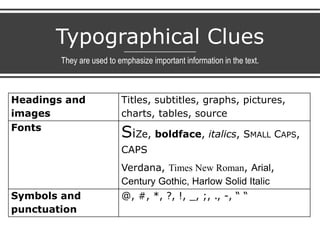
Typographical Clues
They are used to emphasize important information in the text.
Headings and
images
Titles, subtitles, graphs, pictures,
charts, tables, source
Fonts
SiZe, boldface, italics, SMALL CAPS,
CAPS
Verdana, Times New Roman, Arial,
Century Gothic, Harlow Solid Italic
Symbols and
punctuation
@, #, *, ?, !, _, ;, ., -, “ “
Punctuati
on Marks
Punctuation is the system of signs
and symbols given to a reader to
show how a sentence is
constructed and how it should be
read to make its meaning clear.
Each symbol is called
“punctuation mark.”
Every writer uses
them in different ways
for many purposes in
the text.
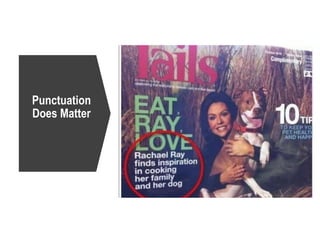
Punctuation
Does Matter
What do you
understand
from this
message?
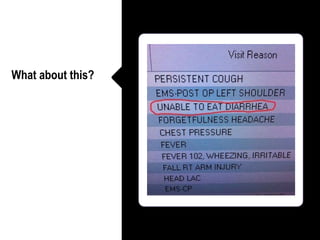
What about this?
If you went
to a
restaurant
and saw
this, what
would you
think?
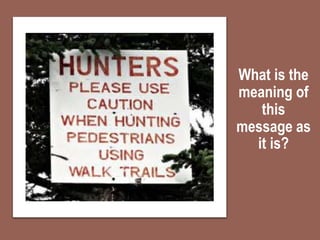
What is the
meaning of
this
message as
it is?
And what
would you
understand in
this case?
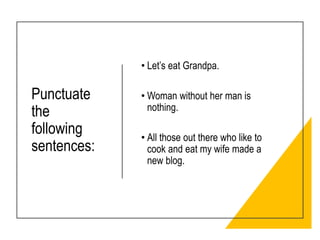
Punctuate
the
following
sentences:
• Let’s eat Grandpa.
• Woman without her man is
nothing.
• All those out there who like to
cook and eat my wife made a
new blog.
Punctuate
the
following
sentences:
• Let’s eat, Grandpa.
• Woman, without her, man is
nothing.
• All those out there who like to
cook and eat, my wife made a
new blog.
Dash [ ─ ] (en dash)
 In informal writing, it is used to give extra (additional) information or to
introduce an additional thought/ comment.
On May 25, 2009, the people of Munshiganj—a village of 35,000 on the southwest
coast—got a glimpse of what to expect from a multifoot rise in sea level.
Bangladesh is, after all, one of the most densely populated—and extremely noisy—
nations on Earth.
 To show an abrupt change or suspension.
But when it comes to weigh control, exercise—though necesssary—can take only so far.
Dash [ ─ ] (en dash)
• To introduce defining phrases or lists.
…and polycyclic aromatic hydrocarbons (PAHs)—chemicals created when
muscle meats such as beef, pork, fowl and fish are cooked at high
temperature—that have remained…
In another study, men who consumed a third of an ounce (ten grams) a day
of well-done meat—whether crispy bacon, sausage, steak, pork or
hamburger—had a 40% higher risk of prostate cancer.
Dash [ ─ ] (en dash)
 In informal writing, to separate an independent part of a sentence.
The movie─which was released last year─became one of the most popular in
the last ceremony.
 To show a speaker's pause or a change.
Please, ask Tony to─no, I'll tell him.
 To avoid writing taboo words in full.
Would you please pick up these–shoes?
Parentheses ( )
• To give extra information such as dates, numbers and amounts
of money.
Haydn (1732-1809) wrote over 100 symphonies.
• To add an explanation, extra information or an extra thought.
Lewis was playing a harpsicord (a baroque keyboard instrument).
• To enclose cross-references.
The abacus (see picture on page 1) is used for teaching numbers.
Parentheses ( )
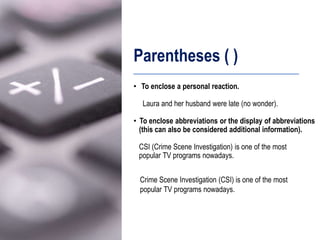
• To enclose a personal reaction.
Laura and her husband were late (no wonder).
• To enclose abbreviations or the display of abbreviations
(this can also be considered additional information).
CSI (Crime Scene Investigation) is one of the most
popular TV programs nowadays.
Crime Scene Investigation (CSI) is one of the most
popular TV programs nowadays.
Square Brackets [ ]
• To enclose explanatory or missing […] material, especially in quoted text.
It is [a] good question.
• The bracketed expression [sic] is used to indicate errors that are “thus in the original.”
• To indicate when the text has been modified for clarity.
“I’d like to thank my parentals [sic] for their love, tolerance […] and assistance.”
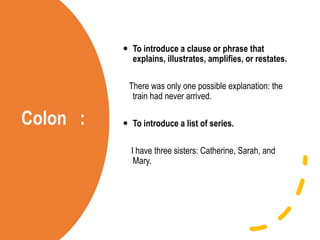
Colon :
 To introduce a clause or phrase that
explains, illustrates, amplifies, or restates.
There was only one possible explanation: the
train had never arrived.
 To introduce a list of series.
I have three sisters: Catherine, Sarah, and
Mary.
Quotation Marks “ ”
 To enclose words that were spoken (quotations).
“It can’t be possible,” she said.
 To enclose short pieces of text written by someone else (citations).
“I am driven to action by the missteps and misjudgments of the White House and
the Pentagon.” (Newbold)
 To show emphasis, irony, humor, and sarcasm.
So those are your “best” shoes?
 To enclose titles of short stories.
Edgar Allan Poe wrote “ The Raven. ”
Quotation Marks “ ”
 To enclose foerign terms.
She brought “tortillas” and “enchiladas.”
 To emphazise a word or phrase that the writer believes is untrue, not used in its currently
accepted sense, or morally wrong.
In the fifteenth century, we “knew” that the Sun’s revolutions divided day from night.
 To enclose translations of foreign terms
The scientific name of the Cotton Rose is hibiscus mutabilis meaning “changeable hibiscus.”
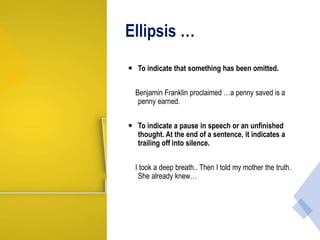
Ellipsis …
 To indicate that something has been omitted.
Benjamin Franklin proclaimed …a penny saved is a
penny earned.
 To indicate a pause in speech or an unfinished
thought. At the end of a sentence, it indicates a
trailing off into silence.
I took a deep breath.. Then I told my mother the truth.
She already knew…
Italics
 To indicate the use of new, slang, or foreign words.
The name of the Cotton Rose is hibiscus mutabilis.
 To refer to a letter, word, number, or expression.
Young people overuse the word cool.
 To emphasize something that is important.
These are my things!
 To write titles of major works, films, TV programs
Cinema Paradiso is one of my favorite movies ever.
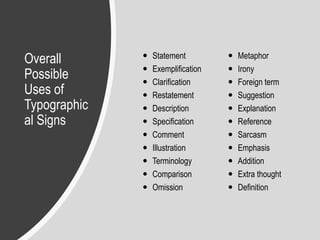
Overall
Possible
Uses of
Typographic
al Signs
 Statement
 Exemplification
 Clarification
 Restatement
 Description
 Specification
 Comment
 Illustration
 Terminology
 Comparison
 Omission
 Metaphor
 Irony
 Foreign term
 Suggestion
 Explanation
 Reference
 Sarcasm
 Emphasis
 Addition
 Extra thought
 Definition

Typographical clues and punctuation marks

  • 1.
    By N. Valdelomar TypographicalClues and Punctuation Marks
  • 2.
    Typographical Clues • Goodtypography and design in a textbook aren’t just decorations to make it look pretty. They are devices authors use to make information more accessible to the reader. • Typography visually organize information with a structure that makes the hierarchy of ideas and the relationships among those ideas obvious. As a reader, you can use typographic and design cues to help you accurately gather information from the printed page. http://www.estrellamountain.edu/sites/default/files/sections/learning- support/using-typography-and-design-clues.pdf
  • 3.
    Typographical Clues They areused to emphasize important information in the text. Headings and images Titles, subtitles, graphs, pictures, charts, tables, source Fonts SiZe, boldface, italics, SMALL CAPS, CAPS Verdana, Times New Roman, Arial, Century Gothic, Harlow Solid Italic Symbols and punctuation @, #, *, ?, !, _, ;, ., -, “ “
  • 4.
    Punctuati on Marks Punctuation isthe system of signs and symbols given to a reader to show how a sentence is constructed and how it should be read to make its meaning clear. Each symbol is called “punctuation mark.” Every writer uses them in different ways for many purposes in the text.
  • 5.
  • 6.
  • 7.
  • 8.
    If you went toa restaurant and saw this, what would you think?
  • 9.
    What is the meaningof this message as it is?
  • 10.
  • 11.
    Punctuate the following sentences: • Let’s eatGrandpa. • Woman without her man is nothing. • All those out there who like to cook and eat my wife made a new blog.
  • 12.
    Punctuate the following sentences: • Let’s eat,Grandpa. • Woman, without her, man is nothing. • All those out there who like to cook and eat, my wife made a new blog.
  • 13.
    Dash [ ─] (en dash)  In informal writing, it is used to give extra (additional) information or to introduce an additional thought/ comment. On May 25, 2009, the people of Munshiganj—a village of 35,000 on the southwest coast—got a glimpse of what to expect from a multifoot rise in sea level. Bangladesh is, after all, one of the most densely populated—and extremely noisy— nations on Earth.  To show an abrupt change or suspension. But when it comes to weigh control, exercise—though necesssary—can take only so far.
  • 14.
    Dash [ ─] (en dash) • To introduce defining phrases or lists. …and polycyclic aromatic hydrocarbons (PAHs)—chemicals created when muscle meats such as beef, pork, fowl and fish are cooked at high temperature—that have remained… In another study, men who consumed a third of an ounce (ten grams) a day of well-done meat—whether crispy bacon, sausage, steak, pork or hamburger—had a 40% higher risk of prostate cancer.
  • 15.
    Dash [ ─] (en dash)  In informal writing, to separate an independent part of a sentence. The movie─which was released last year─became one of the most popular in the last ceremony.  To show a speaker's pause or a change. Please, ask Tony to─no, I'll tell him.  To avoid writing taboo words in full. Would you please pick up these–shoes?
  • 16.
    Parentheses ( ) •To give extra information such as dates, numbers and amounts of money. Haydn (1732-1809) wrote over 100 symphonies. • To add an explanation, extra information or an extra thought. Lewis was playing a harpsicord (a baroque keyboard instrument). • To enclose cross-references. The abacus (see picture on page 1) is used for teaching numbers.
  • 17.
    Parentheses ( ) •To enclose a personal reaction. Laura and her husband were late (no wonder). • To enclose abbreviations or the display of abbreviations (this can also be considered additional information). CSI (Crime Scene Investigation) is one of the most popular TV programs nowadays. Crime Scene Investigation (CSI) is one of the most popular TV programs nowadays.
  • 18.
    Square Brackets [] • To enclose explanatory or missing […] material, especially in quoted text. It is [a] good question. • The bracketed expression [sic] is used to indicate errors that are “thus in the original.” • To indicate when the text has been modified for clarity. “I’d like to thank my parentals [sic] for their love, tolerance […] and assistance.”
  • 19.
    Colon :  Tointroduce a clause or phrase that explains, illustrates, amplifies, or restates. There was only one possible explanation: the train had never arrived.  To introduce a list of series. I have three sisters: Catherine, Sarah, and Mary.
  • 20.
    Quotation Marks “”  To enclose words that were spoken (quotations). “It can’t be possible,” she said.  To enclose short pieces of text written by someone else (citations). “I am driven to action by the missteps and misjudgments of the White House and the Pentagon.” (Newbold)  To show emphasis, irony, humor, and sarcasm. So those are your “best” shoes?  To enclose titles of short stories. Edgar Allan Poe wrote “ The Raven. ”
  • 21.
    Quotation Marks “”  To enclose foerign terms. She brought “tortillas” and “enchiladas.”  To emphazise a word or phrase that the writer believes is untrue, not used in its currently accepted sense, or morally wrong. In the fifteenth century, we “knew” that the Sun’s revolutions divided day from night.  To enclose translations of foreign terms The scientific name of the Cotton Rose is hibiscus mutabilis meaning “changeable hibiscus.”
  • 22.
    Ellipsis …  Toindicate that something has been omitted. Benjamin Franklin proclaimed …a penny saved is a penny earned.  To indicate a pause in speech or an unfinished thought. At the end of a sentence, it indicates a trailing off into silence. I took a deep breath.. Then I told my mother the truth. She already knew…
  • 23.
    Italics  To indicatethe use of new, slang, or foreign words. The name of the Cotton Rose is hibiscus mutabilis.  To refer to a letter, word, number, or expression. Young people overuse the word cool.  To emphasize something that is important. These are my things!  To write titles of major works, films, TV programs Cinema Paradiso is one of my favorite movies ever.
  • 24.
    Overall Possible Uses of Typographic al Signs Statement  Exemplification  Clarification  Restatement  Description  Specification  Comment  Illustration  Terminology  Comparison  Omission  Metaphor  Irony  Foreign term  Suggestion  Explanation  Reference  Sarcasm  Emphasis  Addition  Extra thought  Definition