What is asentence?
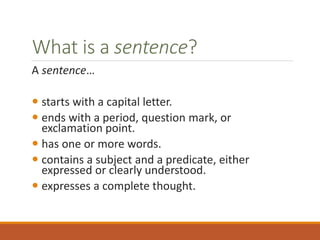
A sentence…
starts with a capital letter.
ends with a period, question mark, or
exclamation point.
has one or more words.
contains a subject and a predicate, either
expressed or clearly understood.
expresses a complete thought.
3.
What is asubject?
It is the person, place, thing, or idea that is doing or being something.
To find the subject, ask yourself the question:
Who + the verb? or What + the verb?
The Swiss have a long history of making watches.
Who has a long history of making watches?
Siesta is a short break in the afternoon.
What is a short break in the afternoon?
4.
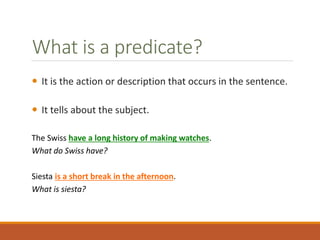
What is apredicate?
It is the action or description that occurs in the sentence.
It tells about the subject.
The Swiss have a long history of making watches.
What do Swiss have?
Siesta is a short break in the afternoon.
What is siesta?
5.
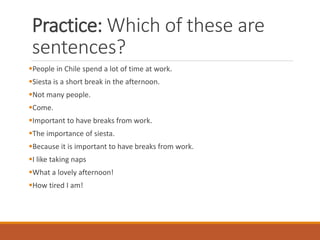
Practice: Which ofthese are
sentences?
▪People in Chile spend a lot of time at work.
▪Siesta is a short break in the afternoon.
▪Not many people.
▪Come.
▪Important to have breaks from work.
▪The importance of siesta.
▪Because it is important to have breaks from work.
▪I like taking naps
▪What a lovely afternoon!
▪How tired I am!
6.
Phrases
•A phrase isa syntactic structure that consists of
more than one word but lacks the subject-
predicate organization.
•It is a group of words that functions as a single
unit. Most phrases have a central word which
defines the type of phrase. This word is called the
head of the phrase.
7.
Phrases
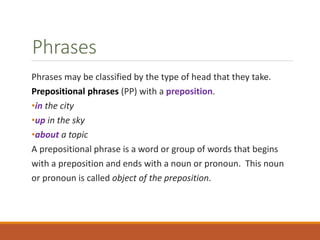
Phrases may beclassified by the type of head that they take.
Prepositional phrases (PP) with a preposition.
•in the city
•up in the sky
•about a topic
A prepositional phrase is a word or group of words that begins
with a preposition and ends with a noun or pronoun. This noun
or pronoun is called object of the preposition.
8.
Phrases
Noun phrase (NP)with a noun as head:
a nap the well-known Swiss watches
Verb phrase (VP) with a verb as head:
goes back in time will come
Adjective phrase with an adjective as head:
full of joy extremely talented
Adverb phrase with adverb as head
very carefully
9.
Sentence Classification
Sentences canbe classified according to their function:
declarative sentence: makes a statement.
Costa Ricans usually take short naps.
interrogative sentence: asks a question
What time do you go to bed?
Are short breaks necessary for you?
exclamatory sentence: expresses strong feeling or emotion; it must be a complete sentence.
What a beautiful day this is!
How happy I feel!
imperative sentence: expresses a command or a request
Never study for hours without a break.
Use different notebooks and folders for each class.
Don’t do many things at a time.
10.
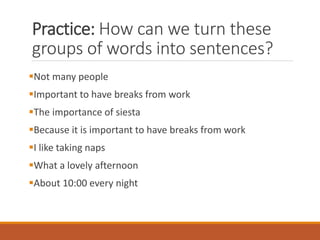
Practice: How canwe turn these
groups of words into sentences?
▪Not many people
▪Important to have breaks from work
▪The importance of siesta
▪Because it is important to have breaks from work
▪I like taking naps
▪What a lovely afternoon
▪About 10:00 every night
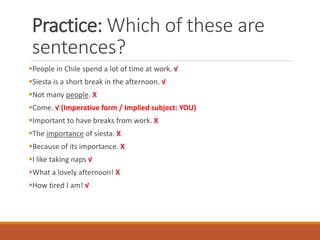
Practice: Which ofthese are
sentences?
▪People in Chile spend a lot of time at work. √
▪Siesta is a short break in the afternoon. √
▪Not many people. X
▪Come. √ (Imperative form / Implied subject: YOU)
▪Important to have breaks from work. X
▪The importance of siesta. X
▪Because of its importance. X
▪I like taking naps √
▪What a lovely afternoon! X
▪How tired I am! √
13.
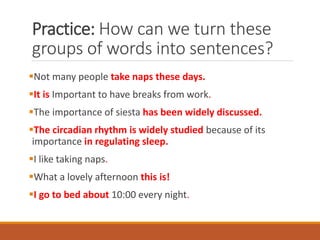
Practice: How canwe turn these
groups of words into sentences?
▪Not many people take naps these days.
▪It is Important to have breaks from work.
▪The importance of siesta has been widely discussed.
▪The circadian rhythm is widely studied because of its
importance in regulating sleep.
▪I like taking naps.
▪What a lovely afternoon this is!
▪I go to bed about 10:00 every night.