ONLINE CLASS
Topic: Types of Questions
By
Dr. Pramod kumar yadav
Assistant professor
David Hare Training College(WBUTTEPA)
Please visit for teaching learning material
https://pramodkumaryadav.gnomio.com/
6/20/2021
Types of question: By Dr. Pramod Kumar
Yadav
Different Types of Questions based on
Bloom's Taxonomy
• Bloom’s Taxonomy is a classification of the
different objectives and skills that educators set
for their students (learning objectives). The
taxonomy was proposed in 1956 by Benjamin
Bloom, an educational psychologist at the
University of Chicago. The terminology has been
recently (2001)updated to include the following
six levels of learning. These 6 levels can be used
to structure the learning objectives, lessons, and
assessments of the course. :
6/20/2021 Types of question: By Dr. Pramod Kumar Yadav
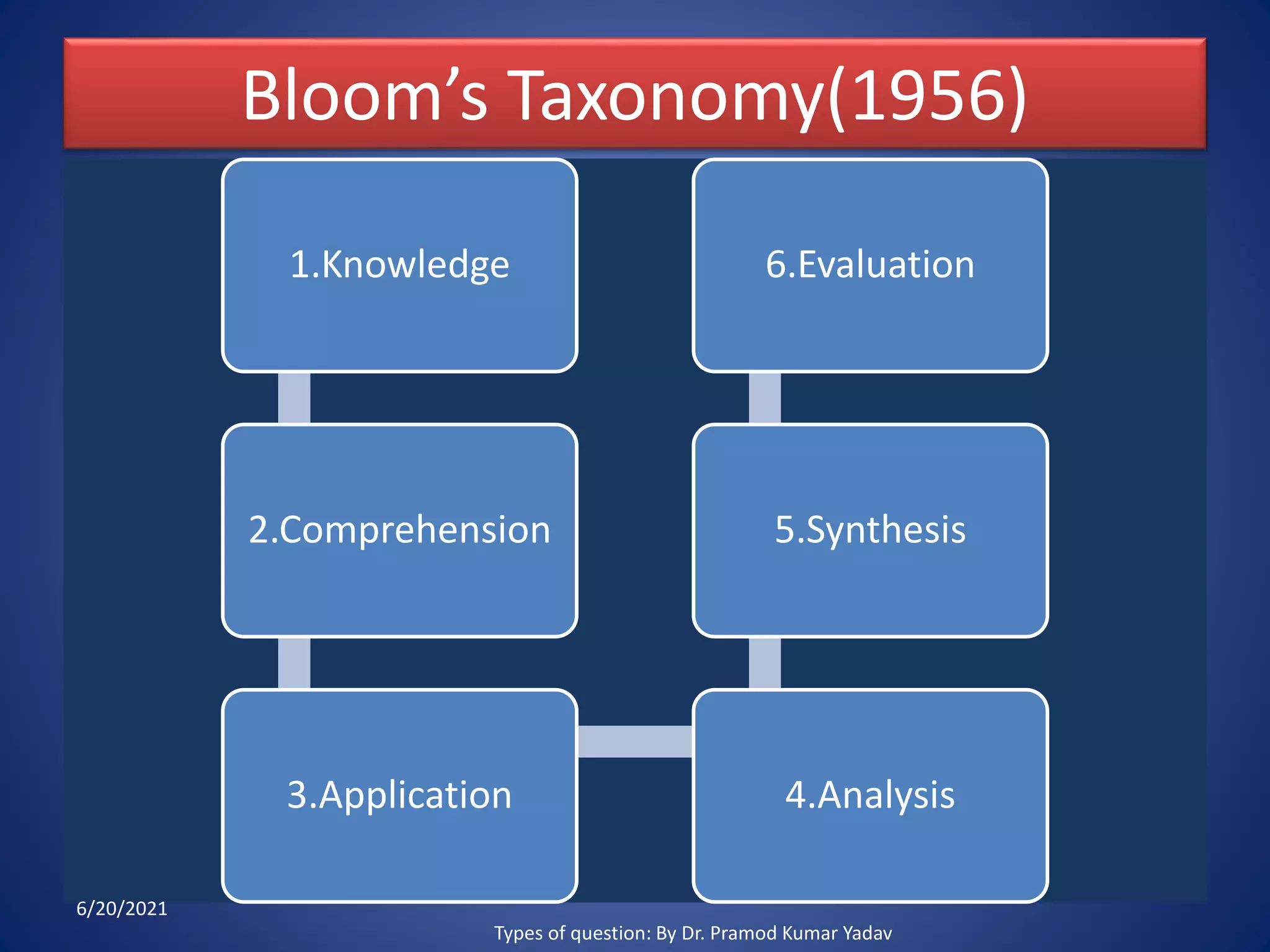
Bloom’s Taxonomy(1956)
1.Knowledge
2.Comprehension
3.Application 4.Analysis
5.Synthesis
6.Evaluation
6/20/2021
Types of question: By Dr. Pramod Kumar Yadav
Revised Bloom’s Taxonomy(2001)
I.
Remembering
II.
Understanding
III. Applying IV. Analyzing
V. Evaluating
VI. Creating
6/20/2021
Types of question: By Dr. Pramod Kumar Yadav
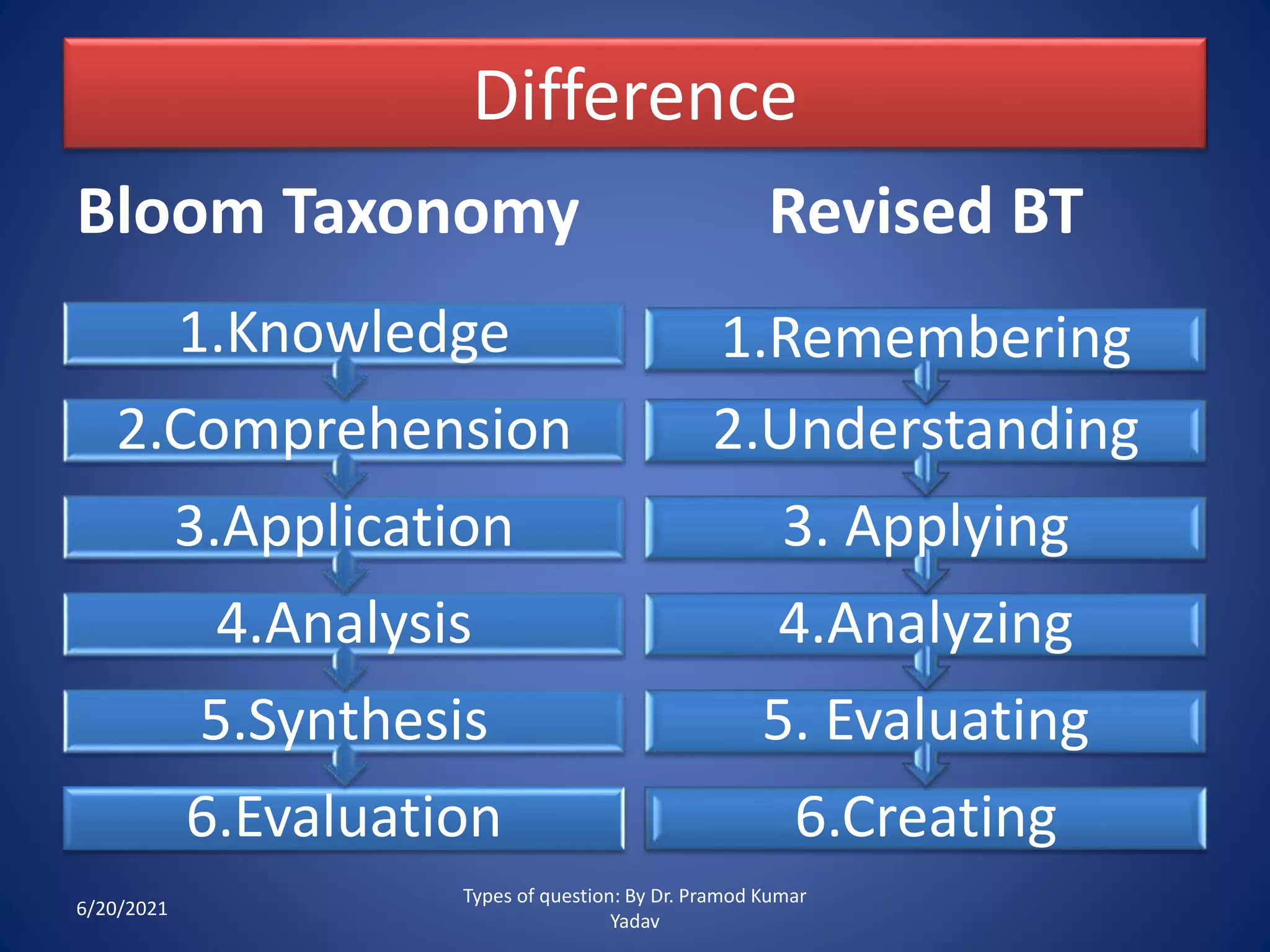
Difference
Bloom Taxonomy
6.Evaluation
5.Synthesis
4.Analysis
3.Application
2.Comprehension
1.Knowledge
Revised BT
6.Creating
5. Evaluating
4.Analyzing
3. Applying
2.Understanding
1.Remembering
6/20/2021
Types of question: By Dr. Pramod Kumar
Yadav
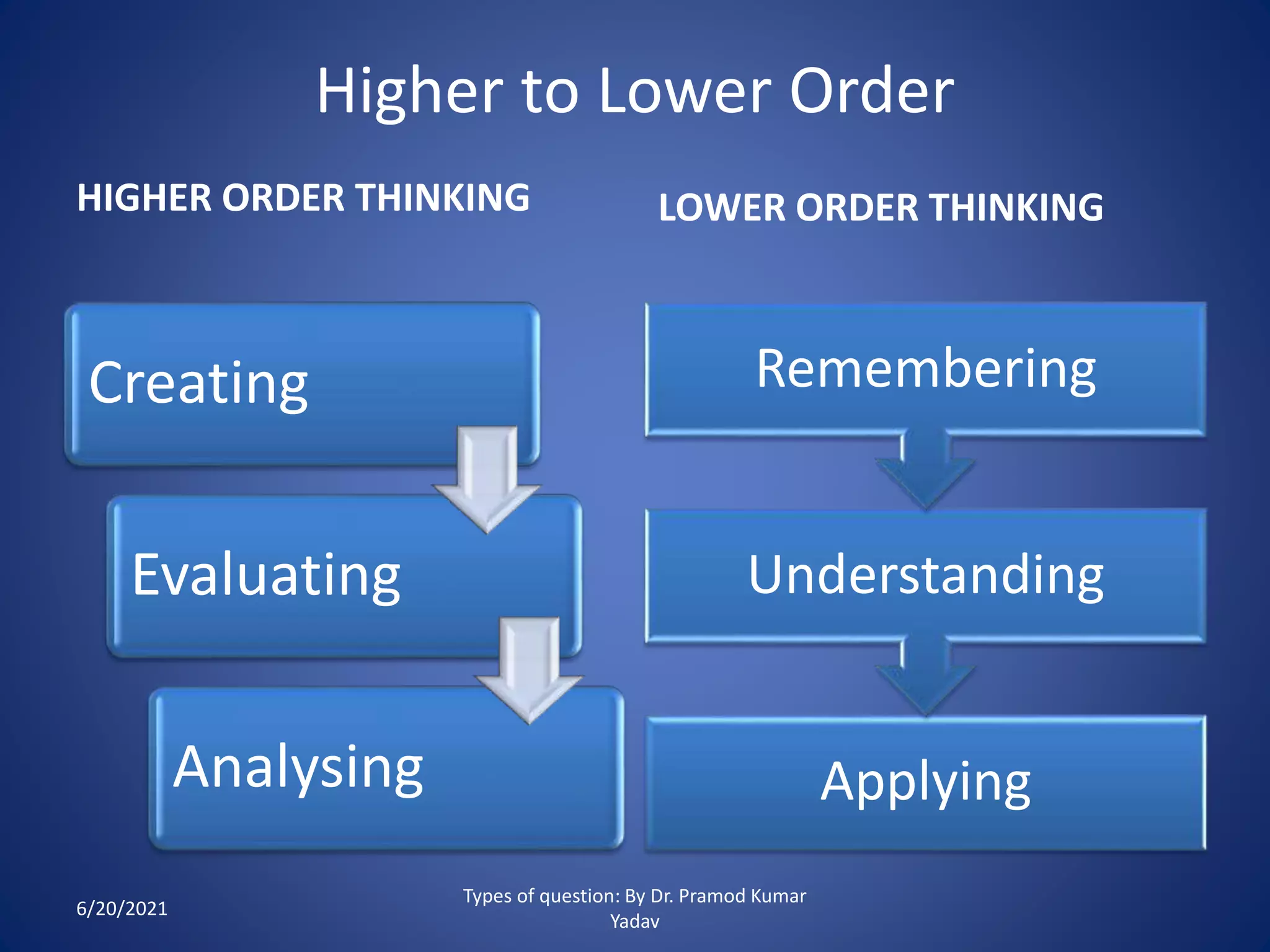
Higher to Lower Order
HIGHER ORDER THINKING
Creating
Evaluating
Analysing
LOWER ORDER THINKING
Applying
Understanding
Remembering
6/20/2021
Types of question: By Dr. Pramod Kumar
Yadav
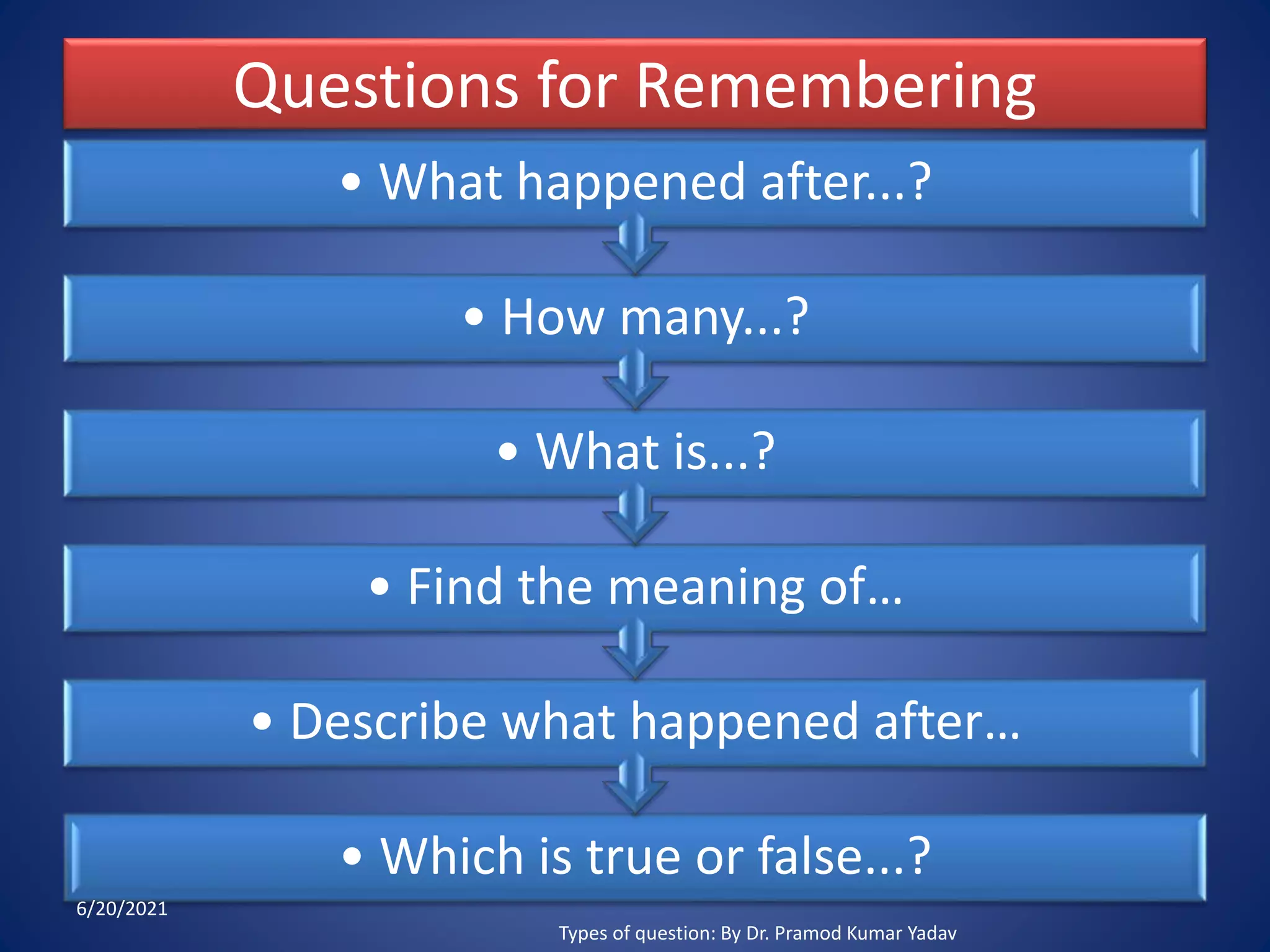
Questions for Remembering
• Which is true or false...?
• Describe what happened after…
• Find the meaning of…
• What is...?
• How many...?
• What happened after...?
6/20/2021
Types of question: By Dr. Pramod Kumar Yadav
Questions for Understanding
• Can you write in your own
words?
• How would you explain…?
• Can you write a brief outline...?
• What do you think could have
happened next...?
• What was the main idea...?
6/20/2021
Types of question: By Dr. Pramod Kumar
Yadav
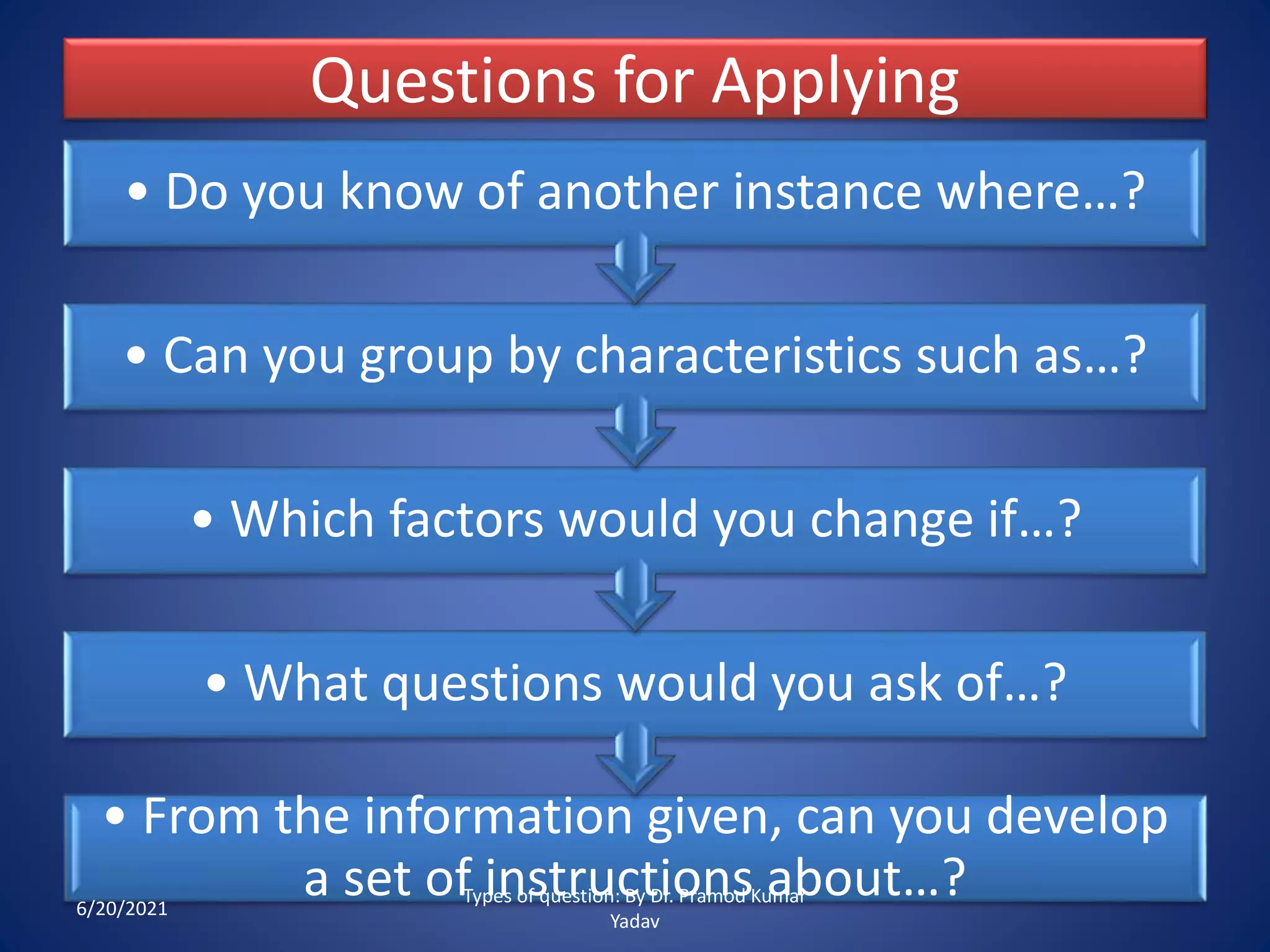
Questions for Applying
• From the information given, can you develop
a set of instructions about…?
• What questions would you ask of…?
• Which factors would you change if…?
• Can you group by characteristics such as…?
• Do you know of another instance where…?
6/20/2021
Types of question: By Dr. Pramod Kumar
Yadav
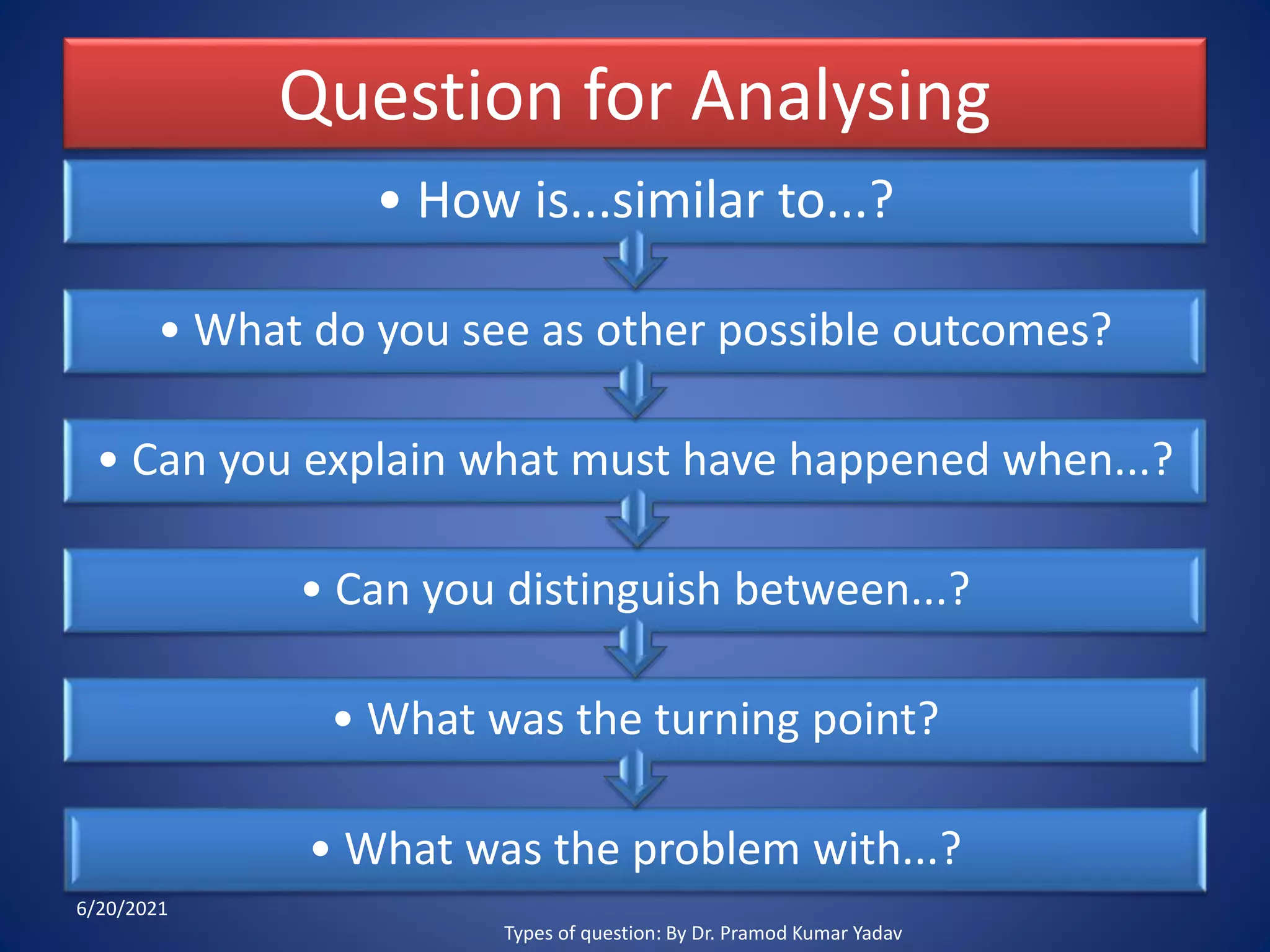
Question for Analysing
• What was the problem with...?
• What was the turning point?
• Can you distinguish between...?
• Can you explain what must have happened when...?
• What do you see as other possible outcomes?
• How is...similar to...?
6/20/2021
Types of question: By Dr. Pramod Kumar Yadav
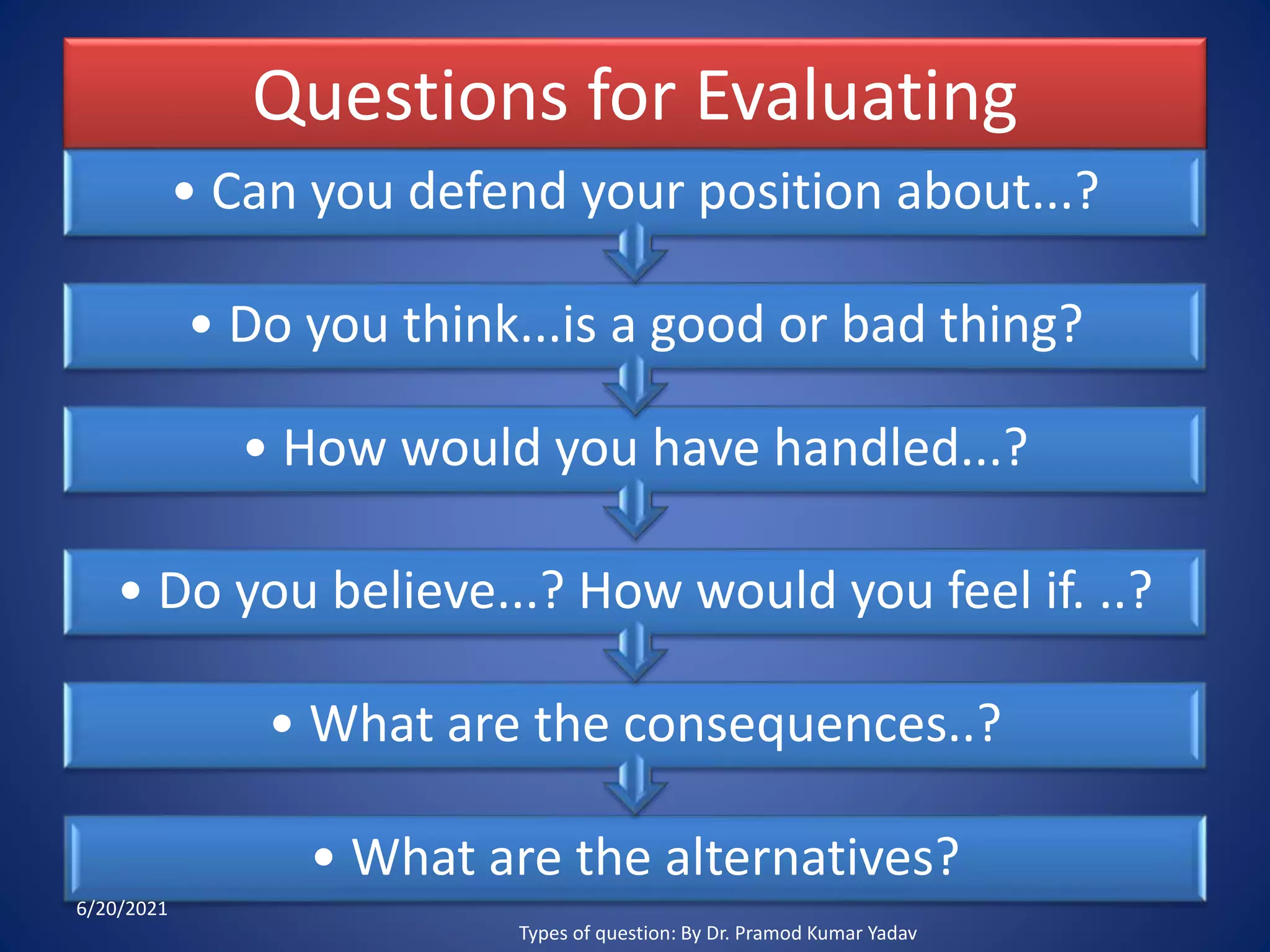
Questions for Evaluating
• What are the alternatives?
• What are the consequences..?
• Do you believe...? How would you feel if. ..?
• How would you have handled...?
• Do you think...is a good or bad thing?
• Can you defend your position about...?
6/20/2021
Types of question: By Dr. Pramod Kumar Yadav
Questions for Creating
• Can you design a...?
• Can you see a possible solution
..?
• If you had access to all resources,
how would you deal with...?
• What would happen if ...?
• How many ways can you...?
6/20/2021
Types of question: By Dr. Pramod Kumar Yadav
6/20/2021
Types of question: By Dr. Pramod Kumar
Yadav
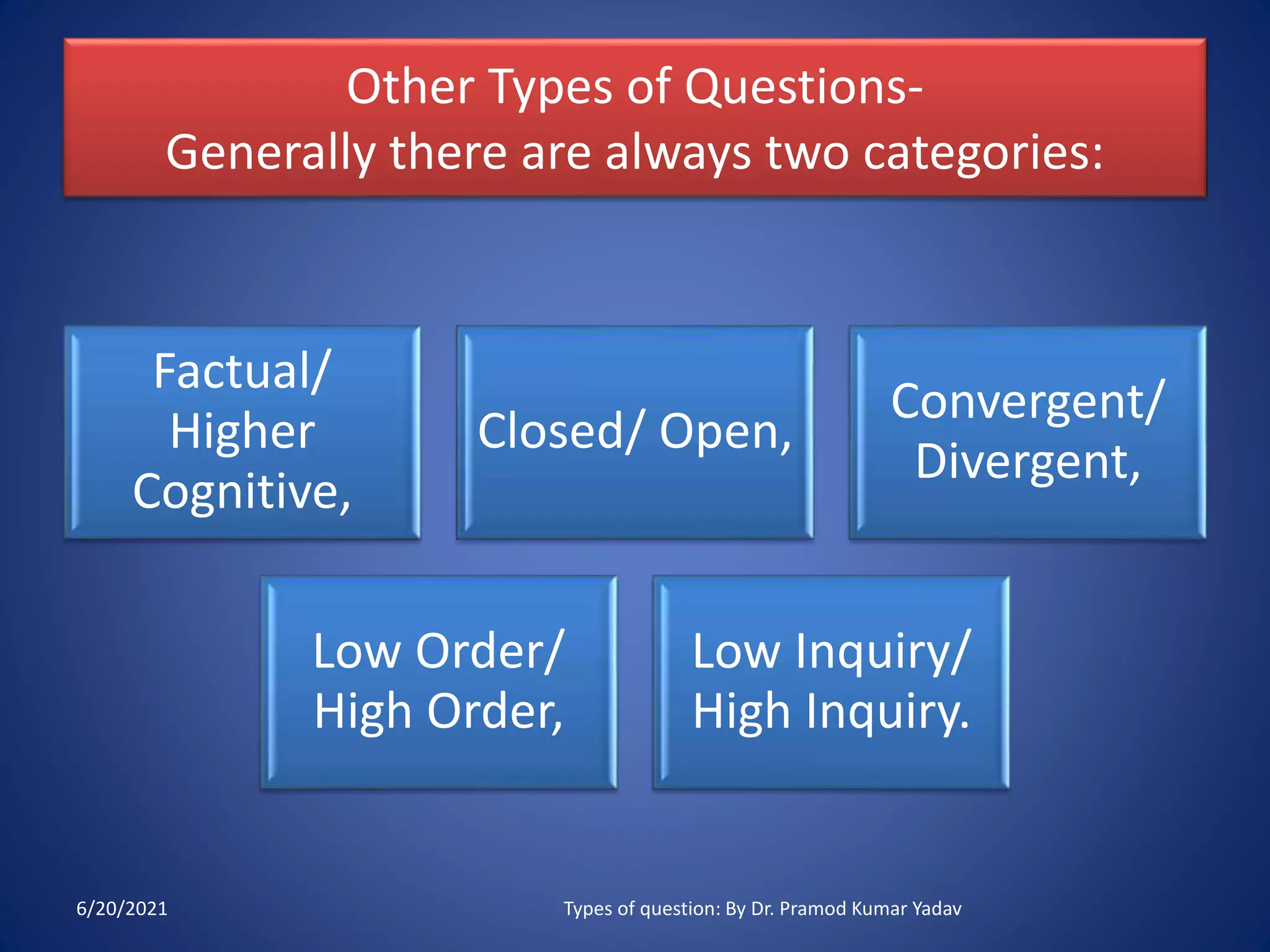
Other Types of Questions-
Generally there are always two categories:
Factual/
Higher
Cognitive,
Closed/ Open,
Convergent/
Divergent,
Low Order/
High Order,
Low Inquiry/
High Inquiry.
6/20/2021 Types of question: By Dr. Pramod Kumar Yadav
Video
6/20/2021
Types of question: By Dr. Pramod Kumar
Yadav
Thank You for Learning
6/20/2021 Types of question: By Dr. Pramod Kumar Yadav

Types of Questions based o RBT

  • 1.
    ONLINE CLASS Topic: Typesof Questions By Dr. Pramod kumar yadav Assistant professor David Hare Training College(WBUTTEPA) Please visit for teaching learning material https://pramodkumaryadav.gnomio.com/ 6/20/2021 Types of question: By Dr. Pramod Kumar Yadav
  • 2.
    Different Types ofQuestions based on Bloom's Taxonomy • Bloom’s Taxonomy is a classification of the different objectives and skills that educators set for their students (learning objectives). The taxonomy was proposed in 1956 by Benjamin Bloom, an educational psychologist at the University of Chicago. The terminology has been recently (2001)updated to include the following six levels of learning. These 6 levels can be used to structure the learning objectives, lessons, and assessments of the course. : 6/20/2021 Types of question: By Dr. Pramod Kumar Yadav
  • 3.
  • 4.
    Revised Bloom’s Taxonomy(2001) I. Remembering II. Understanding III.Applying IV. Analyzing V. Evaluating VI. Creating 6/20/2021 Types of question: By Dr. Pramod Kumar Yadav
  • 5.
    Difference Bloom Taxonomy 6.Evaluation 5.Synthesis 4.Analysis 3.Application 2.Comprehension 1.Knowledge Revised BT 6.Creating 5.Evaluating 4.Analyzing 3. Applying 2.Understanding 1.Remembering 6/20/2021 Types of question: By Dr. Pramod Kumar Yadav
  • 6.
    Higher to LowerOrder HIGHER ORDER THINKING Creating Evaluating Analysing LOWER ORDER THINKING Applying Understanding Remembering 6/20/2021 Types of question: By Dr. Pramod Kumar Yadav
  • 7.
    Questions for Remembering •Which is true or false...? • Describe what happened after… • Find the meaning of… • What is...? • How many...? • What happened after...? 6/20/2021 Types of question: By Dr. Pramod Kumar Yadav
  • 8.
    Questions for Understanding •Can you write in your own words? • How would you explain…? • Can you write a brief outline...? • What do you think could have happened next...? • What was the main idea...? 6/20/2021 Types of question: By Dr. Pramod Kumar Yadav
  • 9.
    Questions for Applying •From the information given, can you develop a set of instructions about…? • What questions would you ask of…? • Which factors would you change if…? • Can you group by characteristics such as…? • Do you know of another instance where…? 6/20/2021 Types of question: By Dr. Pramod Kumar Yadav
  • 10.
    Question for Analysing •What was the problem with...? • What was the turning point? • Can you distinguish between...? • Can you explain what must have happened when...? • What do you see as other possible outcomes? • How is...similar to...? 6/20/2021 Types of question: By Dr. Pramod Kumar Yadav
  • 11.
    Questions for Evaluating •What are the alternatives? • What are the consequences..? • Do you believe...? How would you feel if. ..? • How would you have handled...? • Do you think...is a good or bad thing? • Can you defend your position about...? 6/20/2021 Types of question: By Dr. Pramod Kumar Yadav
  • 12.
    Questions for Creating •Can you design a...? • Can you see a possible solution ..? • If you had access to all resources, how would you deal with...? • What would happen if ...? • How many ways can you...? 6/20/2021 Types of question: By Dr. Pramod Kumar Yadav
  • 13.
    6/20/2021 Types of question:By Dr. Pramod Kumar Yadav
  • 14.
    Other Types ofQuestions- Generally there are always two categories: Factual/ Higher Cognitive, Closed/ Open, Convergent/ Divergent, Low Order/ High Order, Low Inquiry/ High Inquiry. 6/20/2021 Types of question: By Dr. Pramod Kumar Yadav
  • 15.
    Video 6/20/2021 Types of question:By Dr. Pramod Kumar Yadav
  • 16.
    Thank You forLearning 6/20/2021 Types of question: By Dr. Pramod Kumar Yadav