1
PATTERNS
SUBJECT: Machining Process – 2
Index
 What does patterns mean?
 Types of Patterns
 Sweep Patterns
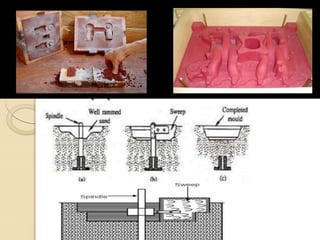
 Sweep Patterns (Images)
2
What does Patterns mean?
 In the method of casting, patterns is to
duplicate an object which has to be casted.
This is used to prepare a cavity into which
molten material will be poured during the
casting process.
3
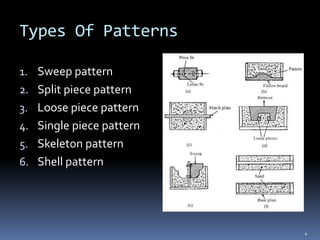
Types Of Patterns
1. Sweep pattern
2. Split piece pattern
3. Loose piece pattern
4. Single piece pattern
5. Skeleton pattern
6. Shell pattern
4
Sweep Patterns
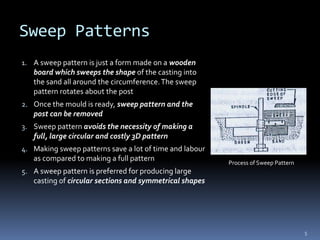
1. A sweep pattern is just a form made on a wooden
board which sweeps the shape of the casting into
the sand all around the circumference.The sweep
pattern rotates about the post
2. Once the mould is ready, sweep pattern and the
post can be removed
3. Sweep pattern avoids the necessity of making a
full, large circular and costly 3D pattern
4. Making sweep patterns save a lot of time and labour
as compared to making a full pattern
5. A sweep pattern is preferred for producing large
casting of circular sections and symmetrical shapes
5
Process of Sweep Pattern
6
Split piece pattern
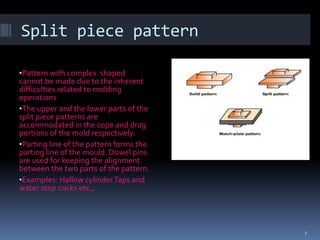
•Pattern with complex shaped
cannot be made due to the inherent
difficulties related to molding
operations
•The upper and the lower parts of the
split piece patterns are
accommodated in the cope and drag
portions of the mold respectively.
•Parting line of the pattern forms the
parting line of the mould. Dowel pins
are used for keeping the alignment
between the two parts of the pattern.
•Examples: Hallow cylinderTaps and
water stop cocks etc.,
7
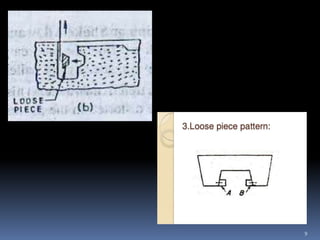
Loose piece pattern
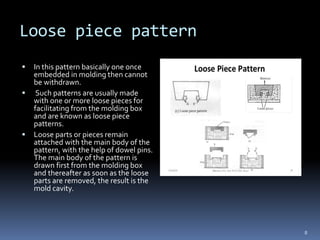
 In this pattern basically one once
embedded in molding then cannot
be withdrawn.
 Such patterns are usually made
with one or more loose pieces for
facilitating from the molding box
and are known as loose piece
patterns.
 Loose parts or pieces remain
attached with the main body of the
pattern, with the help of dowel pins.
The main body of the pattern is
drawn first from the molding box
and thereafter as soon as the loose
parts are removed, the result is the
mold cavity.
8
9
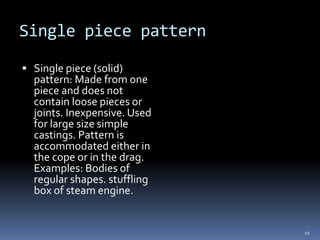
Single piece pattern
 Single piece (solid)
pattern: Made from one
piece and does not
contain loose pieces or
joints. Inexpensive. Used
for large size simple
castings. Pattern is
accommodated either in
the cope or in the drag.
Examples: Bodies of
regular shapes. stuffling
box of steam engine.
10
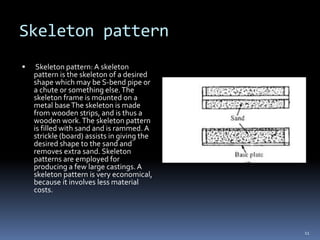
Skeleton pattern
 Skeleton pattern: A skeleton
pattern is the skeleton of a desired
shape which may be S-bend pipe or
a chute or something else.The
skeleton frame is mounted on a
metal baseThe skeleton is made
from wooden strips, and is thus a
wooden work.The skeleton pattern
is filled with sand and is rammed. A
strickle (board) assists in giving the
desired shape to the sand and
removes extra sand. Skeleton
patterns are employed for
producing a few large castings.A
skeleton pattern is very economical,
because it involves less material
costs.
11
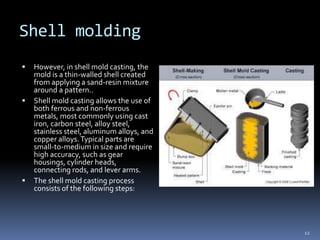
Shell molding
 However, in shell mold casting, the
mold is a thin-walled shell created
from applying a sand-resin mixture
around a pattern..
 Shell mold casting allows the use of
both ferrous and non-ferrous
metals, most commonly using cast
iron, carbon steel, alloy steel,
stainless steel, aluminum alloys, and
copper alloys.Typical parts are
small-to-medium in size and require
high accuracy, such as gear
housings, cylinder heads,
connecting rods, and lever arms.
 The shell mold casting process
consists of the following steps:
12
Thankyou
By:
Pradip Darji Jay Desai
130510119031 130510119032
Mechanical (A) Mechanical (A)
Kuntal Deshpande Vinit Gadhoya
130510119034 130510119035
Mechanical (A) Mechanical (A)
13

types of pattern

  • 1.
  • 2.
    Index  What doespatterns mean?  Types of Patterns  Sweep Patterns  Sweep Patterns (Images) 2
  • 3.
    What does Patternsmean?  In the method of casting, patterns is to duplicate an object which has to be casted. This is used to prepare a cavity into which molten material will be poured during the casting process. 3
  • 4.
    Types Of Patterns 1.Sweep pattern 2. Split piece pattern 3. Loose piece pattern 4. Single piece pattern 5. Skeleton pattern 6. Shell pattern 4
  • 5.
    Sweep Patterns 1. Asweep pattern is just a form made on a wooden board which sweeps the shape of the casting into the sand all around the circumference.The sweep pattern rotates about the post 2. Once the mould is ready, sweep pattern and the post can be removed 3. Sweep pattern avoids the necessity of making a full, large circular and costly 3D pattern 4. Making sweep patterns save a lot of time and labour as compared to making a full pattern 5. A sweep pattern is preferred for producing large casting of circular sections and symmetrical shapes 5 Process of Sweep Pattern
  • 6.
  • 7.
    Split piece pattern •Patternwith complex shaped cannot be made due to the inherent difficulties related to molding operations •The upper and the lower parts of the split piece patterns are accommodated in the cope and drag portions of the mold respectively. •Parting line of the pattern forms the parting line of the mould. Dowel pins are used for keeping the alignment between the two parts of the pattern. •Examples: Hallow cylinderTaps and water stop cocks etc., 7
  • 8.
    Loose piece pattern In this pattern basically one once embedded in molding then cannot be withdrawn.  Such patterns are usually made with one or more loose pieces for facilitating from the molding box and are known as loose piece patterns.  Loose parts or pieces remain attached with the main body of the pattern, with the help of dowel pins. The main body of the pattern is drawn first from the molding box and thereafter as soon as the loose parts are removed, the result is the mold cavity. 8
  • 9.
  • 10.
    Single piece pattern Single piece (solid) pattern: Made from one piece and does not contain loose pieces or joints. Inexpensive. Used for large size simple castings. Pattern is accommodated either in the cope or in the drag. Examples: Bodies of regular shapes. stuffling box of steam engine. 10
  • 11.
    Skeleton pattern  Skeletonpattern: A skeleton pattern is the skeleton of a desired shape which may be S-bend pipe or a chute or something else.The skeleton frame is mounted on a metal baseThe skeleton is made from wooden strips, and is thus a wooden work.The skeleton pattern is filled with sand and is rammed. A strickle (board) assists in giving the desired shape to the sand and removes extra sand. Skeleton patterns are employed for producing a few large castings.A skeleton pattern is very economical, because it involves less material costs. 11
  • 12.
    Shell molding  However,in shell mold casting, the mold is a thin-walled shell created from applying a sand-resin mixture around a pattern..  Shell mold casting allows the use of both ferrous and non-ferrous metals, most commonly using cast iron, carbon steel, alloy steel, stainless steel, aluminum alloys, and copper alloys.Typical parts are small-to-medium in size and require high accuracy, such as gear housings, cylinder heads, connecting rods, and lever arms.  The shell mold casting process consists of the following steps: 12
  • 13.
    Thankyou By: Pradip Darji JayDesai 130510119031 130510119032 Mechanical (A) Mechanical (A) Kuntal Deshpande Vinit Gadhoya 130510119034 130510119035 Mechanical (A) Mechanical (A) 13