Presented By
Mrs.Usha Rani Kandula, MSc(N),
Assistant professor in Adult health nursing, Department of Clinical nursing, Arsi
University, College of health sciences, Asella, Ethiopia, Institutional email:
usharani2020@arsiun.edu.et.
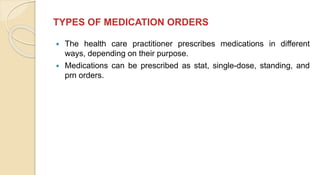
TYPES OF MEDICATION ORDERS
 The health care practitioner prescribes medications in different
ways, depending on their purpose.
 Medications can be prescribed as stat, single-dose, standing, and
prn orders.
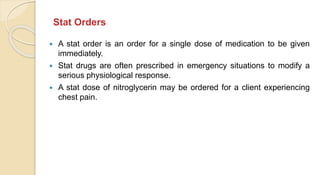
Stat Orders
 A stat order is an order for a single dose of medication to be given
immediately.
 Stat drugs are often prescribed in emergency situations to modify a
serious physiological response.
 A stat dose of nitroglycerin may be ordered for a client experiencing
chest pain.
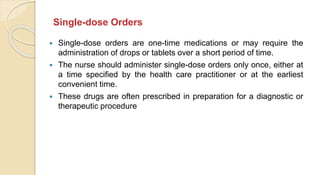
Single-dose Orders
 Single-dose orders are one-time medications or may require the
administration of drops or tablets over a short period of time.
 The nurse should administer single-dose orders only once, either at
a time specified by the health care practitioner or at the earliest
convenient time.
 These drugs are often prescribed in preparation for a diagnostic or
therapeutic procedure
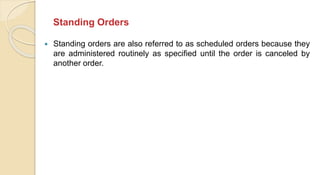
Standing Orders
 Standing orders are also referred to as scheduled orders because they
are administered routinely as specified until the order is canceled by
another order.
prn Orders
 A drug may be ordered on a prn (as needed) basis as circumstances
indicate.
 The drug is administered when, in the nurse’s judgment, the client’s
condition requires it.
PARTS OF THE DRUG ORDER
All orders should be written clearly and legibly, and the drug order should
contain seven parts:
1. The name of the client.
2. The date and time when the order is written.
3. The name of the drug to be administered.
4. The dosage.
5. The route by which it is to be administered and special directives
about its administration.
6. The time of administration and frequency.
7. The signature of the person writing the order, such as the physician
or advanced practice registered nurse.
Thanking you

Types of medication orders.pptx

  • 1.
    Presented By Mrs.Usha RaniKandula, MSc(N), Assistant professor in Adult health nursing, Department of Clinical nursing, Arsi University, College of health sciences, Asella, Ethiopia, Institutional email: usharani2020@arsiun.edu.et.
  • 2.
    TYPES OF MEDICATIONORDERS  The health care practitioner prescribes medications in different ways, depending on their purpose.  Medications can be prescribed as stat, single-dose, standing, and prn orders.
  • 3.
    Stat Orders  Astat order is an order for a single dose of medication to be given immediately.  Stat drugs are often prescribed in emergency situations to modify a serious physiological response.  A stat dose of nitroglycerin may be ordered for a client experiencing chest pain.
  • 4.
    Single-dose Orders  Single-doseorders are one-time medications or may require the administration of drops or tablets over a short period of time.  The nurse should administer single-dose orders only once, either at a time specified by the health care practitioner or at the earliest convenient time.  These drugs are often prescribed in preparation for a diagnostic or therapeutic procedure
  • 5.
    Standing Orders  Standingorders are also referred to as scheduled orders because they are administered routinely as specified until the order is canceled by another order.
  • 6.
    prn Orders  Adrug may be ordered on a prn (as needed) basis as circumstances indicate.  The drug is administered when, in the nurse’s judgment, the client’s condition requires it.
  • 7.
    PARTS OF THEDRUG ORDER
  • 8.
    PARTS OF THEDRUG ORDER All orders should be written clearly and legibly, and the drug order should contain seven parts: 1. The name of the client. 2. The date and time when the order is written. 3. The name of the drug to be administered. 4. The dosage.
  • 9.
    5. The routeby which it is to be administered and special directives about its administration. 6. The time of administration and frequency. 7. The signature of the person writing the order, such as the physician or advanced practice registered nurse. Thanking you