 Quantile-quantile plots
qqnorm(x)
qqline(x)
Quantile – Quantile-Quantile plot
qqplot(x, y)
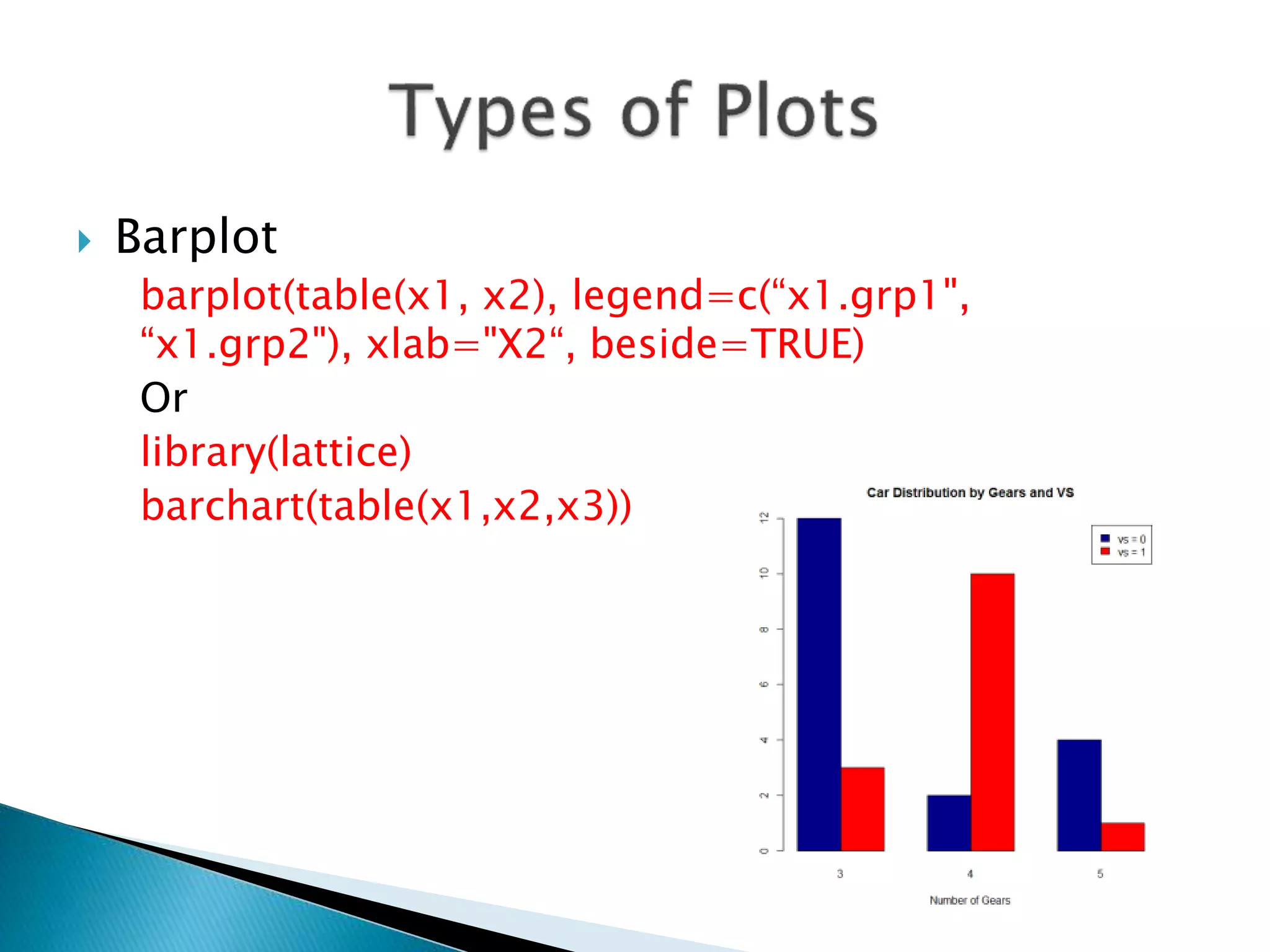
 Barplot
barplot(table(x1, x2), legend=c(“x1.grp1",
“x1.grp2"), xlab="X2“, beside=TRUE)
Or
library(lattice)
barchart(table(x1,x2,x3))
 Boxplots and Violin Plots
boxplot(x)
 horizontal = TRUE
library(vioplot)
vioplot(x1, x2, x3)
• Side-by-side boxplots
boxplot(y~x)
Or
library(lattice)
bwplot(y~x)
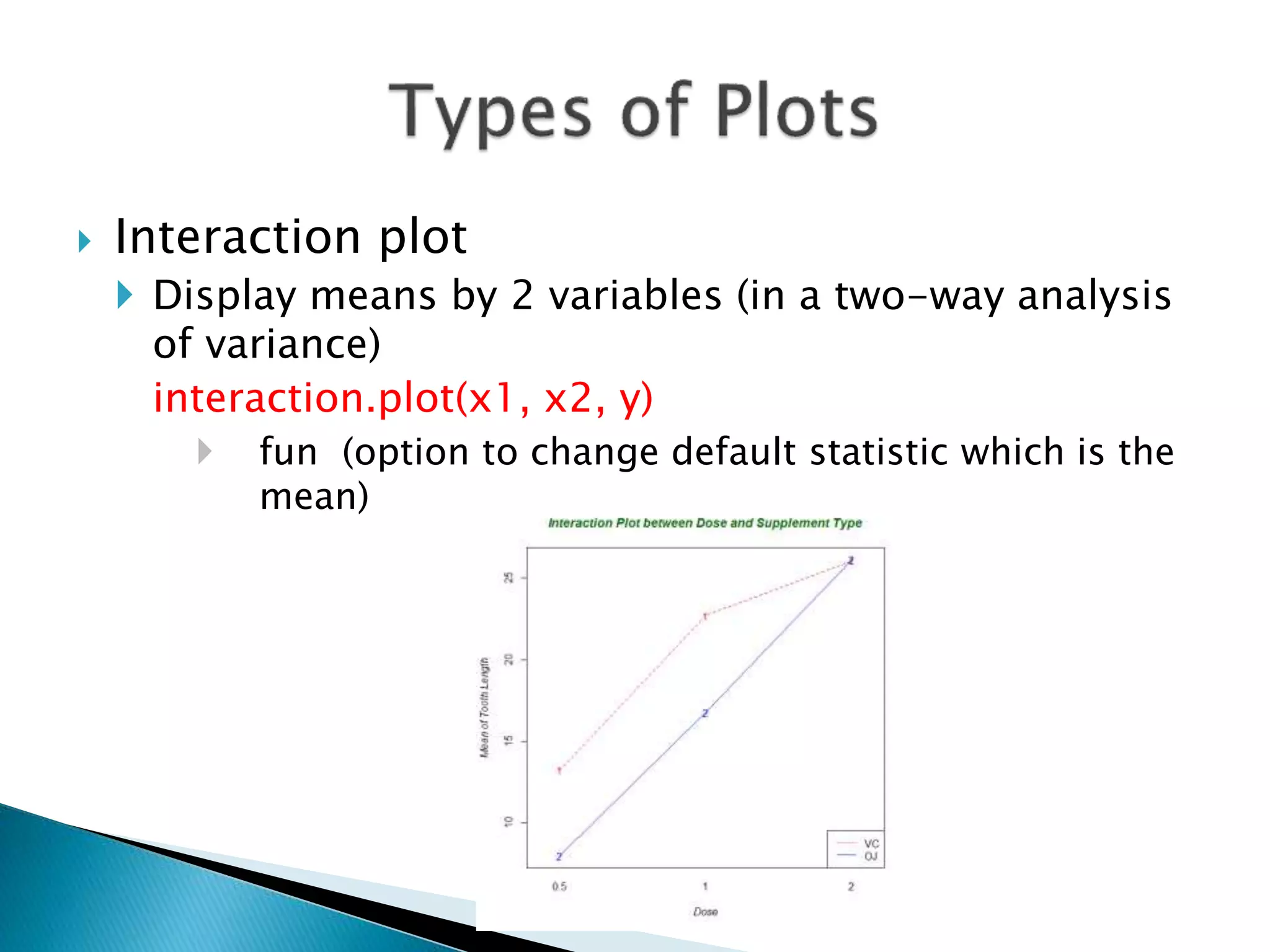
 Interaction plot
 Display means by 2 variables (in a two-way analysis
of variance)
interaction.plot(x1, x2, y)
 fun (option to change default statistic which is the
mean)
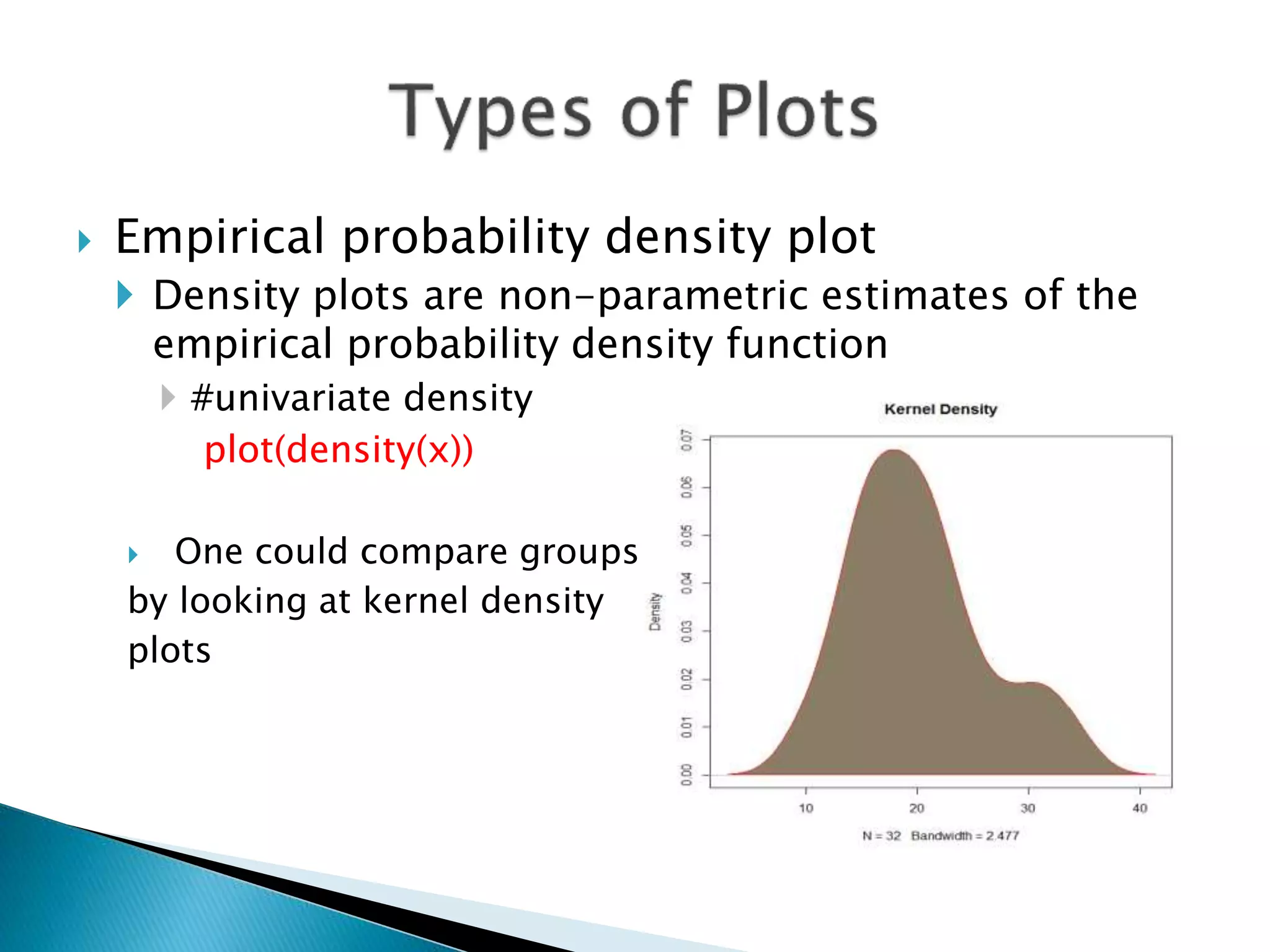
 Empirical probability density plot
 Density plots are non-parametric estimates of the
empirical probability density function
 #univariate density
plot(density(x))
 One could compare groups
by looking at kernel density
plots
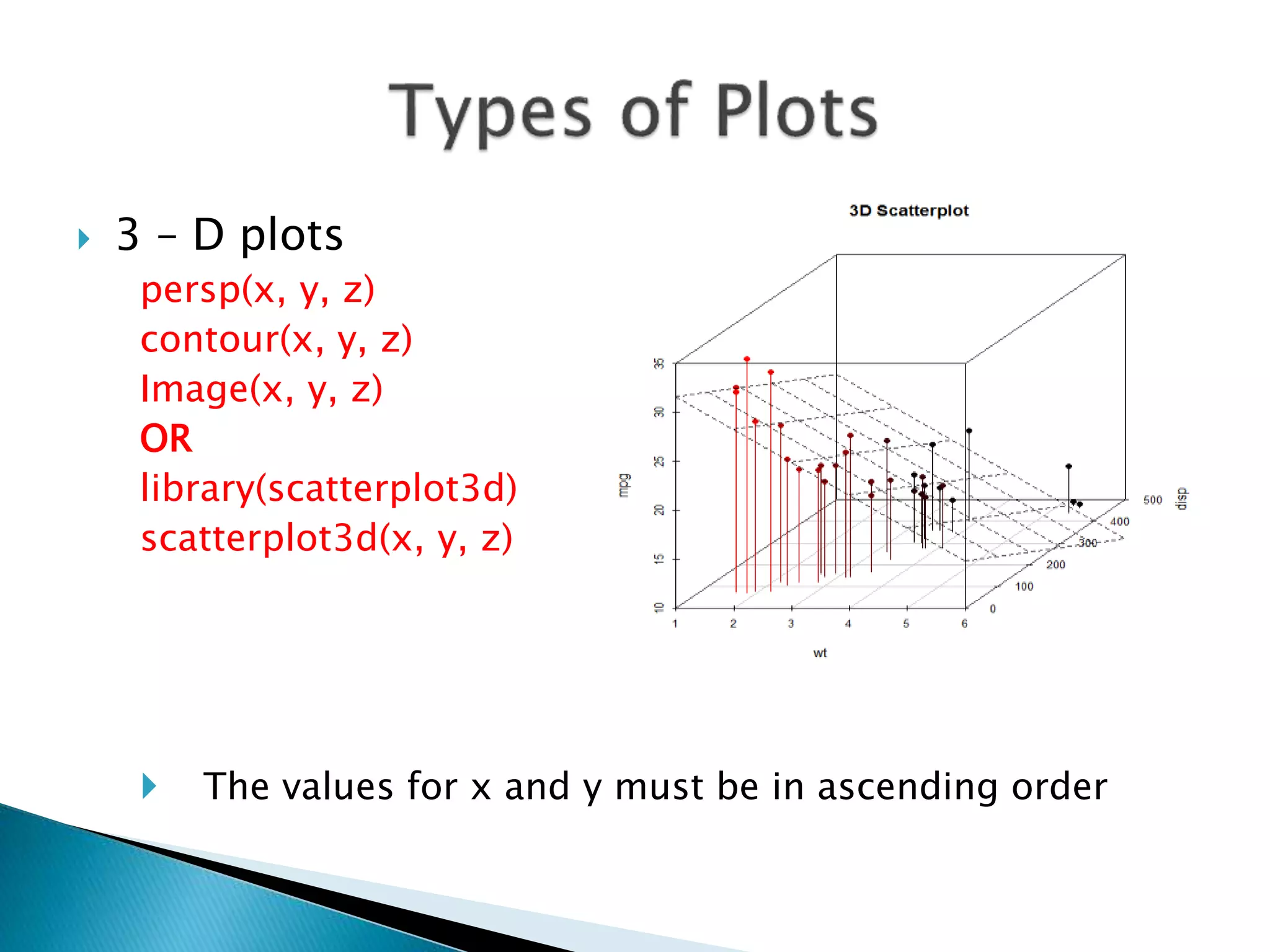
 3 – D plots
persp(x, y, z)
contour(x, y, z)
Image(x, y, z)
OR
library(scatterplot3d)
scatterplot3d(x, y, z)
 The values for x and y must be in ascending order
 A list of graphical parameters that define the
default behavior of all plot functions.
 Just like other R objects, par elements are similarly
modifiable, with slightly different syntax.
◦ e.g. par(“bg”=“lightcyan”)
◦ This would change the background color of all
subsequent plots to light cyan
 When par elements are modified directly (as above,
this changes all subsequent plotting behavior.
 Size of margins
◦ par(mar=c(bot, left, top, right))
 Save graphical settings
◦ par() #view currents settings
◦ opar <- par() #make a copy of current settings
◦ par(opar) #restore original settings
 Multiple plots per page
◦ par(mfrow=c(a, b)) #a rows and b columns
◦ par(mfcol=c(a,b))
 bg – plot background color
 lty – line type (e.g. dot, dash, solid)
 lwd – line width
 col – color
 cex – text size inside plot
 xlab, ylab – axes labels
 main – title
 pch – plotting symbol
 Add an arbitrary straight line:
 plot(x, y)
 abline(intercept, slope)
 Plot symbols
 plot(x, y, pch=pchval)
PCH symbols used in R
 “col=“ and “bg=” are also specified
 PCH can also be in characters such as
“A”, “a”, “%” etc.
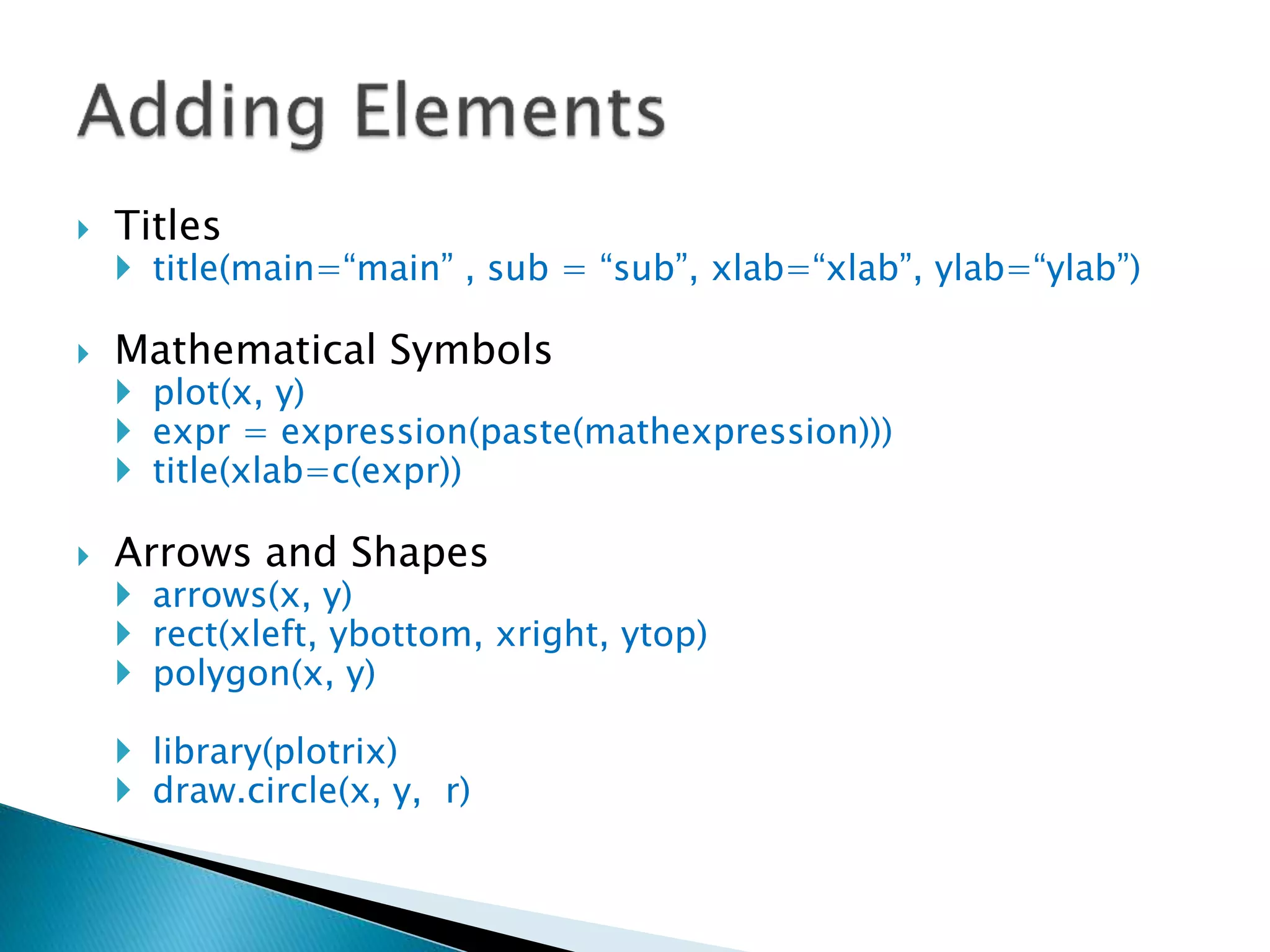
 Titles
 title(main=“main” , sub = “sub”, xlab=“xlab”, ylab=“ylab”)
 Mathematical Symbols
 plot(x, y)
 expr = expression(paste(mathexpression)))
 title(xlab=c(expr))
 Arrows and Shapes
 arrows(x, y)
 rect(xleft, ybottom, xright, ytop)
 polygon(x, y)
 library(plotrix)
 draw.circle(x, y, r)
 Line styles, line width and colors
 plot(….)
 lines(x, y, lty=ltyval, lwd = lwdval,
col=colval)
col Default plotting color. Some functions (e.g. lines)
accept a vector of values that are recycled.
col.axis color for axis annotation
col.lab color for x and y labels
col.main color for titles
col.sub color for subtitles
fg plot foreground color (axes, boxes - also sets col= to
same)
bg plot background color
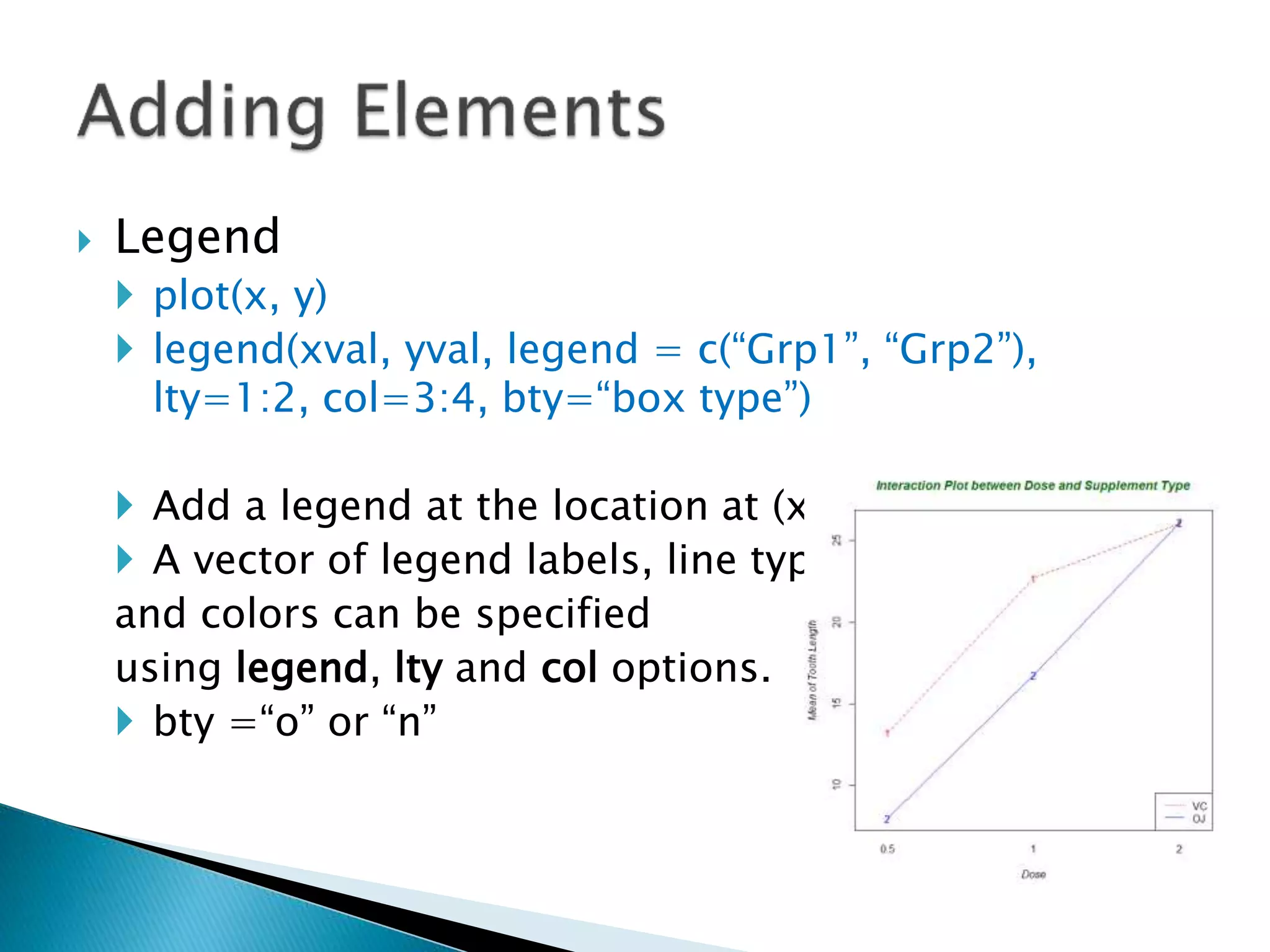
 Legend
 plot(x, y)
 legend(xval, yval, legend = c(“Grp1”, “Grp2”),
lty=1:2, col=3:4, bty=“box type”)
 Add a legend at the location at (xval, yval)
 A vector of legend labels, line types,
and colors can be specified
using legend, lty and col options.
 bty =“o” or “n”
 Adding Points or Lines to an Existing Graphic
 plot(x, y)
 points(x, y)
 lines(x, y, type=“type”)
type =
 p points
 l lines
 o overplotted points and lines
 b, c points (empty if "c") joined by lines
 s, S stair steps
 h histogram-like vertical lines
 n does not produce any points or lines
 OLS line fit to the points
 plot(x, y)
 abline(lm(y~x))
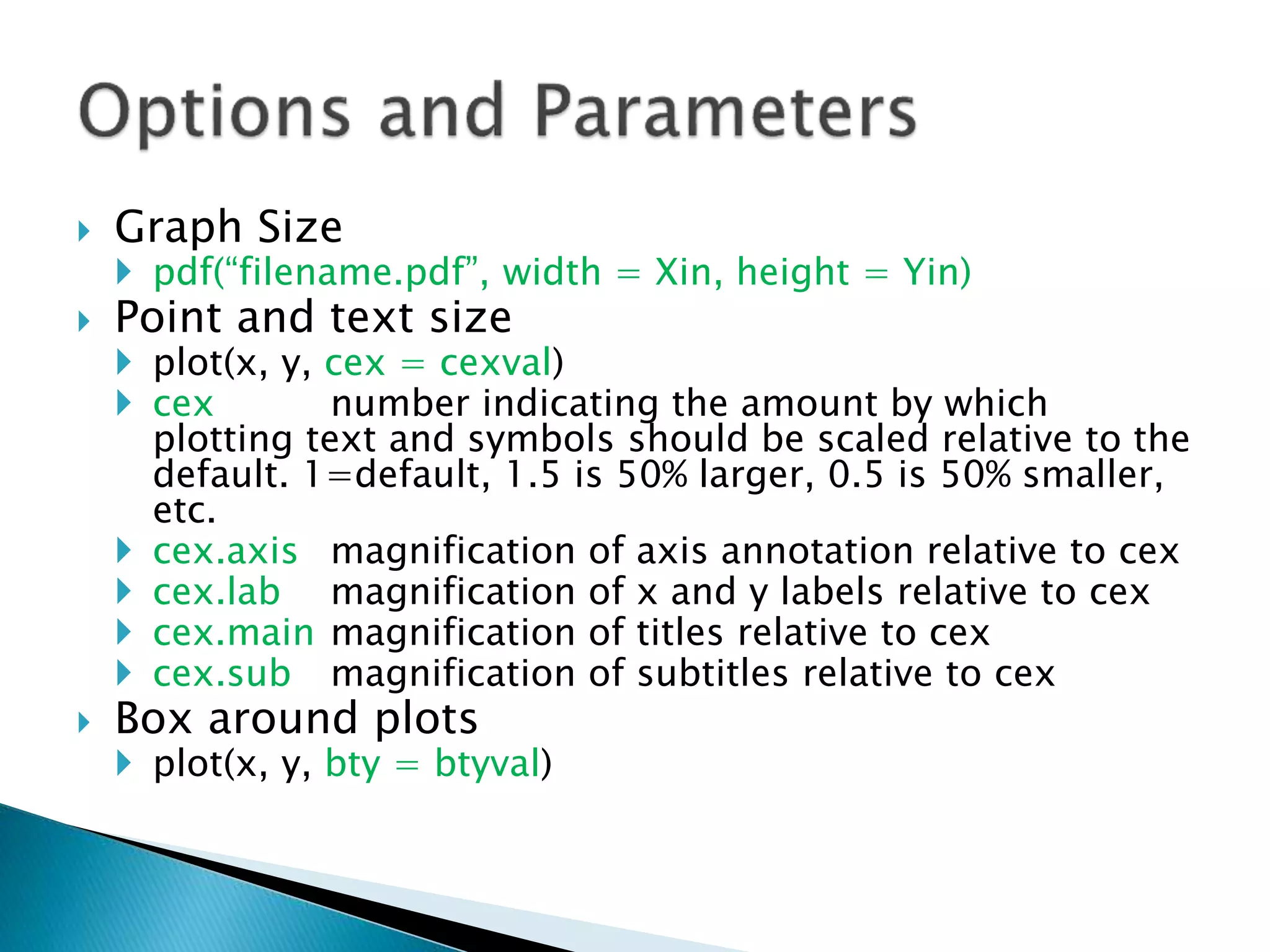
 Graph Size
 pdf(“filename.pdf”, width = Xin, height = Yin)
 Point and text size
 plot(x, y, cex = cexval)
 cex number indicating the amount by which
plotting text and symbols should be scaled relative to the
default. 1=default, 1.5 is 50% larger, 0.5 is 50% smaller,
etc.
 cex.axis magnification of axis annotation relative to cex
 cex.lab magnification of x and y labels relative to cex
 cex.main magnification of titles relative to cex
 cex.sub magnification of subtitles relative to cex
 Box around plots
 plot(x, y, bty = btyval)
 Axis labels, values, and tick marks
◦ plot(x, y, lab=c(x, y, len), #number of tick marks
las=lasval, #orientation of tick marks
tck = tckval, #length of tick marks
xaxp = c(x1, x2, n), #coordinates of the extreme tick
marks
yaxp = c(x1, x2, n),
xlab = “X axis label”, ylab=“Y axis label”)
◦ las = 0 labels are parallel to axis
◦ las=2 labels are perpendicular to axis
◦ tck = 0 suppresses the tick mark
 Axis Range and Style
◦ plot(x, y, xlim = c(minx, maxx), ylim = c (miny, maxy),
xaxs=“i”, yaxs=“i”)
 The xaxs and yaxs control whether the tick marks extend
beyond the limits of the plotted observations (default) or are
constrained to be internal (“i”)
 See also:
 axis()
 mtext()
 Omit axis
◦ plot(x, y, xaxt = “n”, yaxy=“n”)
 Fonts
 font Integer specifying font to use for text.
1=plain, 2=bold, 3=italic, 4=bold italic,
5=symbol
 font.axis font for axis annotation
 font.lab font for x and y labels
 font.main font for titles
 font.sub font for subtitles
 ps font point size (roughly 1/72 inch)
text size=ps*cex
 family font family for drawing text. Standard values
are "serif", "sans", "mono", "symbol".
 More on how to change colors
◦ You can specify colors in R by index, name,
hexadecimal, or RGB.
◦ For example col=1, col="white", and col="#FFFFFF"
are equivalent.
◦ colors() #list of color names
 The number of plots on a page, and their placement on the page,
can be controlled using par() or layout().
 The number of figure regions can be controlled using mfrow and
mfcol.
e.g. par(mfrow=c(3,2)) # Creates 6 figures arranged in
3 rows and 2 columns
 layout() allows the creation of multiple figure regions of unequal
sizes.
e.g. layout(matrix(c(1,2)), heights=c(2,1))
 Many statistical functions (regression, cluster
analysis) create special objects. These arguments
will automatically format graphical output in a
specific way.
 e.g. Produce diagnostic plots from a linear model
analysis (see R code)
# Reg = lm()
# plot(Reg)
 hclust()
 agnes() # hierarchical cluster analysis
 Specify destination of graphics output or simply right
click and copy
 Could be files
◦ Not Scalable
 JPG # not recommended, introduces blurry artifacts
around the lines
 BMP
 PNG
◦ Scalable:
 Postscript # preferred in LaTex
 Pdf # great for posters
 pdf(“file.pdf”)
 plot(….)
 dev.off()
 jpeg(“file.jpeg”)
 plot(…)
 dev.off()
 win.metafile(file.wmf)
 plot(…)
 dev.off()
 Similar code for BMP, TIFF, PNG, POSTSCRIPT
 PNG is usually recommended
 The dev.off() function is used to close the graphical device

R graphics

  • 2.
     Quantile-quantile plots qqnorm(x) qqline(x) Quantile– Quantile-Quantile plot qqplot(x, y)
  • 3.
     Barplot barplot(table(x1, x2),legend=c(“x1.grp1", “x1.grp2"), xlab="X2“, beside=TRUE) Or library(lattice) barchart(table(x1,x2,x3))
  • 4.
     Boxplots andViolin Plots boxplot(x)  horizontal = TRUE library(vioplot) vioplot(x1, x2, x3) • Side-by-side boxplots boxplot(y~x) Or library(lattice) bwplot(y~x)
  • 5.
     Interaction plot Display means by 2 variables (in a two-way analysis of variance) interaction.plot(x1, x2, y)  fun (option to change default statistic which is the mean)
  • 6.
     Empirical probabilitydensity plot  Density plots are non-parametric estimates of the empirical probability density function  #univariate density plot(density(x))  One could compare groups by looking at kernel density plots
  • 7.
     3 –D plots persp(x, y, z) contour(x, y, z) Image(x, y, z) OR library(scatterplot3d) scatterplot3d(x, y, z)  The values for x and y must be in ascending order
  • 8.
     A listof graphical parameters that define the default behavior of all plot functions.  Just like other R objects, par elements are similarly modifiable, with slightly different syntax. ◦ e.g. par(“bg”=“lightcyan”) ◦ This would change the background color of all subsequent plots to light cyan  When par elements are modified directly (as above, this changes all subsequent plotting behavior.
  • 9.
     Size ofmargins ◦ par(mar=c(bot, left, top, right))  Save graphical settings ◦ par() #view currents settings ◦ opar <- par() #make a copy of current settings ◦ par(opar) #restore original settings  Multiple plots per page ◦ par(mfrow=c(a, b)) #a rows and b columns ◦ par(mfcol=c(a,b))
  • 10.
     bg –plot background color  lty – line type (e.g. dot, dash, solid)  lwd – line width  col – color  cex – text size inside plot  xlab, ylab – axes labels  main – title  pch – plotting symbol
  • 11.
     Add anarbitrary straight line:  plot(x, y)  abline(intercept, slope)  Plot symbols  plot(x, y, pch=pchval) PCH symbols used in R  “col=“ and “bg=” are also specified  PCH can also be in characters such as “A”, “a”, “%” etc.
  • 12.
     Titles  title(main=“main”, sub = “sub”, xlab=“xlab”, ylab=“ylab”)  Mathematical Symbols  plot(x, y)  expr = expression(paste(mathexpression)))  title(xlab=c(expr))  Arrows and Shapes  arrows(x, y)  rect(xleft, ybottom, xright, ytop)  polygon(x, y)  library(plotrix)  draw.circle(x, y, r)
  • 14.
     Line styles,line width and colors  plot(….)  lines(x, y, lty=ltyval, lwd = lwdval, col=colval) col Default plotting color. Some functions (e.g. lines) accept a vector of values that are recycled. col.axis color for axis annotation col.lab color for x and y labels col.main color for titles col.sub color for subtitles fg plot foreground color (axes, boxes - also sets col= to same) bg plot background color
  • 15.
     Legend  plot(x,y)  legend(xval, yval, legend = c(“Grp1”, “Grp2”), lty=1:2, col=3:4, bty=“box type”)  Add a legend at the location at (xval, yval)  A vector of legend labels, line types, and colors can be specified using legend, lty and col options.  bty =“o” or “n”
  • 16.
     Adding Pointsor Lines to an Existing Graphic  plot(x, y)  points(x, y)  lines(x, y, type=“type”) type =  p points  l lines  o overplotted points and lines  b, c points (empty if "c") joined by lines  s, S stair steps  h histogram-like vertical lines  n does not produce any points or lines  OLS line fit to the points  plot(x, y)  abline(lm(y~x))
  • 17.
     Graph Size pdf(“filename.pdf”, width = Xin, height = Yin)  Point and text size  plot(x, y, cex = cexval)  cex number indicating the amount by which plotting text and symbols should be scaled relative to the default. 1=default, 1.5 is 50% larger, 0.5 is 50% smaller, etc.  cex.axis magnification of axis annotation relative to cex  cex.lab magnification of x and y labels relative to cex  cex.main magnification of titles relative to cex  cex.sub magnification of subtitles relative to cex  Box around plots  plot(x, y, bty = btyval)
  • 18.
     Axis labels,values, and tick marks ◦ plot(x, y, lab=c(x, y, len), #number of tick marks las=lasval, #orientation of tick marks tck = tckval, #length of tick marks xaxp = c(x1, x2, n), #coordinates of the extreme tick marks yaxp = c(x1, x2, n), xlab = “X axis label”, ylab=“Y axis label”) ◦ las = 0 labels are parallel to axis ◦ las=2 labels are perpendicular to axis ◦ tck = 0 suppresses the tick mark
  • 19.
     Axis Rangeand Style ◦ plot(x, y, xlim = c(minx, maxx), ylim = c (miny, maxy), xaxs=“i”, yaxs=“i”)  The xaxs and yaxs control whether the tick marks extend beyond the limits of the plotted observations (default) or are constrained to be internal (“i”)  See also:  axis()  mtext()  Omit axis ◦ plot(x, y, xaxt = “n”, yaxy=“n”)
  • 20.
     Fonts  fontInteger specifying font to use for text. 1=plain, 2=bold, 3=italic, 4=bold italic, 5=symbol  font.axis font for axis annotation  font.lab font for x and y labels  font.main font for titles  font.sub font for subtitles  ps font point size (roughly 1/72 inch) text size=ps*cex  family font family for drawing text. Standard values are "serif", "sans", "mono", "symbol".
  • 21.
     More onhow to change colors ◦ You can specify colors in R by index, name, hexadecimal, or RGB. ◦ For example col=1, col="white", and col="#FFFFFF" are equivalent. ◦ colors() #list of color names
  • 22.
     The numberof plots on a page, and their placement on the page, can be controlled using par() or layout().  The number of figure regions can be controlled using mfrow and mfcol. e.g. par(mfrow=c(3,2)) # Creates 6 figures arranged in 3 rows and 2 columns  layout() allows the creation of multiple figure regions of unequal sizes. e.g. layout(matrix(c(1,2)), heights=c(2,1))
  • 23.
     Many statisticalfunctions (regression, cluster analysis) create special objects. These arguments will automatically format graphical output in a specific way.  e.g. Produce diagnostic plots from a linear model analysis (see R code) # Reg = lm() # plot(Reg)  hclust()  agnes() # hierarchical cluster analysis
  • 24.
     Specify destinationof graphics output or simply right click and copy  Could be files ◦ Not Scalable  JPG # not recommended, introduces blurry artifacts around the lines  BMP  PNG ◦ Scalable:  Postscript # preferred in LaTex  Pdf # great for posters
  • 25.
     pdf(“file.pdf”)  plot(….) dev.off()  jpeg(“file.jpeg”)  plot(…)  dev.off()  win.metafile(file.wmf)  plot(…)  dev.off()  Similar code for BMP, TIFF, PNG, POSTSCRIPT  PNG is usually recommended  The dev.off() function is used to close the graphical device