Types of
Handoffs
BY
228T1A0403
228T1A0404
228T1A0405
228T1A0406
Introduction
• A handoff (or handover) is the process of transferring an ongoing call or
data session from one base station to another as a mobile user moves.
• Ensures uninterrupted communication in cellular networks.
• Handoff (or handover) is a crucial process in cellular mobile
communication that ensures seamless and uninterrupted service as
users move across different coverage areas.
• It refers to the procedure where an active call, data session, or
communication is transferred from one cell tower or base station to
another without disrupting the ongoing service.
• Handoff mechanisms are designed to maintain a continuous connection as
users travel through the coverage zones of various base stations within a
network or switch between different networks.
Types of Handoffs (Overview)
01
04
02
03
Hard Handoff Soft Handoff
Horizontal Handoff –
Between same
network types
Vertical Handoff –
Between different
network types
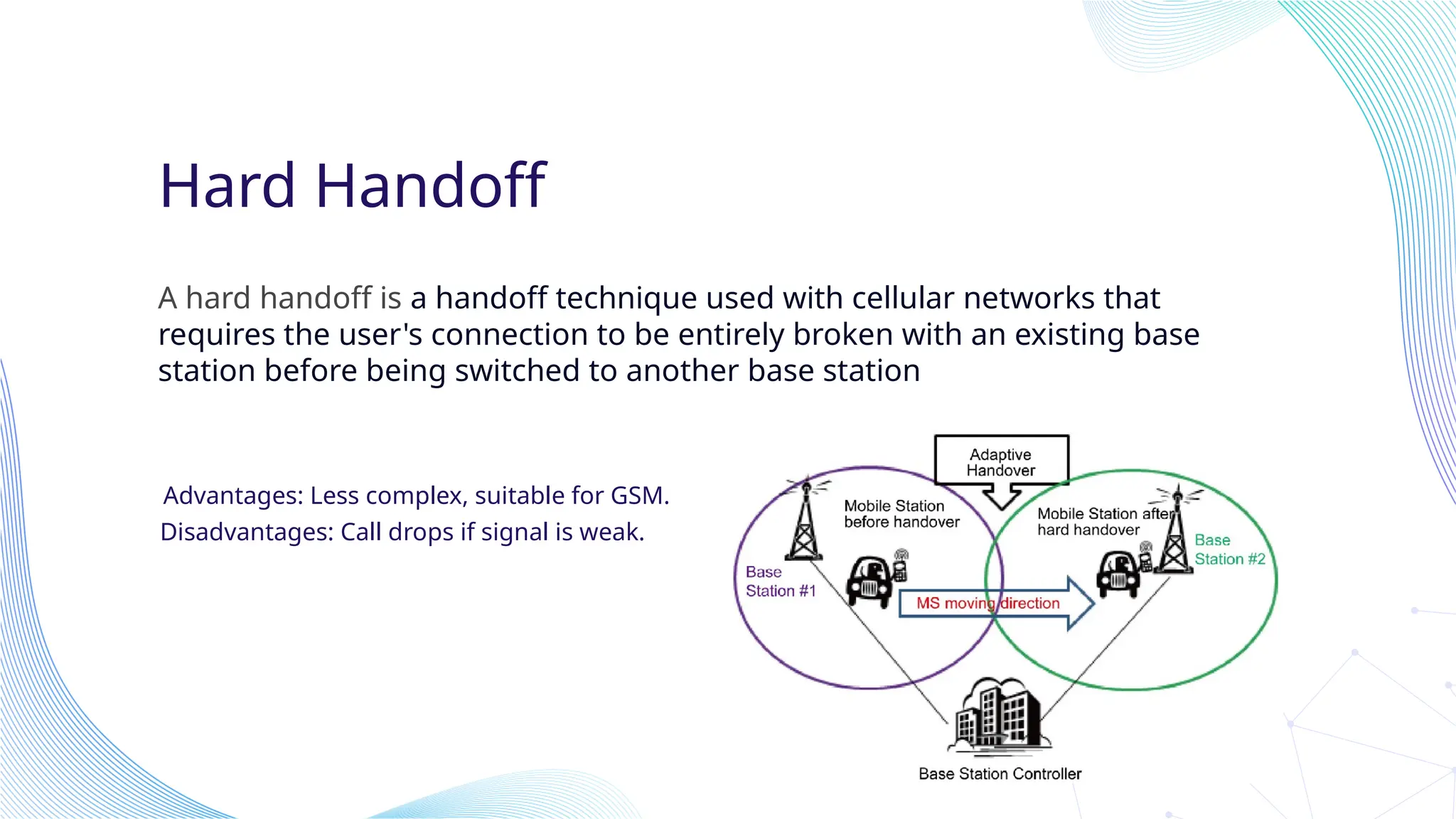
Hard Handoff
A hard handoff is a handoff technique used with cellular networks that
requires the user's connection to be entirely broken with an existing base
station before being switched to another base station
Advantages: Less complex, suitable for GSM.
Disadvantages: Call drops if signal is weak.
Soft hand off
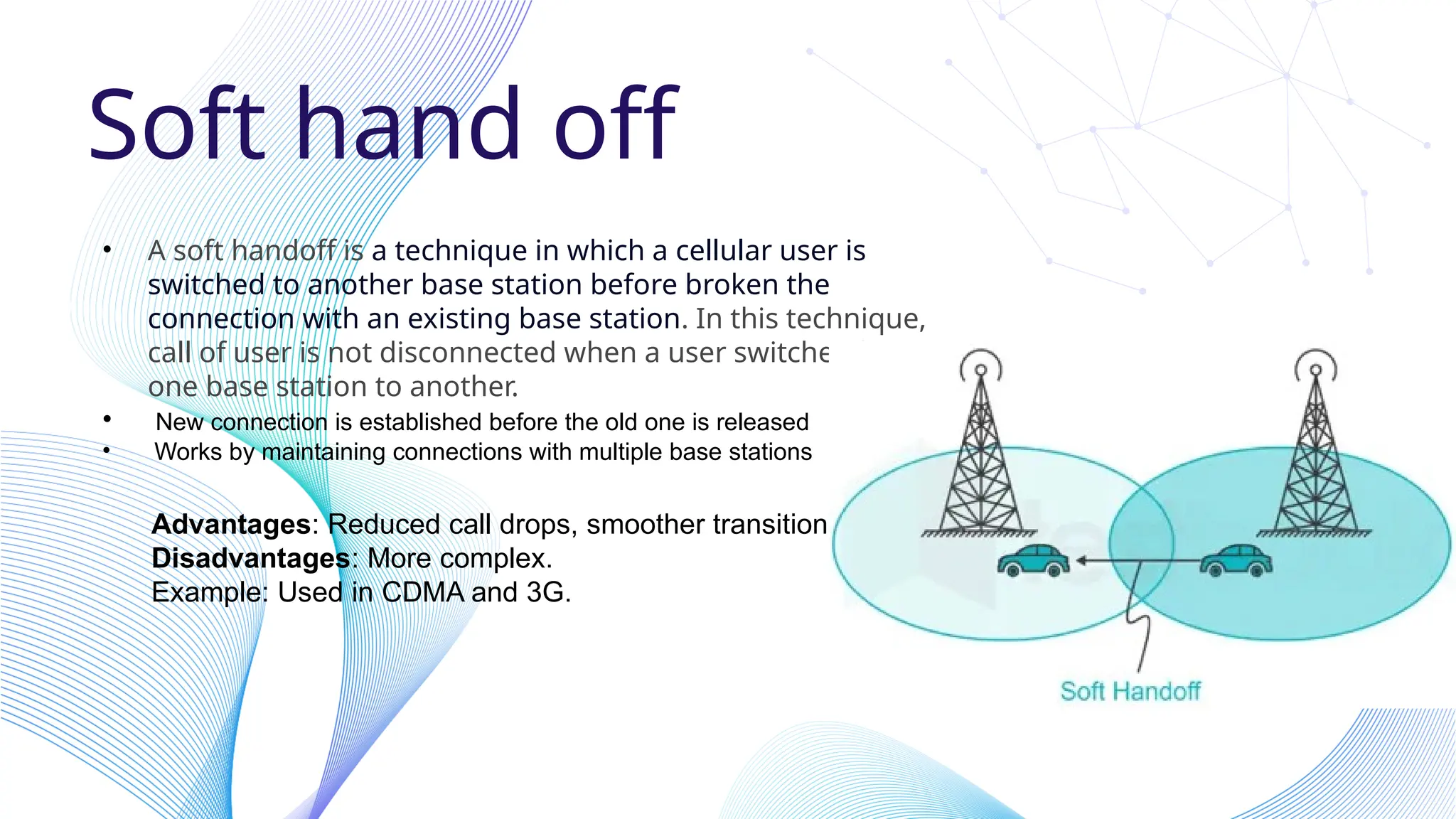
• A soft handoff is a technique in which a cellular user is
switched to another base station before broken the
connection with an existing base station. In this technique,
call of user is not disconnected when a user switches from
one base station to another.
• New connection is established before the old one is released
• Works by maintaining connections with multiple base stations
Advantages: Reduced call drops, smoother transition.
Disadvantages: More complex.
Example: Used in CDMA and 3G.
Horinzontal Hand-off
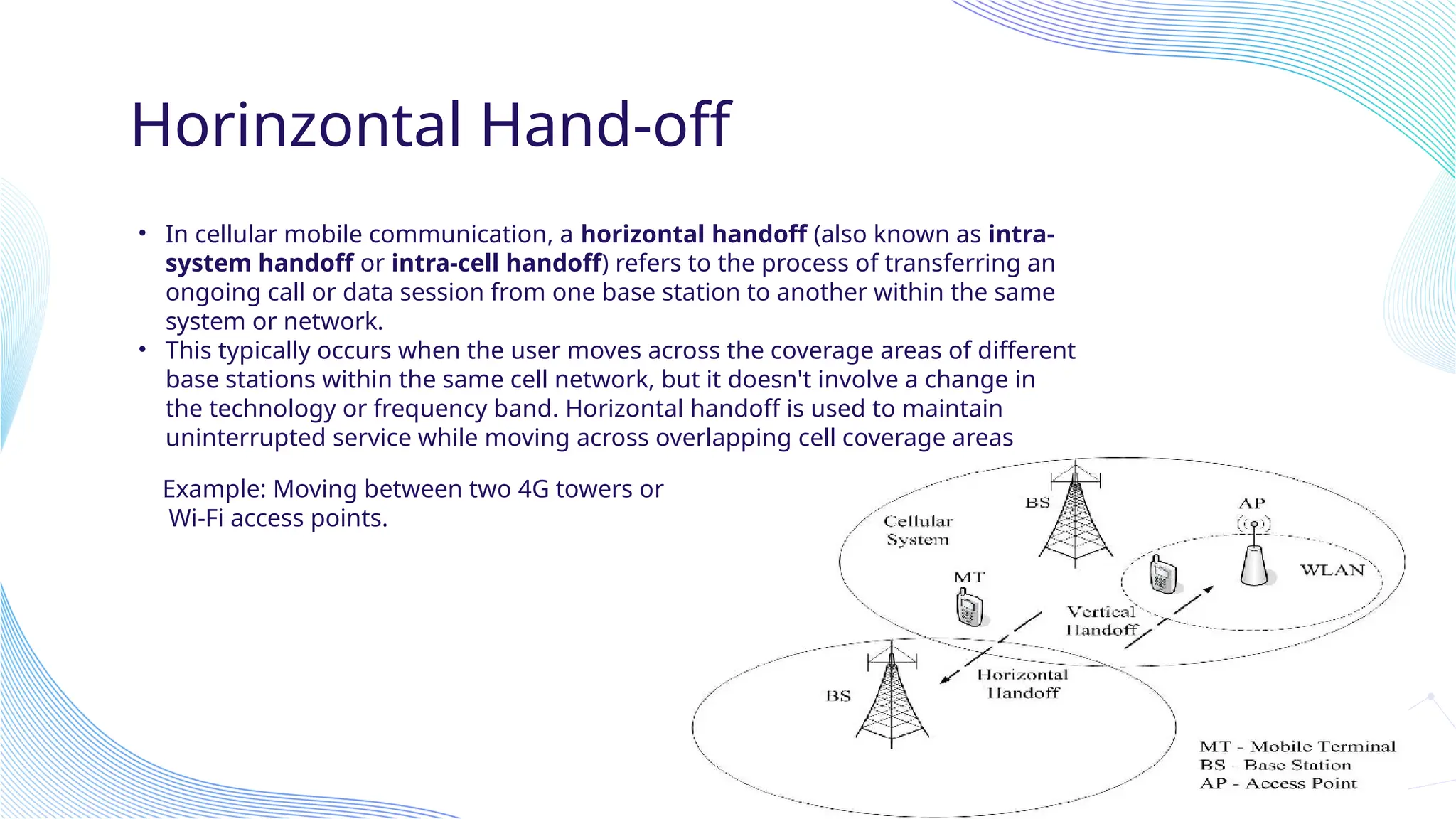
• In cellular mobile communication, a horizontal handoff (also known as intra-
system handoff or intra-cell handoff) refers to the process of transferring an
ongoing call or data session from one base station to another within the same
system or network.
• This typically occurs when the user moves across the coverage areas of different
base stations within the same cell network, but it doesn't involve a change in
the technology or frequency band. Horizontal handoff is used to maintain
uninterrupted service while moving across overlapping cell coverage areas
Example: Moving between two 4G towers or
Wi-Fi access points.
Vertical Handoff
vertical handoff (also called inter-system handoff or inter-network handoff) refers to the
process of transferring an ongoing call or data session between different types of networks or
technologies. Unlike horizontal handoff (intra-system), vertical handoff occurs when a mobile
device moves between networks that use different communication technologies, such as from a
2G (GSM) to a 3G (UMTS), 4G (LTE), or even a Wi-Fi network. Vertical handoff is crucial in
providing seamless connectivity when users transition across different network types.
Example: Switching from Wi-Fi to 4G when leaving a Wi-Fi
zone.
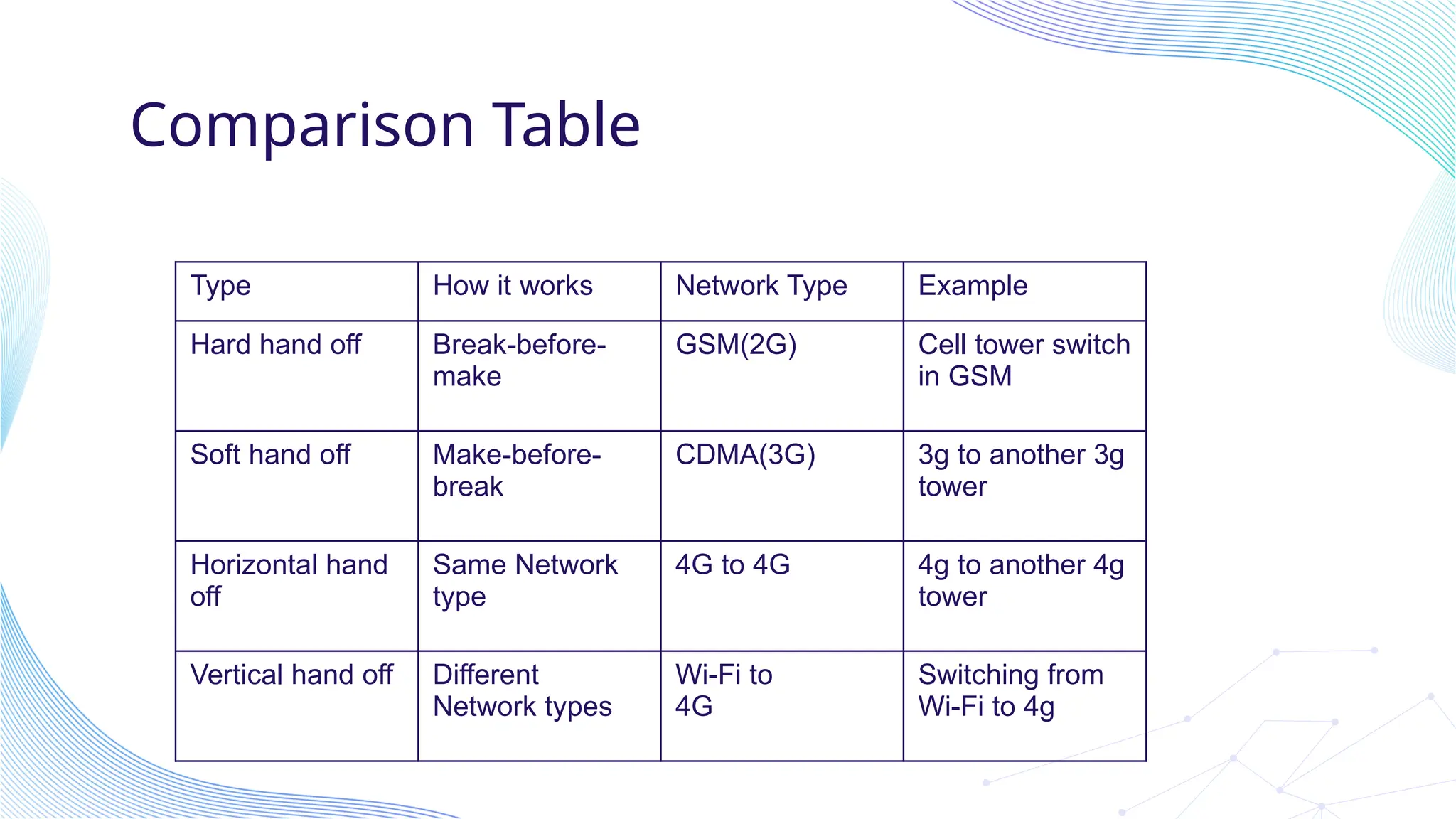
Comparison Table
Type How it works Network Type Example
Hard hand off Break-before-
make
GSM(2G) Cell tower switch
in GSM
Soft hand off Make-before-
break
CDMA(3G) 3g to another 3g
tower
Horizontal hand
off
Same Network
type
4G to 4G 4g to another 4g
tower
Vertical hand off Different
Network types
Wi-Fi to
4G
Switching from
Wi-Fi to 4g
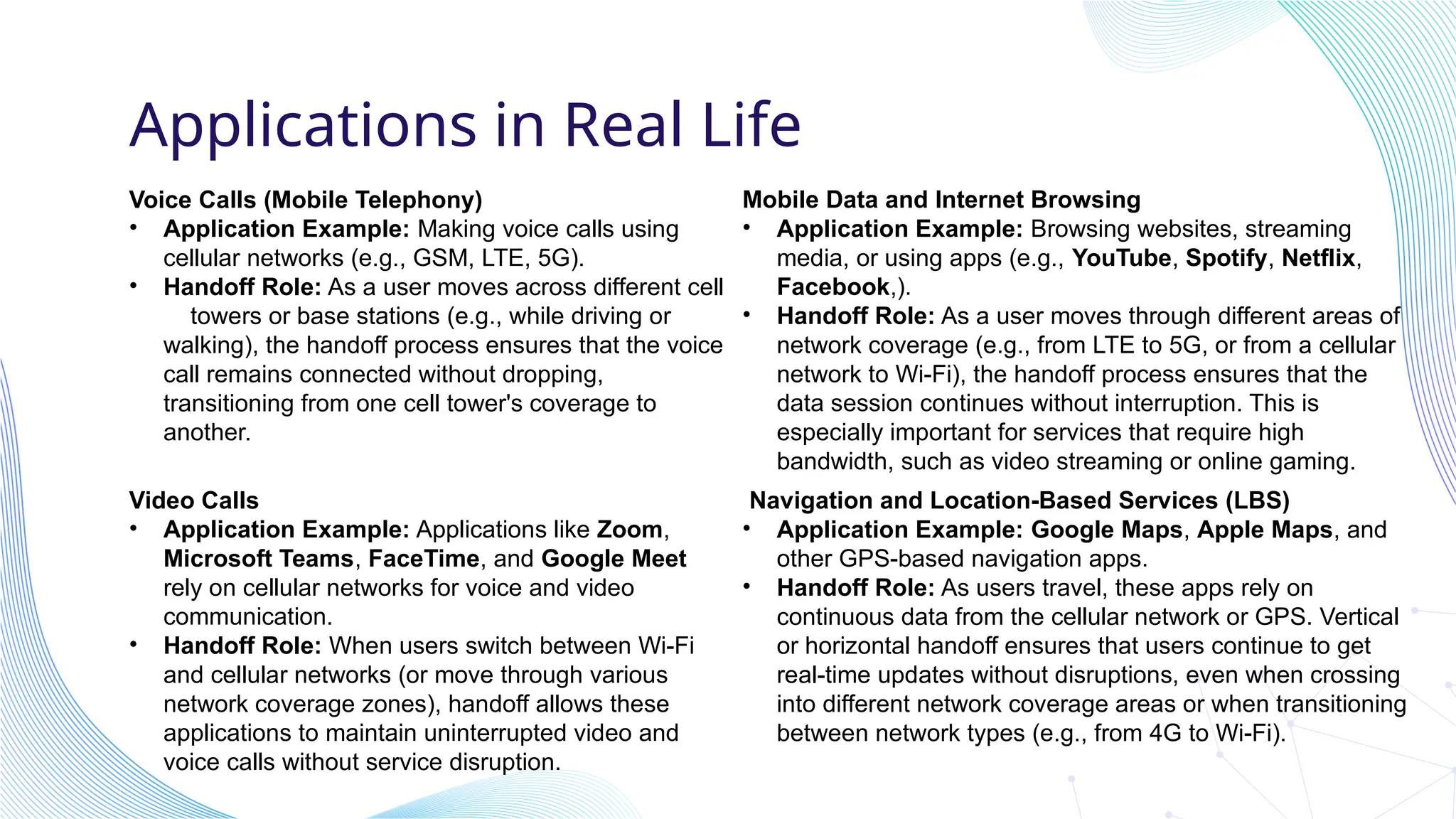
Applications in Real Life
Voice Calls (Mobile Telephony)
• Application Example: Making voice calls using
cellular networks (e.g., GSM, LTE, 5G).
• Handoff Role: As a user moves across different cell
towers or base stations (e.g., while driving or
walking), the handoff process ensures that the voice
call remains connected without dropping,
transitioning from one cell tower's coverage to
another.
Video Calls
• Application Example: Applications like Zoom,
Microsoft Teams, FaceTime, and Google Meet
rely on cellular networks for voice and video
communication.
• Handoff Role: When users switch between Wi-Fi
and cellular networks (or move through various
network coverage zones), handoff allows these
applications to maintain uninterrupted video and
voice calls without service disruption.
Mobile Data and Internet Browsing
• Application Example: Browsing websites, streaming
media, or using apps (e.g., YouTube, Spotify, Netflix,
Facebook,).
• Handoff Role: As a user moves through different areas of
network coverage (e.g., from LTE to 5G, or from a cellular
network to Wi-Fi), the handoff process ensures that the
data session continues without interruption. This is
especially important for services that require high
bandwidth, such as video streaming or online gaming.
Navigation and Location-Based Services (LBS)
• Application Example: Google Maps, Apple Maps, and
other GPS-based navigation apps.
• Handoff Role: As users travel, these apps rely on
continuous data from the cellular network or GPS. Vertical
or horizontal handoff ensures that users continue to get
real-time updates without disruptions, even when crossing
into different network coverage areas or when transitioning
between network types (e.g., from 4G to Wi-Fi).
Future Trends in Handoff Technology
 5G and Beyond (6G) Networks
• Enhanced Handoff Mechanisms
• Ultra-low Latency Handoff
• Network Slicing
 AI and Machine Learning for Intelligent Handoff Decisions
• AI-powered Handoff Algorithms
• Context-Aware Handoff
 Seamless Vertical Handoff (Between Cellular and Wi-Fi
Networks)
• Wi-Fi 6 and Wi-Fi 7 Integration
• 5G and Wi-Fi Integration
 Edge Computing and Handoff
 Autonomous Vehicles and Drones
 Massive IoT and 5G Connectivity
conclusion
Vertical handoff enables seamless transitions between different network types, ensuring
continuous service for mobile users. It is essential for maintaining reliable connectivity in
environments with mixed network coverage (e.g., areas with both cellular and Wi-Fi
networks). The key challenge in vertical handoff is ensuring smooth, seamless transitions
while maintaining quality and minimizing service disruptions, which is crucial for real-time
services like voice calls, video streaming, and online gaming.
Thanks!

Types of handsoff are being discussed.pptx

  • 1.
  • 2.
    Introduction • A handoff(or handover) is the process of transferring an ongoing call or data session from one base station to another as a mobile user moves. • Ensures uninterrupted communication in cellular networks. • Handoff (or handover) is a crucial process in cellular mobile communication that ensures seamless and uninterrupted service as users move across different coverage areas. • It refers to the procedure where an active call, data session, or communication is transferred from one cell tower or base station to another without disrupting the ongoing service. • Handoff mechanisms are designed to maintain a continuous connection as users travel through the coverage zones of various base stations within a network or switch between different networks.
  • 3.
    Types of Handoffs(Overview) 01 04 02 03 Hard Handoff Soft Handoff Horizontal Handoff – Between same network types Vertical Handoff – Between different network types
  • 4.
    Hard Handoff A hardhandoff is a handoff technique used with cellular networks that requires the user's connection to be entirely broken with an existing base station before being switched to another base station Advantages: Less complex, suitable for GSM. Disadvantages: Call drops if signal is weak.
  • 5.
    Soft hand off •A soft handoff is a technique in which a cellular user is switched to another base station before broken the connection with an existing base station. In this technique, call of user is not disconnected when a user switches from one base station to another. • New connection is established before the old one is released • Works by maintaining connections with multiple base stations Advantages: Reduced call drops, smoother transition. Disadvantages: More complex. Example: Used in CDMA and 3G.
  • 6.
    Horinzontal Hand-off • Incellular mobile communication, a horizontal handoff (also known as intra- system handoff or intra-cell handoff) refers to the process of transferring an ongoing call or data session from one base station to another within the same system or network. • This typically occurs when the user moves across the coverage areas of different base stations within the same cell network, but it doesn't involve a change in the technology or frequency band. Horizontal handoff is used to maintain uninterrupted service while moving across overlapping cell coverage areas Example: Moving between two 4G towers or Wi-Fi access points.
  • 7.
    Vertical Handoff vertical handoff(also called inter-system handoff or inter-network handoff) refers to the process of transferring an ongoing call or data session between different types of networks or technologies. Unlike horizontal handoff (intra-system), vertical handoff occurs when a mobile device moves between networks that use different communication technologies, such as from a 2G (GSM) to a 3G (UMTS), 4G (LTE), or even a Wi-Fi network. Vertical handoff is crucial in providing seamless connectivity when users transition across different network types. Example: Switching from Wi-Fi to 4G when leaving a Wi-Fi zone.
  • 8.
    Comparison Table Type Howit works Network Type Example Hard hand off Break-before- make GSM(2G) Cell tower switch in GSM Soft hand off Make-before- break CDMA(3G) 3g to another 3g tower Horizontal hand off Same Network type 4G to 4G 4g to another 4g tower Vertical hand off Different Network types Wi-Fi to 4G Switching from Wi-Fi to 4g
  • 9.
    Applications in RealLife Voice Calls (Mobile Telephony) • Application Example: Making voice calls using cellular networks (e.g., GSM, LTE, 5G). • Handoff Role: As a user moves across different cell towers or base stations (e.g., while driving or walking), the handoff process ensures that the voice call remains connected without dropping, transitioning from one cell tower's coverage to another. Video Calls • Application Example: Applications like Zoom, Microsoft Teams, FaceTime, and Google Meet rely on cellular networks for voice and video communication. • Handoff Role: When users switch between Wi-Fi and cellular networks (or move through various network coverage zones), handoff allows these applications to maintain uninterrupted video and voice calls without service disruption. Mobile Data and Internet Browsing • Application Example: Browsing websites, streaming media, or using apps (e.g., YouTube, Spotify, Netflix, Facebook,). • Handoff Role: As a user moves through different areas of network coverage (e.g., from LTE to 5G, or from a cellular network to Wi-Fi), the handoff process ensures that the data session continues without interruption. This is especially important for services that require high bandwidth, such as video streaming or online gaming. Navigation and Location-Based Services (LBS) • Application Example: Google Maps, Apple Maps, and other GPS-based navigation apps. • Handoff Role: As users travel, these apps rely on continuous data from the cellular network or GPS. Vertical or horizontal handoff ensures that users continue to get real-time updates without disruptions, even when crossing into different network coverage areas or when transitioning between network types (e.g., from 4G to Wi-Fi).
  • 10.
    Future Trends inHandoff Technology  5G and Beyond (6G) Networks • Enhanced Handoff Mechanisms • Ultra-low Latency Handoff • Network Slicing  AI and Machine Learning for Intelligent Handoff Decisions • AI-powered Handoff Algorithms • Context-Aware Handoff  Seamless Vertical Handoff (Between Cellular and Wi-Fi Networks) • Wi-Fi 6 and Wi-Fi 7 Integration • 5G and Wi-Fi Integration  Edge Computing and Handoff  Autonomous Vehicles and Drones  Massive IoT and 5G Connectivity
  • 11.
    conclusion Vertical handoff enablesseamless transitions between different network types, ensuring continuous service for mobile users. It is essential for maintaining reliable connectivity in environments with mixed network coverage (e.g., areas with both cellular and Wi-Fi networks). The key challenge in vertical handoff is ensuring smooth, seamless transitions while maintaining quality and minimizing service disruptions, which is crucial for real-time services like voice calls, video streaming, and online gaming.
  • 12.