Types of electric vehicles
What we will learn in this presentation ?
• Electric vehicle
• Types of electric vehicle
• Hybrid electric vehicle
• Types of Hybrid electric vehicle
• Fuel Cell electric vehicle
What do you mean by electric vehicle :
• BEVs are also known as All-Electric Vehicles (AEV). Electric Vehicles using BEV technology run entirely on a
battery-powered electric drivetrain. The electricity used to drive the vehicle is stored in a large battery pack which
can be charged by plugging into the electricity grid. The charged battery pack then provides power to one or more
electric motors to run the electric car.
• Main Components of BEV:
• Electric motor, Inverter, Battery, Control Module, Drive train
• Working Principles of BEV:
• The power for the electric motor is converted from the DC Battery to AC. As the accelerator is pressed, a signal is
sent to the controller. The controller adjusts the speed of the vehicle by changing the frequency of the AC power
from the inverter to the motor. The motor then connects and leads to the turning of wheels , If the brakes are
pressed, or the electric car is decelerating, the motor becomes an alternator and produces power, which is sent
back to the battery
• Examples of BEV:
• MG ZS, TATA Nexon ev , TATA Tigor ev, Mahindra E20 plus, Hyundai Kona, Mahindra eVerito
This Photo by Unknown Author is licensed under CC BY-NC
This Photo by Unknown Author is licensed under
CC BY-NC-ND
Types of electric vehicle :
• There are four types of electric vehicles available:
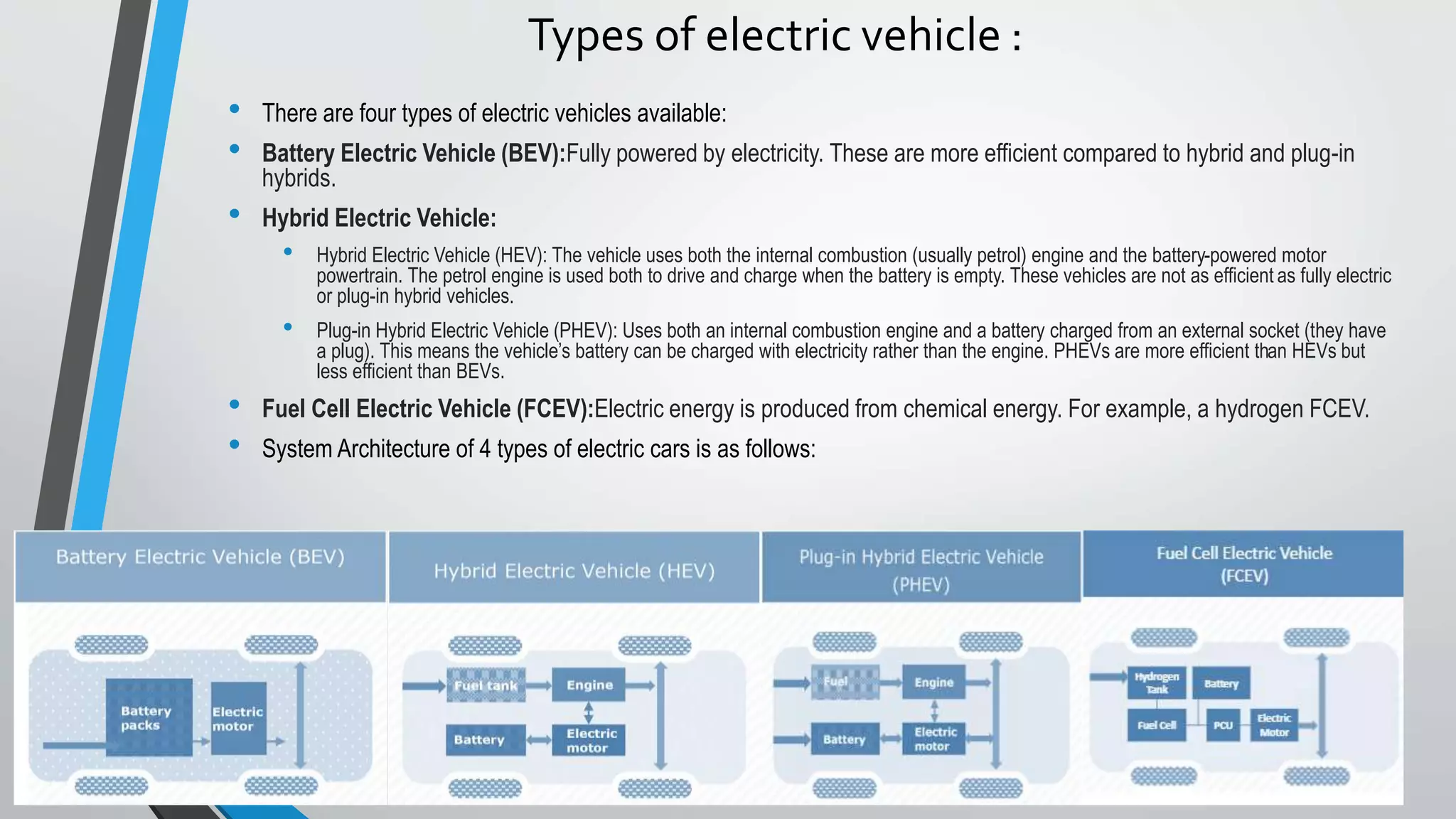
• Battery Electric Vehicle (BEV):Fully powered by electricity. These are more efficient compared to hybrid and plug-in
hybrids.
• Hybrid Electric Vehicle:
• Hybrid Electric Vehicle (HEV): The vehicle uses both the internal combustion (usually petrol) engine and the battery-powered motor
powertrain. The petrol engine is used both to drive and charge when the battery is empty. These vehicles are not as efficient as fully electric
or plug-in hybrid vehicles.
• Plug-in Hybrid Electric Vehicle (PHEV): Uses both an internal combustion engine and a battery charged from an external socket (they have
a plug). This means the vehicle’s battery can be charged with electricity rather than the engine. PHEVs are more efficient than HEVs but
less efficient than BEVs.
• Fuel Cell Electric Vehicle (FCEV):Electric energy is produced from chemical energy. For example, a hydrogen FCEV.
• System Architecture of 4 types of electric cars is as follows:
Hybrid electric vehicle :
• Hybrid Electric Vehicle (HEV):
• HEVs are also known as series hybrid or parallel hybrid. HEVs have both engine and electric motor. The
engine gets energy from fuel, and the motor gets electricity from batteries. The transmission is rotated
simultaneously by both engine and electric motor. This then drives the wheels.
• Main Components of HEV:
• Engine, Electric motor, Battery pack with controller & inverter, Fuel tank, Control module
• Working Principles of HEV:
• The fuel tank supplies energy to the engine like a regular car. The batteries run on an electric motor. Both the
engine and electric motor can turn the transmission at the same time.
• Examples of HEV:
• Volvo xc 90 , GrandVitara , Honda city eHev,Toyota camry, lexus ES300 h
Types of Hybrid Electric vehicles :
• The electric vehicle according to level of Hybridization.
* Micro Hybrid (not really electric )
* Mild Hybrid (assist the IC engine also helps to increase the mileage )
Ex : SHVS (Suzuki Hybrid Vehicle System)
* Strong / Full Hybrid (uses both electric as well as IC engine power)
* PHEV (Plug in Hybrid electric vehicle)
• Types of Hybrid electric vehicle
The type of HEV is determined by how the powertrain propels the vehicle down the road and
may be
* Series HEV
* Parallel HEV
* Series Parallel HEV
Plug-in Hybrid Electric Vehicle
(PHEV):
• The PHEVs They have both engine and a motor. You can choose among the fuels, conventional fuel (such as petrol) or alternative fuel
(such as bio-diesel). It can also be powered by a rechargeable battery pack. The battery can be charged externally.
• PHEVs can run in at least 2 modes:
• All-electric Mode, in which the motor and battery provide all the car’s energy
• Hybrid Mode, in which both electricity and petrol/diesel are employed
• Main Components of PHEV:
• Electric motor, Engine, Inverter, Battery, Fuel tank, Control module, Battery Charger (if onboard model)
• Working Principles of PHEV:
• PHEVs start-up in all-electric mode and make use of electricity until their battery pack is depleted. Once the battery gets drained, the
engine takes over, and the vehicle operates as a conventional, non-plug-in hybrid. PHEVs can be charged by plugging into an outside
electric power source, engine, or regenerative braking. When brakes are applied, the electric motor acts as a generator, using the energy
to charge the battery. The engine’s power is supplemented by the electric motor; as a result, smaller engines can be used, increasing the
car’s fuel efficiency without compromising performance.
• Examples of PHEV:
• Porsche Cayenne S E-Hybrid, BMW 330e, Porsche Panamera S E-hybrid, Chevy Volt, Chrysler Pacifica, Ford C-Max Energi , Mercedes
C350e, Mercedes S550e, Mercedes GLE550e, Mini Cooper SE Countryman, Ford Fusion Energi , Audi A3 E-Tron, BMW i8, BMW X5
xdrive40e, Fiat 500e, Hyundai Sonata, Kia Optima, Volvo XC90 T8.
Series (Extended-Range) Hybrid
• A series hybrid is like a battery electric vehicle
(BEV) in design. Here, the combustion engine
drives an electric generator instead of directly
driving the wheels. The generator both charges
a battery and powers an electric motor that
moves the vehicle. When large amounts of
power are required, the motor draws electricity
from both the battery and the generator. Series
hybrids may also be referred to as extended-
range electric vehicles (EREVs) or range-
extended electric vehicles (REEVs) since the
gas engine only generates electricity to be used
by the electric motor and never directly drives
the wheels. Modern examples include the
Cadillac ELR, Chevrolet Volt, and Fisker
Karma, Jaguar c-x75 concept car.
Parallel Hybrid
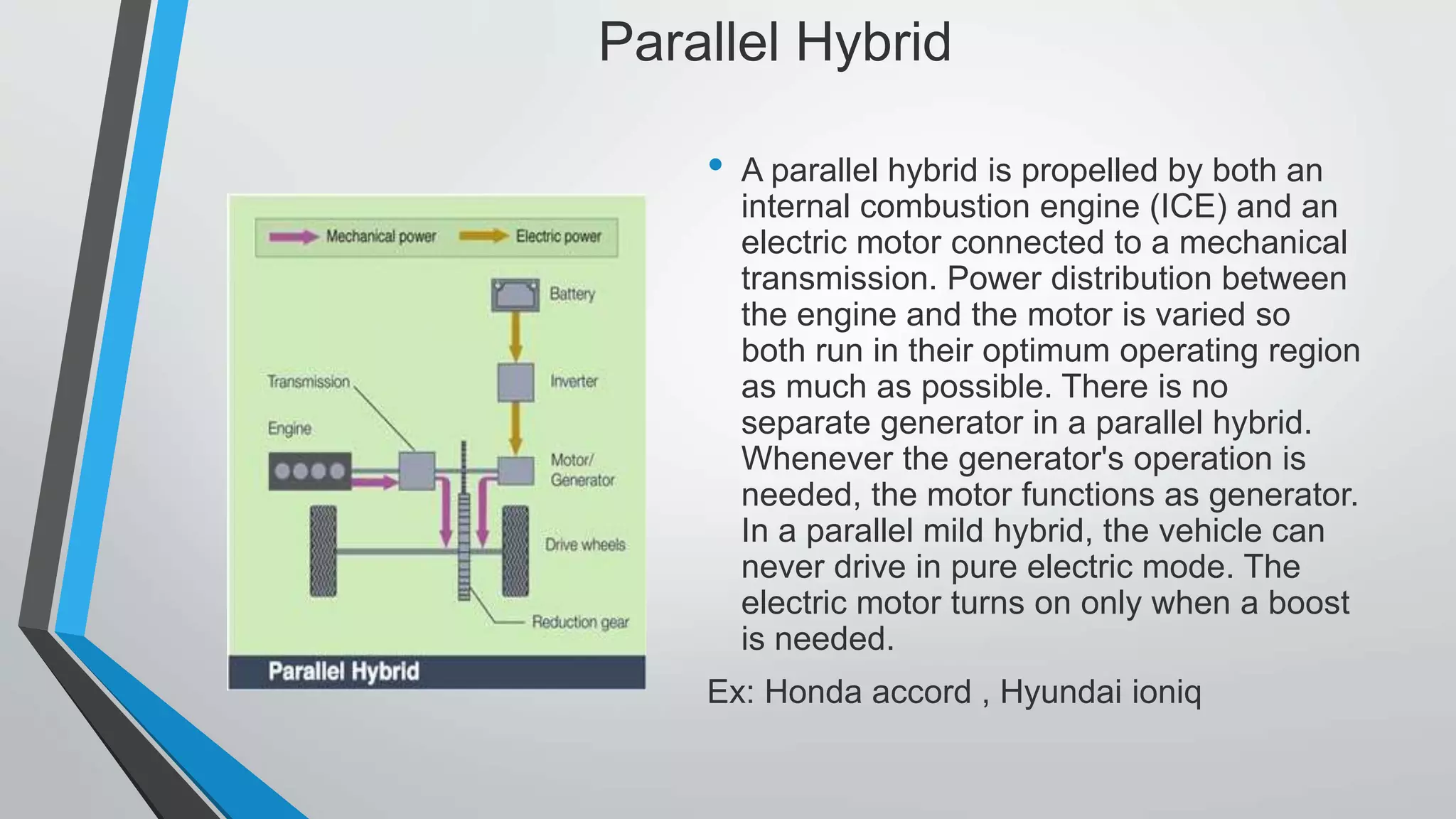
• A parallel hybrid is propelled by both an
internal combustion engine (ICE) and an
electric motor connected to a mechanical
transmission. Power distribution between
the engine and the motor is varied so
both run in their optimum operating region
as much as possible. There is no
separate generator in a parallel hybrid.
Whenever the generator's operation is
needed, the motor functions as generator.
In a parallel mild hybrid, the vehicle can
never drive in pure electric mode. The
electric motor turns on only when a boost
is needed.
Ex: Honda accord , Hyundai ioniq
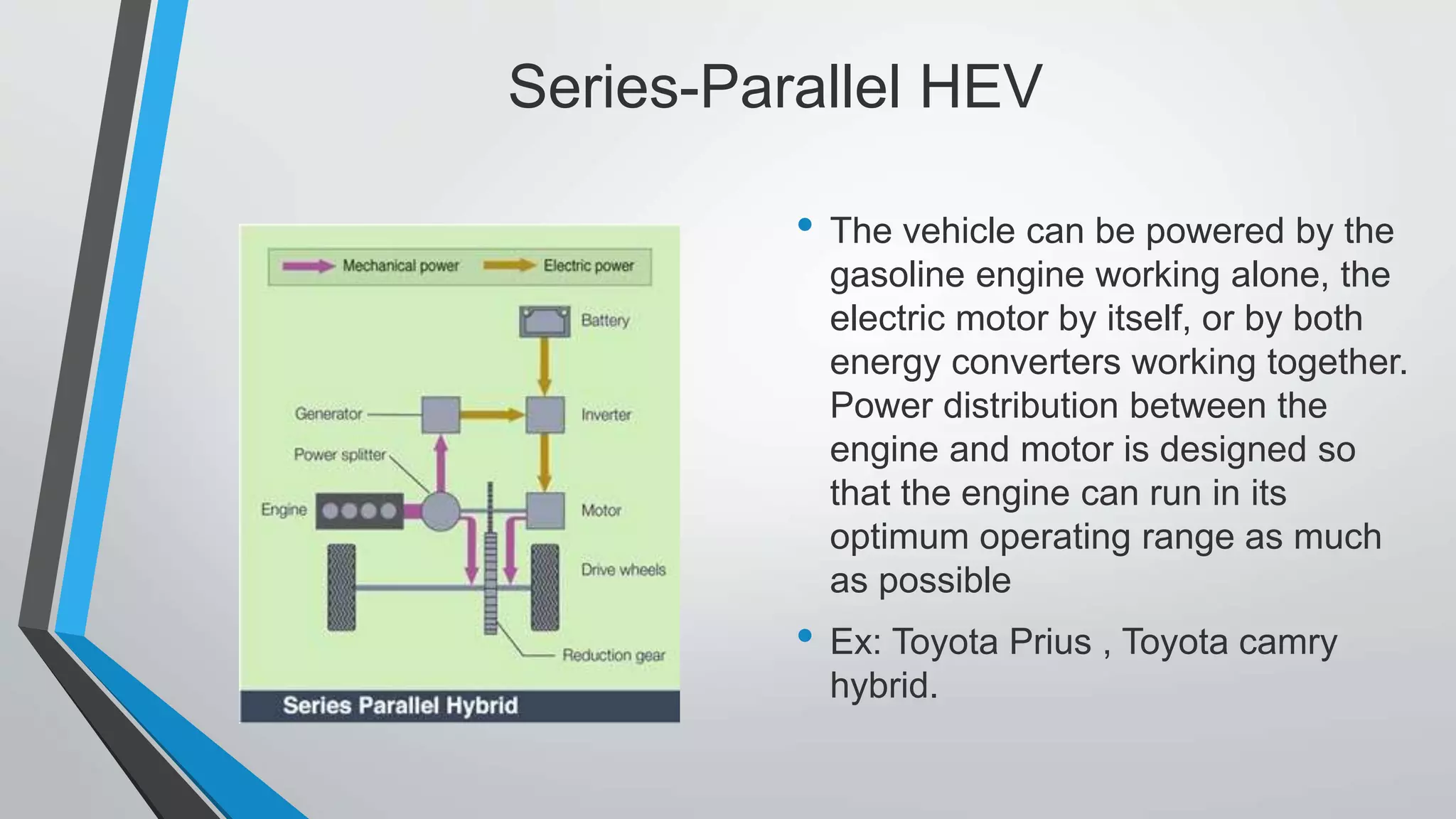
Series-Parallel HEV
• The vehicle can be powered by the
gasoline engine working alone, the
electric motor by itself, or by both
energy converters working together.
Power distribution between the
engine and motor is designed so
that the engine can run in its
optimum operating range as much
as possible
• Ex: Toyota Prius , Toyota camry
hybrid.
Fuel Cell Electric
Vehicle(FCEV):
• FCEVs are also known as Zero-Emission Vehicles. They employ ‘fuel cell technology’
to generate the electricity required to run the vehicle. The chemical energy of the fuel
is converted directly into electric energy.
• Main Components of FCEV:
• Electric motor, Fuel-cell stack, Hydrogen storage tank, battery with converter and
controller
• Examples of FCEV:
• Toyota Mirai, Riversimple Rasa, Hyundai Tucson FCEV, Honda Clarity Fuel Cell,
Hyundai Nexo.
Working of FCEV :
Fuel CellTechnologies
• Proton Exchange Membrane Fuel Cells:
• PEMFCs use solid polymer membranes as the electrolyte.The polymer membrane
is perfluorosulfonic acid, which is also referred to as Nafion (Dupont®).This
polymer membrane is acidic; therefore the ions transported are hydrogen ions (H+)
or protons.The PEMFC is fueled with pure hydrogen and oxygen or air as oxidant
• A fuel cell is a galvanic cell in which the chemical energy of a fuel is converted
directly into electrical energy by means of electrochemical processes.The fuel and
oxidizing agent are continuously and separately supplied to the two electrodes of
the cell, where they undergo a reaction. Electrolyte is necessary to conduct the
ions from one electrode to the other as shown in Figure 14.1. Fuel is supplied to the
anode or positive electrode, where electrons are released from the fuel under
catalyst.The electrons, under the potential difference between these two
electrodes, flow through the external circuit to the cathode electrode or negative
electrode, where combining positive ions and oxygen, reaction products, or
exhaust are produced.
Thank you

Types of electric vehicles.pptx

  • 1.
  • 2.
    What we willlearn in this presentation ? • Electric vehicle • Types of electric vehicle • Hybrid electric vehicle • Types of Hybrid electric vehicle • Fuel Cell electric vehicle
  • 3.
    What do youmean by electric vehicle : • BEVs are also known as All-Electric Vehicles (AEV). Electric Vehicles using BEV technology run entirely on a battery-powered electric drivetrain. The electricity used to drive the vehicle is stored in a large battery pack which can be charged by plugging into the electricity grid. The charged battery pack then provides power to one or more electric motors to run the electric car. • Main Components of BEV: • Electric motor, Inverter, Battery, Control Module, Drive train • Working Principles of BEV: • The power for the electric motor is converted from the DC Battery to AC. As the accelerator is pressed, a signal is sent to the controller. The controller adjusts the speed of the vehicle by changing the frequency of the AC power from the inverter to the motor. The motor then connects and leads to the turning of wheels , If the brakes are pressed, or the electric car is decelerating, the motor becomes an alternator and produces power, which is sent back to the battery • Examples of BEV: • MG ZS, TATA Nexon ev , TATA Tigor ev, Mahindra E20 plus, Hyundai Kona, Mahindra eVerito
  • 4.
    This Photo byUnknown Author is licensed under CC BY-NC This Photo by Unknown Author is licensed under CC BY-NC-ND
  • 5.
    Types of electricvehicle : • There are four types of electric vehicles available: • Battery Electric Vehicle (BEV):Fully powered by electricity. These are more efficient compared to hybrid and plug-in hybrids. • Hybrid Electric Vehicle: • Hybrid Electric Vehicle (HEV): The vehicle uses both the internal combustion (usually petrol) engine and the battery-powered motor powertrain. The petrol engine is used both to drive and charge when the battery is empty. These vehicles are not as efficient as fully electric or plug-in hybrid vehicles. • Plug-in Hybrid Electric Vehicle (PHEV): Uses both an internal combustion engine and a battery charged from an external socket (they have a plug). This means the vehicle’s battery can be charged with electricity rather than the engine. PHEVs are more efficient than HEVs but less efficient than BEVs. • Fuel Cell Electric Vehicle (FCEV):Electric energy is produced from chemical energy. For example, a hydrogen FCEV. • System Architecture of 4 types of electric cars is as follows:
  • 6.
    Hybrid electric vehicle: • Hybrid Electric Vehicle (HEV): • HEVs are also known as series hybrid or parallel hybrid. HEVs have both engine and electric motor. The engine gets energy from fuel, and the motor gets electricity from batteries. The transmission is rotated simultaneously by both engine and electric motor. This then drives the wheels. • Main Components of HEV: • Engine, Electric motor, Battery pack with controller & inverter, Fuel tank, Control module • Working Principles of HEV: • The fuel tank supplies energy to the engine like a regular car. The batteries run on an electric motor. Both the engine and electric motor can turn the transmission at the same time. • Examples of HEV: • Volvo xc 90 , GrandVitara , Honda city eHev,Toyota camry, lexus ES300 h
  • 7.
    Types of HybridElectric vehicles : • The electric vehicle according to level of Hybridization. * Micro Hybrid (not really electric ) * Mild Hybrid (assist the IC engine also helps to increase the mileage ) Ex : SHVS (Suzuki Hybrid Vehicle System) * Strong / Full Hybrid (uses both electric as well as IC engine power) * PHEV (Plug in Hybrid electric vehicle) • Types of Hybrid electric vehicle The type of HEV is determined by how the powertrain propels the vehicle down the road and may be * Series HEV * Parallel HEV * Series Parallel HEV
  • 8.
    Plug-in Hybrid ElectricVehicle (PHEV): • The PHEVs They have both engine and a motor. You can choose among the fuels, conventional fuel (such as petrol) or alternative fuel (such as bio-diesel). It can also be powered by a rechargeable battery pack. The battery can be charged externally. • PHEVs can run in at least 2 modes: • All-electric Mode, in which the motor and battery provide all the car’s energy • Hybrid Mode, in which both electricity and petrol/diesel are employed • Main Components of PHEV: • Electric motor, Engine, Inverter, Battery, Fuel tank, Control module, Battery Charger (if onboard model) • Working Principles of PHEV: • PHEVs start-up in all-electric mode and make use of electricity until their battery pack is depleted. Once the battery gets drained, the engine takes over, and the vehicle operates as a conventional, non-plug-in hybrid. PHEVs can be charged by plugging into an outside electric power source, engine, or regenerative braking. When brakes are applied, the electric motor acts as a generator, using the energy to charge the battery. The engine’s power is supplemented by the electric motor; as a result, smaller engines can be used, increasing the car’s fuel efficiency without compromising performance. • Examples of PHEV: • Porsche Cayenne S E-Hybrid, BMW 330e, Porsche Panamera S E-hybrid, Chevy Volt, Chrysler Pacifica, Ford C-Max Energi , Mercedes C350e, Mercedes S550e, Mercedes GLE550e, Mini Cooper SE Countryman, Ford Fusion Energi , Audi A3 E-Tron, BMW i8, BMW X5 xdrive40e, Fiat 500e, Hyundai Sonata, Kia Optima, Volvo XC90 T8.
  • 9.
    Series (Extended-Range) Hybrid •A series hybrid is like a battery electric vehicle (BEV) in design. Here, the combustion engine drives an electric generator instead of directly driving the wheels. The generator both charges a battery and powers an electric motor that moves the vehicle. When large amounts of power are required, the motor draws electricity from both the battery and the generator. Series hybrids may also be referred to as extended- range electric vehicles (EREVs) or range- extended electric vehicles (REEVs) since the gas engine only generates electricity to be used by the electric motor and never directly drives the wheels. Modern examples include the Cadillac ELR, Chevrolet Volt, and Fisker Karma, Jaguar c-x75 concept car.
  • 10.
    Parallel Hybrid • Aparallel hybrid is propelled by both an internal combustion engine (ICE) and an electric motor connected to a mechanical transmission. Power distribution between the engine and the motor is varied so both run in their optimum operating region as much as possible. There is no separate generator in a parallel hybrid. Whenever the generator's operation is needed, the motor functions as generator. In a parallel mild hybrid, the vehicle can never drive in pure electric mode. The electric motor turns on only when a boost is needed. Ex: Honda accord , Hyundai ioniq
  • 11.
    Series-Parallel HEV • Thevehicle can be powered by the gasoline engine working alone, the electric motor by itself, or by both energy converters working together. Power distribution between the engine and motor is designed so that the engine can run in its optimum operating range as much as possible • Ex: Toyota Prius , Toyota camry hybrid.
  • 12.
    Fuel Cell Electric Vehicle(FCEV): •FCEVs are also known as Zero-Emission Vehicles. They employ ‘fuel cell technology’ to generate the electricity required to run the vehicle. The chemical energy of the fuel is converted directly into electric energy. • Main Components of FCEV: • Electric motor, Fuel-cell stack, Hydrogen storage tank, battery with converter and controller • Examples of FCEV: • Toyota Mirai, Riversimple Rasa, Hyundai Tucson FCEV, Honda Clarity Fuel Cell, Hyundai Nexo.
  • 13.
  • 14.
    Fuel CellTechnologies • ProtonExchange Membrane Fuel Cells: • PEMFCs use solid polymer membranes as the electrolyte.The polymer membrane is perfluorosulfonic acid, which is also referred to as Nafion (Dupont®).This polymer membrane is acidic; therefore the ions transported are hydrogen ions (H+) or protons.The PEMFC is fueled with pure hydrogen and oxygen or air as oxidant • A fuel cell is a galvanic cell in which the chemical energy of a fuel is converted directly into electrical energy by means of electrochemical processes.The fuel and oxidizing agent are continuously and separately supplied to the two electrodes of the cell, where they undergo a reaction. Electrolyte is necessary to conduct the ions from one electrode to the other as shown in Figure 14.1. Fuel is supplied to the anode or positive electrode, where electrons are released from the fuel under catalyst.The electrons, under the potential difference between these two electrodes, flow through the external circuit to the cathode electrode or negative electrode, where combining positive ions and oxygen, reaction products, or exhaust are produced.
  • 15.