Use…
Context
Clues
Stop – no need to run
to the dictionary! The
meaning of the word
you don’t know may
be right there in the
text!
C. Blonski
12/12
What are Context Clues?
• Context Clues are words in and around a
sentence containing an unknown word. The
clues help us understand the meaning of the
unfamiliar word.
• Knowing about Context Clues is especially useful
for content area reading. Content area reading is
reading that you do in different subject areas
such as social studies, science and even math!
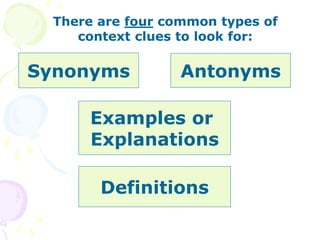
There are four common types of
context clues to look for:
Synonyms Antonyms
Definitions
Examples or
Explanations
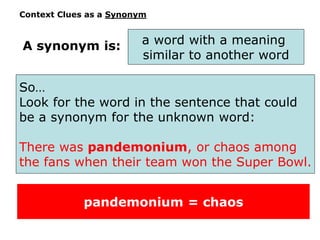
A synonym is:
Context Clues as a Synonym
a word with a meaning
similar to another word
So…
Look for the word in the sentence that could
be a synonym for the unknown word:
There was pandemonium, or chaos among
the fans when their team won the Super Bowl.
pandemonium = chaos
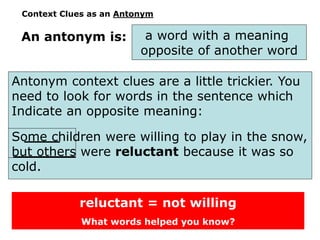
An antonym is:
Context Clues as an Antonym
a word with a meaning
opposite of another word
Antonym context clues are a little trickier. You
need to look for words in the sentence which
Indicate an opposite meaning:
Some children were willing to play in the snow,
but others were reluctant because it was so
cold.
reluctant = not willing
What words helped you know?
____
_______
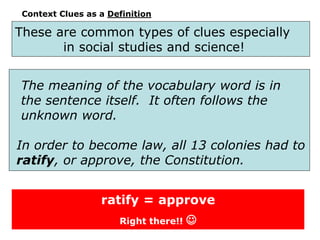
Context Clues as a Definition
The meaning of the vocabulary word is in
the sentence itself. It often follows the
unknown word.
In order to become law, all 13 colonies had to
ratify, or approve, the Constitution.
ratify = approve
Right there!! 
These are common types of clues especially
in social studies and science!
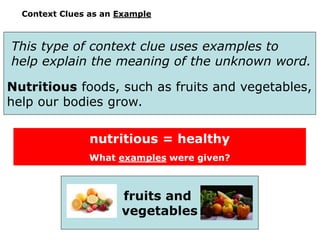
Context Clues as an Example
This type of context clue uses examples to
help explain the meaning of the unknown word.
Nutritious foods, such as fruits and vegetables,
help our bodies grow.
nutritious = healthy
What examples were given?
fruits and
vegetables
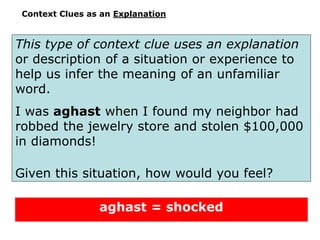
Context Clues as an Explanation
This type of context clue uses an explanation
or description of a situation or experience to
help us infer the meaning of an unfamiliar
word.
I was aghast when I found my neighbor had
robbed the jewelry store and stolen $100,000
in diamonds!
Given this situation, how would you feel?
aghast = shocked
•Sometimes the context clues aren’t obvious.
•You will need to use your background
knowledge and the words being used to
infer or draw a conclusion.
•How you interpret the word can affect your
overall understanding of the text.
Slow down and read carefully when you
encounter unfamiliar words!
Are you ready for a little fun?
Can you use context clues to guess the
meaning of a nonsense word?
I love my peramangada. I got him
when I was in first grade. He has four
short legs and gray hair. He does not
like strangers, especially when they come
around my house.
My peramangada sleeps at the
foot of my bed every night. When I
come home from school, he always tries
to jump up and lick my face. My
peramangada is so cute!
Wouldn’t you love a sweet
peramangada like mine?
Use the following clues to guess this
mystery person!
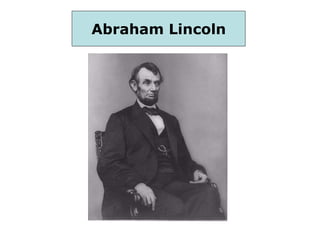
I was born on February 12, 1809.
My first home was a log cabin
in Kentucky.
I was a lawyer in Illinois and known for
being honest.
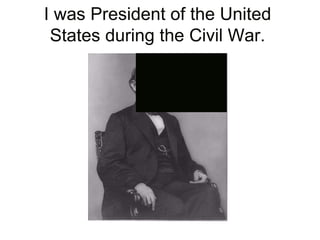
I was President of the United
States during the Civil War.
Abraham Lincoln
One more chance to prove
our smarts!
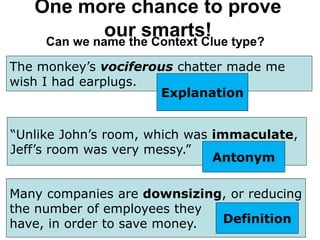
Can we name the Context Clue type?
The monkey’s vociferous chatter made me
wish I had earplugs.
Explanation
“Unlike John’s room, which was immaculate,
Jeff’s room was very messy.”
Antonym
Many companies are downsizing, or reducing
the number of employees they
have, in order to save money. Definition
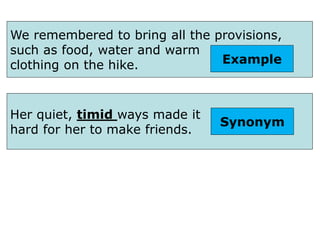
We remembered to bring all the provisions,
such as food, water and warm
clothing on the hike. Example
Her quiet, timid ways made it
hard for her to make friends.
Synonym

Context_Clues_Power_Point.ppt

  • 1.
    Use… Context Clues Stop – noneed to run to the dictionary! The meaning of the word you don’t know may be right there in the text! C. Blonski 12/12
  • 2.
    What are ContextClues? • Context Clues are words in and around a sentence containing an unknown word. The clues help us understand the meaning of the unfamiliar word. • Knowing about Context Clues is especially useful for content area reading. Content area reading is reading that you do in different subject areas such as social studies, science and even math!
  • 3.
    There are fourcommon types of context clues to look for: Synonyms Antonyms Definitions Examples or Explanations
  • 4.
    A synonym is: ContextClues as a Synonym a word with a meaning similar to another word So… Look for the word in the sentence that could be a synonym for the unknown word: There was pandemonium, or chaos among the fans when their team won the Super Bowl. pandemonium = chaos
  • 5.
    An antonym is: ContextClues as an Antonym a word with a meaning opposite of another word Antonym context clues are a little trickier. You need to look for words in the sentence which Indicate an opposite meaning: Some children were willing to play in the snow, but others were reluctant because it was so cold. reluctant = not willing What words helped you know? ____ _______
  • 6.
    Context Clues asa Definition The meaning of the vocabulary word is in the sentence itself. It often follows the unknown word. In order to become law, all 13 colonies had to ratify, or approve, the Constitution. ratify = approve Right there!!  These are common types of clues especially in social studies and science!
  • 7.
    Context Clues asan Example This type of context clue uses examples to help explain the meaning of the unknown word. Nutritious foods, such as fruits and vegetables, help our bodies grow. nutritious = healthy What examples were given? fruits and vegetables
  • 8.
    Context Clues asan Explanation This type of context clue uses an explanation or description of a situation or experience to help us infer the meaning of an unfamiliar word. I was aghast when I found my neighbor had robbed the jewelry store and stolen $100,000 in diamonds! Given this situation, how would you feel? aghast = shocked
  • 9.
    •Sometimes the contextclues aren’t obvious. •You will need to use your background knowledge and the words being used to infer or draw a conclusion. •How you interpret the word can affect your overall understanding of the text. Slow down and read carefully when you encounter unfamiliar words! Are you ready for a little fun?
  • 10.
    Can you usecontext clues to guess the meaning of a nonsense word? I love my peramangada. I got him when I was in first grade. He has four short legs and gray hair. He does not like strangers, especially when they come around my house. My peramangada sleeps at the foot of my bed every night. When I come home from school, he always tries to jump up and lick my face. My peramangada is so cute!
  • 11.
    Wouldn’t you lovea sweet peramangada like mine?
  • 12.
    Use the followingclues to guess this mystery person!
  • 13.
    I was bornon February 12, 1809.
  • 14.
    My first homewas a log cabin in Kentucky.
  • 15.
    I was alawyer in Illinois and known for being honest.
  • 16.
    I was Presidentof the United States during the Civil War.
  • 17.
  • 18.
    One more chanceto prove our smarts! Can we name the Context Clue type? The monkey’s vociferous chatter made me wish I had earplugs. Explanation “Unlike John’s room, which was immaculate, Jeff’s room was very messy.” Antonym Many companies are downsizing, or reducing the number of employees they have, in order to save money. Definition
  • 19.
    We remembered tobring all the provisions, such as food, water and warm clothing on the hike. Example Her quiet, timid ways made it hard for her to make friends. Synonym