Presented by: 
Anabelle S. Dela Cerna, Ma. Ed.
What is a 
SPEECH 
CHOIR?
Speech choirs are 
performance groups that 
recite speeches in unison, 
often with elements of 
choreography and costuming 
to help bring the speech to 
life.
It is also called choral speaking. It 
has a hallowed tradition. 
The first plays put on by the 
Greeks featured choruses of 
speakers. 
Today, speech choir is a popular 
teaching as well as a performing 
art. 
It operates like a musical choir 
minus the music, instead of 
singing, speech choirs perform 
spoken-word pieces like poems.
There are two (2) TYPES 
OF SPEECH CHOIR: 
1. Conventional Speech 
Choir or Traditional 
Speech Choir 
and 
2. Dynamic Speech Choir 
or Theatrical Speech 
Choir
Traditional Speech Choir 
-it does not require to use 
costumes, props, nor 
choreography. 
-the choir just simply 
speaks or reads a literary 
piece 
Dynamic Speech 
Choir 
-it is the reverse of 
the conventional 
speech choir
Elements of a Speech 
Choir
1. Members 
The speech choir is typically the 
same size of a singing choir 
having anywhere from 12 to 100 
members or more. However, most 
schools and competitions features 
choir of 25 to 40 members. The 
group is typically are divided into 
groups based on the members’ 
natural voices or speaking voices.
2. Pieces 
Selections are typically poems or 
poetic passages, such as from 
Greek dramas or Shakespeare’s 
plays. The conductor gives some 
thought to the passage, breaking 
into parts. Facial expressions and 
intonation are also carefully 
planned so all the members can 
practice in unison. Solo parts for 
specific members can add 
dramatic effect.
3.Choreography 
Choreography of movement is not 
necessary component for speech choir. 
Many successful competition choirs recite 
their pieces while standing in place with 
their hands at their sides, attention 
directed solely at the conductor. 
*However, in Greek tradition, speech 
choirs marched from side to side in 
alternating patterns called ā€œstropheā€ and 
ā€œantistropheā€. 
Thus, movement is a part of the rich 
history of speech choir and some 
conductors choose to choreograph 
elaborate movement to accompany their 
pieces.
4. Costuming 
As with any other performance art, 
thought should be put into how the 
speech choir will dress. Costumes can 
be as simple as matching outfits or 
robes, such as a vocal choir would 
wear, or elaborate theatrical garb. 
*Plain uniforms allow the audience to 
concentrate on facial expressions and 
allow the choir to recite several very 
different pieces in one performance. 
*Themed costume for a single piece can 
highlight its meaning or help to 
differentiate between voice groups.
5. Voice Quality 
The ability to combine 
successfully the light, 
medium, and dark voices 
in the choir . it is the 
ability to communicate 
through voice, reactions 
to thoughts or emotions.
6. Number of Voices 
The ability to add or subtract whole 
sections, banks, smaller groups, or 
solo speakers to increase or diminish 
the power or richness of the sound to 
better express the meaning. 
7.Pitch 
Pitch refers to the variations of 
the voice on the musical scale 
and is generally referred to as 
the inflection. Children generally 
have little problem with pitch 
because they use it naturally and 
freely.
8.Power 
Ability to use volume, force, or loudness as emphasis 
in appropriate places to better express feeling and 
meaning. A power build should be related to the 
elements of a sentence and growing emotion. 
9.Phrasing and rhythm 
Ability to use phrasing and rhythm as reinforcements for 
each other. Each much blend to better express the 
meaning of the verse.
10.Tempo 
Tempo refers to the rate of speed at which 
a reading progresses. The ability to 
balance the rhythm of a piece and the 
tempo of performance. Tempo should 
relate to the central ā€œbeatā€ of the poem. If 
it is too fast or too slow. 
11.Staging 
The ability to successfully organize and position 
the choir on stage or risers for the performance 
effect. The ability to stage entrances and exits 
which enhance the mood of the poem and the 
performance. The ability to ā€œcostumeā€ speakers in 
a way which also enhances the performance as a 
whole.
What are the 
things to be 
remembered in 
doing speech 
choir?
1.Breathing 
The most important part of any 
performing art, from playing an 
instrument to acting in a play is 
BREATHING. While we breath 
involuntarily all the time, many 
green performers forget to breath 
while on stage. 
2.Articulation and Diction 
The audience wants to hear what you have to 
say. If you don’t articulate, all they will hear is 
a bunch of mush. By practicing your 
articulation and diction, your words will be 
clear and vibrant. Strive to make every word 
lucid and colourful.
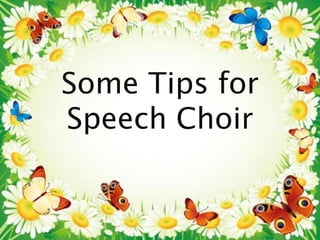
3.Connection to the 
group 
A speech choir is a living organism made up 
on individuals, never forget that. You are not 
performing a monologue, you are a part of a 
group performance. Onstage, the choir is 
your family. Connecting with them will 
eliminate any stage fright. If anything 
unexpected happens, the group must 
respond and correct together. 
4.The Text 
The text is your guide; it’s what the audience came to 
see and hear you perform. Performing the texts 
requires you to know the text inside and out. Once you 
know what you are saying, add color and meaning to 
the words. Let the audience ā€œseeā€ what you are saying. 
Let your personal reaction to the words sprinkle 
meaning on the performance.
Some Tips for 
Speech Choir
1. Teach the students 
pronunciation. 
Simply use a dictionary that 
has a pronunciation guide to 
it. Refer to its pronunciation 
key which you can find on its 
introductory pages to 
determine how a word is 
pronounced.
2.Teach them stress 
and intonation. 
Things such as rising 
intonation and falling 
intonation are crucial in speech 
choir. Which word to be 
stressed depends also on your 
intended meaning.
3. A good number for 
speech choir is 40 
members. But you can 
have 20-25 participants if 
so desired. 
4. The contest piece is often 
a poem.
5. Divide your participants 
into three voices: light, 
medium and dark. 
Medium are also females with deep 
voices. Dark are of course only 
males with very deep voices. There 
should also be a solo for each 
voice: solo light, solo medium and 
solo dark.
5. Arrange the contest 
piece before giving it to 
your participants. 
This means that you have already assigned 
parts for each voice, for the solo and for 
the unison (meaning all three voices). 
Keep in mind though that even if all three 
voices speak together but their voices 
should be clearly distinct from each 
other. This is called blending.
6. Memorize the piece. 
If you are the conductor, the 
more you should memorize it. 
Before giving the contest piece to 
your participants, see to it that 
you have double-checked its 
pronunciation in the dictionary 
or the web.
7. Drill into your 
participants to feel the 
piece. 
Their facial expression should 
reflect what they are speaking. 
Facial expressions can’t be taught. 
It should come from within. It 
should not look artificial but 
should come from their hearts.
8.Deliver with the intent to 
be understood. 
-for conventional speech choir, actions 
and props are unnecessary. Simply 
standing with hands on their sides is 
enough. What counts are the voice and 
the facial expression. Remember the 
audience should understand what you 
are talking about.
9.The conductor may stand 
at the back of the judges. 
He may conduct in any manner he 
wants as long as he is able to guide 
his participants for an effective 
speech choir presentation.
10. Speech choir participants 
should only look at the 
conductor the whole time of 
their presentation. 
They should not fidget or make 
unnecessary moves throughout 
their delivery. Nevertheless they 
should not be standing tensed in 
front of the crowd but relaxed.
Thank you very much!

Speech choir

  • 1.
    Presented by: AnabelleS. Dela Cerna, Ma. Ed.
  • 2.
    What is a SPEECH CHOIR?
  • 3.
    Speech choirs are performance groups that recite speeches in unison, often with elements of choreography and costuming to help bring the speech to life.
  • 4.
    It is alsocalled choral speaking. It has a hallowed tradition. The first plays put on by the Greeks featured choruses of speakers. Today, speech choir is a popular teaching as well as a performing art. It operates like a musical choir minus the music, instead of singing, speech choirs perform spoken-word pieces like poems.
  • 5.
    There are two(2) TYPES OF SPEECH CHOIR: 1. Conventional Speech Choir or Traditional Speech Choir and 2. Dynamic Speech Choir or Theatrical Speech Choir
  • 6.
    Traditional Speech Choir -it does not require to use costumes, props, nor choreography. -the choir just simply speaks or reads a literary piece Dynamic Speech Choir -it is the reverse of the conventional speech choir
  • 7.
    Elements of aSpeech Choir
  • 8.
    1. Members Thespeech choir is typically the same size of a singing choir having anywhere from 12 to 100 members or more. However, most schools and competitions features choir of 25 to 40 members. The group is typically are divided into groups based on the members’ natural voices or speaking voices.
  • 9.
    2. Pieces Selectionsare typically poems or poetic passages, such as from Greek dramas or Shakespeare’s plays. The conductor gives some thought to the passage, breaking into parts. Facial expressions and intonation are also carefully planned so all the members can practice in unison. Solo parts for specific members can add dramatic effect.
  • 10.
    3.Choreography Choreography ofmovement is not necessary component for speech choir. Many successful competition choirs recite their pieces while standing in place with their hands at their sides, attention directed solely at the conductor. *However, in Greek tradition, speech choirs marched from side to side in alternating patterns called ā€œstropheā€ and ā€œantistropheā€. Thus, movement is a part of the rich history of speech choir and some conductors choose to choreograph elaborate movement to accompany their pieces.
  • 11.
    4. Costuming Aswith any other performance art, thought should be put into how the speech choir will dress. Costumes can be as simple as matching outfits or robes, such as a vocal choir would wear, or elaborate theatrical garb. *Plain uniforms allow the audience to concentrate on facial expressions and allow the choir to recite several very different pieces in one performance. *Themed costume for a single piece can highlight its meaning or help to differentiate between voice groups.
  • 12.
    5. Voice Quality The ability to combine successfully the light, medium, and dark voices in the choir . it is the ability to communicate through voice, reactions to thoughts or emotions.
  • 13.
    6. Number ofVoices The ability to add or subtract whole sections, banks, smaller groups, or solo speakers to increase or diminish the power or richness of the sound to better express the meaning. 7.Pitch Pitch refers to the variations of the voice on the musical scale and is generally referred to as the inflection. Children generally have little problem with pitch because they use it naturally and freely.
  • 14.
    8.Power Ability touse volume, force, or loudness as emphasis in appropriate places to better express feeling and meaning. A power build should be related to the elements of a sentence and growing emotion. 9.Phrasing and rhythm Ability to use phrasing and rhythm as reinforcements for each other. Each much blend to better express the meaning of the verse.
  • 15.
    10.Tempo Tempo refersto the rate of speed at which a reading progresses. The ability to balance the rhythm of a piece and the tempo of performance. Tempo should relate to the central ā€œbeatā€ of the poem. If it is too fast or too slow. 11.Staging The ability to successfully organize and position the choir on stage or risers for the performance effect. The ability to stage entrances and exits which enhance the mood of the poem and the performance. The ability to ā€œcostumeā€ speakers in a way which also enhances the performance as a whole.
  • 16.
    What are the things to be remembered in doing speech choir?
  • 17.
    1.Breathing The mostimportant part of any performing art, from playing an instrument to acting in a play is BREATHING. While we breath involuntarily all the time, many green performers forget to breath while on stage. 2.Articulation and Diction The audience wants to hear what you have to say. If you don’t articulate, all they will hear is a bunch of mush. By practicing your articulation and diction, your words will be clear and vibrant. Strive to make every word lucid and colourful.
  • 18.
    3.Connection to the group A speech choir is a living organism made up on individuals, never forget that. You are not performing a monologue, you are a part of a group performance. Onstage, the choir is your family. Connecting with them will eliminate any stage fright. If anything unexpected happens, the group must respond and correct together. 4.The Text The text is your guide; it’s what the audience came to see and hear you perform. Performing the texts requires you to know the text inside and out. Once you know what you are saying, add color and meaning to the words. Let the audience ā€œseeā€ what you are saying. Let your personal reaction to the words sprinkle meaning on the performance.
  • 19.
    Some Tips for Speech Choir
  • 20.
    1. Teach thestudents pronunciation. Simply use a dictionary that has a pronunciation guide to it. Refer to its pronunciation key which you can find on its introductory pages to determine how a word is pronounced.
  • 21.
    2.Teach them stress and intonation. Things such as rising intonation and falling intonation are crucial in speech choir. Which word to be stressed depends also on your intended meaning.
  • 22.
    3. A goodnumber for speech choir is 40 members. But you can have 20-25 participants if so desired. 4. The contest piece is often a poem.
  • 23.
    5. Divide yourparticipants into three voices: light, medium and dark. Medium are also females with deep voices. Dark are of course only males with very deep voices. There should also be a solo for each voice: solo light, solo medium and solo dark.
  • 24.
    5. Arrange thecontest piece before giving it to your participants. This means that you have already assigned parts for each voice, for the solo and for the unison (meaning all three voices). Keep in mind though that even if all three voices speak together but their voices should be clearly distinct from each other. This is called blending.
  • 25.
    6. Memorize thepiece. If you are the conductor, the more you should memorize it. Before giving the contest piece to your participants, see to it that you have double-checked its pronunciation in the dictionary or the web.
  • 26.
    7. Drill intoyour participants to feel the piece. Their facial expression should reflect what they are speaking. Facial expressions can’t be taught. It should come from within. It should not look artificial but should come from their hearts.
  • 27.
    8.Deliver with theintent to be understood. -for conventional speech choir, actions and props are unnecessary. Simply standing with hands on their sides is enough. What counts are the voice and the facial expression. Remember the audience should understand what you are talking about.
  • 28.
    9.The conductor maystand at the back of the judges. He may conduct in any manner he wants as long as he is able to guide his participants for an effective speech choir presentation.
  • 29.
    10. Speech choirparticipants should only look at the conductor the whole time of their presentation. They should not fidget or make unnecessary moves throughout their delivery. Nevertheless they should not be standing tensed in front of the crowd but relaxed.
  • 30.