TYPES OF
BUSINESS ANALYTICS
UNIT 2
UNIT 2: TYPES OF BUSINESS ANALYTICS
• DESCRIPTIVE ANALYTIUCS
• DIAGNOSTIC ANALYTICS
• PREDICTIVE ANALYTICS
• PRESCRIPTIVE ANALYTICS
DESCRIPTIVE ANALYTICS
• Descriptive analytics is the interpretation of historical data
to better understand changes that have occurred in a
business.
• Answer the question “What happened?”
• Descriptive analytics can help to identify the areas of
strength and weakness in an organization.
STEPS IN DESCRIPTIVE ANALYTICS
State Business Metrics
Identify the data required
Extract and prepare data
Analyse data
Present data
STATE THE METRICS
• Identify the metrics
• Metrics must reflect the goals
• E.g.: Sales revenue of a product for last few months
IDENTIFY THE DATA REQUIRED
• Search for data
• Identify the multiple resources
• Internal and external
• E.g.: Collecting revenue data from sales people and
dealers
EXTRACT AND PREPARE DATA
• Extract the data
• Combine the data
• Prepare the data
• E.g.: Collect data and arrange in columns and rows
ANALYSE DATA
• Use tools for analysis
• Basic Mathematical formulas
E.g: Calculating average revenue
PRESENT DATA
• Presenting data in different forms
• Graphs, chart, table etc.
• E.g.: Revenue in rows and columns
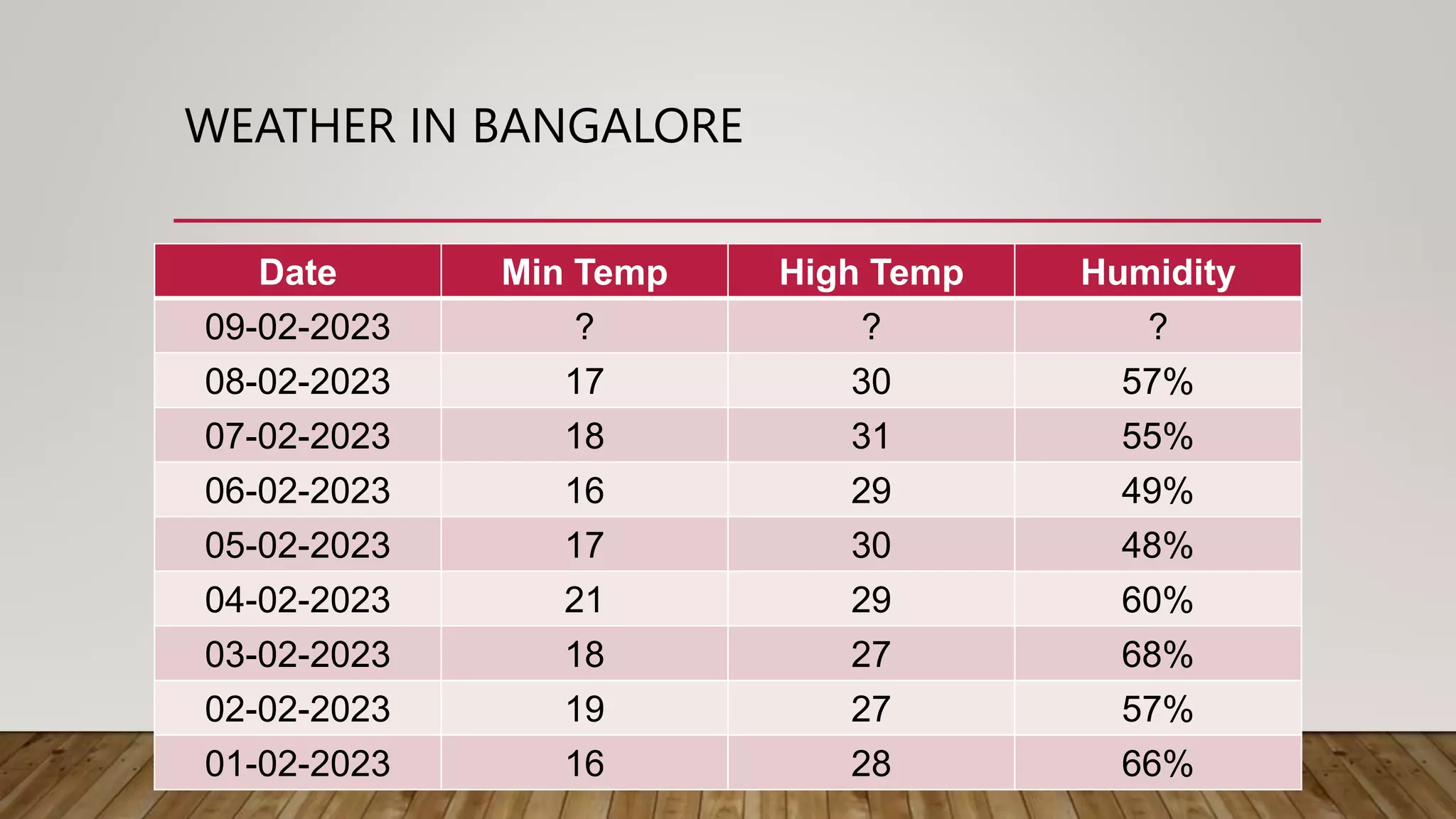
WEATHER IN BANGALORE
Date Min Temp High Temp Humidity
09-02-2023 ? ? ?
08-02-2023 17 30 57%
07-02-2023 18 31 55%
06-02-2023 16 29 49%
05-02-2023 17 30 48%
04-02-2023 21 29 60%
03-02-2023 18 27 68%
02-02-2023 19 27 57%
01-02-2023 16 28 66%
TECHNIQUES OF DESCRIPTIVE ANALYTICS
• Frequency distribution
• Pie chart
• Bar chart
• Scatterplot
• Histogram
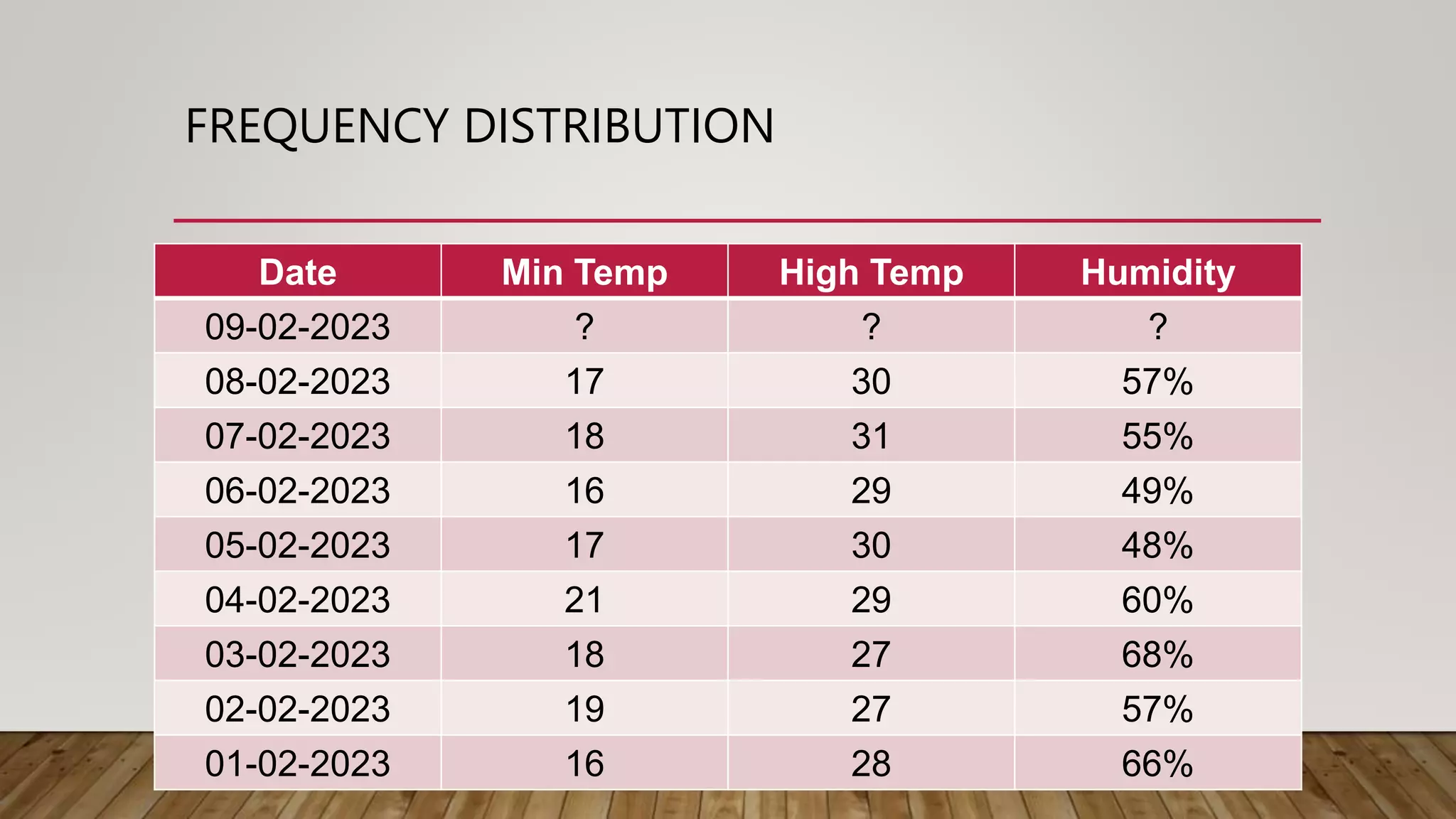
FREQUENCY DISTRIBUTION
Date Min Temp High Temp Humidity
09-02-2023 ? ? ?
08-02-2023 17 30 57%
07-02-2023 18 31 55%
06-02-2023 16 29 49%
05-02-2023 17 30 48%
04-02-2023 21 29 60%
03-02-2023 18 27 68%
02-02-2023 19 27 57%
01-02-2023 16 28 66%
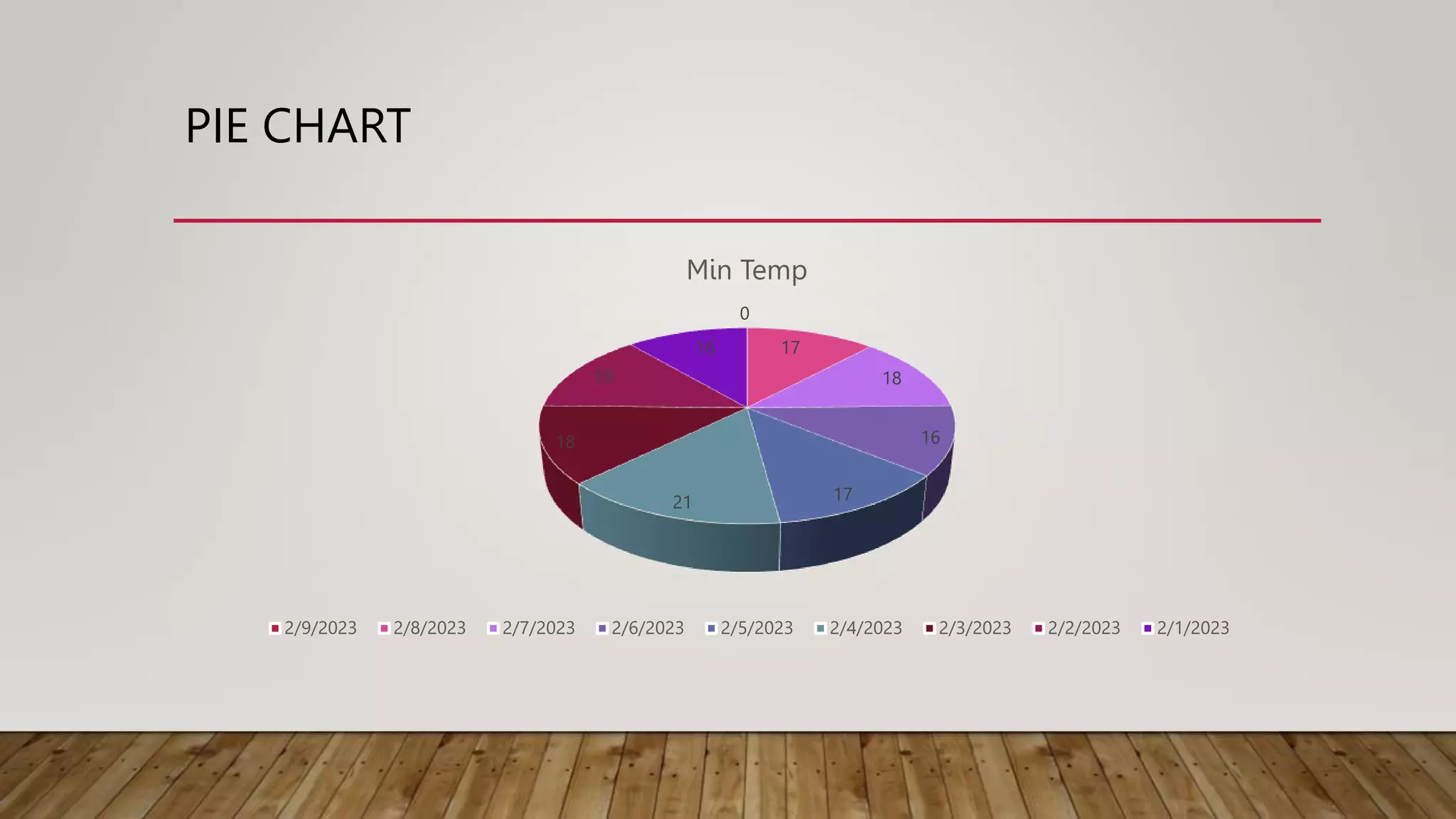
PIE CHART
0
17
18
16
17
21
18
19
16
Min Temp
2/9/2023 2/8/2023 2/7/2023 2/6/2023 2/5/2023 2/4/2023 2/3/2023 2/2/2023 2/1/2023
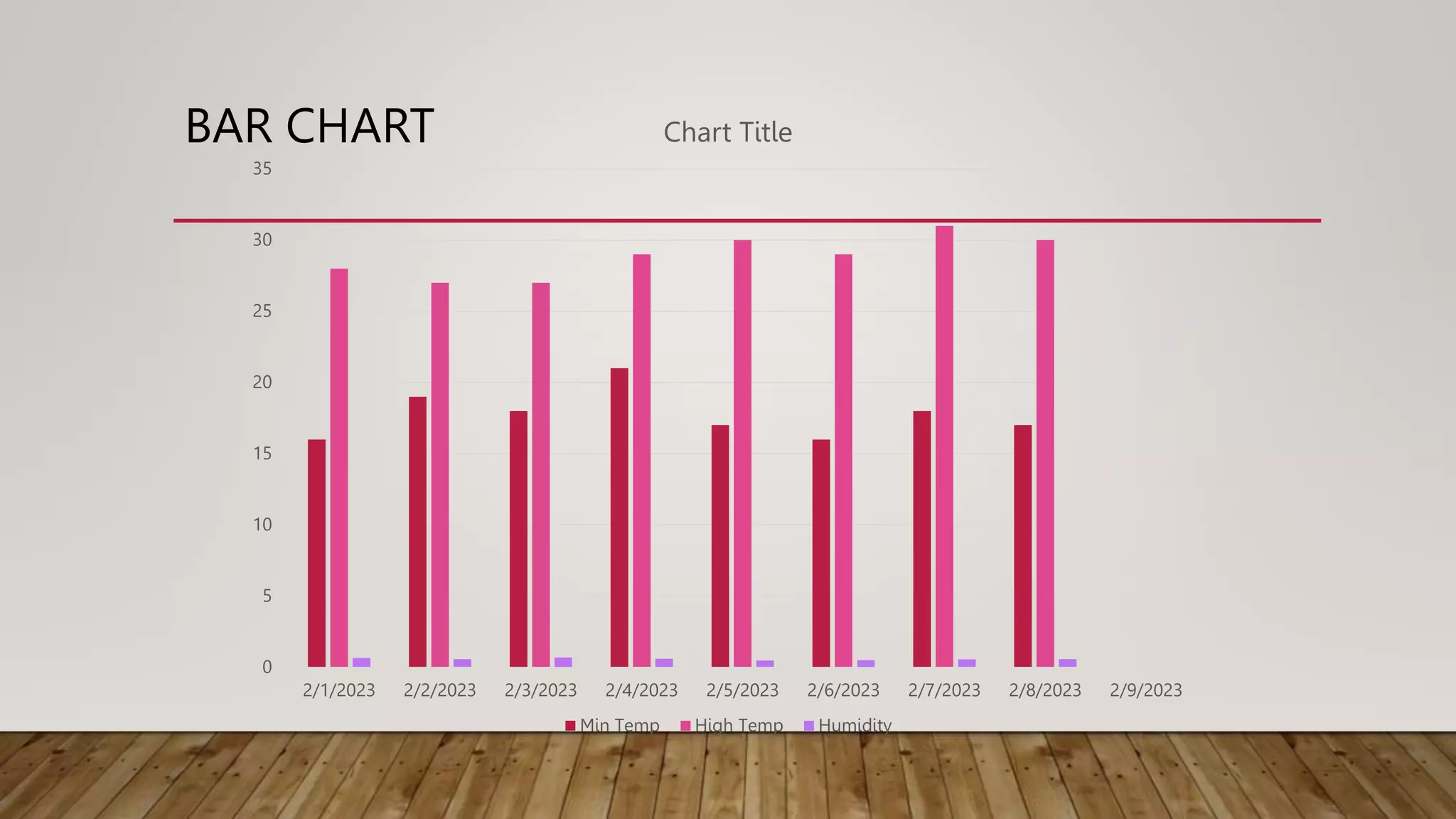
BAR CHART
0
5
10
15
20
25
30
35
2/1/2023 2/2/2023 2/3/2023 2/4/2023 2/5/2023 2/6/2023 2/7/2023 2/8/2023 2/9/2023
Chart Title
Min Temp High Temp Humidity
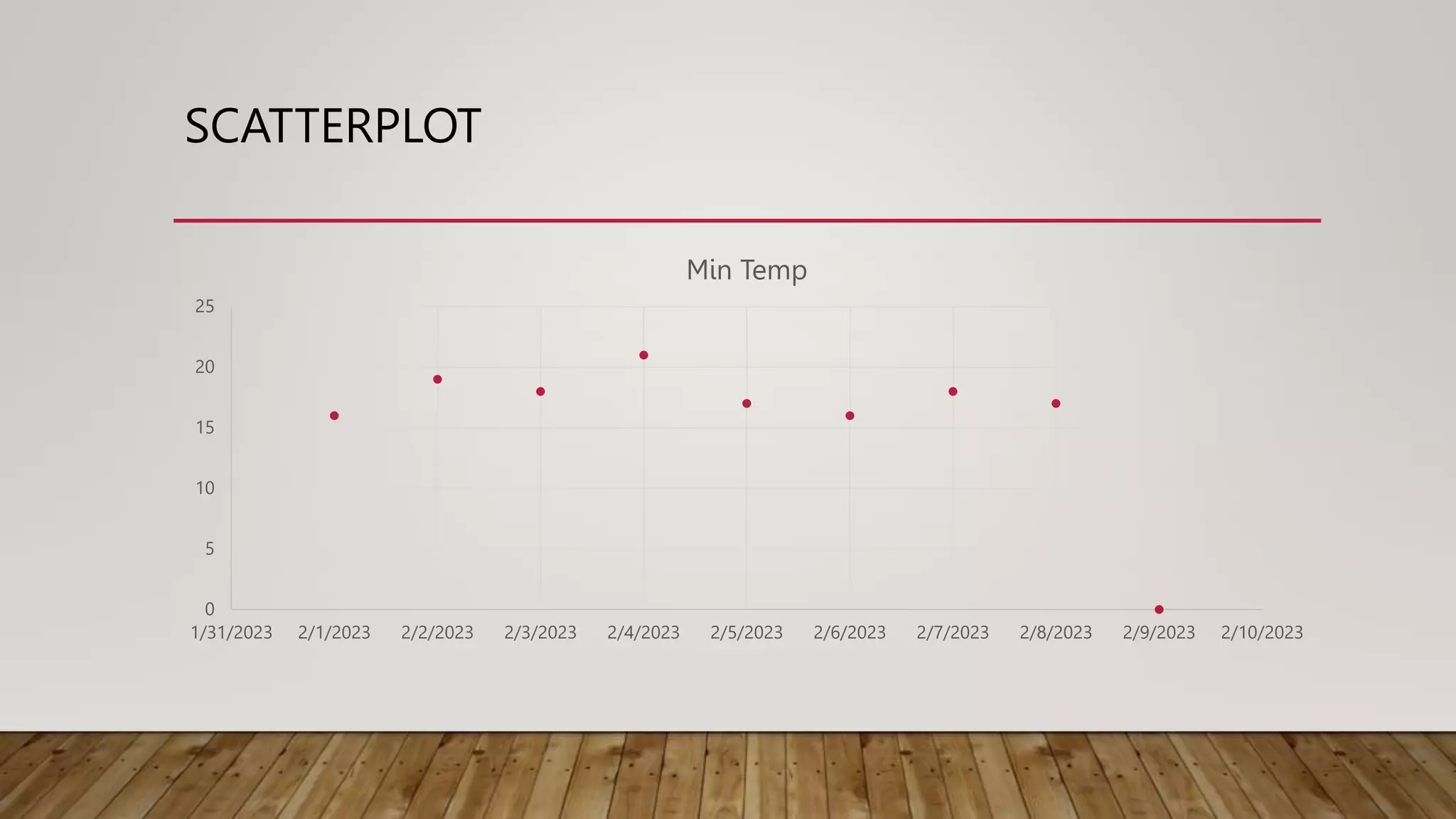
SCATTERPLOT
0
5
10
15
20
25
1/31/2023 2/1/2023 2/2/2023 2/3/2023 2/4/2023 2/5/2023 2/6/2023 2/7/2023 2/8/2023 2/9/2023 2/10/2023
Min Temp
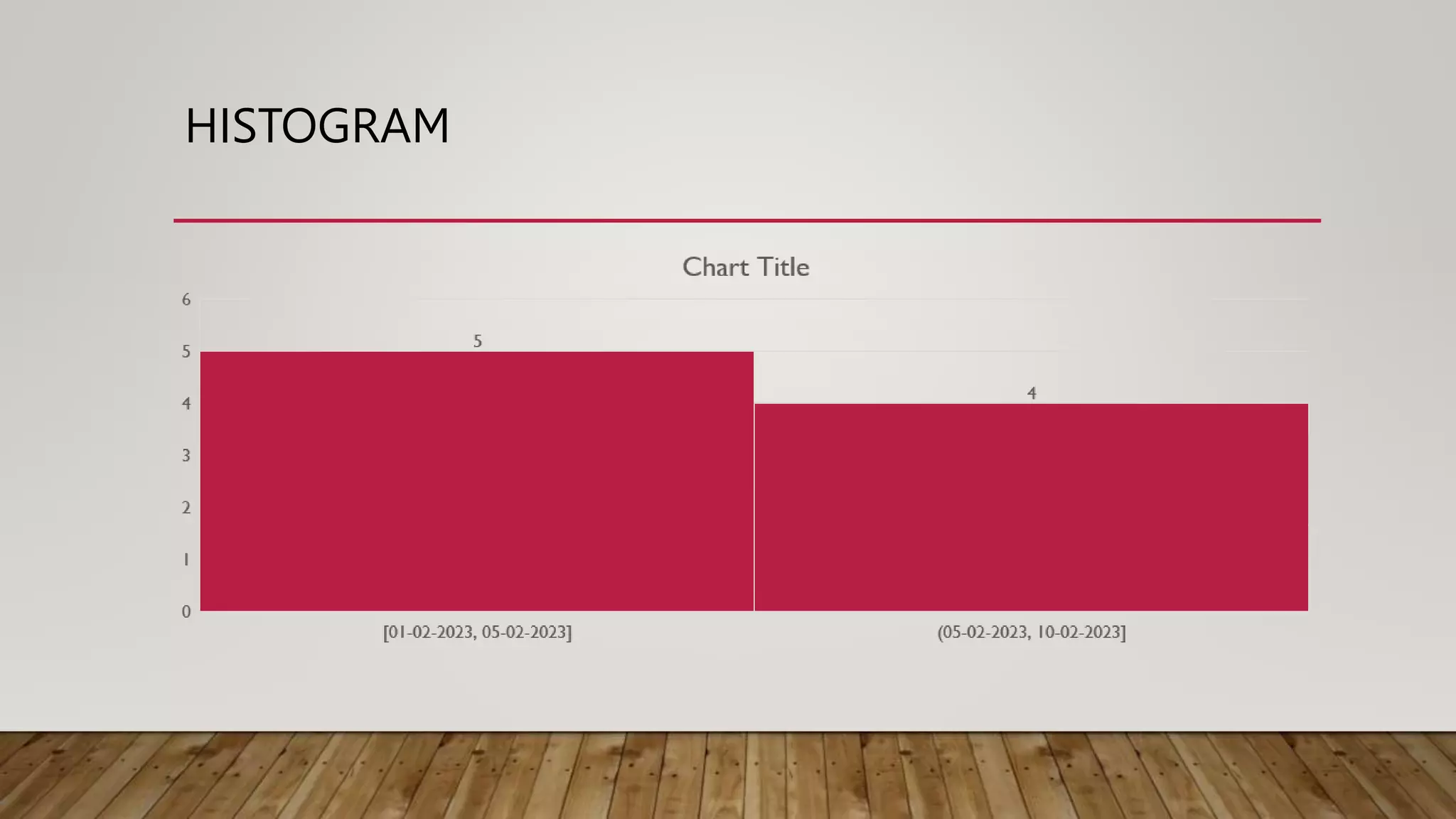
HISTOGRAM
APPLICATIONS OF DESCRIPTIVE ANALYTICS
• Analysing sales data
• Analysing social metrics (Facebook, Twitter)
• Assessing trends in travel destinations
• Weather forecast
• Online customer behaviour
• Supply chain management
• Manufacturing
ADVANTAGES OF DESCRIPTIVE ANALYTICS
 Access to information
 Precise estimation of frequency
 Economical
 Easy to complete
 Compared to inferential statistics
DISADVANTAGES OF DESCRIPTIVE ANALYTICS
 Data may not be complete
 Reasons for trends can’t be identified
 Descriptive analytics cannot be used to make future predictions.
 Your results cannot be applied to a larger population as a whole.
 Descriptive analytics provide no information regarding the method
of data collection.
DIAGNOSTIC ANALYTICS
• Diagnostic analytics is the process of using data to determine
the causes of trends and correlations between variables. It can
be viewed as a logical next step after using descriptive
analytics to identify trends.
• Diagnostic analysis can be done manually, using an algorithm,
or with statistical software (such as Microsoft Excel).
• Answers the question “Why did this happen?”
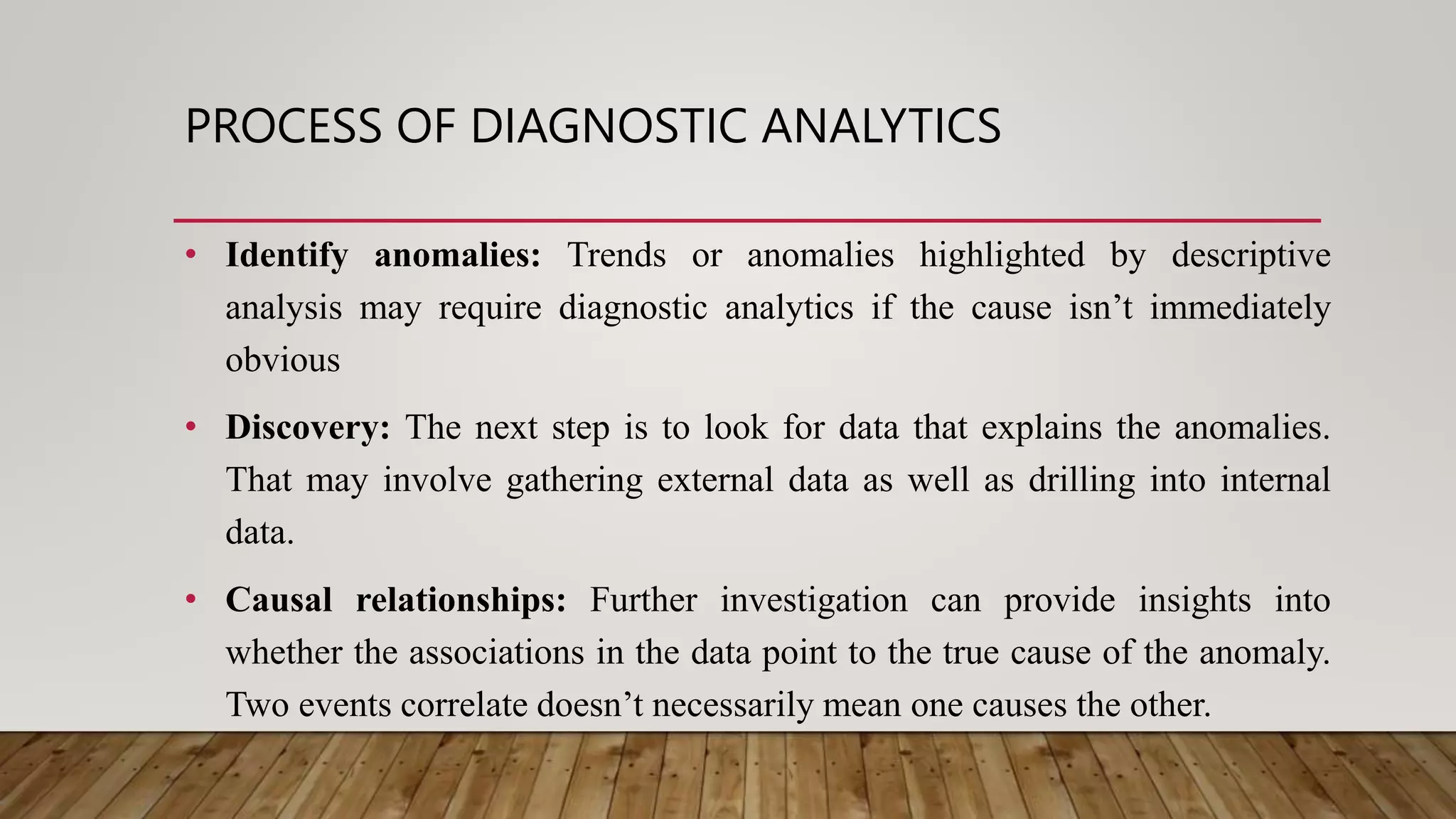
PROCESS OF DIAGNOSTIC ANALYTICS
• Identify anomalies: Trends or anomalies highlighted by descriptive
analysis may require diagnostic analytics if the cause isn’t immediately
obvious
• Discovery: The next step is to look for data that explains the anomalies.
That may involve gathering external data as well as drilling into internal
data.
• Causal relationships: Further investigation can provide insights into
whether the associations in the data point to the true cause of the anomaly.
Two events correlate doesn’t necessarily mean one causes the other.
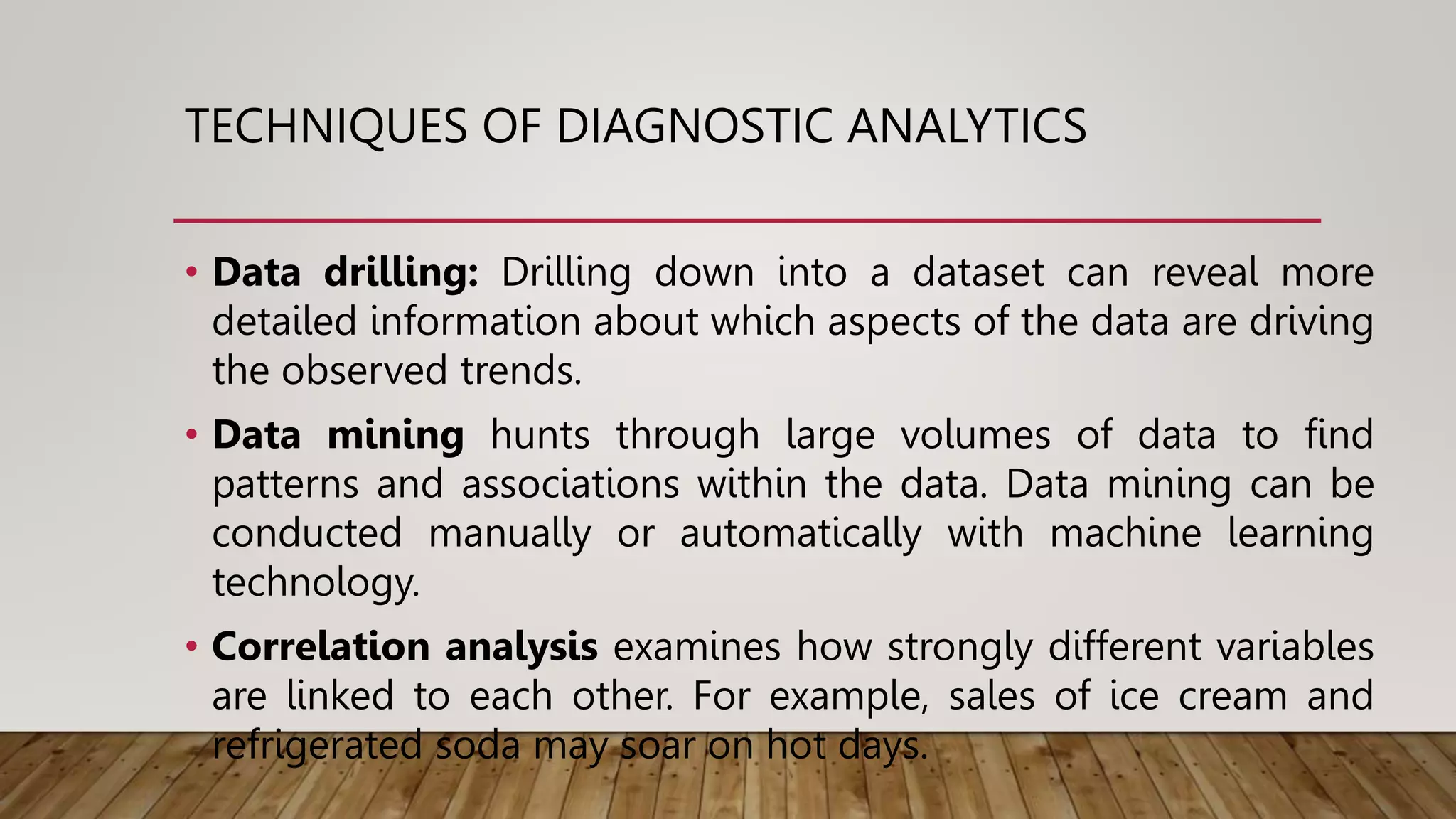
TECHNIQUES OF DIAGNOSTIC ANALYTICS
• Data drilling: Drilling down into a dataset can reveal more
detailed information about which aspects of the data are driving
the observed trends.
• Data mining hunts through large volumes of data to find
patterns and associations within the data. Data mining can be
conducted manually or automatically with machine learning
technology.
• Correlation analysis examines how strongly different variables
are linked to each other. For example, sales of ice cream and
refrigerated soda may soar on hot days.
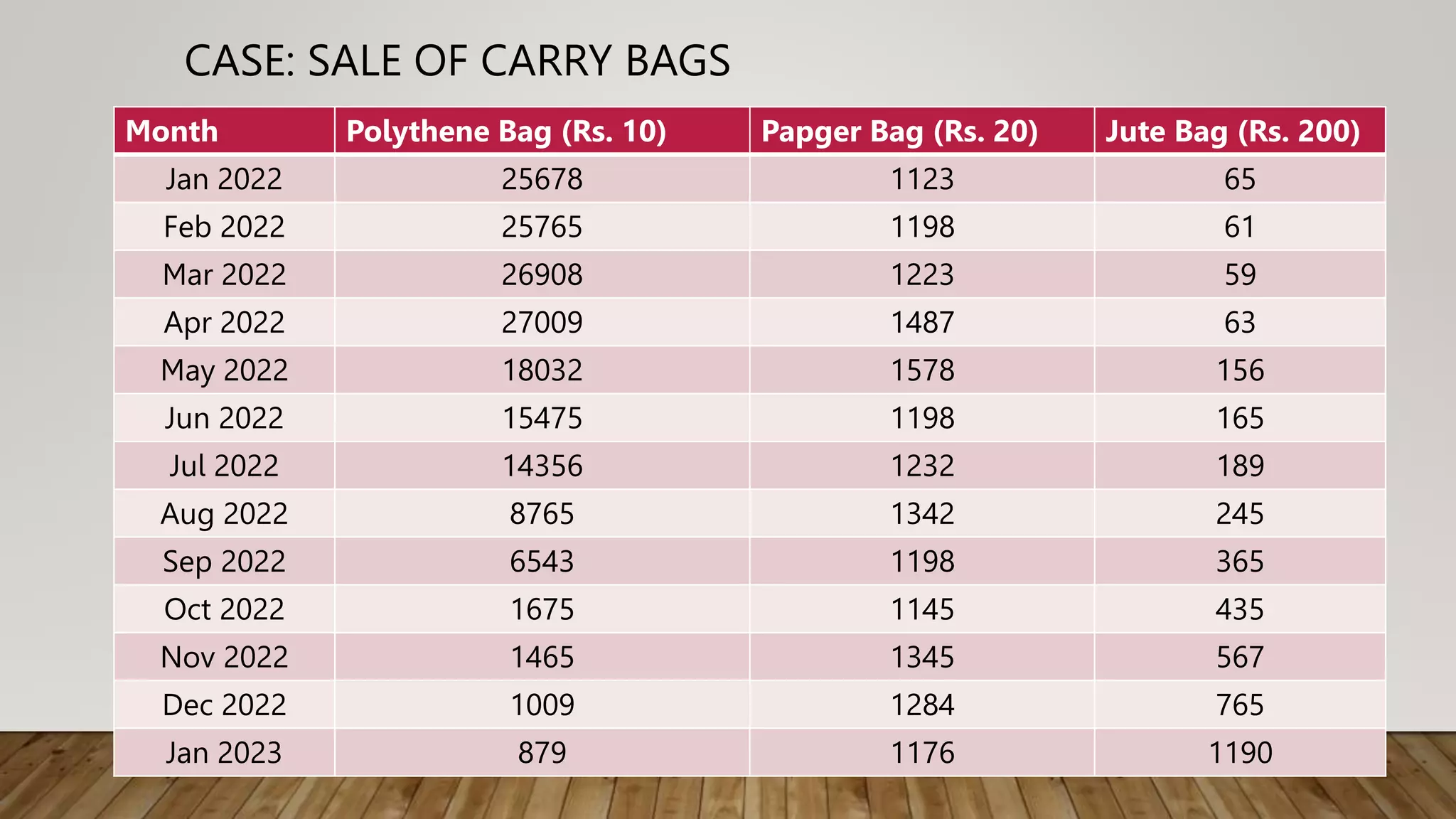
CASE: SALE OF CARRY BAGS
Month Polythene Bag (Rs. 10) Papger Bag (Rs. 20) Jute Bag (Rs. 200)
Jan 2022 25678 1123 65
Feb 2022 25765 1198 61
Mar 2022 26908 1223 59
Apr 2022 27009 1487 63
May 2022 18032 1578 156
Jun 2022 15475 1198 165
Jul 2022 14356 1232 189
Aug 2022 8765 1342 245
Sep 2022 6543 1198 365
Oct 2022 1675 1145 435
Nov 2022 1465 1345 567
Dec 2022 1009 1284 765
Jan 2023 879 1176 1190
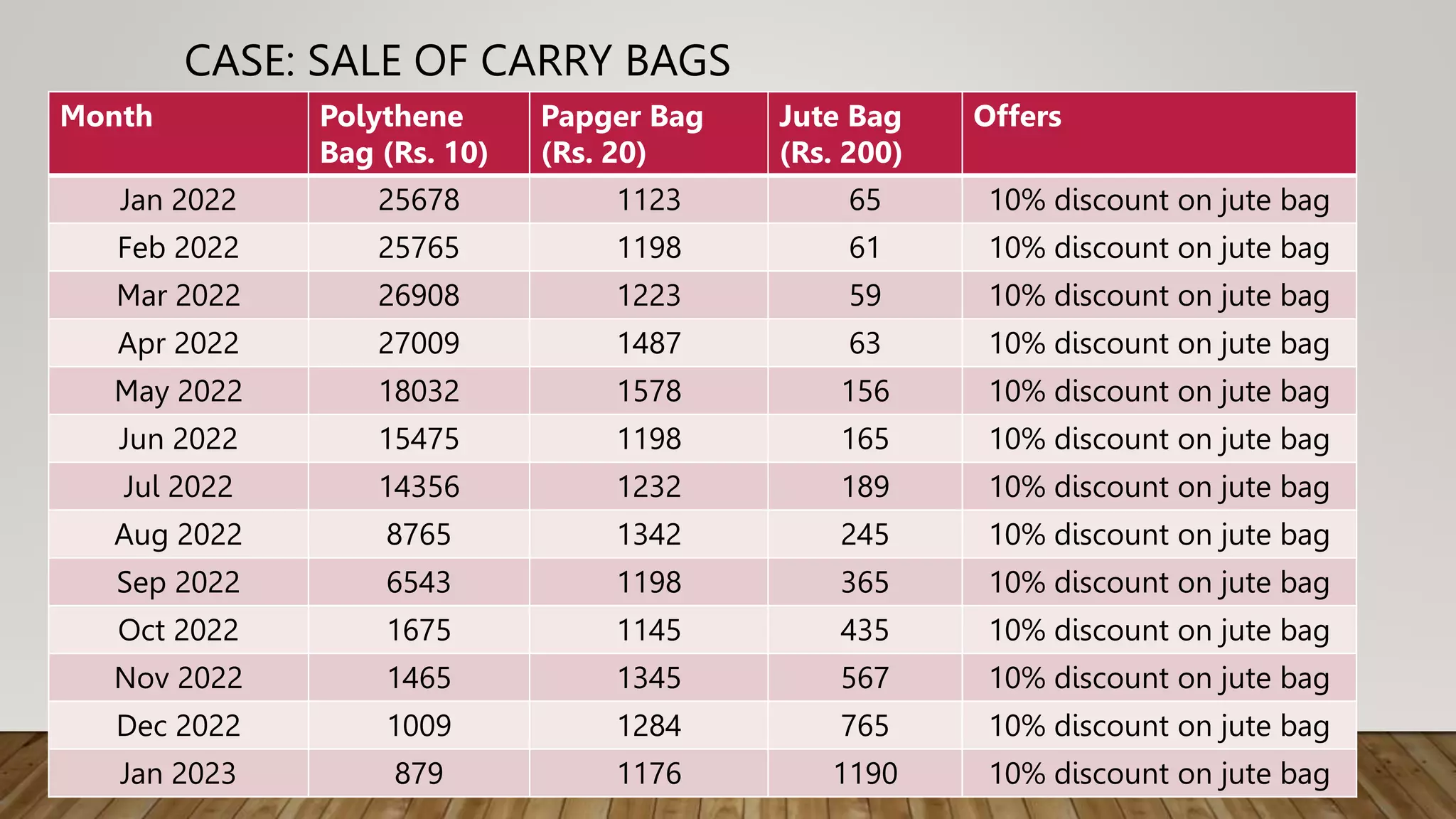
CASE: SALE OF CARRY BAGS
Month Polythene
Bag (Rs. 10)
Papger Bag
(Rs. 20)
Jute Bag
(Rs. 200)
Offers
Jan 2022 25678 1123 65 10% discount on jute bag
Feb 2022 25765 1198 61 10% discount on jute bag
Mar 2022 26908 1223 59 10% discount on jute bag
Apr 2022 27009 1487 63 10% discount on jute bag
May 2022 18032 1578 156 10% discount on jute bag
Jun 2022 15475 1198 165 10% discount on jute bag
Jul 2022 14356 1232 189 10% discount on jute bag
Aug 2022 8765 1342 245 10% discount on jute bag
Sep 2022 6543 1198 365 10% discount on jute bag
Oct 2022 1675 1145 435 10% discount on jute bag
Nov 2022 1465 1345 567 10% discount on jute bag
Dec 2022 1009 1284 765 10% discount on jute bag
Jan 2023 879 1176 1190 10% discount on jute bag
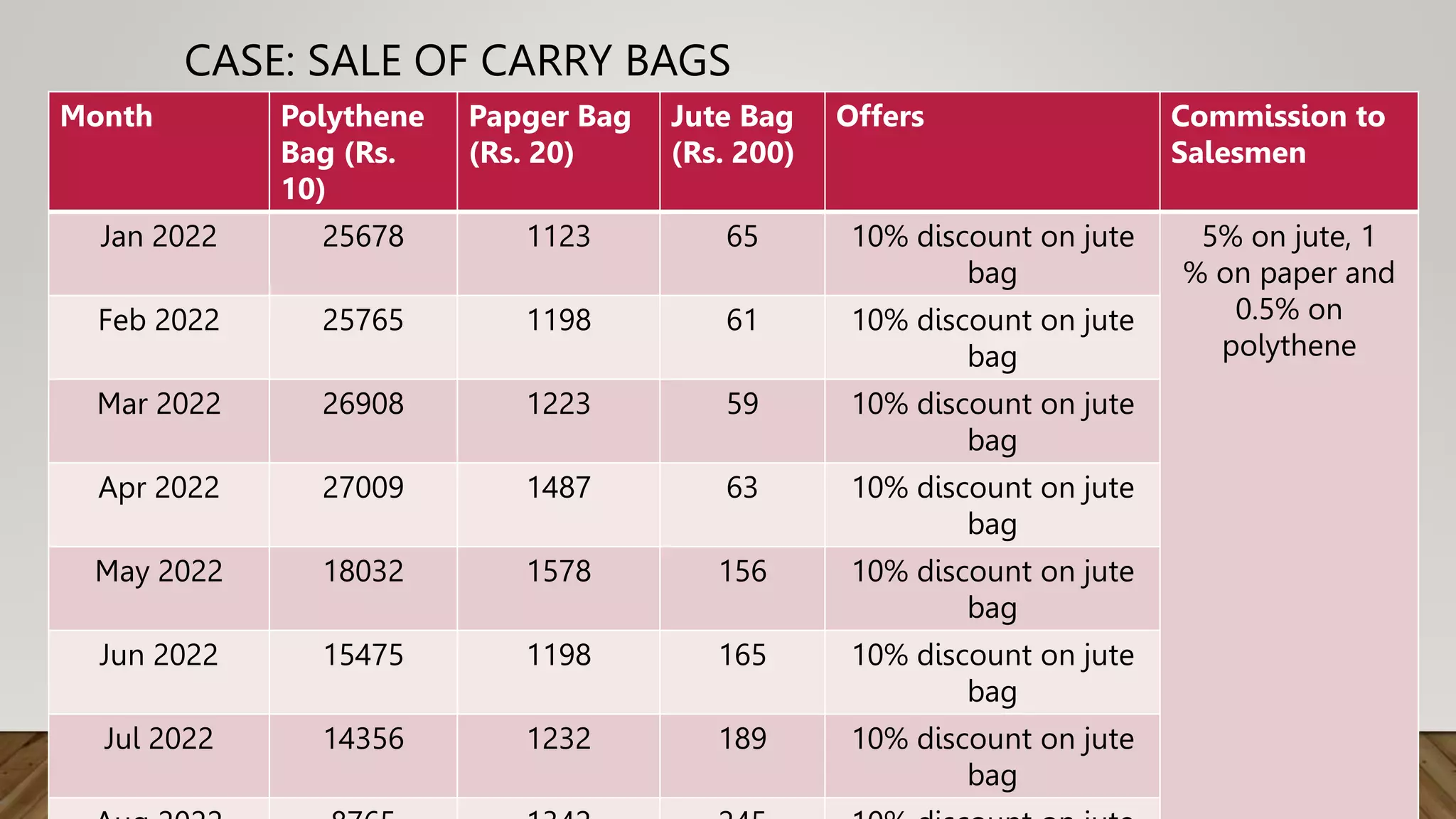
CASE: SALE OF CARRY BAGS
Month Polythene
Bag (Rs.
10)
Papger Bag
(Rs. 20)
Jute Bag
(Rs. 200)
Offers Commission to
Salesmen
Jan 2022 25678 1123 65 10% discount on jute
bag
5% on jute, 1
% on paper and
0.5% on
polythene
Feb 2022 25765 1198 61 10% discount on jute
bag
Mar 2022 26908 1223 59 10% discount on jute
bag
Apr 2022 27009 1487 63 10% discount on jute
bag
May 2022 18032 1578 156 10% discount on jute
bag
Jun 2022 15475 1198 165 10% discount on jute
bag
Jul 2022 14356 1232 189 10% discount on jute
bag
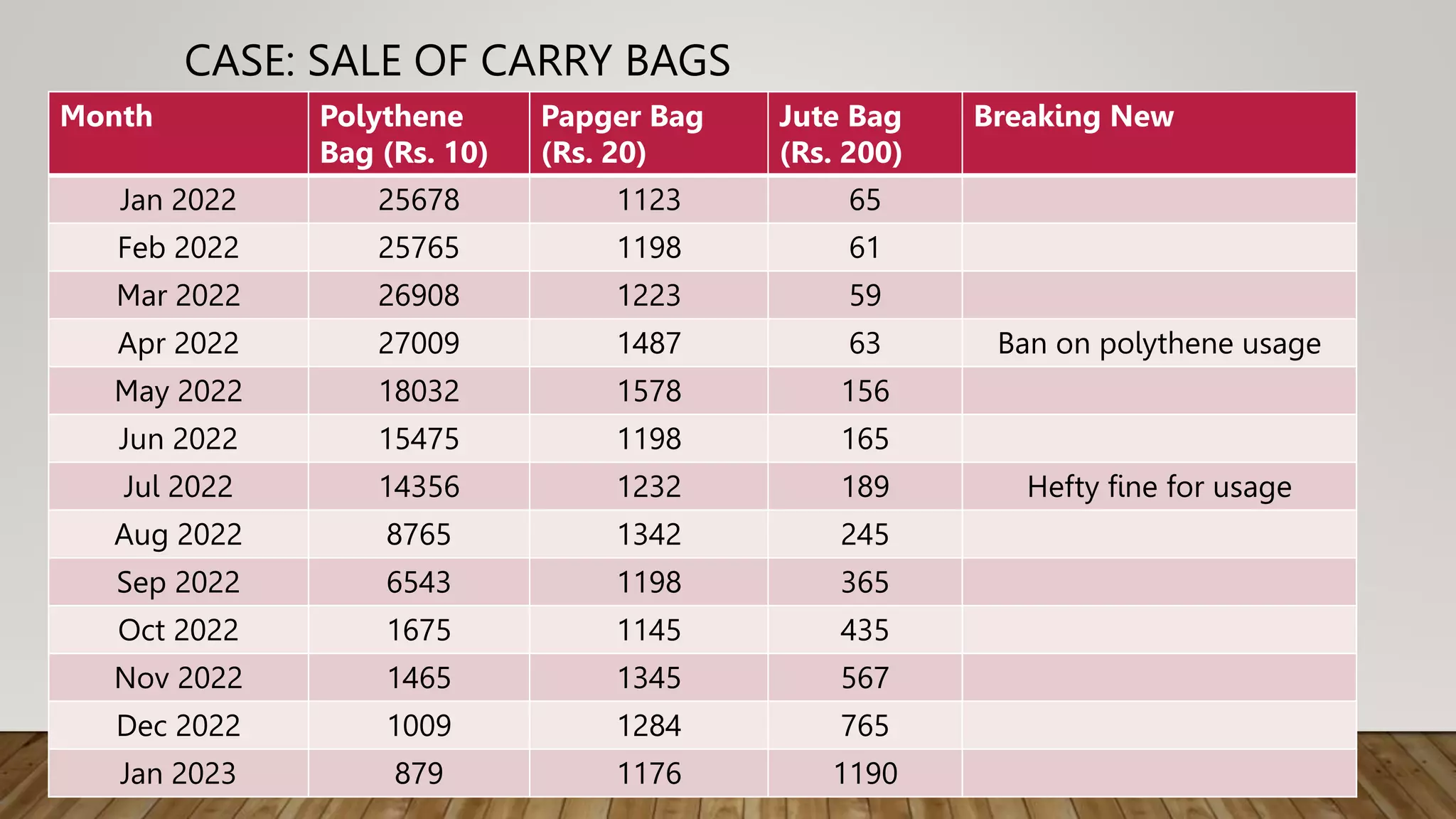
CASE: SALE OF CARRY BAGS
Month Polythene
Bag (Rs. 10)
Papger Bag
(Rs. 20)
Jute Bag
(Rs. 200)
Breaking New
Jan 2022 25678 1123 65
Feb 2022 25765 1198 61
Mar 2022 26908 1223 59
Apr 2022 27009 1487 63 Ban on polythene usage
May 2022 18032 1578 156
Jun 2022 15475 1198 165
Jul 2022 14356 1232 189 Hefty fine for usage
Aug 2022 8765 1342 245
Sep 2022 6543 1198 365
Oct 2022 1675 1145 435
Nov 2022 1465 1345 567
Dec 2022 1009 1284 765
Jan 2023 879 1176 1190
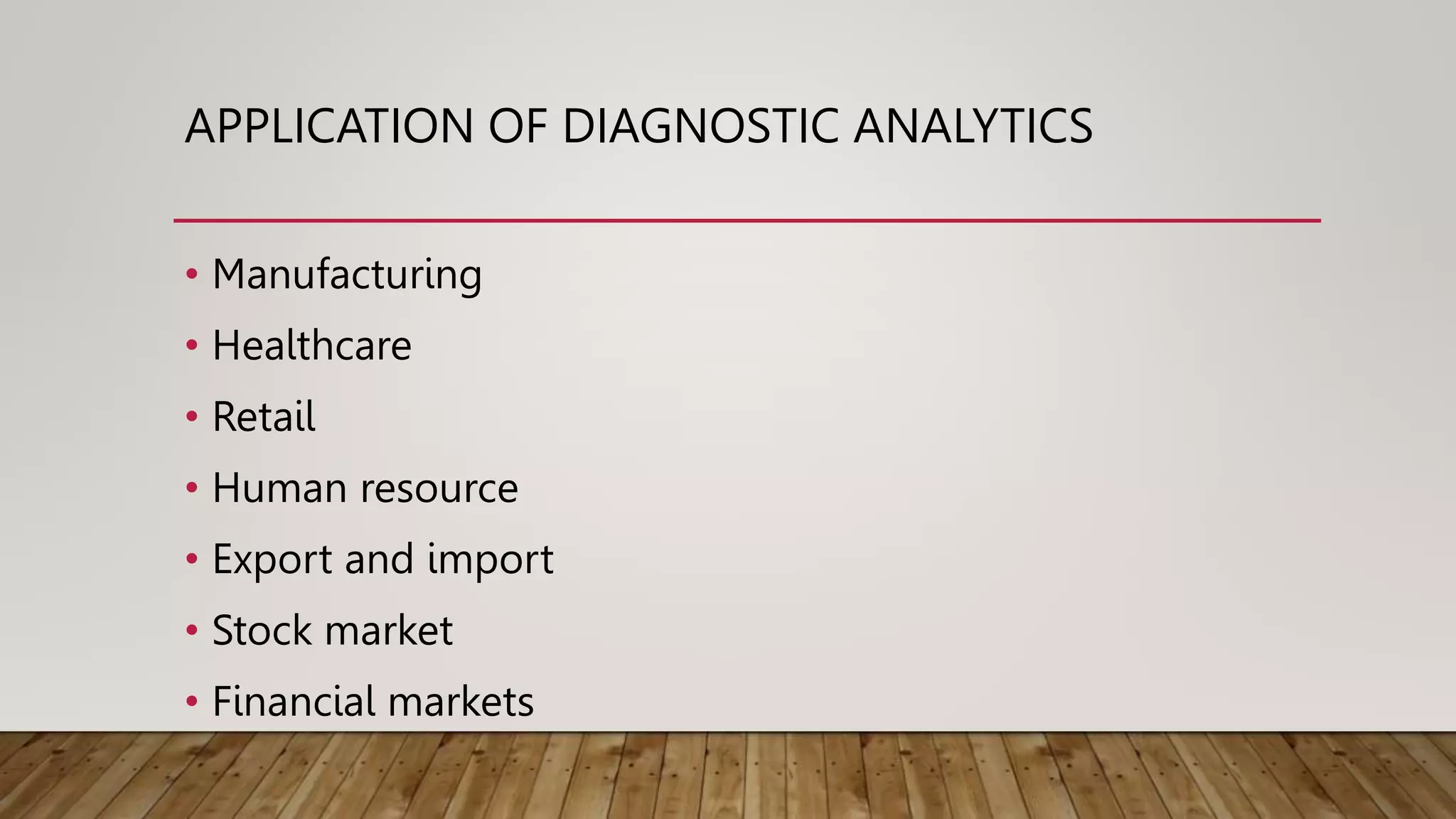
APPLICATION OF DIAGNOSTIC ANALYTICS
• Manufacturing
• Healthcare
• Retail
• Human resource
• Export and import
• Stock market
• Financial markets
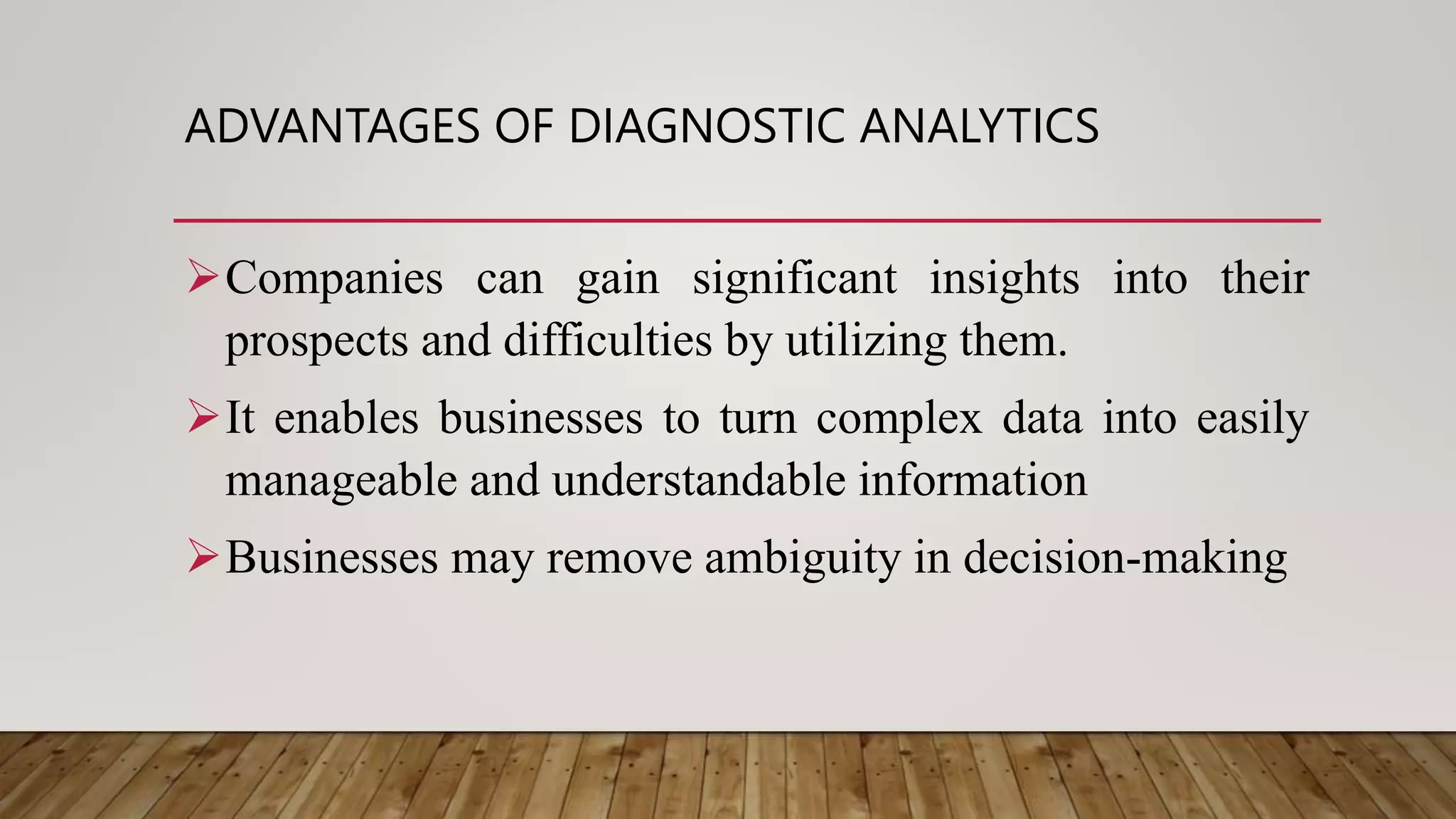
ADVANTAGES OF DIAGNOSTIC ANALYTICS
Companies can gain significant insights into their
prospects and difficulties by utilizing them.
It enables businesses to turn complex data into easily
manageable and understandable information
Businesses may remove ambiguity in decision-making
DISADVANTAGES OF DIAGNOSTIC ANALYTICS
One of the drawbacks of this sort of analytics is that it
focuses on past events, limiting its capacity to deliver
useful future insights.
It cannot find the solution for a given problem.
PREDICTIVE ANALYTICS
• The term predictive analytics refers to the use of statistics and modeling
techniques to make predictions about future outcomes and performance.
• Predictive analytics looks at current and historical data patterns to
determine if those patterns are likely to emerge again. This allows
businesses and investors to adjust where they use their resources to take
advantage of possible future events.
• Predictive analysis can also be used to improve operational efficiencies and
reduce risk.
PROCESS OF PREDICTIVE ANALYTICS
• Define the requirements
• Explore the data
• Develop the model
• Deploy the model
• Validate the results
TECHNIQUES OF PREDICTIVE ANALYTICS
•Decision tree
•Regression
•Neural networks
DECISION TREE
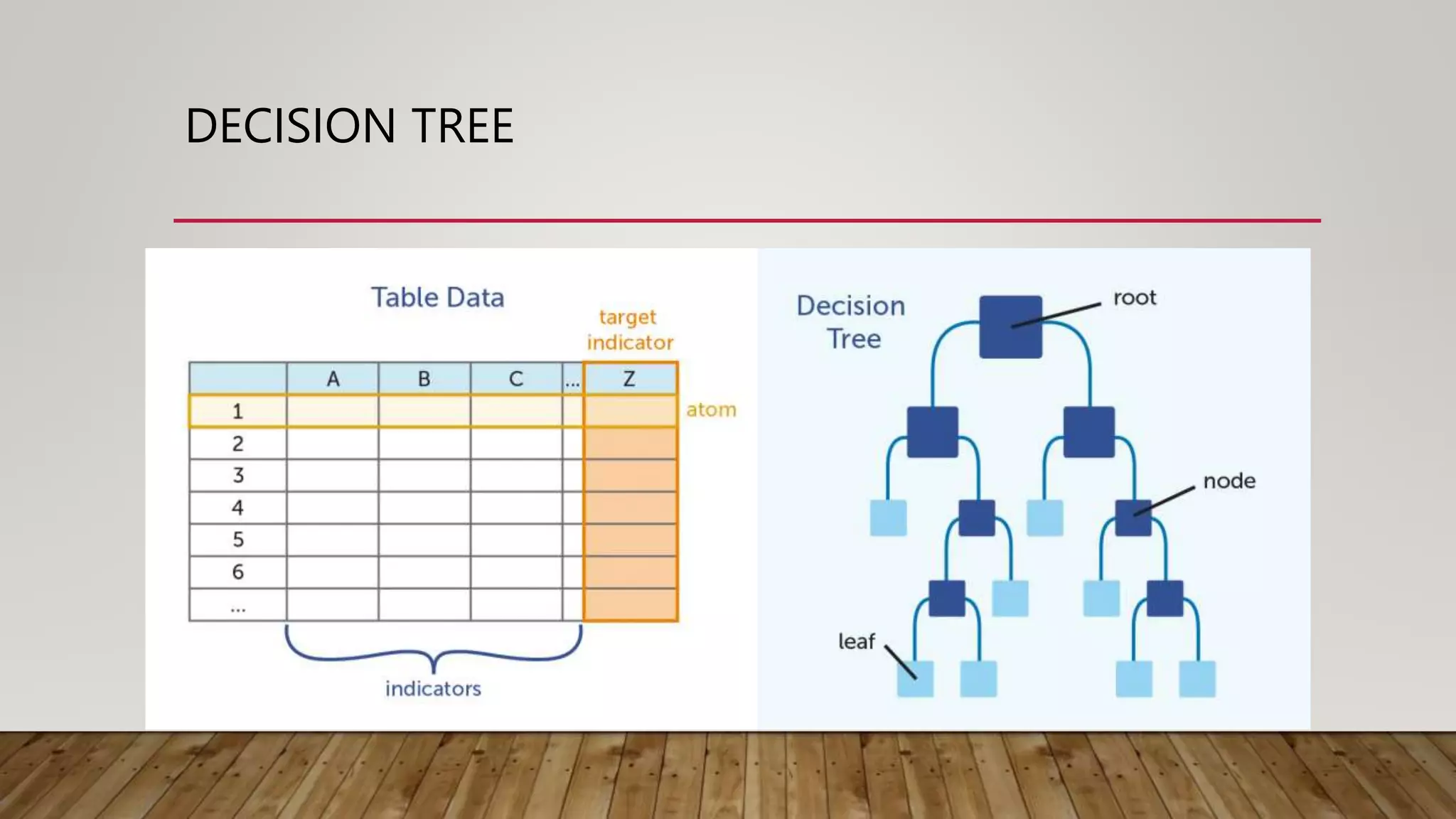
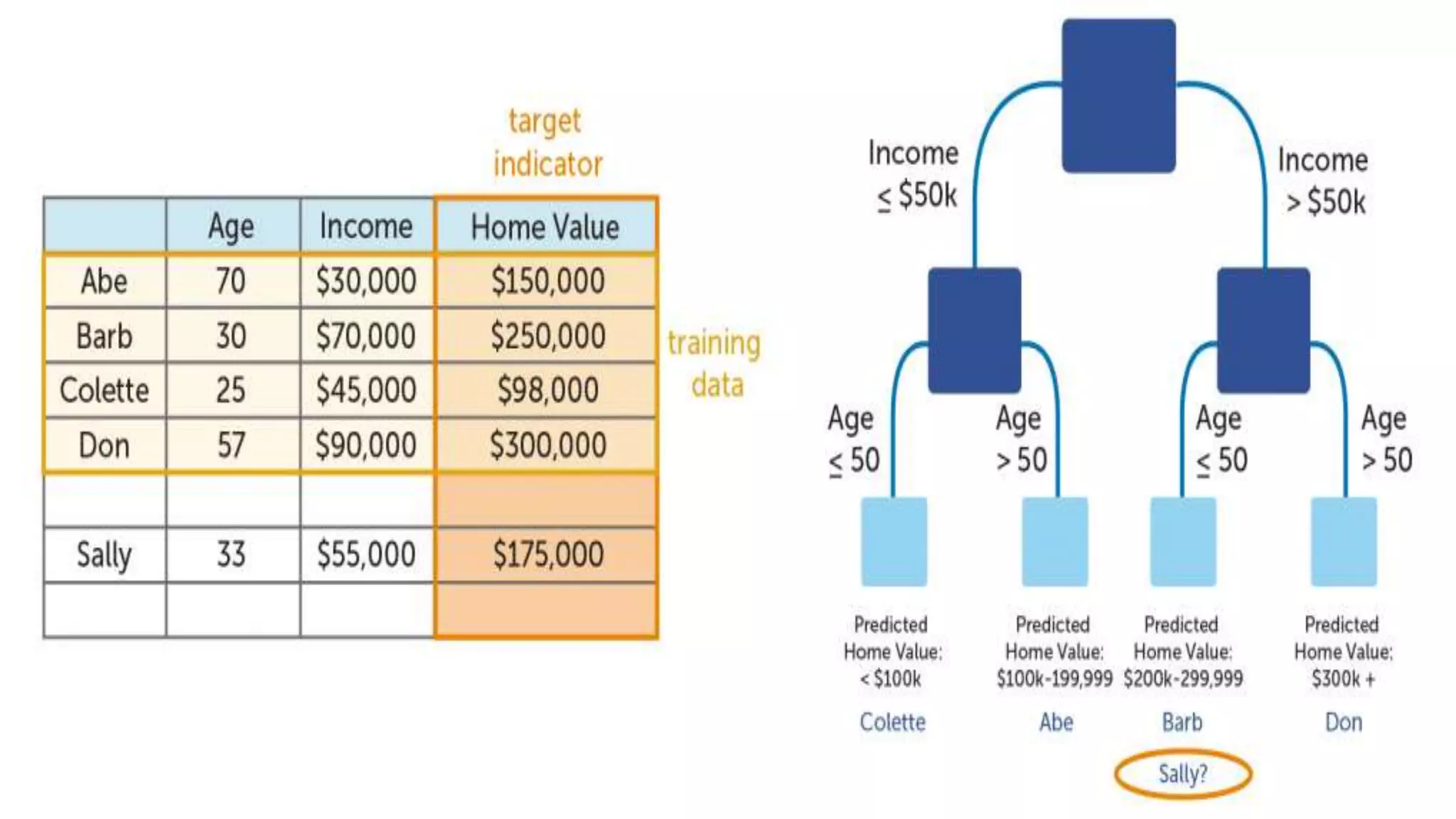
• This type of model places data into different sections based on
certain variables.
• Just as the name implies, it looks like a tree with individual
branches and leaves.
• Branches indicate the choices available while individual leaves
represent a particular decision.
DECISION TREE
REGRESSION
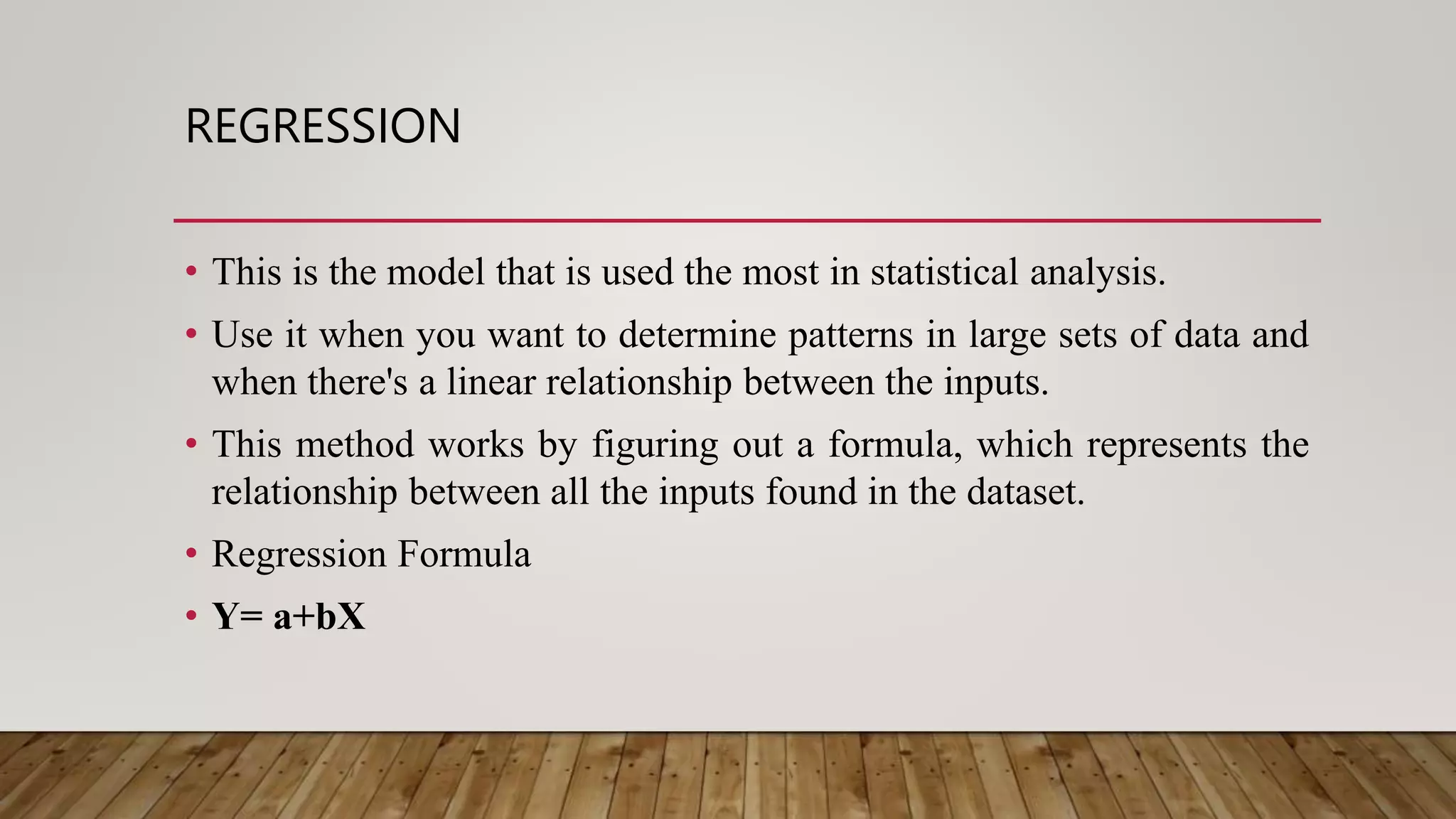
• This is the model that is used the most in statistical analysis.
• Use it when you want to determine patterns in large sets of data and
when there's a linear relationship between the inputs.
• This method works by figuring out a formula, which represents the
relationship between all the inputs found in the dataset.
• Regression Formula
• Y= a+bX
NEURAL NETWORKS
• Neural networks were developed as a form of predictive
analytics by imitating the way the human brain works.
• This model can deal with complex data relationships
using artificial intelligence and pattern recognition.
• Use it if you have several hurdles that you need to
overcome like when you have too much data on hand
APPLICATION OF PREDICTIVE ANALYTICS
• Forecasting
• Credit
• Underwriting
• Marketing
• Fraud detection
• Supply chain
• Human resources
ADVANTAGES
 This type of analysis can help entities when you need to make
predictions about outcomes when there are no other (and obvious)
answers available.
 Investors, financial professionals, and business leaders are able to
use models to help reduce risk.
 There is a significant impact to cost reduction when models are
used.
DISADVANTAGES
 The use of predictive analytics has been criticized and, in some
cases, legally restricted due to perceived inequities in its
outcomes.
 Regardless of whether the predictions drawn from the use of
such analytics are accurate, their use is generally limited.
 It cannot provide any solution to given problem
PRESCRIPTIVE ANALYTICS
• Prescriptive analytics is the process of using data to
determine an optimal course of action.
• Prescriptive analytics attempts to answer the question
"What do we need to do to achieve this?"
• It involves the use of technology to help businesses make
better decisions through the analysis of raw data.
EXAMPLE
• A human resources manager is tasked with up-skilling a team
under his care.
• However, he realizes that team members who lack a particular
skill set may not be able to take the upgrade course he has in
mind.
• An algorithm can identify team members who do not possess the
necessary skills and send them an automated recommendation
that they acquire the skill set with another course before they
come to this one.
BOTTOM LINE
• You have to remember that the recommendation generated
is completely based on the accuracy of the information
provided and the model developed to get an answer.
• The recommendation does not become a standard for all
human resource personnel that are faced with a similar
situation.
• Each algorithmic model created is uniquely customized to
the particular situation and need.
PROCESS OF PRESCRIPTIVE ANALYTICS
• 1) Define the question. It is the first step to clearly define the
problem you’re trying to solve or which question you’d like to
answer. This will inform your data requirements and allow your
prescriptive model to generate an actionable output.
• 2) Integrate your data. Gather the data you need and prepare
your dataset. To help your model be the most accurate, you
should bring in data representing every factor you can think of.
PROCESS OF PRESCRIPTIVE ANALYTICS
• 3) Develop your model. Now you’re ready to build, train, evaluate and deploy
your prescriptive model. You can hire a data scientist to code one from scratch
or you can leverage an AutoML tool to develop a custom ML model yourself as
a citizen data scientist.
• 4) Deploy your model. Once you’re confident in its performance, you can make
your prescriptive model available for use. This may be a one-time project or as
part of an on-going production process.
• 5) Take action. Now you should review the recommendation, decide if it makes
sense to you, and then take appropriate actions. Some situations require human
intuition and judgment.
•
TECHNIQUES OF PRESCRIPTIVE ANALYTICS
•Optimisation
•Simulation
•Machine Learning
OPTIMISATION
Optimization consists in the construction of a mathematical model
(with variables and equations) whose resolution allows finding the best
solution to a problem: the optimal one.
A classic example is the traveling salesman problem, consisting in
visiting a set of cities only once and returning to the city of departure
traveling the shortest possible distance.
OPTIMISATION
• IBM customer Fleetpride is a real-life example of a business deriving value
from prescriptive analytics. Fleetpride sells parts and provides services for
heavy-duty trucks and trailers.
• They built a model that uses historical shipping data to predict the shipping
orders per warehouse by day, week and month.
• They apply decision optimization to the model to determine the optimal
action for dealing with customer demand on any given day, including
staffing and inventory placement.
SIMULATION
Simulation consists in building a digital replica (a model) of the system
under study
Unlike optimization, it does not automatically offer the best
configuration,
Simulation can help when systems are not easy to describe
mathematically or when historical data is not adequate for training or
testing machine learning techniques.
Instead of representing a complete system as a statistical algorithm or
generating a fixed data set, simulation captures the characteristics and
relationships of system components to provide a dynamic model.
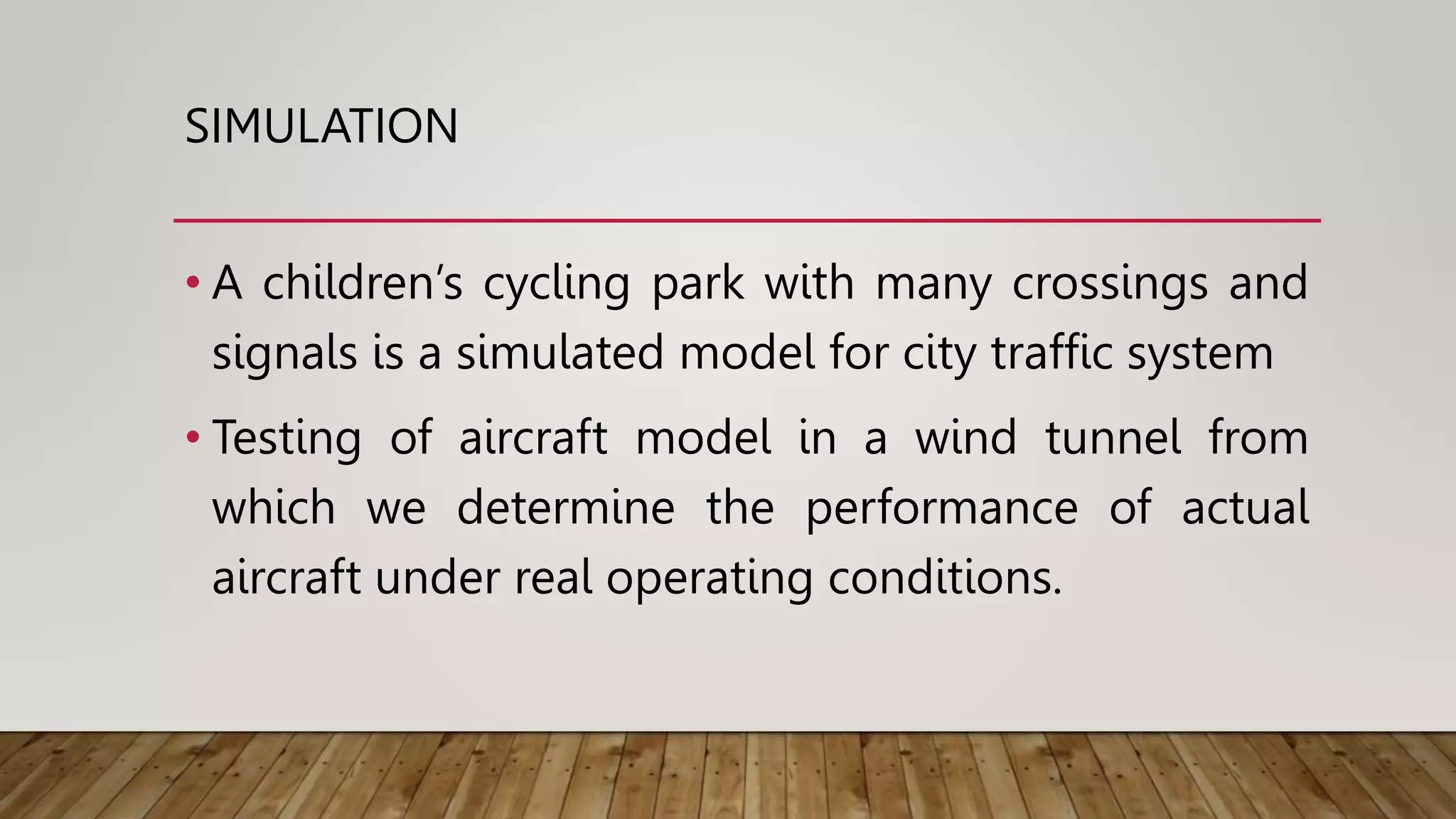
SIMULATION
• A children’s cycling park with many crossings and
signals is a simulated model for city traffic system
• Testing of aircraft model in a wind tunnel from
which we determine the performance of actual
aircraft under real operating conditions.
MACHINE LEARNING
• Machine learning is a subfield of artificial intelligence that gives
computers the ability to learn without explicitly being programmed.
• The function of a machine learning system can be descriptive,
meaning that the system uses the data to explain what
happened; predictive, meaning the system uses the data to predict
what will happen; or prescriptive, meaning the system will use the
data to make suggestions about what action to take.
MACHINE LEARNING
• Machine learning can translate speech into text. Certain software
applications can convert live voice and recorded speech into a text
file. The speech can be segmented by intensities on time-frequency
bands as well.
• Voice search
• Voice dialing
• Appliance control
• Some of the most common uses of speech recognition software are
devices like Google Home or Amazon Alexa.
APPLICATION OF PRESCRIPTIVE ANALYTICS
• Healthcare
• Banking
• Marketing
• Hotels
• Airlines
• Manufacturing
• Gaming
ADVANTAGES
• Prescriptive analytics can cut through the clutter of immediate
uncertainty and changing conditions.
• It can help prevent fraud, limit risk, increase efficiency, meet
business goals, and create more loyal customers.
• It can help organizations make decisions based on highly analyzed
facts rather than jump to under-informed conclusions based on
instinct.
DISADVANTAGES
• It is only effective if organizations know what questions to ask
and how to react to the answers.
• If the input assumptions are invalid, the output results will not
be accurate.
• This form of data analytics is only suitable for short-term
solutions.

TYPES OF ANALYTICS.pptx

  • 1.
  • 2.
    UNIT 2: TYPESOF BUSINESS ANALYTICS • DESCRIPTIVE ANALYTIUCS • DIAGNOSTIC ANALYTICS • PREDICTIVE ANALYTICS • PRESCRIPTIVE ANALYTICS
  • 3.
    DESCRIPTIVE ANALYTICS • Descriptiveanalytics is the interpretation of historical data to better understand changes that have occurred in a business. • Answer the question “What happened?” • Descriptive analytics can help to identify the areas of strength and weakness in an organization.
  • 4.
    STEPS IN DESCRIPTIVEANALYTICS State Business Metrics Identify the data required Extract and prepare data Analyse data Present data
  • 5.
    STATE THE METRICS •Identify the metrics • Metrics must reflect the goals • E.g.: Sales revenue of a product for last few months
  • 6.
    IDENTIFY THE DATAREQUIRED • Search for data • Identify the multiple resources • Internal and external • E.g.: Collecting revenue data from sales people and dealers
  • 7.
    EXTRACT AND PREPAREDATA • Extract the data • Combine the data • Prepare the data • E.g.: Collect data and arrange in columns and rows
  • 8.
    ANALYSE DATA • Usetools for analysis • Basic Mathematical formulas E.g: Calculating average revenue
  • 9.
    PRESENT DATA • Presentingdata in different forms • Graphs, chart, table etc. • E.g.: Revenue in rows and columns
  • 10.
    WEATHER IN BANGALORE DateMin Temp High Temp Humidity 09-02-2023 ? ? ? 08-02-2023 17 30 57% 07-02-2023 18 31 55% 06-02-2023 16 29 49% 05-02-2023 17 30 48% 04-02-2023 21 29 60% 03-02-2023 18 27 68% 02-02-2023 19 27 57% 01-02-2023 16 28 66%
  • 11.
    TECHNIQUES OF DESCRIPTIVEANALYTICS • Frequency distribution • Pie chart • Bar chart • Scatterplot • Histogram
  • 12.
    FREQUENCY DISTRIBUTION Date MinTemp High Temp Humidity 09-02-2023 ? ? ? 08-02-2023 17 30 57% 07-02-2023 18 31 55% 06-02-2023 16 29 49% 05-02-2023 17 30 48% 04-02-2023 21 29 60% 03-02-2023 18 27 68% 02-02-2023 19 27 57% 01-02-2023 16 28 66%
  • 13.
    PIE CHART 0 17 18 16 17 21 18 19 16 Min Temp 2/9/20232/8/2023 2/7/2023 2/6/2023 2/5/2023 2/4/2023 2/3/2023 2/2/2023 2/1/2023
  • 14.
    BAR CHART 0 5 10 15 20 25 30 35 2/1/2023 2/2/20232/3/2023 2/4/2023 2/5/2023 2/6/2023 2/7/2023 2/8/2023 2/9/2023 Chart Title Min Temp High Temp Humidity
  • 15.
    SCATTERPLOT 0 5 10 15 20 25 1/31/2023 2/1/2023 2/2/20232/3/2023 2/4/2023 2/5/2023 2/6/2023 2/7/2023 2/8/2023 2/9/2023 2/10/2023 Min Temp
  • 16.
  • 17.
    APPLICATIONS OF DESCRIPTIVEANALYTICS • Analysing sales data • Analysing social metrics (Facebook, Twitter) • Assessing trends in travel destinations • Weather forecast • Online customer behaviour • Supply chain management • Manufacturing
  • 18.
    ADVANTAGES OF DESCRIPTIVEANALYTICS  Access to information  Precise estimation of frequency  Economical  Easy to complete  Compared to inferential statistics
  • 19.
    DISADVANTAGES OF DESCRIPTIVEANALYTICS  Data may not be complete  Reasons for trends can’t be identified  Descriptive analytics cannot be used to make future predictions.  Your results cannot be applied to a larger population as a whole.  Descriptive analytics provide no information regarding the method of data collection.
  • 20.
    DIAGNOSTIC ANALYTICS • Diagnosticanalytics is the process of using data to determine the causes of trends and correlations between variables. It can be viewed as a logical next step after using descriptive analytics to identify trends. • Diagnostic analysis can be done manually, using an algorithm, or with statistical software (such as Microsoft Excel). • Answers the question “Why did this happen?”
  • 21.
    PROCESS OF DIAGNOSTICANALYTICS • Identify anomalies: Trends or anomalies highlighted by descriptive analysis may require diagnostic analytics if the cause isn’t immediately obvious • Discovery: The next step is to look for data that explains the anomalies. That may involve gathering external data as well as drilling into internal data. • Causal relationships: Further investigation can provide insights into whether the associations in the data point to the true cause of the anomaly. Two events correlate doesn’t necessarily mean one causes the other.
  • 22.
    TECHNIQUES OF DIAGNOSTICANALYTICS • Data drilling: Drilling down into a dataset can reveal more detailed information about which aspects of the data are driving the observed trends. • Data mining hunts through large volumes of data to find patterns and associations within the data. Data mining can be conducted manually or automatically with machine learning technology. • Correlation analysis examines how strongly different variables are linked to each other. For example, sales of ice cream and refrigerated soda may soar on hot days.
  • 23.
    CASE: SALE OFCARRY BAGS Month Polythene Bag (Rs. 10) Papger Bag (Rs. 20) Jute Bag (Rs. 200) Jan 2022 25678 1123 65 Feb 2022 25765 1198 61 Mar 2022 26908 1223 59 Apr 2022 27009 1487 63 May 2022 18032 1578 156 Jun 2022 15475 1198 165 Jul 2022 14356 1232 189 Aug 2022 8765 1342 245 Sep 2022 6543 1198 365 Oct 2022 1675 1145 435 Nov 2022 1465 1345 567 Dec 2022 1009 1284 765 Jan 2023 879 1176 1190
  • 24.
    CASE: SALE OFCARRY BAGS Month Polythene Bag (Rs. 10) Papger Bag (Rs. 20) Jute Bag (Rs. 200) Offers Jan 2022 25678 1123 65 10% discount on jute bag Feb 2022 25765 1198 61 10% discount on jute bag Mar 2022 26908 1223 59 10% discount on jute bag Apr 2022 27009 1487 63 10% discount on jute bag May 2022 18032 1578 156 10% discount on jute bag Jun 2022 15475 1198 165 10% discount on jute bag Jul 2022 14356 1232 189 10% discount on jute bag Aug 2022 8765 1342 245 10% discount on jute bag Sep 2022 6543 1198 365 10% discount on jute bag Oct 2022 1675 1145 435 10% discount on jute bag Nov 2022 1465 1345 567 10% discount on jute bag Dec 2022 1009 1284 765 10% discount on jute bag Jan 2023 879 1176 1190 10% discount on jute bag
  • 25.
    CASE: SALE OFCARRY BAGS Month Polythene Bag (Rs. 10) Papger Bag (Rs. 20) Jute Bag (Rs. 200) Offers Commission to Salesmen Jan 2022 25678 1123 65 10% discount on jute bag 5% on jute, 1 % on paper and 0.5% on polythene Feb 2022 25765 1198 61 10% discount on jute bag Mar 2022 26908 1223 59 10% discount on jute bag Apr 2022 27009 1487 63 10% discount on jute bag May 2022 18032 1578 156 10% discount on jute bag Jun 2022 15475 1198 165 10% discount on jute bag Jul 2022 14356 1232 189 10% discount on jute bag
  • 26.
    CASE: SALE OFCARRY BAGS Month Polythene Bag (Rs. 10) Papger Bag (Rs. 20) Jute Bag (Rs. 200) Breaking New Jan 2022 25678 1123 65 Feb 2022 25765 1198 61 Mar 2022 26908 1223 59 Apr 2022 27009 1487 63 Ban on polythene usage May 2022 18032 1578 156 Jun 2022 15475 1198 165 Jul 2022 14356 1232 189 Hefty fine for usage Aug 2022 8765 1342 245 Sep 2022 6543 1198 365 Oct 2022 1675 1145 435 Nov 2022 1465 1345 567 Dec 2022 1009 1284 765 Jan 2023 879 1176 1190
  • 27.
    APPLICATION OF DIAGNOSTICANALYTICS • Manufacturing • Healthcare • Retail • Human resource • Export and import • Stock market • Financial markets
  • 28.
    ADVANTAGES OF DIAGNOSTICANALYTICS Companies can gain significant insights into their prospects and difficulties by utilizing them. It enables businesses to turn complex data into easily manageable and understandable information Businesses may remove ambiguity in decision-making
  • 29.
    DISADVANTAGES OF DIAGNOSTICANALYTICS One of the drawbacks of this sort of analytics is that it focuses on past events, limiting its capacity to deliver useful future insights. It cannot find the solution for a given problem.
  • 30.
    PREDICTIVE ANALYTICS • Theterm predictive analytics refers to the use of statistics and modeling techniques to make predictions about future outcomes and performance. • Predictive analytics looks at current and historical data patterns to determine if those patterns are likely to emerge again. This allows businesses and investors to adjust where they use their resources to take advantage of possible future events. • Predictive analysis can also be used to improve operational efficiencies and reduce risk.
  • 31.
    PROCESS OF PREDICTIVEANALYTICS • Define the requirements • Explore the data • Develop the model • Deploy the model • Validate the results
  • 32.
    TECHNIQUES OF PREDICTIVEANALYTICS •Decision tree •Regression •Neural networks
  • 33.
    DECISION TREE • Thistype of model places data into different sections based on certain variables. • Just as the name implies, it looks like a tree with individual branches and leaves. • Branches indicate the choices available while individual leaves represent a particular decision.
  • 34.
  • 36.
    REGRESSION • This isthe model that is used the most in statistical analysis. • Use it when you want to determine patterns in large sets of data and when there's a linear relationship between the inputs. • This method works by figuring out a formula, which represents the relationship between all the inputs found in the dataset. • Regression Formula • Y= a+bX
  • 37.
    NEURAL NETWORKS • Neuralnetworks were developed as a form of predictive analytics by imitating the way the human brain works. • This model can deal with complex data relationships using artificial intelligence and pattern recognition. • Use it if you have several hurdles that you need to overcome like when you have too much data on hand
  • 38.
    APPLICATION OF PREDICTIVEANALYTICS • Forecasting • Credit • Underwriting • Marketing • Fraud detection • Supply chain • Human resources
  • 39.
    ADVANTAGES  This typeof analysis can help entities when you need to make predictions about outcomes when there are no other (and obvious) answers available.  Investors, financial professionals, and business leaders are able to use models to help reduce risk.  There is a significant impact to cost reduction when models are used.
  • 40.
    DISADVANTAGES  The useof predictive analytics has been criticized and, in some cases, legally restricted due to perceived inequities in its outcomes.  Regardless of whether the predictions drawn from the use of such analytics are accurate, their use is generally limited.  It cannot provide any solution to given problem
  • 41.
    PRESCRIPTIVE ANALYTICS • Prescriptiveanalytics is the process of using data to determine an optimal course of action. • Prescriptive analytics attempts to answer the question "What do we need to do to achieve this?" • It involves the use of technology to help businesses make better decisions through the analysis of raw data.
  • 42.
    EXAMPLE • A humanresources manager is tasked with up-skilling a team under his care. • However, he realizes that team members who lack a particular skill set may not be able to take the upgrade course he has in mind. • An algorithm can identify team members who do not possess the necessary skills and send them an automated recommendation that they acquire the skill set with another course before they come to this one.
  • 43.
    BOTTOM LINE • Youhave to remember that the recommendation generated is completely based on the accuracy of the information provided and the model developed to get an answer. • The recommendation does not become a standard for all human resource personnel that are faced with a similar situation. • Each algorithmic model created is uniquely customized to the particular situation and need.
  • 44.
    PROCESS OF PRESCRIPTIVEANALYTICS • 1) Define the question. It is the first step to clearly define the problem you’re trying to solve or which question you’d like to answer. This will inform your data requirements and allow your prescriptive model to generate an actionable output. • 2) Integrate your data. Gather the data you need and prepare your dataset. To help your model be the most accurate, you should bring in data representing every factor you can think of.
  • 45.
    PROCESS OF PRESCRIPTIVEANALYTICS • 3) Develop your model. Now you’re ready to build, train, evaluate and deploy your prescriptive model. You can hire a data scientist to code one from scratch or you can leverage an AutoML tool to develop a custom ML model yourself as a citizen data scientist. • 4) Deploy your model. Once you’re confident in its performance, you can make your prescriptive model available for use. This may be a one-time project or as part of an on-going production process. • 5) Take action. Now you should review the recommendation, decide if it makes sense to you, and then take appropriate actions. Some situations require human intuition and judgment. •
  • 46.
    TECHNIQUES OF PRESCRIPTIVEANALYTICS •Optimisation •Simulation •Machine Learning
  • 47.
    OPTIMISATION Optimization consists inthe construction of a mathematical model (with variables and equations) whose resolution allows finding the best solution to a problem: the optimal one. A classic example is the traveling salesman problem, consisting in visiting a set of cities only once and returning to the city of departure traveling the shortest possible distance.
  • 48.
    OPTIMISATION • IBM customerFleetpride is a real-life example of a business deriving value from prescriptive analytics. Fleetpride sells parts and provides services for heavy-duty trucks and trailers. • They built a model that uses historical shipping data to predict the shipping orders per warehouse by day, week and month. • They apply decision optimization to the model to determine the optimal action for dealing with customer demand on any given day, including staffing and inventory placement.
  • 49.
    SIMULATION Simulation consists inbuilding a digital replica (a model) of the system under study Unlike optimization, it does not automatically offer the best configuration, Simulation can help when systems are not easy to describe mathematically or when historical data is not adequate for training or testing machine learning techniques. Instead of representing a complete system as a statistical algorithm or generating a fixed data set, simulation captures the characteristics and relationships of system components to provide a dynamic model.
  • 50.
    SIMULATION • A children’scycling park with many crossings and signals is a simulated model for city traffic system • Testing of aircraft model in a wind tunnel from which we determine the performance of actual aircraft under real operating conditions.
  • 51.
    MACHINE LEARNING • Machinelearning is a subfield of artificial intelligence that gives computers the ability to learn without explicitly being programmed. • The function of a machine learning system can be descriptive, meaning that the system uses the data to explain what happened; predictive, meaning the system uses the data to predict what will happen; or prescriptive, meaning the system will use the data to make suggestions about what action to take.
  • 52.
    MACHINE LEARNING • Machinelearning can translate speech into text. Certain software applications can convert live voice and recorded speech into a text file. The speech can be segmented by intensities on time-frequency bands as well. • Voice search • Voice dialing • Appliance control • Some of the most common uses of speech recognition software are devices like Google Home or Amazon Alexa.
  • 53.
    APPLICATION OF PRESCRIPTIVEANALYTICS • Healthcare • Banking • Marketing • Hotels • Airlines • Manufacturing • Gaming
  • 54.
    ADVANTAGES • Prescriptive analyticscan cut through the clutter of immediate uncertainty and changing conditions. • It can help prevent fraud, limit risk, increase efficiency, meet business goals, and create more loyal customers. • It can help organizations make decisions based on highly analyzed facts rather than jump to under-informed conclusions based on instinct.
  • 55.
    DISADVANTAGES • It isonly effective if organizations know what questions to ask and how to react to the answers. • If the input assumptions are invalid, the output results will not be accurate. • This form of data analytics is only suitable for short-term solutions.