OBJECTIVES:
• Define lodgingindustry.
• Describe the different type of accommodations.
• Explain the organizations of the lodging industry.
• Discuss the management methods in the lodging industry.
• Explain the different career opportunities in lodging
industry.
4.
Lodging Industry
• Lodgingis a catch-all term for any service that provides somewhere for
people to sleep or stay overnight.
• This means that it covers everything from high-end accommodation to
cheaper options, as well as places to stay on land or sea. All in all, this
makes it a very varied and interesting field to work in.
5.
Types of Accommodation
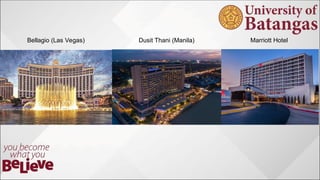
1.Hotels
Hotels provide guests a room and access to additional hotel amenities and services,
including food, housekeeping, concierge, Wi-Fi, and more. Many hotels will have
their own restaurant or bar, and some will also have meeting rooms, sports and
leisure facilities, and other services.
Hotels are often broken down based on ‘star ratings‘, which go from 1-star to 5-star. A
1-star hotel will usually provide very basic facilities. In contrast, a 5-star hotel will
be a luxury hotel, with high-quality facilities and services, including swimming
pools, fitness and spa facilities, butler services, and more
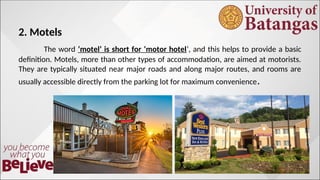
2. Motels
The word‘motel’ is short for ‘motor hotel‘, and this helps to provide a basic
definition. Motels, more than other types of accommodation, are aimed at motorists.
They are typically situated near major roads and along major routes, and rooms are
usually accessible directly from the parking lot for maximum convenience.
8.
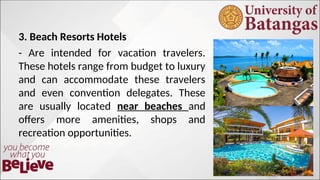
3. Beach ResortsHotels
- Are intended for vacation travelers.
These hotels range from budget to luxury
and can accommodate these travelers
and even convention delegates. These
are usually located near beaches and
offers more amenities, shops and
recreation opportunities.
9.
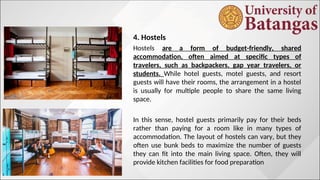
4. Hostels
Hostels area form of budget-friendly, shared
accommodation, often aimed at specific types of
travelers, such as backpackers, gap year travelers, or
students. While hotel guests, motel guests, and resort
guests will have their rooms, the arrangement in a hostel
is usually for multiple people to share the same living
space.
In this sense, hostel guests primarily pay for their beds
rather than paying for a room like in many types of
accommodation. The layout of hostels can vary, but they
often use bunk beds to maximize the number of guests
they can fit into the main living space. Often, they will
provide kitchen facilities for food preparation
10.
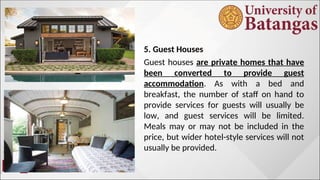
5. Guest Houses
Guesthouses are private homes that have
been converted to provide guest
accommodation. As with a bed and
breakfast, the number of staff on hand to
provide services for guests will usually be
low, and guest services will be limited.
Meals may or may not be included in the
price, but wider hotel-style services will not
usually be provided.
11.
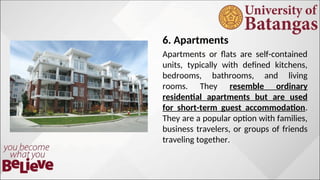
6. Apartments
Apartments orflats are self-contained
units, typically with defined kitchens,
bedrooms, bathrooms, and living
rooms. They resemble ordinary
residential apartments but are used
for short-term guest accommodation.
They are a popular option with families,
business travelers, or groups of friends
traveling together.
12.
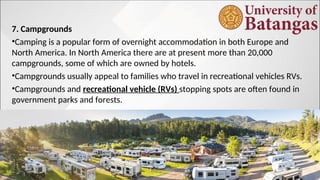
7. Campgrounds
•Camping isa popular form of overnight accommodation in both Europe and
North America. In North America there are at present more than 20,000
campgrounds, some of which are owned by hotels.
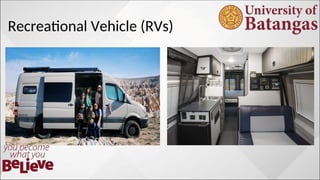
•Campgrounds usually appeal to families who travel in recreational vehicles RVs.
•Campgrounds and recreational vehicle (RVs) stopping spots are often found in
government parks and forests.
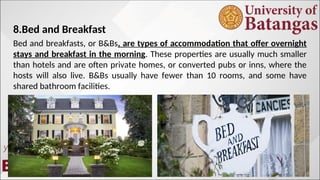
8.Bed and Breakfast
Bedand breakfasts, or B&Bs, are types of accommodation that offer overnight
stays and breakfast in the morning. These properties are usually much smaller
than hotels and are often private homes, or converted pubs or inns, where the
hosts will also live. B&Bs usually have fewer than 10 rooms, and some have
shared bathroom facilities.
15.
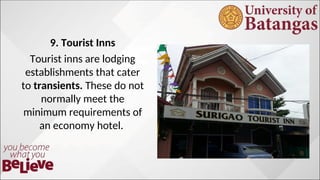
9. Tourist Inns
Touristinns are lodging
establishments that cater
to transients. These do not
normally meet the
minimum requirements of
an economy hotel.
16.
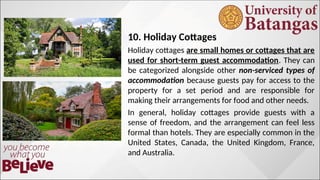
10. Holiday Cottages
Holidaycottages are small homes or cottages that are
used for short-term guest accommodation. They can
be categorized alongside other non-serviced types of
accommodation because guests pay for access to the
property for a set period and are responsible for
making their arrangements for food and other needs.
In general, holiday cottages provide guests with a
sense of freedom, and the arrangement can feel less
formal than hotels. They are especially common in the
United States, Canada, the United Kingdom, France,
and Australia.
17.
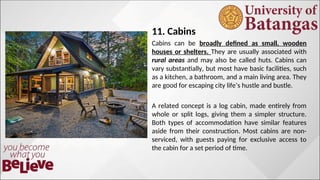
11. Cabins
Cabins canbe broadly defined as small, wooden
houses or shelters. They are usually associated with
rural areas and may also be called huts. Cabins can
vary substantially, but most have basic facilities, such
as a kitchen, a bathroom, and a main living area. They
are good for escaping city life’s hustle and bustle.
A related concept is a log cabin, made entirely from
whole or split logs, giving them a simpler structure.
Both types of accommodation have similar features
aside from their construction. Most cabins are non-
serviced, with guests paying for exclusive access to
the cabin for a set period of time.
18.
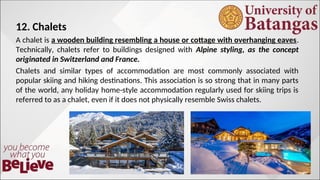
12. Chalets
A chaletis a wooden building resembling a house or cottage with overhanging eaves.
Technically, chalets refer to buildings designed with Alpine styling, as the concept
originated in Switzerland and France.
Chalets and similar types of accommodation are most commonly associated with
popular skiing and hiking destinations. This association is so strong that in many parts
of the world, any holiday home-style accommodation regularly used for skiing trips is
referred to as a chalet, even if it does not physically resemble Swiss chalets.
19.
13. Time-sharing
•Is amore recent unique type of accommodation.
•It started in Europe in the 1960s when people found it difficult to make
reservations every year in popular hotels during summer.
•Time-sharing is the selling of vacation lodging, usually condominium, for
specific weeks or weeks over a given number of years.
20.
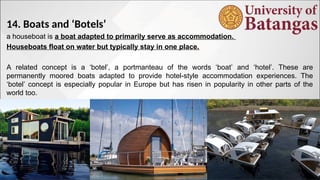
14. Boats and‘Botels’
a houseboat is a boat adapted to primarily serve as accommodation.
Houseboats float on water but typically stay in one place.
A related concept is a ‘botel’, a portmanteau of the words ‘boat’ and ‘hotel’. These are
permanently moored boats adapted to provide hotel-style accommodation experiences. The
‘botel’ concept is especially popular in Europe but has risen in popularity in other parts of the
world too.
21.
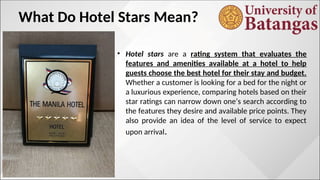
What Do HotelStars Mean?
• Hotel stars are a rating system that evaluates the
features and amenities available at a hotel to help
guests choose the best hotel for their stay and budget.
Whether a customer is looking for a bed for the night or
a luxurious experience, comparing hotels based on their
star ratings can narrow down one’s search according to
the features they desire and available price points. They
also provide an idea of the level of service to expect
upon arrival.
22.
American Hotel RatingSystem vs European Hotel Star Rating System
American hotel star rating systems rank hotels out of 5 stars, while European
hotel rating systems rank hotels out of 4 stars, with a 4 star hotel being the
most luxurious. American hotels are also judged by private companies and
websites, whereas European hotels are evaluated by government agencies
and independent organizations.
23.
What Is a1 Star Hotel?
• A 1 star hotel is a hotel that only provides the bare necessities for a night’s stay, such as a bed
and a bathroom. You can expect limited amenities and minimal service from the staff.
Although some may consider 1 star hotels to be dingy and dirty, the single-star rating is just an
indication of their basic accommodations and does not reflect cleanliness or safety. One-star
hotels offer a place to lay your head for the night, but that is about it. A television or phone
may or may not be included in the rooms.
• One-star hotels are typically privately owned and not part of a chain of businesses. Most 1 star
hotels are situated close to restaurants and fast food locations, but will not have food options
available on-site beyond a vending machine. Reception desk hours will also be limited and
housekeeping services are generally only performed between guests.
24.
What Is a2 Star Hotel?
• A 2 star hotel offers the basic necessities of a bed and bathroom in each room and
may offer some limited amenities, like a television, phone, and closet. Some
examples of 2 star hotels include Sleep Inn & Suites, Econo Lodge Inn & Suites, and
Comfort Inn. There may also be 24-hour front desk services, along with daily
housekeeping and a self-serve dining option at the hotel, such as a continental
breakfast.
• Two-star hotels are often part of a larger chain and can be located in various cities.
These hotels are made for travelers passing through and will be located directly off
major expressway exits. They may even offer reward points as part of loyalty
programs for those who travel often.
25.
What Is a3 Star Hotel?
• A 3-star hotel offers a balance between affordability and amenities. They are generally the mid-tier option
of upscale hotel chains, focusing on style along with comfort. Think Hampton Inn, Hyatt Place, and
Courtyard by Marriott Lancaster. Three-star hotels may not be super luxurious but a guest can expect to
have their basic needs cared for along with bonus accessories to make their stay more enjoyable.
• Rooms are often spacious with a couch or comfy chair, a desk, closet, phone, alarm clock, and flat-screen TV
that features extended cable packages. These hotels can also offer on-site amenities, such as free Wi-Fi, a
gym, pool, and dining facilities for breakfast.
• You’ll usually find 3 star hotels located near restaurants and local attractions, including amusement parks,
theaters, and stadiums. They are geared towards business travelers, so they are strategically placed near
major cities. They also offer 24-hour front desk assistance, conference rooms, and room service to
accommodate business needs.
26.
What Is a4 Star Hotel?
• A 4 star hotel is an upscale hotel that provides amenities, activities, and extras to create a full experience
for multi-night stays. These facilities are often large and located in touristic areas, such as near beaches or
major cities. The lobbies are noticeably elegant, and the buildings are fully staffed with reception desk,
valets, concierges, housekeeping, and kitchen employees.
• Four-star hotels may also have indoor and outdoor pools, spas, tennis and basketball courts, workout
classes led by instructors, movie nights, and live music. Hilton Grand Vacation Resorts, Omni Hotels and
Resorts, and Westin by Marriott are well-known examples of 4 star hotels.
• Rooms in 4-star hotels are spacious and comfortable, with king-sized soft mattresses and lavish hotel
bedding. Along with a desk and premium furnishings, they may also include a safe, bathrobes, and slippers.
Most rooms will have large flat-screen TVs with DVD rentals available in the lobby. A 4 star hotel may also
be gated and feature multiple buildings on its premises, with golf-cart shuttling available from building to
building
27.
What Is a5 Star Hotel?
• A 5 star hotel is a hotel that provides a luxurious experience and high-end
accommodations. Five-star hotels are known to be some of the most
glamorous hospitality locations in the world due to the level of service they
provide. Some of the services guests may find at a 5 star hotel include a
personal butler, doorman, designated concierge, around-the-clock room
service, valet parking, spas with trained masseuses, gyms with personal
trainers, live entertainment, and even child care
28.
A hotel organizationcan be large and complex. A typical hotel has seven
major division namely:
•Personnel
•Engineering and maintenance
•Accounting
•Security
•Food and beverage
•Marketing and sales
•Rooms divisions.
29.
Management Methods
• Traditionally,hotels are operated by the people who own
the property. In some cases the operator may lease the
hotel from the owner and the manage it. In other cases,
special arrangements are made such as franchising and
management contracts.
Under a managementcontract, the hotel management
company does not have a financial interest in the hotels’ land
building. The Landlord owns the property but does not have
any interest in managing it. In return for operating the
property for the landlord, the management company receives
a basic annual management fee, plus an incentives which is
based on the hotels gross profit and or net profit but may also
be based partly on total sales.
33.
Meal Plan
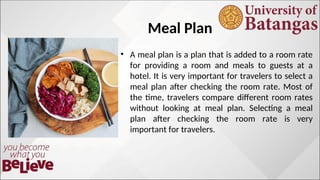
• Ameal plan is a plan that is added to a room rate
for providing a room and meals to guests at a
hotel. It is very important for travelers to select a
meal plan after checking the room rate. Most of
the time, travelers compare different room rates
without looking at meal plan. Selecting a meal
plan after checking the room rate is very
important for travelers.
34.
1. American Plan(AP)
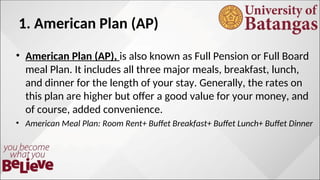
• American Plan (AP), is also known as Full Pension or Full Board
meal Plan. It includes all three major meals, breakfast, lunch,
and dinner for the length of your stay. Generally, the rates on
this plan are higher but offer a good value for your money, and
of course, added convenience.
• American Meal Plan: Room Rent+ Buffet Breakfast+ Buffet Lunch+ Buffet Dinner
35.
2. Modified AmericanPlan(MAP)
• Modified American Plan(MAP), is also known as Half Board or Half
Pension meal plan. It is a modified version of the American Plan
and includes a room stay with breakfast and a choice between
lunch and dinner.
• Modified American Plan: Room Rent+ Buffet Breakfast+ (Buffet Lunch/Buffet Dinner)
36.
3. Continental Plan(CP)
• Continental Plan (CP), is where your room stay involves a
daily breakfast at the hotel. The hotel can either affix its
option of breakfast menu or provide in the dining area for a
buffet breakfast. Also, whether the room service provides
the breakfast or in a general dining area, depends from
hotel to hotel.
• Continental Plan: Room Rent+ Buffet Breakfast only
37.
4.European Plan(EP)
• EuropeanPlan(EP), means that only the stay is included in
the rates and that you will have to pay extra for using the
hotel’s dining facilities. This can be called the “Room Only”
Plan, in general terms.
• European Plan: Room Rent only
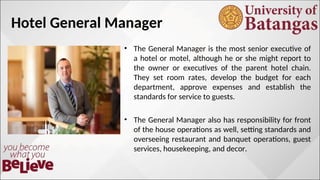
Hotel General Manager
•The General Manager is the most senior executive of
a hotel or motel, although he or she might report to
the owner or executives of the parent hotel chain.
They set room rates, develop the budget for each
department, approve expenses and establish the
standards for service to guests.
• The General Manager also has responsibility for front
of the house operations as well, setting standards and
overseeing restaurant and banquet operations, guest
services, housekeeping, and decor.
40.
Sales Manager
• Salesmanagers (also called sales representatives)
are responsible for selling products and/or services
as identified in the sales and marketing plan of an
organization. Sales managers are self-motivated,
able to set and achieve goals, and use time and
effort effectively and efficiently.
• They have effective selling skills and strong
product/service knowledge, and can adapt what
they sell to meet specific client needs.
10/10/12
41.
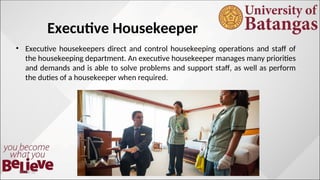
Executive Housekeeper
• Executivehousekeepers direct and control housekeeping operations and staff of
the housekeeping department. An executive housekeeper manages many priorities
and demands and is able to solve problems and support staff, as well as perform
the duties of a housekeeper when required.
10/10/12
42.
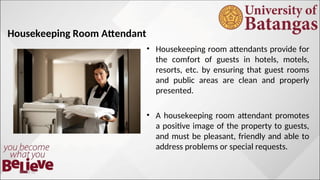
Housekeeping Room Attendant
•Housekeeping room attendants provide for
the comfort of guests in hotels, motels,
resorts, etc. by ensuring that guest rooms
and public areas are clean and properly
presented.
• A housekeeping room attendant promotes
a positive image of the property to guests,
and must be pleasant, friendly and able to
address problems or special requests.
10/10/12
43.
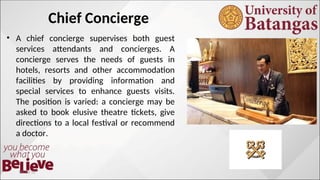
Chief Concierge
• Achief concierge supervises both guest
services attendants and concierges. A
concierge serves the needs of guests in
hotels, resorts and other accommodation
facilities by providing information and
special services to enhance guests visits.
The position is varied: a concierge may be
asked to book elusive theatre tickets, give
directions to a local festival or recommend
a doctor.
10/10/12
44.
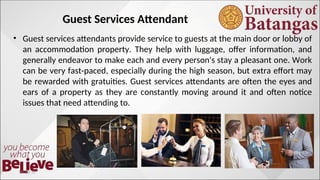
Guest Services Attendant
•Guest services attendants provide service to guests at the main door or lobby of
an accommodation property. They help with luggage, offer information, and
generally endeavor to make each and every person's stay a pleasant one. Work
can be very fast-paced, especially during the high season, but extra effort may
be rewarded with gratuities. Guest services attendants are often the eyes and
ears of a property as they are constantly moving around it and often notice
issues that need attending to.
10/10/12
45.
Front Desk Agent
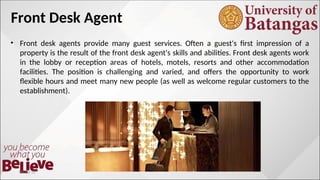
•Front desk agents provide many guest services. Often a guest's first impression of a
property is the result of the front desk agent's skills and abilities. Front desk agents work
in the lobby or reception areas of hotels, motels, resorts and other accommodation
facilities. The position is challenging and varied, and offers the opportunity to work
flexible hours and meet many new people (as well as welcome regular customers to the
establishment).
10/10/12
#10 Often, guests will stay in a guest house alongside their hosts, but the hosts may reside in a separate part of the property to give guests more privacy. Interactions with the hosts may be limited outside of any meals included. Guests are usually expected to keep their rooms clean and be more self-reliant than hotel guests.
#11 Two different types of accommodation fall under this umbrella. Serviced apartments are managed properties that offer housekeeping services, room service, and other hotel-style services. Conventional apartments are an example of non-serviced accommodation, where guests cannot access hotel facilities or services.
#14 The B&B concept is usually intended to provide guests with low-cost accommodation, a homely feel, and a personal touch. Many B&Bs are family-owned and may have additional employees, but the total number of staff will be low. Amenities will also usually be limited, and B&Bs are ideal for short stays or budget-conscious travelers.
#21 https://www.webstaurantstore.com/blog/3566/hotel-star-explained.html
Hotels can receive a rating of 1 to 5 stars, with 1 being the most basic and 5 being the most extravagant. However, a universal hotel star ranking system does not exist, so you can find the same hotel rated differently depending on which website you visit. Be sure to check for a star rating guide on the site you are using for a better understanding of how they are ranking the hotels. It is important to note that the star rating that customers may leave in their review of a location is different from a hotel star rating. Customers can review and rate their experience with a star value while hotel stars are an indication of their features and amenities.
#27 Guests can choose from an assortment of heated pools and hot tubs, saunas and steam rooms, dance halls, golf courses, and game rooms for their entertainment. These locations may also feature various on-site gourmet restaurant and bar options with top-rated chefs. Five-star hotels boast their attention to detail, catering the experience to each guest, whether that be with personalized menus or by accommodating special room requests.
Five-star hotels are usually architecturally beautiful and located in state-of-the-art facilities. The hotel building and rooms typically have a theme and lean heavily into a particular architectural style, with extravagant lobbies and rooms crafted by interior designers. Each room is spacious, potentially featuring a separate living room, patio, kitchen, and minibar. Guests may have a personal jacuzzi tub, designer bathrobes, and high-end toiletries in their rooms as well. With a five-star hotel, guests are pampered during their stay, with their needs and desires are taken care of.