Media Planning and Analysis Chapter Fourteen
Chapter Fourteen Objectives Describe the major factors used in segmenting target audiences for media strategy purposes Explain the meaning of reach, frequency, gross rating points, target rating points, effective rating points, and other media concepts Discuss the logic of the three-exposure hypothesis and its role in media and vehicle selection
Chapter Fourteen Objectives Describe the use of the efficiency-index procedure for media selection Distinguish the differences among three forms of advertising allocation:  continuous, pulsed, and flighted schedules Explain the principle of recency, or shelf-space model, and implications for allocating advertising expenditures over time
Chapter Fourteen Objectives Perform cost-per-thousand calculations Interpret the output from a computerized media model
Saab 9-5 In the late 1990s, Saab introduced a new luxury sedan: the Saab 9-5 Saab had done little to expand its brand image in U.S. Historically it attracted younger customers, but needed the luxury sedan to appeal to families and older customers
Saab 9-5 A mass-market advertising campaign was undertaken with the following objectives: Generate excitement for new 9-5 model line Increase overall awareness for Saab name Encourage customers to visit dealers and test-drive Retail 11,000 units of 9-5 during introductory year
Saab 9-5 Television commercials were run on network TV and cable in May A newspaper campaign began earlier in March with ads in USA Today and Wall Street Journal Ads also ran yearlong in several automobile magazines Internet banner ads were also run throughout the year
Saab 9-5 Media Plan Tactical Plan
Saab 9-5 Magazine Ad Magazine ad
Saab 9-5 Dealer Kit Dealer Information Kit
Saab 9-5 Direct Mail uestionnaire Direct mail questionnaire
Saab 9-5 Direct Mail Response  to Questionnaire Response to direct mail questionnaire
Saab 9-5 Dealer Leads Dealer lead information card
Saab 9-5 Dealer Sales Literature Dealer consumer sales literature
Saab 9-5 Consumer Test Drive Contest Test-drive invitation and contest
Saab 9-5 Consumer Test Drive Contest Contest entry card
1-800-COLLECT Media Strategy 1-800-Collect media strategy guide
Media Overview Advertisers are placing more emphasis than ever on media planning  Choosing media & vehicles is the most complicated of all marketing communications decisions Aside from specific vehicles in media, the planner has to choose geographical locations and budget distribution over time
The Media-Planning Process Media planning Involves the process of designing a scheduling plan that shows how advertising time and space will contribute to the achievement of marketing objectives
Overview for the Media Planning Process Advertising Strategy Media Strategy Audience Selection Objective Specification Media and Vehicle Media Buying Marketing Strategy Advertising Objectives Advertising Budget Message Strategy Media Strategy
The Media-Planning Process As shown in the figure, media planning involves coordination the coordination of three levels of strategy formulations: Marketing Strategy Advertising Strategy Media Strategy
The Media-Planning Process Marketing Strategy: Provides impetus and direction for choice of both advertising and media strategies Advertising Strategy: Involves advertising budgets, objectives and message and media strategies –  extends from overall marketing strategy
The Media-Planning Process 4. Buying media 1. Selecting the target audience 2. Specifying media objectives 3. Selecting media categories and vehicles
Selecting the Target Audience Four major factors (1)  Buyographics (4) Lifestyle/psychographics (2) Geographic (3) Demographic
Specifying Media Objectives What proportion of the population should be reached with advertising message during specified period (reach) How frequently should audience be exposed to message during this period (frequency) How much total advertising is needed to accomplish reach and frequency objectives (weight)
Specifying Media Objectives How should the advertising budget be allocated over time (continuity) How close to the time of purchase should the target audience be exposed to the advertising message (recency) What is the most economically justifiable way to accomplish objectives (cost)
Reach Percentage of target audience that is exposed to an advertisement, at least  once, during a certain time frame (usually four weeks)
Reach Reach  represents the percentage of target customers who have an opportunity to see the advertisers message. Other terms used by Media Planners to describe reach: 1+ (read “one-plus”) net coverage unduplicated audience cumulative audience ( or “cume”)
Factors Determining the Reach More people are reached when a media schedule uses multiple media The  number and diversity of  media vehicles used By diversifying the day parts
Frequency Average number of times  an advertisement reaches  the target audience in a  four-week period
Market Factors/Frequency Levels Brand History New   High Brand Share High   Low Brand Loyalty High   Low Purchase Cycle Short    High Usage Cycle Short   High Share of Voice High   High Market Factor  Type   Frequency
Message Creative Factors/Frequency Levels Message Complexity Simple Low Message Uniqueness Unique Low Newness New High Image Factors Image High Message variation Little Low Message/Creative Factor  Type   Frequency
Media Factors/Frequency Levels Clutter high High Editorial Nature Consistent Low Attentiveness High Low Scheduling Continuous Low Number of Media a Lot Low Media Factor  Type  Frequency
Weight How much advertising volume is required to accomplish advertising objectives Three weight metrics: Gross ratings Target ratings Effective ratings
Weight Gross rating points, or GRPs, are an indicator of the amount of gross weight that a particular advertising schedule is capable of delivering GRPs=Reach(R) X Frequency(F)
Determining GRPs in Practice GRPs are the sum of all vehicle ratings in a media schedule Rating: proportion of the target audience presumed to be exposed to a single occurrence of an advertising vehicle in which the advertiser’s brand is advertised
Determining GRPs in Practice 100 GRPs could mean: 100 % exposed once   50 % exposed twice 25%  exposed four times etc.
Weight Target Rating Points (TRPs) Adjust a vehicle’s rating to reflect just those individuals who match the advertiser’s target audience
Weight Effective Rating Points (ERPs) Effective reach Effective frequency
The Concept of ERPs How often the target audience have an opportunity to be exposed? Effective reach  is based on the idea that an advertising schedule is effective only if it does not reach members of target audience too few or too many times
How Many Exposures are Needed? Three-Exposure Hypothesis The minimum number of exposures needed for advertising to be effective is three
How Many Exposures are Needed? The Efficiency-Index Procedure Media schedule that generates the most exposure value per GRP
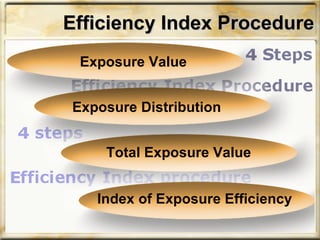
Efficiency Index Procedure Exposure Value Exposure Distribution Total Exposure Value Index of Exposure Efficiency
Effective Reach in Advertising Practice 3-10 exposures during a media-planning period (typically 4 weeks) Using multiple media Subjective factors must be considered
Continuity How advertising is allocated during the course of an advertising campaign : how should the media budget be distributed?
Continuity Continuous schedule Pulsing Flighting
Continuous, Pulsing, and Flighting Schedules 0 200 400 600 J F M A M J J A S O N D Continuous Pulsing Flighting Advertising Schedules Ad $ (in thousands) (months)
Recency Planning Consumers’ first exposure to an advertisement is the most powerful Advertising primary role is to influence brand choice (2) Achieving a high level of weekly reach for a brand should be emphasized over acquiring heavy frequency
Optimizing Weekly Reach Advertising teaches consumers Influence brand selection Messages are most effective when close to  purchase time Cost-Effectiveness of first exposure is greater  than subsequent Allocate budget to reach consumers often Reach target audience continuously rather than sporadically
Toward Reconciliation Illustration of advertising’s “ Chance Encounter” and the value of achieving reach
Cost Considerations The cost of reaching 1,000 members of the target audience, excluding those people who fall outside the target market
Cost considerations Cost per Thousand (CPM) Target Market (TM) CPM=  Cost of ad   # of contacts  (expressed in thousands) CPM-TM=   Cost of ad  # of TM contacts   (expressed in thousands)
Cost Considerations Measures of cost efficiency, not of effectiveness Lack of comparability across media Misused unless vehicles within a particular medium are compared on the same basis
Tradeoffs Tradeoff must be made because media planners operate under the constraint of fixed advertising budget
Media Planning Software ADplus 1. User develops a media database 2. User selects criterion for schedule optimization 3. User specifies constraints 4. ADplus seeks out the optimum media schedule
Diet Dr. Pepper Campaign Market Situation Sluggish category growth  Growth of new-age beverages Price sensitive Lack of bottler attention and focus Inadequate distribution Greater spending by major competitors
Media Strategy Media plan for  Diet Dr. Pepper
Media Plan for Diet Dr. Pepper Media plan for  Diet Dr. Pepper (page 2)
Campaign Target and Objectives Increase sales by 4% and improve growth rate to 1.5 times the diet soda category Heighten consumer knowledge Differentiate product
Results Sales grew by 6.6% Consumer brand ratings of Diet Dr. Pepper surpassed Diet Coke and Diet Pepsi in several key areas

Media planning analysis

  • 1.
    Media Planning andAnalysis Chapter Fourteen
  • 2.
    Chapter Fourteen ObjectivesDescribe the major factors used in segmenting target audiences for media strategy purposes Explain the meaning of reach, frequency, gross rating points, target rating points, effective rating points, and other media concepts Discuss the logic of the three-exposure hypothesis and its role in media and vehicle selection
  • 3.
    Chapter Fourteen ObjectivesDescribe the use of the efficiency-index procedure for media selection Distinguish the differences among three forms of advertising allocation: continuous, pulsed, and flighted schedules Explain the principle of recency, or shelf-space model, and implications for allocating advertising expenditures over time
  • 4.
    Chapter Fourteen ObjectivesPerform cost-per-thousand calculations Interpret the output from a computerized media model
  • 5.
    Saab 9-5 Inthe late 1990s, Saab introduced a new luxury sedan: the Saab 9-5 Saab had done little to expand its brand image in U.S. Historically it attracted younger customers, but needed the luxury sedan to appeal to families and older customers
  • 6.
    Saab 9-5 Amass-market advertising campaign was undertaken with the following objectives: Generate excitement for new 9-5 model line Increase overall awareness for Saab name Encourage customers to visit dealers and test-drive Retail 11,000 units of 9-5 during introductory year
  • 7.
    Saab 9-5 Televisioncommercials were run on network TV and cable in May A newspaper campaign began earlier in March with ads in USA Today and Wall Street Journal Ads also ran yearlong in several automobile magazines Internet banner ads were also run throughout the year
  • 8.
    Saab 9-5 MediaPlan Tactical Plan
  • 9.
    Saab 9-5 MagazineAd Magazine ad
  • 10.
    Saab 9-5 DealerKit Dealer Information Kit
  • 11.
    Saab 9-5 DirectMail uestionnaire Direct mail questionnaire
  • 12.
    Saab 9-5 DirectMail Response to Questionnaire Response to direct mail questionnaire
  • 13.
    Saab 9-5 DealerLeads Dealer lead information card
  • 14.
    Saab 9-5 DealerSales Literature Dealer consumer sales literature
  • 15.
    Saab 9-5 ConsumerTest Drive Contest Test-drive invitation and contest
  • 16.
    Saab 9-5 ConsumerTest Drive Contest Contest entry card
  • 17.
    1-800-COLLECT Media Strategy1-800-Collect media strategy guide
  • 18.
    Media Overview Advertisersare placing more emphasis than ever on media planning Choosing media & vehicles is the most complicated of all marketing communications decisions Aside from specific vehicles in media, the planner has to choose geographical locations and budget distribution over time
  • 19.
    The Media-Planning ProcessMedia planning Involves the process of designing a scheduling plan that shows how advertising time and space will contribute to the achievement of marketing objectives
  • 20.
    Overview for theMedia Planning Process Advertising Strategy Media Strategy Audience Selection Objective Specification Media and Vehicle Media Buying Marketing Strategy Advertising Objectives Advertising Budget Message Strategy Media Strategy
  • 21.
    The Media-Planning ProcessAs shown in the figure, media planning involves coordination the coordination of three levels of strategy formulations: Marketing Strategy Advertising Strategy Media Strategy
  • 22.
    The Media-Planning ProcessMarketing Strategy: Provides impetus and direction for choice of both advertising and media strategies Advertising Strategy: Involves advertising budgets, objectives and message and media strategies – extends from overall marketing strategy
  • 23.
    The Media-Planning Process4. Buying media 1. Selecting the target audience 2. Specifying media objectives 3. Selecting media categories and vehicles
  • 24.
    Selecting the TargetAudience Four major factors (1) Buyographics (4) Lifestyle/psychographics (2) Geographic (3) Demographic
  • 25.
    Specifying Media ObjectivesWhat proportion of the population should be reached with advertising message during specified period (reach) How frequently should audience be exposed to message during this period (frequency) How much total advertising is needed to accomplish reach and frequency objectives (weight)
  • 26.
    Specifying Media ObjectivesHow should the advertising budget be allocated over time (continuity) How close to the time of purchase should the target audience be exposed to the advertising message (recency) What is the most economically justifiable way to accomplish objectives (cost)
  • 27.
    Reach Percentage oftarget audience that is exposed to an advertisement, at least once, during a certain time frame (usually four weeks)
  • 28.
    Reach Reach represents the percentage of target customers who have an opportunity to see the advertisers message. Other terms used by Media Planners to describe reach: 1+ (read “one-plus”) net coverage unduplicated audience cumulative audience ( or “cume”)
  • 29.
    Factors Determining theReach More people are reached when a media schedule uses multiple media The number and diversity of media vehicles used By diversifying the day parts
  • 30.
    Frequency Average numberof times an advertisement reaches the target audience in a four-week period
  • 31.
    Market Factors/Frequency LevelsBrand History New High Brand Share High Low Brand Loyalty High Low Purchase Cycle Short High Usage Cycle Short High Share of Voice High High Market Factor Type Frequency
  • 32.
    Message Creative Factors/FrequencyLevels Message Complexity Simple Low Message Uniqueness Unique Low Newness New High Image Factors Image High Message variation Little Low Message/Creative Factor Type Frequency
  • 33.
    Media Factors/Frequency LevelsClutter high High Editorial Nature Consistent Low Attentiveness High Low Scheduling Continuous Low Number of Media a Lot Low Media Factor Type Frequency
  • 34.
    Weight How muchadvertising volume is required to accomplish advertising objectives Three weight metrics: Gross ratings Target ratings Effective ratings
  • 35.
    Weight Gross ratingpoints, or GRPs, are an indicator of the amount of gross weight that a particular advertising schedule is capable of delivering GRPs=Reach(R) X Frequency(F)
  • 36.
    Determining GRPs inPractice GRPs are the sum of all vehicle ratings in a media schedule Rating: proportion of the target audience presumed to be exposed to a single occurrence of an advertising vehicle in which the advertiser’s brand is advertised
  • 37.
    Determining GRPs inPractice 100 GRPs could mean: 100 % exposed once 50 % exposed twice 25% exposed four times etc.
  • 38.
    Weight Target RatingPoints (TRPs) Adjust a vehicle’s rating to reflect just those individuals who match the advertiser’s target audience
  • 39.
    Weight Effective RatingPoints (ERPs) Effective reach Effective frequency
  • 40.
    The Concept ofERPs How often the target audience have an opportunity to be exposed? Effective reach is based on the idea that an advertising schedule is effective only if it does not reach members of target audience too few or too many times
  • 41.
    How Many Exposuresare Needed? Three-Exposure Hypothesis The minimum number of exposures needed for advertising to be effective is three
  • 42.
    How Many Exposuresare Needed? The Efficiency-Index Procedure Media schedule that generates the most exposure value per GRP
  • 43.
    Efficiency Index ProcedureExposure Value Exposure Distribution Total Exposure Value Index of Exposure Efficiency
  • 44.
    Effective Reach inAdvertising Practice 3-10 exposures during a media-planning period (typically 4 weeks) Using multiple media Subjective factors must be considered
  • 45.
    Continuity How advertisingis allocated during the course of an advertising campaign : how should the media budget be distributed?
  • 46.
  • 47.
    Continuous, Pulsing, andFlighting Schedules 0 200 400 600 J F M A M J J A S O N D Continuous Pulsing Flighting Advertising Schedules Ad $ (in thousands) (months)
  • 48.
    Recency Planning Consumers’first exposure to an advertisement is the most powerful Advertising primary role is to influence brand choice (2) Achieving a high level of weekly reach for a brand should be emphasized over acquiring heavy frequency
  • 49.
    Optimizing Weekly ReachAdvertising teaches consumers Influence brand selection Messages are most effective when close to purchase time Cost-Effectiveness of first exposure is greater than subsequent Allocate budget to reach consumers often Reach target audience continuously rather than sporadically
  • 50.
    Toward Reconciliation Illustrationof advertising’s “ Chance Encounter” and the value of achieving reach
  • 51.
    Cost Considerations Thecost of reaching 1,000 members of the target audience, excluding those people who fall outside the target market
  • 52.
    Cost considerations Costper Thousand (CPM) Target Market (TM) CPM= Cost of ad # of contacts (expressed in thousands) CPM-TM= Cost of ad # of TM contacts (expressed in thousands)
  • 53.
    Cost Considerations Measuresof cost efficiency, not of effectiveness Lack of comparability across media Misused unless vehicles within a particular medium are compared on the same basis
  • 54.
    Tradeoffs Tradeoff mustbe made because media planners operate under the constraint of fixed advertising budget
  • 55.
    Media Planning SoftwareADplus 1. User develops a media database 2. User selects criterion for schedule optimization 3. User specifies constraints 4. ADplus seeks out the optimum media schedule
  • 56.
    Diet Dr. PepperCampaign Market Situation Sluggish category growth Growth of new-age beverages Price sensitive Lack of bottler attention and focus Inadequate distribution Greater spending by major competitors
  • 57.
    Media Strategy Mediaplan for Diet Dr. Pepper
  • 58.
    Media Plan forDiet Dr. Pepper Media plan for Diet Dr. Pepper (page 2)
  • 59.
    Campaign Target andObjectives Increase sales by 4% and improve growth rate to 1.5 times the diet soda category Heighten consumer knowledge Differentiate product
  • 60.
    Results Sales grewby 6.6% Consumer brand ratings of Diet Dr. Pepper surpassed Diet Coke and Diet Pepsi in several key areas