TECHNICAL SEMINAR ON
TWEEL
Guided by
P.Salonika Sravani
(Asst.Prof Mec)
Presented by
K.Rajasekhar Reddy
15705A0326
ANNAMACHARYA INSTITUTE OF
TECHNOLOGY &SCIENCES
DEPARTMENT OF MECHANICAL ENGINEERING
CONTENTS
 What is a pneumatic tyre and drawbacks
 What is a Tweel?
 What makes tyres airless?
 How does it works?
 Advantages
 Disadvantages
 Applications
 Conclusion
 References
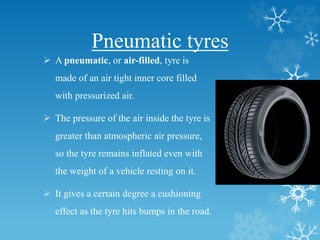
Pneumatic tyres
 A pneumatic, or air-filled, tyre is
made of an air tight inner core filled
with pressurized air.
 The pressure of the air inside the tyre is
greater than atmospheric air pressure,
so the tyre remains inflated even with
the weight of a vehicle resting on it.
 It gives a certain degree a cushioning
effect as the tyre hits bumps in the road.
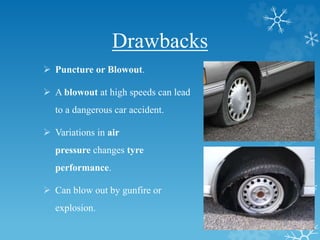
Drawbacks
 Puncture or Blowout.
 A blowout at high speeds can lead
to a dangerous car accident.
 Variations in air
pressure changes tyre
performance.
 Can blow out by gunfire or
explosion.
What is Tweel?
 The name “Tweel” is the contraction in English of
“ t yre” and “W h eel”. Rather than a wheel + a tyre , we now
have a single product TWEEL. Mounting and removal
operation will be simpler. To start with, Tweels could be fitted
on vehicles with small wheels, such as wheelchairs, thus
substantially improving the mobility of disabled people.
 “Tweel” is nothing but a air less (or) Non pneaumatic tyres
 Airless tyres or Non-pneumatic tyres (NPT) , are tyres that are not
supported by air pressure.
What makes tyre “AIRLESS”?
 The structure of SPOKES stretching along the
inner side of tyres supporting the weight of the
vehicle.
 A synthetic resin that becomes flexible when
heated, can be processed into a variety of
shapes, and become hard when cooled.
 The changes from heating and cooling can
generally repeated , making it easy to both mold
and recycle the material
Why Tweel?
 The heart of Tweel innovation is its simple
looking hub and spoke design that replaces
the need for air pressure while delivering
performance previously only available from
pneumatic tyres.
 Tweel still delivers pneumatic –like
performance weight-carrying capacity, ride
comfort, and the ability to “envelope” road
hazards.
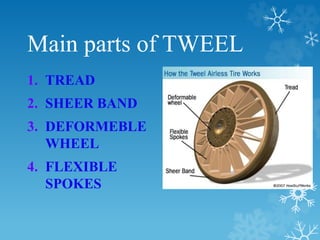
Main parts of TWEEL
1. TREAD
2. SHEER BAND
3. DEFORMEBLE
WHEEL
4. FLEXIBLE
SPOKES
How does it works?
.
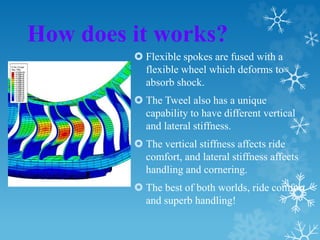
 Flexible spokes are fused with a
flexible wheel which deforms to
absorb shock.
 The Tweel also has a unique
capability to have different vertical
and lateral stiffness.
 The vertical stiffness affects ride
comfort, and lateral stiffness affects
handling and cornering.
 The best of both worlds, ride comfort
and superb handling!
 On working the Tweel is a single unit, though it
actually begins an assembly of four pieces bonded
together: the hub, polyurethane spoke section, a
“sheer band” surrounding the spoke and the tread
band.
 The sheer band surrounding the spokes effectively
takes the place of air pressure, distributing the
load.
 The tread is similar in appearance to a
conventional tyre.
 Tweel works well over rocky terrains, so it should
work well for four-wheel vehicles too.
The tension of the sheer band on the spokes
and the strength of spokes themselves replace
the air pressure of a traditional tyre.
The tread is then attached to the sheer band.
The Tweel looks sort of like a very large,
futuristic bicycle wheel.
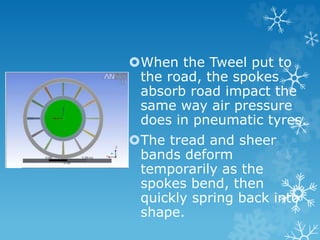
When the Tweel put to
the road, the spokes
absorb road impact the
same way air pressure
does in pneumatic tyres.
The tread and sheer
bands deform
temporarily as the
spokes bend, then
quickly spring back into
shape.
Advantages
 Eliminates air leaks or tyre blow outs.
 No maintenance required.
 Facilitate recycling.
 Remains mobile even with some of the spokes are damaged or
missing.
 Durability & Long Life.
 Can take gunfire or explosion.
 Less environmental impact.
Disadvantages
 Lack of adjustability.
 Vibration.
 Different Manufacturing technique.
 Not as economic as pneumatic tyres.
Applications
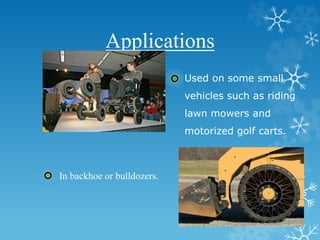
Used on some small
vehicles such as riding
lawn mowers and
motorized golf carts.
In backhoe or bulldozers.
continued..
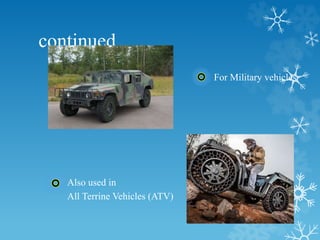
For Military vehicles
Also used in
All Terrine Vehicles (ATV)
Conclusion
For years, vehicles have been running on pneumatic tyres
and there was almost a full stop for any further improvement
of tyres. In 20th century the engineers have come up with a
new concept where the tyres never require air, if the
drawbacks that are being encountered presently are and
improved then there is good future for these tyres. And the
vehicles can run without the necessity of air.
[1].Rhyne, T. B., and Cron, S. M., “Development of a Non-Pneumatic
Wheel,” Tire Science and Technology, Volume 34, Number 3, July-
September 2006
[3]. Dr.Joshi.C.Haran, “Static analysis of airless tyres “,International
Journal of Scientific and Research Publications, Volume 3, Issue 8,
August 2013
[3]. htpps://www.michelin.com last visited on 26/03/14 at 8 am
REFERENCES
Tweel (Airless Tyres)

Tweel (Airless Tyres)

  • 1.
    TECHNICAL SEMINAR ON TWEEL Guidedby P.Salonika Sravani (Asst.Prof Mec) Presented by K.Rajasekhar Reddy 15705A0326 ANNAMACHARYA INSTITUTE OF TECHNOLOGY &SCIENCES DEPARTMENT OF MECHANICAL ENGINEERING
  • 2.
    CONTENTS  What isa pneumatic tyre and drawbacks  What is a Tweel?  What makes tyres airless?  How does it works?  Advantages  Disadvantages  Applications  Conclusion  References
  • 3.
    Pneumatic tyres  Apneumatic, or air-filled, tyre is made of an air tight inner core filled with pressurized air.  The pressure of the air inside the tyre is greater than atmospheric air pressure, so the tyre remains inflated even with the weight of a vehicle resting on it.  It gives a certain degree a cushioning effect as the tyre hits bumps in the road.
  • 4.
    Drawbacks  Puncture orBlowout.  A blowout at high speeds can lead to a dangerous car accident.  Variations in air pressure changes tyre performance.  Can blow out by gunfire or explosion.
  • 5.
    What is Tweel? The name “Tweel” is the contraction in English of “ t yre” and “W h eel”. Rather than a wheel + a tyre , we now have a single product TWEEL. Mounting and removal operation will be simpler. To start with, Tweels could be fitted on vehicles with small wheels, such as wheelchairs, thus substantially improving the mobility of disabled people.  “Tweel” is nothing but a air less (or) Non pneaumatic tyres  Airless tyres or Non-pneumatic tyres (NPT) , are tyres that are not supported by air pressure.
  • 6.
    What makes tyre“AIRLESS”?  The structure of SPOKES stretching along the inner side of tyres supporting the weight of the vehicle.  A synthetic resin that becomes flexible when heated, can be processed into a variety of shapes, and become hard when cooled.  The changes from heating and cooling can generally repeated , making it easy to both mold and recycle the material
  • 7.
    Why Tweel?  Theheart of Tweel innovation is its simple looking hub and spoke design that replaces the need for air pressure while delivering performance previously only available from pneumatic tyres.  Tweel still delivers pneumatic –like performance weight-carrying capacity, ride comfort, and the ability to “envelope” road hazards.
  • 8.
    Main parts ofTWEEL 1. TREAD 2. SHEER BAND 3. DEFORMEBLE WHEEL 4. FLEXIBLE SPOKES
  • 9.
    How does itworks? .  Flexible spokes are fused with a flexible wheel which deforms to absorb shock.  The Tweel also has a unique capability to have different vertical and lateral stiffness.  The vertical stiffness affects ride comfort, and lateral stiffness affects handling and cornering.  The best of both worlds, ride comfort and superb handling!
  • 10.
     On workingthe Tweel is a single unit, though it actually begins an assembly of four pieces bonded together: the hub, polyurethane spoke section, a “sheer band” surrounding the spoke and the tread band.  The sheer band surrounding the spokes effectively takes the place of air pressure, distributing the load.  The tread is similar in appearance to a conventional tyre.  Tweel works well over rocky terrains, so it should work well for four-wheel vehicles too.
  • 11.
    The tension ofthe sheer band on the spokes and the strength of spokes themselves replace the air pressure of a traditional tyre. The tread is then attached to the sheer band. The Tweel looks sort of like a very large, futuristic bicycle wheel.
  • 12.
    When the Tweelput to the road, the spokes absorb road impact the same way air pressure does in pneumatic tyres. The tread and sheer bands deform temporarily as the spokes bend, then quickly spring back into shape.
  • 13.
    Advantages  Eliminates airleaks or tyre blow outs.  No maintenance required.  Facilitate recycling.  Remains mobile even with some of the spokes are damaged or missing.  Durability & Long Life.  Can take gunfire or explosion.  Less environmental impact.
  • 14.
    Disadvantages  Lack ofadjustability.  Vibration.  Different Manufacturing technique.  Not as economic as pneumatic tyres.
  • 15.
    Applications Used on somesmall vehicles such as riding lawn mowers and motorized golf carts. In backhoe or bulldozers.
  • 16.
    continued.. For Military vehicles Alsoused in All Terrine Vehicles (ATV)
  • 17.
    Conclusion For years, vehicleshave been running on pneumatic tyres and there was almost a full stop for any further improvement of tyres. In 20th century the engineers have come up with a new concept where the tyres never require air, if the drawbacks that are being encountered presently are and improved then there is good future for these tyres. And the vehicles can run without the necessity of air.
  • 18.
    [1].Rhyne, T. B.,and Cron, S. M., “Development of a Non-Pneumatic Wheel,” Tire Science and Technology, Volume 34, Number 3, July- September 2006 [3]. Dr.Joshi.C.Haran, “Static analysis of airless tyres “,International Journal of Scientific and Research Publications, Volume 3, Issue 8, August 2013 [3]. htpps://www.michelin.com last visited on 26/03/14 at 8 am REFERENCES