NON-PNEUMATIC AIRLESS TYRE
A Seminar Report
Submitted by
MONISH
in partial fulfillment for the award of the degree
of
BACHELOR OF TECHNOLOGY
IN
MECHANICAL ENGINEERING
At
JIET GROUP OF INSTITUTIONS
JODHPUR INSTITUTE OF ENGINEERING AND TECHNOLOGY
NH-62, NEW PALI ROAD, MOGRA
JODHPUR
SESSION 2020-21
CERTIFICATE
This is to certify that seminar titled “NON-PNUEMATIC AIRLESS
TYRE” being submitted by MONISH of B.Tech. final year, Roll No.
17EJIME043 in partial fulfillment for the award of degree of Bachelor
of Technology in Mechanical Engineering, at JIET, Jodhpur affiliated
with RTU, Kota as a record of student’s own work carried out by him
under guidance of the undersigned.
He has not submitted the matter embodied in the seminar in this form
for the award of any other degree.
Prof. (Dr.) DEEPAK MEHRA MR. LOKENDRA KUMAR
Professor & Head, ME Asst. Prof., ME
External Examiner_________________________
Internal Examiner__________________________
ACKNOWLEDGEMENT
It gives me immense pleasure in presenting my Seminar report. I would like to take this
opportunity to express my deepest gratitude to the people who have contributed their
valuable time for helping me to successfully complete this training.With great pleasure
and acknowledgement I extend my deep and sincere gratitude to
MR. LOKENDRA KUMAR, (Assistant Professor) in Jodhpur Institute of
Engineering and Technology for providing me the necessary guidance and helped me a
lot in enhancing my skills.
Also as a guide, for his constant support and provided me necessary guidance throughout
the course of our work and in enhancing my knowledge. His sincerity, thoroughness and
preservance have been a constant source of inspiration for me.
I would like to thank our seminar coordinator Er. Mohd Jawed Iqbal for providing me
the critical views and guidance for the preparation of the seminar.
I also do not like to miss the opportunity to acknowledge the contribution of all faculty
members of the department of their kind assistance and cooperation during the
development of our seminar. Last but not least, I acknowledge my friends for their
contribution in the completion of the seminar
MONISH RAZZA
Roll No.: - 17EJIME043
Batch : 7H-1
( VII SEM , IV YEAR)
ABSTRACT
An airless tire is a solitary unit supplanting the pneumatic tire, in getting assembly. It replaces every one
of the segments of a regular outspread tire and is comprised of an unbending center point, associated
with a shear band by methods for adaptable,
deformable polyurethane spokes and a tread band, all working as a solitary unit.
The Tweel, a sort of airless tire, however, discovers its nonspecific application in military and earth
moving applicant particles because of its level confirmation configuration can render the pneumatic tire
out of date in do mastic autos. Our project includes outline an investigation of an airless tire for doing
mastic autos The model will be done in Pro E and investigation will do in Ansys.
From the evolution of automobiles, vehicles have been using pnuematic tyres where the air is encased in
rubber to provide suspension to the vehicle. Ever since no change has been made for decades, And with
undergoing few changes the pneumatic tyres still have relevance in the market .
A few tyre companies have started experimenting with designs for non-pneumatic tyres including
Michelin and Bridgestone, but neither design has made it to mass production. Creating a new non-
pneumatic design for tyres have many advantages.
For one thing, there are huge safety benefits. Having an airless tyre means there is no possibility of a
blowout, which, in turn, means the number of highway accidents will but cut significantly.
Even for situations such as Humvees in the military, utilizing non-pneumatic tyres has a great positive
impact on safety. Tyres are the weak point in military vehicles and are often targeted with explosives. If
these vehicles used airless tyres, this would no longer be a concern. There is also an environmental
benefit to using this type of tyre.
Since they never go flat and can be retreaded, airless tyres will not have to be thrown away and replaced
nearly as often as pneumatic tyres. This will cut down landfill mass significantly. Due to these benefits, I
believe that it is extremely important that research and production of airless tyres is continued and
increased.
Cars are things that people use every day, so any improvements over existing designs would affect the
lives of the majority of people.
TABLE OF CONTENT
CHAPTER
NO.
TITLE PAGE NO.
1 INTRODUCTION 1-11
1.1 SPOKE DEFORMATION IN NPT
1.2 WORKING OF NPT 10
1.3 COMPARISION WITH CONVENTIONAL TYRE 11
2 LITERATURE REVIEW 12-13
2.1 RESEARCH PAPERS REVIEW 12
2.2 INFERENCES DRAWN FROM LITERATURE REVIEW 13
3 DESIGNING PROCESS 14-22
3.1 VARIOUS TYPE OF STRUCTURES 14
3.2 ADVANTAGES OF POLYURETHANE/NYLON 4,6 NPT
OVER RUBBER TYRES
16
3.3 FINITE ELEMENT METHOD USED FOR ANALYSIS 21
3.4 STATIC STRUCTURAL ANALYSIS 22
4 MICHELLIN TWEELS : CASE STUDY 23
5 ADVANTAGES & DISADVANTAGES 27
6 APPLICATIONS AND FUTURE SCOPE 28
7 CONCLUSION 29
8 REFRENCES 29
TABLE OF FIGURES
FIGURE NO. FIGURE TITLE
1.1 Tube tyre structure
1.2 Tube less tyre stucture
1.3 Tweel structure
1.4 Deformation of tweels
3.1 Honeycomb stucture
3.2 Spoke stucture
3.3 Triangle stucture
3.4 Diamonds stucture
3.5 Material properties
3.6 FEM analysis process
3.7 FEM analysis methodology
3.8 Tyre ANSYS model
3.9 Comparision of load and deflection
3.10 Total deformation static load
4.1 Michelin tweel
4.2 Caster wheel
6.1 N.P.T. in Military Vehicle
6.2 N.P.T. in Wheel Chair
6.3 N.P.T. in NASA Lunar Rover
6.4 N.P.T. in Terrain Vehicle
CHAPTER 1
INTRODUCTION
PROBLEM IN CONVENTOINAL TYRE :
 LOWER ROLLING RESISTANCE
The increasing concerns over the green-house effect will in the near future require more attention to
rolling resistance than ever before; in fact from an already high attention to a very high attention.
The trend towards lower rolling resistance has been obvious for many years. Significant progress was
reported in the recent Tyre Energy Efficiency Report in reducing rolling resistance, as measured for new
passenger tyres, over the past 25 years. More tyre models today, when measured new, have rolling
resistance coefficients below 0.009, and the most energy-efficient tyres have coefficients that are 20 to
30 percent lower than the most energy efficient radial models of 25 years ago.
Another trend is the increased popularity of run-flat tyres; mostly having stiffer sidewalls or some
material added that can avoid running a flat tyre on the rim. The above-mentioned Tyre Energy
Efficiency Report concluded that run-flat tyres weigh more than conventional radial tyres — which
increases their material and production cost — and they tend to exhibit higher rolling resis-tance. This
author thinks that this may turn the trend back to more traditional designs, or turn the interest over into
designs which have run-flat capabilities without increased rolling resistance.
The increasing popularity and more frequent governmental support for hybrid or electric veh-icles will
also require lower rolling resistance since this directly affects the distance one can run in the electric
mode.
Finally, it shall be mentioned that labeling of energy efficiency (in practice rolling resistance) of tyres is
likely to happen in the near future. The intention is that consumers will use this informa-tion to their
selection of replacement tyres; per-haps even vehicle manufacturers would use such information when
deciding on OE tyres if this information will be available for the full range of tyre brands and
dimensions and not only be determined by themselves for a few tyres. A conference organized by the
IEA in November 2005 [IEA, 2005] indicated a rather universal support for the labeling of energy
efficiency and also the Tyre Energy Efficiency Report suggested this.
 INCREASING CONCERN FOR LOW NOISE AND ROLLING RESISTANCE
NECESSARY
Both rolling resistance and noise emission are expressions of energy losses in the rolling of tyres. It is
not surprising that these characteristics are at large positively correlated; although exceptions exist.
Nevertheless, it is this author's conclusion that exterior noise and rolling resistance will drive the tyre
development to a large extent in the coming years [Sandberg, 2003]. Probably, the present focus on
high-speed and high-power performance, which both are in some conflict with low noise and rolling
resistance (and thus air pollution), will at last have to give in to the latter performances.
Another present trend is the high priority put on the visual appearance of tyres, as a selling argument; in
particular for "sporty" vehicles. The styling trend was heavily criticized recently as being in conflict with
good technology by one of the foremost tyre experts in the world, Dr Joe Walter, in a column in Tire
Technology Interna-tional [Walter, 2006]. It is likely that this trend will be broken when it is in conflict
with the increasing environmental demands.
Vehicle manufacturers will have to face the possible effects of this which may be uncom-fortable to
some.
UNDERSTANDING VARIOUS TYPES OF TYRES
A tyre is most important part of any vehicle. Tyre is a rubber member which provides cushioning effect
as well as provides clearance to vehicle. The rubber member is mounted on wheel rim.
In tube tyre, tube is present inside the tyre. A tube tyre has a structure as shown in the figure
Figure 1.1
While in tubeless tyre there is no tube. A tire is a ring shaped component that was mounted on a wheel's
rim to transfer the vehicle’s load from the axle. As shown in fig.
Figure 1.2
Tyre which is used in automobile, bicycle, motorcycle is pneumatically inflated structures which provide
a good rolling, cushioning effect. Such tyre is using numbers of year and they are developing.
Some companies are trying to develop tyre which are airless that means they are non pneumatic.
Michelin and Bridgestone are the tyre which are firstly design, they are non pneumatic. So begins an
article discussing the development of air less tires, something that has become more prevalent in the past
few years.
Airless tyres or Non-pneumatic tyres area unit the tyres that aren't supported by atmospheric pressure.
These tyres are known as Tweel that could be a merger of the words tyre and wheel.
This is as a result of the Tweel doesn't use a conventional wheel hub assembly.
The Tweel construct was initial declared by Michelin back in 2005.
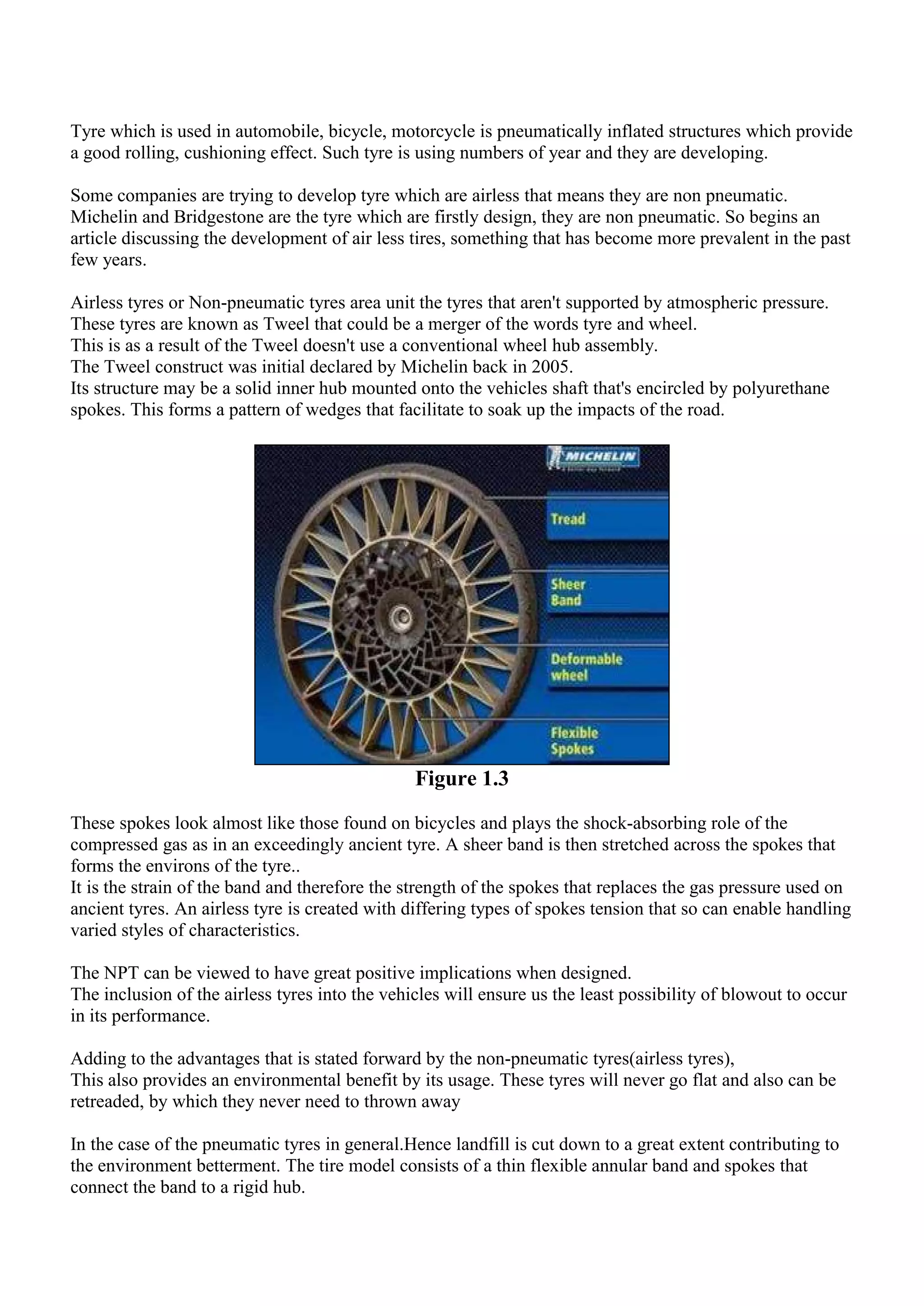
Its structure may be a solid inner hub mounted onto the vehicles shaft that's encircled by polyurethane
spokes. This forms a pattern of wedges that facilitate to soak up the impacts of the road.
Figure 1.3
These spokes look almost like those found on bicycles and plays the shock-absorbing role of the
compressed gas as in an exceedingly ancient tyre. A sheer band is then stretched across the spokes that
forms the environs of the tyre..
It is the strain of the band and therefore the strength of the spokes that replaces the gas pressure used on
ancient tyres. An airless tyre is created with differing types of spokes tension that so can enable handling
varied styles of characteristics.
The NPT can be viewed to have great positive implications when designed.
The inclusion of the airless tyres into the vehicles will ensure us the least possibility of blowout to occur
in its performance.
Adding to the advantages that is stated forward by the non-pneumatic tyres(airless tyres),
This also provides an environmental benefit by its usage. These tyres will never go flat and also can be
retreaded, by which they never need to thrown away
In the case of the pneumatic tyres in general.Hence landfill is cut down to a great extent contributing to
the environment betterment. The tire model consists of a thin flexible annular band and spokes that
connect the band to a rigid hub.
The circular band is modeled exploitation recurvate beam theory that takes under consideration
deformations because of bending, cutting off and circumferential extension. The impact of the spokes,
which are distributed unceasingly within the model and act as linear springs, is accounted for less than in
tension that introduces a nonlinear response. The quasi-static, two-dimensional analysis focuses on
however the contact patch, vertical tire stiffness and rolling resistance are laid low with the stiffness
properties of the band and therefore the spokes.
(1.1) WORKING
The pneumatic tyre is made up of polymer which has high resistance to shock of road as well as have
good elastic property. They are made up of tread, shear band, deformable wheel and flexible spoke.
Thread is placed on the upper side of wheel which provides good tensile strength and help to wheel to
stay in position. Shear band is outer covering of the pneumatic tyre which transmits shock. Flexible
spokes are attached to the shear band which is generally in triangular in shape. The shock from the shear
band was get absorb by these spokes. The spokes are further attached to deformable wheel.
The wheel are attach to the vehicle. While the vehicle is in running various shock effects by the vehicle.
As the shock get trapped the flexible spokes get bend and the shock get absorb. As the shock leave the
spoke gets in their original shape.
(1.2) SPOKE DEFORMATION IN NPT
The unventilated tyre (Tweel) doesn’t use a conventional wheel hub assembly.
A solid inner hub mounts to the shaft and is encircled by polymer spokes panoplied in a very pattern of
wedges. A shear band is stretched across the spokes, forming the fringes of the tyre. On it sits the tread,
the half that comes in touch with the surface of the road.
The cushion shaped by the air cornered within a standard tyre is replaced by the strength of the spokes
that receive the strain of the shear band. Placed on the shear band is that the tread, the half that produces
contact with the surface of the road.
When the Tweel is running on the road, the spokes absorb road defects identical manner atmospheric
pressure will within the case of gas tyres. The versatile tread and shear bands deform briefly because the
spokes bend, then quickly return to the initial form. Totally different spoke tensions may be used,PRN
by the handling characteristics and lateral stiffness may vary. However, once created the Tweel’s spoke
tensions and lateral stiffness can't be adjusted.
Figure 1.4
(1.3) COMPARISION WITH CONVENTIONAL TYRE
ADVANTAGES OF NPT
1. No more air valves.
2. No more air compressors at Petrol Pumps.
3. No more flat tires in the middle of long drives.
4.The Tweel promises performance levels beyond those possible with conventional
Pneumatic technology.
5. Potential benefits of the Tweel include the obvious safety and convenience of never
having flat tyres. Also, the concept has the potential for true performance gains.
6. The Tweel can also withstand a police 'stinger' spike strip, which would force law enforcement to
adapt in order to catch a suspect in a vehicle equipped with Tweels.
7. It provides a comfortable ride and increases vehicle handling
8. Its flexibility provides an increase in surface area of contact thereby increases the grip with the ground.
9. It can take gun fires and spikes without becoming immobile.
DISADVANTAGES OF NPT
1. The non-pneumatic tyre are expensive as compared to pneumatic tyres.
2. The replacement of any component in the non-pneumatic tyre is impossible i.e. Every time the tyre is
worn-out we have to replace the whole assembly.
3. It can withstand police spikes which may make it difficult for law enforcement.
4. Lack of adjustability is one disadvantage of non-pneumatic tyres if once manufactured cannot be
altered or adjusted.
Potential benefits of the Tweel include not only the obvious safety and convenience of never having flat
tires, but also, in automotive applications, the Tweel airless tire has the potential to be able to brake
better – a significant performance compromise that is inherent to pneumatic tires.
Unlike a pneumatic tire, a Tweel can be designed to have high lateral stiffness while simultaneously
having low vertical stiffness. This can be achieved because, in the design elements of a Tweel, the
vertical and lateral stiffness are not inseparably linked and can thus be optimized independently.
Because there is no air bladder under the tread, tread patterns can, if desired, even incorporate water
evacuation through holes in the design thus eliminating or significantly reducing hydroplaning. Michelin
expects the tread to last two to three times as long as a conventional tire. Because the tread rubber
around the outer circumference is replaceable when worn (as opposed to disposing of a whole worn tire),
the potential environmental impact of a Tweel airless tire can be less than that of a conventional
pneumatic tire.
Tweel is useful for: "vehicles that don't have suspensions like lawn mowers – those low speed specialty
vehicles that don't have suspensions. The comfort is quite good and better than inflated tyres" said Terry
K. Gettys, Executive Vice-President, Research and Development, and member of the Group Executive
Committee at French tire company Michelin.[4]
Military testing has indicated that the Tweel deflects mine blasts away from the vehicle better than
standard tires and that the Tweel remains mobile even with several spokes damaged or missing.
CHAPTER 2
LITERATURE REVIEW
2.1 RESEARCH PAPERS REVIEW
Its goal was a replacement for traditional tires that is designed to function without air in the first place.
mounted on a car, the NPT is a single unit, though it actually begins as an assembly of four pieces
bonded together: the hub, a polyurethane spoke section, a "shear band" surrounding the spokes, and the
tread band -- the rubber layer that wraps around the circumference and touches the pavement.
While the NPT's hub functions as it would in a normal wheel -- a rigid attachment point to the axle -- the
polyurethane spokes are flexible to help absorb road impacts. The shear band surrounding the spokes
effectively takes the place of the air pressure, distributing the load.
The tread is similar in appearance to a conventional tire. One of the basic shortcomings of a tire filled
with air is that the inflation pressure is distributed equally around the tire, both up and down (vertically)
as well as side-to side (laterally). That property keeps the tire round, but it also means that raising the
pressure to improve cornering -- increasing lateral stiffness -- also adds up-down stiffness, making the
ride harsher.With the NPT's injection-molded spokes, those characteristics are no longer linked -- a point
of particular excitement to an engineer The spokes can be engineered to give the Tweel five times as
much lateral stiffness as current pneumatic tires without any loss of ride comfort.
Its structure may be a solid inner hub mounted onto the vehicles shaft that's encircled by polyurethane
spokes. This forms a pattern of wedges that facilitate to soak up the impacts of the road. These spokes
look almost like those found on bicycles and plays the shock-absorbing role of the compressed gas as in
an exceedingly ancient tyre. A sheer band is then stretched across the spokes that forms the environs of
the tyre. It is the strain of the band and therefore the strength of the spokes that replaces the gas pressure
used on ancient tyres. An airless tyre is created with differing types of spokes tension that so can enable
handling varied styles of characteristics.
From the design analysis it was concluded that the Diamond tyre structure was found out to be solid, and
also bears more load comparative to the other structures. The material changes brought about in the
carcass and also in the tread has also contributed to the reduction the total deformation.
Thus the proposed work can bear a greater amount force and at the same time exhibits a comparatively
small total deformation.
These types of tyres can be mainly employed for the heavy load vehicles where the load factor is a main
concern
It is also important to think about the implications of a technology such as this. This type of innovation
will become increasingly valuable in the future because of the advantages that this tyre has and the wide
range of applications in which it can be used. So that in all cases non pneumatic tyre is more valuable
and has more scope in future. Thus it concludes that non pneumatic tyre is more profitable in future than
pneumatic tyre.
2.2 INFERENCES DRAWN FROM LITERATURE REVIEW
The first pneumatic tyres for bicycle by Dunlop have been dominant since 1888. Its market was stable
due to the following four advantages over rigid wheel:
(I) low energy loss on rough surfaces
(II) low vertical stiffness
(III) low contact pressure
(IV) low mass.
But as study says they do have four compensating disadvantages:
(I) the possibility of catastrophic damage – flat while driving
(II) the required maintenance for proper internal air pressure
(III) the complicated manufacturing process.
In the next stage of development wire spokes in the tyre material were added to increase the resilience
property. Engineers, in the aspect of overcoming the disadvantages of pneumatic tyres, invented
non-pneumatic tyres by replacing air column with elastomers or polygon flexible spokes.
Airless tyres are similar to pneumatic tyres in that they carry significant loads at large deformations but
are quite different in that they carry these loads without the benefit of inflation pressure.
Whereas all pneumatic tyres of a given size, inflated to a particular pressure, will have nearly identical
vertical stiffness and ground contact pressure, an airless tyre has it’s stiffness and contact pressure
governed by a host of geometric and material parameters
In recent years, manufacturers have devoted an increasing amount of attention to tires that let motorists
continue driving after a puncture, for 100 miles or more, at a reduced speed. Several such "run flat"
designs are now available, providing convenience and peace of mind for travelers as well as freeing
automakers to eliminate the weight and cost of spare tires. Mass manufacturers, which markets run-flat
tires under the Pax name, took a different approach in developing the NPT.
The tire provides good traction, cushion effect. The design satisfies the main functions of the tire. The
air-less tire has two components that are an outer band and flexible inner band.
In the air-less tire design manufacturing point of view, material saving is obtained by replacing outer
band only after tread wear. The flexible inner band repeated use obtained green engineering and also
reduce the environmental pollution.
The driver mind-stress may reduce by using air-less tire in an automobile by avoiding irrelated problems
in the tire. NPT has higher vertical stiffness, which is directly related to load carrying capacity, than
conventional pneumatic tyre based on the same size.The NPT also transmit more of the feel of a coarse
road surface than customers would tolerate in a production tire, but the level is understandable
considering the early stage of development. More important, the steering's response as the driver begins
a turn is excellent, and large bumps were swallowed up easily by the NPT.
There are other negatives: the flexibility, at this stage, contributes to greater friction, though it is within 5
percent of that generated by a conventional radial tire. And so far, the Tweel is no lighter than the tire
and wheel it replaces. research into it can make it cheaper than pneumatic tyre. This innovative project is
also backed and guided by engineering codes of ethics which will ensure that the development is
conducted in a way that it responsible and fair
CHAPTER 3
DESIGNING PROCESS
(3.1) VARIOUS TYPE OF STRUCTURES
 THERE ARE 4 TYPES OF NPT :
(1). Honey Comb Structure (3). Triangular Structure
Figure 3.1 Figure 3.3
(2) . Spokes type Structure (4). Diamond Structure
Figure 3.32 Figure 3.4
The results obtained on comparison between the structures using normal and composite materials were
Analysis of these structure :
(A) Honey Comb Structure :
The above figure explains the total deformation of the tyre when a load of 1200 N is applied, the
load is acting on the centre of the axle where the deformation. of total tyre with stress and strain
relationship is seen in this figure. The colour representation shows the deformation of the tyre when
load is applied. The total deformation of the tyre in this type of structure is 0.00079721.
(B) Spoke type Structure :
The above figure explains the total deformation of the tyre when a load of 1200 N is applied.The
normal analysis is done with the materials such as polyurethane as spokes and natural rubber as
thread of the tyre and the inner layer of the tyre is used as nylon which is used in pneumatic tyres
The hub is used as aluminum which is the basic materials of a normal airless tyre.
(C) Triangular Structure :
The above figure explains the total deformation of the tyre when a load of 1200 N is applied the
load is a acting on the centre of the axle where the deformation of total tyre with stress and strain
relationship is seen in this figure.
(C) Diamond Structure :
The above figure shows the total deformation of the tyre when a load of 1200 N is applied the load
is acting on the centre of the axle where the deformation of total tyre with stress and strain
relationship is seen in the figure.
The performance analysis of the four various structures such as honeycomb, spokes, triangular, and
diamond are given in the above table. The total deformations of the various structures are shown in
which diamond structure has lesser deformation than the other three structures. Thus the diamond
structure gives the high load carrying capacity.
3.2 ADVANTAGES OF POLYURETHANE/NYLON 4,6 NPT OVER RUBBER TYRES
A. Cushioning
The cushioning ability of a tire is directly related to its durometer or hardness. The higher the
durometer number, the harder the tire. Rubber tires will typically be in the range of 67- 75 durometer
while polyurethane tires will fall between 83 and 95 durometer.
Simply put, the softer the tire, the more impact it can absorb. Since polyurethane is typically harder, it
is known for giving a rougher ride to the lift truck operator than rubber.
Rubber is about 15 durometer points softer than the softest polyurethane compound. If a soft ride is
important to a lift truck operator, then a rubber tire can be used efficiently and effectively.
Polyurethane tires are not widely available in compounds softer than 83 durometer. Softer
polyurethane quickly loose their overall toughness and load capacity. As loads have increased over
the years polyurethane manufactures have developed compounds as hard as 95 durometer to increase
performance
.
While these compounds can carry significantly more load, they offer little in the way of cushion to the
operator. Many times the maintenance manager is faced with the difficult decision to sacrifice
operator comfort for increased productivity that can be attained with the higher durometer
polyurethane tire. Summarizing, 95 durometer polyurethane tire will offer about 15% additional load
capacity than an 83 durometer.
The additional load capacity may not sound like much, however it can mean getting the tonnage
through a warehouse without the downtime from failing tires.
B. Traction
Another difference between rubber and polyurethane can be found in each material’s ability to grip
the surface on which it operates. Rubber tires will always have a softer tread surface, while
polyurethane tires will be harder. Since rubber is softer, it will provide a broader foot print on the
surface than polyurethane.
As a result, rubber will always provide the customer with better traction than even the softest
polyurethane. However, polyurethane manufacturers have developed a process called “siping” or
“routing” where various tread styles are machined onto the surface of the tire. After this process,
polyurethane tires have significantly better traction without sacrificing load capacity.
C. Load capacity
From a capacity standpoint, a polyurethane tire will carry twice the load of a rubber tire.
For this reason alone, lift truck manufacturers have utilized polyurethane for load wheels and tires.
Tires made of polyurethane will be much more resistant to splitting, tearing, or chunking out under
load as rubber tires have a tendency to do.
Since loads and speeds carried by all types of lift trucks seem to be constantly increasing in recent
years, premature failure caused by continuous overloading seems to be the main cause of failure for
both rubber and polyurethane.
D. Wear and Abrasion Resistance
While rubber will offer a softer ride, it will not wear as well as polyurethane. In fact, as a general rule
polyurethane tires will outlast rubber tires by about four times. As the rubber tire is used, it looses
fragments of its tread because of surface conditions and general abrasion. On the other hand,
Polyurethane does not experience similar wear due to its overall toughness. Polyurethanes tend to
excel under sliding abrasion while rubber performs less effectively.
E. Cutting and Tearing Resistance
Due to its overall toughness, the polyurethane tire will withstand rough floor conditions and debris
much better than rubber. Rubber does not exhibit high cut / tear strengths. Once torn or cut, a rubber
tire will see the cut or tear area propagate. Polyurethane is resistant to both cutting and tearing. In fact,
the items that would normally cut and tear a rubber tire will become imbedded in the Polyurethane
tread without causing it to cut or tear. However, it should be noted that the cutting and tearing of both
rubber and polyurethane, ultimately reduces the life of each compound.
F. High Speed Operation
Polyurethane tires do not dissipate internal heat well. As the speed of the truck is increased, the
polyurethane tire becomes less desirable. Internal Combustion and propane lift trucks generally travel
too fast for polyurethane tires and operate outside,
So a rubber tire is the preferred choice in this application. Most electric lift trucks travel at speeds of
6-8 miles per hour. Within this speed range, polyurethanes excel. Rubber dissipates heat well and will
hold up in the higher speed applications.
G. Floor Marking
Polyurethane tires do not mark the floor of a warehouse. Even though polyurethane tires come
in a wide array of colors, the basic chemistry used will not allow any colorant to mark floors. A
polyurethane tire can pick up dirt off the floor and lay it back down on the coated surface. This can
leave one with the impression that the polyurethane tire is marking the floor. Dirt that has
impregnated the coated surface does look like particles from the tire. Rubber on the other hand does
mark floors if one is using a standard rubber compound. Carbon Black used in rubber is the primary
culprit. There are non
marking rubber products on the market that generally do not mark the floor.
These tires are typically grey in color as they lack the carbon black Additive.
H. Chemical Resistance
Another comparison between rubber and polyurethane tires can be made in the area of chemical
resistance. As an example, a rubber tire exposed to solvents may tend to loose its ability to have good
tear strength and chunk resistance
while the polyurethane is unaffected after long term exposure. However, it should be noted that harsh
solvents like methyl ethyl ketone, methylene chloride or acids can destroy polyurethanes as well.
I. Price
From a pricing stand point it is difficult to precisely compare a polyurethane and rubber tire. One can
Always be sure of one thing; the polyurethane tire will be more expensive due to raw material costs.
Conversely, rubber raw materials are much less expensive.
Depending on the compounds, a rubber tyre can cost 25-50% less than a polyurethane tire. Since
rubber tires can be used in a wider array of applications and will always cost less, rubber will always
be the most prevalent product used in the material handling industry.
However, if the lift truck is an electric and the load requirements are high, then a polyurethane tire is
used in spite of the additional costs. But remember, while a polyurethane tire can cost twice as much
as a rubber tire, the polyurethane tire can last up to four times longer.
 MATERIAL PROPERTIES OF NYLONE 4,6
Figure 3.5
 TOTAL DEFORMATION AND EQUIVALENT STRESS
 DEFORMATION DATA OF NEOPRENE RUBBER VS NYLONE 4,6
UNDER MODE ANALYSIS
 HEAT AND FLUX TEMPRATURE
(3.3) FINITE ELEMENT METHOD USED FOR ANALYSIS
The finite element method (FEM) is the most widely used method for solving problems of engineering
and mathematical models. Typical problem areas of interest include the traditional fields of structural
analysis, heat transfer, fluid flow, mass transport, and electromagnetic potential.
The FEM is a particular numerical method for solving partial differential equations in two or three
space variables (i.e., some boundary value problems). To solve a problem, the FEM subdivides a large
system into smaller, simpler parts that are called finite elements. This is achieved by a particular space
discretization in the space dimensions, which is implemented by the construction of a mesh of the object:
the numerical domain for the solution, which has a finite number of points.
The finite element method formulation of a boundary value problem finally results in a system of
algebraic equations. The method approximates the unknown function over the domain.[1] The simple
equations that model these finite elements are then assembled into a larger system of equations that
models the entire problem.
The FEM then uses variational methods from the calculus of variations to approximate a solution by
minimizing an associated error function.
Studying or analyzing a phenomenon with FEM is often referred to as finite element analysis (FEA).
Figure 3.6 Figure 3.7
(3.4) STATIC STRUCTURAL ANALYSIS
The overall vertical stiffness of the airless tyre is controlled by the bending and extensional stiffness of
the ring combined with the radial stiffness of the spokes. The alteration of the geometry of the structure
or the composition of the polyurethane composite used, offers a wide range of operation applicable for
various load.
Once an application has been identified for designing an airless tyre, the first step in the design process
is to define the technical targets against which the design iterations can be measured. The following list
is typical of the technical characteristics that might be specified for a new design:
• Overall tyre Geometry (Diameter, Width)
• Hub Geometry (Diameter, Width)
• Mass
• Stiffness (Vertical, Lateral, and Longitudinal)
• Ground Contact Pressure (Average and Peak)
• Rolling Resistance
• Durability
• Maximum Speed
• Impact Resistance
At a minimum, the designer must define the following
parameters:
• Ring Shear Layer Material modulus
• Ring Shear Layer Thickness
• Spoke Modulus
• Spoke Thickness
• Spoke Count
• Spoke Curvature
• Spoke Length
The structural analysis of airless tyre for passenger vehicle application was done.
The analysis is that of a passenger vehicle with an airless tyre in statically loaded condition. The
deflection of the tyre for various loads was done and the results were compared with that of a pneumatic
tyre of the same dimension. While the pneumatic tyre acts as a hardening spring, the airless tyre acts as a
softening spring. Note that the two tires have the same load at a deflection of about 0.011 M. Looking at
the 0.011 M point where the secant stiffness of both tires is the same, we can see that the tangent
stiffness of the airless tyre is about half that of the pneumatic tire. We have the paradoxical situation of
low deflection and low stiffness.
Figure 3.8 Figure 3.9 Figure 3.10
CHAPTER 4
MICHELLIN TWEELS : CASE STUDY
Figure 4.1
The Michelin Tweel™ is a non-pneumatic tire and wheel assembly designed for wheelchairs. It
combines Non-Pneumatic “Bottom Loader” technology (load is supported by the bottom of the wheel)
with Bias Ply Pneumatic “Top Loader” technology (load is carried by the top of the wheel) to form a
Non-Pneumatic “Top Loader” tire and wheel assembly.
Tweels™ have the ability to deliver performance characteristics similar to pneumatic tires but with
greater damage tolerance and the maintenance reduction characteristics of non-pneumatic tires.
Tweels™ are designed to accept more deflection and absorb more energy from shock loads than
equivalent size pneumatic and non-pneumatic tires, thus simplifying suspensions by eliminating
suspension components.
Tweels™ simplify wheelchair manufacturing and final assembly thus presenting a significant overall
cost savings for the manufacturer.
SUMMARY
The Michelin Tweel™ is a non-pneumatic tire and wheel assembly designed for wheelchairs. It
combines Non-Pneumatic “Bottom Loader” technology (load is supported by the bottom of the wheel)
with Bias Ply Pneumatic “Top Loader” technology (load is carried by the top of the wheel) to form a
Non-Pneumatic “Top Loader” tire and wheel assembly.
Tweels™ have the ability to deliver performance characteristics similar to pneumatic tires but with
greater damage tolerance
The maintenance reduction characteristics of non-pneumatic tires. Tweels™ are designed to accept more
deflection and absorb more energy from shock loads than equivalent size pneumatic and non-pneumatic
tires, thus simplifying suspensions by eliminating suspension components.
Tweels™ simplify wheelchair manufacturing and final assembly thus presenting a significant overall
cost savings for the manufacturer.
Key Features of Tweels :
• Very low wear rate, resulting in an estimated tire life expectancy 3 - 4 times more than other non-
pneumatic tires
• In manual wheelchairs, eliminates the need for front suspension system
• In power wheelchairs, reduction in overall weight of the wheelchair due to elimination of suspension
components
• Improved range due to lower rolling resistance
• Higher shock load energy absorption than equivalent pneumatic tires
• Can handle severe vertical deflections (bumps and potholes) without damage
• Capable of motion in a damaged state which allows the user to reach their destination for service
• Eliminates need for tire pressure monitoring and maintenance, thus reducing thenumber of service calls
• Elimination of “caster chatter / shudder”
• Non marking due to silica base and reduced amount of carbon black in material composition
• Extremely versatile, the caster and drive wheels can be manufactured in any size and thus can
becustomized to fit any wheelchair
Consumer Benefit :
The increased cost of the Tweel™ will be offset by the decrease in need for replacement tires and the
elimination of costly suspension system components both on manual and power wheelchairs.
Depending on the amount of use, wheelchair users are frequently faced with replacing their tires.
Standard wheelchair users replace their tires at least 1-2 times per year, and sport wheelchair users
replace their tires 3-4 times per year.
This can be very costly 2to consumers since Medicaid and other 3rd party insurers only allow
reimbursement for one set of tires per year.
This means that the consumer would then incur the cost for any additional tires that their wheelchair
may need in a given calendar year. Tweel™ technology has the capability of reducing these costs since
they are 3-4 times more durable than current wheelchair wheels.
With the increased reliability and durability provided by Tweels™, tire replacements will become less
frequent and, therefore, less costly to the consumer and insurance companies who provide
reimbursements.
Manufacturer Benefit :
On power wheelchairs, the increased cost of the Tweel™ assembly will be more than offset by the
elimination of the cost of certain suspension components, thus decreasing the overall manufacturing cost
of the wheelchair. With fewer suspension components subject to potential failure on the wheelchair,
there will be an elimination of maintenance and warranty claims for the manufacturer on those removed
components, resulting in further manufacturer savings. An additional benefit is the reduction of overall
weight of the wheelchair. For example, on the iBOT, the increased weight of the Tweel™ was more than
offset by the removal of 4.4 pounds worth of suspension components, resulting in a significant weight
difference between the Tweel™ and the next best pneumatic alternative.
Target Markets :
Tweels™ are targeted at all manufacturers of both manual and power wheelchairs. Tweels™ are also
targeted primarily towards disabled consumers who purchase new wheelchairs. People who would
benefit from the Tweels™ have disabilities including cerebrovascular disease, quadriplegia or paraplegia,
osteoarthritis, multiple sclerosis, absence or loss of lower extremity, and cerebral palsy. Those
consumers looking to replace their current wheels provide a secondary market for the Tweels™. These
individuals are looking for reliability and durability in their tires, as well as versatility
Product Description :
TWEEL TECHNICAL INFORMATION
Product Description - The Tweel™ wheel replacements embody resilient, structurally supported, non-
pneumatic tire technology and provide many of the performance characteristics and advantages of
pneumatic tires while possessing wear and maintenance characteristics similar to non-pneumatic tires.
The Tweel™ mimics the mechanics of a pneumatic tire and thus allows very low stiffness and long
deflection distance. Its efficient load carrying allows the Tweel™ to have reduced mass relative to
current non-pneumatic solutions in addition to allowing more deflection distance than the same size
pneumatic tire. Thus, shock transmission to the chair from rough surfaces and obstacles is greatly
reduced. The Tweel™ is also able to replace a front suspension system on most wheelchairs, therefore
reducing weight, space, and cost.
It is important to note that there remains flexibility in design for the caster wheel in that the size and
stiffness of these wheels can be tailored to specific applications.
Figure 4.2
Technical Description:
Michelin’s resilient, structurally supported non-pneumatic assembly, the Tweel™, has performance
capabilities like pneumatic tires that are a substantial improvement over any other airless tire product.
The key component of the technology is a structure called the shear ring. The shear ring replaces the
function of the crown belts and the air pressure that normally carry the load in a radial tire. The design of
the shear ring consists of three concentric layered elements.
There is an elastomeric annular band that is called the shear layer. The shear layer is captured between
two composite rings of the same width as the shear layer. The composite rings have a circumferential
tensile modulus of elasticity that is substantially greater than the shear modulus of elasticity of the shear
layer. The main characteristic of the shear ring is that deflecting the circular unloaded shape puts the
elastomeric band in a state of shear deformation. See Figure 3 for a depiction of shear in the deflected
shear ring.
The shear deformation of the ring results in a uniform contact patch pressure distribution again indicated
in Figure 3. This uniform contact patch pressure is the first key aspect of the technology. All prior non-
pneumatic tires, which carry load via compression of structures between the contact patch and the wheel,
have parabolic contact patch pressure distributions that limit a number of performance criteria, such as:
traction, soft-soil flotation and tread life. The uniform contact patch pressure distribution delivered by
shear rings is equivalent to that of pneumatic tires. This allows the use of conventional tread materials
and tread patterns that result in traction and wear life similar to pneumatic tires. Although the current
embodiment of the drive Tweel™ assembly for power chairs is 2 in width, the contact area is more
comparable to a 3 wide pneumatic tire which has a rounded crown
Further, the contact patch pressure of this technology can be low enough to offer the prospect of
satisfactory mobility in marginal soil conditions.
The current estimate However, any tire, pneumatic or not, that must operate continuously at a low foot
print pressure must be made larger to provide the necessary footprint area without imposing excessive
vertical deflection. (Excessive deflection would cause more shear strain and lead to early ring failure.)
The shear ring transmits the contact patch load to the top of the tire like a compression arch. The ring is
attached to the wheel via polyurethane spokes, which act only in tension Figure 2: Shear Beam Cross
SectionFigure 3: Shear Ring in DeflectionTop CoverLow Loss, High Modulus Elastomeric Shear
LayerCable Reinforced BeltsFigure 1: Shear Beam Cross SectionFigure 1: Shear Beam Cross
SectionBottom CoverTop CoverLow Loss, High Modulus Elastomeric Shear LayerCable Reinforced
BeltsFigure 1: Shear Beam Cross SectionFigure 1: Shear Beam Cross SectionBottom Cover2:13to
transmit the ring load to the wheel. See the structural schematic in Figure 4 to visualize the load path.
The spokes buckle as they pass over the contact patch and therefore provide little load transmission via
compression. The transmission of load via the top of the shear ring is the second key aspect of the
technology.
The initial version of the Tweel™ assembly concept is shown in Figure 5. The entire structure is utilized
to carry the wheel load, making the resulting tire much more efficient than classic non-pneumatic tires in
the amount of load carried per unit mass of the tire / wheel system. Further, the absence of structures
transmitting wheel loads directly to the road in compression allows much higher levels of deflection
without causing excessive material strains. No prior non-pneumatic tire design has been able to deliver
this combination of performance characteristics.
The design of the spokes and their relationship to the wheel control the forces transmitted from the shear
ring to wheel. Unlike pneumatic tires, where all the forces transmitted by the structure are proportional
to the inflation pressure, the Tweel™ can be made soft in one direction and stiff in another. The lateral
depth of the flat, vane style spokes contributes to the high lateral stiffness of Tweel™ assemblies. This
fact removes some of the classic constraints of design that are inescapable when dealing with traditional
pneumatic designs and, therefore, present a tremendous opportunity for wheel assemblies for many
applications with improved handling and performance.
The shapes of pneumatic tires are dominated by the constraints of being pressure vessels. Although the
belts in radial tires allow their basic shape to be flattened into low aspect ratio, low load carrying sport
applications, there are currently no reasonable structures that lead to tall and narrow pneumatic solutions,
such as those in the dimensional range of rear manual tires and bicycle tires. With more understanding
and development of the technology, this could change in the future. Because the spoke loads allow the
use of unreinforced elastomeric materials, the complexity of the spoke design is limited only by the cost
of the mold. This allows substantial design flexibility in meeting the load transmission characteristics
required for each vehicle application.
Further, the absence of inflation pressure loads and simple, robust connections of the spokes to the wheel
allow more freedom in the wheel design. The wheel can be compliant, carrying its own share of shock
loads because the spokes can be crushed against the outer wheel surface without damage. These
additional degrees of design freedom available to Tweel™ designers make up the third key aspect of the
technology. Tweels™ can be more easily designed to supplement or replace suspensions in most
applications than can pneumatic tires and are far more tolerant of suspension bottoming shock loads.
CHAPTER 5
ADVANTAGES & DISADVANTAGES
ADVANTAGES:
One of the greatest advantages of this technology would be the fact that the tyre is service-free. No more
air pressure check, no more flat tires and no more blow-outs mean a lot less to worry about when driving
car. It is also conceived to last longer. Also, the balancing between traction and comfort could become a
thing of the past. That’s because Michelin has found that it can tune Tweel performances independently
of each other, which is a significant change from conventional tires. This means that vertical stiffness
(which primarily affects ride comfort) and lateral stiffness (which affects handling and cornering) can
both be optimised, pushing the performance envelope in these applications and enabling new
performances not possible for current inflated tires.
It doesn’t require maintenance and it is risk-free, the Tweel tyre could be a good choice for special
vehicles like those used in the army, in the construction business or even in the exploration of other
planets. In 2009, Michelin has developed for NASA a Tweel-based tyre to be used in the latest
generation of lunar rover vehicles. The Michelin Lunar Wheel maintains flexibility and constant ground
pressure, allowing the vehicle to move through loose soil and craters. In addition, it combines low mass
and high payload capacity, making it 3.3 times more efficient than the original Apollo Lunar Rover
wheels. Its textile tread enables the rover to maintain traction at very low temperatures.
Tweel technology could also penetrate the personal mobility market. At the public demonstration of the
Tweel, Michelin placed prototypes on the iBOT, a personal mobility device for physically impaired
people, and the Segway Centaur, a four-wheeled ATV-type vehicle that uses Segway’s self-balancing
technology.
DISADVANTAGES:
It is not the perfect tire. At least not yet. One of its biggest flaws is vibration. Above 50 mph, the Tweel
vibrates considerably, thus generating noise and heat. A fast moving Tweel is reportedly unpleasantly
loud. Long distance driving at high speeds generates more heat than Michelin engineers would like.
That’s why, for the moment, the first applications of the Tweel are in low-speed vehicles, such as
construction vehicles. The Tweel is perfect for such use because the ruggedness of the airless design will
be a major advantage on a construction site. Michelin is also exploring military use of the Tweel, which
would be ideal in combat situations, where conventional tyres are an easy target.
Another big obstacle in the Tweel’s way is the tire industry itself. Making Tweels is quite a different
process than making a pneumatic tire. The retooling of the many tire factories, plus the equipment
necessary to service the new tire around the world represents also an important obstacle to the broad
adoption of airless tires. Because of these drawbacks, Michelin is not planning to roll out the Tweel to
consumers any time soon.
Last but not least, another challenge for the Tweel could be the drivers themselves who would see their
beloved radial tires and rims replaced by a not so good looking Tweel. Of course, Michelin could place
some covers to hide the spokes, but the psychological impact on the consumer should not be neglected.
It might be the inventor of the Tweel, but another company is working on a similar project. Resilient
Technologies is developing their own airless tire, known as the NPT (non-pneumatic tire). That
company is using a more aggressive development and marketing strategy aimed at military use. The
NPT is based on a different configuration of spokes, but the general idea is the same as Tweel's
CHAPTER 6
APPLICATIONS AND FUTURE SCOPE
 Given the high speed problems with the Tweel, the first commercial applications will be in lower-
speed, lower-weight vehicles such as wheelchairs, scooters, and other such devices.
 The iBOT mobility device and Segway's Concept Centaur were both introduced with Tweels.
Michelin also has additional projects for Tweel on small construction equipment, such as skid steer
loaders, for which it seems well-suited.
 The first large-scale applications may be in the military where a flat-proof tyre would be
advantageous.
 Military testing has indicated that the Tweel deflects mine blasts away from the vehicle better than
standard tyres and that the Tweel remains mobile even with some of the spokes are damaged or
missing.
 NASA has contracted Michelin to develop a wheel for the next generation Lunar Rover based on the
Tweel.
 This has resulted in the Lunar Rover Initiative AB Scarab wheels.
 The first large-scale applications may be in the military where a flat-proof tyre would be
advantageous.
 Military testing has indicated that the Tweel deflects mine blasts away from the vehicle better than
standard tyres and that the Tweel remains mobile even with some of the spokes are damaged or
missing.
 NASA has contracted Michelin to develop a wheel for the next generation Lunar Rover based on
the Tweel. This has resulted in the Lunar Rover Initiative AB Scarab wheels.
 Future of Tweel Technology: For Michelin, Tweel is a long-term vision that represents the next
step in a long path of industry-changing innovations.
 In the short-term, the lessons learned from Tweel research are being applied to improve those
conventional tyre performances. In the future, Tweel may reinvent the way that vehicles move.
Checking tyre pressure, fixing flats, highway blow-outs and balancing between traction and comfort
could all fade into memory.
Figure 6.1 Figure 6.2
Figure 6.3 Figure 6.4
CHAPTER 7
CONCLUSION
 It is concluded that tyres featuring low noise and low rolling resistance will be required in the near
future and that the interest in and need for im-proved characteristics in this respect will receive
much more attention and priority in the tyres of the next 10 years than for present market tyres.
 If the climate changes will force a sudden and dramatic change in transportation and vehicle
emissions policies, which is not an unlikely scenario, the tyre and vehicle manufacturer who fails to
consider unconventional solutions may suddenly find itself in an inferior position to the one who
can see and actually explore the possibilities of new technologies.
 There are possibilities to reduce noise and rolling resistance further than today by traditional tyre
design measures; in particular if the extreme high-speed demands (speeds in excess of 200 km/h)
can be abandoned.
 It is further concluded that there are several possi-bilities for a breakthrough in tyre design for low
noise and low rolling resistance within the next 10 years or so, provided sufficient resources are
spent on developing the concepts presented above.
REFRENCES
1. NON PNEUMATIC TYRE (IJESRT) Pranav A. Rangdal, Kumar R. Chandak ,
Prof. Ganesh M.Bagade
2. DESIGN AND STATIC ANALYSIS OF AIRLESSTYRE TOREDUCE
DEFORMATION Nibin JacobMathew, Dillip Kumar Sahoo, E. Mithun
Chakravarthy
3. STATIC ANALYSIS OF AIRLESS TYRES C. Manibaalan, Balamurugan.S
Keshore, Dr.Joshi.C.Haran
4. Design and Analysis of Air less Tires IJARIIT(International journal of advance
research ideas and innovation in technology) Dr. R. Ramachandra
5. Mechanical characteristics of airless tyre by laboratory testing.(ICMARI)The
International Conference on Materials Research and Innovation
6. https://sphhp.buffalo.edu/content/dam/sphhp/cat/kt4tt/pdf/leahy/Michelin%20T
weels%20Comm%20Pkg.pdf
7. https://www.nytimes.com/2005/01/03/automobiles/reinventing-the-wheel-and-
the-tire-too.html
8. https://smartech.gatech.edu/bitstream/handle/1853/37202/cobert_austin_m_2009
12_mast.pdf

Non-Pnuematic (Airless tyres) seminar report

  • 1.
    NON-PNEUMATIC AIRLESS TYRE ASeminar Report Submitted by MONISH in partial fulfillment for the award of the degree of BACHELOR OF TECHNOLOGY IN MECHANICAL ENGINEERING At JIET GROUP OF INSTITUTIONS JODHPUR INSTITUTE OF ENGINEERING AND TECHNOLOGY NH-62, NEW PALI ROAD, MOGRA JODHPUR SESSION 2020-21
  • 2.
    CERTIFICATE This is tocertify that seminar titled “NON-PNUEMATIC AIRLESS TYRE” being submitted by MONISH of B.Tech. final year, Roll No. 17EJIME043 in partial fulfillment for the award of degree of Bachelor of Technology in Mechanical Engineering, at JIET, Jodhpur affiliated with RTU, Kota as a record of student’s own work carried out by him under guidance of the undersigned. He has not submitted the matter embodied in the seminar in this form for the award of any other degree. Prof. (Dr.) DEEPAK MEHRA MR. LOKENDRA KUMAR Professor & Head, ME Asst. Prof., ME External Examiner_________________________ Internal Examiner__________________________
  • 3.
    ACKNOWLEDGEMENT It gives meimmense pleasure in presenting my Seminar report. I would like to take this opportunity to express my deepest gratitude to the people who have contributed their valuable time for helping me to successfully complete this training.With great pleasure and acknowledgement I extend my deep and sincere gratitude to MR. LOKENDRA KUMAR, (Assistant Professor) in Jodhpur Institute of Engineering and Technology for providing me the necessary guidance and helped me a lot in enhancing my skills. Also as a guide, for his constant support and provided me necessary guidance throughout the course of our work and in enhancing my knowledge. His sincerity, thoroughness and preservance have been a constant source of inspiration for me. I would like to thank our seminar coordinator Er. Mohd Jawed Iqbal for providing me the critical views and guidance for the preparation of the seminar. I also do not like to miss the opportunity to acknowledge the contribution of all faculty members of the department of their kind assistance and cooperation during the development of our seminar. Last but not least, I acknowledge my friends for their contribution in the completion of the seminar MONISH RAZZA Roll No.: - 17EJIME043 Batch : 7H-1 ( VII SEM , IV YEAR)
  • 4.
    ABSTRACT An airless tireis a solitary unit supplanting the pneumatic tire, in getting assembly. It replaces every one of the segments of a regular outspread tire and is comprised of an unbending center point, associated with a shear band by methods for adaptable, deformable polyurethane spokes and a tread band, all working as a solitary unit. The Tweel, a sort of airless tire, however, discovers its nonspecific application in military and earth moving applicant particles because of its level confirmation configuration can render the pneumatic tire out of date in do mastic autos. Our project includes outline an investigation of an airless tire for doing mastic autos The model will be done in Pro E and investigation will do in Ansys. From the evolution of automobiles, vehicles have been using pnuematic tyres where the air is encased in rubber to provide suspension to the vehicle. Ever since no change has been made for decades, And with undergoing few changes the pneumatic tyres still have relevance in the market . A few tyre companies have started experimenting with designs for non-pneumatic tyres including Michelin and Bridgestone, but neither design has made it to mass production. Creating a new non- pneumatic design for tyres have many advantages. For one thing, there are huge safety benefits. Having an airless tyre means there is no possibility of a blowout, which, in turn, means the number of highway accidents will but cut significantly. Even for situations such as Humvees in the military, utilizing non-pneumatic tyres has a great positive impact on safety. Tyres are the weak point in military vehicles and are often targeted with explosives. If these vehicles used airless tyres, this would no longer be a concern. There is also an environmental benefit to using this type of tyre. Since they never go flat and can be retreaded, airless tyres will not have to be thrown away and replaced nearly as often as pneumatic tyres. This will cut down landfill mass significantly. Due to these benefits, I believe that it is extremely important that research and production of airless tyres is continued and increased. Cars are things that people use every day, so any improvements over existing designs would affect the lives of the majority of people.
  • 5.
    TABLE OF CONTENT CHAPTER NO. TITLEPAGE NO. 1 INTRODUCTION 1-11 1.1 SPOKE DEFORMATION IN NPT 1.2 WORKING OF NPT 10 1.3 COMPARISION WITH CONVENTIONAL TYRE 11 2 LITERATURE REVIEW 12-13 2.1 RESEARCH PAPERS REVIEW 12 2.2 INFERENCES DRAWN FROM LITERATURE REVIEW 13 3 DESIGNING PROCESS 14-22 3.1 VARIOUS TYPE OF STRUCTURES 14 3.2 ADVANTAGES OF POLYURETHANE/NYLON 4,6 NPT OVER RUBBER TYRES 16 3.3 FINITE ELEMENT METHOD USED FOR ANALYSIS 21 3.4 STATIC STRUCTURAL ANALYSIS 22 4 MICHELLIN TWEELS : CASE STUDY 23 5 ADVANTAGES & DISADVANTAGES 27 6 APPLICATIONS AND FUTURE SCOPE 28 7 CONCLUSION 29 8 REFRENCES 29
  • 6.
    TABLE OF FIGURES FIGURENO. FIGURE TITLE 1.1 Tube tyre structure 1.2 Tube less tyre stucture 1.3 Tweel structure 1.4 Deformation of tweels 3.1 Honeycomb stucture 3.2 Spoke stucture 3.3 Triangle stucture 3.4 Diamonds stucture 3.5 Material properties 3.6 FEM analysis process 3.7 FEM analysis methodology 3.8 Tyre ANSYS model 3.9 Comparision of load and deflection 3.10 Total deformation static load 4.1 Michelin tweel 4.2 Caster wheel 6.1 N.P.T. in Military Vehicle 6.2 N.P.T. in Wheel Chair 6.3 N.P.T. in NASA Lunar Rover 6.4 N.P.T. in Terrain Vehicle
  • 7.
    CHAPTER 1 INTRODUCTION PROBLEM INCONVENTOINAL TYRE :  LOWER ROLLING RESISTANCE The increasing concerns over the green-house effect will in the near future require more attention to rolling resistance than ever before; in fact from an already high attention to a very high attention. The trend towards lower rolling resistance has been obvious for many years. Significant progress was reported in the recent Tyre Energy Efficiency Report in reducing rolling resistance, as measured for new passenger tyres, over the past 25 years. More tyre models today, when measured new, have rolling resistance coefficients below 0.009, and the most energy-efficient tyres have coefficients that are 20 to 30 percent lower than the most energy efficient radial models of 25 years ago. Another trend is the increased popularity of run-flat tyres; mostly having stiffer sidewalls or some material added that can avoid running a flat tyre on the rim. The above-mentioned Tyre Energy Efficiency Report concluded that run-flat tyres weigh more than conventional radial tyres — which increases their material and production cost — and they tend to exhibit higher rolling resis-tance. This author thinks that this may turn the trend back to more traditional designs, or turn the interest over into designs which have run-flat capabilities without increased rolling resistance. The increasing popularity and more frequent governmental support for hybrid or electric veh-icles will also require lower rolling resistance since this directly affects the distance one can run in the electric mode. Finally, it shall be mentioned that labeling of energy efficiency (in practice rolling resistance) of tyres is likely to happen in the near future. The intention is that consumers will use this informa-tion to their selection of replacement tyres; per-haps even vehicle manufacturers would use such information when deciding on OE tyres if this information will be available for the full range of tyre brands and dimensions and not only be determined by themselves for a few tyres. A conference organized by the IEA in November 2005 [IEA, 2005] indicated a rather universal support for the labeling of energy efficiency and also the Tyre Energy Efficiency Report suggested this.  INCREASING CONCERN FOR LOW NOISE AND ROLLING RESISTANCE NECESSARY Both rolling resistance and noise emission are expressions of energy losses in the rolling of tyres. It is not surprising that these characteristics are at large positively correlated; although exceptions exist. Nevertheless, it is this author's conclusion that exterior noise and rolling resistance will drive the tyre development to a large extent in the coming years [Sandberg, 2003]. Probably, the present focus on high-speed and high-power performance, which both are in some conflict with low noise and rolling resistance (and thus air pollution), will at last have to give in to the latter performances. Another present trend is the high priority put on the visual appearance of tyres, as a selling argument; in particular for "sporty" vehicles. The styling trend was heavily criticized recently as being in conflict with good technology by one of the foremost tyre experts in the world, Dr Joe Walter, in a column in Tire Technology Interna-tional [Walter, 2006]. It is likely that this trend will be broken when it is in conflict with the increasing environmental demands. Vehicle manufacturers will have to face the possible effects of this which may be uncom-fortable to some.
  • 8.
    UNDERSTANDING VARIOUS TYPESOF TYRES A tyre is most important part of any vehicle. Tyre is a rubber member which provides cushioning effect as well as provides clearance to vehicle. The rubber member is mounted on wheel rim. In tube tyre, tube is present inside the tyre. A tube tyre has a structure as shown in the figure Figure 1.1 While in tubeless tyre there is no tube. A tire is a ring shaped component that was mounted on a wheel's rim to transfer the vehicle’s load from the axle. As shown in fig. Figure 1.2
  • 9.
    Tyre which isused in automobile, bicycle, motorcycle is pneumatically inflated structures which provide a good rolling, cushioning effect. Such tyre is using numbers of year and they are developing. Some companies are trying to develop tyre which are airless that means they are non pneumatic. Michelin and Bridgestone are the tyre which are firstly design, they are non pneumatic. So begins an article discussing the development of air less tires, something that has become more prevalent in the past few years. Airless tyres or Non-pneumatic tyres area unit the tyres that aren't supported by atmospheric pressure. These tyres are known as Tweel that could be a merger of the words tyre and wheel. This is as a result of the Tweel doesn't use a conventional wheel hub assembly. The Tweel construct was initial declared by Michelin back in 2005. Its structure may be a solid inner hub mounted onto the vehicles shaft that's encircled by polyurethane spokes. This forms a pattern of wedges that facilitate to soak up the impacts of the road. Figure 1.3 These spokes look almost like those found on bicycles and plays the shock-absorbing role of the compressed gas as in an exceedingly ancient tyre. A sheer band is then stretched across the spokes that forms the environs of the tyre.. It is the strain of the band and therefore the strength of the spokes that replaces the gas pressure used on ancient tyres. An airless tyre is created with differing types of spokes tension that so can enable handling varied styles of characteristics. The NPT can be viewed to have great positive implications when designed. The inclusion of the airless tyres into the vehicles will ensure us the least possibility of blowout to occur in its performance. Adding to the advantages that is stated forward by the non-pneumatic tyres(airless tyres), This also provides an environmental benefit by its usage. These tyres will never go flat and also can be retreaded, by which they never need to thrown away In the case of the pneumatic tyres in general.Hence landfill is cut down to a great extent contributing to the environment betterment. The tire model consists of a thin flexible annular band and spokes that connect the band to a rigid hub.
  • 10.
    The circular bandis modeled exploitation recurvate beam theory that takes under consideration deformations because of bending, cutting off and circumferential extension. The impact of the spokes, which are distributed unceasingly within the model and act as linear springs, is accounted for less than in tension that introduces a nonlinear response. The quasi-static, two-dimensional analysis focuses on however the contact patch, vertical tire stiffness and rolling resistance are laid low with the stiffness properties of the band and therefore the spokes. (1.1) WORKING The pneumatic tyre is made up of polymer which has high resistance to shock of road as well as have good elastic property. They are made up of tread, shear band, deformable wheel and flexible spoke. Thread is placed on the upper side of wheel which provides good tensile strength and help to wheel to stay in position. Shear band is outer covering of the pneumatic tyre which transmits shock. Flexible spokes are attached to the shear band which is generally in triangular in shape. The shock from the shear band was get absorb by these spokes. The spokes are further attached to deformable wheel. The wheel are attach to the vehicle. While the vehicle is in running various shock effects by the vehicle. As the shock get trapped the flexible spokes get bend and the shock get absorb. As the shock leave the spoke gets in their original shape. (1.2) SPOKE DEFORMATION IN NPT The unventilated tyre (Tweel) doesn’t use a conventional wheel hub assembly. A solid inner hub mounts to the shaft and is encircled by polymer spokes panoplied in a very pattern of wedges. A shear band is stretched across the spokes, forming the fringes of the tyre. On it sits the tread, the half that comes in touch with the surface of the road. The cushion shaped by the air cornered within a standard tyre is replaced by the strength of the spokes that receive the strain of the shear band. Placed on the shear band is that the tread, the half that produces contact with the surface of the road. When the Tweel is running on the road, the spokes absorb road defects identical manner atmospheric pressure will within the case of gas tyres. The versatile tread and shear bands deform briefly because the spokes bend, then quickly return to the initial form. Totally different spoke tensions may be used,PRN by the handling characteristics and lateral stiffness may vary. However, once created the Tweel’s spoke tensions and lateral stiffness can't be adjusted. Figure 1.4
  • 11.
    (1.3) COMPARISION WITHCONVENTIONAL TYRE ADVANTAGES OF NPT 1. No more air valves. 2. No more air compressors at Petrol Pumps. 3. No more flat tires in the middle of long drives. 4.The Tweel promises performance levels beyond those possible with conventional Pneumatic technology. 5. Potential benefits of the Tweel include the obvious safety and convenience of never having flat tyres. Also, the concept has the potential for true performance gains. 6. The Tweel can also withstand a police 'stinger' spike strip, which would force law enforcement to adapt in order to catch a suspect in a vehicle equipped with Tweels. 7. It provides a comfortable ride and increases vehicle handling 8. Its flexibility provides an increase in surface area of contact thereby increases the grip with the ground. 9. It can take gun fires and spikes without becoming immobile. DISADVANTAGES OF NPT 1. The non-pneumatic tyre are expensive as compared to pneumatic tyres. 2. The replacement of any component in the non-pneumatic tyre is impossible i.e. Every time the tyre is worn-out we have to replace the whole assembly. 3. It can withstand police spikes which may make it difficult for law enforcement. 4. Lack of adjustability is one disadvantage of non-pneumatic tyres if once manufactured cannot be altered or adjusted. Potential benefits of the Tweel include not only the obvious safety and convenience of never having flat tires, but also, in automotive applications, the Tweel airless tire has the potential to be able to brake better – a significant performance compromise that is inherent to pneumatic tires. Unlike a pneumatic tire, a Tweel can be designed to have high lateral stiffness while simultaneously having low vertical stiffness. This can be achieved because, in the design elements of a Tweel, the vertical and lateral stiffness are not inseparably linked and can thus be optimized independently. Because there is no air bladder under the tread, tread patterns can, if desired, even incorporate water evacuation through holes in the design thus eliminating or significantly reducing hydroplaning. Michelin expects the tread to last two to three times as long as a conventional tire. Because the tread rubber around the outer circumference is replaceable when worn (as opposed to disposing of a whole worn tire), the potential environmental impact of a Tweel airless tire can be less than that of a conventional pneumatic tire. Tweel is useful for: "vehicles that don't have suspensions like lawn mowers – those low speed specialty vehicles that don't have suspensions. The comfort is quite good and better than inflated tyres" said Terry K. Gettys, Executive Vice-President, Research and Development, and member of the Group Executive Committee at French tire company Michelin.[4] Military testing has indicated that the Tweel deflects mine blasts away from the vehicle better than standard tires and that the Tweel remains mobile even with several spokes damaged or missing.
  • 12.
    CHAPTER 2 LITERATURE REVIEW 2.1RESEARCH PAPERS REVIEW Its goal was a replacement for traditional tires that is designed to function without air in the first place. mounted on a car, the NPT is a single unit, though it actually begins as an assembly of four pieces bonded together: the hub, a polyurethane spoke section, a "shear band" surrounding the spokes, and the tread band -- the rubber layer that wraps around the circumference and touches the pavement. While the NPT's hub functions as it would in a normal wheel -- a rigid attachment point to the axle -- the polyurethane spokes are flexible to help absorb road impacts. The shear band surrounding the spokes effectively takes the place of the air pressure, distributing the load. The tread is similar in appearance to a conventional tire. One of the basic shortcomings of a tire filled with air is that the inflation pressure is distributed equally around the tire, both up and down (vertically) as well as side-to side (laterally). That property keeps the tire round, but it also means that raising the pressure to improve cornering -- increasing lateral stiffness -- also adds up-down stiffness, making the ride harsher.With the NPT's injection-molded spokes, those characteristics are no longer linked -- a point of particular excitement to an engineer The spokes can be engineered to give the Tweel five times as much lateral stiffness as current pneumatic tires without any loss of ride comfort. Its structure may be a solid inner hub mounted onto the vehicles shaft that's encircled by polyurethane spokes. This forms a pattern of wedges that facilitate to soak up the impacts of the road. These spokes look almost like those found on bicycles and plays the shock-absorbing role of the compressed gas as in an exceedingly ancient tyre. A sheer band is then stretched across the spokes that forms the environs of the tyre. It is the strain of the band and therefore the strength of the spokes that replaces the gas pressure used on ancient tyres. An airless tyre is created with differing types of spokes tension that so can enable handling varied styles of characteristics. From the design analysis it was concluded that the Diamond tyre structure was found out to be solid, and also bears more load comparative to the other structures. The material changes brought about in the carcass and also in the tread has also contributed to the reduction the total deformation. Thus the proposed work can bear a greater amount force and at the same time exhibits a comparatively small total deformation. These types of tyres can be mainly employed for the heavy load vehicles where the load factor is a main concern It is also important to think about the implications of a technology such as this. This type of innovation will become increasingly valuable in the future because of the advantages that this tyre has and the wide range of applications in which it can be used. So that in all cases non pneumatic tyre is more valuable and has more scope in future. Thus it concludes that non pneumatic tyre is more profitable in future than pneumatic tyre.
  • 13.
    2.2 INFERENCES DRAWNFROM LITERATURE REVIEW The first pneumatic tyres for bicycle by Dunlop have been dominant since 1888. Its market was stable due to the following four advantages over rigid wheel: (I) low energy loss on rough surfaces (II) low vertical stiffness (III) low contact pressure (IV) low mass. But as study says they do have four compensating disadvantages: (I) the possibility of catastrophic damage – flat while driving (II) the required maintenance for proper internal air pressure (III) the complicated manufacturing process. In the next stage of development wire spokes in the tyre material were added to increase the resilience property. Engineers, in the aspect of overcoming the disadvantages of pneumatic tyres, invented non-pneumatic tyres by replacing air column with elastomers or polygon flexible spokes. Airless tyres are similar to pneumatic tyres in that they carry significant loads at large deformations but are quite different in that they carry these loads without the benefit of inflation pressure. Whereas all pneumatic tyres of a given size, inflated to a particular pressure, will have nearly identical vertical stiffness and ground contact pressure, an airless tyre has it’s stiffness and contact pressure governed by a host of geometric and material parameters In recent years, manufacturers have devoted an increasing amount of attention to tires that let motorists continue driving after a puncture, for 100 miles or more, at a reduced speed. Several such "run flat" designs are now available, providing convenience and peace of mind for travelers as well as freeing automakers to eliminate the weight and cost of spare tires. Mass manufacturers, which markets run-flat tires under the Pax name, took a different approach in developing the NPT. The tire provides good traction, cushion effect. The design satisfies the main functions of the tire. The air-less tire has two components that are an outer band and flexible inner band. In the air-less tire design manufacturing point of view, material saving is obtained by replacing outer band only after tread wear. The flexible inner band repeated use obtained green engineering and also reduce the environmental pollution. The driver mind-stress may reduce by using air-less tire in an automobile by avoiding irrelated problems in the tire. NPT has higher vertical stiffness, which is directly related to load carrying capacity, than conventional pneumatic tyre based on the same size.The NPT also transmit more of the feel of a coarse road surface than customers would tolerate in a production tire, but the level is understandable considering the early stage of development. More important, the steering's response as the driver begins a turn is excellent, and large bumps were swallowed up easily by the NPT. There are other negatives: the flexibility, at this stage, contributes to greater friction, though it is within 5 percent of that generated by a conventional radial tire. And so far, the Tweel is no lighter than the tire and wheel it replaces. research into it can make it cheaper than pneumatic tyre. This innovative project is also backed and guided by engineering codes of ethics which will ensure that the development is conducted in a way that it responsible and fair
  • 14.
    CHAPTER 3 DESIGNING PROCESS (3.1)VARIOUS TYPE OF STRUCTURES  THERE ARE 4 TYPES OF NPT : (1). Honey Comb Structure (3). Triangular Structure Figure 3.1 Figure 3.3 (2) . Spokes type Structure (4). Diamond Structure Figure 3.32 Figure 3.4 The results obtained on comparison between the structures using normal and composite materials were
  • 15.
    Analysis of thesestructure : (A) Honey Comb Structure : The above figure explains the total deformation of the tyre when a load of 1200 N is applied, the load is acting on the centre of the axle where the deformation. of total tyre with stress and strain relationship is seen in this figure. The colour representation shows the deformation of the tyre when load is applied. The total deformation of the tyre in this type of structure is 0.00079721. (B) Spoke type Structure : The above figure explains the total deformation of the tyre when a load of 1200 N is applied.The normal analysis is done with the materials such as polyurethane as spokes and natural rubber as thread of the tyre and the inner layer of the tyre is used as nylon which is used in pneumatic tyres The hub is used as aluminum which is the basic materials of a normal airless tyre. (C) Triangular Structure : The above figure explains the total deformation of the tyre when a load of 1200 N is applied the load is a acting on the centre of the axle where the deformation of total tyre with stress and strain relationship is seen in this figure.
  • 16.
    (C) Diamond Structure: The above figure shows the total deformation of the tyre when a load of 1200 N is applied the load is acting on the centre of the axle where the deformation of total tyre with stress and strain relationship is seen in the figure. The performance analysis of the four various structures such as honeycomb, spokes, triangular, and diamond are given in the above table. The total deformations of the various structures are shown in which diamond structure has lesser deformation than the other three structures. Thus the diamond structure gives the high load carrying capacity. 3.2 ADVANTAGES OF POLYURETHANE/NYLON 4,6 NPT OVER RUBBER TYRES
  • 17.
    A. Cushioning The cushioningability of a tire is directly related to its durometer or hardness. The higher the durometer number, the harder the tire. Rubber tires will typically be in the range of 67- 75 durometer while polyurethane tires will fall between 83 and 95 durometer. Simply put, the softer the tire, the more impact it can absorb. Since polyurethane is typically harder, it is known for giving a rougher ride to the lift truck operator than rubber. Rubber is about 15 durometer points softer than the softest polyurethane compound. If a soft ride is important to a lift truck operator, then a rubber tire can be used efficiently and effectively. Polyurethane tires are not widely available in compounds softer than 83 durometer. Softer polyurethane quickly loose their overall toughness and load capacity. As loads have increased over the years polyurethane manufactures have developed compounds as hard as 95 durometer to increase performance . While these compounds can carry significantly more load, they offer little in the way of cushion to the operator. Many times the maintenance manager is faced with the difficult decision to sacrifice operator comfort for increased productivity that can be attained with the higher durometer polyurethane tire. Summarizing, 95 durometer polyurethane tire will offer about 15% additional load capacity than an 83 durometer. The additional load capacity may not sound like much, however it can mean getting the tonnage through a warehouse without the downtime from failing tires. B. Traction Another difference between rubber and polyurethane can be found in each material’s ability to grip the surface on which it operates. Rubber tires will always have a softer tread surface, while polyurethane tires will be harder. Since rubber is softer, it will provide a broader foot print on the surface than polyurethane. As a result, rubber will always provide the customer with better traction than even the softest polyurethane. However, polyurethane manufacturers have developed a process called “siping” or “routing” where various tread styles are machined onto the surface of the tire. After this process, polyurethane tires have significantly better traction without sacrificing load capacity. C. Load capacity From a capacity standpoint, a polyurethane tire will carry twice the load of a rubber tire. For this reason alone, lift truck manufacturers have utilized polyurethane for load wheels and tires. Tires made of polyurethane will be much more resistant to splitting, tearing, or chunking out under load as rubber tires have a tendency to do. Since loads and speeds carried by all types of lift trucks seem to be constantly increasing in recent years, premature failure caused by continuous overloading seems to be the main cause of failure for both rubber and polyurethane. D. Wear and Abrasion Resistance While rubber will offer a softer ride, it will not wear as well as polyurethane. In fact, as a general rule polyurethane tires will outlast rubber tires by about four times. As the rubber tire is used, it looses fragments of its tread because of surface conditions and general abrasion. On the other hand, Polyurethane does not experience similar wear due to its overall toughness. Polyurethanes tend to excel under sliding abrasion while rubber performs less effectively.
  • 18.
    E. Cutting andTearing Resistance Due to its overall toughness, the polyurethane tire will withstand rough floor conditions and debris much better than rubber. Rubber does not exhibit high cut / tear strengths. Once torn or cut, a rubber tire will see the cut or tear area propagate. Polyurethane is resistant to both cutting and tearing. In fact, the items that would normally cut and tear a rubber tire will become imbedded in the Polyurethane tread without causing it to cut or tear. However, it should be noted that the cutting and tearing of both rubber and polyurethane, ultimately reduces the life of each compound. F. High Speed Operation Polyurethane tires do not dissipate internal heat well. As the speed of the truck is increased, the polyurethane tire becomes less desirable. Internal Combustion and propane lift trucks generally travel too fast for polyurethane tires and operate outside, So a rubber tire is the preferred choice in this application. Most electric lift trucks travel at speeds of 6-8 miles per hour. Within this speed range, polyurethanes excel. Rubber dissipates heat well and will hold up in the higher speed applications. G. Floor Marking Polyurethane tires do not mark the floor of a warehouse. Even though polyurethane tires come in a wide array of colors, the basic chemistry used will not allow any colorant to mark floors. A polyurethane tire can pick up dirt off the floor and lay it back down on the coated surface. This can leave one with the impression that the polyurethane tire is marking the floor. Dirt that has impregnated the coated surface does look like particles from the tire. Rubber on the other hand does mark floors if one is using a standard rubber compound. Carbon Black used in rubber is the primary culprit. There are non marking rubber products on the market that generally do not mark the floor. These tires are typically grey in color as they lack the carbon black Additive. H. Chemical Resistance Another comparison between rubber and polyurethane tires can be made in the area of chemical resistance. As an example, a rubber tire exposed to solvents may tend to loose its ability to have good tear strength and chunk resistance while the polyurethane is unaffected after long term exposure. However, it should be noted that harsh solvents like methyl ethyl ketone, methylene chloride or acids can destroy polyurethanes as well. I. Price From a pricing stand point it is difficult to precisely compare a polyurethane and rubber tire. One can Always be sure of one thing; the polyurethane tire will be more expensive due to raw material costs. Conversely, rubber raw materials are much less expensive. Depending on the compounds, a rubber tyre can cost 25-50% less than a polyurethane tire. Since rubber tires can be used in a wider array of applications and will always cost less, rubber will always be the most prevalent product used in the material handling industry. However, if the lift truck is an electric and the load requirements are high, then a polyurethane tire is used in spite of the additional costs. But remember, while a polyurethane tire can cost twice as much as a rubber tire, the polyurethane tire can last up to four times longer.
  • 19.
     MATERIAL PROPERTIESOF NYLONE 4,6 Figure 3.5  TOTAL DEFORMATION AND EQUIVALENT STRESS
  • 20.
     DEFORMATION DATAOF NEOPRENE RUBBER VS NYLONE 4,6 UNDER MODE ANALYSIS  HEAT AND FLUX TEMPRATURE
  • 21.
    (3.3) FINITE ELEMENTMETHOD USED FOR ANALYSIS The finite element method (FEM) is the most widely used method for solving problems of engineering and mathematical models. Typical problem areas of interest include the traditional fields of structural analysis, heat transfer, fluid flow, mass transport, and electromagnetic potential. The FEM is a particular numerical method for solving partial differential equations in two or three space variables (i.e., some boundary value problems). To solve a problem, the FEM subdivides a large system into smaller, simpler parts that are called finite elements. This is achieved by a particular space discretization in the space dimensions, which is implemented by the construction of a mesh of the object: the numerical domain for the solution, which has a finite number of points. The finite element method formulation of a boundary value problem finally results in a system of algebraic equations. The method approximates the unknown function over the domain.[1] The simple equations that model these finite elements are then assembled into a larger system of equations that models the entire problem. The FEM then uses variational methods from the calculus of variations to approximate a solution by minimizing an associated error function. Studying or analyzing a phenomenon with FEM is often referred to as finite element analysis (FEA). Figure 3.6 Figure 3.7
  • 22.
    (3.4) STATIC STRUCTURALANALYSIS The overall vertical stiffness of the airless tyre is controlled by the bending and extensional stiffness of the ring combined with the radial stiffness of the spokes. The alteration of the geometry of the structure or the composition of the polyurethane composite used, offers a wide range of operation applicable for various load. Once an application has been identified for designing an airless tyre, the first step in the design process is to define the technical targets against which the design iterations can be measured. The following list is typical of the technical characteristics that might be specified for a new design: • Overall tyre Geometry (Diameter, Width) • Hub Geometry (Diameter, Width) • Mass • Stiffness (Vertical, Lateral, and Longitudinal) • Ground Contact Pressure (Average and Peak) • Rolling Resistance • Durability • Maximum Speed • Impact Resistance At a minimum, the designer must define the following parameters: • Ring Shear Layer Material modulus • Ring Shear Layer Thickness • Spoke Modulus • Spoke Thickness • Spoke Count • Spoke Curvature • Spoke Length The structural analysis of airless tyre for passenger vehicle application was done. The analysis is that of a passenger vehicle with an airless tyre in statically loaded condition. The deflection of the tyre for various loads was done and the results were compared with that of a pneumatic tyre of the same dimension. While the pneumatic tyre acts as a hardening spring, the airless tyre acts as a softening spring. Note that the two tires have the same load at a deflection of about 0.011 M. Looking at the 0.011 M point where the secant stiffness of both tires is the same, we can see that the tangent stiffness of the airless tyre is about half that of the pneumatic tire. We have the paradoxical situation of low deflection and low stiffness. Figure 3.8 Figure 3.9 Figure 3.10
  • 23.
    CHAPTER 4 MICHELLIN TWEELS: CASE STUDY Figure 4.1 The Michelin Tweel™ is a non-pneumatic tire and wheel assembly designed for wheelchairs. It combines Non-Pneumatic “Bottom Loader” technology (load is supported by the bottom of the wheel) with Bias Ply Pneumatic “Top Loader” technology (load is carried by the top of the wheel) to form a Non-Pneumatic “Top Loader” tire and wheel assembly. Tweels™ have the ability to deliver performance characteristics similar to pneumatic tires but with greater damage tolerance and the maintenance reduction characteristics of non-pneumatic tires. Tweels™ are designed to accept more deflection and absorb more energy from shock loads than equivalent size pneumatic and non-pneumatic tires, thus simplifying suspensions by eliminating suspension components. Tweels™ simplify wheelchair manufacturing and final assembly thus presenting a significant overall cost savings for the manufacturer. SUMMARY The Michelin Tweel™ is a non-pneumatic tire and wheel assembly designed for wheelchairs. It combines Non-Pneumatic “Bottom Loader” technology (load is supported by the bottom of the wheel) with Bias Ply Pneumatic “Top Loader” technology (load is carried by the top of the wheel) to form a Non-Pneumatic “Top Loader” tire and wheel assembly. Tweels™ have the ability to deliver performance characteristics similar to pneumatic tires but with greater damage tolerance The maintenance reduction characteristics of non-pneumatic tires. Tweels™ are designed to accept more deflection and absorb more energy from shock loads than equivalent size pneumatic and non-pneumatic tires, thus simplifying suspensions by eliminating suspension components. Tweels™ simplify wheelchair manufacturing and final assembly thus presenting a significant overall cost savings for the manufacturer. Key Features of Tweels : • Very low wear rate, resulting in an estimated tire life expectancy 3 - 4 times more than other non- pneumatic tires • In manual wheelchairs, eliminates the need for front suspension system
  • 24.
    • In powerwheelchairs, reduction in overall weight of the wheelchair due to elimination of suspension components • Improved range due to lower rolling resistance • Higher shock load energy absorption than equivalent pneumatic tires • Can handle severe vertical deflections (bumps and potholes) without damage • Capable of motion in a damaged state which allows the user to reach their destination for service • Eliminates need for tire pressure monitoring and maintenance, thus reducing thenumber of service calls • Elimination of “caster chatter / shudder” • Non marking due to silica base and reduced amount of carbon black in material composition • Extremely versatile, the caster and drive wheels can be manufactured in any size and thus can becustomized to fit any wheelchair Consumer Benefit : The increased cost of the Tweel™ will be offset by the decrease in need for replacement tires and the elimination of costly suspension system components both on manual and power wheelchairs. Depending on the amount of use, wheelchair users are frequently faced with replacing their tires. Standard wheelchair users replace their tires at least 1-2 times per year, and sport wheelchair users replace their tires 3-4 times per year. This can be very costly 2to consumers since Medicaid and other 3rd party insurers only allow reimbursement for one set of tires per year. This means that the consumer would then incur the cost for any additional tires that their wheelchair may need in a given calendar year. Tweel™ technology has the capability of reducing these costs since they are 3-4 times more durable than current wheelchair wheels. With the increased reliability and durability provided by Tweels™, tire replacements will become less frequent and, therefore, less costly to the consumer and insurance companies who provide reimbursements. Manufacturer Benefit : On power wheelchairs, the increased cost of the Tweel™ assembly will be more than offset by the elimination of the cost of certain suspension components, thus decreasing the overall manufacturing cost of the wheelchair. With fewer suspension components subject to potential failure on the wheelchair, there will be an elimination of maintenance and warranty claims for the manufacturer on those removed components, resulting in further manufacturer savings. An additional benefit is the reduction of overall weight of the wheelchair. For example, on the iBOT, the increased weight of the Tweel™ was more than offset by the removal of 4.4 pounds worth of suspension components, resulting in a significant weight difference between the Tweel™ and the next best pneumatic alternative. Target Markets : Tweels™ are targeted at all manufacturers of both manual and power wheelchairs. Tweels™ are also targeted primarily towards disabled consumers who purchase new wheelchairs. People who would benefit from the Tweels™ have disabilities including cerebrovascular disease, quadriplegia or paraplegia, osteoarthritis, multiple sclerosis, absence or loss of lower extremity, and cerebral palsy. Those consumers looking to replace their current wheels provide a secondary market for the Tweels™. These individuals are looking for reliability and durability in their tires, as well as versatility
  • 25.
    Product Description : TWEELTECHNICAL INFORMATION Product Description - The Tweel™ wheel replacements embody resilient, structurally supported, non- pneumatic tire technology and provide many of the performance characteristics and advantages of pneumatic tires while possessing wear and maintenance characteristics similar to non-pneumatic tires. The Tweel™ mimics the mechanics of a pneumatic tire and thus allows very low stiffness and long deflection distance. Its efficient load carrying allows the Tweel™ to have reduced mass relative to current non-pneumatic solutions in addition to allowing more deflection distance than the same size pneumatic tire. Thus, shock transmission to the chair from rough surfaces and obstacles is greatly reduced. The Tweel™ is also able to replace a front suspension system on most wheelchairs, therefore reducing weight, space, and cost. It is important to note that there remains flexibility in design for the caster wheel in that the size and stiffness of these wheels can be tailored to specific applications. Figure 4.2 Technical Description: Michelin’s resilient, structurally supported non-pneumatic assembly, the Tweel™, has performance capabilities like pneumatic tires that are a substantial improvement over any other airless tire product. The key component of the technology is a structure called the shear ring. The shear ring replaces the function of the crown belts and the air pressure that normally carry the load in a radial tire. The design of the shear ring consists of three concentric layered elements. There is an elastomeric annular band that is called the shear layer. The shear layer is captured between two composite rings of the same width as the shear layer. The composite rings have a circumferential tensile modulus of elasticity that is substantially greater than the shear modulus of elasticity of the shear layer. The main characteristic of the shear ring is that deflecting the circular unloaded shape puts the elastomeric band in a state of shear deformation. See Figure 3 for a depiction of shear in the deflected shear ring. The shear deformation of the ring results in a uniform contact patch pressure distribution again indicated in Figure 3. This uniform contact patch pressure is the first key aspect of the technology. All prior non- pneumatic tires, which carry load via compression of structures between the contact patch and the wheel, have parabolic contact patch pressure distributions that limit a number of performance criteria, such as: traction, soft-soil flotation and tread life. The uniform contact patch pressure distribution delivered by shear rings is equivalent to that of pneumatic tires. This allows the use of conventional tread materials
  • 26.
    and tread patternsthat result in traction and wear life similar to pneumatic tires. Although the current embodiment of the drive Tweel™ assembly for power chairs is 2 in width, the contact area is more comparable to a 3 wide pneumatic tire which has a rounded crown Further, the contact patch pressure of this technology can be low enough to offer the prospect of satisfactory mobility in marginal soil conditions. The current estimate However, any tire, pneumatic or not, that must operate continuously at a low foot print pressure must be made larger to provide the necessary footprint area without imposing excessive vertical deflection. (Excessive deflection would cause more shear strain and lead to early ring failure.) The shear ring transmits the contact patch load to the top of the tire like a compression arch. The ring is attached to the wheel via polyurethane spokes, which act only in tension Figure 2: Shear Beam Cross SectionFigure 3: Shear Ring in DeflectionTop CoverLow Loss, High Modulus Elastomeric Shear LayerCable Reinforced BeltsFigure 1: Shear Beam Cross SectionFigure 1: Shear Beam Cross SectionBottom CoverTop CoverLow Loss, High Modulus Elastomeric Shear LayerCable Reinforced BeltsFigure 1: Shear Beam Cross SectionFigure 1: Shear Beam Cross SectionBottom Cover2:13to transmit the ring load to the wheel. See the structural schematic in Figure 4 to visualize the load path. The spokes buckle as they pass over the contact patch and therefore provide little load transmission via compression. The transmission of load via the top of the shear ring is the second key aspect of the technology. The initial version of the Tweel™ assembly concept is shown in Figure 5. The entire structure is utilized to carry the wheel load, making the resulting tire much more efficient than classic non-pneumatic tires in the amount of load carried per unit mass of the tire / wheel system. Further, the absence of structures transmitting wheel loads directly to the road in compression allows much higher levels of deflection without causing excessive material strains. No prior non-pneumatic tire design has been able to deliver this combination of performance characteristics. The design of the spokes and their relationship to the wheel control the forces transmitted from the shear ring to wheel. Unlike pneumatic tires, where all the forces transmitted by the structure are proportional to the inflation pressure, the Tweel™ can be made soft in one direction and stiff in another. The lateral depth of the flat, vane style spokes contributes to the high lateral stiffness of Tweel™ assemblies. This fact removes some of the classic constraints of design that are inescapable when dealing with traditional pneumatic designs and, therefore, present a tremendous opportunity for wheel assemblies for many applications with improved handling and performance. The shapes of pneumatic tires are dominated by the constraints of being pressure vessels. Although the belts in radial tires allow their basic shape to be flattened into low aspect ratio, low load carrying sport applications, there are currently no reasonable structures that lead to tall and narrow pneumatic solutions, such as those in the dimensional range of rear manual tires and bicycle tires. With more understanding and development of the technology, this could change in the future. Because the spoke loads allow the use of unreinforced elastomeric materials, the complexity of the spoke design is limited only by the cost of the mold. This allows substantial design flexibility in meeting the load transmission characteristics required for each vehicle application. Further, the absence of inflation pressure loads and simple, robust connections of the spokes to the wheel allow more freedom in the wheel design. The wheel can be compliant, carrying its own share of shock loads because the spokes can be crushed against the outer wheel surface without damage. These additional degrees of design freedom available to Tweel™ designers make up the third key aspect of the technology. Tweels™ can be more easily designed to supplement or replace suspensions in most applications than can pneumatic tires and are far more tolerant of suspension bottoming shock loads.
  • 27.
    CHAPTER 5 ADVANTAGES &DISADVANTAGES ADVANTAGES: One of the greatest advantages of this technology would be the fact that the tyre is service-free. No more air pressure check, no more flat tires and no more blow-outs mean a lot less to worry about when driving car. It is also conceived to last longer. Also, the balancing between traction and comfort could become a thing of the past. That’s because Michelin has found that it can tune Tweel performances independently of each other, which is a significant change from conventional tires. This means that vertical stiffness (which primarily affects ride comfort) and lateral stiffness (which affects handling and cornering) can both be optimised, pushing the performance envelope in these applications and enabling new performances not possible for current inflated tires. It doesn’t require maintenance and it is risk-free, the Tweel tyre could be a good choice for special vehicles like those used in the army, in the construction business or even in the exploration of other planets. In 2009, Michelin has developed for NASA a Tweel-based tyre to be used in the latest generation of lunar rover vehicles. The Michelin Lunar Wheel maintains flexibility and constant ground pressure, allowing the vehicle to move through loose soil and craters. In addition, it combines low mass and high payload capacity, making it 3.3 times more efficient than the original Apollo Lunar Rover wheels. Its textile tread enables the rover to maintain traction at very low temperatures. Tweel technology could also penetrate the personal mobility market. At the public demonstration of the Tweel, Michelin placed prototypes on the iBOT, a personal mobility device for physically impaired people, and the Segway Centaur, a four-wheeled ATV-type vehicle that uses Segway’s self-balancing technology. DISADVANTAGES: It is not the perfect tire. At least not yet. One of its biggest flaws is vibration. Above 50 mph, the Tweel vibrates considerably, thus generating noise and heat. A fast moving Tweel is reportedly unpleasantly loud. Long distance driving at high speeds generates more heat than Michelin engineers would like. That’s why, for the moment, the first applications of the Tweel are in low-speed vehicles, such as construction vehicles. The Tweel is perfect for such use because the ruggedness of the airless design will be a major advantage on a construction site. Michelin is also exploring military use of the Tweel, which would be ideal in combat situations, where conventional tyres are an easy target. Another big obstacle in the Tweel’s way is the tire industry itself. Making Tweels is quite a different process than making a pneumatic tire. The retooling of the many tire factories, plus the equipment necessary to service the new tire around the world represents also an important obstacle to the broad adoption of airless tires. Because of these drawbacks, Michelin is not planning to roll out the Tweel to consumers any time soon. Last but not least, another challenge for the Tweel could be the drivers themselves who would see their beloved radial tires and rims replaced by a not so good looking Tweel. Of course, Michelin could place some covers to hide the spokes, but the psychological impact on the consumer should not be neglected. It might be the inventor of the Tweel, but another company is working on a similar project. Resilient Technologies is developing their own airless tire, known as the NPT (non-pneumatic tire). That company is using a more aggressive development and marketing strategy aimed at military use. The NPT is based on a different configuration of spokes, but the general idea is the same as Tweel's
  • 28.
    CHAPTER 6 APPLICATIONS ANDFUTURE SCOPE  Given the high speed problems with the Tweel, the first commercial applications will be in lower- speed, lower-weight vehicles such as wheelchairs, scooters, and other such devices.  The iBOT mobility device and Segway's Concept Centaur were both introduced with Tweels. Michelin also has additional projects for Tweel on small construction equipment, such as skid steer loaders, for which it seems well-suited.  The first large-scale applications may be in the military where a flat-proof tyre would be advantageous.  Military testing has indicated that the Tweel deflects mine blasts away from the vehicle better than standard tyres and that the Tweel remains mobile even with some of the spokes are damaged or missing.  NASA has contracted Michelin to develop a wheel for the next generation Lunar Rover based on the Tweel.  This has resulted in the Lunar Rover Initiative AB Scarab wheels.  The first large-scale applications may be in the military where a flat-proof tyre would be advantageous.  Military testing has indicated that the Tweel deflects mine blasts away from the vehicle better than standard tyres and that the Tweel remains mobile even with some of the spokes are damaged or missing.  NASA has contracted Michelin to develop a wheel for the next generation Lunar Rover based on the Tweel. This has resulted in the Lunar Rover Initiative AB Scarab wheels.  Future of Tweel Technology: For Michelin, Tweel is a long-term vision that represents the next step in a long path of industry-changing innovations.  In the short-term, the lessons learned from Tweel research are being applied to improve those conventional tyre performances. In the future, Tweel may reinvent the way that vehicles move. Checking tyre pressure, fixing flats, highway blow-outs and balancing between traction and comfort could all fade into memory. Figure 6.1 Figure 6.2 Figure 6.3 Figure 6.4
  • 29.
    CHAPTER 7 CONCLUSION  Itis concluded that tyres featuring low noise and low rolling resistance will be required in the near future and that the interest in and need for im-proved characteristics in this respect will receive much more attention and priority in the tyres of the next 10 years than for present market tyres.  If the climate changes will force a sudden and dramatic change in transportation and vehicle emissions policies, which is not an unlikely scenario, the tyre and vehicle manufacturer who fails to consider unconventional solutions may suddenly find itself in an inferior position to the one who can see and actually explore the possibilities of new technologies.  There are possibilities to reduce noise and rolling resistance further than today by traditional tyre design measures; in particular if the extreme high-speed demands (speeds in excess of 200 km/h) can be abandoned.  It is further concluded that there are several possi-bilities for a breakthrough in tyre design for low noise and low rolling resistance within the next 10 years or so, provided sufficient resources are spent on developing the concepts presented above. REFRENCES 1. NON PNEUMATIC TYRE (IJESRT) Pranav A. Rangdal, Kumar R. Chandak , Prof. Ganesh M.Bagade 2. DESIGN AND STATIC ANALYSIS OF AIRLESSTYRE TOREDUCE DEFORMATION Nibin JacobMathew, Dillip Kumar Sahoo, E. Mithun Chakravarthy 3. STATIC ANALYSIS OF AIRLESS TYRES C. Manibaalan, Balamurugan.S Keshore, Dr.Joshi.C.Haran 4. Design and Analysis of Air less Tires IJARIIT(International journal of advance research ideas and innovation in technology) Dr. R. Ramachandra 5. Mechanical characteristics of airless tyre by laboratory testing.(ICMARI)The International Conference on Materials Research and Innovation 6. https://sphhp.buffalo.edu/content/dam/sphhp/cat/kt4tt/pdf/leahy/Michelin%20T weels%20Comm%20Pkg.pdf 7. https://www.nytimes.com/2005/01/03/automobiles/reinventing-the-wheel-and- the-tire-too.html 8. https://smartech.gatech.edu/bitstream/handle/1853/37202/cobert_austin_m_2009 12_mast.pdf