What is a Television Crime Drama? Defining the genre
A television crime drama Television Crime Drama is a genre (or type) of TV programme. It always follows certain rules. The rules of a genre are called the conventions (typical elements) of a genre (type of programme). Watch this trailer:  http:// www.youtube.com/watch?v =Fyu413qiOXY&playnext=1&list=PL707CE5DF0C72205B   What tells you it is a television Crime Drama programme?
Is it a television crime drama? 1.Is it on television, or originally made for TV? (it can’t be a film that came out in cinemas) 2. Is it mainly about a crime? 3. Is it a drama (made-up, acted, fictional?)
Are these TV crime dramas? X-Men A documentary about drug smuggling CSI: Miami Thor Reality show about police work Dr Who Morse A story on the news about a murder Pirates of the Caribbean For each example, say why it is or can’t be a TV crime drama. Use the three questions to help you decide: Is it on television, or originally made for TV? (it can’t be a film that came out in cinemas) Is it mainly about a crime? Is it a drama (made-up, acted, fictional?)
Typical characters Crime dramas usually include three types of character: The ones who  solve the crimes  (detectives, private eyes, police officers, forensic scientists). The ones who  commit the crimes  (criminals, murderers, thieves). The  victims  (the ones who get murdered, attacked, robbed, beaten up, mugged, stolen from, burgled). Watch the first 40 seconds of either of these clips - can you work out who is the criminal, who is the victim and who is the crime solver?  http://www.bbc.co.uk/programmes/b00vk2lp   http:// www.youtube.com/watch?v = IAUbPFIlFIc&feature = relmfu
Typical plot / storyline The typical plot centres around solving a crime (the murder, attack, burglary) The story usually follows those who solve the crime (the detectives, police) The crime is not usually solved until the end of the episode or programme.
To keep you interested… One of the pleasures of TV Crime drama is watching the crime get solved. But if it was solved too quickly or easily, it wouldn’t be interesting. So Crime Drama plots usually have: A mystery or enigma at the start – a puzzle or mystery – who killed the dead man? And why? Lots of suspense – will they catch the killer in time?  A red herring – will they arrest the wrong person; do the clues point to an innocent person? Some personal drama – the detective's marriage is falling apart; the detectives fall out with each other; the detective loses his promotion.
Plot devices Watch these two clips of two very different TV crime dramas. What aspects of the plot devices can you see? Mysteries or enigmas? Suspense? Red herrings? Personal drama? CSI:NY  http://www.youtube.com/watch?v=r4_HyIc89Wk Morse:  http:// www.youtube.com/watch?v =qukmZgyOQr4
Narratives and closure If it is a one-off drama, then the narrative will be closed (all the loose ends will be tied up at the end of the programme). If it is a series, there may be one storyline that gets finished in the episode, for example a crime that is solved, then other storylines that run on through the whole series. These other storylines may end on cliff-hangers to keep the audience coming back for the next episode.
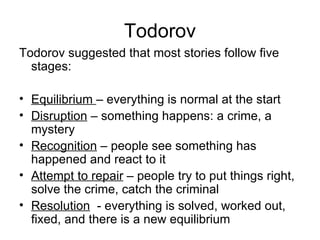
Todorov Todorov suggested that most stories follow five stages: Equilibrium  – everything is normal at the start Disruption  – something happens: a crime, a mystery Recognition  – people see something has happened and react to it Attempt to repair  – people try to put things right, solve the crime, catch the criminal Resolution   - everything is solved, worked out, fixed, and there is a new equilibrium
Applying Todorov’s theory Watch a whole episode of  Rastamouse  (on CBeebies iPlayer) or watch the clip below: http:// www.youtube.com/watch?v =4ZCvydOxcq0   Try to work out the five stages Equilibrium:  Rastamouse and his friends are playing their music Disruption  Recognition  Attempt to repair  Resolution
Typical settings for TV Crime Drama Often in the city (seen as a dangerous place) But sometimes in the countryside…consider the murder rate in Midsomer! Within this, individual locations often include police stations, law courts, science labs, police cars, detectives’ houses, alleyways, nightclubs, victims’ houses….
Match these TV crime dramas with their setting. Midsomer Murders Manchester NYPD Blue English gardens  CSI: Miami Country houses Rosemary and Thyme Midsomer  Rastamouse Oxford Poirot Miami Inspector Morse Baltimore Cracker New York The Wire Mouseland Can you think of anywhere that  wouldn’t  work as the location of a TV crime drama?
Mise-en-scene Mise-en-scene refers to what can be seen in a camera shot. Look at this image:  http://www.bbc.co.uk/programmes/b00vk2lp   What are the characters’ positions (facing the camera? Standing aggressively? Sitting shyly?) What does this tell us about what kind of person they are? What are the characters’ facial expressions? (Glaring at the camera? Smiling? Laughing? Winking?) What does this tell us about what kind of person they are? What props (things) are there in the shot? (A coffee mug? A new car? A gun? A pencil?) What does this tell us about the person? What costume does the character have? ( A suit? Jeans? A flowery dress?) What does this tell us about the person? Where is the location or setting? (in a front room? In prison? In an office?) What does this tell us about the person? Is the lighting bright or dim? Full-on or from the side? What mood does this give to the image?
Mise-en-scene analysis Look at these images. One is from a television crime drama, and one is not.  http:// www.google.co.uk/imgres?imgurl = http://blog.tvguide.co.uk/wp-content/uploads/prime_suspect.jpg&imgrefurl =http:// blog.tvguide   http://www.bbc.co.uk/programmes/b006v5y2   Describe what you can see in each image: Characters posture, position, facial expression Costumes Location Props Lighting Camera shot type and angle How does each image have a different mood and feel?
Define the genre What are the genre conventions of Television Crime Drama?  Explain, using these words:  genre conventions plot character setting Teaching TV Crime Drama  www.devonldp.org

1. What Is a Cime Drama?

  • 1.
    What is aTelevision Crime Drama? Defining the genre
  • 2.
    A television crimedrama Television Crime Drama is a genre (or type) of TV programme. It always follows certain rules. The rules of a genre are called the conventions (typical elements) of a genre (type of programme). Watch this trailer: http:// www.youtube.com/watch?v =Fyu413qiOXY&playnext=1&list=PL707CE5DF0C72205B What tells you it is a television Crime Drama programme?
  • 3.
    Is it atelevision crime drama? 1.Is it on television, or originally made for TV? (it can’t be a film that came out in cinemas) 2. Is it mainly about a crime? 3. Is it a drama (made-up, acted, fictional?)
  • 4.
    Are these TVcrime dramas? X-Men A documentary about drug smuggling CSI: Miami Thor Reality show about police work Dr Who Morse A story on the news about a murder Pirates of the Caribbean For each example, say why it is or can’t be a TV crime drama. Use the three questions to help you decide: Is it on television, or originally made for TV? (it can’t be a film that came out in cinemas) Is it mainly about a crime? Is it a drama (made-up, acted, fictional?)
  • 5.
    Typical characters Crimedramas usually include three types of character: The ones who solve the crimes (detectives, private eyes, police officers, forensic scientists). The ones who commit the crimes (criminals, murderers, thieves). The victims (the ones who get murdered, attacked, robbed, beaten up, mugged, stolen from, burgled). Watch the first 40 seconds of either of these clips - can you work out who is the criminal, who is the victim and who is the crime solver? http://www.bbc.co.uk/programmes/b00vk2lp http:// www.youtube.com/watch?v = IAUbPFIlFIc&feature = relmfu
  • 6.
    Typical plot /storyline The typical plot centres around solving a crime (the murder, attack, burglary) The story usually follows those who solve the crime (the detectives, police) The crime is not usually solved until the end of the episode or programme.
  • 7.
    To keep youinterested… One of the pleasures of TV Crime drama is watching the crime get solved. But if it was solved too quickly or easily, it wouldn’t be interesting. So Crime Drama plots usually have: A mystery or enigma at the start – a puzzle or mystery – who killed the dead man? And why? Lots of suspense – will they catch the killer in time? A red herring – will they arrest the wrong person; do the clues point to an innocent person? Some personal drama – the detective's marriage is falling apart; the detectives fall out with each other; the detective loses his promotion.
  • 8.
    Plot devices Watchthese two clips of two very different TV crime dramas. What aspects of the plot devices can you see? Mysteries or enigmas? Suspense? Red herrings? Personal drama? CSI:NY http://www.youtube.com/watch?v=r4_HyIc89Wk Morse: http:// www.youtube.com/watch?v =qukmZgyOQr4
  • 9.
    Narratives and closureIf it is a one-off drama, then the narrative will be closed (all the loose ends will be tied up at the end of the programme). If it is a series, there may be one storyline that gets finished in the episode, for example a crime that is solved, then other storylines that run on through the whole series. These other storylines may end on cliff-hangers to keep the audience coming back for the next episode.
  • 10.
    Todorov Todorov suggestedthat most stories follow five stages: Equilibrium – everything is normal at the start Disruption – something happens: a crime, a mystery Recognition – people see something has happened and react to it Attempt to repair – people try to put things right, solve the crime, catch the criminal Resolution - everything is solved, worked out, fixed, and there is a new equilibrium
  • 11.
    Applying Todorov’s theoryWatch a whole episode of Rastamouse (on CBeebies iPlayer) or watch the clip below: http:// www.youtube.com/watch?v =4ZCvydOxcq0 Try to work out the five stages Equilibrium: Rastamouse and his friends are playing their music Disruption Recognition Attempt to repair Resolution
  • 12.
    Typical settings forTV Crime Drama Often in the city (seen as a dangerous place) But sometimes in the countryside…consider the murder rate in Midsomer! Within this, individual locations often include police stations, law courts, science labs, police cars, detectives’ houses, alleyways, nightclubs, victims’ houses….
  • 13.
    Match these TVcrime dramas with their setting. Midsomer Murders Manchester NYPD Blue English gardens CSI: Miami Country houses Rosemary and Thyme Midsomer Rastamouse Oxford Poirot Miami Inspector Morse Baltimore Cracker New York The Wire Mouseland Can you think of anywhere that wouldn’t work as the location of a TV crime drama?
  • 14.
    Mise-en-scene Mise-en-scene refersto what can be seen in a camera shot. Look at this image: http://www.bbc.co.uk/programmes/b00vk2lp What are the characters’ positions (facing the camera? Standing aggressively? Sitting shyly?) What does this tell us about what kind of person they are? What are the characters’ facial expressions? (Glaring at the camera? Smiling? Laughing? Winking?) What does this tell us about what kind of person they are? What props (things) are there in the shot? (A coffee mug? A new car? A gun? A pencil?) What does this tell us about the person? What costume does the character have? ( A suit? Jeans? A flowery dress?) What does this tell us about the person? Where is the location or setting? (in a front room? In prison? In an office?) What does this tell us about the person? Is the lighting bright or dim? Full-on or from the side? What mood does this give to the image?
  • 15.
    Mise-en-scene analysis Lookat these images. One is from a television crime drama, and one is not. http:// www.google.co.uk/imgres?imgurl = http://blog.tvguide.co.uk/wp-content/uploads/prime_suspect.jpg&imgrefurl =http:// blog.tvguide http://www.bbc.co.uk/programmes/b006v5y2 Describe what you can see in each image: Characters posture, position, facial expression Costumes Location Props Lighting Camera shot type and angle How does each image have a different mood and feel?
  • 16.
    Define the genreWhat are the genre conventions of Television Crime Drama? Explain, using these words: genre conventions plot character setting Teaching TV Crime Drama www.devonldp.org