Characters in Crime Dramas
Recap: typical characters Crime dramas usually include three types of character: The ones who  solve the crimes  (detectives, private eyes, police officers, forensic scientists). The ones who  commit the crimes  (rapists, criminals, murderers, thieves). The  victims  (the ones who get murdered, attacked, robbed, beaten up, mugged).
The crime solvers Character types and stock characters: The grumpy detective The sidekick The troubled police officer The crooked police officer The brilliant genius Watch these clips. Which character types / stock characters can you identify? http:// www.youtube.com/watch?v =H2ignoBlhpE   http:// www.youtube.com/watch?v =cSQq_bC5kIw
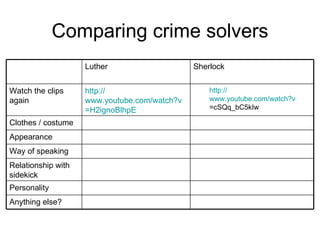
Comparing crime solvers Personality Way of speaking Appearance Anything else? Relationship with sidekick Clothes / costume http:// www.youtube.com/watch?v =cSQq_bC5kIw   http:// www.youtube.com/watch?v =H2ignoBlhpE Watch the clips again Sherlock Luther
Adding interest to the lead character It is almost typical now that the lead crime solver will have a complex and troubled personal life. In this clip for Comic Relief, Robbie Coltrane (Cracker) and Helen Mirren (Prime Suspect) compare their characters. http:// www.youtube.com/watch?v =FrSSvOrI860&feature= fvsr   What are the typical ways that characters show their complex and troubled life?
Sherlock Holmes and Dr. Watson Watch the clip where the actor, Benedict Cumberbatch, talks about playing the new Sherlock Holmes http:// www.youtube.com/watch?v =qR5Dyt2CwNY&feature=related   Why do audiences enjoy watching Sherlock? What is the relationship between Sherlock and Watson? What is the relationship between Sherlock and the Police?
Crime solvers Can have the programme named after them (eponymous) Can work in pairs where they are equal Can have a lead player and a sidekick Can be an ensemble drama (where a team of crime solvers work together to solve the crime)
Lead? Pair? Ensemble? Research the following programmes and work out what kind of crime solvers the programme features. Label them as L, P or E: Starsky and Hutch Law and Order UK Sherlock Holmes The X Files The Wire 24 The Bill Monk CSI: Mami   Rosemary and Thyme Scott and Bailey Morse
The criminals The crime solvers are central characters who are in every episode / series. The criminals are often  transient  characters: they only appear in one episode or one series, because they get caught at the end. The next episode has a different crime to solve and a different criminal.
The Victims Like the criminals, the victims are often transient characters, appearing only in a single episode. Even where the victim is dead, the episode may still revolve around finding out about the victim's lifestyle and habits, and may feature the victim’s family.
Identifying the characters Watch this clip of CSI:Miami http:// www.youtube.com/watch?v =HgoqmG69RJg   Who are the crime solvers? Did you get the impression it is a lead, pair or ensemble set up?  Who was the main focus of the clip? Who is the criminal? Was the criminal a typical criminal? Who is the victim? Was the victim a typical victim?
Stereotypical characters The crime solvers may be stock characters, but they often avoid being stereotypes. Not all the crime solvers are middle-aged white men. This is because they are the lead characters – they are complex and well-developed. But what about the more transient characters? How are criminals represented? Are they usually shown as men or women? Any particular racial background? From any particular social class? How are victims represented? Are they usually shown as men or women? Any particular racial background? From any particular social class? Are there stereotypes of criminals? Are there stereotypes of victims? Do stereotypes make us believe that certain types of people are more likely to be criminals, or more likely to be victims?
Good vs. Evil The theory of Binary Oppositions, by Levi-Strauss  suggests that all stories are basically about a conflict between good and evil, heroes and villains and so on. In TV crime drama, the binary oppositions are usually clear: the crime solvers vs. the criminals.
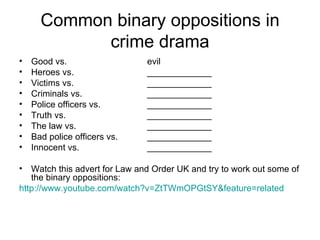
Common binary oppositions in crime drama Good vs.  evil Heroes vs.  _____________ Victims vs.  _____________ Criminals vs. _____________ Police officers vs.  _____________ Truth vs.  _____________ The law vs.  _____________ Bad police officers vs. _____________ Innocent vs.  _____________ Watch this advert for Law and Order UK and try to work out some of the binary oppositions: http:// www.youtube.com/watch?v = ZtTWmOPGtSY&feature =related
Unclear binary oppositions In some programmes this opposition isn’t so clear: the crime solvers become ambiguous, (not completely good) and some criminals may commit crimes for good reasons. Some victims may be presented as innocent, or as partly deserving their fate. Sometimes the binary oppositions change over a series: those who started out as good become less good, those who seemed criminal at first turn out to be good guys.
Unclear binary oppositions Watch this clip of CSI:Miami http:// www.youtube.com/watch?v =XdABsmb6brE&NR=1   Identify the characters: crime solvers; criminals; victims. Are the binary oppositions clear here? Keeping the binary oppositions unclear can make the narrative more complex, more intriguing and add more suspense: who is the criminal? Is the criminal actually on the side of good? Was the victim also a criminal?
Summarise Summarise the key points about characters in TV Crime Drama Use these words: lead, pair, ensemble, criminal, victim, sidekick Try to use these too: stereotype, eponymous, represented, binary opposition, transient Teaching TV Crime Drama  www.devonldp.org

2. Who Are The Characters In Crime Drama?

  • 1.
  • 2.
    Recap: typical charactersCrime dramas usually include three types of character: The ones who solve the crimes (detectives, private eyes, police officers, forensic scientists). The ones who commit the crimes (rapists, criminals, murderers, thieves). The victims (the ones who get murdered, attacked, robbed, beaten up, mugged).
  • 3.
    The crime solversCharacter types and stock characters: The grumpy detective The sidekick The troubled police officer The crooked police officer The brilliant genius Watch these clips. Which character types / stock characters can you identify? http:// www.youtube.com/watch?v =H2ignoBlhpE http:// www.youtube.com/watch?v =cSQq_bC5kIw
  • 4.
    Comparing crime solversPersonality Way of speaking Appearance Anything else? Relationship with sidekick Clothes / costume http:// www.youtube.com/watch?v =cSQq_bC5kIw http:// www.youtube.com/watch?v =H2ignoBlhpE Watch the clips again Sherlock Luther
  • 5.
    Adding interest tothe lead character It is almost typical now that the lead crime solver will have a complex and troubled personal life. In this clip for Comic Relief, Robbie Coltrane (Cracker) and Helen Mirren (Prime Suspect) compare their characters. http:// www.youtube.com/watch?v =FrSSvOrI860&feature= fvsr What are the typical ways that characters show their complex and troubled life?
  • 6.
    Sherlock Holmes andDr. Watson Watch the clip where the actor, Benedict Cumberbatch, talks about playing the new Sherlock Holmes http:// www.youtube.com/watch?v =qR5Dyt2CwNY&feature=related Why do audiences enjoy watching Sherlock? What is the relationship between Sherlock and Watson? What is the relationship between Sherlock and the Police?
  • 7.
    Crime solvers Canhave the programme named after them (eponymous) Can work in pairs where they are equal Can have a lead player and a sidekick Can be an ensemble drama (where a team of crime solvers work together to solve the crime)
  • 8.
    Lead? Pair? Ensemble?Research the following programmes and work out what kind of crime solvers the programme features. Label them as L, P or E: Starsky and Hutch Law and Order UK Sherlock Holmes The X Files The Wire 24 The Bill Monk CSI: Mami Rosemary and Thyme Scott and Bailey Morse
  • 9.
    The criminals Thecrime solvers are central characters who are in every episode / series. The criminals are often transient characters: they only appear in one episode or one series, because they get caught at the end. The next episode has a different crime to solve and a different criminal.
  • 10.
    The Victims Likethe criminals, the victims are often transient characters, appearing only in a single episode. Even where the victim is dead, the episode may still revolve around finding out about the victim's lifestyle and habits, and may feature the victim’s family.
  • 11.
    Identifying the charactersWatch this clip of CSI:Miami http:// www.youtube.com/watch?v =HgoqmG69RJg Who are the crime solvers? Did you get the impression it is a lead, pair or ensemble set up? Who was the main focus of the clip? Who is the criminal? Was the criminal a typical criminal? Who is the victim? Was the victim a typical victim?
  • 12.
    Stereotypical characters Thecrime solvers may be stock characters, but they often avoid being stereotypes. Not all the crime solvers are middle-aged white men. This is because they are the lead characters – they are complex and well-developed. But what about the more transient characters? How are criminals represented? Are they usually shown as men or women? Any particular racial background? From any particular social class? How are victims represented? Are they usually shown as men or women? Any particular racial background? From any particular social class? Are there stereotypes of criminals? Are there stereotypes of victims? Do stereotypes make us believe that certain types of people are more likely to be criminals, or more likely to be victims?
  • 13.
    Good vs. EvilThe theory of Binary Oppositions, by Levi-Strauss suggests that all stories are basically about a conflict between good and evil, heroes and villains and so on. In TV crime drama, the binary oppositions are usually clear: the crime solvers vs. the criminals.
  • 14.
    Common binary oppositionsin crime drama Good vs. evil Heroes vs. _____________ Victims vs. _____________ Criminals vs. _____________ Police officers vs. _____________ Truth vs. _____________ The law vs. _____________ Bad police officers vs. _____________ Innocent vs. _____________ Watch this advert for Law and Order UK and try to work out some of the binary oppositions: http:// www.youtube.com/watch?v = ZtTWmOPGtSY&feature =related
  • 15.
    Unclear binary oppositionsIn some programmes this opposition isn’t so clear: the crime solvers become ambiguous, (not completely good) and some criminals may commit crimes for good reasons. Some victims may be presented as innocent, or as partly deserving their fate. Sometimes the binary oppositions change over a series: those who started out as good become less good, those who seemed criminal at first turn out to be good guys.
  • 16.
    Unclear binary oppositionsWatch this clip of CSI:Miami http:// www.youtube.com/watch?v =XdABsmb6brE&NR=1 Identify the characters: crime solvers; criminals; victims. Are the binary oppositions clear here? Keeping the binary oppositions unclear can make the narrative more complex, more intriguing and add more suspense: who is the criminal? Is the criminal actually on the side of good? Was the victim also a criminal?
  • 17.
    Summarise Summarise thekey points about characters in TV Crime Drama Use these words: lead, pair, ensemble, criminal, victim, sidekick Try to use these too: stereotype, eponymous, represented, binary opposition, transient Teaching TV Crime Drama www.devonldp.org