PRE-WRITING & PROCESS WRITING FORMAT
SUB TOPICS
The writing process:
Prewriting
Writing a First Draft
Revising
Editing
THE WRITING PROCESS
No writing process is ever perfect – there will
always have to be countless editing, revisions,
corrections, etc.
There are 4 processes in writing anything,
whether an article, an essay, or even a chapter of
a novel.
PRE - WRITING
Usually when presented with a specific topic,
many writers have a mental block about what to
write and how to go about it.
May not be able to think of something
interesting, or unable to think of the supporting
details of your topic.
Even after starting an essay, you might be blank
halfway. You may wonder “What else can I say?”
or “Where can I go from there?”
These are perfectly normal emotions to
experience when writing.
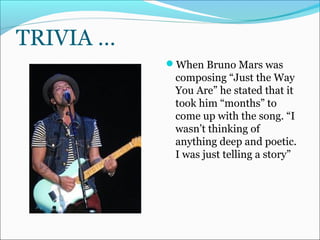
TRIVIA …
When Bruno Mars was
composing “Just the Way
You Are” he stated that it
took him “months” to
come up with the song. “I
wasn’t thinking of
anything deep and poetic.
I was just telling a story”
There are five prewriting techniques to help you
develop an idea and get it on paper:
Free writing
Questioning
Making a list
Clustering
Preparing an outline
Free writing: Jotting down ideas, phrases,
sentences, etc. Don’t worry about mistakes. Don’t
hold back.
Questioning: Generating ideas and details by
asking questions about your subjects. Use the 5W
1H guideline to help you.
Making a list: Also known as brainstorming, you
collect ideas and details. Make a list about your
subject.
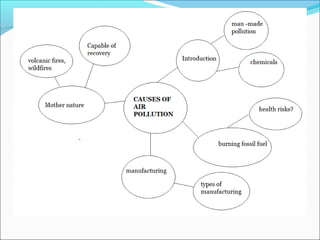
Clustering: Map out your ideas.
Preparing an outline: a combination of all the
four parts of prewriting.
If you are unable to come up with something
solid, then you have to do more prewriting for the
topics that you have listed.
Think carefully about the points that you are
making.
OUTLINING
An outline helps you work on your essay further.
It is basically a quick check on whether your
essay is coherent.
It removes the distraction of words and phrases
and makes sentences and thoughts more
organized.
EXAMPLE…
Topic sentence: Learning a foreign language has many
benefits:
Develop their mental ability
Make new friends
Open to ideas/ ideologies
Accelerates cognitive development
Be competitive in the global market
More culturally sensitive
Languages connect people
Different way of seeing the world
Improves interpretative capabilities
A) Languages connect people:
 Make new friends
 Be competitive in the global market
B) More culturally sensitive:
 Open to ideas / ideologies
 Different way of seeing the world
C) Develop their mental ability:
 Accelerates cognitive development
 Improves interpretative capabilities
WRITING A FIRST DRAFT
It’s time to give your essay a body – but it takes
plenty of writing and patience.
You must flesh out a cohesive sentence – it doesn’t
have to be neat at first – the whole point is to get
your idea across.
E.g: Learning a foreign language has many benefits.
It can connect us socially and professionally.
REVISING AND EDITING
The main idea is there, but it needs more work – simply writing it for
the sake of writing won’t get you anywhere!
E.g: Recently, I’ve just begun learning the basics of Mandarin. Now
that I’m learning a tongue that is not my own, I’ve found that learning
a foreign language does have its benefits. For instance, on a social
scale, I can converse with my Chinese friends with a wider vocabulary
than simply saying “yeah meh?” or “like that hor”.
On a professional scale, being able to speak a foreign language can get
you the respect you deserve from your colleagues who struggle to
communicate with their foreign peers. You can play the role of both
speaker and interpreter!
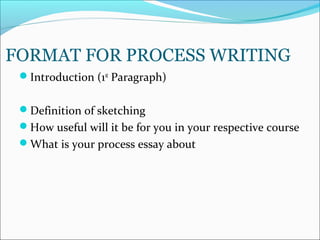
FORMAT FOR PROCESS WRITING
Introduction (1st
Paragraph)
Definition of sketching
How useful will it be for you in your respective course
What is your process essay about
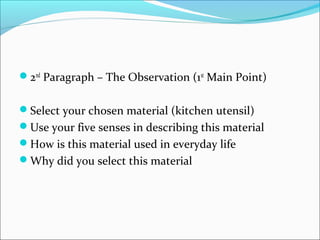
2nd
Paragraph – The Observation (1st
Main Point)
Select your chosen material (kitchen utensil)
Use your five senses in describing this material
How is this material used in everyday life
Why did you select this material
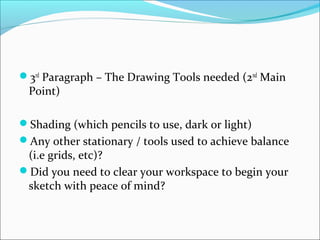
3rd
Paragraph – The Drawing Tools needed (2nd
Main
Point)
Shading (which pencils to use, dark or light)
Any other stationary / tools used to achieve balance
(i.e grids, etc)?
Did you need to clear your workspace to begin your
sketch with peace of mind?
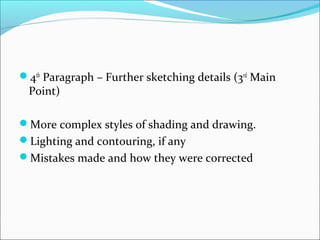
4th
Paragraph – Further sketching details (3rd
Main
Point)
More complex styles of shading and drawing.
Lighting and contouring, if any
Mistakes made and how they were corrected
5th
Paragraph – Conclusion
How long was the process of your sketch and why
was it so long
How did you feel after it’s completion
Would you do this again?
Tutorial3prewritingprocessessayformat 150806133957-lva1-app6891

Tutorial3prewritingprocessessayformat 150806133957-lva1-app6891

  • 1.
    PRE-WRITING & PROCESSWRITING FORMAT
  • 2.
    SUB TOPICS The writingprocess: Prewriting Writing a First Draft Revising Editing
  • 3.
    THE WRITING PROCESS Nowriting process is ever perfect – there will always have to be countless editing, revisions, corrections, etc. There are 4 processes in writing anything, whether an article, an essay, or even a chapter of a novel.
  • 4.
    PRE - WRITING Usuallywhen presented with a specific topic, many writers have a mental block about what to write and how to go about it. May not be able to think of something interesting, or unable to think of the supporting details of your topic.
  • 5.
    Even after startingan essay, you might be blank halfway. You may wonder “What else can I say?” or “Where can I go from there?” These are perfectly normal emotions to experience when writing.
  • 6.
    TRIVIA … When BrunoMars was composing “Just the Way You Are” he stated that it took him “months” to come up with the song. “I wasn’t thinking of anything deep and poetic. I was just telling a story”
  • 7.
    There are fiveprewriting techniques to help you develop an idea and get it on paper: Free writing Questioning Making a list Clustering Preparing an outline
  • 8.
    Free writing: Jottingdown ideas, phrases, sentences, etc. Don’t worry about mistakes. Don’t hold back. Questioning: Generating ideas and details by asking questions about your subjects. Use the 5W 1H guideline to help you.
  • 9.
    Making a list:Also known as brainstorming, you collect ideas and details. Make a list about your subject. Clustering: Map out your ideas.
  • 11.
    Preparing an outline:a combination of all the four parts of prewriting. If you are unable to come up with something solid, then you have to do more prewriting for the topics that you have listed. Think carefully about the points that you are making.
  • 12.
    OUTLINING An outline helpsyou work on your essay further. It is basically a quick check on whether your essay is coherent. It removes the distraction of words and phrases and makes sentences and thoughts more organized.
  • 13.
    EXAMPLE… Topic sentence: Learninga foreign language has many benefits: Develop their mental ability Make new friends Open to ideas/ ideologies Accelerates cognitive development Be competitive in the global market More culturally sensitive Languages connect people Different way of seeing the world Improves interpretative capabilities
  • 14.
    A) Languages connectpeople:  Make new friends  Be competitive in the global market B) More culturally sensitive:  Open to ideas / ideologies  Different way of seeing the world C) Develop their mental ability:  Accelerates cognitive development  Improves interpretative capabilities
  • 15.
    WRITING A FIRSTDRAFT It’s time to give your essay a body – but it takes plenty of writing and patience. You must flesh out a cohesive sentence – it doesn’t have to be neat at first – the whole point is to get your idea across. E.g: Learning a foreign language has many benefits. It can connect us socially and professionally.
  • 16.
    REVISING AND EDITING Themain idea is there, but it needs more work – simply writing it for the sake of writing won’t get you anywhere! E.g: Recently, I’ve just begun learning the basics of Mandarin. Now that I’m learning a tongue that is not my own, I’ve found that learning a foreign language does have its benefits. For instance, on a social scale, I can converse with my Chinese friends with a wider vocabulary than simply saying “yeah meh?” or “like that hor”. On a professional scale, being able to speak a foreign language can get you the respect you deserve from your colleagues who struggle to communicate with their foreign peers. You can play the role of both speaker and interpreter!
  • 17.
    FORMAT FOR PROCESSWRITING Introduction (1st Paragraph) Definition of sketching How useful will it be for you in your respective course What is your process essay about
  • 18.
    2nd Paragraph – TheObservation (1st Main Point) Select your chosen material (kitchen utensil) Use your five senses in describing this material How is this material used in everyday life Why did you select this material
  • 19.
    3rd Paragraph – TheDrawing Tools needed (2nd Main Point) Shading (which pencils to use, dark or light) Any other stationary / tools used to achieve balance (i.e grids, etc)? Did you need to clear your workspace to begin your sketch with peace of mind?
  • 20.
    4th Paragraph – Furthersketching details (3rd Main Point) More complex styles of shading and drawing. Lighting and contouring, if any Mistakes made and how they were corrected
  • 21.
    5th Paragraph – Conclusion Howlong was the process of your sketch and why was it so long How did you feel after it’s completion Would you do this again?