Core Tenets
Presentation by Mark Feder, October 2007; revised September 2013
# 1
In the previous presentations we looked at the special qualities that
characterize our instructional plan and explored the roles of teacher and
student. In this presentation we will look a little closer at how the
program’s core tenets relate to one another and suit language learning
needs.
Core Tenets
# 2
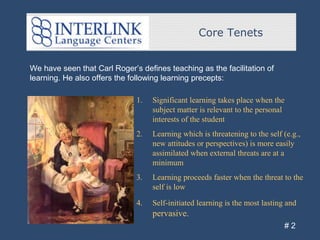
We have seen that Carl Roger’s defines teaching as the facilitation of
learning. He also offers the following learning precepts:
1. Significant learning takes place when the
subject matter is relevant to the personal
interests of the student
2. Learning which is threatening to the self (e.g.,
new attitudes or perspectives) is more easily
assimilated when external threats are at a
minimum
3. Learning proceeds faster when the threat to the
self is low
4. Self-initiated learning is the most lasting and
pervasive.
Core Tenets
# 3
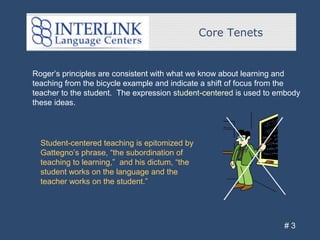
Roger’s principles are consistent with what we know about learning and
teaching from the bicycle example and indicate a shift of focus from the
teacher to the student. The expression student-centered is used to embody
these ideas.
Student-centered teaching is epitomized by
Gattegno’s phrase, “the subordination of
teaching to learning,” and his dictum, “the
student works on the language and the
teacher works on the student.”
Core Tenets
# 4
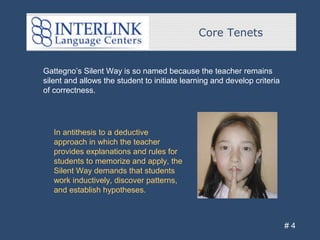
Gattegno’s Silent Way is so named because the teacher remains
silent and allows the student to initiate learning and develop criteria
of correctness.
In antithesis to a deductive
approach in which the teacher
provides explanations and rules for
students to memorize and apply, the
Silent Way demands that students
work inductively, discover patterns,
and establish hypotheses.
Core Tenets
# 5
In the Silent Way, the student’s mind is actively engaged in solving
problems and making discoveries (heuristic learning). Because the
student initiates and controls the learning, this approach caters to
individual needs. The student gets what he or she needs rather
than whatever the teacher happens to dish out.
Learning that is inductive, heuristic,
individualized, and needs-based is
affectively oriented and places the focus
clearly on the learner rather than the teacher
– and in Roger’s terms is relevant to the
learner. Heuristic learning, by definition, has
real meaning and relevance.
Core Tenets
# 6
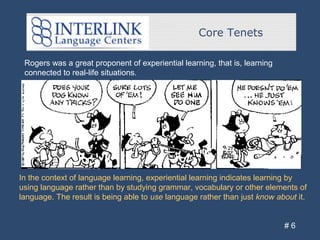
Rogers was a great proponent of experiential learning, that is, learning
connected to real-life situations.
In the context of language learning, experiential learning indicates learning by
using language rather than by studying grammar, vocabulary or other elements of
language. The result is being able to use language rather than just know about it.
Core Tenets
# 7
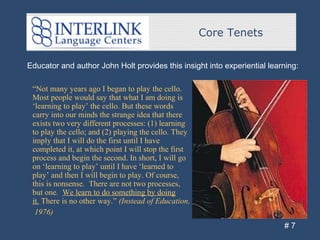
Educator and author John Holt provides this insight into experiential learning:
“Not many years ago I began to play the cello.
Most people would say that what I am doing is
‘learning to play’ the cello. But these words
carry into our minds the strange idea that there
exists two very different processes: (1) learning
to play the cello; and (2) playing the cello. They
imply that I will do the first until I have
completed it, at which point I will stop the first
process and begin the second. In short, I will go
on ‘learning to play’ until I have ‘learned to
play’ and then I will begin to play. Of course,
this is nonsense. There are not two processes,
but one. We learn to do something by doing
it. There is no other way.” (Instead of Education,
1976)
Core Tenets
# 8
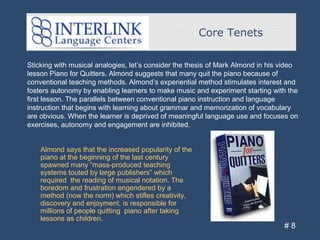
Sticking with musical analogies, let’s consider the thesis of Mark Almond in his video
lesson Piano for Quitters. Almond suggests that many quit the piano because of
conventional teaching methods. Almond’s experiential method stimulates interest and
fosters autonomy by enabling learners to make music and experiment starting with the
first lesson. The parallels between conventional piano instruction and language
instruction that begins with learning about grammar and memorization of vocabulary
are obvious. When the learner is deprived of meaningful language use and focuses on
exercises, autonomy and engagement are inhibited.
Almond says that the increased popularity of the
piano at the beginning of the last century
spawned many “mass-produced teaching
systems touted by large publishers” which
required the reading of musical notation. The
boredom and frustration engendered by a
method (now the norm) which stifles creativity,
discovery and enjoyment, is responsible for
millions of people quitting piano after taking
lessons as children.
Core Tenets
# 9
The importance of learning by doing has been recognized through the
ages and is not restricted to specific types of learning.
“You learn to speak by speaking, to study by
studying, to run by running, to work by working;
and just so, you learn to love by loving. All those
who think to learn in any other way deceive
themselves.” Saint Francis de Sales
“I hear and I forget.
I see and I believe.
I do and I understand.” Confucius
“One must learn by doing the thing.” Sophocles
Core Tenets
# 10
Stephen Krashen advocates an experiential approach and distinguishes
between acquisition, which he views as a natural and powerful developer
of language skills, and conscious learning, which he considers limited and
far less significant.
The Acquisition-Learning Distinction
acquisition learning
similar to child first language acquisition formal knowledge of language
“picking up” a language “knowing about” a language
subconscious conscious
implicit knowledge explicit knowledge
formal teaching does not help formal teaching helps
From The Natural Approach, Stephen Krashen and Tracy Terrell, 1983
Core Tenets
# 11
In other words, learning experientially, learning by doing, is the only
practical way to master a foreign language.
According to Krashen, "Acquisition
requires meaningful interaction in the
target language -- natural
communication -- in which speakers
are concerned not with the form of
their utterances but with the
messages they are conveying and
understanding."
Core Tenets
# 12
The primary component of Krashen’s acquisition theory is the comprehensible
input hypothesis. The idea is that language – that includes vocabulary and
syntax – is acquired naturally through appropriate language contact.
The Input Hypothesis - Major Points
1. Relates to acquisition, not to learning.
2. We acquire by understanding language a bit beyond our current level of competence.
This is done with the help of context.
3. Spoken fluency emerges gradually and is not taught directly.
4. When caretakers talk to acquirers so that the acquirers understand the message,
input automatically contains “I+1”, the grammatical structures the acquirer is “ready” to
acquire.
From The Natural Approach, Stephen Krashen and Tracy Terrell, 1983
Core Tenets
# 13
Another component of Krashen’s acquisition theory is what he terms the
affective filter.
The affective filter acts to prevent input from being used for language
acquisition. Acquirers with optimal attitudes are hypothesized to have a low
affective filter. Classrooms that encourage low filters are those that promote
low anxiety among students, that keep students off the defensive.
From The Natural Approach, Stephen Krashen and Tracy Terrell, 1983
input
filter
Language
Acquisition
Device
acquired competence
Core Tenets
# 14
For Krashen, the role of the teacher is to provide students with extensive
comprehensible input and to supply affective support. Earl Stevick relates a story
supporting this position and affirming his own insistence that in order to learn, students
must have a feeling of “primacy in a world of meaningful action.”
“I happened to get [a job] teaching ESL. I had never heard of ESL before…my
approach was very casual and low pressure. My method usually consisted of
thinking up a topic to talk about, introducing it, and encouraging each student to
express her feelings.”
The teacher goes on to say that the students’ skills improved and he decided to
take up a career in ESL. Feeling guilty about the casual approach of his first
class, and attempting to become a truly professional ESL teacher, he adopted
a “traditional authoritarian style with the textbook dominant.” He concludes:
“I can look back on these four years and see a gradual decline in the
performance of my students…My present style of teaching bypasses the
students’ feelings and basic needs, and concentrates on method. I never see
successes like those first [students].”
From Teaching Languages: A Way and Ways, 1980
Core Tenets
# 15
Empathy, caring and respect for the student are necessary qualities for
effective teaching. When methodology gets in the way of such attitudes, the
result is invariably disastrous.
"In all things we learn only from those we love." Goethe
"the secret of education lies in respecting the pupil." Emerson
"Students learn what they care about, from people they care about and who,
they know, care about them . . . “ Barbara Harrell Carson
“No man can be a good teacher unless he has feelings of warm affection
toward his pupils and a genuine desire to impart to them what he himself
believes to be of value.” Bertrand Russell
“Theories and goals of education don’t matter a whit if you don’t consider your
students to be human beings. “ Lou Ann Walker
Core Tenets
# 16
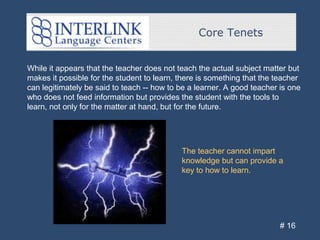
While it appears that the teacher does not teach the actual subject matter but
makes it possible for the student to learn, there is something that the teacher
can legitimately be said to teach -- how to be a learner. A good teacher is one
who does not feed information but provides the student with the tools to
learn, not only for the matter at hand, but for the future.
The teacher cannot impart
knowledge but can provide a
key to how to learn.
Core Tenets
# 17
The teacher is, in effect, teaching the student to be an independent,
autonomous learner capable of enhancing skills outside of the classroom.
Being an autonomous learner is especially important in a task as colossal as
learning a language, because learning must continue after the language
course ends.
“We now accept the fact that learning is a lifelong process … and the
most pressing task is to teach people how to learn.” Peter F. Drucker
“The greatest sign of success for a teacher ... is to be able to say, ‘The
children are now working as if I did not exist.’” Maria Montessori
“A teacher is one who makes himself progressively unnecessary.”
Thomas Carruthers
Core Tenets
# 18
We now have some ideas about the nature of learning and teaching to serve
as a foundation for our instructional plan. We have seen the crucial role of
the affective domain in different kinds of learning including language
acquisition and we have established that teaching consists mainly of fostering
a readiness to learn. We have also looked at the inter-relationship of the core
tenets of the instructional plan which call for a program that is:
Student-centered
Experiential
Holistic
Needs-based
Interactive
Heuristic
THE END

Tutorial 3r

  • 1.
    Core Tenets Presentation byMark Feder, October 2007; revised September 2013 # 1 In the previous presentations we looked at the special qualities that characterize our instructional plan and explored the roles of teacher and student. In this presentation we will look a little closer at how the program’s core tenets relate to one another and suit language learning needs.
  • 2.
    Core Tenets # 2 Wehave seen that Carl Roger’s defines teaching as the facilitation of learning. He also offers the following learning precepts: 1. Significant learning takes place when the subject matter is relevant to the personal interests of the student 2. Learning which is threatening to the self (e.g., new attitudes or perspectives) is more easily assimilated when external threats are at a minimum 3. Learning proceeds faster when the threat to the self is low 4. Self-initiated learning is the most lasting and pervasive.
  • 3.
    Core Tenets # 3 Roger’sprinciples are consistent with what we know about learning and teaching from the bicycle example and indicate a shift of focus from the teacher to the student. The expression student-centered is used to embody these ideas. Student-centered teaching is epitomized by Gattegno’s phrase, “the subordination of teaching to learning,” and his dictum, “the student works on the language and the teacher works on the student.”
  • 4.
    Core Tenets # 4 Gattegno’sSilent Way is so named because the teacher remains silent and allows the student to initiate learning and develop criteria of correctness. In antithesis to a deductive approach in which the teacher provides explanations and rules for students to memorize and apply, the Silent Way demands that students work inductively, discover patterns, and establish hypotheses.
  • 5.
    Core Tenets # 5 Inthe Silent Way, the student’s mind is actively engaged in solving problems and making discoveries (heuristic learning). Because the student initiates and controls the learning, this approach caters to individual needs. The student gets what he or she needs rather than whatever the teacher happens to dish out. Learning that is inductive, heuristic, individualized, and needs-based is affectively oriented and places the focus clearly on the learner rather than the teacher – and in Roger’s terms is relevant to the learner. Heuristic learning, by definition, has real meaning and relevance.
  • 6.
    Core Tenets # 6 Rogerswas a great proponent of experiential learning, that is, learning connected to real-life situations. In the context of language learning, experiential learning indicates learning by using language rather than by studying grammar, vocabulary or other elements of language. The result is being able to use language rather than just know about it.
  • 7.
    Core Tenets # 7 Educatorand author John Holt provides this insight into experiential learning: “Not many years ago I began to play the cello. Most people would say that what I am doing is ‘learning to play’ the cello. But these words carry into our minds the strange idea that there exists two very different processes: (1) learning to play the cello; and (2) playing the cello. They imply that I will do the first until I have completed it, at which point I will stop the first process and begin the second. In short, I will go on ‘learning to play’ until I have ‘learned to play’ and then I will begin to play. Of course, this is nonsense. There are not two processes, but one. We learn to do something by doing it. There is no other way.” (Instead of Education, 1976)
  • 8.
    Core Tenets # 8 Stickingwith musical analogies, let’s consider the thesis of Mark Almond in his video lesson Piano for Quitters. Almond suggests that many quit the piano because of conventional teaching methods. Almond’s experiential method stimulates interest and fosters autonomy by enabling learners to make music and experiment starting with the first lesson. The parallels between conventional piano instruction and language instruction that begins with learning about grammar and memorization of vocabulary are obvious. When the learner is deprived of meaningful language use and focuses on exercises, autonomy and engagement are inhibited. Almond says that the increased popularity of the piano at the beginning of the last century spawned many “mass-produced teaching systems touted by large publishers” which required the reading of musical notation. The boredom and frustration engendered by a method (now the norm) which stifles creativity, discovery and enjoyment, is responsible for millions of people quitting piano after taking lessons as children.
  • 9.
    Core Tenets # 9 Theimportance of learning by doing has been recognized through the ages and is not restricted to specific types of learning. “You learn to speak by speaking, to study by studying, to run by running, to work by working; and just so, you learn to love by loving. All those who think to learn in any other way deceive themselves.” Saint Francis de Sales “I hear and I forget. I see and I believe. I do and I understand.” Confucius “One must learn by doing the thing.” Sophocles
  • 10.
    Core Tenets # 10 StephenKrashen advocates an experiential approach and distinguishes between acquisition, which he views as a natural and powerful developer of language skills, and conscious learning, which he considers limited and far less significant. The Acquisition-Learning Distinction acquisition learning similar to child first language acquisition formal knowledge of language “picking up” a language “knowing about” a language subconscious conscious implicit knowledge explicit knowledge formal teaching does not help formal teaching helps From The Natural Approach, Stephen Krashen and Tracy Terrell, 1983
  • 11.
    Core Tenets # 11 Inother words, learning experientially, learning by doing, is the only practical way to master a foreign language. According to Krashen, "Acquisition requires meaningful interaction in the target language -- natural communication -- in which speakers are concerned not with the form of their utterances but with the messages they are conveying and understanding."
  • 12.
    Core Tenets # 12 Theprimary component of Krashen’s acquisition theory is the comprehensible input hypothesis. The idea is that language – that includes vocabulary and syntax – is acquired naturally through appropriate language contact. The Input Hypothesis - Major Points 1. Relates to acquisition, not to learning. 2. We acquire by understanding language a bit beyond our current level of competence. This is done with the help of context. 3. Spoken fluency emerges gradually and is not taught directly. 4. When caretakers talk to acquirers so that the acquirers understand the message, input automatically contains “I+1”, the grammatical structures the acquirer is “ready” to acquire. From The Natural Approach, Stephen Krashen and Tracy Terrell, 1983
  • 13.
    Core Tenets # 13 Anothercomponent of Krashen’s acquisition theory is what he terms the affective filter. The affective filter acts to prevent input from being used for language acquisition. Acquirers with optimal attitudes are hypothesized to have a low affective filter. Classrooms that encourage low filters are those that promote low anxiety among students, that keep students off the defensive. From The Natural Approach, Stephen Krashen and Tracy Terrell, 1983 input filter Language Acquisition Device acquired competence
  • 14.
    Core Tenets # 14 ForKrashen, the role of the teacher is to provide students with extensive comprehensible input and to supply affective support. Earl Stevick relates a story supporting this position and affirming his own insistence that in order to learn, students must have a feeling of “primacy in a world of meaningful action.” “I happened to get [a job] teaching ESL. I had never heard of ESL before…my approach was very casual and low pressure. My method usually consisted of thinking up a topic to talk about, introducing it, and encouraging each student to express her feelings.” The teacher goes on to say that the students’ skills improved and he decided to take up a career in ESL. Feeling guilty about the casual approach of his first class, and attempting to become a truly professional ESL teacher, he adopted a “traditional authoritarian style with the textbook dominant.” He concludes: “I can look back on these four years and see a gradual decline in the performance of my students…My present style of teaching bypasses the students’ feelings and basic needs, and concentrates on method. I never see successes like those first [students].” From Teaching Languages: A Way and Ways, 1980
  • 15.
    Core Tenets # 15 Empathy,caring and respect for the student are necessary qualities for effective teaching. When methodology gets in the way of such attitudes, the result is invariably disastrous. "In all things we learn only from those we love." Goethe "the secret of education lies in respecting the pupil." Emerson "Students learn what they care about, from people they care about and who, they know, care about them . . . “ Barbara Harrell Carson “No man can be a good teacher unless he has feelings of warm affection toward his pupils and a genuine desire to impart to them what he himself believes to be of value.” Bertrand Russell “Theories and goals of education don’t matter a whit if you don’t consider your students to be human beings. “ Lou Ann Walker
  • 16.
    Core Tenets # 16 Whileit appears that the teacher does not teach the actual subject matter but makes it possible for the student to learn, there is something that the teacher can legitimately be said to teach -- how to be a learner. A good teacher is one who does not feed information but provides the student with the tools to learn, not only for the matter at hand, but for the future. The teacher cannot impart knowledge but can provide a key to how to learn.
  • 17.
    Core Tenets # 17 Theteacher is, in effect, teaching the student to be an independent, autonomous learner capable of enhancing skills outside of the classroom. Being an autonomous learner is especially important in a task as colossal as learning a language, because learning must continue after the language course ends. “We now accept the fact that learning is a lifelong process … and the most pressing task is to teach people how to learn.” Peter F. Drucker “The greatest sign of success for a teacher ... is to be able to say, ‘The children are now working as if I did not exist.’” Maria Montessori “A teacher is one who makes himself progressively unnecessary.” Thomas Carruthers
  • 18.
    Core Tenets # 18 Wenow have some ideas about the nature of learning and teaching to serve as a foundation for our instructional plan. We have seen the crucial role of the affective domain in different kinds of learning including language acquisition and we have established that teaching consists mainly of fostering a readiness to learn. We have also looked at the inter-relationship of the core tenets of the instructional plan which call for a program that is: Student-centered Experiential Holistic Needs-based Interactive Heuristic THE END