HOW TO SEE
AND UNDERSTAND THE
HISTORICAL SITE

STUDENTS NAMES :
SALMAN ALTUWARIKI
ABDULLAH ALHATHAL
ABDULLAH ALMAZROU

SUPERVISORS :
PROF. IMAN ALDEN OTA BASHI
ARCH. ABDULAZIZ ALSUGAIER
ARCH. MAJED ALAREFE
THE LOCATION
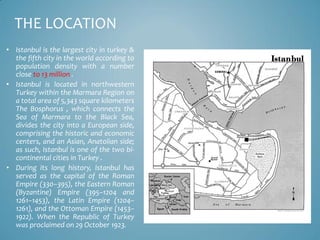
• Istanbul is the largest city in turkey &
  the fifth city in the world according to
  population density with a number
  close to 13 million .
• Istanbul is located in northwestern
  Turkey within the Marmara Region on
  a total area of 5,343 square kilometers
  The Bosphorus , which connects the
  Sea of Marmara to the Black Sea,
  divides the city into a European side,
  comprising the historic and economic
  centers, and an Asian, Anatolian side;
  as such, Istanbul is one of the two bi-
  continental cities in Turkey .
• During its long history, Istanbul has
  served as the capital of the Roman
  Empire (330–395), the Eastern Roman
  (Byzantine) Empire (395–1204 and
  1261–1453), the Latin Empire (1204–
  1261), and the Ottoman Empire (1453–
  1922). When the Republic of Turkey
  was proclaimed on 29 October 1923.
THE TOPOGRAPHY
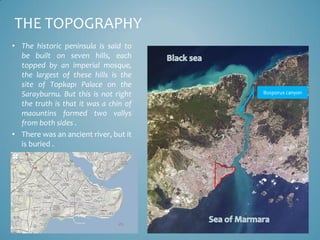
• The historic peninsula is said to
  be built on seven hills, each
  topped by an imperial mosque,
  the largest of these hills is the
  site of Topkapı Palace on the
  Sarayburnu. But this is not right    Bosporus canyon

  the truth is that it was a chin of
  maountins formed two vallys
  from both sides .
• There was an ancient river, but it
  is buried .
THE GROWTH OF ISTANBUL CITY
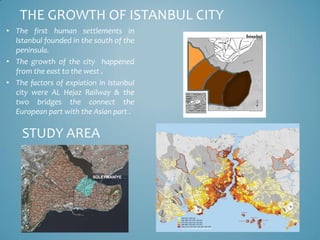
• The first human settlements in
  Istanbul founded in the south of the
  peninsula.
• The growth of the city happened
  from the east to the west .
• The factors of expiation in Istanbul
  city were AL Hejaz Railway & the
  two bridges the connect the
  European part with the Asian part .

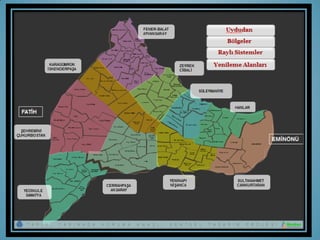
    STUDY AREA

                         SÜLEYMANİYE
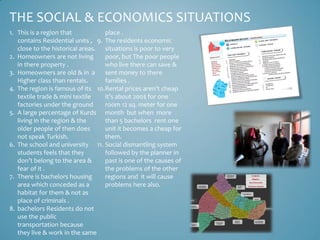
THE SOCIAL & ECONOMICS SITUATIONS
1. This is a region that           place .
   contains Residential units , 9. The residents economic
   close to the historical areas. situations is poor to very
2. Homeowners are not living       poor, but The poor people
   in there property .             who live there can save &
3. Homeowners are old & in a       sent money to there
   Higher class than rentals.      families .
4. The region is famous of its 10.Rental prices aren’t cheap
   textile trade & mini textile    it’s about 200$ for one
   factories under the ground      room 12 sq. meter for one
5. A large percentage of Kurds month but when more
   living in the region & the      than 5 bachelors rent one
   older people of then does       unit it becomes a cheap for
   not speak Turkish.              them.
6. The school and university 11. Social dismantling system
   students feels that they        followed by the planner in
   don’t belong to the area &      past is one of the causes of
   fear of it .                    the problems of the other
7. There is bachelors housing      regions and it will cause
   area which conceded as a        problems here also.
   habitat for them & not as
   place of criminals .
8. bachelors Residents do not
   use the public
   transportation because
   they live & work in the same
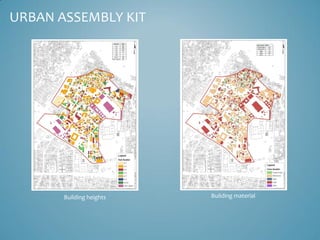
URBAN ASSEMBLY KIT


       Building heights   Building material
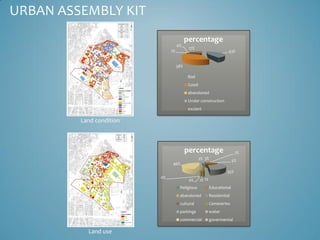
URBAN ASSEMBLY KIT
                                          percentage
                                    0%
                                           17%
                               2%                                   43%


                                    38%

                                           Bad
                                           Good
                                           abandoned
                                           Under construction
                                           exclant

         Land condition


                                          percentage                     7%
                                                  2% 3%                 5%
                                46%
                                                                   35%
                          0%
                                           0%     1% 1%
                                     Religious            Educational
                                     abandoned            Residential
                                     cultural             Cemeteries
                                     parkings             water
                                     commercial           govermental

           Land use
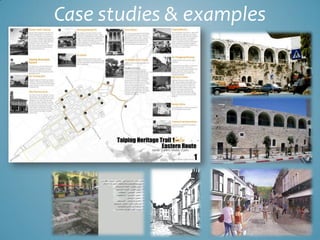
Case studies & examples
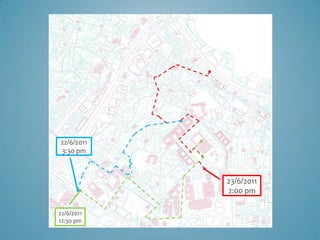
22/6/2011
3:30 pm


            23/6/2011
            2:00 pm

22/6/2011
12:30 pm
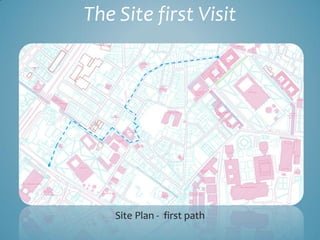
The Site first Visit


    Site Plan - first path
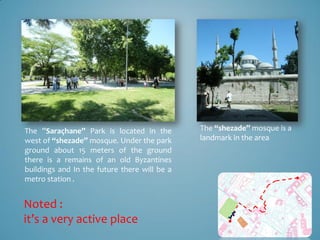
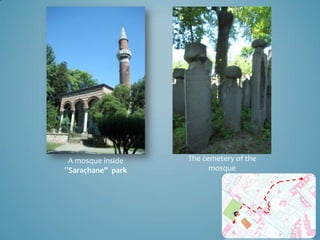
The ”Saraçhane” Park is located in the        The “shezade” mosque is a
west of “shezade” mosque. Under the park      landmark in the area
ground about 15 meters of the ground
there is a remains of an old Byzantines
buildings and In the future there will be a
metro station .


Noted :
it’s a very active place
A mosque inside   The cemetery of the
”Saraçhane” park         mosque
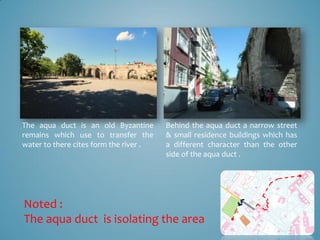
The aqua duct is an old Byzantine       Behind the aqua duct a narrow street
remains which use to transfer the       & small residence buildings which has
water to there cites form the river .   a different character than the other
                                        side of the aqua duct .


Noted :
The aqua duct is isolating the area
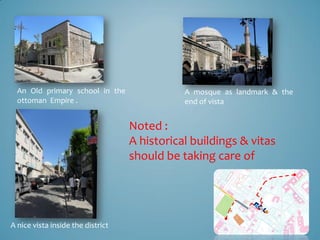
An Old primary school in the                A mosque as landmark & the
  ottoman Empire .                            end of vista


                                   Noted :
                                   A historical buildings & vitas
                                   should be taking care of


A nice vista inside the district
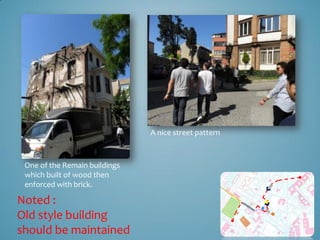
A nice street pattern


 One of the Remain buildings
 which built of wood then
 enforced with brick.

Noted :
Old style building
should be maintained
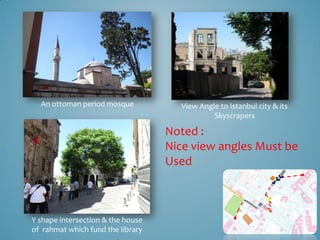
An ottoman period mosque           View Angle to Istanbul city & its
                                              Skyscrapers

                                   Noted :
                                   Nice view angles Must be
                                   Used


Y shape intersection & the house
of rahmat which fund the library
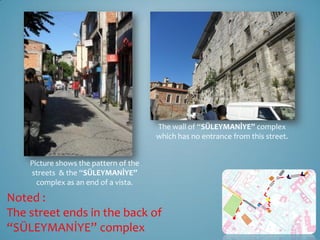
The wall of “SÜLEYMANİYE” complex
                                       which has no entrance from this street.


    Picture shows the pattern of the
    streets & the “SÜLEYMANİYE”
      complex as an end of a vista.

Noted :
The street ends in the back of
“SÜLEYMANİYE” complex
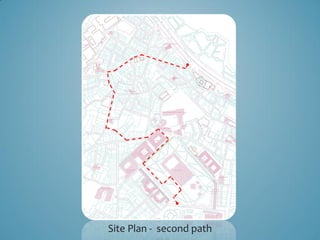
Site Plan - second path
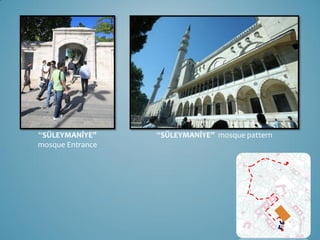
“SÜLEYMANİYE”     “SÜLEYMANİYE” mosque pattern
mosque Entrance
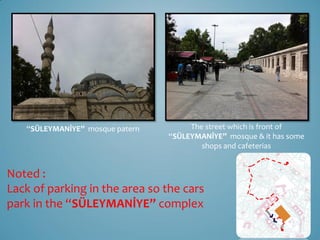
“SÜLEYMANİYE” mosque patern        The street which is front of
                                 “SÜLEYMANİYE” mosque & it has some
                                         shops and cafeterias


Noted :
Lack of parking in the area so the cars
park in the “SÜLEYMANİYE” complex
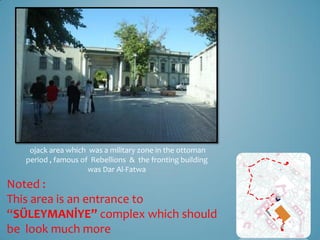
ojack area which was a military zone in the ottoman
   period , famous of Rebellions & the fronting building
                     was Dar Al-Fatwa

Noted :
This area is an entrance to
“SÜLEYMANİYE” complex which should
be look much more
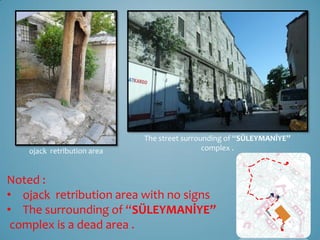
The street surrounding of “SÜLEYMANİYE”
    ojack retribution area                    complex .


Noted :
• ojack retribution area with no signs
• The surrounding of “SÜLEYMANİYE”
 complex is a dead area .
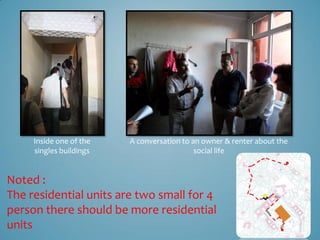
Inside one of the   A conversation to an owner & renter about the
     singles buildings                      social life


Noted :
The residential units are two small for 4
person there should be more residential
units
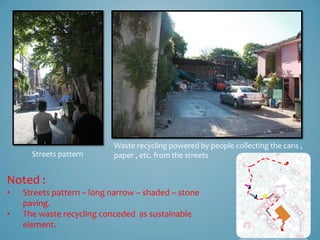
Waste recycling powered by people collecting the cans ,
      Streets pattern      paper , etc. from the streets


Noted :
•   Streets pattern – long narrow – shaded – stone
    paving.
•   The waste recycling conceded as sustainable
    element.
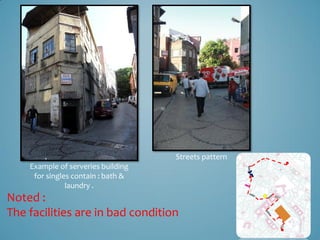
Streets pattern
    Example of serveries building
     for singles contain : bath &
               laundry .
Noted :
The facilities are in bad condition
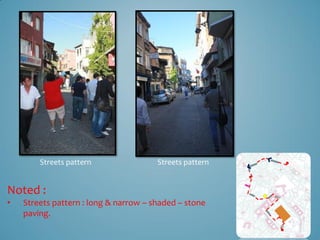
Streets pattern                Streets pattern


Noted :
•   Streets pattern : long & narrow – shaded – stone
    paving.
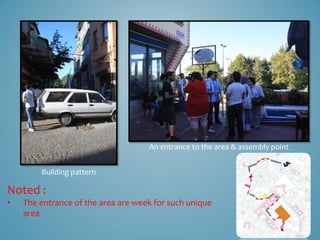
An entrance to the area & assembly point


        Building pattern

Noted :
•   The entrance of the area are week for such unique
    area
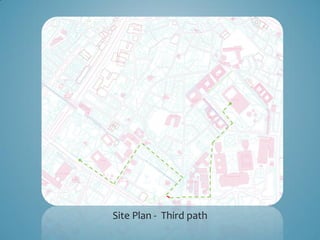
Site Plan - Third path
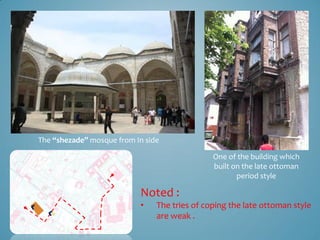
The “shezade” mosque from In side

                                               One of the building which
                                               built on the late ottoman
                                                      period style

                           Noted :
                           •    The tries of coping the late ottoman style
                                are weak .
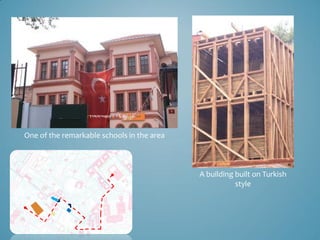
One of the remarkable schools in the area


                                            A building built on Turkish
                                                       style
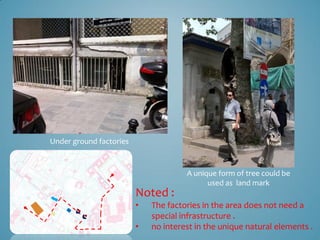
Under ground factories


                                      A unique form of tree could be
                                            used as land mark
                         Noted :
                         •   The factories in the area does not need a
                             special infrastructure .
                         •   no interest in the unique natural elements .
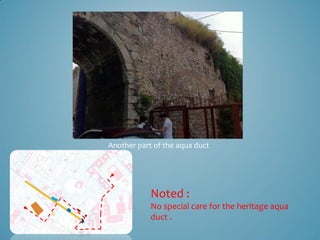
Another part of the aqua duct


            Noted :
            No special care for the heritage aqua
            duct .
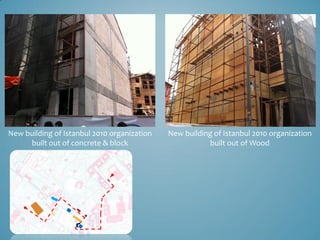
New building of Istanbul 2010 organization   New building of Istanbul 2010 organization
     built out of concrete & block                      built out of Wood
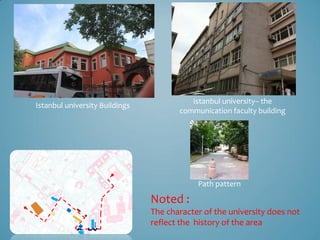
Istanbul university– the
Istanbul university Buildings
                                       communication faculty building


                                            Path pattern

                                Noted :
                                The character of the university does not
                                reflect the history of the area
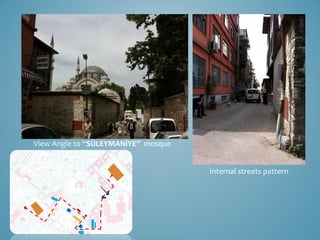
View Angle to “SÜLEYMANİYE” mosque


                                     Internal streets pattern
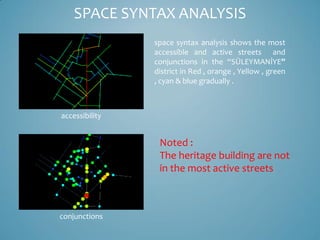
SPACE SYNTAX ANALYSIS
                space syntax analysis shows the most
                accessible and active streets and
                conjunctions in the “SÜLEYMANİYE”
                district in Red , orange , Yellow , green
                , cyan & blue gradually .


accessibility


                 Noted :
                 The heritage building are not
                 in the most active streets


conjunctions
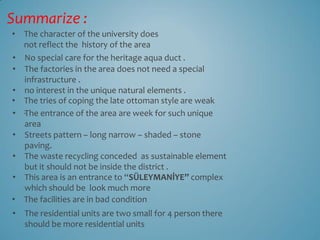
Summarize :
• The character of the university does
  not reflect the history of the area
• No special care for the heritage aqua duct .
• The factories in the area does not need a special
   infrastructure .
• no interest in the unique natural elements .
• The tries of coping the late ottoman style are weak
• .The entrance of the area are week for such unique
   area
• Streets pattern – long narrow – shaded – stone
   paving.
• The waste recycling conceded as sustainable element
   but it should not be inside the district .
• This area is an entrance to “SÜLEYMANİYE” complex
   which should be look much more
• The facilities are in bad condition
• The residential units are two small for 4 person there
  should be more residential units
•    The street ends in the back of “SÜLEYMANİYE” complex
•   Old style building should be maintained
•   The aqua duct isolate the area
•   A historical buildings & vitas should be taking care of
•   The heritage building are not in the most active streets
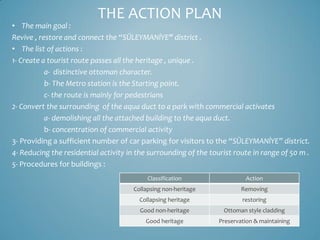
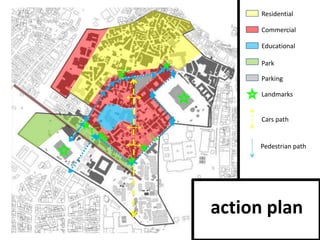
THE ACTION PLAN
• The main goal :
Revive , restore and connect the “SÜLEYMANİYE” district .
• The list of actions :
1- Create a tourist route passes all the heritage , unique .
           a- distinctive ottoman character.
           b- The Metro station is the Starting point.
           c- the route is mainly for pedestrians
2- Convert the surrounding of the aqua duct to a park with commercial activates
           a- demolishing all the attached building to the aqua duct.
           b- concentration of commercial activity
3- Providing a sufficient number of car parking for visitors to the “SÜLEYMANİYE” district.
4- Reducing the residential activity in the surrounding of the tourist route in range of 50 m .
5- Procedures for buildings :
                                           Classification                 Action
                                      Collapsing non-heritage            Removing
                                        Collapsing heritage              restoring
                                        Good non-heritage          Ottoman style cladding
                                          Good heritage          Preservation & maintaining
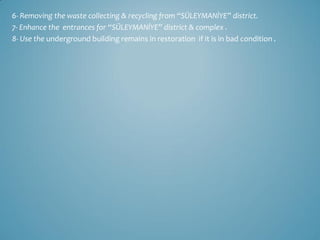
6- Removing the waste collecting & recycling from “SÜLEYMANİYE” district.
7- Enhance the entrances for “SÜLEYMANİYE” district & complex .
8- Use the underground building remains in restoration if it is in bad condition .
Residential

      Commercial

      Educational

      Park

      Parking

      Landmarks


      Cars path


     Pedestrian path


action plan

Turkey summer training project

  • 1.
    HOW TO SEE ANDUNDERSTAND THE HISTORICAL SITE STUDENTS NAMES : SALMAN ALTUWARIKI ABDULLAH ALHATHAL ABDULLAH ALMAZROU SUPERVISORS : PROF. IMAN ALDEN OTA BASHI ARCH. ABDULAZIZ ALSUGAIER ARCH. MAJED ALAREFE
  • 2.
    THE LOCATION • Istanbulis the largest city in turkey & the fifth city in the world according to population density with a number close to 13 million . • Istanbul is located in northwestern Turkey within the Marmara Region on a total area of 5,343 square kilometers The Bosphorus , which connects the Sea of Marmara to the Black Sea, divides the city into a European side, comprising the historic and economic centers, and an Asian, Anatolian side; as such, Istanbul is one of the two bi- continental cities in Turkey . • During its long history, Istanbul has served as the capital of the Roman Empire (330–395), the Eastern Roman (Byzantine) Empire (395–1204 and 1261–1453), the Latin Empire (1204– 1261), and the Ottoman Empire (1453– 1922). When the Republic of Turkey was proclaimed on 29 October 1923.
  • 3.
    THE TOPOGRAPHY • Thehistoric peninsula is said to be built on seven hills, each topped by an imperial mosque, the largest of these hills is the site of Topkapı Palace on the Sarayburnu. But this is not right Bosporus canyon the truth is that it was a chin of maountins formed two vallys from both sides . • There was an ancient river, but it is buried .
  • 4.
    THE GROWTH OFISTANBUL CITY • The first human settlements in Istanbul founded in the south of the peninsula. • The growth of the city happened from the east to the west . • The factors of expiation in Istanbul city were AL Hejaz Railway & the two bridges the connect the European part with the Asian part . STUDY AREA SÜLEYMANİYE
  • 5.
    THE SOCIAL &ECONOMICS SITUATIONS 1. This is a region that place . contains Residential units , 9. The residents economic close to the historical areas. situations is poor to very 2. Homeowners are not living poor, but The poor people in there property . who live there can save & 3. Homeowners are old & in a sent money to there Higher class than rentals. families . 4. The region is famous of its 10.Rental prices aren’t cheap textile trade & mini textile it’s about 200$ for one factories under the ground room 12 sq. meter for one 5. A large percentage of Kurds month but when more living in the region & the than 5 bachelors rent one older people of then does unit it becomes a cheap for not speak Turkish. them. 6. The school and university 11. Social dismantling system students feels that they followed by the planner in don’t belong to the area & past is one of the causes of fear of it . the problems of the other 7. There is bachelors housing regions and it will cause area which conceded as a problems here also. habitat for them & not as place of criminals . 8. bachelors Residents do not use the public transportation because they live & work in the same
  • 7.
    URBAN ASSEMBLY KIT Building heights Building material
  • 8.
    URBAN ASSEMBLY KIT percentage 0% 17% 2% 43% 38% Bad Good abandoned Under construction exclant Land condition percentage 7% 2% 3% 5% 46% 35% 0% 0% 1% 1% Religious Educational abandoned Residential cultural Cemeteries parkings water commercial govermental Land use
  • 9.
  • 10.
    22/6/2011 3:30 pm 23/6/2011 2:00 pm 22/6/2011 12:30 pm
  • 11.
    The Site firstVisit Site Plan - first path
  • 12.
    The ”Saraçhane” Parkis located in the The “shezade” mosque is a west of “shezade” mosque. Under the park landmark in the area ground about 15 meters of the ground there is a remains of an old Byzantines buildings and In the future there will be a metro station . Noted : it’s a very active place
  • 13.
    A mosque inside The cemetery of the ”Saraçhane” park mosque
  • 14.
    The aqua ductis an old Byzantine Behind the aqua duct a narrow street remains which use to transfer the & small residence buildings which has water to there cites form the river . a different character than the other side of the aqua duct . Noted : The aqua duct is isolating the area
  • 15.
    An Old primaryschool in the A mosque as landmark & the ottoman Empire . end of vista Noted : A historical buildings & vitas should be taking care of A nice vista inside the district
  • 16.
    A nice streetpattern One of the Remain buildings which built of wood then enforced with brick. Noted : Old style building should be maintained
  • 17.
    An ottoman periodmosque View Angle to Istanbul city & its Skyscrapers Noted : Nice view angles Must be Used Y shape intersection & the house of rahmat which fund the library
  • 18.
    The wall of“SÜLEYMANİYE” complex which has no entrance from this street. Picture shows the pattern of the streets & the “SÜLEYMANİYE” complex as an end of a vista. Noted : The street ends in the back of “SÜLEYMANİYE” complex
  • 19.
    Site Plan -second path
  • 20.
    “SÜLEYMANİYE” “SÜLEYMANİYE” mosque pattern mosque Entrance
  • 21.
    “SÜLEYMANİYE” mosque patern The street which is front of “SÜLEYMANİYE” mosque & it has some shops and cafeterias Noted : Lack of parking in the area so the cars park in the “SÜLEYMANİYE” complex
  • 22.
    ojack area whichwas a military zone in the ottoman period , famous of Rebellions & the fronting building was Dar Al-Fatwa Noted : This area is an entrance to “SÜLEYMANİYE” complex which should be look much more
  • 23.
    The street surroundingof “SÜLEYMANİYE” ojack retribution area complex . Noted : • ojack retribution area with no signs • The surrounding of “SÜLEYMANİYE” complex is a dead area .
  • 24.
    Inside one ofthe A conversation to an owner & renter about the singles buildings social life Noted : The residential units are two small for 4 person there should be more residential units
  • 25.
    Waste recycling poweredby people collecting the cans , Streets pattern paper , etc. from the streets Noted : • Streets pattern – long narrow – shaded – stone paving. • The waste recycling conceded as sustainable element.
  • 26.
    Streets pattern Example of serveries building for singles contain : bath & laundry . Noted : The facilities are in bad condition
  • 27.
    Streets pattern Streets pattern Noted : • Streets pattern : long & narrow – shaded – stone paving.
  • 28.
    An entrance tothe area & assembly point Building pattern Noted : • The entrance of the area are week for such unique area
  • 29.
    Site Plan -Third path
  • 30.
    The “shezade” mosquefrom In side One of the building which built on the late ottoman period style Noted : • The tries of coping the late ottoman style are weak .
  • 31.
    One of theremarkable schools in the area A building built on Turkish style
  • 32.
    Under ground factories A unique form of tree could be used as land mark Noted : • The factories in the area does not need a special infrastructure . • no interest in the unique natural elements .
  • 33.
    Another part ofthe aqua duct Noted : No special care for the heritage aqua duct .
  • 34.
    New building ofIstanbul 2010 organization New building of Istanbul 2010 organization built out of concrete & block built out of Wood
  • 35.
    Istanbul university– the Istanbuluniversity Buildings communication faculty building Path pattern Noted : The character of the university does not reflect the history of the area
  • 36.
    View Angle to“SÜLEYMANİYE” mosque Internal streets pattern
  • 37.
    SPACE SYNTAX ANALYSIS space syntax analysis shows the most accessible and active streets and conjunctions in the “SÜLEYMANİYE” district in Red , orange , Yellow , green , cyan & blue gradually . accessibility Noted : The heritage building are not in the most active streets conjunctions
  • 38.
    Summarize : • Thecharacter of the university does not reflect the history of the area • No special care for the heritage aqua duct . • The factories in the area does not need a special infrastructure . • no interest in the unique natural elements . • The tries of coping the late ottoman style are weak • .The entrance of the area are week for such unique area • Streets pattern – long narrow – shaded – stone paving. • The waste recycling conceded as sustainable element but it should not be inside the district . • This area is an entrance to “SÜLEYMANİYE” complex which should be look much more • The facilities are in bad condition • The residential units are two small for 4 person there should be more residential units
  • 39.
    The street ends in the back of “SÜLEYMANİYE” complex • Old style building should be maintained • The aqua duct isolate the area • A historical buildings & vitas should be taking care of • The heritage building are not in the most active streets
  • 40.
    THE ACTION PLAN •The main goal : Revive , restore and connect the “SÜLEYMANİYE” district . • The list of actions : 1- Create a tourist route passes all the heritage , unique . a- distinctive ottoman character. b- The Metro station is the Starting point. c- the route is mainly for pedestrians 2- Convert the surrounding of the aqua duct to a park with commercial activates a- demolishing all the attached building to the aqua duct. b- concentration of commercial activity 3- Providing a sufficient number of car parking for visitors to the “SÜLEYMANİYE” district. 4- Reducing the residential activity in the surrounding of the tourist route in range of 50 m . 5- Procedures for buildings : Classification Action Collapsing non-heritage Removing Collapsing heritage restoring Good non-heritage Ottoman style cladding Good heritage Preservation & maintaining
  • 41.
    6- Removing thewaste collecting & recycling from “SÜLEYMANİYE” district. 7- Enhance the entrances for “SÜLEYMANİYE” district & complex . 8- Use the underground building remains in restoration if it is in bad condition .
  • 42.
    Residential Commercial Educational Park Parking Landmarks Cars path Pedestrian path action plan