• INTRODUCTION
•Tube methodology is a manual method using
separate test tubes for each reaction.
•Gel column agglutination methodology uses gel or
glass beads.
•Red blood cells and antibodies are combined in
microtubes filled with gel matrix, then centrifuged
to force the red blood cells through the column.
. The Tube Agglutination Method is a
traditional method for blood grouping and
typing.
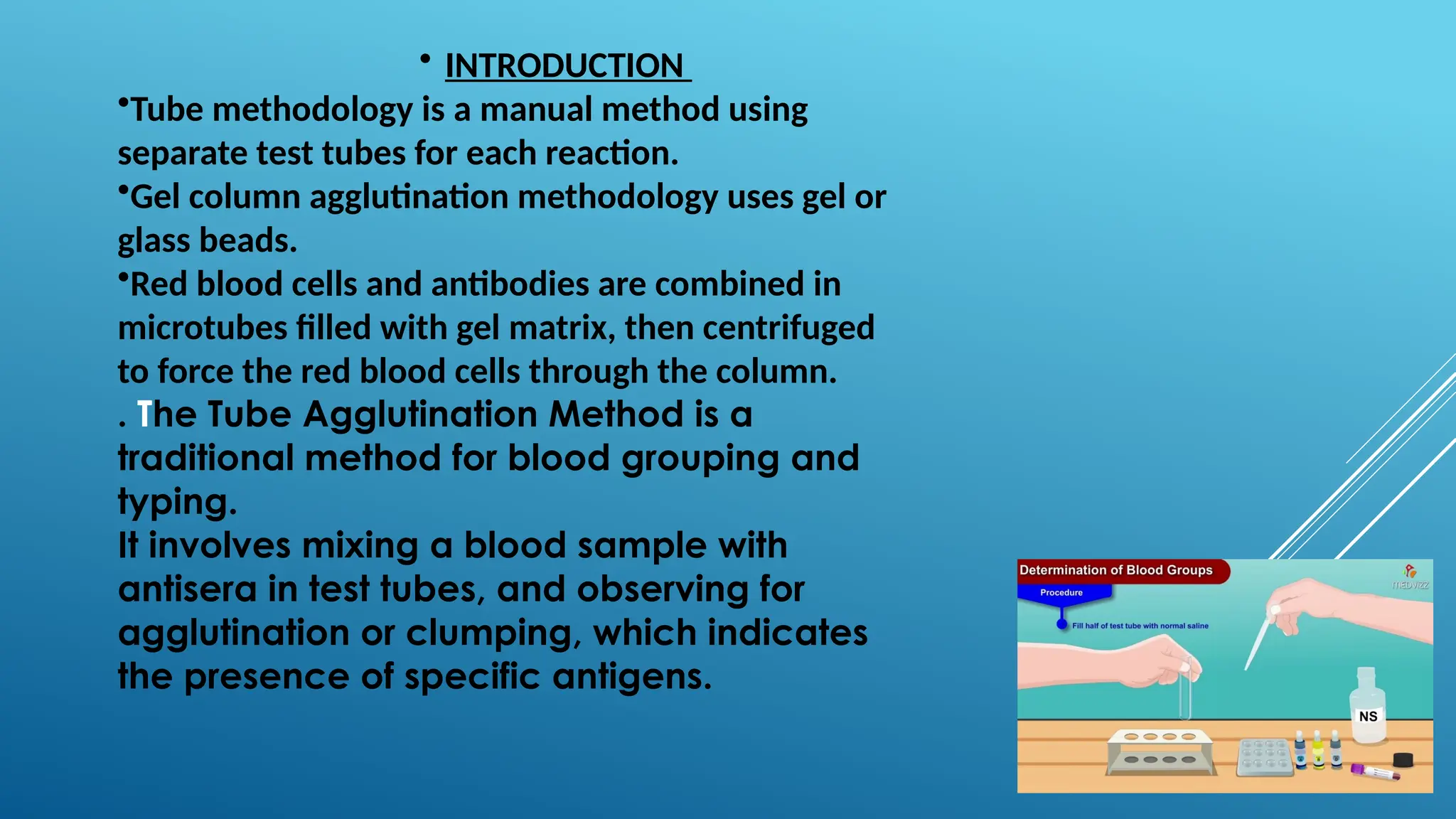
It involves mixing a blood sample with
antisera in test tubes, and observing for
agglutination or clumping, which indicates
the presence of specific antigens.
•Blood collection methods include
•VENIPUNCTURE (penetrating a vein with a needle)
with an evacuated tube system, syringe method, or
butterfly infusion set;
•CAPILLARY BLOOD system whereby the skin puncture
is done with the use of a lan
•METHOD:- Tube method
•The tube method for blood grouping requires the
following:
•BLOOD SAMPLE: A small blood sample from the
patient
•ANTISERA: Specific antisera to mix with the blood
sample
•TEST TUBES: Separate test tubes for each reaction
•CENTRIFUGE: A centrifuge to spin the tubes after
mixing
•REAGENTS AND SAMPLES: Reagents and samples
should be at room temperature (18–25°C)
•The tube method is a traditional laboratory
technique that determines a person's blood group
by mixing a blood sample with antisera in test tubes
and observing for agglutination.
•Agglutination, or clumping, indicates the presence
of specific antigens.
•The tube method is more reliable and sensitive
than the slide test, and it can be used for initial
blood typing and emergencies. It requires less
reagent than the slide method.
•To determine blood type, both forward and
reverse grouping are performed:
•FORWARD GROUPING: Determines the
presence or absence of A and B antigens in red
blood cells (RBCs)
•REVERSE GROUPING: Determines the presence
or absence of anti-A and anti-B in serum
•Blood Group Testing - Frontiers
•The test tube method is a more sensitive and
faster alternative to the slide method that
requires lower amounts of reagents and is...
•REQUIREMENT:-
•The tube method for determining blood type
requires the following:
•REAGENTS: Anti-A and Anti-B reagents for
forward typing, and A and B red blood cells for
back typing
•Test tubes: 12 x 75 mm test tubes
•Pipettes: For transferring reagents
•Physiologic saline: For preparing the red blood
cell suspension
•PROCEDURE:-
•The tube method, also known as the tube agglutination method, is a procedure for
determining a person's blood type by mixing a blood sample with specific antisera in
test tubes:
•Prepare reagents and samples: Bring the reagents and samples to room
temperature.
•Prepare red blood cell suspension: Prepare a 5% suspension of red blood cells in an
isotonic solution.
•Add reagents to tubes: Transfer a drop of each reagent into a separate, marked
tube.
•Add red blood cell suspension: Add 50 µl of red blood cell suspension to each tube.
•Mix and centrifuge: Shake the tubes to mix, then centrifuge at 500 g for one
minute.
•Read results: Gently shake the tubes while reading macroscopically for
agglutination.
•Interpret results: If the red blood cells sediment is undisturbed, it's considered
complete agglutination. If the red blood cells are uniformly distributed, it's non-
agglutination.
TUBE METHOD BLOOD GROUP. abo rh postitivepptx

TUBE METHOD BLOOD GROUP. abo rh postitivepptx

  • 1.
    • INTRODUCTION •Tube methodologyis a manual method using separate test tubes for each reaction. •Gel column agglutination methodology uses gel or glass beads. •Red blood cells and antibodies are combined in microtubes filled with gel matrix, then centrifuged to force the red blood cells through the column. . The Tube Agglutination Method is a traditional method for blood grouping and typing. It involves mixing a blood sample with antisera in test tubes, and observing for agglutination or clumping, which indicates the presence of specific antigens.
  • 2.
    •Blood collection methodsinclude •VENIPUNCTURE (penetrating a vein with a needle) with an evacuated tube system, syringe method, or butterfly infusion set; •CAPILLARY BLOOD system whereby the skin puncture is done with the use of a lan •METHOD:- Tube method •The tube method for blood grouping requires the following: •BLOOD SAMPLE: A small blood sample from the patient •ANTISERA: Specific antisera to mix with the blood sample •TEST TUBES: Separate test tubes for each reaction
  • 3.
    •CENTRIFUGE: A centrifugeto spin the tubes after mixing •REAGENTS AND SAMPLES: Reagents and samples should be at room temperature (18–25°C) •The tube method is a traditional laboratory technique that determines a person's blood group by mixing a blood sample with antisera in test tubes and observing for agglutination. •Agglutination, or clumping, indicates the presence of specific antigens. •The tube method is more reliable and sensitive than the slide test, and it can be used for initial blood typing and emergencies. It requires less reagent than the slide method.
  • 4.
    •To determine bloodtype, both forward and reverse grouping are performed: •FORWARD GROUPING: Determines the presence or absence of A and B antigens in red blood cells (RBCs) •REVERSE GROUPING: Determines the presence or absence of anti-A and anti-B in serum •Blood Group Testing - Frontiers •The test tube method is a more sensitive and faster alternative to the slide method that requires lower amounts of reagents and is...
  • 5.
    •REQUIREMENT:- •The tube methodfor determining blood type requires the following: •REAGENTS: Anti-A and Anti-B reagents for forward typing, and A and B red blood cells for back typing •Test tubes: 12 x 75 mm test tubes •Pipettes: For transferring reagents •Physiologic saline: For preparing the red blood cell suspension
  • 6.
    •PROCEDURE:- •The tube method,also known as the tube agglutination method, is a procedure for determining a person's blood type by mixing a blood sample with specific antisera in test tubes: •Prepare reagents and samples: Bring the reagents and samples to room temperature. •Prepare red blood cell suspension: Prepare a 5% suspension of red blood cells in an isotonic solution. •Add reagents to tubes: Transfer a drop of each reagent into a separate, marked tube. •Add red blood cell suspension: Add 50 µl of red blood cell suspension to each tube. •Mix and centrifuge: Shake the tubes to mix, then centrifuge at 500 g for one minute. •Read results: Gently shake the tubes while reading macroscopically for agglutination. •Interpret results: If the red blood cells sediment is undisturbed, it's considered complete agglutination. If the red blood cells are uniformly distributed, it's non- agglutination.