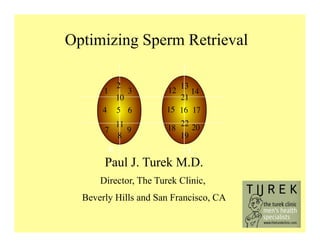
Optimizing Sperm Retrieval
Paul J. Turek M.D.
Director, The Turek Clinic,
Beverly Hills and San Francisco, CA
1
2
3
654
9
8
7
11
10
12
13
14
171615
20
19
18
22
21
R L
Optimizing Sperm Retrieval
Learning Objectives
• Describe the role of medical therapy before sperm retrieval
• Delineate two strategies currently used to find and retrieve
testicular sperm in nonobstructive azoospermia
• Explain how sperm search can be optimized in the andrology
laboratory
Test Answers
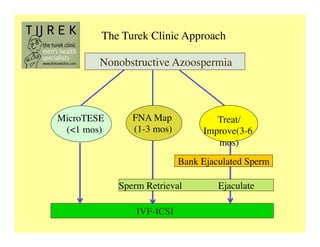
These can be tough cases!
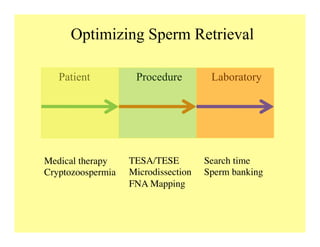
Optimizing Sperm Retrieval
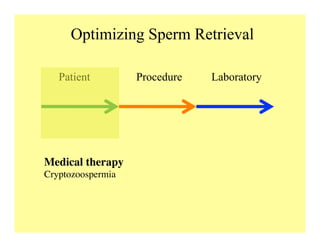
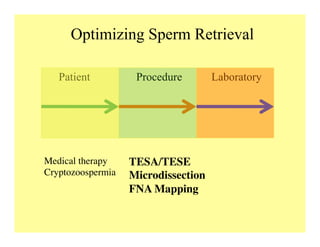
Patient Procedure Laboratory
Medical therapy	

Cryptozoospermia	

TESA/TESE	

Microdissection	

FNA Mapping	

Search time	

Sperm banking
Optimizing Sperm Retrieval
Patient Procedure Laboratory
Medical therapy	

Cryptozoospermia
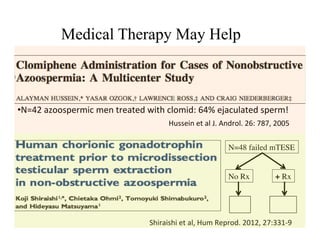
• N=42	
  azoospermic	
  men	
  treated	
  with	
  clomid:	
  64%	
  ejaculated	
  sperm!	
  	

Hussein	
  et	
  al	
  J.	
  Androl.	
  26:	
  787,	
  2005	


Medical Therapy May Help
Shiraishi	
  et	
  al,	
  Hum	
  Reprod.	
  2012,	
  27:331-­‐9	
  
N=48 failed mTESE	

No Rx	

 + Rx
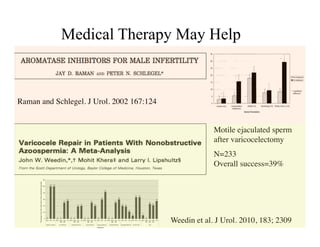
Raman and Schlegel. J Urol. 2002 167:124	

Medical Therapy May Help
Motile ejaculated sperm
after varicocelectomy	

N=233	

Overall success=39% 	

Weedin et al. J Urol. 2010, 183; 2309
Optimizing Sperm Retrieval
Patient Procedure Laboratory
Medical therapy	

Cryptozoospermia
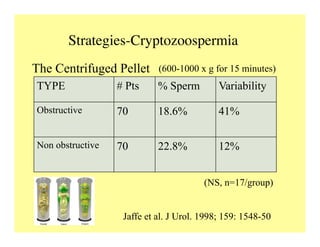
Strategies-Cryptozoospermia	

The Centrifuged Pellet
Jaffe et al. J Urol. 1998; 159: 1548-50
TYPE # Pts % Sperm Variability
Obstructive 70 18.6% 41%
Non obstructive 70 22.8% 12%
(NS, n=17/group)
(600-1000 x g for 15 minutes)
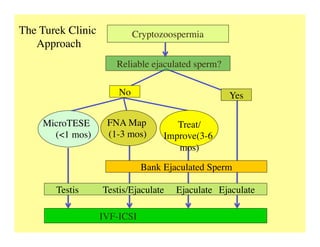
Cryptozoospermia	


Reliable ejaculated sperm?	

No	

IVF-ICSI 	

Bank Ejaculated Sperm	

Yes	

FNA Map
(1-3 mos)	

MicroTESE
(<1 mos)	

Treat/
Improve(3-6
mos)	

Testis Testis/Ejaculate Ejaculate 	

Ejaculate 	

The Turek Clinic	

Approach
2010-2012	

N=40 men with
cryptozoospermia	

Mean age=38 years	

No sperm 	

Nonmotile	

Motile	

Motile and 	

nonmotile	

10%	

25%	

60%	

5%	

Hagerty et al, 2012	

• 85% of men able to
	

bank sperm	

• 40% sample-to-
	

sample
	

variability	

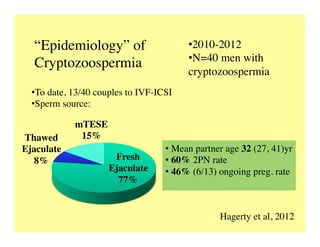
“Epidemiology” of 	

Cryptozoospermia
• 2010-2012	

• N=40 men with
cryptozoospermia	

• To date, 13/40 couples to IVF-ICSI	

• Sperm source:	

Fresh 	

Ejaculate	

77%	

Thawed 	

Ejaculate	

8%	

mTESE	

15%	

• Mean partner age 32 (27, 41)yr	

• 60% 2PN rate	

• 46% (6/13) ongoing preg. rate	

Hagerty et al, 2012	

“Epidemiology” of 	

Cryptozoospermia
Sperm Source and ICSI Fertilization	

NOA-Testis sperm	

 NOA-Cryptozoospermia	

X	

X	

What kind of performance differences do we expect 	

between cryptozoospermic and testicular sperm?
Optimizing Sperm Retrieval
Patient Procedure Laboratory
Medical therapy	

Cryptozoospermia	

TESA/TESE	

Microdissection	

FNA Mapping
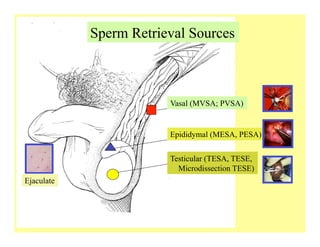
Vasal (MVSA; PVSA)
Epididymal (MESA, PESA)
Testicular (TESA, TESE,
Microdissection TESE)
Sperm Retrieval Sources
Ejaculate
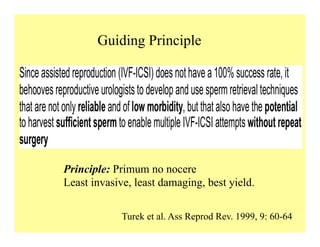
Principle: Primum no nocere
Least invasive, least damaging, best yield.
Turek et al. Ass Reprod Rev. 1999, 9: 60-64
Guiding Principle
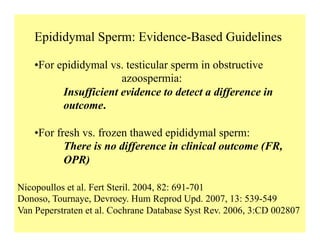
Epididymal Sperm: Evidence-Based Guidelines
Nicopoullos et al. Fert Steril. 2004, 82: 691-701
Donoso, Tournaye, Devroey. Hum Reprod Upd. 2007, 13: 539-549
Van Peperstraten et al. Cochrane Database Syst Rev. 2006, 3:CD 002807
• For epididymal vs. testicular sperm in obstructive
azoospermia:
Insufficient evidence to detect a difference in
outcome.
• For fresh vs. frozen thawed epididymal sperm:
There is no difference in clinical outcome (FR,
OPR)
Testicular Sperm: Evidence-Based Guidelines
Donoso, Tournaye, Devroey. Hum Reprod Upd. 2007, 13: 539-549
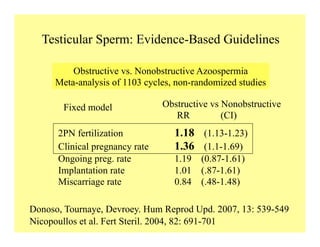
Obstructive vs. Nonobstructive Azoospermia
Meta-analysis of 1103 cycles, non-randomized studies
Obstructive vs Nonobstructive
RR (CI)
2PN fertilization 1.18 (1.13-1.23)
Clinical pregnancy rate 1.36 (1.1-1.69)
Ongoing preg. rate 1.19 (0.87-1.61)
Implantation rate 1.01 (.87-1.61)
Miscarriage rate 0.84 (.48-1.48)
Fixed model
Nicopoullos et al. Fert Steril. 2004, 82: 691-701
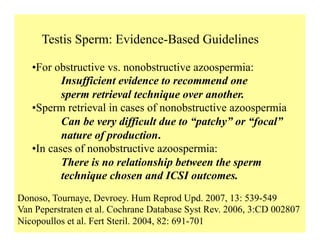
Testis Sperm: Evidence-Based Guidelines
Donoso, Tournaye, Devroey. Hum Reprod Upd. 2007, 13: 539-549
Van Peperstraten et al. Cochrane Database Syst Rev. 2006, 3:CD 002807
Nicopoullos et al. Fert Steril. 2004, 82: 691-701
• For obstructive vs. nonobstructive azoospermia:
Insufficient evidence to recommend one
sperm retrieval technique over another.
• Sperm retrieval in cases of nonobstructive azoospermia
Can be very difficult due to “patchy” or “focal”
nature of production.
• In cases of nonobstructive azoospermia:
There is no relationship between the sperm
technique chosen and ICSI outcomes.
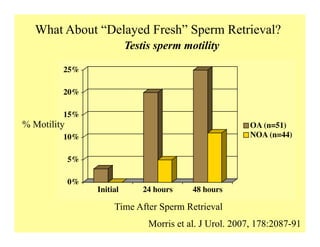
What About “Delayed Fresh” Sperm Retrieval?
Morris et al. J Urol. 2007, 178:2087-91
0%
5%
10%
15%
20%
25%
Initial 24 hours 48 hours
OA (n=51)
NOA (n=44)
Time After Sperm Retrieval
% Motility
Testis sperm motility
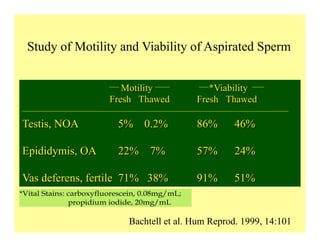
Study of Motility and Viability of Aspirated Sperm
Bachtell et al. Hum Reprod. 1999, 14:101
Motility *Viability
Fresh Thawed Fresh Thawed
Testis, NOA 5% 0.2% 86% 46%
Epididymis, OA 22% 7% 57% 24%
Vas deferens, fertile 71% 38% 91% 51%
*Vital Stains: carboxyfluorescein, 0.08mg/mL;
propidium iodide, 20mg/mL
Testicular Sperm: Evidence-Based Guidelines
Donoso, Tournaye, Devroey. Hum Reprod Upd. 2007, 13: 539-549
Van Peperstraten et al. Cochrane Database Syst Rev. 2006, 3:CD 002807
Nicopoullos et al. Fert Steril. 2004, 82: 691-701
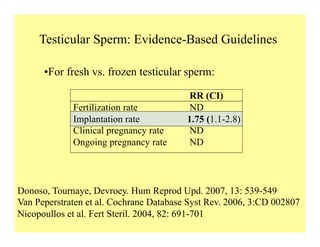
• For fresh vs. frozen testicular sperm:
RR (CI)
Fertilization rate ND
Implantation rate 1.75 (1.1-2.8)
Clinical pregnancy rate ND
Ongoing pregnancy rate ND
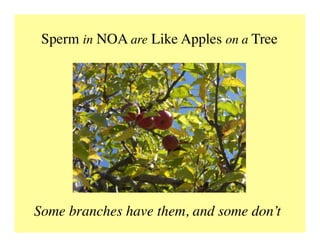
Sperm in NOA are Like Apples on a Tree	

Some branches have them, and some don’t
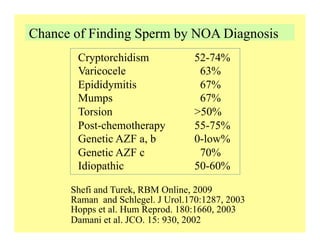
Cryptorchidism 52-74%
Varicocele 63%
Epididymitis 67%
Mumps 67%
Torsion >50%
Post-chemotherapy 55-75%
Genetic AZF a, b 0-low%
Genetic AZF c 70%
Idiopathic 50-60%
Chance of Finding Sperm by NOA Diagnosis
Shefi and Turek, RBM Online, 2009
Raman and Schlegel. J Urol.170:1287, 2003
Hopps et al. Hum Reprod. 180:1660, 2003
Damani et al. JCO. 15: 930, 2002
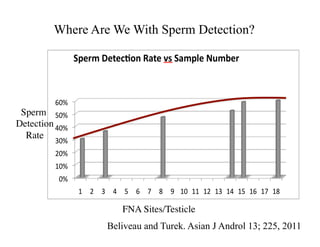
FNA Sites/Testicle	

Sperm	

Detection	

Rate	

Beliveau and Turek. Asian J Androl 13; 225, 2011
Where Are We With Sperm Detection?
MicrodissectionFNA Mapping 	

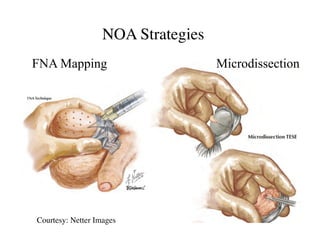
NOA Strategies	

Courtesy: Netter Images
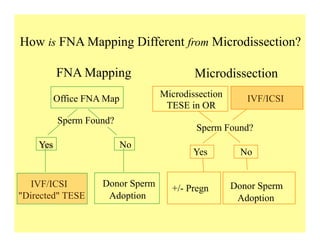
How is FNA Mapping Different from Microdissection?
Office FNA Map
Sperm Found?
Yes No
IVF/ICSI
"Directed" TESE
Donor Sperm
Adoption
FNA Mapping
Microdissection
TESE in OR
Sperm Found?
IVF/ICSI
Yes No
Donor Sperm
Adoption
+/- Pregn
Microdissection
1
2
3
654
9
8
7
11
10
12
13
14
171615
20
19
18
22
21
R L
1
2
3
654
9
8
7
11
10
12
13
14
171615
20
19
18
22
21
R L
1
2
3
654
9
8
7
11
10
12
13
14
171615
20
19
18
22
21
R L
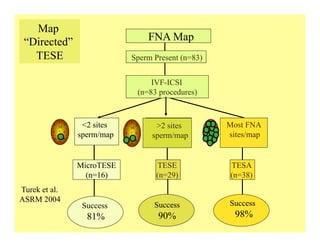
Turek et al.
ASRM 2004
FNA Map
Sperm Present (n=83)
TESE
(n=29)
MicroTESE
(n=16)
IVF-ICSI
(n=83 procedures)
<2 sites
sperm/map
Success
81%
Success
90%
TESA
(n=38)
Most FNA
sites/map
Success
98%
Map
“Directed”
TESE
>2 sites
sperm/map
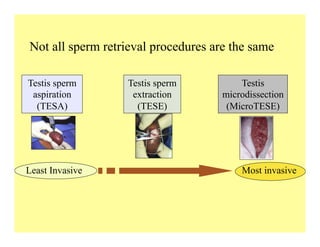
Testis sperm
aspiration
(TESA)
Testis sperm
extraction
(TESE)
Testis
microdissection
(MicroTESE)
Least Invasive Most invasive
Not all sperm retrieval procedures are the same
IVF-ICSI 	

Bank Ejaculated Sperm	

FNA Map
(1-3 mos)	

MicroTESE
(<1 mos)	

Treat/
Improve(3-6
mos)	

Sperm Retrieval 	

 Ejaculate 	

The Turek Clinic Approach	

Nonobstructive Azoospermia
0	

20	

40	

60	

80	

100	

120	

100%	

53%	

92%	

% Successful	

Retrieval	

mTESE	

 MAP +	

mTESE	

MAP +	

TESA/E	

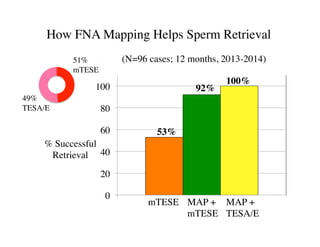
How FNA Mapping Helps Sperm Retrieval	

(N=96 cases; 12 months, 2013-2014)	

49%	

TESA/E	

51% 	

mTESE
19%	

14%	

% Bilateral	

Procedures	

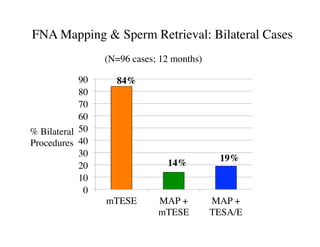
FNA Mapping & Sperm Retrieval: Bilateral Cases	

(N=96 cases; 12 months)	

0	

10	

20	

30	

40	

50	

60	

70	

80	

90	

mTESE	

 MAP +
mTESE	

MAP +
TESA/E	

84%
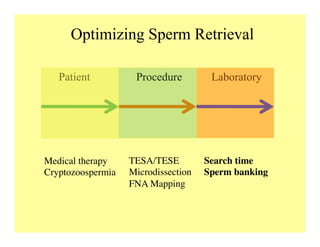
Optimizing Sperm Retrieval
Patient Procedure Laboratory
Medical therapy	

Cryptozoospermia	

TESA/TESE	

Microdissection	

FNA Mapping	

Search time	

Sperm banking
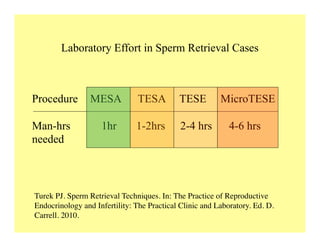
Laboratory Effort in Sperm Retrieval Cases
Turek PJ. Sperm Retrieval Techniques. In: The Practice of Reproductive
Endocrinology and Infertility: The Practical Clinic and Laboratory. Ed. D.
Carrell. 2010.	

Procedure MESA TESA TESE MicroTESE
Man-hrs 1hr 1-2hrs 2-4 hrs 4-6 hrs
needed
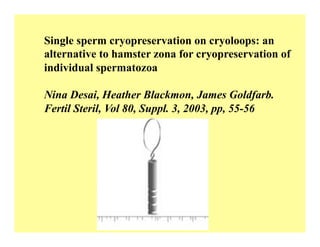
Single sperm cryopreservation on cryoloops: an
alternative to hamster zona for cryopreservation of
individual spermatozoa
Nina Desai, Heather Blackmon, James Goldfarb.
Fertil Steril, Vol 80, Suppl. 3, 2003, pp, 55-56
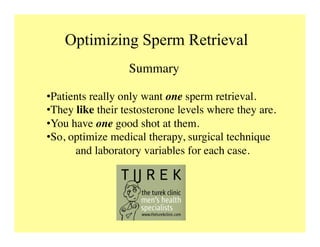
Optimizing Sperm Retrieval
Summary	

• Patients really only want one sperm retrieval.	

• They like their testosterone levels where they are.	

• You have one good shot at them.	

• So, optimize medical therapy, surgical technique
	

and laboratory variables for each case.

Sperm Retreival: Optimizing Sperm Retrieval and Pregnancy in Nonobstructive Azoospermia

  • 1.
    Optimizing Sperm Retrieval PaulJ. Turek M.D. Director, The Turek Clinic, Beverly Hills and San Francisco, CA 1 2 3 654 9 8 7 11 10 12 13 14 171615 20 19 18 22 21 R L
  • 2.
    Optimizing Sperm Retrieval LearningObjectives • Describe the role of medical therapy before sperm retrieval • Delineate two strategies currently used to find and retrieve testicular sperm in nonobstructive azoospermia • Explain how sperm search can be optimized in the andrology laboratory
  • 3.
    Test Answers These canbe tough cases!
  • 4.
    Optimizing Sperm Retrieval PatientProcedure Laboratory Medical therapy Cryptozoospermia TESA/TESE Microdissection FNA Mapping Search time Sperm banking
  • 5.
    Optimizing Sperm Retrieval PatientProcedure Laboratory Medical therapy Cryptozoospermia
  • 6.
    • N=42  azoospermic  men  treated  with  clomid:  64%  ejaculated  sperm!   Hussein  et  al  J.  Androl.  26:  787,  2005       Medical Therapy May Help Shiraishi  et  al,  Hum  Reprod.  2012,  27:331-­‐9   N=48 failed mTESE No Rx + Rx
  • 8.
    Raman and Schlegel.J Urol. 2002 167:124 Medical Therapy May Help Motile ejaculated sperm after varicocelectomy N=233 Overall success=39% Weedin et al. J Urol. 2010, 183; 2309
  • 9.
    Optimizing Sperm Retrieval PatientProcedure Laboratory Medical therapy Cryptozoospermia
  • 10.
    Strategies-Cryptozoospermia The Centrifuged Pellet Jaffeet al. J Urol. 1998; 159: 1548-50 TYPE # Pts % Sperm Variability Obstructive 70 18.6% 41% Non obstructive 70 22.8% 12% (NS, n=17/group) (600-1000 x g for 15 minutes)
  • 11.
    Cryptozoospermia Reliable ejaculated sperm? No IVF-ICSI Bank Ejaculated Sperm Yes FNA Map (1-3 mos) MicroTESE (<1 mos) Treat/ Improve(3-6 mos) Testis Testis/Ejaculate Ejaculate Ejaculate The Turek Clinic Approach
  • 12.
    2010-2012 N=40 men with cryptozoospermia Meanage=38 years No sperm Nonmotile Motile Motile and nonmotile 10% 25% 60% 5% Hagerty et al, 2012 • 85% of men able to bank sperm • 40% sample-to- sample variability “Epidemiology” of Cryptozoospermia
  • 13.
    • 2010-2012 • N=40 men with cryptozoospermia • Todate, 13/40 couples to IVF-ICSI • Sperm source: Fresh Ejaculate 77% Thawed Ejaculate 8% mTESE 15% • Mean partner age 32 (27, 41)yr • 60% 2PN rate • 46% (6/13) ongoing preg. rate Hagerty et al, 2012 “Epidemiology” of Cryptozoospermia
  • 14.
    Sperm Source andICSI Fertilization NOA-Testis sperm NOA-Cryptozoospermia X X What kind of performance differences do we expect between cryptozoospermic and testicular sperm?
  • 15.
    Optimizing Sperm Retrieval PatientProcedure Laboratory Medical therapy Cryptozoospermia TESA/TESE Microdissection FNA Mapping
  • 16.
    Vasal (MVSA; PVSA) Epididymal(MESA, PESA) Testicular (TESA, TESE, Microdissection TESE) Sperm Retrieval Sources Ejaculate
  • 17.
    Principle: Primum nonocere Least invasive, least damaging, best yield. Turek et al. Ass Reprod Rev. 1999, 9: 60-64 Guiding Principle
  • 18.
    Epididymal Sperm: Evidence-BasedGuidelines Nicopoullos et al. Fert Steril. 2004, 82: 691-701 Donoso, Tournaye, Devroey. Hum Reprod Upd. 2007, 13: 539-549 Van Peperstraten et al. Cochrane Database Syst Rev. 2006, 3:CD 002807 • For epididymal vs. testicular sperm in obstructive azoospermia: Insufficient evidence to detect a difference in outcome. • For fresh vs. frozen thawed epididymal sperm: There is no difference in clinical outcome (FR, OPR)
  • 19.
    Testicular Sperm: Evidence-BasedGuidelines Donoso, Tournaye, Devroey. Hum Reprod Upd. 2007, 13: 539-549 Obstructive vs. Nonobstructive Azoospermia Meta-analysis of 1103 cycles, non-randomized studies Obstructive vs Nonobstructive RR (CI) 2PN fertilization 1.18 (1.13-1.23) Clinical pregnancy rate 1.36 (1.1-1.69) Ongoing preg. rate 1.19 (0.87-1.61) Implantation rate 1.01 (.87-1.61) Miscarriage rate 0.84 (.48-1.48) Fixed model Nicopoullos et al. Fert Steril. 2004, 82: 691-701
  • 20.
    Testis Sperm: Evidence-BasedGuidelines Donoso, Tournaye, Devroey. Hum Reprod Upd. 2007, 13: 539-549 Van Peperstraten et al. Cochrane Database Syst Rev. 2006, 3:CD 002807 Nicopoullos et al. Fert Steril. 2004, 82: 691-701 • For obstructive vs. nonobstructive azoospermia: Insufficient evidence to recommend one sperm retrieval technique over another. • Sperm retrieval in cases of nonobstructive azoospermia Can be very difficult due to “patchy” or “focal” nature of production. • In cases of nonobstructive azoospermia: There is no relationship between the sperm technique chosen and ICSI outcomes.
  • 21.
    What About “DelayedFresh” Sperm Retrieval? Morris et al. J Urol. 2007, 178:2087-91 0% 5% 10% 15% 20% 25% Initial 24 hours 48 hours OA (n=51) NOA (n=44) Time After Sperm Retrieval % Motility Testis sperm motility
  • 22.
    Study of Motilityand Viability of Aspirated Sperm Bachtell et al. Hum Reprod. 1999, 14:101 Motility *Viability Fresh Thawed Fresh Thawed Testis, NOA 5% 0.2% 86% 46% Epididymis, OA 22% 7% 57% 24% Vas deferens, fertile 71% 38% 91% 51% *Vital Stains: carboxyfluorescein, 0.08mg/mL; propidium iodide, 20mg/mL
  • 23.
    Testicular Sperm: Evidence-BasedGuidelines Donoso, Tournaye, Devroey. Hum Reprod Upd. 2007, 13: 539-549 Van Peperstraten et al. Cochrane Database Syst Rev. 2006, 3:CD 002807 Nicopoullos et al. Fert Steril. 2004, 82: 691-701 • For fresh vs. frozen testicular sperm: RR (CI) Fertilization rate ND Implantation rate 1.75 (1.1-2.8) Clinical pregnancy rate ND Ongoing pregnancy rate ND
  • 24.
    Sperm in NOAare Like Apples on a Tree Some branches have them, and some don’t
  • 25.
    Cryptorchidism 52-74% Varicocele 63% Epididymitis67% Mumps 67% Torsion >50% Post-chemotherapy 55-75% Genetic AZF a, b 0-low% Genetic AZF c 70% Idiopathic 50-60% Chance of Finding Sperm by NOA Diagnosis Shefi and Turek, RBM Online, 2009 Raman and Schlegel. J Urol.170:1287, 2003 Hopps et al. Hum Reprod. 180:1660, 2003 Damani et al. JCO. 15: 930, 2002
  • 26.
    FNA Sites/Testicle Sperm Detection Rate Beliveau andTurek. Asian J Androl 13; 225, 2011 Where Are We With Sperm Detection?
  • 27.
    MicrodissectionFNA Mapping NOAStrategies Courtesy: Netter Images
  • 28.
    How is FNAMapping Different from Microdissection? Office FNA Map Sperm Found? Yes No IVF/ICSI "Directed" TESE Donor Sperm Adoption FNA Mapping Microdissection TESE in OR Sperm Found? IVF/ICSI Yes No Donor Sperm Adoption +/- Pregn Microdissection
  • 29.
    1 2 3 654 9 8 7 11 10 12 13 14 171615 20 19 18 22 21 R L 1 2 3 654 9 8 7 11 10 12 13 14 171615 20 19 18 22 21 R L 1 2 3 654 9 8 7 11 10 12 13 14 171615 20 19 18 22 21 RL Turek et al. ASRM 2004 FNA Map Sperm Present (n=83) TESE (n=29) MicroTESE (n=16) IVF-ICSI (n=83 procedures) <2 sites sperm/map Success 81% Success 90% TESA (n=38) Most FNA sites/map Success 98% Map “Directed” TESE >2 sites sperm/map
  • 30.
    Testis sperm aspiration (TESA) Testis sperm extraction (TESE) Testis microdissection (MicroTESE) LeastInvasive Most invasive Not all sperm retrieval procedures are the same
  • 31.
    IVF-ICSI Bank EjaculatedSperm FNA Map (1-3 mos) MicroTESE (<1 mos) Treat/ Improve(3-6 mos) Sperm Retrieval Ejaculate The Turek Clinic Approach Nonobstructive Azoospermia
  • 32.
    0 20 40 60 80 100 120 100% 53% 92% % Successful Retrieval mTESE MAP+ mTESE MAP + TESA/E How FNA Mapping Helps Sperm Retrieval (N=96 cases; 12 months, 2013-2014) 49% TESA/E 51% mTESE
  • 33.
    19% 14% % Bilateral Procedures FNA Mapping& Sperm Retrieval: Bilateral Cases (N=96 cases; 12 months) 0 10 20 30 40 50 60 70 80 90 mTESE MAP + mTESE MAP + TESA/E 84%
  • 34.
    Optimizing Sperm Retrieval PatientProcedure Laboratory Medical therapy Cryptozoospermia TESA/TESE Microdissection FNA Mapping Search time Sperm banking
  • 35.
    Laboratory Effort inSperm Retrieval Cases Turek PJ. Sperm Retrieval Techniques. In: The Practice of Reproductive Endocrinology and Infertility: The Practical Clinic and Laboratory. Ed. D. Carrell. 2010. Procedure MESA TESA TESE MicroTESE Man-hrs 1hr 1-2hrs 2-4 hrs 4-6 hrs needed
  • 36.
    Single sperm cryopreservationon cryoloops: an alternative to hamster zona for cryopreservation of individual spermatozoa Nina Desai, Heather Blackmon, James Goldfarb. Fertil Steril, Vol 80, Suppl. 3, 2003, pp, 55-56
  • 37.
    Optimizing Sperm Retrieval Summary • Patientsreally only want one sperm retrieval. • They like their testosterone levels where they are. • You have one good shot at them. • So, optimize medical therapy, surgical technique and laboratory variables for each case.