Semenology Update in Assisted
Reproductive Technology
• Abimibola Nanna
• Msc Clinical Embryology, UK
Learning Objective
• Know the different origins and types of sperm
samples
• Know the different parameters of basic semen
analysis
• Understand why sperm preparation is
necessary in ART
• Know the different techniques for sperm
preparation
Condt
• Understand the different types of sperm
samples for IVF or ICSI
• Evaluate the semen samples prior to IVF or
ICSI
Outline of Presentation
• Origin of spermatozoa
• The ejaculate basic semen parameters
• Why is semen preparation necessary
• Different preparation techniques
• Method and procedure for preparation for
different types of semen samples
• Critical evaluation of the prepared semen fraction
for IVF or ICSI
• Sperm preparation conclusion
Origin of Spermatozoa
Ejaculate origin:
• Natural, retrograde , or electro-ejaculate
• Frozen ejaculate, coitus with non- spermicide
condon
Epididymal or Testicular origin
• Testicular sperm extraction-TESE
• Microsurgical epididymal sperm aspiration-
MESA
Cond
Percutaneous epididymal/ testicular
extraction
• Fine needle aspiration from testis-TESA
• Percutaneous epididymal sperm aspiration-
PESA
The Ejaculate
• Lower limit for semen volume is 1.5ml
• Ejaculate consist of 10% cells and 90% liquid
• The cell fraction consist of : spermatozoa, rounds,
other debris
• The liquid consist of : prostate fraction, seminal vesicle
fraction, minor fraction from bulbourethral and
epididymides
• The quality of the ejaculate is determine by: testes,
accessory organ secretion, abstention and illness
• Abstinence period of 2-3 days before ejaculation and
maximize conception rate
Basic semen parameters in ART
• Concentration
• Motility
• Morphology
Sperm concentration-2010 W.H.O
• Concentration: number of spermatozoa per ml
• Concentration lower reference limit is 15
million/ml
• Total sperm count lower reference limit is 39
million per ejaculate
• Recommended counting chamber is 100um
deep haemocytometer or Makler chamber
• Concentration can fluctuate due to
environmental and non-environmental factors
Cond
• Polyzoospermia, oligozoospermia,
cryptozoospermia, necrozoospermia and
azoospermia
Motility
• Expressed in percentage of spermatozoa
according to W.H.H 2010 guidelines
• Accessed as soon as possible, within one hour of
production using wet preparation
• Progressive motility-PR
• Non-progressive motility-NR
• Immotile-IM
• Progressive motility normal value of 32%
• Total progressive motility (PR+NR)-40%
Cond
• Asthenozoospermia, necrozoospermia
• Progressive motility is crucial for IVF, IUI
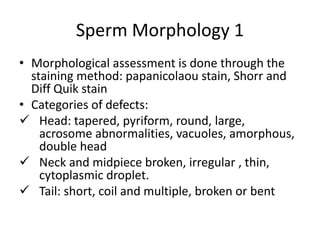
Sperm Morphology 1
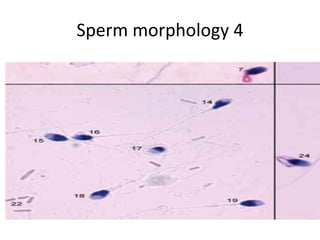
• Morphological assessment is done through the
staining method: papanicolaou stain, Shorr and
Diff Quik stain
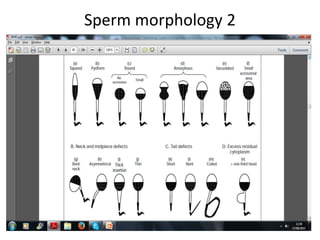
• Categories of defects:
 Head: tapered, pyriform, round, large,
acrosome abnormalities, vacuoles, amorphous,
double head
 Neck and midpiece broken, irregular , thin,
cytoplasmic droplet.
 Tail: short, coil and multiple, broken or bent
Sperm morphology 2
Sperm morphology 3
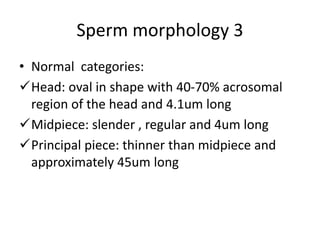
• Normal categories:
Head: oval in shape with 40-70% acrosomal
region of the head and 4.1um long
Midpiece: slender , regular and 4um long
Principal piece: thinner than midpiece and
approximately 45um long
Sperm morphology 4
Sperm morphology 5
• Normal values for sperm morphology is ≥4%
• Teratozoospermia and globozoospermia
• Can be affected with the days of abstinence
• Can be affected by the environment
Why sperm preparation
• Capacitation:
Separation of spermatozoa and seminal plasma
Biochemical process of plasma membrane-
hyperactivation
 Preparation for acrosome reaction
• Isolation of subpopulation of spermatozoa with
progressive motility and normal sperm morphology
• Elimination of dead spermatozoa , other
contaminating cells and debris
Contd
• Elimination/reduction of leukocytes
• Elimination/reduction of bacteria
• Elimination/reduction of reactive oxygen
species
• Enrichment of functional sperms with good
DNA integrity
Sperm preparation
• Depends on sperm concentration
• Normal count and motility-swim up
• Subnormal semen parameters- density
gradient
• Severe oligozoospermic- direct centrifugation
Direct Swim up
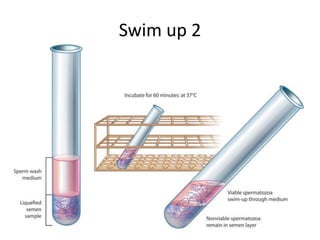
• Spermatozoa are allow to swim up into a fraction
of culture medium
• Upper section of the overlaying culture which
contain motile cells is removed and centrifuged
• Exclusion of debris, immotile spermatozoa and
other cells
• Pellet is re-suspended in culture medium
• Swim up techniques has variation in the type and
volume of overlaying medium
• Round bottom tubes are used for this separation
Swim up 2
Advantage
• For normal sperm concentration and motility
• Elimination of reactive oxygen species
• Excellent pregnancy rate for IUI, IVF procedure
• Sperms cell with high level of DNA integrity
• Selection of sperm cells with intact membrane
and morphology
• Cost-effectiveness-cheap
Disadvantage
• Lower recovery of motile spermatozoa
• Time consuming
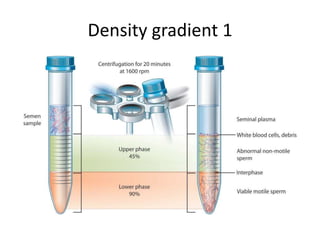
Density gradient 1
Density gradient 2
• Principle: Centrifugation through a gradient with
different densities (weight/volume)
- Two step discontinous gradient
- Laying isotonic suspension with different
concentration of collodial silica particles coated
with silane.
-Highest density fraction on the bottom of the tube
-Semen fraction on top of the gradient
-More than one test tube can use for oligozoospermic
and asthenozoospermic samples
Density gradient 3
• Centrifugation of the gradient: Distribution of
sperm according to their density
-Highest motile spermatozoa harvested from
the bottom and overlay with 0.5ml of sperm
prep medium
-The best fraction for fertilization
-Immotile spermatozoa, other cells and debris
are retained in the low density fraction
Advantage
• Numbers of density layers can be two or three
• Lower production of reactive oxygen species
• Less chromatin defects obtained
• Valid for sperm concentration that is great
than 4million/ml
• High recovery of motile spermatozoa that is
free from debris, leukocytes and germ cells
• Easy to standardized
Disadvantage
• Round cells concentrate at the interface
between two layers
• Creation of barriers that is impermeable to
spermatozoa with round cells sample
• Low recovery rate of spermatozoa with round
cells samples
• It cannot be use for severe oligozoospermia as
spermatozoa will be lost at the low density
fraction
Disadvantage
• Lower DNA integrity
• Production of good interphases between
layers can take some time
• Multiple centrifugation
Centrifugation method for severe
oligozoospermia
• Centrifuge raw sperm with sperm preparation
medium at 1800g for 5 minutes
• Remove supernatant and add small volume of
sperm prep medium over the pellet
• Allow it to undergo swim up and aspirate the
upper layer that contain motile sperm cells fpr
ICSI
Sperm preparation 1
• Fresh ejaculated semen
- semen collection done near the lab
-Reception of sample and patient identification
- Liquefaction
- Evaluation of semen parameters according to
W.H.O criteria
• Preparation techniques; density gradient or swim up
• Preparation of the selected fraction for IVF or ICSI by
adding 0.5 culture medium
• Evaluation of final fraction concentration and motility
Sperm preparation 2
• Retrograde ejaculated semen
-Semen passes into the bladder at ejaculation
-Sodium bicarbonate intake for the alkalinization of the
bladder
• Three fraction are collected and examined
-Antegrade fraction
- First retrograde urine fraction in buffer medium
- Remaining of retrograde urine fraction
-Examination of these fractions
• Washing and concentration of retrograde fraction
• Preparation for ICSI is similar to fresh ejaculate
Sperm preparation 3
• Frozen ejaculated semen
-Partner sperm of donor sperm
-Number of straws for thawing depends on
indication; sperm quality and fertility treatment
-Identify double check for all straws
-Disinfection of straws
-Preparation is similar to fresh ejaculated samples
-Warning: avoid osmotic shock by dropwise
addition of washing medium to frozen semen
samples from the sperm bank
Sperm preparation 4
• Open testicular sperm extraction
-For non-obstructive azoospermia
-Local anesthesia
-Collection of biopsy sample-seminiferous
tubules into buffer
-Mechanical shredding of biopsy samples
under stereomicroscope with sterile needles
or scissors to release spermatozoa from tubuli
Sperm preparation 4
-Put the product into a 5ml falcon tube and
centrifuge for 5 minutes at 1800g.
-Remove supernatant with a pasteur pipette
and suspend pellet in 0.2ml of culture
medium
-Retrieve sperm cell from pellet through swim
up
-For retrieval of sufficient sperm cells,
incubation is done for 24 hours
Sperm preparation 4
- Biopsy collection should be done a day
before oocyte retrieval
-When immotile spermatozoa, spermatozoa
are attached to other tissues or no
spermatozoa is seen, then enzymatic digestion
of tissues and erythrocyte lysis should be
done
Sperm preparation 5
• Microsurgical epididymal sperm aspiration MESA
-For obstructive azoospermia patients
-It is a blind procedure where a cut is made in
a single tubule of the epididymis and the content
is aspirated
-Aspirates are released in buffered medium
-Preparation by density gradient
centrifugation
-Sample can be frozen for future use
Sperm preparation 5
• Percutaneous epididymal sperm aspiration PESA
-For obstructive azoospermia patient
-It is a blind procedure where a fine needle is
used to puncture the epididymis
-Sample is aspirated percutaneously
-Aspirates are released in buffer medium
-Similar preparation procedure as for MESA
Sperm preparation 5
• Testicular sperm aspiration- TESA
-For obstructive azoospermia
-it is done where there is no sperm cells in the
epididymis
- It is a blind procedure under local anesthesis
- A wide bore needle is used to aspirate
sperm cells directly from the testis
- Petri dish with micro droplets of buffer
medium
Sperm preparation 5
-Testicular aspirates are released in the
droplets
-Check for motile sperm cells
-Repeated aspiration can be done
-No freezing is possible for spermatozoa in
droplet under oil
Critical evaluation of the fraction for
IVF
• Embryologist critically evaluates the final fraction for
IVF
• Motility: Final fraction with 100% progressive motility
• Concentration: Progressive motile sperm concentration
is between 1-20million/ml after sperm preparation
• Sperm volume to be added to each insemination
well/droplet is calculated
• 100,000 progressive motile sperm cells per oocyte in a
microdroplet under oil or each well four well dish.
Critical evaluation of the fraction for
ICSI
• The least sluggish motility separate viable
from dead spermatozoa
• Immotile spermatozoa:
- Demand for second semen sample
-Hypo-osmotic swelling test for sperm cell
selection.
• Hyaluronic acid binding method
Conclusion
• Basic seminal parameters like comcentration,
motility are assessed in ART
• Different sources of spermatozoa are
examined in ART and extracted
• Spermatozoa are separated from seminal fluid
by direct swim up or density gradient to
obtain functional spermatozoa for ART.
• IVF is for normal semen parameters while ICSI
for abnormal semen parameters
THANK YOU

Semenology update in assisted reproductive technology4

  • 1.
    Semenology Update inAssisted Reproductive Technology • Abimibola Nanna • Msc Clinical Embryology, UK
  • 2.
    Learning Objective • Knowthe different origins and types of sperm samples • Know the different parameters of basic semen analysis • Understand why sperm preparation is necessary in ART • Know the different techniques for sperm preparation
  • 3.
    Condt • Understand thedifferent types of sperm samples for IVF or ICSI • Evaluate the semen samples prior to IVF or ICSI
  • 4.
    Outline of Presentation •Origin of spermatozoa • The ejaculate basic semen parameters • Why is semen preparation necessary • Different preparation techniques • Method and procedure for preparation for different types of semen samples • Critical evaluation of the prepared semen fraction for IVF or ICSI • Sperm preparation conclusion
  • 5.
    Origin of Spermatozoa Ejaculateorigin: • Natural, retrograde , or electro-ejaculate • Frozen ejaculate, coitus with non- spermicide condon Epididymal or Testicular origin • Testicular sperm extraction-TESE • Microsurgical epididymal sperm aspiration- MESA
  • 6.
    Cond Percutaneous epididymal/ testicular extraction •Fine needle aspiration from testis-TESA • Percutaneous epididymal sperm aspiration- PESA
  • 7.
    The Ejaculate • Lowerlimit for semen volume is 1.5ml • Ejaculate consist of 10% cells and 90% liquid • The cell fraction consist of : spermatozoa, rounds, other debris • The liquid consist of : prostate fraction, seminal vesicle fraction, minor fraction from bulbourethral and epididymides • The quality of the ejaculate is determine by: testes, accessory organ secretion, abstention and illness • Abstinence period of 2-3 days before ejaculation and maximize conception rate
  • 8.
    Basic semen parametersin ART • Concentration • Motility • Morphology
  • 9.
    Sperm concentration-2010 W.H.O •Concentration: number of spermatozoa per ml • Concentration lower reference limit is 15 million/ml • Total sperm count lower reference limit is 39 million per ejaculate • Recommended counting chamber is 100um deep haemocytometer or Makler chamber • Concentration can fluctuate due to environmental and non-environmental factors
  • 10.
  • 11.
    Motility • Expressed inpercentage of spermatozoa according to W.H.H 2010 guidelines • Accessed as soon as possible, within one hour of production using wet preparation • Progressive motility-PR • Non-progressive motility-NR • Immotile-IM • Progressive motility normal value of 32% • Total progressive motility (PR+NR)-40%
  • 12.
    Cond • Asthenozoospermia, necrozoospermia •Progressive motility is crucial for IVF, IUI
  • 13.
    Sperm Morphology 1 •Morphological assessment is done through the staining method: papanicolaou stain, Shorr and Diff Quik stain • Categories of defects:  Head: tapered, pyriform, round, large, acrosome abnormalities, vacuoles, amorphous, double head  Neck and midpiece broken, irregular , thin, cytoplasmic droplet.  Tail: short, coil and multiple, broken or bent
  • 14.
  • 15.
    Sperm morphology 3 •Normal categories: Head: oval in shape with 40-70% acrosomal region of the head and 4.1um long Midpiece: slender , regular and 4um long Principal piece: thinner than midpiece and approximately 45um long
  • 16.
  • 17.
    Sperm morphology 5 •Normal values for sperm morphology is ≥4% • Teratozoospermia and globozoospermia • Can be affected with the days of abstinence • Can be affected by the environment
  • 18.
    Why sperm preparation •Capacitation: Separation of spermatozoa and seminal plasma Biochemical process of plasma membrane- hyperactivation  Preparation for acrosome reaction • Isolation of subpopulation of spermatozoa with progressive motility and normal sperm morphology • Elimination of dead spermatozoa , other contaminating cells and debris
  • 19.
    Contd • Elimination/reduction ofleukocytes • Elimination/reduction of bacteria • Elimination/reduction of reactive oxygen species • Enrichment of functional sperms with good DNA integrity
  • 20.
    Sperm preparation • Dependson sperm concentration • Normal count and motility-swim up • Subnormal semen parameters- density gradient • Severe oligozoospermic- direct centrifugation
  • 21.
    Direct Swim up •Spermatozoa are allow to swim up into a fraction of culture medium • Upper section of the overlaying culture which contain motile cells is removed and centrifuged • Exclusion of debris, immotile spermatozoa and other cells • Pellet is re-suspended in culture medium • Swim up techniques has variation in the type and volume of overlaying medium • Round bottom tubes are used for this separation
  • 22.
  • 23.
    Advantage • For normalsperm concentration and motility • Elimination of reactive oxygen species • Excellent pregnancy rate for IUI, IVF procedure • Sperms cell with high level of DNA integrity • Selection of sperm cells with intact membrane and morphology • Cost-effectiveness-cheap
  • 24.
    Disadvantage • Lower recoveryof motile spermatozoa • Time consuming
  • 25.
  • 26.
    Density gradient 2 •Principle: Centrifugation through a gradient with different densities (weight/volume) - Two step discontinous gradient - Laying isotonic suspension with different concentration of collodial silica particles coated with silane. -Highest density fraction on the bottom of the tube -Semen fraction on top of the gradient -More than one test tube can use for oligozoospermic and asthenozoospermic samples
  • 27.
    Density gradient 3 •Centrifugation of the gradient: Distribution of sperm according to their density -Highest motile spermatozoa harvested from the bottom and overlay with 0.5ml of sperm prep medium -The best fraction for fertilization -Immotile spermatozoa, other cells and debris are retained in the low density fraction
  • 28.
    Advantage • Numbers ofdensity layers can be two or three • Lower production of reactive oxygen species • Less chromatin defects obtained • Valid for sperm concentration that is great than 4million/ml • High recovery of motile spermatozoa that is free from debris, leukocytes and germ cells • Easy to standardized
  • 29.
    Disadvantage • Round cellsconcentrate at the interface between two layers • Creation of barriers that is impermeable to spermatozoa with round cells sample • Low recovery rate of spermatozoa with round cells samples • It cannot be use for severe oligozoospermia as spermatozoa will be lost at the low density fraction
  • 30.
    Disadvantage • Lower DNAintegrity • Production of good interphases between layers can take some time • Multiple centrifugation
  • 31.
    Centrifugation method forsevere oligozoospermia • Centrifuge raw sperm with sperm preparation medium at 1800g for 5 minutes • Remove supernatant and add small volume of sperm prep medium over the pellet • Allow it to undergo swim up and aspirate the upper layer that contain motile sperm cells fpr ICSI
  • 32.
    Sperm preparation 1 •Fresh ejaculated semen - semen collection done near the lab -Reception of sample and patient identification - Liquefaction - Evaluation of semen parameters according to W.H.O criteria • Preparation techniques; density gradient or swim up • Preparation of the selected fraction for IVF or ICSI by adding 0.5 culture medium • Evaluation of final fraction concentration and motility
  • 33.
    Sperm preparation 2 •Retrograde ejaculated semen -Semen passes into the bladder at ejaculation -Sodium bicarbonate intake for the alkalinization of the bladder • Three fraction are collected and examined -Antegrade fraction - First retrograde urine fraction in buffer medium - Remaining of retrograde urine fraction -Examination of these fractions • Washing and concentration of retrograde fraction • Preparation for ICSI is similar to fresh ejaculate
  • 34.
    Sperm preparation 3 •Frozen ejaculated semen -Partner sperm of donor sperm -Number of straws for thawing depends on indication; sperm quality and fertility treatment -Identify double check for all straws -Disinfection of straws -Preparation is similar to fresh ejaculated samples -Warning: avoid osmotic shock by dropwise addition of washing medium to frozen semen samples from the sperm bank
  • 35.
    Sperm preparation 4 •Open testicular sperm extraction -For non-obstructive azoospermia -Local anesthesia -Collection of biopsy sample-seminiferous tubules into buffer -Mechanical shredding of biopsy samples under stereomicroscope with sterile needles or scissors to release spermatozoa from tubuli
  • 36.
    Sperm preparation 4 -Putthe product into a 5ml falcon tube and centrifuge for 5 minutes at 1800g. -Remove supernatant with a pasteur pipette and suspend pellet in 0.2ml of culture medium -Retrieve sperm cell from pellet through swim up -For retrieval of sufficient sperm cells, incubation is done for 24 hours
  • 37.
    Sperm preparation 4 -Biopsy collection should be done a day before oocyte retrieval -When immotile spermatozoa, spermatozoa are attached to other tissues or no spermatozoa is seen, then enzymatic digestion of tissues and erythrocyte lysis should be done
  • 38.
    Sperm preparation 5 •Microsurgical epididymal sperm aspiration MESA -For obstructive azoospermia patients -It is a blind procedure where a cut is made in a single tubule of the epididymis and the content is aspirated -Aspirates are released in buffered medium -Preparation by density gradient centrifugation -Sample can be frozen for future use
  • 39.
    Sperm preparation 5 •Percutaneous epididymal sperm aspiration PESA -For obstructive azoospermia patient -It is a blind procedure where a fine needle is used to puncture the epididymis -Sample is aspirated percutaneously -Aspirates are released in buffer medium -Similar preparation procedure as for MESA
  • 40.
    Sperm preparation 5 •Testicular sperm aspiration- TESA -For obstructive azoospermia -it is done where there is no sperm cells in the epididymis - It is a blind procedure under local anesthesis - A wide bore needle is used to aspirate sperm cells directly from the testis - Petri dish with micro droplets of buffer medium
  • 41.
    Sperm preparation 5 -Testicularaspirates are released in the droplets -Check for motile sperm cells -Repeated aspiration can be done -No freezing is possible for spermatozoa in droplet under oil
  • 42.
    Critical evaluation ofthe fraction for IVF • Embryologist critically evaluates the final fraction for IVF • Motility: Final fraction with 100% progressive motility • Concentration: Progressive motile sperm concentration is between 1-20million/ml after sperm preparation • Sperm volume to be added to each insemination well/droplet is calculated • 100,000 progressive motile sperm cells per oocyte in a microdroplet under oil or each well four well dish.
  • 43.
    Critical evaluation ofthe fraction for ICSI • The least sluggish motility separate viable from dead spermatozoa • Immotile spermatozoa: - Demand for second semen sample -Hypo-osmotic swelling test for sperm cell selection. • Hyaluronic acid binding method
  • 44.
    Conclusion • Basic seminalparameters like comcentration, motility are assessed in ART • Different sources of spermatozoa are examined in ART and extracted • Spermatozoa are separated from seminal fluid by direct swim up or density gradient to obtain functional spermatozoa for ART. • IVF is for normal semen parameters while ICSI for abnormal semen parameters
  • 45.