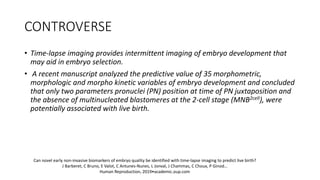
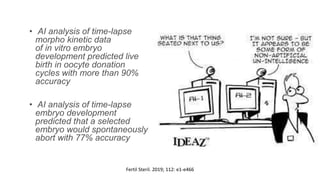
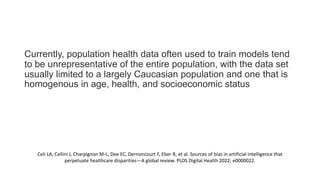
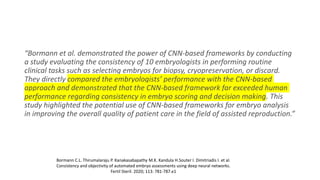
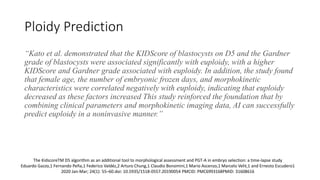
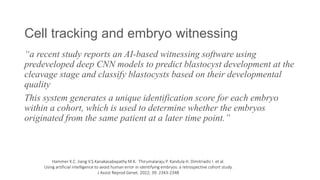
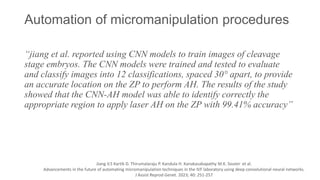
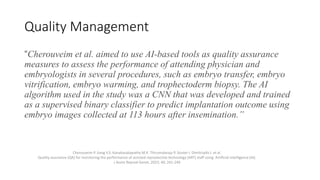
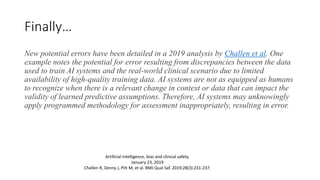
Machine learning and timelapse imaging can be used to analyze embryo development and predict outcomes. Studies have shown that AI can predict live birth from timelapse images with over 90% accuracy. However, models may be biased if not trained on diverse data. New research aims to identify biomarkers from timelapse to select embryos and understand impact of patient ethnicity on development, as embryos from mixed populations may develop faster. AI is also being used to assess oocytes, select sperm, and predict ploidy. Future areas of research include automating procedures and quality management through computer vision. However, lack of diverse training data and changes in context can still lead models to make errors.




![FETUS[1] [Read-Only].pptx First trimmers pregnancy](https://cdn.slidesharecdn.com/ss_thumbnails/fetus1read-only-241220065018-5a8c9205-thumbnail.jpg?width=640&height=640&fit=bounds)


![ONFH[AVN HIP] -TRIPLE REGIME -A NOVAL SURGICAL CONCEPT .pptx](https://cdn.slidesharecdn.com/ss_thumbnails/onfhavnhip2026koaconcalicutdrgokuldevdrmashraf-260210064517-213ec005-thumbnail.jpg?width=640&height=640&fit=bounds)


