 Made by :- Master ?Made by :- Master ?
 Class :- 10Class :- 10
 Roll no. :- ?Roll no. :- ?
 Subject :- English(ppt)Subject :- English(ppt)
The devastating impact of
seismic sea waves
Tsunami (harbor wave)
Seismic sea waves (NOT tidal waves)
Caused by processes that abruptly move large volumes
of ocean water:
earthquake submarine volcanic eruption
coastal/submarine landslide or rockfall
extraterrestrial impact
http://geology.com/articles/tsunami-geology.shtml
 Unless there is an underwater landslide,
strike-slip EQ WILL NOT cause tsunami
 Most tsunami generated by subduction zones
 Chile,Chile,
 Alaska,Alaska,
 Japan,Japan,
 Cascadia,Cascadia,
 Philippines,Philippines,
 New ZealandNew Zealand
 Long wavelengths (over 100 km)
 Periods longer than 1 hour
316,800 ft = 60 miles
 Travel at high speeds :
400 to 500 mph (~200 yards/sec)
 Alaska to CA 4 to 7 hrsAlaska to CA 4 to 7 hrs
 Alaska to Hawaii 4 to 6 hrsAlaska to Hawaii 4 to 6 hrs
 Chile to Hawaii 14 to 15 hrsChile to Hawaii 14 to 15 hrs
 Chile to Japan 22 to 33 hrsChile to Japan 22 to 33 hrs
v = speedv = speed ~~
 g = acceleration of gravity (9.8 m/sec2
)
 d = depth of ocean (m)
 deeper water means higher speed
 For d = 4,600 m, v = 763 km/hr
(speed of jet plane)
gd
 Tsunami slows down (shallower water)
 Example: d = 100 m, v = 113 km/hr
 Wave gets taller
 λ gets shorter, T gets shorter
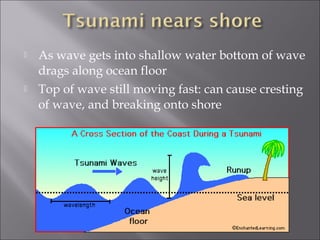
 As wave gets into shallow water bottom of wave
drags along ocean floor
 Top of wave still moving fast: can cause cresting
of wave, and breaking onto shore
 Run-up = measurement of height of water onshore
observed above a reference sea level
 Generally don’t get big gigantic wave
 Water comes as a fast moving rise in tide that rapidly
moves inland
 NOT JUST ONE WAVE…multiple waves coming in
about ½ hour or so apart
 See tsunami wave simulator
http://www.seed.slb.com/en/scictr/watch/living_planet/tsunami_wave/index.
htm
 Loss of energy in a wave is inversely
proportional to λ
 Since λ very long, little energy lost
 Waves can travel great distances and still be
very distructive
 Waves often full of debris (trees, cars, pieces of
wood etc.)
 As the wave recedes, the debris drags more
stuff with it
 Can recede as much as a km out to see, leaving
shoreline empty with flopping fish, boats, etc.
on the bottom
 Pressure recorder on bottom of ocean
 Buoy to communicate readings via
satellite
 Tsunami Warning Centers issue
warning
 Hawaii and Alaska
 When EQ considered capable of generating
tsunami, send warning with estimated arrival
time
 Once tsunami hitsOnce tsunami hits
somewhere, tsunamisomewhere, tsunami
watch established towatch established to
monitor tide gaugesmonitor tide gauges
and ocean buoysand ocean buoys
 When warning is issued – low lying areas are
evacuated
 U.S. Coast guard issues warnings over marine
frequencies
 Some places have sirens
Tsunami
How could you evaluate the level of risk
due to tsunami?
Possible tsunami
“run-up” zones
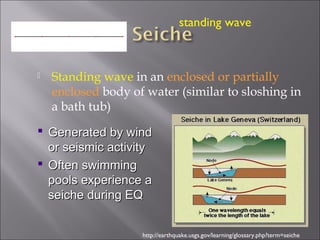
 Standing wave in an enclosed or partially
enclosed body of water (similar to sloshing in
a bath tub)
http://earthquake.usgs.gov/learning/glossary.php?term=seiche
 Generated by windGenerated by wind
or seismic activityor seismic activity
 Often swimmingOften swimming
pools experience apools experience a
seiche during EQseiche during EQ
standing wave
 Scientists at UNR have determinsed the seiches
have occurred on Lake Tahoe in the past
 Low probability – on average once every 2000
to 3000 years
Tsunami

Tsunami

  • 1.
     Made by:- Master ?Made by :- Master ?  Class :- 10Class :- 10  Roll no. :- ?Roll no. :- ?  Subject :- English(ppt)Subject :- English(ppt)
  • 2.
    The devastating impactof seismic sea waves
  • 3.
    Tsunami (harbor wave) Seismicsea waves (NOT tidal waves) Caused by processes that abruptly move large volumes of ocean water: earthquake submarine volcanic eruption coastal/submarine landslide or rockfall extraterrestrial impact
  • 4.
  • 5.
     Unless thereis an underwater landslide, strike-slip EQ WILL NOT cause tsunami  Most tsunami generated by subduction zones  Chile,Chile,  Alaska,Alaska,  Japan,Japan,  Cascadia,Cascadia,  Philippines,Philippines,  New ZealandNew Zealand
  • 6.
     Long wavelengths(over 100 km)  Periods longer than 1 hour 316,800 ft = 60 miles
  • 7.
     Travel athigh speeds : 400 to 500 mph (~200 yards/sec)  Alaska to CA 4 to 7 hrsAlaska to CA 4 to 7 hrs  Alaska to Hawaii 4 to 6 hrsAlaska to Hawaii 4 to 6 hrs  Chile to Hawaii 14 to 15 hrsChile to Hawaii 14 to 15 hrs  Chile to Japan 22 to 33 hrsChile to Japan 22 to 33 hrs
  • 8.
    v = speedv= speed ~~  g = acceleration of gravity (9.8 m/sec2 )  d = depth of ocean (m)  deeper water means higher speed  For d = 4,600 m, v = 763 km/hr (speed of jet plane) gd
  • 9.
     Tsunami slowsdown (shallower water)  Example: d = 100 m, v = 113 km/hr  Wave gets taller  λ gets shorter, T gets shorter
  • 10.
     As wavegets into shallow water bottom of wave drags along ocean floor  Top of wave still moving fast: can cause cresting of wave, and breaking onto shore
  • 11.
     Run-up =measurement of height of water onshore observed above a reference sea level  Generally don’t get big gigantic wave  Water comes as a fast moving rise in tide that rapidly moves inland  NOT JUST ONE WAVE…multiple waves coming in about ½ hour or so apart  See tsunami wave simulator http://www.seed.slb.com/en/scictr/watch/living_planet/tsunami_wave/index. htm
  • 12.
     Loss ofenergy in a wave is inversely proportional to λ  Since λ very long, little energy lost  Waves can travel great distances and still be very distructive
  • 13.
     Waves oftenfull of debris (trees, cars, pieces of wood etc.)  As the wave recedes, the debris drags more stuff with it  Can recede as much as a km out to see, leaving shoreline empty with flopping fish, boats, etc. on the bottom
  • 14.
     Pressure recorderon bottom of ocean  Buoy to communicate readings via satellite  Tsunami Warning Centers issue warning
  • 15.
     Hawaii andAlaska  When EQ considered capable of generating tsunami, send warning with estimated arrival time  Once tsunami hitsOnce tsunami hits somewhere, tsunamisomewhere, tsunami watch established towatch established to monitor tide gaugesmonitor tide gauges and ocean buoysand ocean buoys
  • 16.
     When warningis issued – low lying areas are evacuated  U.S. Coast guard issues warnings over marine frequencies  Some places have sirens
  • 17.
    Tsunami How could youevaluate the level of risk due to tsunami?
  • 18.
  • 19.
     Standing wavein an enclosed or partially enclosed body of water (similar to sloshing in a bath tub) http://earthquake.usgs.gov/learning/glossary.php?term=seiche  Generated by windGenerated by wind or seismic activityor seismic activity  Often swimmingOften swimming pools experience apools experience a seiche during EQseiche during EQ standing wave
  • 20.
     Scientists atUNR have determinsed the seiches have occurred on Lake Tahoe in the past  Low probability – on average once every 2000 to 3000 years