Tsunami
Shinil Lenin,Safwan Nazeer,sreejith,Mehrajuddin
Group-303
Tsunami
• A tsunami is the waves in water created by
earthquakes.
• Normal ocean waves, which are formed by
wind, or tides, due to the moon’s
gravitational pull.
• Tsunami is formed by the displacement of
water.
• One wave moves toward the shoreline,
another travels into the open sea.
Earthquake
• An earthquake is the shaking of earth surface
due to a sudden release of energy in the
Earth's crust due to fracture in the rocks of
earth crust which creates seismic waves.
• Vibrational energy is produced when rocks
break; the energy spreads out in all directions
like ripples on a pond
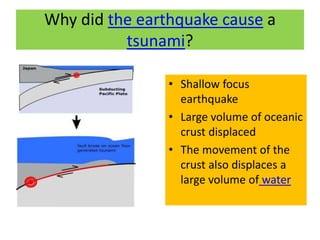
Why did the earthquake cause a
tsunami?
• Shallow focus
earthquake
• Large volume of oceanic
crust displaced
• The movement of the
crust also displaces a
large volume of water
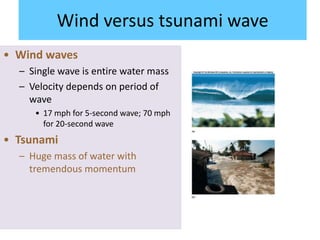
Wind versus tsunami wave
• Wind waves
– Single wave is entire water mass
– Velocity depends on period of
wave
• 17 mph for 5-second wave; 70 mph
for 20-second wave
• Tsunami
– Huge mass of water with
tremendous momentum
Tsunami: velocity
• Related to depth of ocean water
• Pacific Ocean: average depth 18,000 feet
• Velocities in the open ocean: >500 mph
Model of Cascadia 1700 tsunami
Tsunami, Japan, 2011
• 90 feet high
• Up to 2.5 miles
flooding
• 8-10 minute warning
Japan, 2011 tsunami
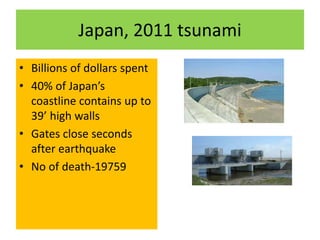
• Billions of dollars spent
• 40% of Japan’s
coastline contains up to
39’ high walls
• Gates close seconds
after earthquake
• No of death-19759
Shoreline arrival of tsunami
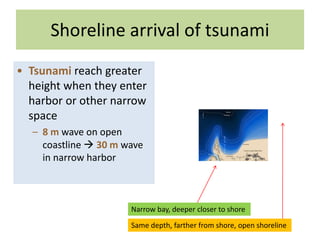
• Tsunami reach greater
height when they enter
harbor or other narrow
space
– 8 m wave on open
coastline  30 m wave
in narrow harbor
Narrow bay, deeper closer to shore
Same depth, farther from shore, open shoreline
Tsunami
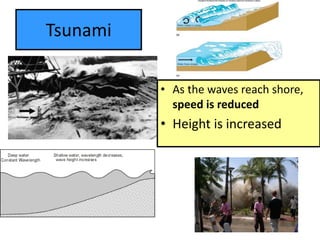
• As the waves reach shore,
speed is reduced
• Height is increased
• If You Feel the Earthquake
– Mild shaking for more than 25 seconds: powerful, distant earthquake may have
generated tsunami
– Sea may withdraw significantly, or may rise, before first big wave
– Water may change character, make unusual sounds
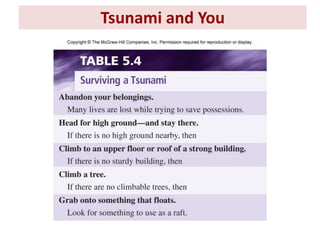
Tsunami and You
Insert table 5.4
Japan’s tsunami warning system
Seismic recording stations
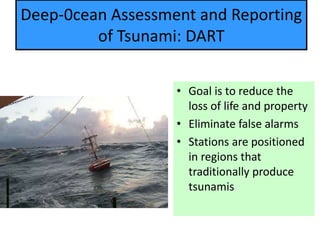
Deep-0cean Assessment and Reporting
of Tsunami: DART
• Goal is to reduce the
loss of life and property
• Eliminate false alarms
• Stations are positioned
in regions that
traditionally produce
tsunamis
Tsunami-harbor wave
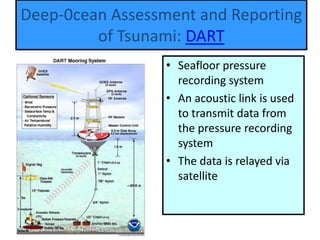
• Seafloor pressure
recording system
• An acoustic link is used
to transmit data from
the pressure recording
system
• The data is relayed via
satellite
Deep-0cean Assessment and Reporting
of Tsunami: DART
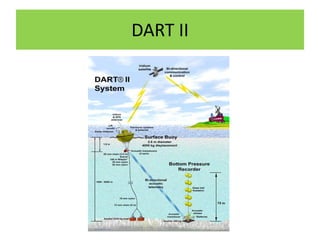
DART II
Tsunami
• Formed when a large volume of water is displaced
• When offshore, one set of waves moves onshore and
another offshore
• Waves arrive in a series in a shorter amount of time
closer to the epicenter
• Waves increase velocity with depth of ocean
• As wave approaches the shoreline:
– the energy orbital collapses,
– friction increases along the ocean bottom,
– wave slows but energy is the same and drives the water
onshore
– Topography of shoreline influences height of surge

Tsunami-1.pptx

  • 1.
  • 2.
    Tsunami • A tsunamiis the waves in water created by earthquakes. • Normal ocean waves, which are formed by wind, or tides, due to the moon’s gravitational pull. • Tsunami is formed by the displacement of water. • One wave moves toward the shoreline, another travels into the open sea.
  • 3.
    Earthquake • An earthquakeis the shaking of earth surface due to a sudden release of energy in the Earth's crust due to fracture in the rocks of earth crust which creates seismic waves. • Vibrational energy is produced when rocks break; the energy spreads out in all directions like ripples on a pond
  • 4.
    Why did theearthquake cause a tsunami? • Shallow focus earthquake • Large volume of oceanic crust displaced • The movement of the crust also displaces a large volume of water
  • 5.
    Wind versus tsunamiwave • Wind waves – Single wave is entire water mass – Velocity depends on period of wave • 17 mph for 5-second wave; 70 mph for 20-second wave • Tsunami – Huge mass of water with tremendous momentum
  • 6.
    Tsunami: velocity • Relatedto depth of ocean water • Pacific Ocean: average depth 18,000 feet • Velocities in the open ocean: >500 mph Model of Cascadia 1700 tsunami
  • 7.
    Tsunami, Japan, 2011 •90 feet high • Up to 2.5 miles flooding • 8-10 minute warning
  • 8.
    Japan, 2011 tsunami •Billions of dollars spent • 40% of Japan’s coastline contains up to 39’ high walls • Gates close seconds after earthquake • No of death-19759
  • 9.
    Shoreline arrival oftsunami • Tsunami reach greater height when they enter harbor or other narrow space – 8 m wave on open coastline  30 m wave in narrow harbor Narrow bay, deeper closer to shore Same depth, farther from shore, open shoreline
  • 10.
    Tsunami • As thewaves reach shore, speed is reduced • Height is increased
  • 11.
    • If YouFeel the Earthquake – Mild shaking for more than 25 seconds: powerful, distant earthquake may have generated tsunami – Sea may withdraw significantly, or may rise, before first big wave – Water may change character, make unusual sounds
  • 12.
  • 13.
  • 14.
  • 15.
    Deep-0cean Assessment andReporting of Tsunami: DART • Goal is to reduce the loss of life and property • Eliminate false alarms • Stations are positioned in regions that traditionally produce tsunamis
  • 16.
    Tsunami-harbor wave • Seafloorpressure recording system • An acoustic link is used to transmit data from the pressure recording system • The data is relayed via satellite Deep-0cean Assessment and Reporting of Tsunami: DART
  • 17.
  • 18.
    Tsunami • Formed whena large volume of water is displaced • When offshore, one set of waves moves onshore and another offshore • Waves arrive in a series in a shorter amount of time closer to the epicenter • Waves increase velocity with depth of ocean • As wave approaches the shoreline: – the energy orbital collapses, – friction increases along the ocean bottom, – wave slows but energy is the same and drives the water onshore – Topography of shoreline influences height of surge