Computer Graphics: A Case 
Study in Linear Algebra 
Deborah A. Trytten 
Spring 2002
What is Graphics? 
The collection of techniques used to 
take mathematical models and create 
images 
Models are often 3D 
Images are often 2D
What Math is Involved? 
Extensive linear algebra 
Change of coordinate systems 
Affine transformations 
Homogeneous matrices 
Geometry 
Calculus 
Discrete Mathematics 
Mathematical Modeling
The Elements 
Objects 
Catalog of reusable models 
Usually a represented as a polygonal mesh 
The Scene 
Camera 
Computer Screen
Desirable Properties 
Speed 
A single frame can have more than a 
million pixels 
Logical control of elements 
Speed 
Visual realism 
Speed
Goal 
Want to create a single matrix that: 
Starts with points in a 3D object 
Arranges them in a scene 
Positions a camera in the scene 
Projects a region of interest to 2D 
Maps projected region of interest to the 
computer screen
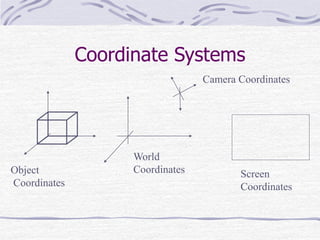
Coordinate Systems 
Object 
Coordinates 
World 
Coordinates 
Camera Coordinates 
Screen 
Coordinates
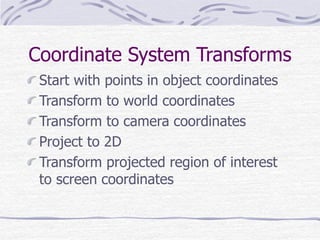
Coordinate System Transforms 
Start with points in object coordinates 
Transform to world coordinates 
Transform to camera coordinates 
Project to 2D 
Transform projected region of interest 
to screen coordinates
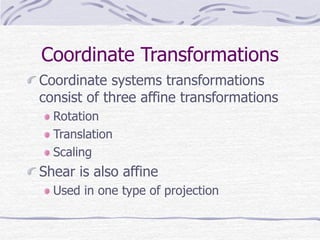
Coordinate Transformations 
Coordinate systems transformations 
consist of three affine transformations 
Rotation 
Translation 
Scaling 
Shear is also affine 
Used in one type of projection
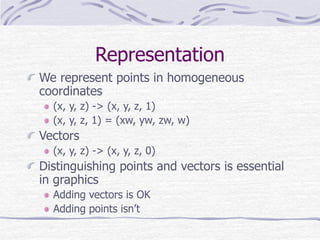
Representation 
We represent points in homogeneous 
coordinates 
(x, y, z) -> (x, y, z, 1) 
(x, y, z, 1) = (xw, yw, zw, w) 
Vectors 
(x, y, z) -> (x, y, z, 0) 
Distinguishing points and vectors is essential 
in graphics 
Adding vectors is OK 
Adding points isn’t
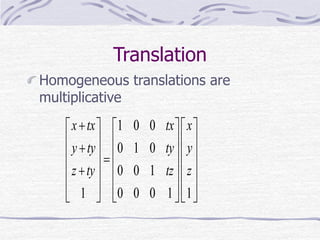
Translation 
Homogeneous translations are 
multiplicative 
x tx tx x 
y ty ty y 
z ty tz z 
    1 0 0 
   
      
 
0 1 0 
       
    0 0 1 
   
      
 1   0 0 0 1   1 

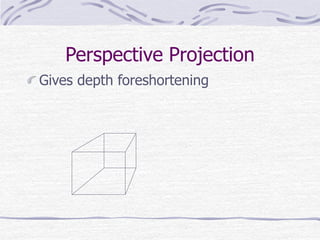
Perspective Projection 
Gives depth foreshortening
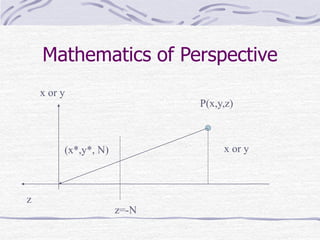
Mathematics of Perspective 
P(x,y,z) 
(x*,y*, N) 
z=-N 
z 
x or y 
x or y
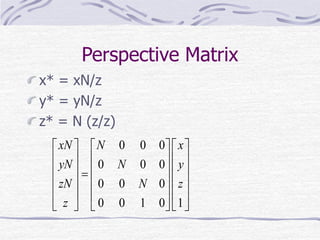
Perspective Matrix 
x* = xN/z 
y* = yN/z 
z* = N (z/z) 
xN N 0 0 0 
x 
yN N y 
zN N z 
z 
      
      
0 0 0 
       
   0 0 0 
   
      
   0 0 1 0   1 

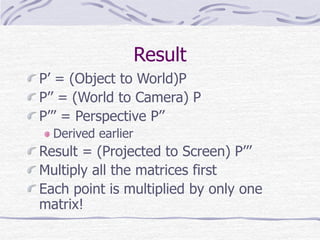
Result 
P’ = (Object to World)P 
P’’ = (World to Camera) P 
P’’’ = Perspective P’’ 
Derived earlier 
Result = (Projected to Screen) P’’’ 
Multiply all the matrices first 
Each point is multiplied by only one 
matrix!

Trytten computergraphics(1)

  • 1.
    Computer Graphics: ACase Study in Linear Algebra Deborah A. Trytten Spring 2002
  • 2.
    What is Graphics? The collection of techniques used to take mathematical models and create images Models are often 3D Images are often 2D
  • 3.
    What Math isInvolved? Extensive linear algebra Change of coordinate systems Affine transformations Homogeneous matrices Geometry Calculus Discrete Mathematics Mathematical Modeling
  • 4.
    The Elements Objects Catalog of reusable models Usually a represented as a polygonal mesh The Scene Camera Computer Screen
  • 5.
    Desirable Properties Speed A single frame can have more than a million pixels Logical control of elements Speed Visual realism Speed
  • 6.
    Goal Want tocreate a single matrix that: Starts with points in a 3D object Arranges them in a scene Positions a camera in the scene Projects a region of interest to 2D Maps projected region of interest to the computer screen
  • 7.
    Coordinate Systems Object Coordinates World Coordinates Camera Coordinates Screen Coordinates
  • 8.
    Coordinate System Transforms Start with points in object coordinates Transform to world coordinates Transform to camera coordinates Project to 2D Transform projected region of interest to screen coordinates
  • 9.
    Coordinate Transformations Coordinatesystems transformations consist of three affine transformations Rotation Translation Scaling Shear is also affine Used in one type of projection
  • 10.
    Representation We representpoints in homogeneous coordinates (x, y, z) -> (x, y, z, 1) (x, y, z, 1) = (xw, yw, zw, w) Vectors (x, y, z) -> (x, y, z, 0) Distinguishing points and vectors is essential in graphics Adding vectors is OK Adding points isn’t
  • 11.
    Translation Homogeneous translationsare multiplicative x tx tx x y ty ty y z ty tz z     1 0 0           0 1 0            0 0 1           1   0 0 0 1   1 
  • 12.
    Perspective Projection Givesdepth foreshortening
  • 13.
    Mathematics of Perspective P(x,y,z) (x*,y*, N) z=-N z x or y x or y
  • 14.
    Perspective Matrix x*= xN/z y* = yN/z z* = N (z/z) xN N 0 0 0 x yN N y zN N z z             0 0 0           0 0 0             0 0 1 0   1 
  • 15.
    Result P’ =(Object to World)P P’’ = (World to Camera) P P’’’ = Perspective P’’ Derived earlier Result = (Projected to Screen) P’’’ Multiply all the matrices first Each point is multiplied by only one matrix!