Matrix Theory in
Computer Graphics & 3D
Modeling
Transforming the Digital World with Linear Algebra
Presented by Your Name, Affiliation
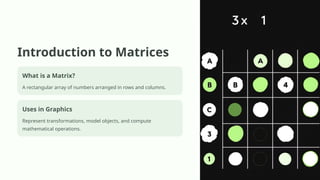
Introduction to Matrices
What is a Matrix?
A rectangular array of numbers arranged in rows and columns.
Uses in Graphics
Represent transformations, model objects, and compute
mathematical operations.
Fundamental Transformations
Translation
Shifts an object’s position
in space.
Scaling
Changes the size uniformly
or non-uniformly.
Rotation
Rotates an object around a
specific axis.
Key Point
Each can be represented
by a transformation
matrix.
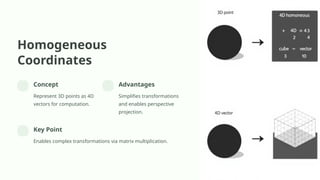
Homogeneous
Coordinates
Concept
Represent 3D points as 4D
vectors for computation.
Advantages
Simplifies transformations
and enables perspective
projection.
Key Point
Enables complex transformations via matrix multiplication.
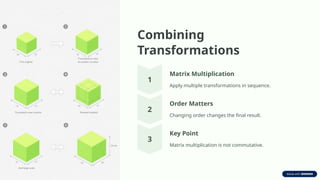
Combining
Transformations
Matrix Multiplication
Apply multiple transformations in sequence.
Order Matters
Changing order changes the final result.
Key Point
Matrix multiplication is not commutative.
Rotation Matrices in
Detail
Axis Rotation Matrix Formula
X Uses cosine and sine for
rotation in YZ plane
Y Rotates in XZ plane with
trigonometric functions
Z Rotates in XY plane via sine and
cosine
Key Point: Different matrices represent rotations around each axis.
Scaling and Shearing Matrices
Uniform Scaling
Scales object equally in all directions.
Non-uniform Scaling
Scales differently along each axis.
Shearing
Distorts shape by shifting parts
without resizing.
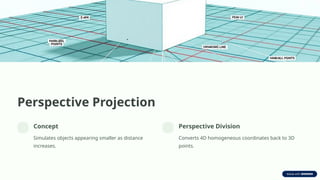
Perspective Projection
Concept
Simulates objects appearing smaller as distance
increases.
Perspective Division
Converts 4D homogeneous coordinates back to 3D
points.
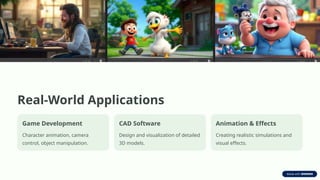
Real-World Applications
Game Development
Character animation, camera
control, object manipulation.
CAD Software
Design and visualization of detailed
3D models.
Animation & Effects
Creating realistic simulations and
visual effects.
Conclusion
1 Recap
Matrix theory underpins all
3D transformations and
modeling.
2 Importance
Essential for digital
graphics and realistic 3D
representations.
3 Further Learning
Explore resources on linear algebra and computer graphi
: By 24B11CS387
Matrix-Theory-in-Computer-Graphics-and-3D-Modeling.pptx

  • 1.
    Matrix Theory in ComputerGraphics & 3D Modeling Transforming the Digital World with Linear Algebra Presented by Your Name, Affiliation
  • 2.
    Introduction to Matrices Whatis a Matrix? A rectangular array of numbers arranged in rows and columns. Uses in Graphics Represent transformations, model objects, and compute mathematical operations.
  • 3.
    Fundamental Transformations Translation Shifts anobject’s position in space. Scaling Changes the size uniformly or non-uniformly. Rotation Rotates an object around a specific axis. Key Point Each can be represented by a transformation matrix.
  • 4.
    Homogeneous Coordinates Concept Represent 3D pointsas 4D vectors for computation. Advantages Simplifies transformations and enables perspective projection. Key Point Enables complex transformations via matrix multiplication.
  • 5.
    Combining Transformations Matrix Multiplication Apply multipletransformations in sequence. Order Matters Changing order changes the final result. Key Point Matrix multiplication is not commutative.
  • 6.
    Rotation Matrices in Detail AxisRotation Matrix Formula X Uses cosine and sine for rotation in YZ plane Y Rotates in XZ plane with trigonometric functions Z Rotates in XY plane via sine and cosine Key Point: Different matrices represent rotations around each axis.
  • 7.
    Scaling and ShearingMatrices Uniform Scaling Scales object equally in all directions. Non-uniform Scaling Scales differently along each axis. Shearing Distorts shape by shifting parts without resizing.
  • 8.
    Perspective Projection Concept Simulates objectsappearing smaller as distance increases. Perspective Division Converts 4D homogeneous coordinates back to 3D points.
  • 9.
    Real-World Applications Game Development Characteranimation, camera control, object manipulation. CAD Software Design and visualization of detailed 3D models. Animation & Effects Creating realistic simulations and visual effects.
  • 10.
    Conclusion 1 Recap Matrix theoryunderpins all 3D transformations and modeling. 2 Importance Essential for digital graphics and realistic 3D representations. 3 Further Learning Explore resources on linear algebra and computer graphi : By 24B11CS387